La Mancha Saffron: Where and How to Experience the Harvest
I’ve already told you about it in my general article on La Mancha: this land is much more than it seems at first glance. And among the many surprises it had in store for me, there was one I really didn’t expect: saffron.
I knew, vaguely, that it was grown in Spain. What I didn’t know is that precisely in this arid plain, which we tend to associate almost exclusively with windmills and Don Quixote, around 90% of all Spanish production is concentrated — and that Azafrán de La Mancha, with its Protected Designation of Origin, is considered by the world of fine dining to be among the best in the world: the same “red gold” that gives colour and aroma to Spain’s great rice dishes, from paella to fideuá, but which here, in La Mancha, is really at home in far humbler dishes, little known outside the region, like gachas or gazpacho manchego.
As someone who loves risotto alla milanese — the real thing, where saffron isn’t just a detail but the absolute star of the dish — this wasn’t something I could simply let pass en passant. So I started looking a little more closely into this Manchego “red gold”, and the story I discovered was even more surprising than I had imagined.
Seeing La Mancha’s saffron fields in bloom requires a little more planning than a normal sightseeing trip: the flowering period is short, the plots are small and they are not always located in the same places. So here are a few practical tips on how to get there, how to organise your visit and when to go.
See all the tips ↓ Show less ↑
How to get to the saffron-growing area
If your trip is mainly focused on saffron, the places I would use as reference points are Consuegra, Madridejos and La Solana. The first two are very close to each other and can easily be combined in the same day; La Solana is farther south and makes more sense as a separate stop.
- By plane: Adolfo Suárez Madrid-Barajas Airport is generally the most convenient option for those arriving from Italy or other European countries. From Madrid, you can then drive to the Consuegra and Madridejos area and, if you wish, continue towards La Solana. To compare flights and fares, I use Google Flights .
- By car: this is definitely the option I recommend, especially if your main goal is to see the fields. The azafranales, the saffron fields, are located outside the towns, the plots are scattered across the countryside and their location can change from one season to another. Having a car also makes it much easier to adjust your plans according to the latest information about the flowering once you are there.
- By public transport: Consuegra and Madridejos can also be reached by bus, but public transport is much less convenient if you want to reach the fields or combine several places in the same day. If your trip is mainly focused on the saffron harvest, I personally wouldn’t rely on bus timetables.
If, on the other hand, you want to include these stops as part of a longer trip, you’ll find all the information about connections and getting around in my complete La Mancha itinerary .
How to organise a visit to the saffron fields
- Don’t set off expecting to find vast purple fields along the road. The cultivated plots are relatively small and scattered across the area. So this is nothing like the huge lavender fields of Provence.
- Don’t rely on coordinates you found online months earlier. The cultivated fields can change and, above all, they do not all flower at exactly the same time. Shortly before your trip, contact a local producer or tourist office instead, to find out where the saffron is actually flowering at that moment.
- In Consuegra, you can ask for information directly at the Tourist Office or contact one of the local producers I mention later in the article.
- Madridejos, on the other hand, is an excellent stop if you want to understand saffron culture beyond the fields themselves: you’ll find museums, traditions and activities connected with harvesting and processing, which I explain in detail in the dedicated section.
- I would include La Solana mainly if you have at least two days available. It is farther from Consuegra and Madridejos, but offers a different way of discovering saffron through its connection with popular culture and zarzuela.
- If you book a visit with a producer, ask specifically whether it also includes access to the fields. A tasting or an explanation of the production process does not necessarily mean that a visit to the azafranales is included.
- If you want to see the harvest, plan to be available during the early hours of the morning. For the subsequent monda, the process of separating the stigmas from the flowers, timings are less restrictive: as I explain later, it is also one of the most interesting stages for understanding just how much manual work lies behind only a few grams of saffron.
When to go to see the fields in bloom and the harvest
- The period to keep in mind is generally the second half of October and the beginning of November. However, there is no exact date that works every year: temperatures and rainfall can bring the flowering forward or delay it.
- If your main goal is to see the flowers and watch the harvest, try to keep your plans fairly flexible and check the situation a few days before your trip.
- If, on the other hand, you are mainly interested in experiencing saffron culture, the second half of October is generally the period with the greatest number of festivals and activities in Consuegra, Madridejos and La Solana. In the rest of the article you’ll find the festivals, museums and experiences that I think are most worth considering.
- Don’t automatically assume that the festivals and the flowering will coincide. Festival dates are set well in advance; the flowers, naturally, follow the weather. You might therefore find a festival in full swing while some fields have not yet reached peak bloom, or arrive a few days later and still find beautiful flowering plots.
In short, there is one very simple rule for this trip: first check where the saffron is flowering, then build your itinerary around that information. It is much more effective than choosing a specific field months in advance and hoping to find it covered in purple flowers when you arrive.
Where saffron is grown in La Mancha
The production area of the Azafrán de La Mancha PDO is huge: it includes a very large number of municipalities, traditionally spread across the provinces of Toledo, Ciudad Real, Cuenca and Albacete — not by chance, the same core provinces that make up geographical La Mancha, which I have already talked about in my general article.
From a practical point of view, there are three areas where you are more likely to come across a saffron field. In Toledo: Consuegra, Madridejos, Camuñas, Villafranca de los Caballeros and Villacañas. In Ciudad Real: Campo de Criptana, Pedro Muñoz, Tomelloso and Manzanares. In Albacete, the most recent PDO statistics also report cultivation around Minaya, Munera, Lezuza and Tobarra.
I’m telling you about this because the news has literally arrived while I’m writing, and it fits too perfectly to leave it out: on 19 June 2026, the Board of Trustees of the Consejo Regulador Foundation of the PDO submitted a request to amend the product specification, in order to expand the geographical area to include the municipalities of Marchamalo and Valdegrudas, both in the province of Guadalajara — therefore outside the historic core of the four provinces.
The amendment was published in the Diario Oficial de Castilla-La Mancha on 11 August 2026: practically two weeks ago.
It’s the perfect example of a principle that also applies to La Mancha in general, as I mentioned earlier: the legal territory of a designation and the geographical and cultural territory that gives it its name almost never match perfectly.
That said, an honest warning before we go any further: don’t be misled by the photos you see on Instagram or on some blogs. As I mentioned, the PDO area is huge — it covers four provinces, soon to be five. But it’s important not to confuse the size of the recognised territory with the actual extent of saffron cultivation: within this vast area, the plots genuinely devoted to saffron are few and small, scattered here and there between one town and another. It’s not like wine, where the La Mancha PDO itself covers more than 165,000 continuous hectares of vineyards — here the logic is the opposite: a huge area is “eligible”, but very little land is actually cultivated.
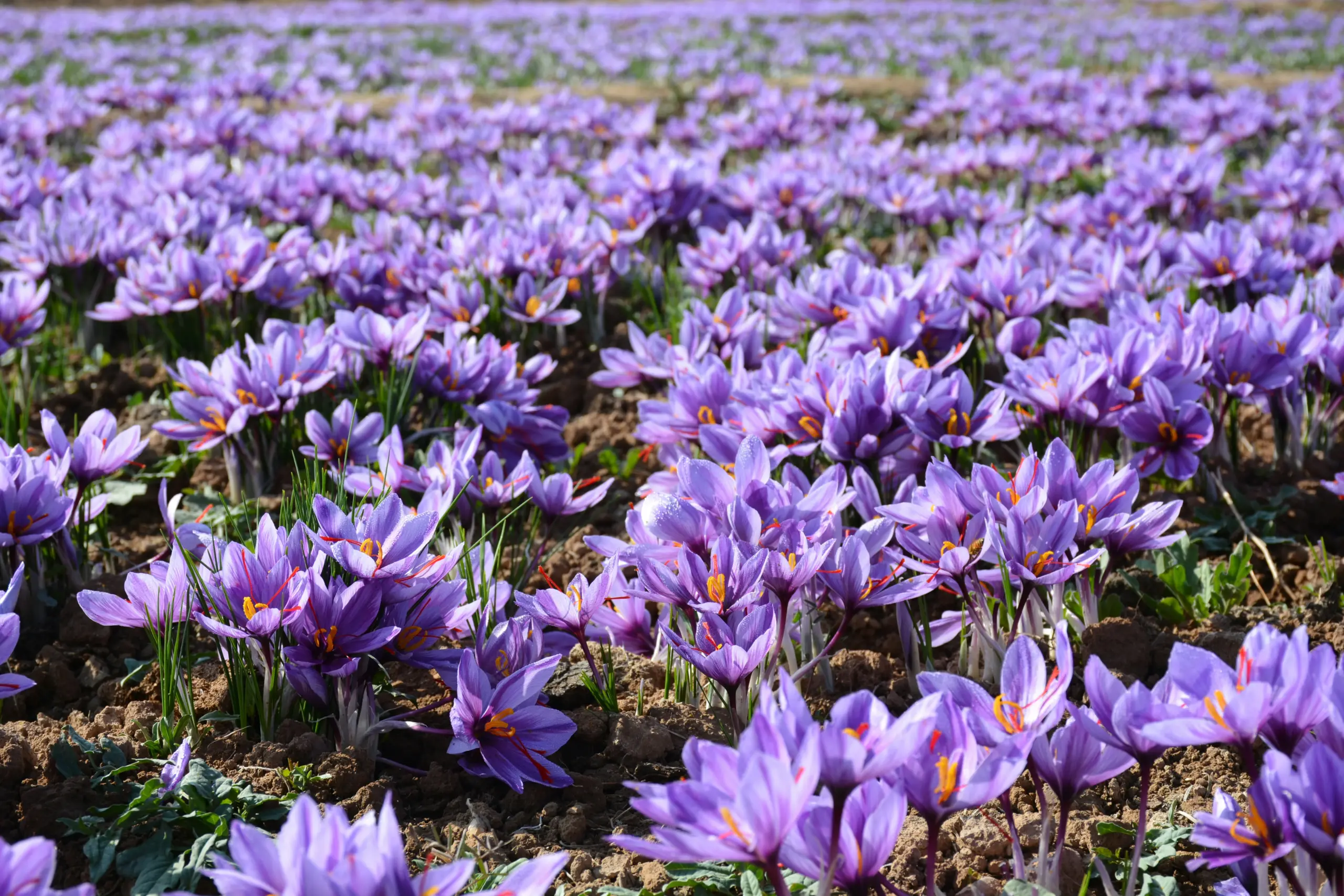
So don’t picture this part of La Mancha as some kind of Spanish “purple Provence”, with endless stretches of lavender-coloured flowers as far as the eye can see. It isn’t like that — and I’m telling you because I’d rather you set off with the right expectations than end up disappointed once you’re there, as happened to me.
The figures confirm it, and in this case the source is official: according to the 2024 campaign report published by the PDO’s Consejo Regulador, the year ended with 349.49 kg of certified PDO saffron, harvested from just 100 hectares of cultivated land in total — a tiny amount compared with the vast territory I was talking about a moment ago. 170 producers out of the 250 registered with the Consejo Regulador took part in the inspections required to market the product with PDO certification.
One practical tip before moving on: you won’t find the coordinates of a “perfect field” to photograph in this article, and that’s not an oversight. The plots change every year. Below, though, I’ll explain how to organise your visit if you want to see the fields in bloom, because the flowering period lasts only a few days. Finding a field in bloom, in short, requires more planning — and more luck — than you might expect.
The Saffron Harvest: a race against time
Saffron from La Mancha is not just a spice: it is a ritual, an art passed down from generation to generation, a deep bond between people and the land. Its production process, carried out entirely by hand, is just as fascinating as the final product.
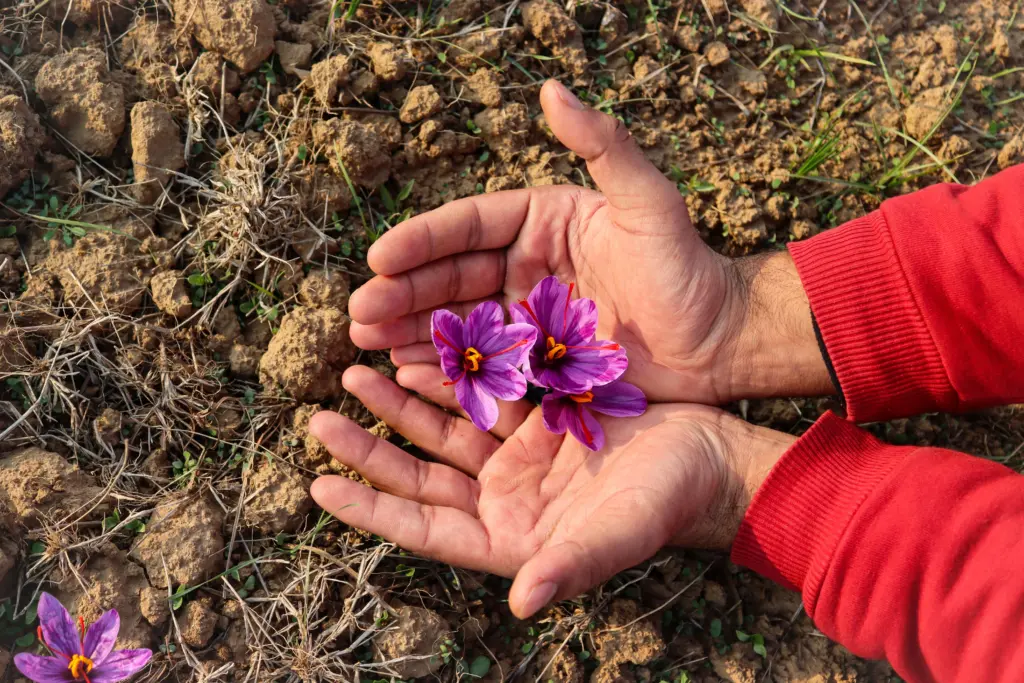
The flowering of Crocus sativus is brief and intense, concentrated in the few weeks between October and November. Each flower lives for only a few days and must be picked every morning, before the sun is high, while the dew is still fresh and the flower is still closed. This helps preserve the colour, aroma and quality of the precious stigmas.
Harvesting requires great manual skill and patience. The flowers are picked one by one, with a clean, precise cut, to avoid damaging or detaching the stigmas. They are never torn from the plant, but carefully cut. After harvesting, the flowers are transported gently and laid out in thin layers, without piling them up, to prevent them from being crushed or deteriorating before processing.
And this is where the most magical moment begins.
The cleaning process, known as monda, desbriznado or desbrizne, must take place on the same day as the harvest, within 12 hours, according to the traditional product specification. It is a race against time: if the stigmas are not separated quickly, they lose quality and aroma.
The gesture is simple, but it requires painstaking precision. The flower is opened by hand and, with almost unbelievable patience, the three red stigmas — the valuable part — are separated. They are cut while leaving a small section of the style attached, at the point where it begins to turn white.
This is the image that captures the true essence of saffron: not industrial machinery, but people — often entire families — sitting around a table, with piles of purple flowers alongside bowls filled with red stigmas. It is a traditionally manual process, handed down from one generation to the next, and still carried out today in homes and cooperatives throughout La Mancha. For a traveller, witnessing this scene is like stepping into a living picture of Spanish rural culture.
After that comes the tostado. The term can be misleading for an Italian: it does not mean “toasting” in the usual sense of the word, but rather gently dehydrating the stigmas using heat.
Traditionally, the stigmas are spread out in a thin layer, up to around 1.5 cm thick, on special sieves. They are then exposed for approximately 20–45 minutes to a constant, even source of indirect heat — traditionally the heat from a wood-fired oven or a stove, but never in direct contact with the flame.
This step is essential for several reasons:
- Reduces the moisture content of the stigmas from 70–80% to around 10–12%.
- Allows the saffron to be stored for a long time.
- Helps develop the aromatic qualities and intense fragrance that make saffron from La Mancha so highly prized.
Once toasted, the saffron is left to cool completely. Only then is it stored in airtight containers, protected from light and moisture, until it is ready to be packaged. This care is essential to preserve its organoleptic properties intact.
How to recognise Azafrán de La Mancha PDO
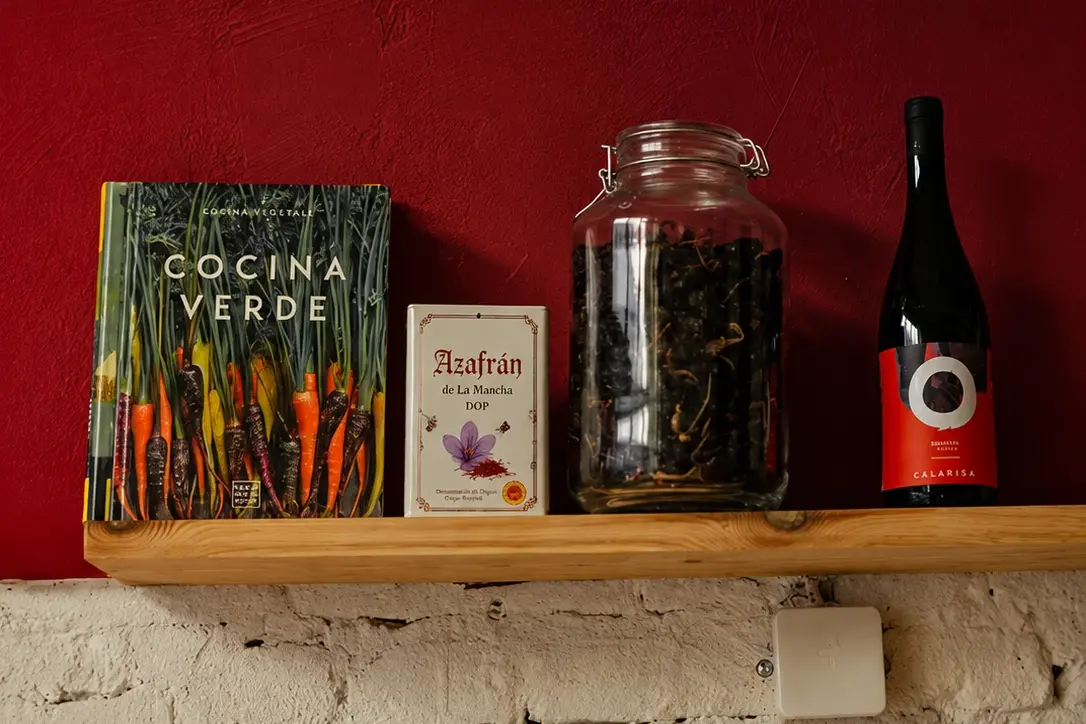
The Azafrán de La Mancha PDO protected designation does not refer only to where the saffron is grown: in order to use the name Azafrán de La Mancha, the product must comply with a specific European product specification.
First of all, there is of course a defined geographical area: cultivation, harvesting and toasting/drying must all take place within the area recognised by the PDO. So it is not enough to buy flowers or stigmas from somewhere else and package them in La Mancha in order to use the designation.
The final product must also meet very specific requirements. PDO saffron is sold in threads, obtained from the stigmas of Crocus sativus, and not simply as a powder, and the specification sets parameters for purity, stigma size, moisture and even minimum values relating to colouring strength, aroma and picrocrocin content, the substance responsible for saffron’s characteristic bitter note. So analytical testing is required, not just verification of geographical origin.
Then there is traceability. In order to market saffron under this designation, the product must be certified by the control body. The packaging must clearly display the wording “Denominación de Origen Protegida Azafrán de La Mancha”, the harvest year, Spanish origin and a numbered back label that makes it possible to identify the package. The current specification also establishes a minimum shelf life of three years, as indicated on the label.
In other words, the PDO simultaneously guarantees where the saffron was produced, how it was processed, which characteristics it must have and the possibility of tracing its origin through a certification and control system.
But this is the important point: saffron without PDO status is not necessarily fake or poor quality. A small producer can grow excellent saffron without joining the designation system. It simply means that, in that case, they cannot sell it using the protected name “Azafrán de La Mancha”. The PDO is therefore not an absolute judgement on the quality of all other saffron: it is a guarantee that that specific product meets all the conditions laid down in the specification.
So when you buy it, don’t stop at the words “saffron from La Mancha” on the package: if you are looking for certified saffron, check for the full designation “Azafrán de La Mancha PDO” and the corresponding numbered back label.
When to see the saffron fields in bloom
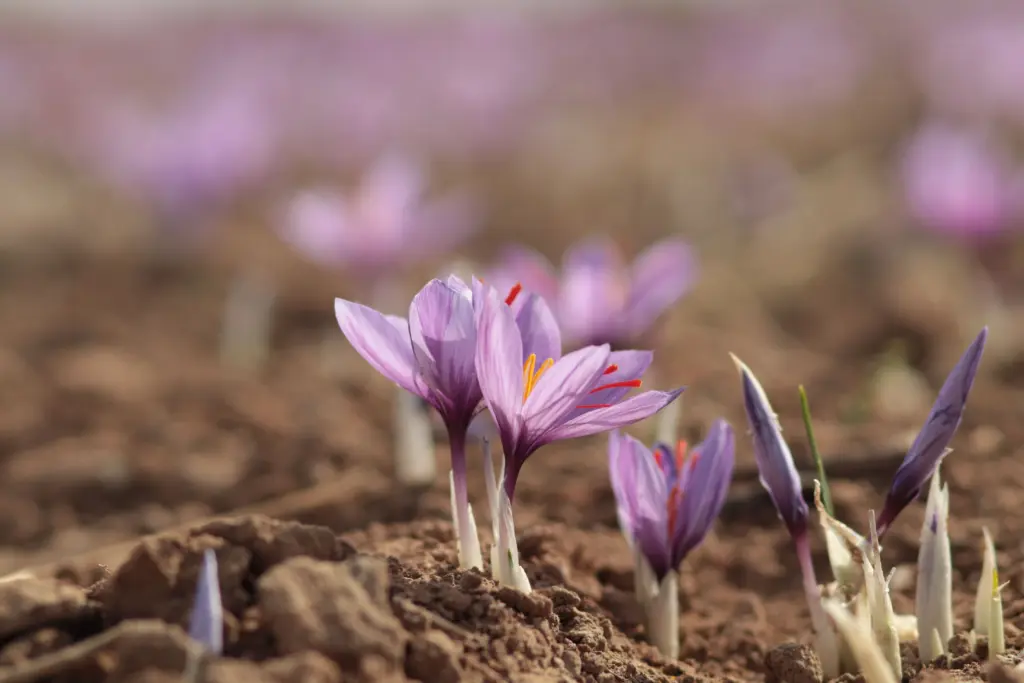
The PDO’s Consejo Regulador identifies the second half of October through the first few days of November as the typical flowering period — with harvesting taking place every day from the early hours of the morning, because the flowers need to be picked before the sun opens them fully.
This is only a general window, not a certainty: weather conditions in any given year can bring the flowering forward or delay it considerably, sometimes by a week or more. If I had to suggest a window to aim for when planning a photography trip, I would say between 25 October and 7 November — but with no guarantees: seeing the saffron in bloom requires up-to-date local information, good timing and a little luck.
That is exactly why the best way to avoid coming back empty-handed is not to rely on a fixed calendar, but to contact the local tourist office in Consuegra, for example, or the one in Madridejos, or contact a producer directly, 24–48 hours in advance: they will be able to tell you exactly where the saffron is flowering at that particular moment.
Where to experience saffron culture
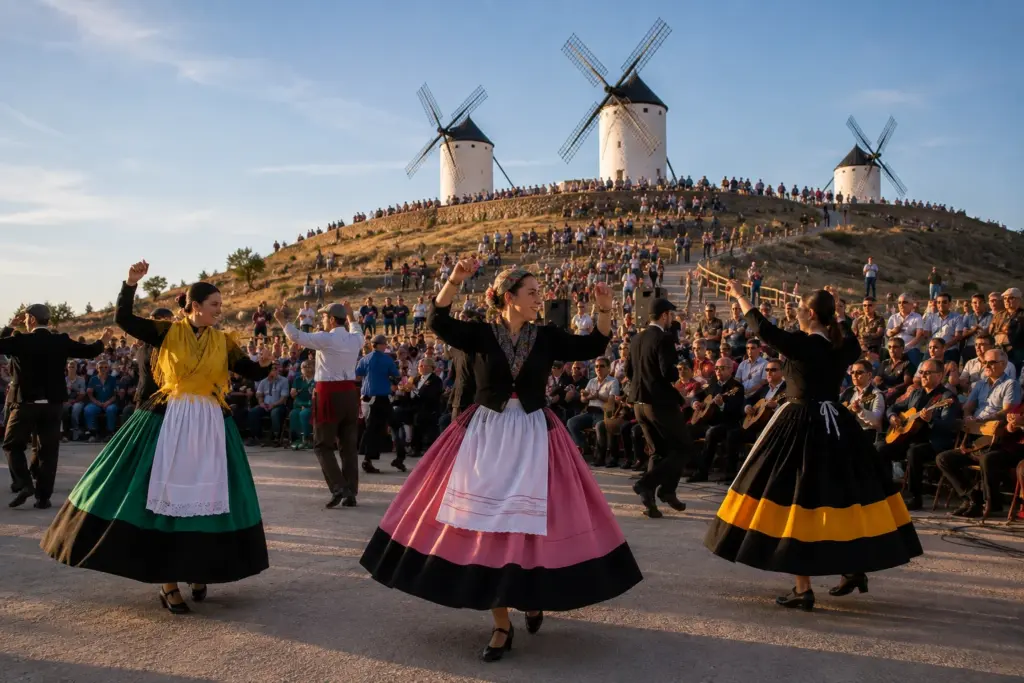
As I mentioned earlier, it isn’t easy to point you to the exact fields to visit and photograph, since they can change from year to year. But one thing is certain: whether or not you manage to find a field in bloom, the saffron harvest season brings with it festivals, folklore and traditions that are well worth experiencing.
Here are my favourite experiences!
Fiesta de la Rosa del Azafrán in Consuegra
If you only have time for one saffron-related stop, make it this one. Since 1963, on the last full weekend of October, Consuegra has hosted the Fiesta de la Rosa del Azafrán, officially declared of Regional Tourist Interest — in 2026 it will celebrate its 64th edition, scheduled from 23 to 26 October, together with a craft fair.
Here you’ll find everything you would expect from a genuine Manchego festival: monda competitions, where participants race to separate the stigmas as quickly as possible; a gastronomic competition featuring traditional dishes — migas, gachas, pisto, asadillo —; the Festival Nacional de Folclore, with dance groups from all over Spain; and the evocative Molienda de la Paz at Molino Sancho, one of the twelve windmills on Cerro Calderico, which still preserves its original wooden machinery. All of this takes place with Consuegra Castle in the background — it would be hard to imagine a more fitting setting for a festival dedicated to La Mancha’s red gold.
How to take part: admission to the festival is free, but for some specific activities — such as the Rutas Tierra de Azafrán (see below) or access to the windmills — it is advisable to book in advance, especially during the festival weekend when visitor numbers are higher.
Saffron culture in Madridejos
If Consuegra is the more festive experience, Madridejos is the more educational one, and probably the best place if you really want to understand the saffron-making process step by step, rather than simply soak up the atmosphere.
The heart of the experience is the Convent of San Francisco, which has housed the Museo del Azafrán y Etnológico since 2008: a historic building in its own right, whose construction began in 1612 and was completed in 1619, largely thanks to the support of two local benefactors, María Cervantes Gallego and Juan de Mayorga. Despite the surname, there is no known connection between María Cervantes Gallego and Miguel de Cervantes — one of those coincidences that is tempting to read more into than is actually there, but which the sources do not confirm. Inside, you’ll find ethnographic displays on saffron cultivation, harvesting and processing, along with practical demonstrations of monda and toasting.
To complete the picture, the town is also home to the Molino del Tío Genaro, a 17th-century windmill that still preserves working original mechanisms, and two of the area’s typical underground silos — the Silo del Tío Zoquete and the Silo del Tío Colorao — which reveal another side of rural life in La Mancha, that of homes dug into the rock.
During the Jornadas del Azafrán (the 2026 dates have not yet been officially published at the time of writing: if you are planning your visit specifically around this event, it is worth checking again later, around late September or early October, when the Town Council usually confirms the programme), the museum also organises theatrical visits and live demonstrations — another good reason to try to match your trip with the event if you can.
How to take part: admission is free, but for some specific activities — such as access to the windmills — it is advisable to book in advance, especially during the Jornadas del Azafrán.
Music and saffron in La Solana
Less visited than the first two, but with a cultural connection that makes the detour worthwhile if you have time: the Museo La Rosa del Azafrán, which takes its name from one of the best-loved works in the Spanish lyrical repertoire, La rosa del azafrán, set here and inspired by the customs, traditions and landscapes of the town.
And this is not an isolated connection: La Solana also hosts the Semana Nacional de la Zarzuela, the only festival in Spain devoted exclusively to this lyrical genre, running since 1984 — in 2026 it is scheduled from 16 to 25 October at the Teatro Tomás Barrera, naturally with La rosa del azafrán on the programme. If your interest in saffron also extends to a less touristy side of Spanish culture, this is probably the most original of the three stops.
As I mentioned earlier, it isn’t easy to point you to the exact fields to visit and photograph, since they can change from year to year. But one thing is certain: whether or not you manage to find a field in bloom, the saffron harvest season brings with it festivals and folklore that are well worth experiencing.
Visiting a saffron producer
If you want to go beyond the folklore and would prefer something more intimate than the large Fiesta de la Rosa del Azafrán, in Consuegra you can also get closer to the people who actually grow saffron. The Town Council organises the Rutas Tierra de Azafrán throughout the year: themed guided tours that combine saffron cultivation with the town’s history, archaeology and water heritage.
One of the most interesting experiences is offered by Alacena del Azafrán, a local producer that grows and packages its own saffron. At their premises on Calle Urda, you can learn more about how this spice is processed, taste some local products and discover interesting facts about traditional cultivation.
But the part I find most interesting is another one: during the very short flowering season, they also organise visits to the azafranales, the saffron fields. Keep in mind that the flowers can only be seen for a few weeks, generally between late October and early November, so it is essential to contact them before planning your trip.
Alacena del Azafrán – Calle Urda 24, Consuegra – tel. 655 965 372 / 655 965 330 – [email protected].
As I’ve taken you on this journey through the saffron of La Mancha, I hope I’ve managed to share the real secret of this trip with you: don’t plan your journey around fields you may never find; plan it around the people — a producer who opens their door to you, a festival that lasts three days, a museum that quietly explains why three red threads are worth so much. The rest will follow naturally, and it won’t disappoint you.