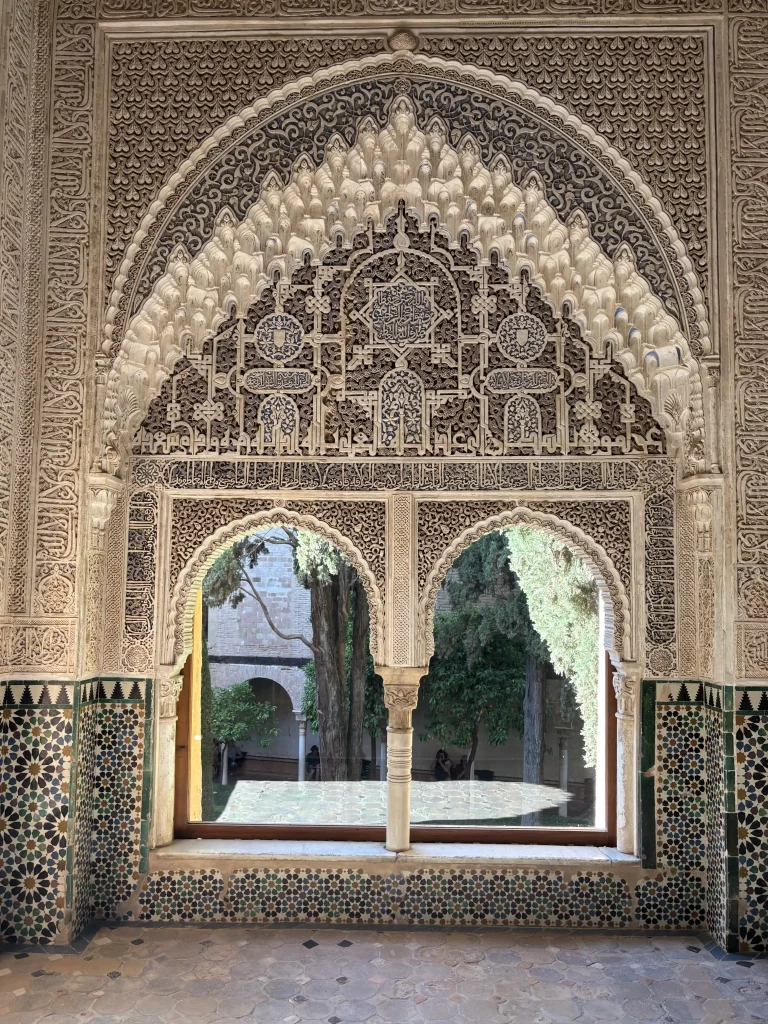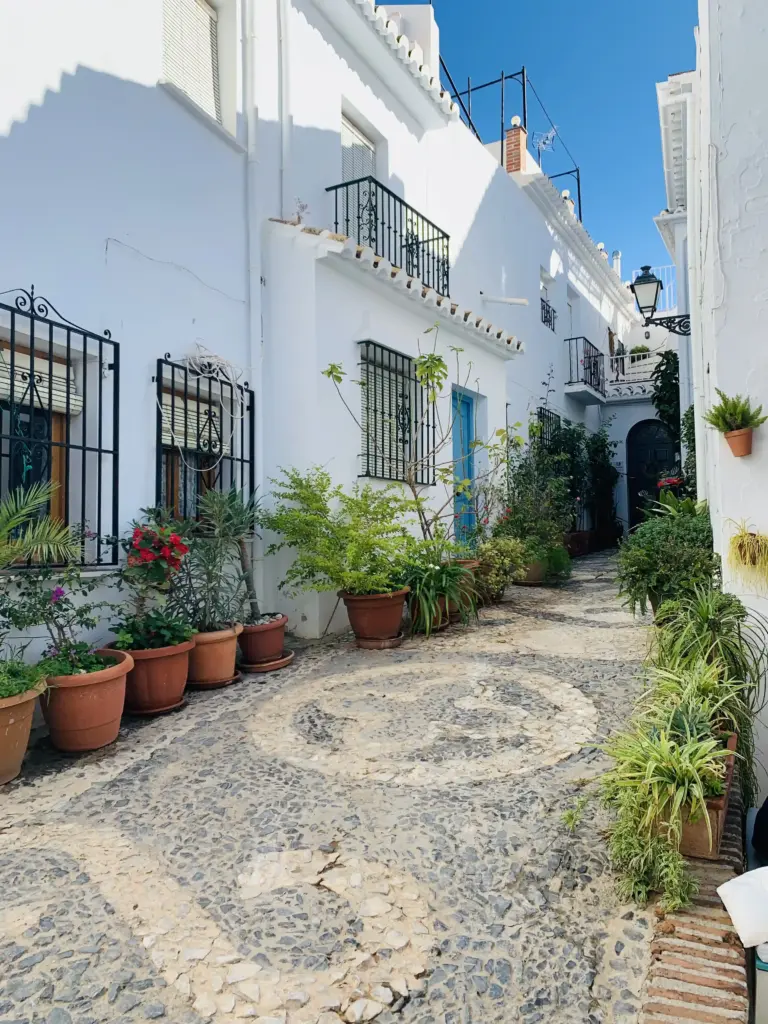
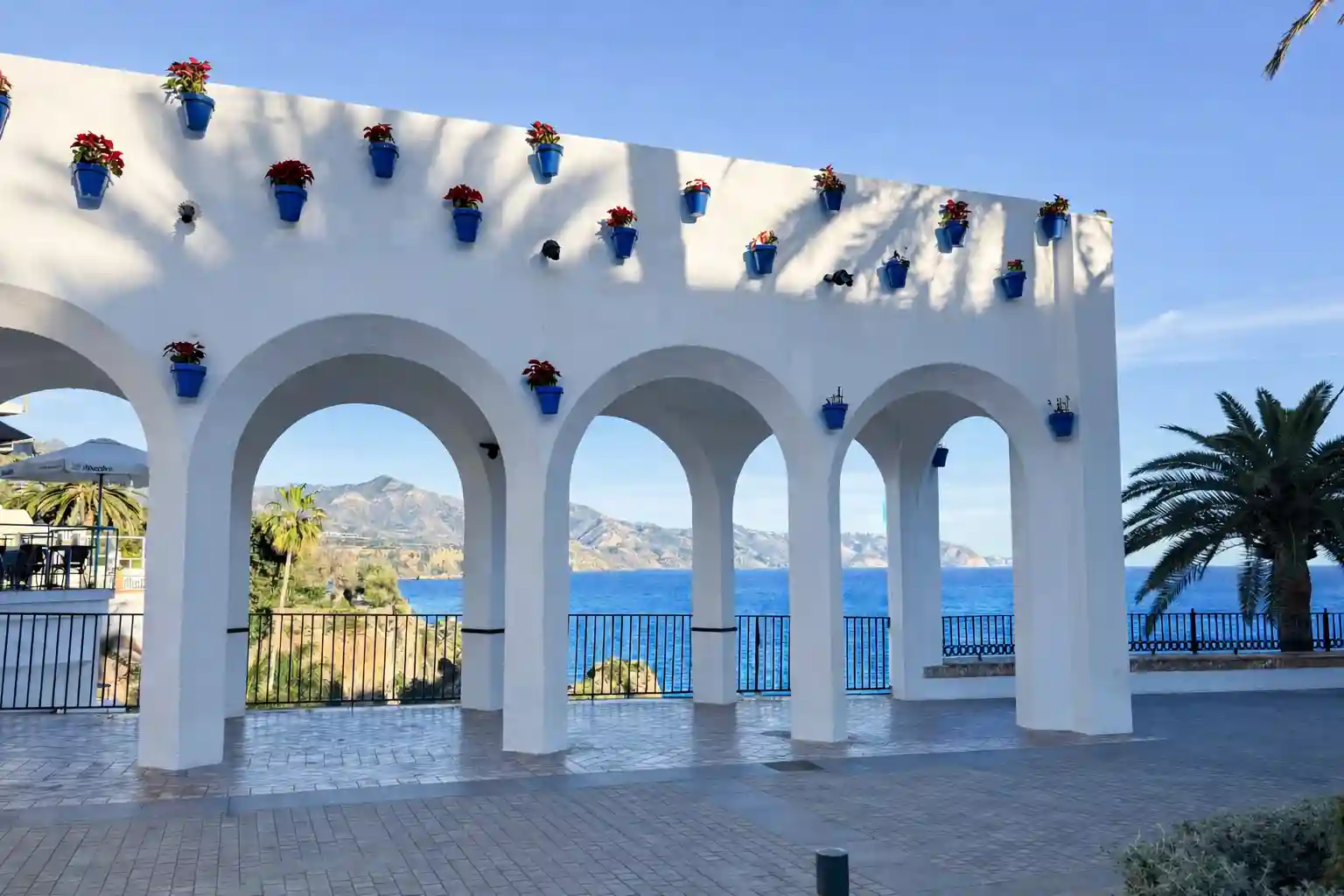
Nerja: a balcony over Europe and a special corner of Andalusia
If you arrive in Nerja expecting to find only beaches, sea and chiringuitos… get ready for a surprise!
Because this little white town overlooking the Mediterranean hides far more treasures than it first appears.
It is the easternmost pueblo blanco in the province of Málaga and lies about 45 minutes from the Andalusian capital. This makes it a perfect stop for a weekend getaway or an extra stage if you are visiting the city of Málaga.
Although Nerja is a seaside destination on the Costa del Sol, it has been spared the uncontrolled urban development that affected places like Torremolinos and other coastal resorts. Nerja has grown mainly through villas and urbanizaciones (residential complexes with pools and shared spaces) built with an effort to respect the character of the area. It sits at the foot of the Almijara mountain range and is surrounded by a series of beautiful beaches and natural coves that can be reached on foot directly from the town.
Here are some practical tips for organising your visit to Nerja: how to get there, where to park, how to get around, how to plan your visit and when to go. A few useful things to know when choosing your transport, exploring the town and its surroundings and organising your days around beaches, opening hours and local rhythms.
Show all tips ↓ Hide tips ↑
How to get to Nerja
- By plane: Málaga Airport is the perfect option for travellers arriving from Europe, thanks to its wide range of flights from many European cities. It is located approximately 8 kilometres from Málaga city centre and is the main air gateway not only to the city, but also to the entire Costa del Sol. One of the best things about the airport is that you can reach the city centre without having to take a taxi or shuttle bus, and then continue to Nerja using other transport connections. The most convenient way to travel from the airport to the city centre is the Cercanías C1 suburban train. The station is located directly opposite the terminal, and from there you can reach Málaga Centro-Alameda in around 12 minutes. The same train also takes you to other towns on the Costa del Sol, including Torremolinos, Benalmádena and Fuengirola. You can buy tickets directly from the Renfe ticket machines before passing through the barriers. An even easier option is to pay directly at the barriers with a contactless bank card or phone: tap the same bank card or device on the reader when entering and again when leaving at your destination station. The system automatically calculates the correct fare. To check the timetable, visit the official Renfe website. To find the best flights and fares, I use Google Flights, which allows you to compare prices across several dates and find the most convenient combination.
- By car: the province of Málaga is certainly one of the coastal areas with the most modern road network, but parking in central Nerja can be expensive and inconvenient. It is usually possible to find some free spaces relatively close to the centre in the public car park near Mercadona: Public car park in Nerja (Google Maps)
- By train: you cannot travel all the way from Málaga to Nerja by train, because Nerja does not have a railway station. The easiest option is the direct coach.
- By coach: services depart from the Estación de Autobuses de Málaga. From here, look for coaches travelling towards Nerja. You can check availability and purchase tickets on the ALSA website. The journey takes approximately 1 hour. In Nerja, the coach arrives at the main stop on Avenida de Pescia, around a 10–15-minute walk from the historic centre and the Balcón de Europa.
How to get around Nerja
- On foot: Nerja is a small, compact town, and most people get around on foot. There are some beautiful walks along the coast, although they are not always flat. During the summer, there is also a tourist road train, which is often used for local journeys. Public transport is mainly useful if you want to reach beaches farther away or nearby white villages such as Frigiliana.
- By local bus: this is a convenient alternative, especially for reaching places farther away, such as Frigiliana, the Nerja Caves or the beaches of Maro. To reach Frigiliana, you can check routes, stops and timetables on the Grupo Fajardo website. For other destinations, such as Maro, the caves or other nearby towns, check the ALSA website.
- By bicycle: cycling is certainly an interesting way to get around the town centre, but to reach destinations farther away, you should at least choose an electric bike. The landscape is hilly, the climbs begin almost immediately, and many routes follow roads shared with cars. The easiest option is the Nerja–Maro route. In June 2026, a continuous cycle connection of approximately 3.5 kilometres was completed between the two towns, making it one of the easiest and most accessible cycling trips in the area. You can also combine it with the Eagle Aqueduct and the Nerja Caves, depending on how much you feel like cycling. We rented electric bikes from Andalucia ebikes, just outside the town centre, and had a great experience. We also discovered that they have shops in Seville, Madrid, Ronda and several other Spanish cities.
How to plan your visit to Nerja
- The day generally starts at around 10:00 am. There is therefore no need to wake up too early if you want to find shops open, people in the streets and, more generally, experience the town’s atmosphere.
- Restaurants normally serve lunch between 1:30 pm and 3:30 pm and dinner approximately between 8:00 pm and 10:30 pm. Arriving at 6:30 pm and expecting a full dinner may mean finding the kitchen still closed. That said, many bars are adapting to tourists’ schedules and extending their service hours slightly. For the best-known restaurants, booking well in advance is recommended. Tapas bars and more traditional establishments generally do not accept reservations, and customers often eat at the counter or at high tables with stools, although some venues also have a separate restaurant area.
- There are plenty of organised tours available for exploring the town and its surroundings. I always check websites such as GetYourGuide or Civitatis to see what is available.
- The museum offers free admission on Sundays after 4:00 pm, while admission to the cave is free early in the morning. You will find all the details in the article, but keep this information in mind when planning your visit.
When to visit Nerja
- The liveliest season begins in April and lasts until October. The sun is warmer, and you can start swimming in the sea. The downside is that there are more tourists and everything feels more crowded and chaotic, especially during the summer.
- If beach life is not your priority, autumn is also well worth considering. Temperatures are mild, there are fewer tourists, and you can experience the city at a more authentic pace.
- In my opinion, the best time to enjoy Nerja is from March to May and from late September to October, when the weather is mild, the sun is warm and there are fewer crowds. Avoid July and August whenever possible: it is hot, there is little shade and the city is packed with tourists.
Moreover, Nerja was the backdrop for one of the most beloved TV series in Spain during the 1980s. Here, the figure of Chanquete is everywhere… in Nerja he is not just a character: he is almost a historical figure.
Chanquete is the adult protagonist of the Spanish TV series Verano Azul (1981–82), filmed right here. A former sailor, he lives in a boat stranded on the beach and acts as a grandfather figure, life mentor, and moral guide to a group of children. His real name in the series is Leopoldo Contreras.
In the 1980s, Spain was emerging from dictatorship and beginning to breathe freedom, modernity, and new ideas.
Chanquete embodied all of this: a free spirit, rejection of rigid rules, respect for children as real people rather than “little ones to be silenced.” He was the adult who listened — something revolutionary at the time.
The series was filmed almost entirely in Nerja, and thanks to Chanquete the town suddenly became famous throughout Spain.
The original boat no longer exists, but there is a visitable replica, along with murals, plaques, and references scattered all around. For many Spaniards, Nerja is not just about the sea: it is the place where they left a piece of their childhood.
A bit of history about Nerja
The area of Nerja has been inhabited for at least 25,000–30,000 years.
The Cuevas de Nerja are not only a natural wonder: they are a true prehistoric archive. Inside, remains of Paleolithic hearths, flint tools, and cave paintings attributed to hunter-gatherer groups have been discovered.
This means that while the rest of Europe was struggling against the ice, people were already living here thanks to an incredibly favorable microclimate.
In Roman times, Nerja was called Detunda and was connected to the coastal network of Hispania Baetica.
It was not a large city, but a strategic point for agricultural production, coastal maritime trade, and the exploitation of marine resources, especially fish salting and the production of garum. In the surrounding areas, remains of Roman rural villas and fragments of transport ceramics have been found.
With the arrival of the Arabs in the 8th century, the town took the name Narixa, meaning “abundant spring.”
Here the real structural transformation of the territory took place. They built canals, agricultural terraces for growing sugar cane, citrus fruits, and mulberry trees for silk, along with an irrigation system (acequias) so ingenious that in some places it is still used today. Nerja thus became a small but prosperous agricultural center linked to the Kingdom of Granada.
In 1487, the troops of the Catholic Monarchs conquered the entire Axarquía area. Narixa was renamed Nerja and underwent a strong Christian repopulation.
As happened in many Andalusian towns during the Reconquest, Muslims who did not convert were progressively expelled or moved inland to the mountainous areas, causing a profound social and demographic change.
In 1884, a violent earthquake struck the region, destroying much of the town.
During a royal visit, Alfonso XII named the promontory on which Nerja stands Balcón de Europa, turning a tragic event into a symbol of identity.
The discovery of the caves in 1959 marked a turning point. From a small agricultural and fishing town, Nerja became an international tourist destination.
The caves are not just an attraction: today they host scientific studies, concerts, and archaeological research, with layers of history ranging from the Paleolithic to the Bronze Age.
What to see and to do in Nerja
Nerja is the easternmost town on the Costa del Sol, a perfect blend of beauty and history, surrounded by breathtaking blue waters. In fact, Nerja is home to some of the most beautiful beaches in Andalusia.
But before the salty swims and sunset sangrias on the beach, we invite you to join us and take a leisurely walk through the historic center.
It’s a relaxed walk of about one hour, mostly flat or with gentle slopes, where you can soak in the everyday life of a charming Andalusian town.
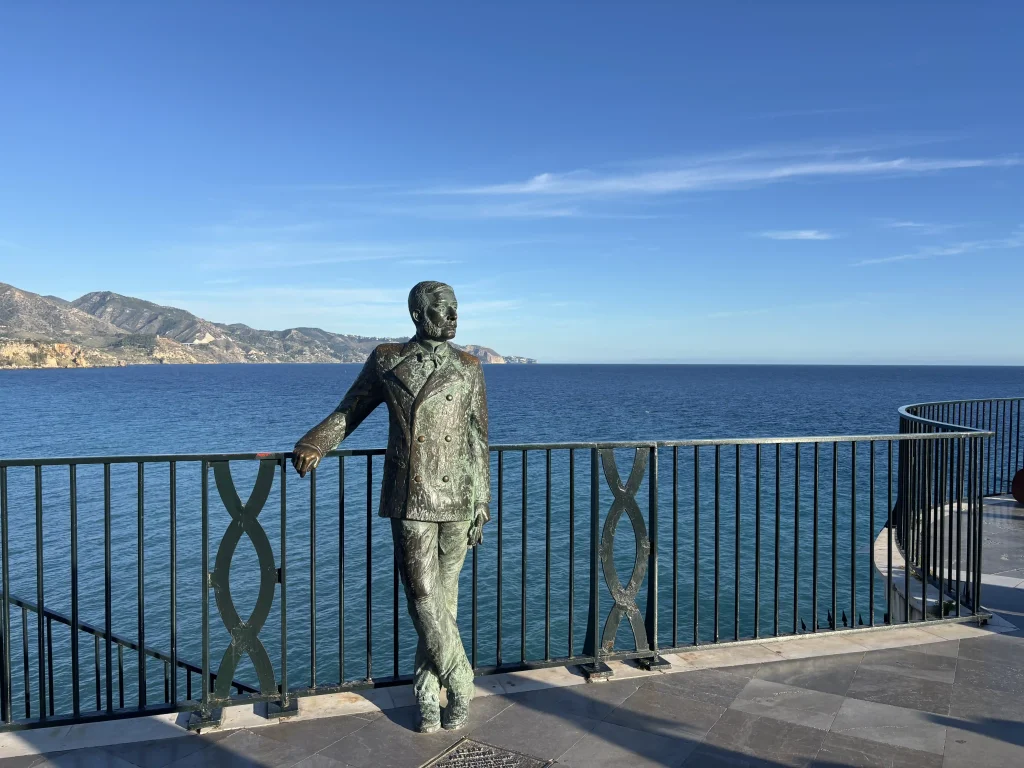
The Balcón de Europa
A tour of Nerja can only begin at the Balcón de Europa.
The Balcón de Europa is not just the most photographed spot in Nerja: it is the true symbolic heart of the town, a place where history, politics, propaganda and… a touch of royal poetry all come together.
The promontory where we stroll today as tourists was originally an Arab fortification called Castillo Bajo. It was used to control the coastline and defend against pirates and sea raids, which were extremely frequent until the 17th century. For this reason, it was also known as the Paseo de la Batería.
Up until the 19th century, there really was a coastal defensive battery here, complete with cannons, used to monitor maritime traffic and protect the town from North African pirates or potential European enemies.
In short, this was not a romantic place at all, but a military zone with cannons aimed at the sea.
After the Reconquista, the structure was maintained as a military lookout point, but over time it lost its strategic importance and gradually became a civil space.
On December 25, 1884, a devastating earthquake struck Málaga and the Axarquía. Nerja was almost completely destroyed.
In January 1885, King Alfonso XII arrived to inspect the damage. From the terrace of the old castle, he looked out over the Mediterranean and pronounced the sentence that would become legendary:
“From here you can see Europe.”
In reality, you cannot see Europe at all from the balcony… you see a sea so intensely blue that you understand why kings occasionally came out with random poetic phrases. Nevertheless, his words remained in history and represented an incredibly powerful political gesture: turning a destroyed town into a symbol of rebirth, openness, and hope.
From that day on, the promontory was officially named Balcón de Europa.
This is also why today you can find the bronze statue of Alfonso XII on the balcony. What makes this statue unique is that it is one of the very few royal statues in Spain placed in a non-monumental, almost “everyday” setting. He is not posed heroically on horseback. He stands there, simply, like any visitor contemplating the sea.
A curious detail about the Balcón de Europa: everyone assumes it is the most touristy place because it is photographed constantly and fills visitors’ social media feeds. But if you go early in the morning or at sunset, you will find elderly people reading the newspaper, teenagers playing guitar, and families taking a stroll.
It is a space that belongs not to tourism, but to the everyday life of the town.
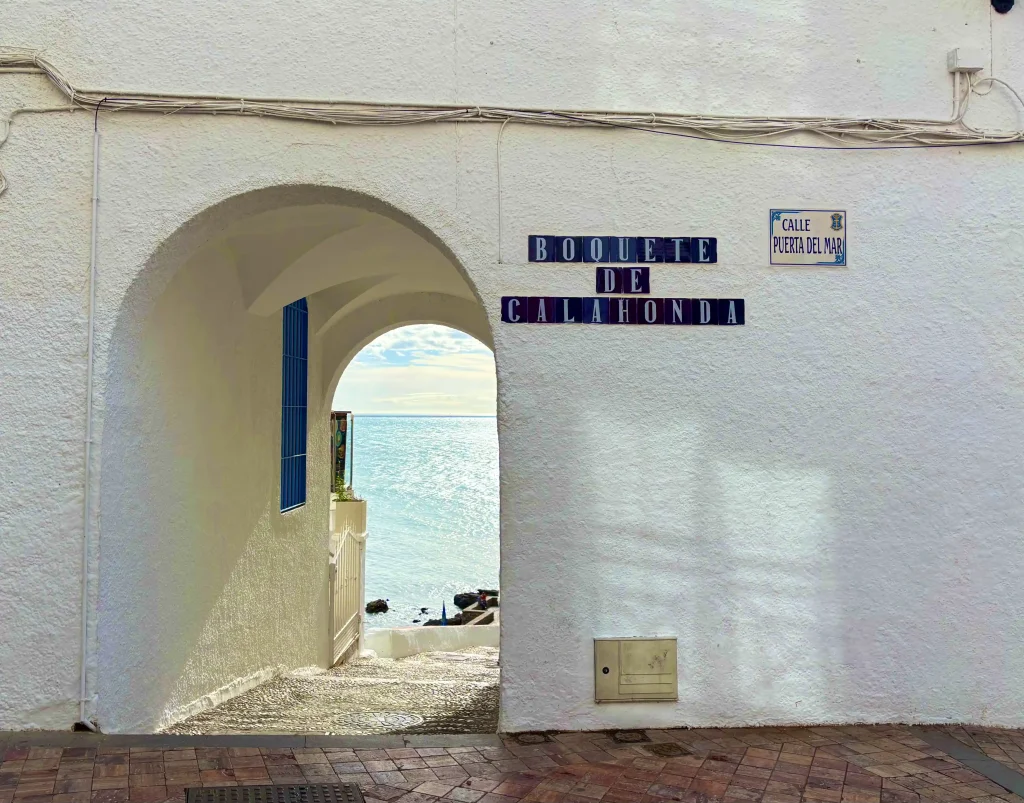
The streets leading to the sea
Around the famous Balcón de Europa stretch the streets where you’ll find buildings that, until just a few decades ago, were homes of fishermen and families tied to the sea. The very position of the balcony is part of the original development of the old fishing village.
Nerja did not grow as a large commercial port with an area reserved exclusively for fishermen (as happens elsewhere). Instead, it developed as a small fishing village spread between the town center and the coastline. Look for the small squares and stairways near the central beaches: that’s where you can still feel the roots of the “seaside village.”
Calle Puerta del Mar and Calle Hernando de Carabeo are the historic streets of Nerja. They connected the agricultural village with the sea and were the natural route for carrying fish, salt, and goods inland. Here, traffic fades away and the atmosphere quickly becomes more “maritime”: old wooden shutters, decorative tiles on façades, and stairways leading down toward the sea.
You will still find low whitewashed houses, balconies with pots of geraniums, and small doorways designed for fishermen’s families.
At the end of the street, a beautiful sea view opens up thanks to the Mirador del Bendito.
I also recommend taking advantage of the stairways that descend toward the sea and going down to Calahonda Beach, Carabeo Beach, or, on the other side, Playa El Salón. Look up from below toward the cliffs: here you truly understand what Nerja once was. The houses are almost attached to the sand, built when the sea was part of everyday life. The oldest buildings are small, simple, long and narrow, often without panoramic terraces. They were not holiday homes: they were working homes.
With this deep blue still in your eyes, we head back toward the center, the beating heart of Nerja.
Returning toward the Balcón de Europa and Calle Puerta del Mar, you can choose to go uphill and take Calle Pintada and Calle Almirante Ferrándiz. This area has more shops and restaurants, but still preserves the picturesque charm of the old fishermen’s houses.
This is where the “historic center” of Nerja begins.
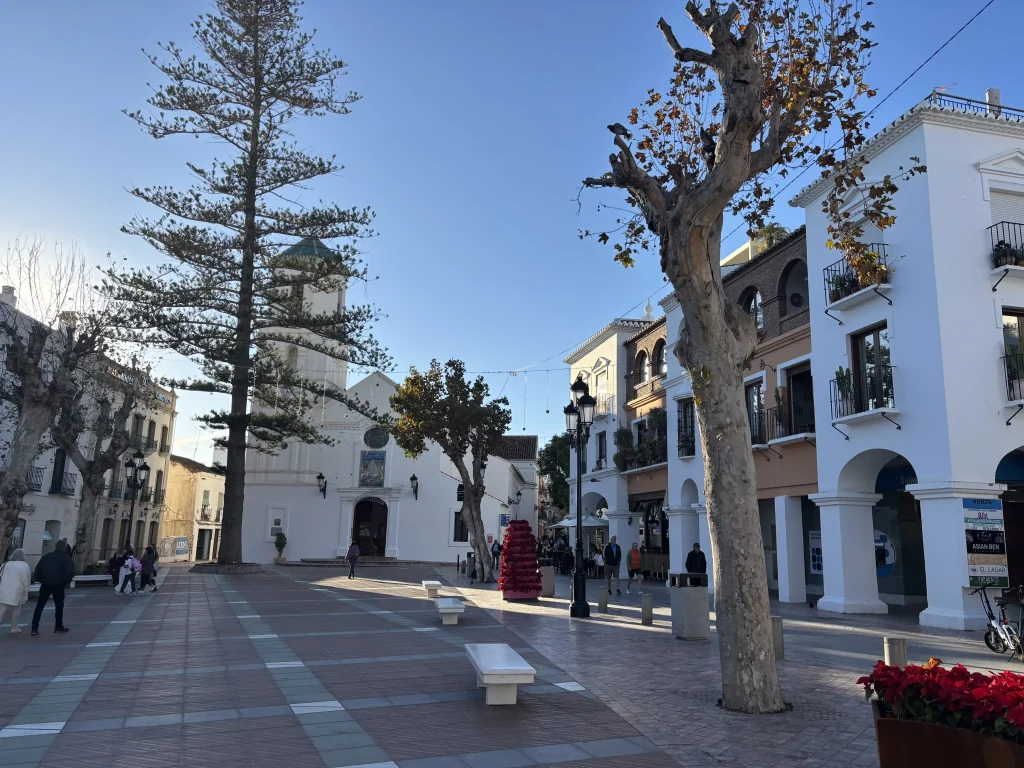
Old Town (Casco Antiguo)
Nerja’s historic center is not large, but it is one of those places that tells you its story without the need for museums: you just have to walk slowly and look at the façades.
The historic houses in the center can be recognized by a few details: one floor or at most two, completely white façades, narrow doors—often made of dark wood—and small balconies with wrought-iron railings.
They were homes of fishermen, craftsmen, and small traders, built for function, not for tourist aesthetics. The urban structure is authentic and has barely changed over time. Everything has been preserved and respected.
Everything revolves around Plaza Cavana and the Iglesia de El Salvador.
The Iglesia de El Salvador is the true “town church” of Nerja: not the largest, not the most ornate, but the one that best tells the story of the transition from an Arab village to an Andalusian Christian community.
It was the reference church for fishermen, where boats and nets were blessed before the most difficult seasons, and where funerals were held for sailors who never returned from the sea.
It overlooks Plaza Balcón de Europa, in the most symbolic point of the town. This is no coincidence: after the Reconquest, the church was built in the heart of ancient Narixa to physically mark the new Christian order.
It was built in 1697, on the remains of a previous mosque. This was a common practice in Andalusia: transforming Islamic places of worship into Catholic churches, often preserving original orientations and structures.
From the outside, it is simple, almost austere. But if you look closely, the bell tower still has proportions and lines that recall a minaret.
Inside, you will find three naves, a wooden ceiling in Mudéjar style, and a Baroque main altar with the image of Cristo del Salvador.
It is certainly not as spectacular as a cathedral, but it is deeply authentic.
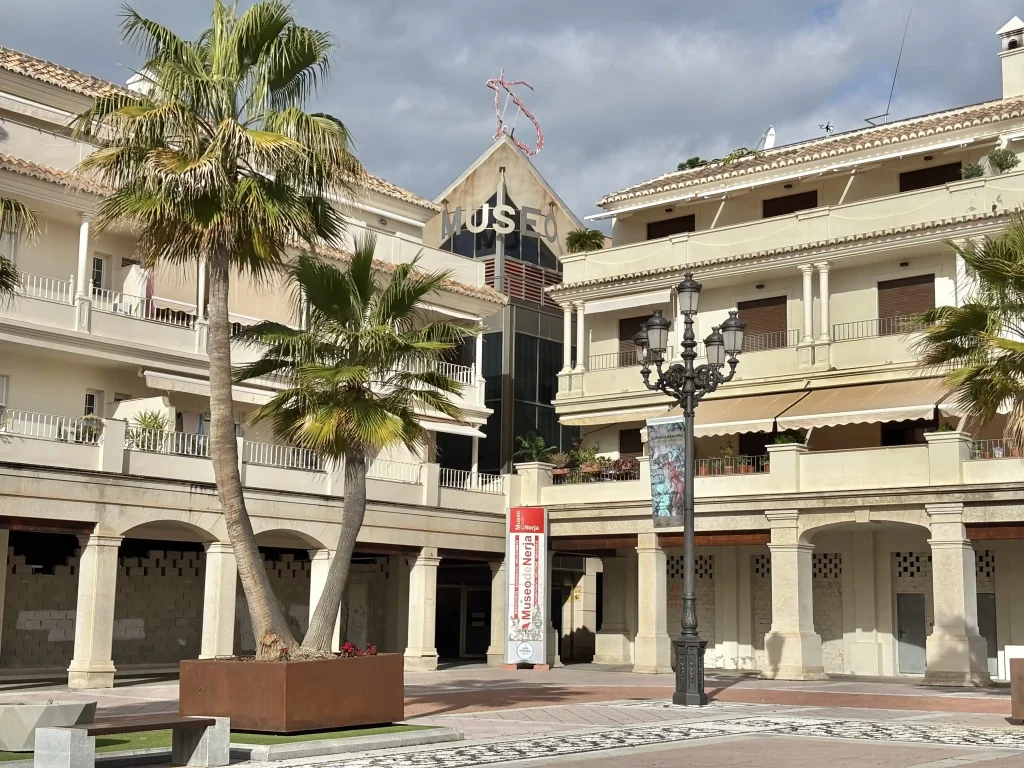
Not far away you’ll find Plaza de España. It is not the most famous square in Nerja — that role belongs to the Balcón de Europa — but it is probably the most important for the town’s everyday life. The Town Hall (Ayuntamiento de Nerja) overlooks this square. In the center, you’ll see a modern and understated fountain.
On festive days, the square transforms with concerts, street markets, cultural events, and local celebrations.
Museum of Nerja’s History
For tickets and information, you can visit the official website. The approximate entrance fee (which may vary slightly if purchased online or on site) is around €5, with possible discounts. In certain periods, admission may be free. If you visit the Cueva de Nerja, access to the museum can also be included in the main ticket within 10 days of your visit, simply by showing your ticket. Opening hours are usually 10:00 – 16:00 and it is closed on Mondays, but always check the official website, as opening days and times may change depending on the season, holidays, or special events. Allow about 45–60 minutes for the visit. It is compact, clear, and suitable even for those who do not enjoy long museum visits.
It is right at the corner between Plaza de España and Calle Hernando de Carabeo that you will find the Museo de Historia de Nerja. This is one of the best places to truly understand the town, because in just a few rooms it manages to tell 30,000 years of local history without feeling heavy or boring.
The museum is housed in the building of the old Ingenio San Antonio, a 16th-century sugar factory that was once one of Nerja’s main economic activities.
The museum route is chronological and very clear:
Prehistory: stone tools, reproductions of hearths, and human remains found in the caves.
Roman period – Detunda: fragments of transport ceramics, everyday objects, and panels about rural villas and coastal trade. It was a small agricultural-maritime hub connected to the vast Roman network of the Baetica.
Islamic period – Narixa: the Arab section is one of the most interesting, with explanations of the irrigation system, agricultural tools, and maps of the historic terraces. Here you understand why Nerja was called the “abundant spring.”
Reconquest and modern age: here you can observe the transformation of the town into a Christian village, its repopulation, and the birth of the first churches and brotherhoods.
The Cueva de Nerja: the museum dedicates significant space to the discovery of the cave and what was found inside it.
The final part is dedicated to temporary exhibitions.
If you visit the Cueva de Nerja, entry is included in the ticket price, so it’s worth stopping by, perhaps before visiting the cave. If you have to pay the full entrance fee separately, in my opinion it is not an essential stop.
I recommend instead taking a look at the program of the Centro Cultural Villa de Nerja. It always offers interesting cultural activities, including jazz concerts, Andalusian music, and local comedies.
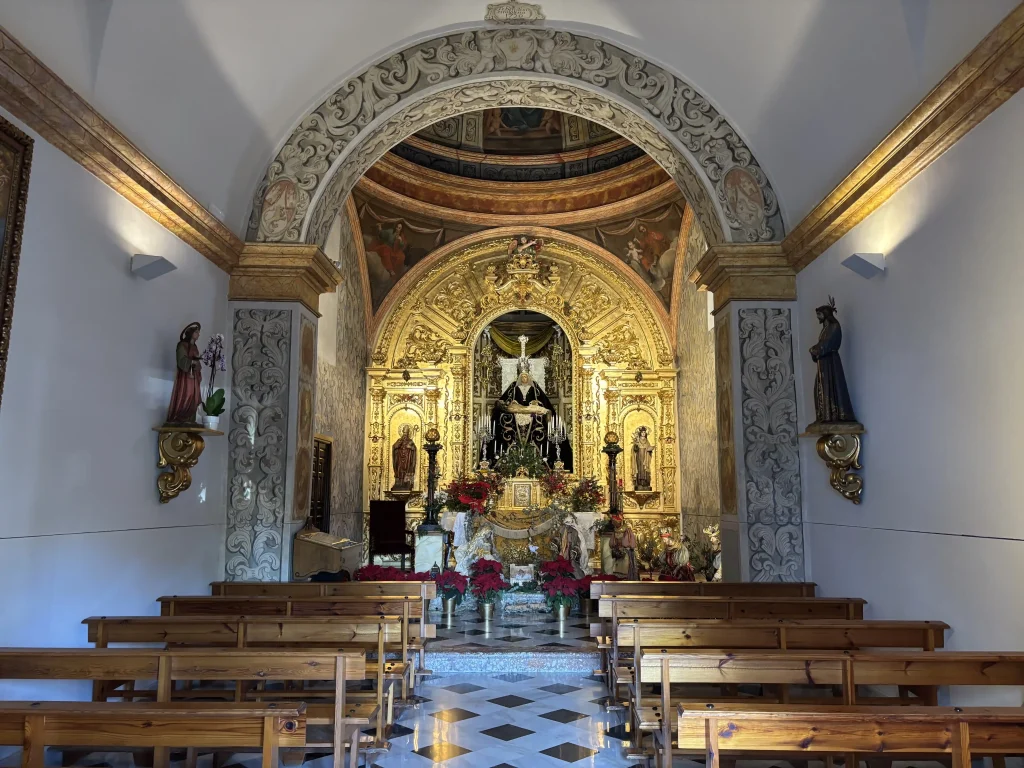
Intimate interior of the Ermita de Nuestra Señora de las Angustias in Nerja with a gilded Baroque altar
Ermita de Nuestra Señora de las Angustias
After exploring Nerja’s history, we now step into the town’s more popular and authentic side by visiting the Ermita de Nuestra Señora de las Angustias. This parish is one of those places that rarely appear in guidebooks, yet for the people of Nerja it holds enormous value. For me, its atmosphere always brings a deep sense of peace and calm.
It is located in the eastern part of the town center, near what used to be the old exit toward the fields and agricultural lands. Historically, this was the reference point for those leaving the village to work the land.
The hermitage was built in the 17th century as a small rural sanctuary. It was not a parish church, but a simple place of prayer, closely linked to everyday life, hardships, illnesses, and farewells.
Devotion to the Virgen de las Angustias is closely connected to suffering and to seeking protection in the most difficult moments of life.
From the outside, it is very modest: a white façade, a small bell tower, and a single nave.
Inside, it feels even more intimate, with the altar dedicated to the Virgin, often decorated with flowers brought directly by residents of the neighborhood. In the back pews, there is almost always someone praying in silence.
Every year in September, the romería and the procesión de Nuestra Señora de las Angustias take place.
It is one of the most intimate religious celebrations in Nerja. The statue is carried in procession and accompanied by entire families. Many take part barefoot or in silence, as a sign of promise or gratitude. There is no tourist folklore here: it is genuine faith.
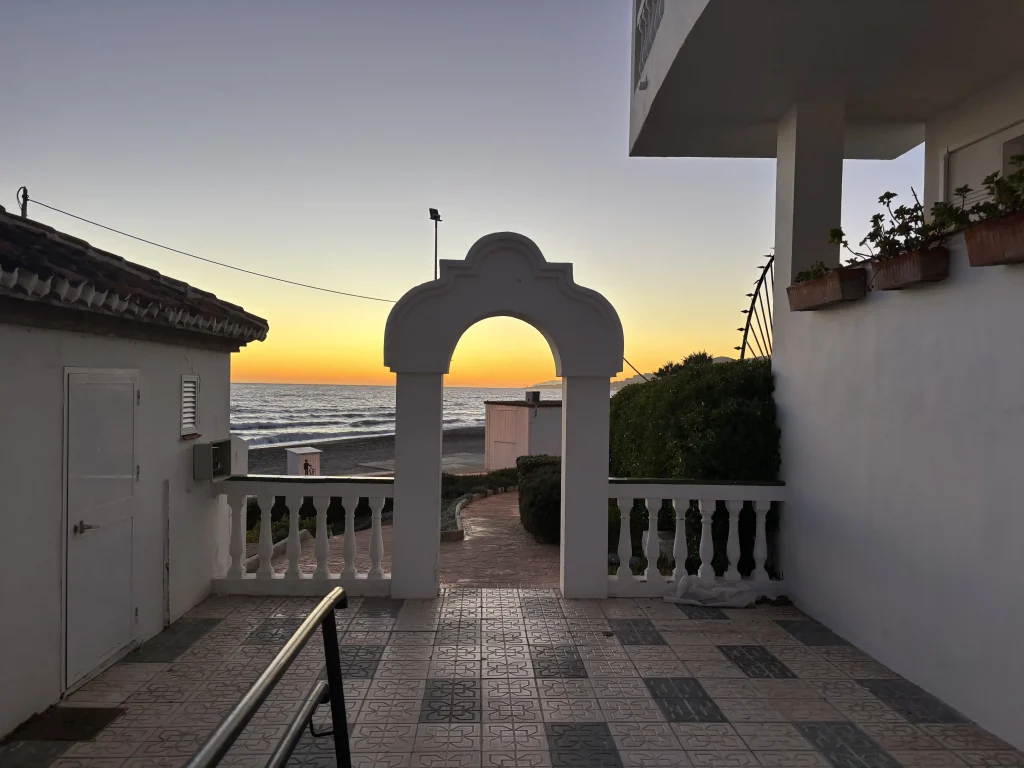
Parque Plaza de los Cangrejos
We now head toward Parque Plaza de los Cangrejos, walking along Calle Málaga. This is one of those places you won’t find on Nerja’s postcards, but one that explains very well how the neighborhood truly lives — and from where you can enjoy a wonderful view.
It is located in the eastern residential area of the town center, to the right of the Balcón de Europa when facing the sea. Far from the tourist flow of the Old Town, it is a neighborhood park designed for families, children, and elderly people who come down in the evening for a quiet stroll.
This park was created to give breathing space to a densely populated area made up of modest houses and small apartment buildings. It was not designed as an attraction, but as a response to a real need of the neighborhood: having a place to meet.
Its name comes from popular local language: children from the area, playing among the rocks and damp coastal spots nearby, used to call this place after the small crabs they would find there.
From here, you can reach the Mirador de la Torrecilla and enjoy one of the most beautiful sunsets on the Costa del Sol. You can also take a walk along the entire paseo marítimo, with the sea on one side and white houses on the other, enjoying a blue view every single day.
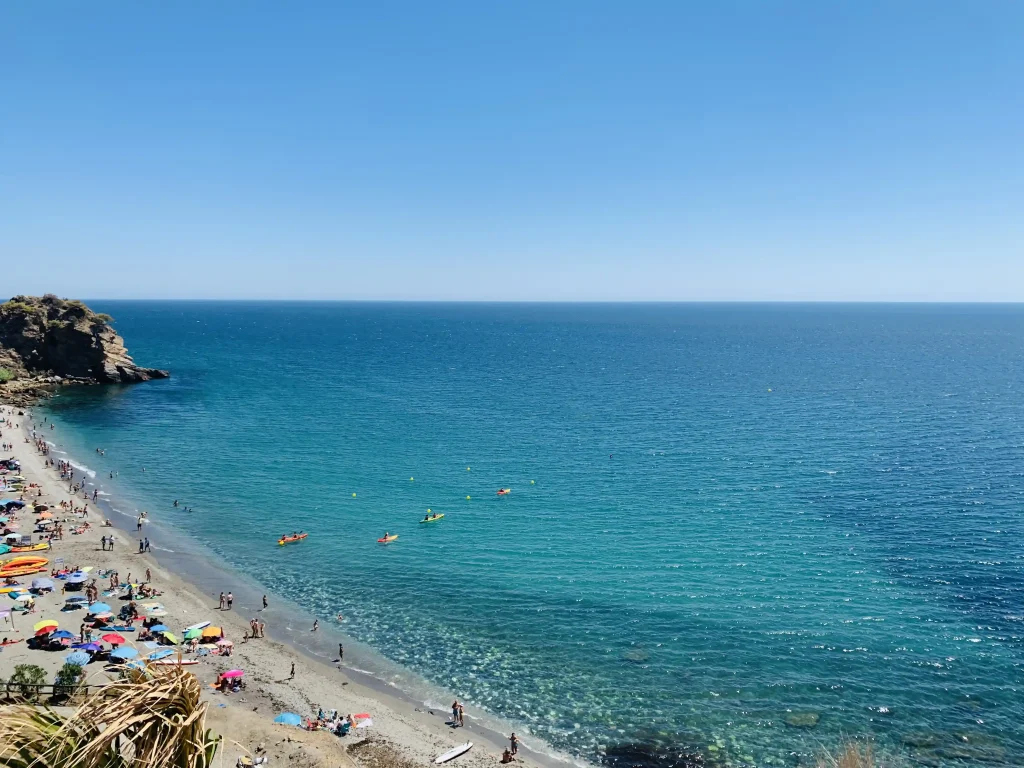
A bit of sun and sea
From the center of Nerja, a series of small urban coves unfold, all easily reachable on foot. It’s one of those places on the Costa del Sol where you can stroll through streets and terraces… and find yourself in a swimsuit within minutes.
The most famous is Playa de Burriana: the largest, the most accessible, and inevitably the busiest. It stretches for about 800 meters, with golden sand and generally calm waters. It’s the right choice if you’re looking for comfort and services: here you’ll find sunbed and umbrella rentals, beachfront bars and restaurants, and activities such as kayaking, paddleboarding, and pedal boats. It’s not the wildest beach, but it’s practical and always reliable.
Below the Balcón de Europa, on opposite sides of the cliff, you’ll find Playa de Calahonda and La Caletilla. These are small, picturesque, and highly photographed coves nestled between the rocks. Space is limited, so arriving early is advisable, but the location is more than worth it.
Another interesting option is Playa El Chucho, also perfect for sunset walks and suitable for families. Less famous, more peaceful, with that relaxed atmosphere that comes naturally along the Costa del Sol.
Leaving the town center, the surroundings of Nerja hide some of the most beautiful beaches in southern Spain.
The most famous is undoubtedly Playa de Maro, also known as Cala de Maro. It lies within the protected natural area of the Maro–Cerro Gordo cliffs, recognizable by the old Arab watchtowers scattered along the coastline.
The water here is crystal clear and intensely blue, perfect for snorkeling and diving, with surprisingly rich marine life. It is sheltered from the wind and ideal for a quiet day stretched out on its pebble beach.
The only real drawback? It’s so beautiful that it attracts a lot of people. The parking area near the beach is small (around 50 cars), so you need to arrive very early in the morning. Alternatively, you can park about 1 km away uphill, where there are public parking spaces (free or paid). There is also a bus that takes you directly to the beach for around €2.
One truly unique feature of Playa de Maro is the waterfall that flows into the sea, which you can see by renting a kayak: a hidden little wonder that makes the experience even more special.
Also within the natural park is Playa del Cañuelo, a beach set in an environment of extraordinary beauty. The water is so transparent that you can often see fish even without a mask. It is easy to reach, well signposted, and accessible even for people with reduced mobility — something rare for such a natural beach.
You will need to park in a dirt parking area at the top of the cliff. From there, you can take a summer shuttle minibus (10:00–22:00, €2–2.25 round trip per person, every 15–30 minutes) or walk down a path (2 km, 30–45 minutes downhill through hills and vegetation). As with the other coves in the area, proper footwear is highly recommended!
Finally, for those who love more secluded coves, there is Cala del Pino. It is a small beach about 350 meters long, surprisingly uncrowded even in high season. Probably because reaching it requires walking along a roughly 200-meter path carved into the cliff. Here I almost risked my dad breaking a leg — ouch!
You can leave the car near the watchtower at the top of the cliff; from there, the path begins. It’s not impossible, but I strongly advise against flip-flops and strollers: closed shoes and a bit of care are much better. Once you arrive, however, the view and the tranquility more than reward the effort.
Where to enjoy a taste of Nerja
Nerja is not only about spectacular beaches and the famous Balcón de Europa: it is also a small gastronomic paradise where Spanish and Mediterranean cuisine blend with international influences. The large presence of British residents and, more generally, visitors from northern Europe who spend several months of the year here has greatly influenced the local culinary experimentation. Here you will find restaurants serving traditional dishes, authentic tapas, places using high-quality local ingredients, and small gastronomic gems that try to satisfy every taste.
I would start with LACAL. A much-loved spot for well-prepared Mediterranean dishes and tapas in the heart of Nerja, with an excellent quality-price ratio and a relaxed atmosphere. They say it serves the best paella in Nerja. I must admit the arroz meloso con pulpo is outstanding. During the summer it’s always full, so booking in advance is highly recommended.
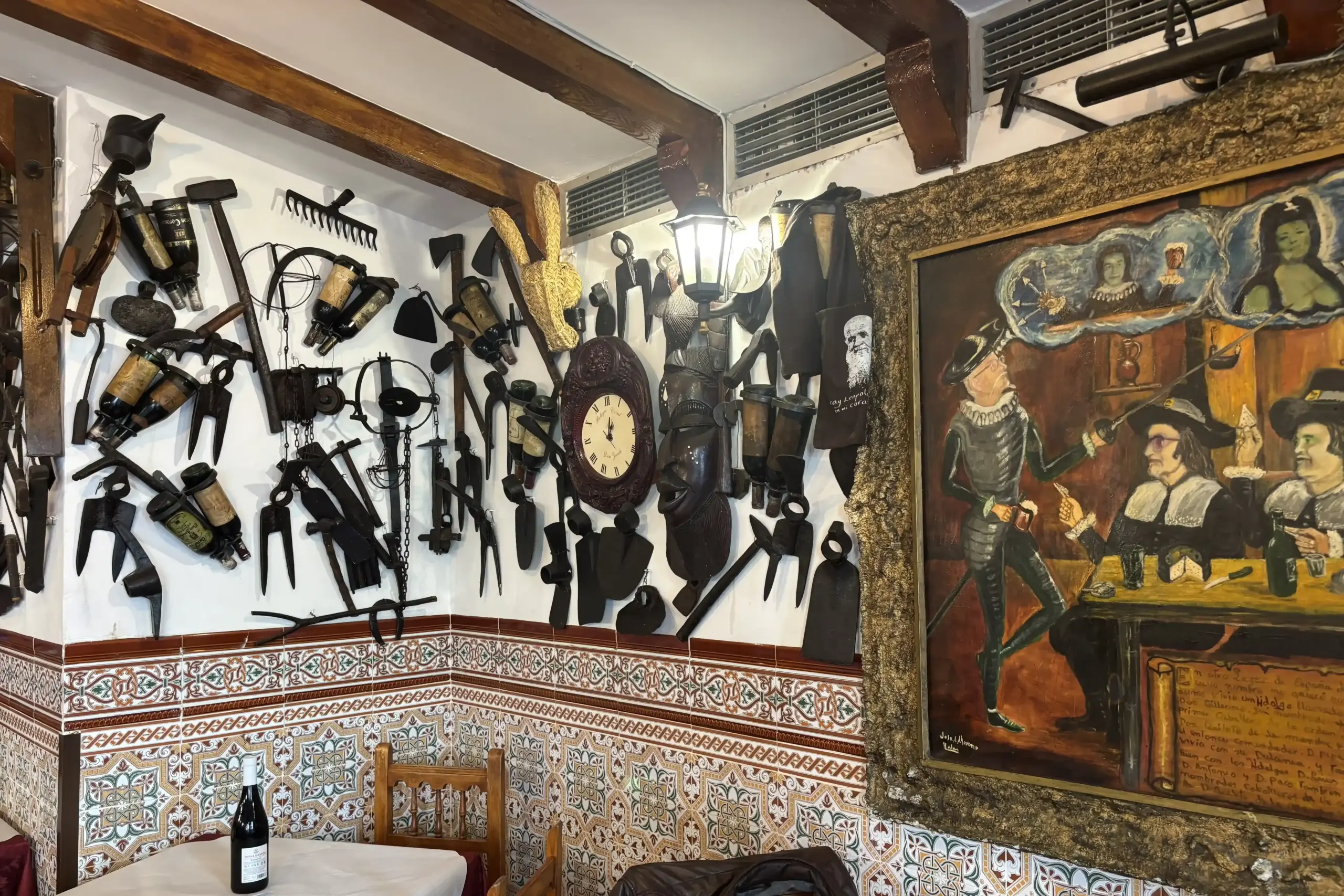
Another restaurant recommended to me by a local is Taberna de Pepe. It’s a typical tavern, away from the most touristy areas. A classic neighborhood taberna with a very Andalusian interior: azulejos, old tools hanging on the walls, wooden tables and chairs. Here you’ll be served generous portions and outstanding traditional dishes, such as rabo de toro… truly exceptional. The place is very small, which gives it intimacy and charm, but also means you should always call ahead to get a table.
For a more “seafaring” experience, there is a highly appreciated seafood restaurant called Puerta del Mar, located on the street of the same name. It is more refined than the previous ones and offers excellent quality fish. In my opinion, the coquinas de Málaga are among the best dishes, but there is plenty to choose from. It’s not the cheapest option, but the quality of the seafood and the direct sea view make the extra expense worthwhile.
Although Nerja is Spanish to the core, many quality venues have successfully combined international dishes with local ingredients. This is the spirit behind Botanic Gastro Bar. It’s a modern bar that immediately catches the eye thanks to its distinctive façade. Here, the chef enjoys playing with beautifully presented dishes and flavor combinations that may seem distant at first, but once tasted come together in a surprisingly harmonious way. I ordered the atún en salsa de vermut: truly unique! I have to say that everything I tried was excellent. It’s not the typical Spanish restaurant, but it’s a wonderful culinary experience that I highly recommend.
Nerja is a town where sun and sea blend seamlessly together at any time of year. You can explore the historic centre and, within two minutes, already be lying on a delightful little cove surrounded by crystal-clear blue water.
For this reason, if you are planning to visit Nerja, it is worth bringing a lightweight towel — I bought this one so I could always carry it with me when travelling to a seaside town: it fits easily into a backpack and does not pick up dirt — as well as a pair of sandals and a practical bag. Nerja’s urban beaches are perfect for an unplanned break between a stroll through the historic centre, some tapas and a little sangría.
As in the rest of Andalusia, the sun is one of the main features of Nerja at any time of year. A hat, sunglasses and a good sunscreen are essential even in winter: the Andalusian light is intense, especially during long walks and the hours spent lying in the sun working on your tan. I always carry this small but very effective sunscreen with me.
Finally, although the climate is mild, it is worth carrying a sweatshirt or a lightweight jacket for the evening, when the sea breeze can make the air feel cooler. I bought this jacket , and it proved to be my most useful item, especially during a boat trip.
Nerja has a slightly more sophisticated style than many other towns and cities in Andalusia. So, if you would like to dress up a little, this is the right place to do it.
Small items such as a power bank may seem like minor details, but they can make your day much easier, especially when you are using your phone’s navigation system to find your way around and want to photograph all the most beautiful corners and moments of your trip. I was given this one and I am very happy with it. There are, however, countless different models. Regardless of the model you choose, I strongly recommend taking one with you: on some occasions, it may save your day!
And now, after falling in love with another special corner of Andalusia, our tour of Nerja comes to an end.
As you have seen, Nerja and its surroundings offer far more than the town might suggest at first glance.
And if all this still isn’t enough, you only need to travel a few more kilometers to keep being amazed: unique caves, pueblos blancos surrounded by bougainvillea, and one of the oldest cities in Europe.
If you’d like to continue the journey and discover these small great treasures, below you’ll find some articles I’ve prepared for you:
Cueva de Nerja: the underground giant of Andalusia between geology and prehistory
Frigiliana: one of the most beautiful white villages in Spain
Málaga: a delightful mix of culture, sunshine, and Mediterranean rhythm
I hope you find them useful!