The Patios of Córdoba
As we’re getting closer to spring, I thought I’d write an article about one of the most beautiful spring events in all of Andalusia: the Fiesta de los Patios in Córdoba. If you’ve never been, get ready — it’s an experience you won’t easily forget.
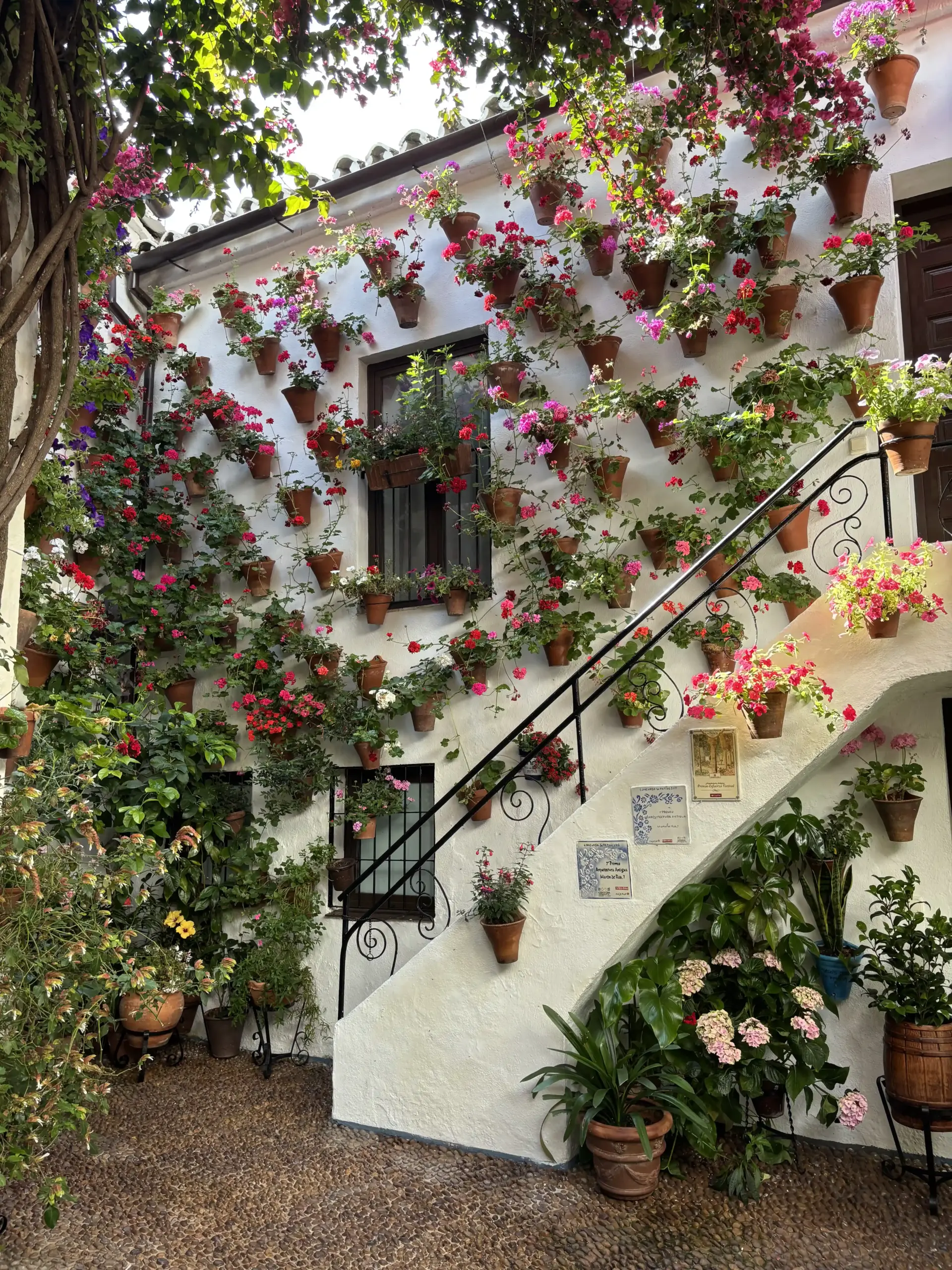
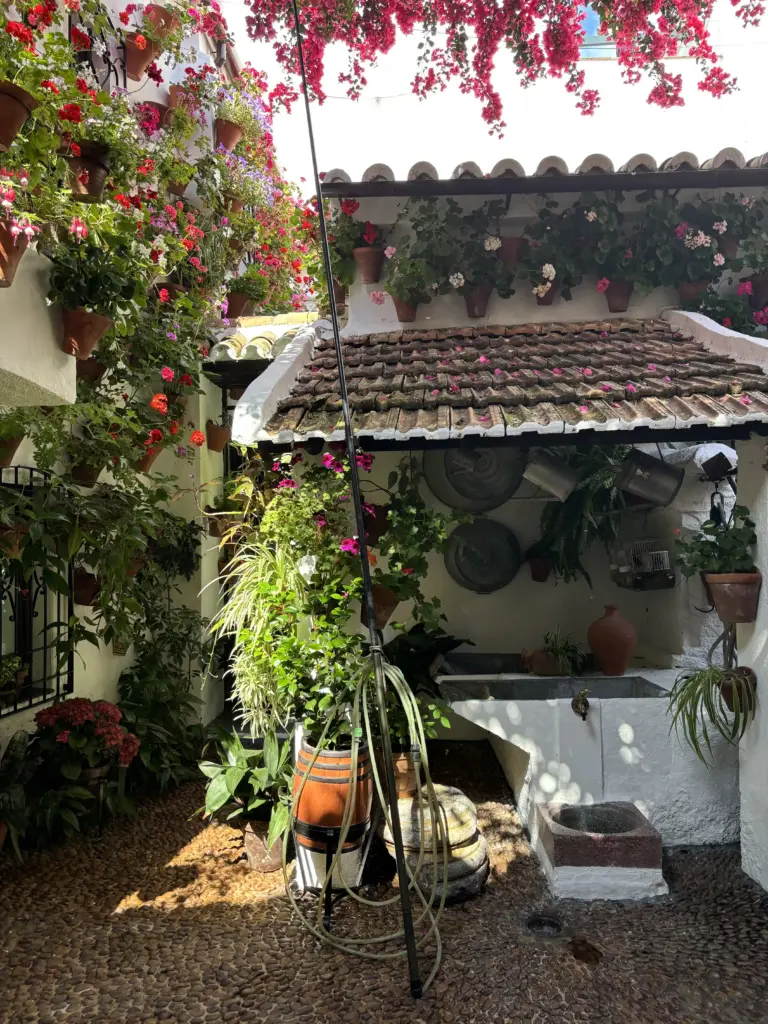
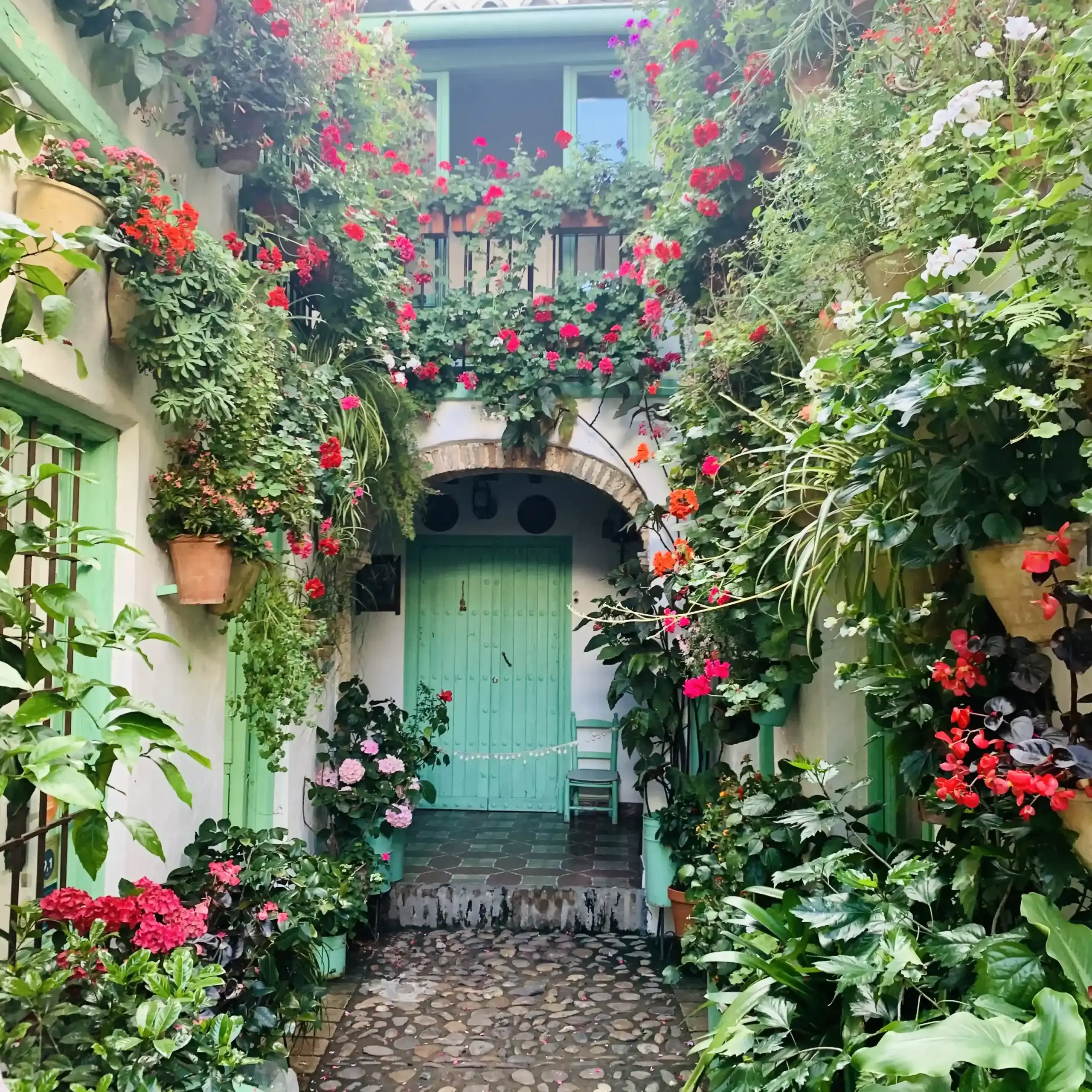
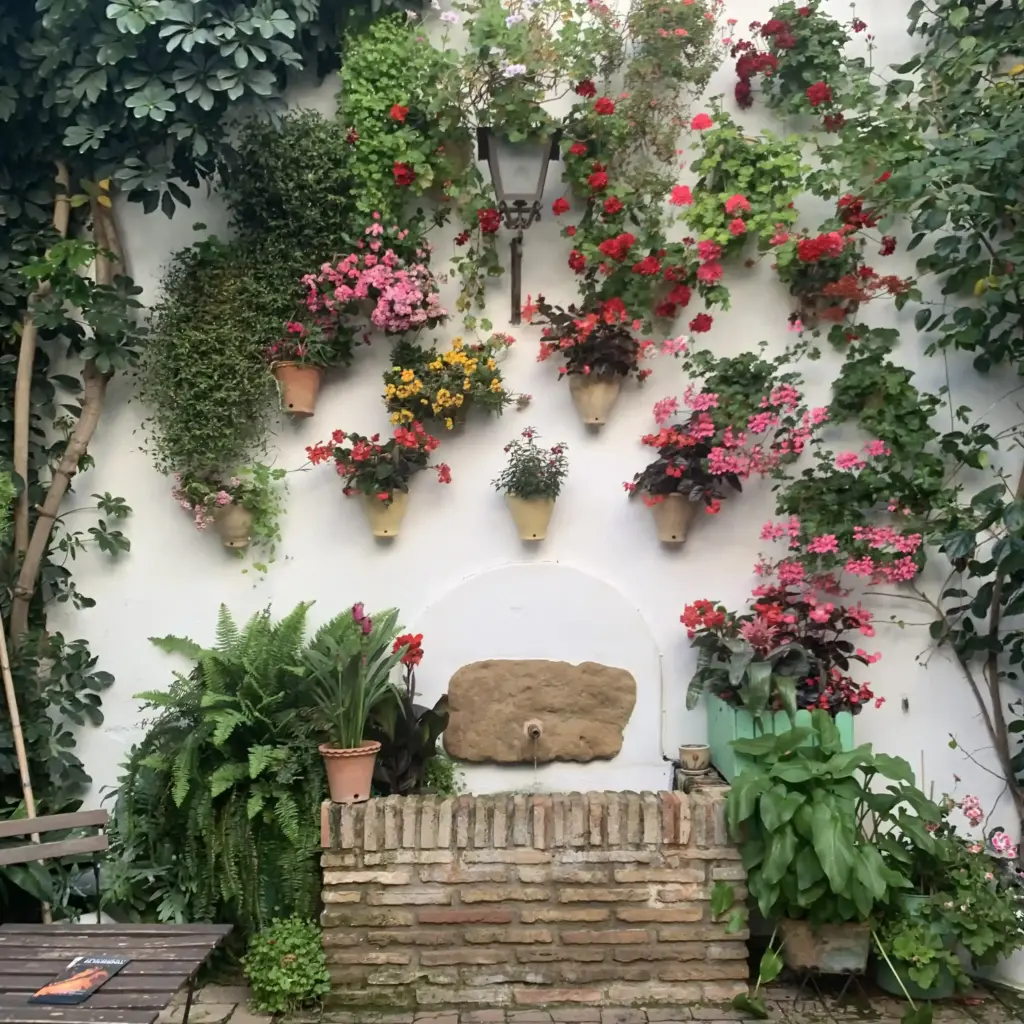
Patios are the inner courtyards of Córdoba’s houses. During the year they are private spaces, but for two weeks the owners open their doors and showcase their work: flower pots everywhere, whitewashed walls, fountains with fresh water, centuries-old wells, plants that seem to embrace the walls and reach toward the sky.
This festival, which is actually an open-door competition, usually takes place during the first two weeks of May. In 2026, for example, it runs from May 4th to May 17th. For two weeks Córdoba transforms: the city becomes a vast, shared secret garden.
In 2012, UNESCO declared the Fiesta de los Patios an Intangible Cultural Heritage of Humanity. Not just for the beauty of the flowers, but because it represents a way of life, knowledge passed down through generations, a piece of history that is still alive.
Many patios, in fact, are cared for by a single person, often elderly, who spends hours every day watering, repotting, and pruning. Behind every perfect corner there is a human story. So when you step inside, behave as you would if someone opened the doors of their home to you in exchange for a smile.
Here are some practical tips for visiting Córdoba’s Fiesta de los Patios: how to get there, where to park, how to get around, how to plan your visit and when to go. A few useful things to know when choosing your transport, moving between the different patio routes and organising your visit around opening hours, queues and the May heat.
Show all tips ↓ Hide tips ↑
How to get to Córdoba
- By train: this is probably the easiest way to reach Córdoba. The Córdoba – Julio Anguita railway station is connected by high-speed trains mainly with Madrid, Seville and Málaga, and is located around a 20-minute walk from the historic centre. You can check timetables and tickets on the websites of Renfe, iryo and OUIGO. To compare all the available train options, I actually always use Trainline and TrainPal, so you can see different companies, prices and timetables in a single search.
- By bus: the bus station is located directly opposite the railway station. Córdoba is connected with many cities in Andalusia and the rest of Spain through companies such as ALSA and Socibus.
- By car: Córdoba is easy to reach, but during the Fiesta de los Patios traffic increases and parking near the centre can become difficult. You can try the area around Avenida de la Libertad or the other side of the Guadalquivir, near the Torre de la Calahorra, but the free spaces fill up early. My advice is to leave the car outside the historic centre and continue on foot or by public transport.
- For more detailed information about airports, stations, connections, parking and public transport, you can read my article about what to see in Córdoba and how to organise your trip.
How to get around the Patios of Córdoba
- On foot: this is the best way to visit most of the patios. The routes cross different neighbourhoods, but many of them are within a reasonable distance of one another and can be connected on foot. The streets are often cobbled and uneven, so wear comfortable shoes and do not underestimate the distances: walking from one patio to another usually means covering much more ground than the map suggests.
- The patios are not concentrated in a single neighbourhood, but are spread across several routes identified by different colours. To avoid spending the entire day rushing from one side of the city to the other, choose one area at a time and visit the patios belonging to the same route.
- As soon as you arrive, download the official map from the Fiesta de los Patios website or pick up a copy from one of the tourist information points. The online version is particularly useful because it shows the location of the patios, the route each one belongs to and the information you need to organise your visit.
- By city bus: this can be useful for reaching the routes furthest from the main tourist area, such as Santa Marina–San Agustín, San Lorenzo and San Pedro–Santiago, or for travelling between these neighbourhoods and the more central areas of the Jewish Quarter and San Basilio without having to walk the entire distance again. The buses are operated by AUCORSA. Before setting out, check the routes, stops and any service changes, as some streets may be closed or diverted during the events held in May.
- By bicycle: a bicycle can be useful for getting closer to the routes through Santa Marina, San Agustín, San Lorenzo, San Pedro and Santiago, especially if your accommodation is in the Jewish Quarter, near the Mezquita or in the San Basilio area. In the narrowest and busiest streets, however, you will often need to get off and continue on foot. Córdoba does not currently have a public bike-sharing service, so you will need to use a private rental company.
How to plan your visit to the Patios
- During the Fiesta de los Patios, the general opening hours are normally divided into two periods: from 11:00 to 14:00 and from 18:00 to 22:00. Opening hours may vary on certain days or for individual patios, so always check the official programme for the edition you are visiting.
- Admission to the patios taking part in the competition is normally free of charge. In some houses, however, you may see a plate or container where you can leave a donation. It is not compulsory, but it is a kind way to contribute to the care of the plants and the preservation of this tradition.
- Tickets and reservations are not normally required to enter the individual patios. Access is, however, controlled at the entrance for safety reasons and to protect the homes. Volunteers or staff members will tell you when you can enter. At the best-known patios, particularly at weekends, you should therefore expect some queuing and bring plenty of patience.
- Plan your visits for the morning opening time or the beginning of the evening session. Temperatures can already be high between 13:00 and 14:00, while the streets tend to become crowded again later in the afternoon. The break between the two opening periods is perfect for lunch, a rest or a visit to an indoor monument.
- Whenever possible, avoid Saturday and Sunday and visit the patios during the week. Weekends attract many more visitors, and the queues outside the most famous homes can become very long.
- Do not try to see every patio in a single day. The most enjoyable part of the experience is taking the time to notice the details, speak with the owners when possible and understand how each home interprets this tradition. Choose one or two routes each day and leave room for detours: some of the lesser-known patios may be the ones you remember most fondly.
- Remember that you are entering private homes. Do not touch the plants, respect the marked areas, avoid blocking the passage and ask permission before photographing people. The Fiesta exists thanks to the generosity of the owners, who open part of their homes to the public.
- Take water, a hat and sunscreen with you. Although many patios are cool and shaded, the walks between one route and another are often under the sun, and queues form outdoors.
- Lunch and dinner generally begin quite late: lunch from around 13:30–14:00 and dinner from approximately 20:30–21:00 onwards. During the festival, the best-known restaurants and those close to the routes can fill up quickly, so it is worth booking ahead or walking slightly away from the busiest areas.
- Before your visit, always consult the official Fiesta de los Patios website. Here you will find the latest dates, the map, the participating patios, the division into routes, any changes to opening hours and the programme of related activities.
- If you would prefer to learn about the history of the tradition with a guide, or join an organised route, you can check the available options on GetYourGuide and Civitatis. During the festival, these tours are not necessary for entering the free patios, but they can help you better understand the architecture of the houses, the care of the plants and the history of the competition.
When to visit the Patios of Córdoba
- The most spectacular time is, of course, the Fiesta de los Patios, which generally takes place during the first half of May. During these weeks, the homes taking part in the competition open to the public free of charge and the patios reach their peak flowering season. It is also the busiest time, however, so book your accommodation in advance and, whenever possible, choose weekdays.
- Not everyone knows that some patios can also be visited outside the festival period. The experience is different, as not all homes will be open and you will not find the same concentration of flowers, but you will be able to visit them at a much more relaxed pace.
- Outside the festival, do not simply turn up at a patio expecting it to be open. Some homes have specific opening hours, while others require a ticket or form part of an organised route. First consult the page dedicated to the patios that can be visited throughout the year and check the conditions for each individual location.
- Outside the competition period, a guided tour can be particularly useful, as it allows you to know in advance which patios are actually accessible and avoid finding their doors closed. You can check the available experiences on GetYourGuide or Civitatis.
- Spring remains the best period for seeing the patios at their most colourful, although autumn can also be pleasant. In midsummer, however, Córdoba’s heat can make walking between the houses very tiring, while in winter the plants and flowers are not at their most spectacular.
A bit of history about the Patios of Córdoba
To understand the patios, as always, we need to start from their history.
Patios date back to the Roman domus: the Romans organized their lives around an inner courtyard, with a portico and often a fountain in the center. It was the heart of the house, the place where family life unfolded.
But it was the Arabs who gave the patio its most intimate character. They adapted the house to their way of living, creating a private space, an oasis of coolness and tranquility that evoked the image of the Garden of Paradise. To protect themselves from the sun and from the gaze of the street, they introduced the characteristic L-shaped entrance (the zaguán): a small corridor that bends, preventing a direct view from the door into the house. In this way, even with the door open, privacy is guaranteed and air can circulate without letting in the heat.
The major change came with the Industrial Revolution. People moved from the countryside to the city, and large noble houses were divided among multiple families. The patio, once private, became a shared space where people used the well, the washbasin, and sometimes even the kitchen together.
Families began to hang flower pots. At first, it is said, it was a necessity to hide damaged plaster, but it soon became a symbol of identity and a friendly rivalry among neighbors.
This healthy rivalry became the seed of the festival.
In 1918, the city council decided to formalize the tradition and organized the first competition. Since 1921, it has been held almost without interruption.
How the Fiesta de los Patios competition works
Around 50–60 patios take part each year (up to 48 between historic and modern, 7 singular, and 5 convent patios), divided into 4 categories:
- Historic Architecture: Patios built up to the 1960s. The preservation of original elements (floors, wells, stone walls, vaults) is evaluated. Any intervention must respect the historical structure.
- Modern Architecture: Newly built houses or older homes with significant renovations. What is evaluated is how the contemporary design fits into the spirit of the Córdoba patio.
- Singular Patios: They belong to associations or institutions. They are evaluated for their monumentality, their size, or because they represent the “official architecture” of their time.
- Convent Patios: They are part of religious buildings. Their size, architectural design, and how they represent the religious architecture of their era are evaluated.
A technical committee evaluates the patios and decides who enters the competition, checking that they meet the criteria of architectural preservation, decoration, and the condition of the plants. There are also “out-of-competition” patios that open to visitors but are not included in the ranking.
In addition to the specific characteristics of each category, the jury evaluates:
- The variety and condition of the plants: seasonal flowers, overall plant health, care of the pots
- The architectural preservation: how well the patio maintains its traditional structure
- The harmony and decoration: arrangement of the pots, colors, visual balance
- The use of water: fountains, wells, elements that create coolness
- The natural lighting
A fixed rule since 1980: patios must be decorated exclusively with seasonal flowers (“flores del tiempo”), no artificial decorations!
The competition is not just a beauty contest. It is, above all, the tool through which the Córdoba City Council protects and funds a piece of living heritage that would otherwise risk disappearing.
Speaking with the owner of a patio, she told me that maintaining a patio all year round is quite expensive: water, soil, new pots, replacing plants that die, whitewashing the walls, repairs. We’re talking about several thousand euros for the larger patios. In essence, the competition gives back prizes in exchange for keeping the tradition alive.
We’re talking about actual cash prizes, not symbolic plaques. The amounts vary from year to year, depending on the municipal budget, but she explained that they are roughly in the range of:
- First prize for Historic Architecture: several thousand euros (typically between €3,000 and €4,000 for the overall winner)
- Prizes for the other categories: smaller but still significant amounts, in the range of hundreds or thousands of euros
- Special “Patio Joven” award (under 35): a financial incentive to encourage younger generations to carry on the tradition
- Award for the most unique plant: a smaller but highly coveted recognition, as it turns a plant into a small celebrity
The competition was created to reward the daily care of the patios and prevent their disappearance: in practice, the City Council transforms a popular tradition into a city-wide celebration and a tourist attraction, also providing financial recognition.
During the festival, especially in the evening hours, you might hear guitars and voices coming from a patio. It’s nothing planned: it’s locals gathering, friends bringing an instrument, neighbors joining in. It’s part of the spirit of the festival, a convivial atmosphere you won’t find written in any official program.
How to organize your visit to the patios
As you can imagine, this event attracts tourists from all over the world.
Its unique atmosphere, the city in celebration, the chance to see patios that open only during those specific days of the year, with flowers at their absolute peak, make the festival something truly incredible.
But be prepared for the downside.
In the San Basilio neighborhood, there are very long queues to enter a patio, especially the most famous ones. Keep in mind that I personally waited up to an hour and a half to get into San Basilio 44. Also, in May, temperatures in Córdoba can already exceed 30°C, especially around midday, so the wait is not exactly comfortable.
Personally, I still think it’s worth it. You just need to be smart and plan your visit like an experienced traveler.
Here are some tips to survive (and enjoy) the Fiesta de los Patios:
- Aim for early morning (right when they open, at 11:00) or the early evening (18:00–19:00). Just make sure to get in line a bit earlier.
- Avoid the peak hours (12:00–14:00 or 17:00–19:00): that’s when both the heat and the queues are at their worst.
- The siesta (14:00–17:00): most patios close during this time, so you can use it to visit something else, move between neighborhoods, or book a table at a good restaurant.
- Plan your visit by itineraries and choose a few patios in each neighborhood. You’ll never manage to see them all. It’s simply impossible if you’re staying just one day.
- But above all, accept that you’ll have to wait in line — be patient… in the end, it will be worth it.
The itineraries
The patios in competition (around 50-60 every year) are grouped into five itineraries, colour-coded to make your visits easier, following the official interactive map. Don’t try to do them all in one day: it’s impossible. Pick one or two per neighbourhood, tops.
As soon as you arrive, my advice is to stop by the tourist office and grab the paper map too: each itinerary is marked with a different colour, so you can plan your day without losing your mind.
One practical heads-up, though: if you compare the paper or PDF map with the interactive one on the website, don’t be surprised if the route colours don’t match — the Town Hall’s printed leaflet and the online version sometimes use slightly different palettes. The itineraries and addresses stay exactly the same, only the colour marking them changes. Below, I’ve used the ones from the online map.
Santa Marina – San Agustín
Another less-travelled itinerary, patios with a popular charm and a few surprises.
San Lorenzo
A transitional neighbourhood, blending historic and modern patios.
Santiago – San Pedro
Fewer tourists, a more authentic, everyday atmosphere. If you want to feel the real Córdoba, come here.
Judería – San Francisco
Right in the heart of the old Jewish quarter. Elegant patios, beautifully kept, less chaotic than San Basilio.
Alcázar Viejo (San Basilio)
The most famous neighbourhood, the one you see on every postcard. Spectacular patios, but also the longest queues. Not to be missed, especially if it’s your first time at the Festival.
Must-see patios
Here’s a selection of the most iconic patios (open to visitors in 2025), some famous for the awards they’ve won, others for their unique charm. Of course, this is my personal selection, so I’m curious to know if you’ll agree!
-
★Siete Revueltas, 1 (Santiago-San Pedro, Singular Patio)
Known as the “Casa de las Campanas”. It’s huge and has some incredible 14th-century stucco work. It was the most visited patio in 2024. -
★Marroquíes, 6 (Santa Marina-San Agustín, Singular Patio)
A true piece of history that’s won first prize countless times. Its giant bougainvillea forms a spectacular natural ceiling. -
★Maese Luis, 9 (Judería-San Francisco, Modern Architecture)
Isabel’s house, where alongside tending the flowers she keeps canaries and tortoises roaming freely around the patio. A marvel! -
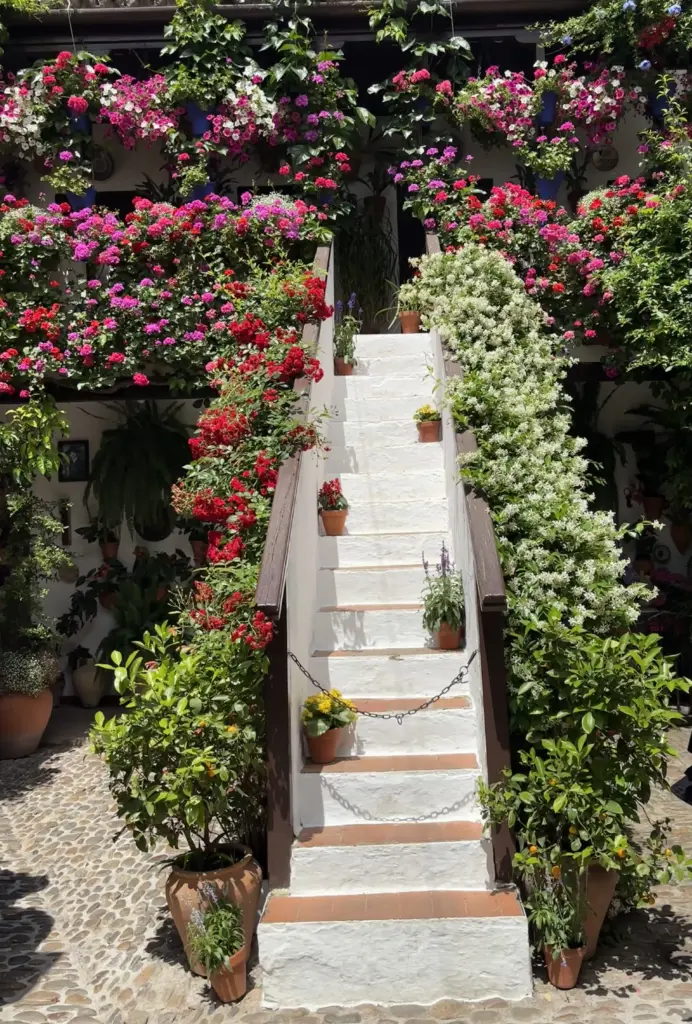
★San Basilio, 44 (Alcázar Viejo, Singular Patio)
You’ve surely seen a thousand photos of its central staircase covered in hanging flowers. It’s the festival’s most iconic image. -
★San Basilio, 40 (Alcázar Viejo, Historic Architecture)
A gorgeous patio. A little corner that feels straight out of a fairy tale, with a well and a washbasin that take you back in time.
Other patios with a special charm
- Calle San Basilio, 14: it can be visited almost all year round. The highlight of this patio is its authentic structure, with an original three-fire kitchen still preserved.
- Calle San Basilio, 17: very small but with incredible charm. Perfect for stopping and enjoying the details without too much crowd.
- Calle Postrera, 28: a narrow patio that bursts with color thanks to its blue flower pots. The owner is very friendly and always happy to chat. He told me a lot of interesting things about the patios.
- Palacio de Viana: even though it doesn’t take part in the competition, it’s a must-see if you don’t plan to return to Córdoba and visit it outside the Festival. Inside, you can explore 12 different patios and a garden, each with its own personality, and see the historical evolution of this architecture from the Middle Ages to the 20th century. The entrance is paid during the year, but usually free during the Festival, so it’s a great opportunity—perhaps during the siesta.
Málaga has its own version of patios too — they’re called corralones. If the patios of Córdoba have won you over, you should know that here you’ll find a more popular, more spontaneous — perhaps more human — version.
These are working-class housing complexes arranged around a large central courtyard shared by the residents, once equipped with a communal well.
Every year in May, the Semana Popular de los Corralones takes place: five days of courtyards open to the public for free, with music, local food, and a contest for the most beautiful patio.
If you’re planning a trip to Andalusia and Málaga is on your list, I explain it in more detail here Málaga: a delightful blend of culture, sunshine, and Mediterranean rhythm. It’s well worth an afternoon away from the usual tourist routes. 🌺
The winners of the Fiesta de los Patios 2026: who won over the jury this year
In mid-May 2026, as tradition dictates, the Ayuntamiento de Córdoba announced the winners of the Municipal Contest of Córdoban Patios 2026, putting the final word on weeks of queues, the scent of jasmine, and (good-natured) rivalry between neighbors. This year 53 patios were in the running, and here are the names that took first prize in each category:
- Ancient Architecture: Guzmanas, 7 (Route 2: San Lorenzo)
- Modern Architecture: Barrionuevo, 43 (Route 3: San Pedro – Santiago)
- Singular Patio: San Basilio, 44 (Route 5: San Basilio)
- Convent Patios: San Rafael, 7 (Route 2: San Lorenzo)
A curiosity that struck me: Guzmanas, 7 came in fifth place in the same category last year, and in 2026 it leapt all the way to the top — proof that behind every patio there’s ongoing work, year after year, not just a stroke of luck. The patio also won the Singular Plant award, thanks to a bougainvillea the jury described as a true manifesto of the “quiet living heritage” tended by Córdoban owners.
And if you’ve already fallen for San Basilio, 44 — the one with the flower-covered staircase you’ve probably already seen in a thousand photos, and which I flagged earlier as one of the must-see patios — know that in 2026 it was officially confirmed as the year’s most beautiful Singular Patio. It’s no coincidence it’s become the festival’s signature image.
Two prizes worth noting went unawarded: the Honorable Mention, worth 4,000 euros, wasn’t given out, while the Best Young Patio award was left without a winner because the minimum of three participating patios required by the rules wasn’t reached. For the young patio award, this is the second year running — a small warning sign about generational turnover among the patios’ caretakers.
If you’re planning your patio tour for the next edition of the festival, it may help to check the full list of all 2026 award winners. You’ll find it on the official website of the Asociación Amigos de los Patios Cordobeses, or directly on the Córdoba tourism portal.
The patios throughout the year
During the Festival, access is free, and as we mentioned, there are significant queues, especially on weekends. If you want to avoid the chaos of May, there are many alternatives to enjoy the patios at any time of the year.
In general, outside the festival, access is paid or requires a reservation, with visiting hours usually concentrated between late morning and late afternoon, and it’s essential to check online before going.
Throughout the rest of the year, you can visit:
- patios open for organized visits (e.g. “Ruta de Patios Córdoba”, with 4 competition patios accessible with a ticket),
- patios that can be visited through guided tours run by local agencies (Córdoba a Pie and similar services manage bookings).
If you go in the low season (autumn or a sunny winter) and book a ruta de patios, you’ll almost have them to yourself, with the chance to talk to the people who live there without the pressure of a queue behind you. That’s how I ended up alone with the owner of a patio, having a spontaneous chat and discovering so much more about this tradition.
The only downside, apart from the cost (which is still very affordable), is that the flowers are not at their peak, given the time of year. My honest advice is to plan your visit just after the festival, so you can enjoy the beauty and colors of the patios without the crowds.
I personally visited the patios out of season with GetYourGuide, and I had a great experience: knowledgeable guide, small group, no queues. If you’d rather not organise it yourself, it’s a convenient option I’m happy to vouch for.
That said, below you’ll also find other options to consider, so you can pick the one that suits you best — though you can also find the most up-to-date information on the Córdoba Tourist Office website.
| Option | Where | When | Price | Notes |
|---|---|---|---|---|
| Ruta de Patios | Several houses on Calle San Basilio: no. 14, 17, 20, 40, 44 | From mid-February to July, and from mid-September to December. Closed in July and August due to the heat. | Around €6.50, usually including 4 or more patios. | The best alternative to the competition. You can buy the ticket directly at the patios or at the tourist offices. Hours are more limited, so check in advance. |
| Privately Managed Patios | Calle Martín de Roa, 7 and 9 | All of May and June, September weekends, and public holidays the rest of the year. | Free donation or a small ticket, depending on the patio. | Two neighbouring patios that open in coordination with each other. Worth checking before you go. |
| Palacio de Viana | Plaza de Don Gome, 2 | Year-round (with summer and winter hours). | Around €8.50 for the patios only. | The most convenient and spectacular option. The patios are always kept in perfect condition. |
| Patio Interpretation Centre | Calle Trueque, 4 (San Lorenzo) | Hours vary. At the moment it isn’t open continuously. | To be confirmed. | An interpretation centre to help you understand the festival. Check the Town Hall’s website before going. I’ve personally never managed to find it open. |
Additionally, there are associations that offer free city tours which also include directions to the main patios (entrance is not included and must be paid on-site). One of my favorites is Córdoba a Pie. The guides are very knowledgeable and really friendly!
Visiting the Patios of Córdoba means spending most of the day on foot, moving between different neighbourhoods, cobbled streets and private homes where the spaces can sometimes be quite narrow. For this reason, when packing your suitcase, it is better to think more about comfort and practicality than quantity.
The sun is one of the main features of spring in Córdoba. A hat, sunglasses and a good sunscreen are therefore essential: although the patios are often cool and shaded, the walks between one route and another and any queues usually take place outdoors. I always carry this sunscreen with me. It is small, but very effective.
You will walk a lot, often along stone streets, uneven surfaces and narrow lanes where it is not always easy to find somewhere to sit. A pair of comfortable shoes that you have already worn before the trip is therefore essential. I would especially avoid travelling with brand-new shoes: walking from one patio to another usually means covering many more kilometres than the map suggests.
A reusable water bottle is a great ally, as temperatures can already be quite high during the Fiesta and shade is not always guaranteed along the routes. I bought a collapsible silicone one from Natura, although it is often unavailable. Alternatively, here you can find a similar one that takes up very little space once empty.
Bring a light bag or a small backpack as well. The patios are private homes and, in some cases, the passageways can be narrow and crowded. A large bag can become inconvenient and may also accidentally knock into pots, plants or other visitors. Many years ago, I was given a Mandarina Duck backpack that was quite small but surprisingly roomy. It is no longer available, but here I found a similar one.
Even though the days can be very warm, it is still worth carrying a light sweatshirt. Some patios feel noticeably cooler than the streets exposed to the sun and, if you stay out until the evening opening period, the air may become fresher after sunset.
Finally, small items such as a power bank may seem like minor details, but they make the day much easier, especially if you use the official map on your phone, check the routes and photograph every patio. I was given this one and I am very happy with it. Naturally, there are many different models available, but whichever one you choose, I strongly recommend bringing one.
As you’ll discover, the patios of Córdoba are not just courtyards filled with red geraniums or perfectly aligned blue pots.
They are shared lives. They are people who, for two weeks a year, choose to turn their home into a collective space.
You can go for the photos — and you’ll take a lot of them.
You can go to say “I’ve seen them too.”
But if you really stop, if you wait for the queue to fade, if you look around… you’ll realize you’re not visiting a tourist attraction, you’re inside a real life.
A patio is not designed to impress tourists. It’s designed to protect from the heat. To create community. To remind us that beauty can be everyday, not necessarily extraordinary.
And that’s exactly why UNESCO recognized them as intangible heritage: not for the flowers, but for the culture they preserve.
Because in the patios of Córdoba, you don’t enter to look. You enter to understand.
And maybe, without even realizing it, you’ll leave with a deeper and more meaningful idea of what “home” really is.
If after Córdoba you want to continue your journey through Andalusia, you can take a look at the Andalusia page, where I’ve collected cities (like Granada and Málaga, both very easy to reach from Córdoba), itineraries, and practical tips.