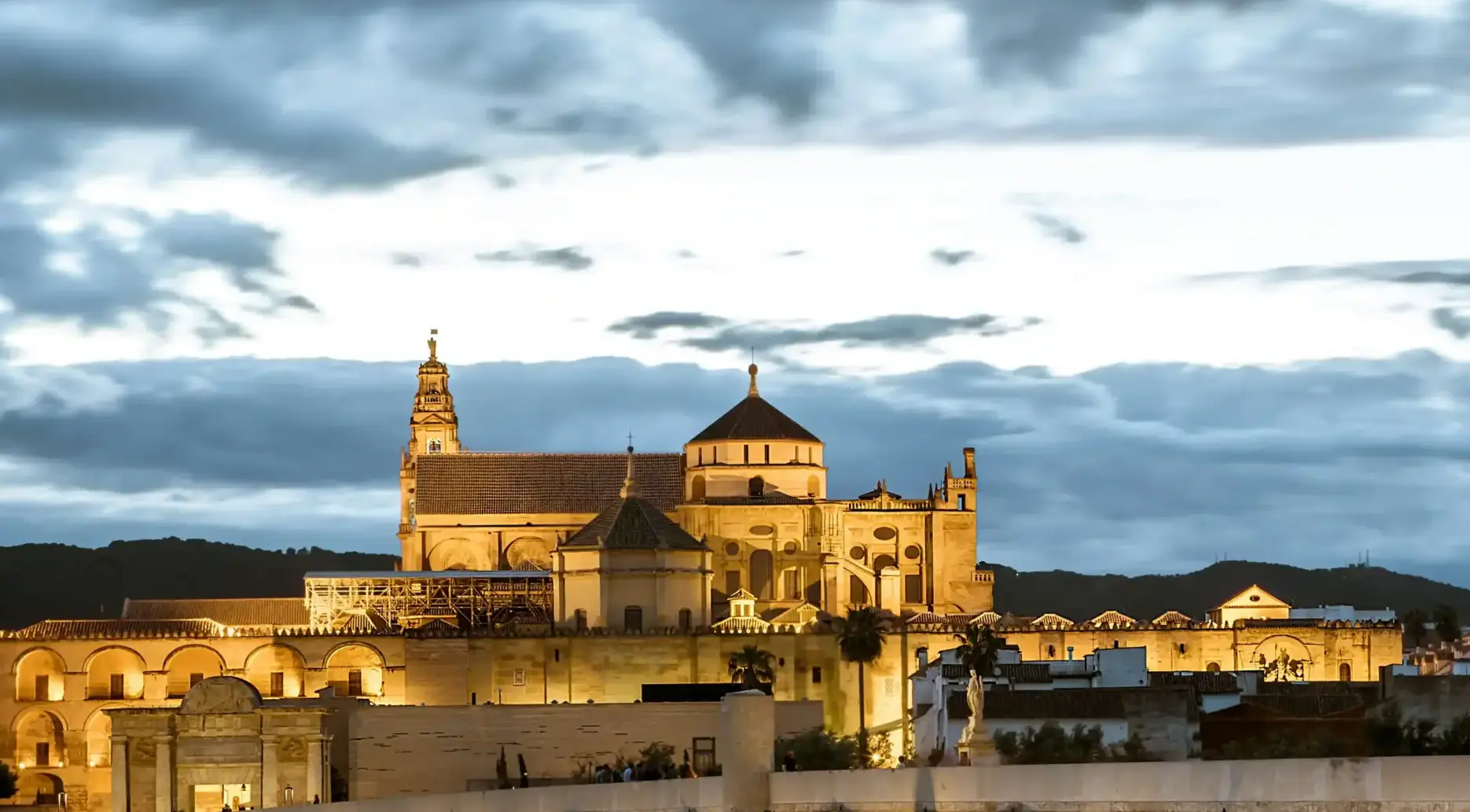
The Mezquita-Cathedral of Córdoba: much more than a cathedral, much more than a mosque
If there is one place that, by itself, explains Córdoba, it is this one.
The Mezquita-Cathedral is one of the most extraordinary monuments ever built by human beings — and that is not an exaggeration. Almost everyone reacts the same way when they enter: an involuntary silence, as if the mind cannot find the words to express its amazement.
You could spend hours here without even noticing. Hours getting lost in the forest of columns that seems to stretch on forever, following the light as it filters through, shifts, and creates different shadows around every corner. Hours feeling small — in the best possible way, the kind that makes you feel good — inside a space that radiates spirituality from every stone. And then even more hours wondering how something like this can truly exist, and how you can actually be standing inside it.
Nothing you read, and no photograph, no matter how beautiful, can prepare you for what it feels like when you cross that threshold.
Once, this was a pilgrimage destination for millions of Muslim worshippers across Europe. Today, it is something far more difficult to define — it is not just a mosque, it is not just a cathedral, and it is not just a museum. It is a place where time seems to behave differently, where silence has weight, and where even the most distracted visitors find themselves lowering their voices almost without realizing it.
Let us try to guide you, at least a little, through this magical place and help prepare you for its wonder.
Here are some practical tips to help you make the most of the Mosque-Cathedral. They are simple, but they can save you time, money and a certain amount of frustration. Remember that:
- Admission to the Mosque-Cathedral of Córdoba generally costs around €15 and can be purchased on the official website.
- It is worth purchasing your ticket online so that you can choose the time that best suits your plans and reduce the amount of time spent queuing.
- The Mosque-Cathedral is normally open every day from 10:00 am to 6:00 pm, but opening times may change because of religious services or special events. Always check the official website before your visit.
- During certain morning hours — usually between 8:00 am and 9:00 am — admission may be free.
-
Several types of ticket are available:
- standard admission;
- visit with an audio guide;
- guided visit;
- admission including access to the tower;
- the “The Soul of Córdoba” night visit.
- If you would prefer to book a guided visit without arranging everything yourself, you can check the available options on GetYourGuide or Civitatis. Before booking, always check what is included in the price, particularly admission to the Mosque-Cathedral, the guide and any access to the Bell Tower.
- Some tickets also include admission to the Fernandine churches located throughout the city.
- Climbing the Bell Tower — which incorporates the former Islamic minaret — requires a separate ticket costing approximately €4, in addition to admission to the Mosque-Cathedral. A visit to the tower normally takes around 20–30 minutes, including the climb, time at the panoramic viewpoint and the descent. Visitors enter the tower in small groups, and access generally follows the same opening hours as the Mosque-Cathedral. Important: the tower is not accessible to people with reduced mobility, as there are approximately 203 steps and no lift.
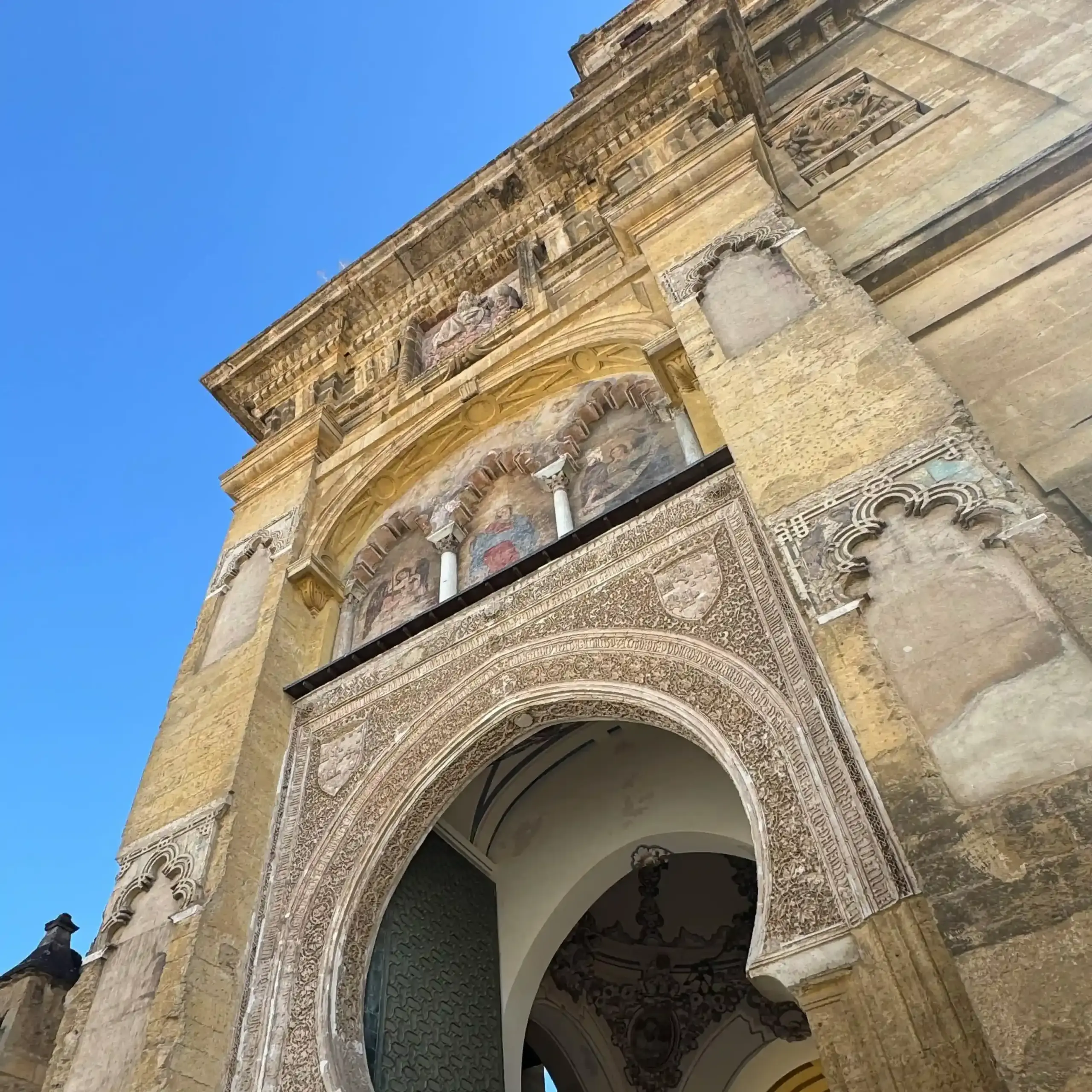
The Puerta del Perdón
The Mezquita can be entered through several different gates, but my advice is to go in through the Puerta del Perdón, the original entrance from the Caliphal period, located beneath the ancient minaret.
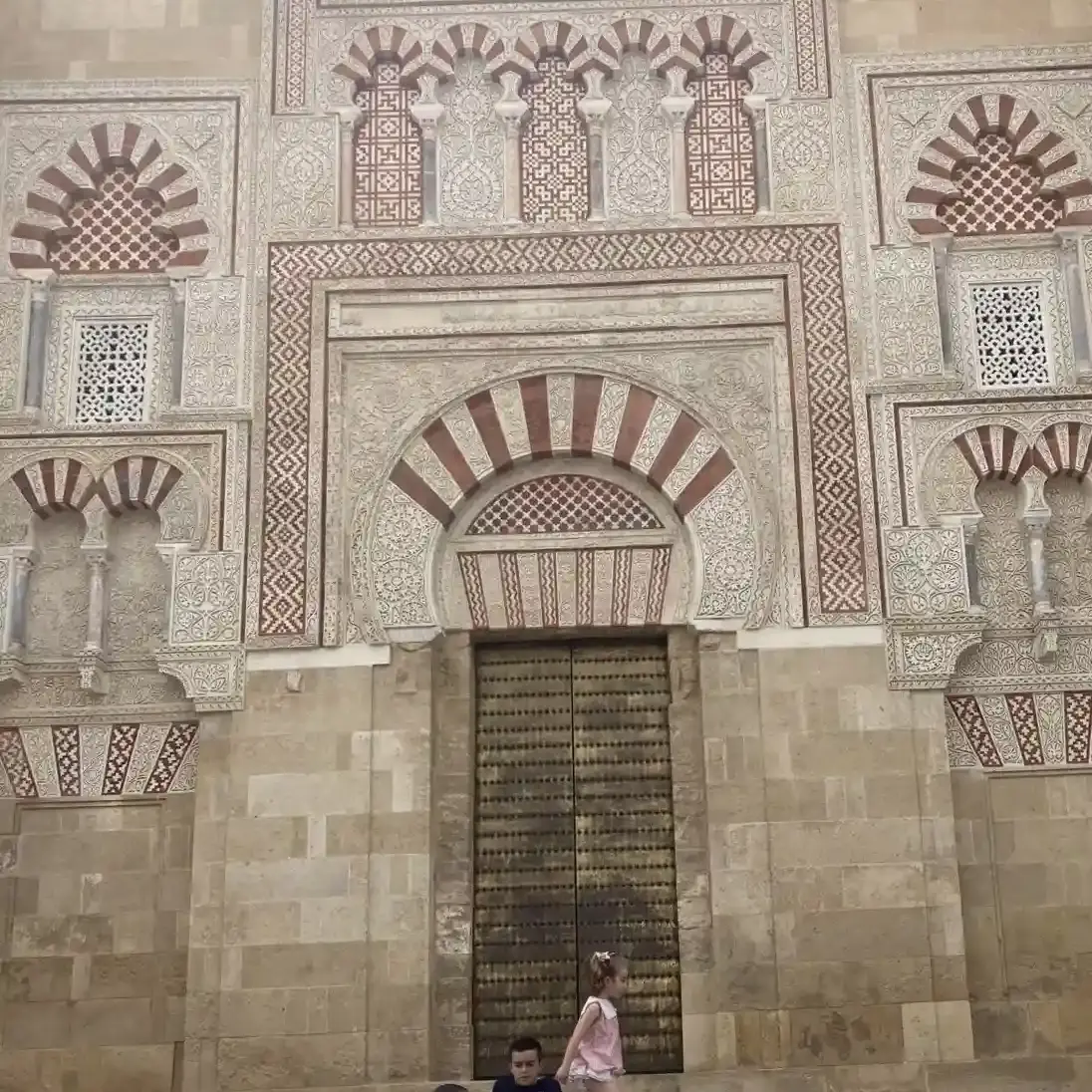
The façade features a large horseshoe arch decorated with stucco. Above it are three small blind arches containing religious imagery, while higher up you can see additional Baroque elements and the bishop’s coat of arms.
Inside, there is a small vestibule leading to the courtyard, covered by a vault decorated with yeserías (ornamental plasterwork).
The two monumental bronze doors, standing 10 metres high and made of pine wood clad in bronze sheets, are a perfect example of Moorish craftsmanship. Today, they are used for the ceremonial entrances to the Mezquita-Cathedral, especially during Holy Week.
The name is no coincidence. The Puerta del Perdón (“Gate of Forgiveness”) owes its name to a real historical practice: in front of this gate, the cathedral chapter publicly granted certain forms of absolution or dispensations on special occasions. Over time, a more popular legend emerged alongside the official story — that anyone who passes through it several times will be forgiven for their sins. Does it actually work? That remains unclear. My advice is simple: walk through it anyway. It costs nothing, connects you to a centuries-old tradition, and allows you to admire one of the most beautiful entrances of the monument up close. As for how many times you should cross it, I’ll leave that decision to you — depending on the number of your sins 😉!
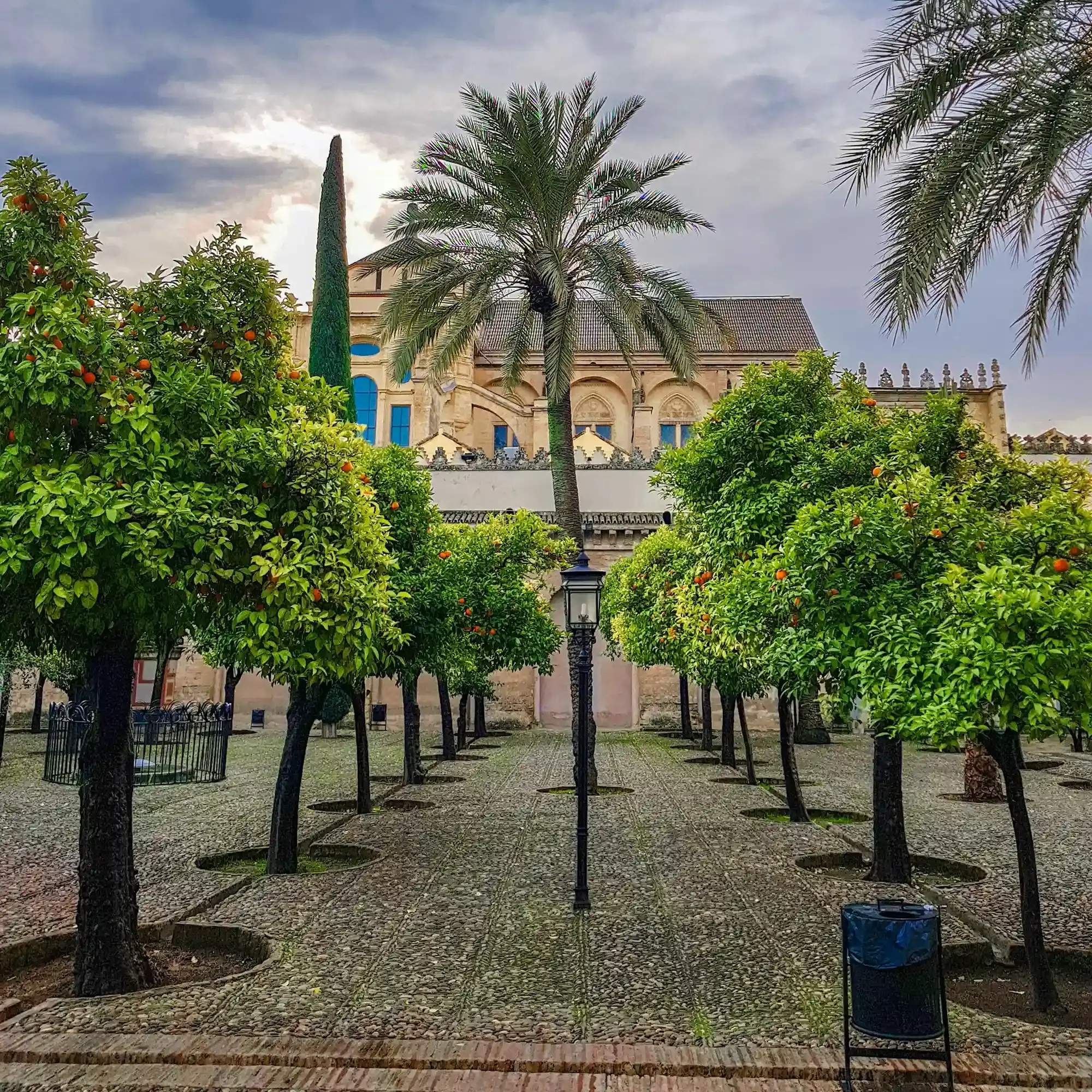
Patio de los Naranjos
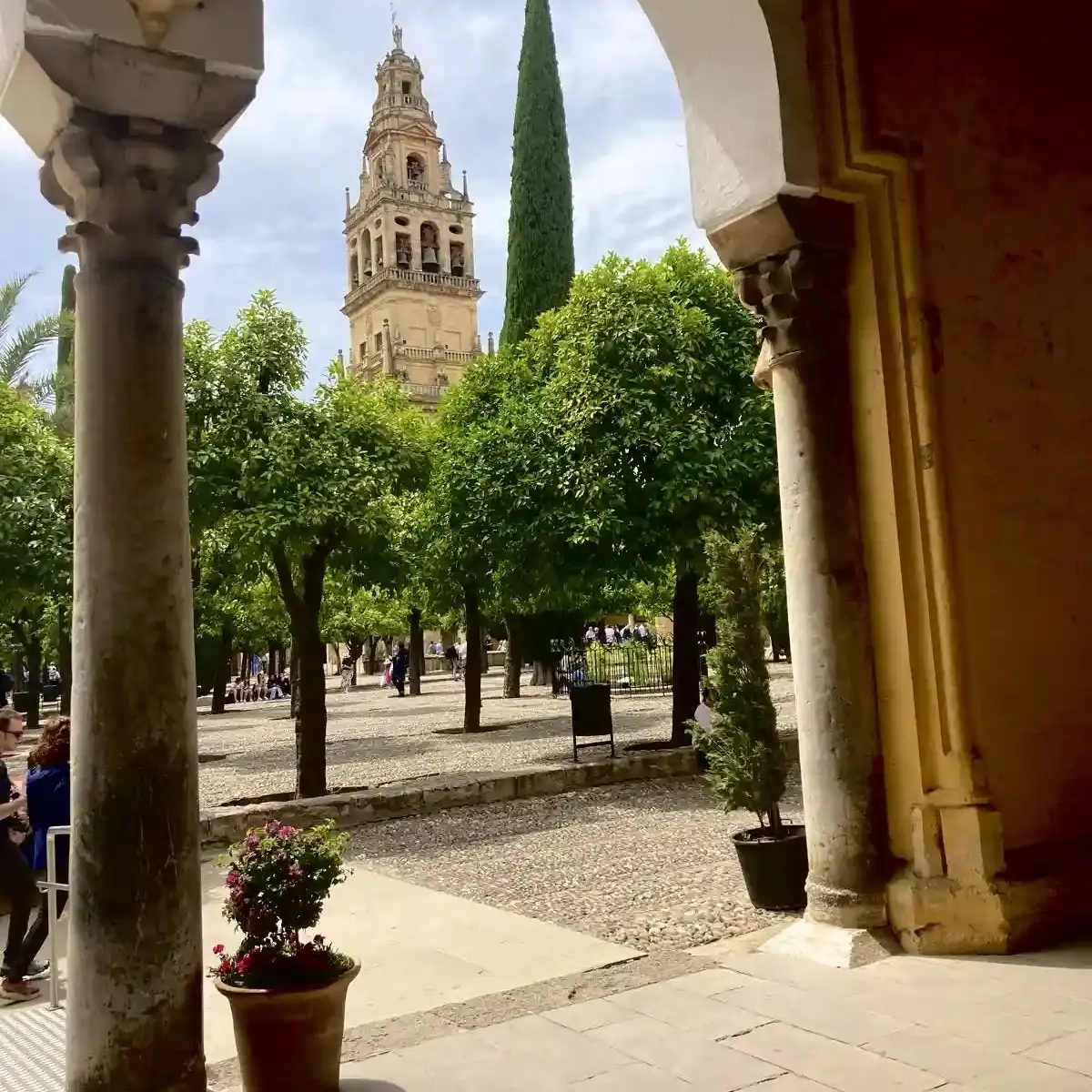
Once you pass through the gate, the first space you encounter is the Patio de los Naranjos. Since the Caliphal period, it served as the area dedicated to ritual ablutions before prayer. It was connected to the city’s water system: water arrived through cisterns and channels to the central fountain, where worshippers purified themselves. The water was also used to irrigate the garden, a place where people gathered to discuss art, literature, and culture. It was also where justice was administered, with trials and sentences taking place here.
What you see today is not the original courtyard. The current patio was built in the 17th century over the former ablution area. Originally, it contained fountains, aromatic plants, and olive trees — an architectural interpretation of the Qur’anic description of paradise. The mosque opened directly onto the courtyard, creating a seamless connection between the interior and the exterior. The fragrant plants blended visually with the forest of columns inside. In fact, the Mudéjar portico that now runs along the walls was added later during the Christian renovations.
It was also during this period that the 96 orange trees were planted, carefully aligned with the rows of interior columns so that the trees in the courtyard appear to continue into the mosque’s stone forest. A deliberate and highly effective visual effect.
The channels that can still be seen today were created by imitating those that existed during the period of al-Andalus. Originally they irrigated olive trees and aromatic herbs, while in the Christian era they were adapted to nourish the orange trees that provided fragrance and shade throughout the courtyard.
The patio is considered the oldest living garden in Europe thanks to the palm tree growing within it. It was brought here directly from Damascus by Muslim rulers and dates back to the 13th century.
Beneath the Patio de los Naranjos, at a depth of around 10 metres, lies a large cistern built around the year 1000, during the final major expansion of the mosque. It was designed to collect rainwater from the Mezquita’s gutters and redistribute it to the gardens, the Arab baths, and the entire religious complex.
Even today, it is possible to spot the small access point used for maintaining the cistern in the courtyard pavement — a detail that almost every visitor walks past without noticing.
The interior
But it is inside that everything changes, and where you truly begin to understand the wonder of this place.
The site originally housed a Roman building, upon which the Visigothic Basilica of Saint Vincent was later constructed, the city’s main Christian place of worship. Its remains can still be seen in the first section of the Mezquita, beneath a glass floor.
When the Muslims arrived, the two faiths initially shared the same building, separated by a wall. Later, as the Arab population grew, Abd al-Rahman I decided to purchase the entire structure, demolish it, and build the great mosque in its place.
Construction began in 785, and the first version was completed the following year.
Over the following centuries, the Umayyad caliphs expanded the complex several times, culminating in 987 under Al-Hakam II. The final result? The second-largest mosque in the world after Mecca, covering more than 23,000 square metres and capable of accommodating 20,000 worshippers.
Inside were kept an original copy of the Qur’an and a relic of the Prophet Muhammad, turning the mosque into a pilgrimage destination for Muslims from across Spain.
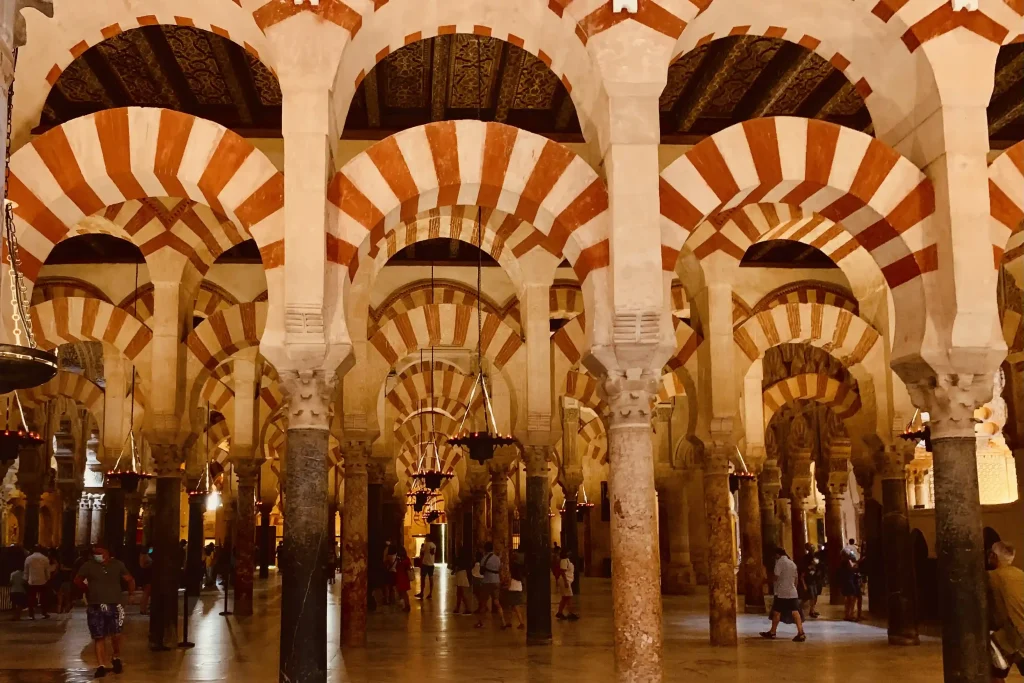
The original structure — the one you encounter immediately after entering — consisted of eleven aisles opening onto the Patio de los Naranjos, supported by columns reused from Roman and Visigothic buildings. Its most distinctive feature is the system of double horseshoe arches, alternating red and white limestone and brick. Repeating endlessly among the columns, they create the impression of a vast stone forest.
Islamic builders drew inspiration from Roman aqueducts for the superimposed arches, from Egyptian traditions for the hypostyle hall, from the Visigoths for the horseshoe arch, and from the Byzantines for the mosaics. The result is something eclectic yet perfectly coherent, belonging to no single style while embracing them all.
With Abd al-Rahman III (951) came a new 40-metre-high minaret — later incorporated into the present-day bell tower — along with another expansion to the south.
Under Al-Hakam II (962–966), the Mihrab — where the sultan and his court prayed — and the Maqsura, separated from the rest of the mosque by screens to ensure privacy and protection, were created. The Mihrab of Córdoba is an absolute masterpiece: decorated with golden mosaics and Qur’anic inscriptions, crowned by an exquisitely crafted horseshoe arch, it is the most sacred and arguably the most beautiful part of the entire building. Around 1,600 kilograms of golden glass tesserae were brought here to decorate the small chamber with magnificent Byzantine mosaics, a task that required master craftsmen sent directly from Byzantium.
With Almanzor (987–994) came the final major expansion to the east: eight new aisles, a total of 856 columns, and 23,400 square metres of floor space.
This forest of identical, perfectly aligned columns is not merely an aesthetic choice. It is theology expressed through architecture: the idea that all people are equal before God and that creation follows a precise order designed by God Himself.
On the southern wall of the prayer hall, you can still see the point where the sabat emerged — the private passage that connected the mosque to the Alcázar (more on that later).
Normally, in Islamic mosques, the prayer hall is oriented towards Mecca. The mihrab of the Mezquita of Córdoba, however, points almost perfectly south, following the same orientation as the Great Mosque of Damascus.
According to one of the most fascinating traditions associated with the Mezquita, it was Abd al-Rahman I himself who personally chose this direction as a symbolic tribute to his hometown in Syria, from which he had been forced to flee before founding the Emirate of Córdoba.
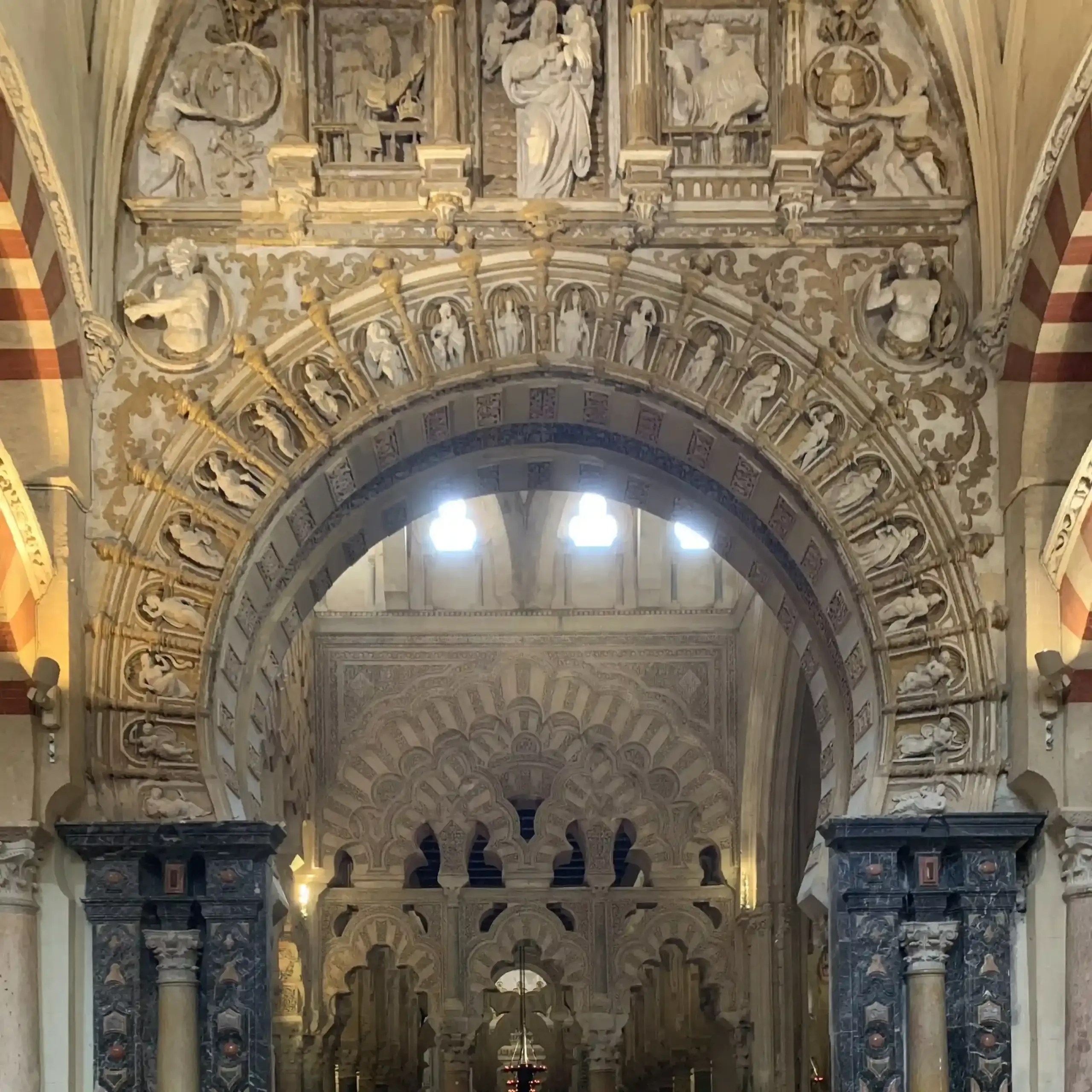
In 1236, after the Reconquista, the mosque was consecrated as a Christian cathedral. Of its original 18 gates, only those opening onto the Patio de los Naranjos remain in use today. Over the following centuries, side chapels were added and, in 1523, Charles V authorized the construction of a Christian nave in the very heart of the building.
The work, entrusted to the Hernán Ruiz family of architects, continued until 1599 and required the demolition of part of the forest of columns in order to insert a Latin-cross structure with an oval dome, combining Plateresque, Gothic, and Baroque styles.
The Renaissance cathedral at the centre consists of a dome surrounding a golden Renaissance choir, featuring mahogany choir stalls brought from the Americas and several chapels (including the Royal Chapel and the Cardinal’s Chapel), built not at ground level but superimposed upon the original mosque.
When Charles V saw the finished result, legend has it that he remarked: “You have destroyed something unique in the world to build something that can be found everywhere.” And he was absolutely right.
The bell tower
The bell tower you see today is the result of nearly a thousand years of layered transformations.
It all began in the 10th century, when Abd al-Rahman III — the first ruler to proclaim himself Caliph of Córdoba — decided to equip the Great Mosque with a 40-metre-high minaret. It was not merely a practical structure: it was a symbol of the presence and power of Islam in the heart of al-Andalus.
That minaret is considered the first to embody the forms and aesthetics we now associate with a classical minaret, and it became a model for many later Islamic constructions across Spain and North Africa, including those of Seville and Marrakech.
With the Christian conquest of Córdoba in 1236, the mosque was consecrated as a cathedral. The Christian community did not demolish the minaret but instead converted it into a bell tower, simply adding a small structure at the top to house the first bells.
In 1589, a severe storm — or perhaps an earthquake, as sources disagree — seriously damaged the structure. It was then decided to undertake a major renovation in keeping with the Renaissance style that dominated the period. Rather than demolishing the old minaret, however, it was “encased” within a new Renaissance tower: a modern outer shell protecting and preserving a 10th-century Islamic core.
Climbing its 194 steps (some sources say 203) is no ordinary ascent. The route follows the original structure of the minaret rather than the spiral staircases we are used to today, because it was designed to allow the muezzin to ride a horse to the top (although in Córdoba the ascent was always made on foot) to call the faithful to prayer. Along the way, Mudéjar details and small windows offer increasingly expansive views over the city.
At the top, 54 metres above the ground, the reward is spectacular: the largest historic centre designated a UNESCO World Heritage Site, the Alcázar, the perfect symmetry of the Patio de los Naranjos, and the surrounding Sierra, which once protected the city on one side while supplying it with everything it needed on the other.
The bell tower of the Mezquita-Cathedral — and, in a way, the entire city of Córdoba — is closely linked to the Archangel Raphael, considered the city’s eternal guardian. Notice the distinction: guardian, not patron saint. For the people of Córdoba, Saint Raphael is not simply a religious figure; he is a familiar, protective presence, almost part of everyday life.
To understand the origins of this deep devotion, we must go back to 1278, during a terrible plague epidemic that was devastating Córdoba. According to tradition, Bishop Don Pascual received a message from the Archangel through an apparition witnessed by a Mercedarian friar, Fray Simón de Sousa:
“Tell Bishop Don Pascual to place my image at the top of the Cathedral tower and to ensure that all his faithful devotees honour me and celebrate my feast every year. If this is done, this punishment shall cease.”
The bishop obeyed, the image was placed on the bell tower, and the plague, according to legend, began to recede.
However, it was the events of 1578 that truly transformed Saint Raphael into the great protector of the city. During another plague outbreak, a priest named Andrés de las Roelas began experiencing visions of the Archangel. At first, he ignored them, doubting their authenticity. But during the fifth apparition, Saint Raphael pronounced the words that can still be read today on many of his monuments throughout Córdoba:
“I swear to you by Christ Crucified that I am Raphael, the Angel whom God has appointed to guard this city.”
Once again, according to tradition, the plague began to subside. From that moment on, Córdoba filled with triunfos, votive monuments dedicated to the Archangel. At least a dozen can still be found throughout the city, each with its own story.
The oldest stands on the Guadalquivir Bridge, positioned almost as a sign of welcome and protection for those arriving in the city. The most famous, however, is the Triunfo de San Rafael at Puerta del Puente, located directly opposite the Mezquita. If you look closely at its base, you will notice an eagle holding a scroll bearing the text of Saint Raphael’s oath. Nearby is also the tombstone of Bishop Pascual, the central figure in the miracle of 1278, discovered by chance during excavations for the monument in an area that once formed part of an old hospital cemetery.
There is also a curious story connected to the year 1860. A cholera epidemic broke out in Seville, and rumours spread that some Sevillians planned to steal the statue of Saint Raphael under cover of darkness, hoping the Archangel would protect their city as well. When the news reached Córdoba, the faithful wasted no time: every night, men armed with heavy sticks stood guard around the statue, ready to prevent the theft by force if necessary. Whether the plot was real or merely a popular rumour remains unknown. What is certain is that the statue never left its beloved Córdoba.
Devotion to Saint Raphael is so deeply rooted that, although the Catholic Church officially celebrates all the Archangels on 29 September, Córdoba has retained the privilege of honouring its protector on 24 October, following an ancient tradition that the people of Córdoba have never truly abandoned.
Yet the Archangel’s presence is not felt only through processions and monuments. It also appears in the smallest details of daily life: Rafael remains one of the most common male names in Córdoba, just as Rafaela is among women. Even the virtual guide on the city’s tourism website is called… Rafael. A small detail that perfectly illustrates how deeply the Archangel remains woven into Córdoba’s identity today.
The outer walls and the Sābāt
Before or after visiting the Mezquita, it is well worth walking around its outer walls. The original Caliphal decorations and gateways are extraordinary, and few people realise that each gate has its own name, marked on the paving stones below.
The Mezquita-Cathedral of Córdoba has more than a dozen gates, but let me tell you about my favourites.
Puerta del Postigo de la Leche: its name comes from the milk and dairy market that once developed in this area. It is considered a service entrance connected to everyday medieval life around the Mezquita rather than a monumental gateway. I particularly like it because a popular legend claims that mothers who were unable to breastfeed could come here to receive help in feeding their children.
Puerta de las Palmas (Bab al-Sadr): located near the right-hand corner of the Puerta del Perdón, it is one of the few gates that still preserves many original Umayyad elements from the 10th century. This was the gate through which the caliph entered the mosque, connected to the ancient sābāt — the elevated passage linking the Alcázar and the Mezquita. The name “Palmas” refers to palm motifs carved into the decoration or symbolically associated with power and victory. The lintel bears an epigraphic dedication to Emir ʿAbd al-Raḥmān II, one of the earliest rulers to expand the mosque.
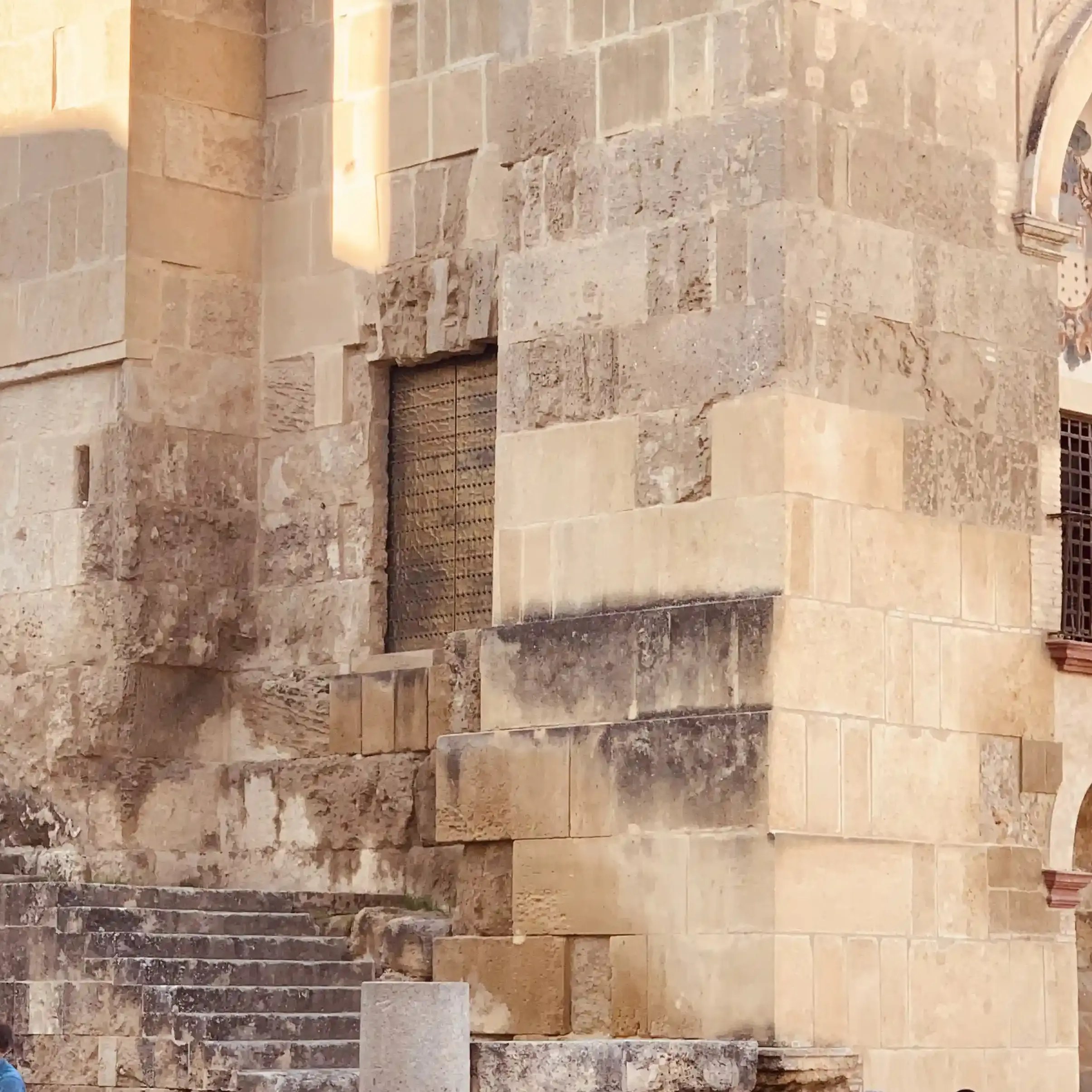
Puerta del Sābāt: on Calle Torrijos, at the corner facing the river, look for a wooden door covered with almost golden decorative elements, located about three or four metres above ground level, almost directly above the stairs. Very few people notice it, but it is an absolutely fascinating detail. On the pavement below, square golden markers trace a route towards the Alcázar. They are not decorative features: they mark the route of the ancient Sābāt, the elevated passageway built in the 10th century to connect the Caliph’s Palace (the Alcázar) with the Mezquita.
It consisted of a covered corridor that allowed the caliph to travel from the palace to the mosque without ever stepping onto a public street, supported by arches high enough to allow carts, horses, and pedestrians to pass underneath. Once through the golden doorway, the route continued behind the mosque wall all the way to the Maqsura, the area reserved for the ruler. Arabic sources describe eight internal gates that could be opened or closed alternately to control movement and ensure security.
The passageway was demolished in 1610 during renovation works at the Episcopal Palace. All that remains today are a few vaulted rooms, now used as the cathedral archive, and the small niche-like doorway in the western wall, known precisely as the Puerta del Sābāt.
Right next to the Puerta del Sābāt there is a detail that almost nobody notices: embedded in the stone wall is a small star. It was not carved by any artist. In reality, it is a fossil — the cross-section of a crinoid, a prehistoric marine animal that became fossilised in the stone millions of years ago. Its perfectly symmetrical shape resembles a tiny star.
Popular tradition says that the Caliph deliberately placed it there as a protective talisman above the gate connecting his palace to the mosque, and that anyone who touched it would receive the protection of Allah.
This legend, known as that of the Estrella de los Deseos — the Star of Wishes — is so deeply rooted that even today attentive locals and visitors stop, touch it, and make a wish.
The truth may be simpler, yet just as fascinating. If you look closely at the outer walls of the Mezquita of Córdoba, you will notice that some of the limestone blocks contain fossilised shells, sea urchins, and other marine organisms. The Sierra Morena, from which part of the building stone was sourced, lay beneath the sea in prehistoric times and was formed in part by sediments left behind as the waters receded.
The Mezquita was one of the great intellectual centres of Córdoba’s Golden Age: philosophers, astronomers, physicians, and jurists, both Christian and Muslim, gathered here. What remains today — the seemingly impossible coexistence of the forest of columns and the cathedral rising from its centre — is perhaps the place in the world where the history of religions becomes most tangible, most contradictory, and most wonderfully fascinating.
Since the Mezquita is still an active place of worship today, respectful clothing is required for entry. It is best to avoid very short shorts and to keep your shoulders covered.
In summer, a simple scarf or shawl to place over your shoulders, or a lightweight top with sleeves, will be enough. In spring and autumn, however, you may notice that while the temperature outside is pleasant, the interior feels much cooler. Bring along a sweatshirt or a light jumper. You never know.
As always, wearing comfortable shoes is important, especially if you plan to climb the bell tower. Those 194 steps won’t climb themselves!
Small items such as a power bank may seem like minor details, but they can make your visit much easier, especially if you want to photograph every beautiful corner of the monument. I was given this one and I absolutely love it. There are, of course, thousands of different models available. Whatever model you choose, I highly recommend bringing one.
But the Mezquita, extraordinary as it is, is only the beginning.
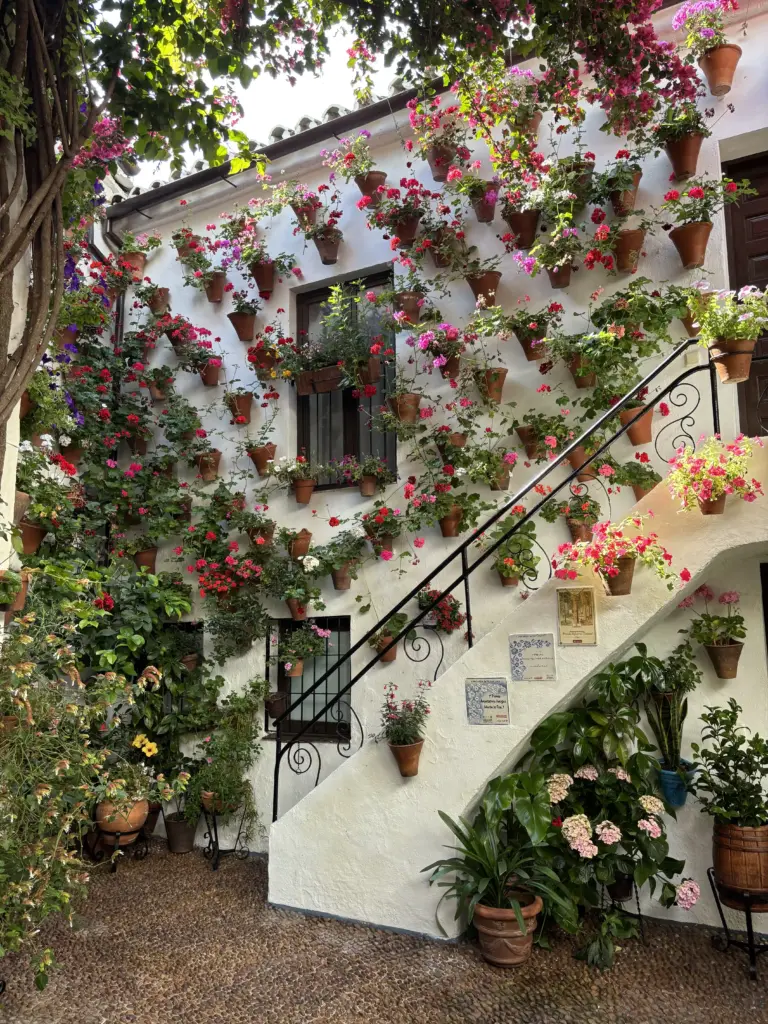
Córdoba is the only city in the world with four UNESCO recognitions: the Mezquita-Cathedral, the historic Judería, Medina Azahara, and the Fiesta de los Patios — a celebration that perhaps more than any other captures the true soul of the city, far removed from caliphal courts and power struggles, and rooted instead in flower-filled courtyards, family life, and everyday beauty.
Four recognitions. One city.
If that is not enough to spark your curiosity, and you want to discover the rest — the hidden stories, the lesser-known neighbourhoods, and the best places to eat and drink — take a look at the section dedicated to Córdoba on ViaggiInChiaro. There is so much more to tell, and we have left nothing out.