Córdoba: the deepest city in Andalusia, between the Mezquita, the patios, and the memory of al-Andalus
The first time I visited Córdoba was almost by chance — a stop during a road trip to Portugal. It wasn’t a planned destination, but I had been so captivated by the way Ildefonso Falcones describes it in The Hand of Fatima — one of my favorite books — that finding myself just a few kilometers away without stopping would have been unforgivable.
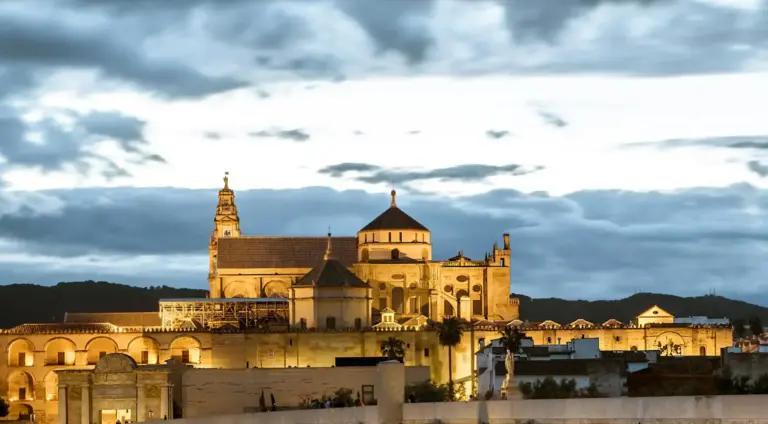
While reading, Córdoba was never just a city. It was a living memory: narrow streets that offered protection from the sun and prying eyes, simple walls concealing courtyards filled with water, shade, and silence. And the Mezquita, always there, dominating everything like a memory impossible to erase — even for those who might have wanted to.
I had imagined that walking through Córdoba would mean something more than simply visiting a city. It would mean breathing living history. And I was not wrong.
Córdoba is not a backdrop for a tourist stroll. It is a profound city, with a past that still beats beneath the surface, a powerful culture, and a beauty that is both delicate and extraordinary. A city that experienced the height of splendor and a gradual, relentless decline. A city that was home to three cultures in apparent coexistence. A city that left the world some of the most incredible monuments ever built.
In this guide, I will tell you everything: the history, the most beautiful corners, the best-kept secrets, and practical advice to truly experience it — not just visit it.
Being here, even for just one day, is a privilege that is not easily forgotten.
Here are some practical tips for organising your visit to Córdoba: how to get there, where to park, how to get around, how to plan your visit and when to go. A few useful things to know when choosing your transport, visiting the main monuments and organising your days around opening hours, meals and the intense summer heat.
Show all tips ↓ Hide tips ↑
How to get to Córdoba
- By plane: Córdoba has a small airport, but it is not served by regular commercial flights. The easiest solution is therefore to fly into Seville Airport, around 130 kilometres away, or Málaga-Costa del Sol Airport, which is approximately 160 kilometres from Córdoba. To find flights and compare prices across different dates, I use Google Flights. Both are good options, as you can easily continue from either Seville or Málaga to Córdoba by train or bus. Further down, you will find all the information about the companies to check and the departure stations.
- By train: in my opinion, this is the easiest way to reach Córdoba from the rest of Spain. The main railway station, officially called Córdoba – Julio Anguita, is located in the modern part of the city, around a 20-minute walk from the historic centre. High-speed trains connect it mainly with Madrid, Seville and Málaga, although there are also connections with other Spanish cities, either direct or requiring a change depending on the route and timetable. You can check timetables and purchase tickets on the official Renfe website, the official iryo website or the official OUIGO website. To compare all the available train options, I actually always use Trainline and TrainPal, so you can see several companies and timetables in a single search.
- By bus: the bus station is located directly opposite the railway station, making it very easy to switch from one form of transport to the other. Córdoba is connected by bus with many cities in Andalusia and the rest of Spain, although journey times and frequencies vary considerably depending on the destination. To check the available routes, you can consult ALSA for cities in Andalusia and Socibus for the rest of Spain. Before purchasing your ticket, always make sure that the stop shown is the Estación de Autobuses de Córdoba.
- By car: Córdoba is easy to reach thanks to the main roads and motorways leading into the city. The real problem begins once you arrive: the historic centre consists of narrow streets, pedestrian areas and restricted-access zones, so driving into it can be inconvenient. Finding free parking near the centre is not impossible, but it requires a little luck. You can try the area around Avenida de la Libertad, north of the centre, or the other side of the Guadalquivir, near the Torre de la Calahorra. The best spaces tend to fill up quite early. Alternatively, the official Córdoba tourism website provides a list of the available public and private car parks. My advice is to leave your car outside the historic centre and continue on foot.
How to get around Córdoba
- On foot: Córdoba is a perfect city to explore on foot. The Mezquita, the Jewish Quarter, the Alcázar de los Reyes Cristianos, the Roman Bridge and most of the main monuments are located within a short distance of one another. The streets of the historic centre are often uneven, cobbled and narrow, so I recommend wearing comfortable shoes, especially if you plan to spend the whole day walking.
- By city bus: Córdoba’s buses are operated by AUCORSA and can be useful for reaching the railway station, the outer neighbourhoods or returning to your accommodation after a long day. Single tickets can be purchased directly on board and can also be paid for using a bank card, mobile phone or contactless device. If you expect to use the buses frequently, you can consider purchasing a Tarjeta Bono-Bus, which reduces the cost of individual journeys and also allows one free transfer within an hour. On the official AUCORSA website you can find updated routes, stops and timetables.
- By bicycle: cycling can be pleasant in the modern areas and along the Guadalquivir, but it is not the most convenient way to explore the heart of the historic centre. The narrow streets, cobbled surfaces, pedestrians and occasional slopes often make walking a more practical option. A bicycle can instead be useful for cycling along the river or reaching more distant neighbourhoods. Córdoba does not currently have a public bike-sharing service. If you would like to explore the city by bicycle, you will need to use one of the private rental companies operating in the city.
- Getting to Medina Azahara: the archaeological site is located around 8 kilometres from central Córdoba and cannot be reached on foot. You can travel there by car or use the daily tourist bus. The journey takes approximately 20 minutes and must be booked separately. Timetables and tickets are available on the dedicated page of the official Córdoba tourism website. I also check websites such as GetYourGuide and Civitatis to see whether there are any interesting guided tours that include transport. They are not the cheapest option, but you can sometimes find good offers.
How to plan your visit to Córdoba
- The city generally begins to come to life at around 10:00. There is therefore no need to wake up too early if you want to find shops open, people walking through the streets and, more generally, experience the city’s atmosphere. There is one important exception: if you want to take advantage of the possible free-entry period at the Mezquita-Cathedral, you will need to start your day much earlier.
- Restaurants normally serve lunch from around 13:30–14:00 and dinner from approximately 20:30–21:00 onwards. In the most touristy areas, some restaurants begin serving earlier, but at 18:30 it is still quite common to find kitchens closed. Booking is recommended for the best-known restaurants, particularly at weekends, during spring and throughout the Patios festival.
- The monument around which you should organise your entire visit is the Mezquita-Cathedral. It is the real bottleneck of a trip to Córdoba: admission is organised according to specific time slots, and some of them may sell out during the busiest periods. My advice is therefore very simple: choose and book your visit to the Mezquita first, and then plan the rest of your itinerary around that time. Also check the opening times for the Bell Tower, as admission is separate and visits take place at scheduled times. To learn more about the history of the monument, understand what to see inside and organise your visit, you can also read my article about the Mezquita-Cathedral of Córdoba.
- From Monday to Saturday, there is normally free admission to the Mezquita-Cathedral from 8:30 to 9:30, except when extraordinary religious services are taking place. Group visits are not permitted during this period, and admission ends before 9:30. It is also a shorter and quieter visit than the standard one, so always check the latest conditions on the official website before organising your day.
- If you would like to visit the Patios of Córdoba, remember that not all of them are freely accessible throughout the year. During the Patios Competition, normally held in May, opening hours are divided into two periods: approximately from 11:00 to 14:00 and from 18:00 to 22:00. Outside the festival, some patios remain open to visitors, but they may have different opening hours, closing days or require an admission ticket. Before visiting, always check the official Patios of Córdoba website. To understand which patios to visit, how the visits work and what to expect during the festival, you can also read my article about the Patios of Córdoba.
- If you are in Córdoba on a Thursday, check the opening hours of the municipal museums. Some places, including the Julio Romero de Torres Museum, the Bullfighting Museum, the Caliphal Baths and the Posada del Potro, offer free-admission periods on non-holiday Thursdays. Opening times may vary between summer and winter, so do not rely on a general rule: always check the respective official websites.
- If you plan to visit several museums and monuments, the official Córdoba tourism website is particularly useful. It brings together opening hours, prices, closing days, free-admission periods and any special visits in a single document. Opening hours often change according to the season, and some monuments close during the middle of the day, so I recommend consulting it while planning your itinerary.
- There are numerous organised tours available in the city, ranging from free walking tours to guided visits of the Mezquita, the Jewish Quarter and Medina Azahara. I always check websites such as GetYourGuide and Civitatis to see which interesting activities are available on the dates of my trip.
- During summer, try to organise your itinerary so that you avoid being outdoors between 14:00 and 18:00 whenever possible. The heat can be extremely intense, and there is not always much shade in the historic centre. Plan outdoor visits for the morning, spend the middle of the day in museums, restaurants or resting, and return to the streets in the late afternoon.
When to visit Córdoba
- The liveliest season is spring, when events such as Holy Week, the May Crosses, the Patios Festival and the Feria take place one after another. This is when the city is at its most spectacular, but it is also when you will find more visitors and generally higher prices. I always try to visit shortly before or just after the main events, so the city still has all the right colours and atmosphere, but with fewer people.
- In my opinion, the best months to visit Córdoba are March, April, May, October and early November. Temperatures are usually more pleasant, and you can walk for many hours without having to deal with the extreme summer heat.
- Avoid July and August if you can. Córdoba is one of the hottest cities in Spain, and during the middle of the day, the temperatures can make even a simple walk exhausting. I visited once during this period, and I remember that even after dinner it was so hot that we went straight back to the hotel instead of continuing our walk through the city. Air conditioning in your accommodation is an absolute must. Our hotel had it, but the heat outside was so intense that the system still struggled to cool the room properly. If you travel in summer, start sightseeing early, avoid the hottest hours and carefully check accommodation reviews, particularly those mentioning the air conditioning.
- Winter can also be a good alternative. The city is quieter, the monuments are less crowded and daytime temperatures can be pleasant, although mornings and evenings can be quite cold and the flowers are not at their most colourful.
A Brief History of Córdoba
Before starting our tour, it is, as always, worth taking a moment to understand where we are.
Córdoba is not just any city: it is, quite possibly, the place in Europe where the succession of civilizations is most dense and most visible — where each layer of history does not merely exist, but can be seen, touched, and walked upon.
Its origins are ancient. A settlement already existed in this area around 1000 BC, although relatively little is known about that period. Even the city’s name remains a matter of debate: scholars have proposed several theories, and none has been definitively proven.
Those who support a Phoenician origin suggest that the name derives from Qart-tuba — meaning either “good city” or “oil mill,” depending on the interpretation. Others, who favor an Iberian origin, see in the name Kartuba a precise geographical reference: kart meaning city and uba meaning river — in other words, “city by the river,” referring to the Guadalquivir, which flows through it.
What we know for certain is that even during this remote period, the area was far from isolated: it was connected to the trade networks of the Guadalquivir Valley and maintained links with both the Phoenicians and the Tartessian civilization. When the Romans arrived in the 2nd century BC, they immediately recognized the strategic potential of the location.
At that time, the Guadalquivir was navigable as far as this point, making Corduba a major commercial and military hub. It became the capital of the province of Hispania Ulterior and, under Augustus, received the title of Colonia Patricia, becoming one of the most prestigious — and most thoroughly Roman — cities in all of Spain. It had a theater (the largest in Spain), an amphitheater, a temple, an aqueduct, a river port, and paved streets. It was already, in every sense, a metropolis.
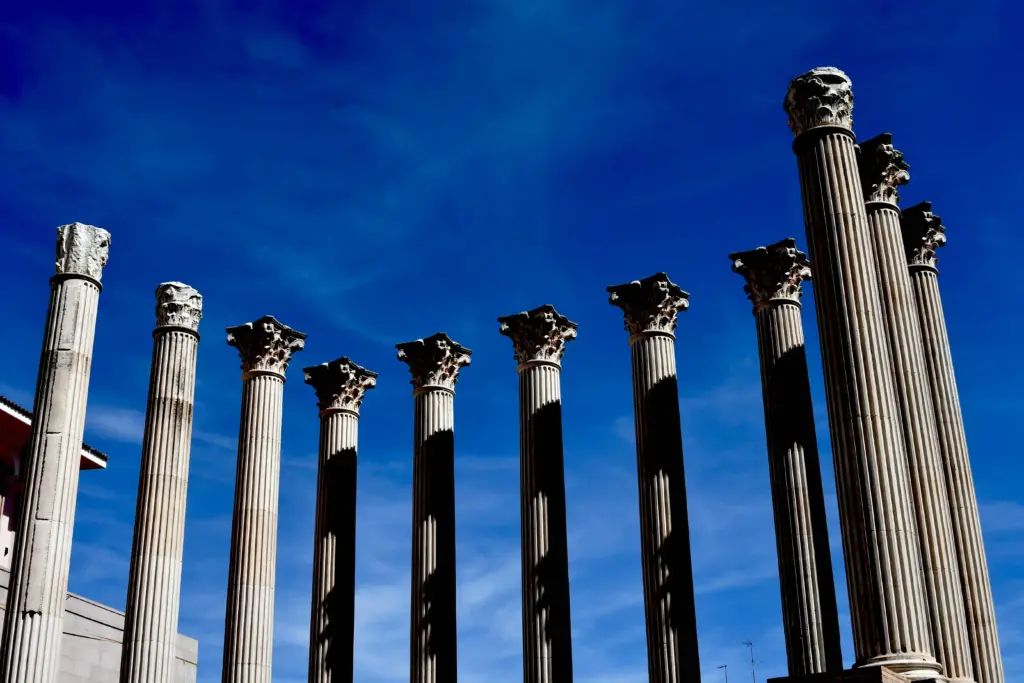
Many of these remains can still be visited today, or are simply integrated into the urban landscape as though they had always belonged there. The foundations of the Roman Forum lie beneath the City Hall. The Roman Temple, with its Corinthian columns, rises among the modern buildings of the city center like an apparition. Along the ancient streets emerge traces of the amphitheater, aqueduct, and funerary monuments — silent reminders of the monumental scale that Corduba had once achieved.
During this period, art, politics, and philosophy flourished. It was here that Seneca the Elder, Seneca the Younger, and Lucan were born — three names that alone are enough to measure the city’s cultural prestige.
But the greatness of Roman Córdoba was not only intellectual. It was also, and perhaps above all, economic. The city’s engine was trade along the Guadalquivir: metals, wine, and above all, olive oil. The Romans did not introduce the olive tree to this land — it was already there — but they radically transformed its scale. They expanded cultivation, organized production, and turned the territory around Corduba into one of the leading olive oil districts of the entire empire, the productive heart of the province of Baetica. Roman writers explicitly praised the olive oil produced in this region. The Guadalquivir became a waterway crowded with shipments of Baetican amphorae — marked with precise seals and destined for Rome and the provinces — within a commercial system that was remarkably modern for its time.
Then came decline. With the fall of the Roman Empire and the brief Visigothic period that followed — the Visigoths settled here in the late 6th century and adopted a more aggressive approach, particularly toward the Jewish communities that had lived freely under Roman rule for centuries — the city lost its center of gravity.
Until the turning point that changed everything.
In 711, the Muslim forces of Tariq ibn Ziyad crossed the Strait of Gibraltar. And just five years later, Córdoba had already become the capital of the Emirate of al-Andalus.
Gibraltar derives from the Arabic جبل طارق — Jabal Tāriq, an expression that literally means “Mountain of Tariq”.
The name refers to Tāriq ibn Ziyad, the Berber commander who crossed the strait in 711 and began the Islamic conquest of the Iberian Peninsula.
Over the centuries, the Arabic term passed through medieval Spanish — with forms such as Gebaltár and Gibraltár — before gradually evolving into modern-day Gibraltar.
The most fascinating thing is that the original meaning has remained virtually unchanged for more than 1,300 years: even today, hidden within a name we pronounce almost without thinking, the “Mountain of Tariq” still survives.
The destiny of Córdoba changed forever in 756, when Abd al-Rahman I — the sole survivor of the Umayyad dynasty of Damascus, decimated by internal struggles with the Abbasids — managed to escape to Spain and establish the independent Emirate of Córdoba.
It marked the beginning of an unprecedented rise in the West.
The decisive leap came in 929. Abd al-Rahman III, weary of constant internal rebellions and determined to challenge the religious authority of the Abbasid Caliph in Baghdad, proclaimed himself Caliph — not only an administrative ruler, but also the temporal and spiritual leader of Sunni Islam. Thus was born the Caliphate of Córdoba, which roughly corresponded to present-day Andalusia, Murcia, the Valencian Community, Castilla-La Mancha, Extremadura, much of southern Castile and León, parts of Aragon and part of southern Catalonia. The city, renamed Qurtubah, became one of the largest and most sophisticated metropolises of the medieval world — the only truly global city in early medieval Europe.
The numbers are still astonishing today. Under Abd al-Rahman III and his son Al-Hakam II, Córdoba reached approximately 450,000 inhabitants, surpassing Constantinople and leaving Paris and Rome — which had barely 30,000 inhabitants each — in a completely different league. It had more than 70 libraries: the personal library of Al-Hakam II alone contained 400,000 volumes, a figure that was simply unimaginable for the time. The city had schools, hospitals, paved streets illuminated at night, functioning sewers, running water supplied by aqueducts to many of its palaces, and around 900 public baths.
It was the intellectual center of the world. It was here that Averroes flourished, the scholar who reintroduced Aristotle to Europe and helped pave the way for Christian scholastic philosophy. It was here that Abu al-Qasim al-Zahrawi, known in the West as Albucasis, worked and wrote, earning his place as the father of modern surgery. And it was here that Maimonides, the great Jewish thinker whose work would forever influence both Christian and Jewish medieval philosophy, was born and educated.
Córdoba was not simply a wealthy city. It was the place where the future was being imagined.
The medicine of al-Andalus achieved enormous prestige throughout medieval Europe. It did not emerge from nowhere, but from a vast effort to collect, translate, and expand ancient knowledge. As the Islamic world expanded, Arab scholars came into contact with the great libraries of antiquity and began translating Greek, Persian, and Indian works into Arabic. Through this process, authors such as Hippocrates and Galen once again circulated throughout the Mediterranean and Europe. Yet the Islamic world did not merely preserve their works: it studied them, commented on them, and developed them further.
One of the most remarkable achievements of Islamic medicine was the creation of the bimaristans, the medieval hospitals of the Arab world. From the 9th century onward, these institutions spread rapidly, and some employed dozens of physicians specializing in ophthalmology, surgery, and traumatology. They were not only places of treatment but also genuine centers of medical education. Many even included gardens where medicinal plants were cultivated to prepare remedies and treatments.
In general, Andalusi medicine placed great emphasis on prevention. Numerous medical treatises explained how to maintain health through a balanced way of life.
It is precisely here that the figure of Maimonides, born in Córdoba in 1135, becomes particularly remarkable. A philosopher and theologian, but above all a practical physician with an extraordinarily modern approach. After leaving al-Andalus because of the Almohad persecutions, he settled in Egypt, where he became physician to the vizier and later to Sultan Saladin himself.
In his writings, he constantly emphasized balance: eating in moderation, avoiding excesses, walking every day, sleeping well, and maintaining peace of mind. For Maimonides, body and mind were inseparable, and many illnesses originated from imbalances in daily life.
What is striking is how many of his ideas still seem surprisingly relevant today. He recommended:
- regular physical activity;
- moderation in diet;
- stress management;
- emotional balance.
According to Maimonides, a physician should not simply treat disease but help patients preserve their health. In this sense, Córdoba was not only a city of monuments and religions: it was also a place where people sought to understand the human body scientifically at a time when much of Western Europe was still far removed from such approaches.
When prevention was not enough, physicians turned to medicines and, ultimately, to surgery. The doctors of al-Andalus were capable of treating cataracts, hemorrhoids, fractures, and dislocations, and even performing tracheotomies. Abulcasis, considered one of the fathers of modern surgery, designed surgical instruments that were incredibly advanced for their time, some of which still bear a resemblance to contemporary medical tools.
Yet alongside this “scientific” medicine, there continued to exist a popular tradition based on amulets, talismans, and protective practices, especially in rural areas. Once again, Córdoba brought different worlds together: science and spirituality, reason and tradition, observation and symbolism.
Jews, Christians, and Muslims lived side by side for centuries in a climate of relative tolerance — the so-called Convivencia. It was a model of coexistence that existed, in different forms, in several cities of al-Andalus, including Granada, Seville, and Málaga, but was rarely matched elsewhere in Europe at the time. It was not a perfect peace, nor was it free from tensions. Yet it was something that the rest of the continent had not yet experienced.
It was during this same period that the city reached the height of its splendor: hundreds of palaces, public buildings, and places of worship — above all, the Mezquita — that rivaled Constantinople, Damascus, and Baghdad. It was the living symbol of what we now call the Arab-Andalusian Golden Age.
But beneath the surface, power was already fragile. Real authority rested in the hands of the vizier Almanzor, who governed on behalf of increasingly weak caliphs while leading military campaigns against the Christian kingdoms of the north. It was a system sustained largely by his personal strength — and one that would collapse with him.
After the death of Almanzor and that of the last caliph, Hisham II, around the year 1000, the caliphate descended into a spiral of civil wars, coups, and rivalries between families and military factions. This period became known as the Fitna — the Andalusian civil war — which culminated in the formal abolition of the caliphate in 1031. Córdoba lost its central political and religious role. The territory fragmented into a constellation of small independent kingdoms, the taifas — Seville, Granada, Toledo, and others — often fighting among themselves and increasingly vulnerable to the advance of the Christian kingdoms of the north, particularly Castile and Aragon.
The city resisted for as long as it could. But without strong leadership, with neighboring cities already fallen (such as Seville) or focused on their own survival (such as Granada), its fate was sealed. On June 29, 1236, after a lengthy siege, King Ferdinand III of Castile — remembered by history as “the Saint” — conquered Córdoba.
What happened afterward is still surprising today. Unlike what occurred in many other cities, the Christian conquerors did not level the Islamic monuments to the ground. Instead, they purified them, reinterpreted them, and adapted them — creating an architectural hybrid unlike anything else in the world.
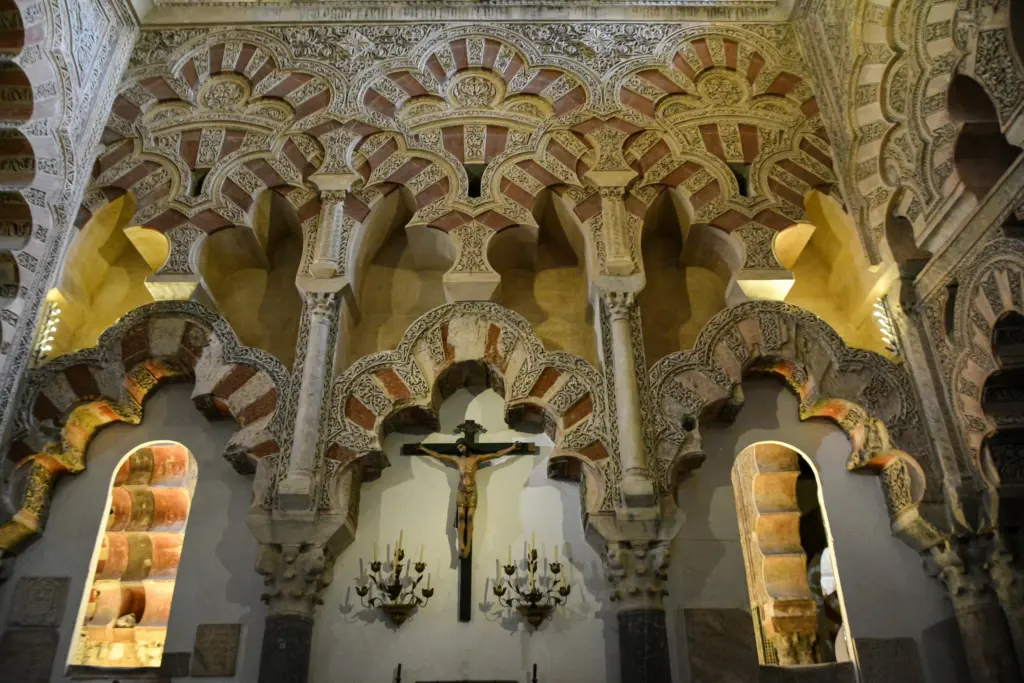
The first act of Ferdinand III was the consecration of the Great Mosque as a Christian cathedral. It was not destroyed — as would almost certainly have happened elsewhere — but purified and adapted for Christian worship. That decision permanently altered the destiny of the building: from a symbol of Umayyad power to a symbol of the Reconquista, a transformation that would reach its full expression in the 16th century with the insertion of a Renaissance basilica within its walls.
The cathedral, however, was not enough. The Christian population was growing, and with it came the need for new places of worship. Ferdinand III launched an ambitious parish-building program that led to the creation of the so-called Fernandine Churches — or Churches of the Reconquista — scattered throughout the urban landscape. Their style is immediately recognizable: a transition from monastic Romanesque to Castilian Gothic architecture, featuring austere structures, coffered ceilings known as artesonados, ribbed pointed arches in pure Mudéjar style, and rose windows decorating their façades.
The term Mudéjar refers to the art and architecture created by Muslim craftsmen for Christian patrons after the Reconquista — a hybrid style born out of necessity and which, over time, became one of the most distinctive artistic expressions of the Iberian Peninsula. Yet Mudéjar was not merely an aesthetic phenomenon. It was also a political statement: the Muslim artisans working for their new Christian rulers embodied, through the very act of their labor, a form of cultural as well as military submission.
Córdoba lost its status as a capital, but it remained an important administrative, commercial, and religious center on the periphery of the new Catholic kingdom. The continuity, however, was only apparent.
Jews and Muslims were expelled. Those who could fled to Granada; those with fewer options crossed the sea to North Africa. Their homes, shops, and lands were confiscated and redistributed by the Crown. Following Ferdinand III came a wave of settlers from León, Toledo, Talavera, Burgos, and even Navarre — not merely peasants, but minor nobles, knights, and members of the clergy who divided among themselves the estates and agricultural lands of the Muslim era. Thus emerged a system of oligarchic lordships that would endure for centuries.
What remains today of this complex history — the historic center, declared a UNESCO World Heritage Site in 1984 — is one of the most meaningful urban ensembles anywhere in the world.
During the following two centuries, Córdoba knew neither internal nor external peace. Its geographical position, on the frontier with the Kingdom of Granada — which would survive until 1492 — transformed it into a permanent military stronghold. Continuous raids and counter-raids devastated the surrounding countryside. Added to this were the feudal struggles among the powerful Castilian families competing for control of the city, creating an atmosphere of instability that hindered economic development for generations.
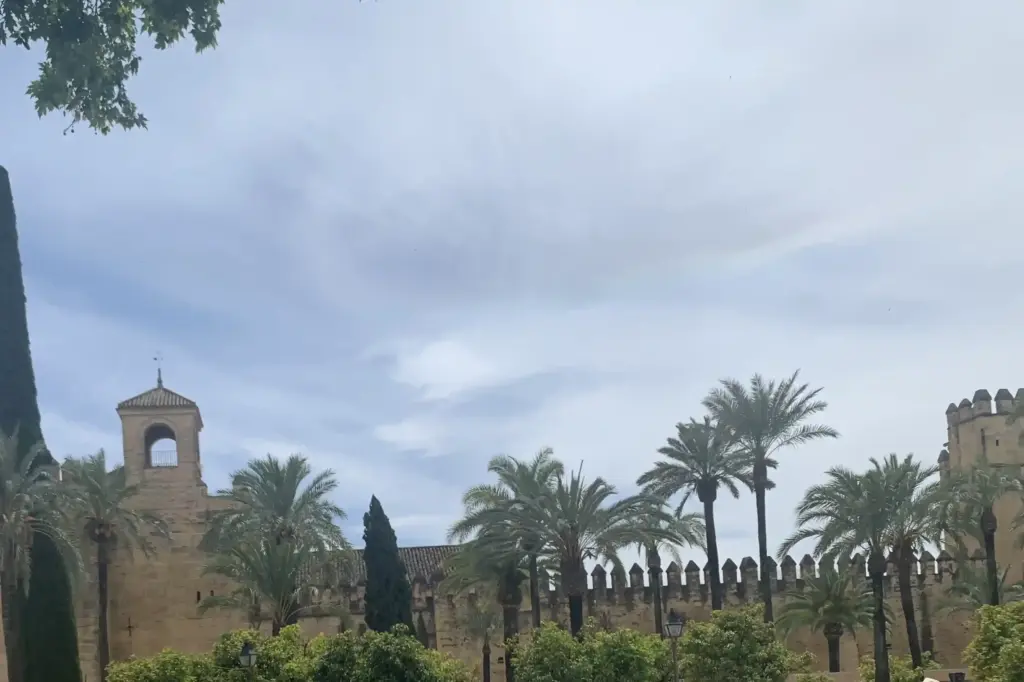
Only with the arrival of the Catholic Monarchs, Ferdinand and Isabella, were these disputes finally brought under control with a firm hand. It was 1478.
And Córdoba once again assumed a central role, at least for a few years. During the 15th century, the Catholic Monarchs temporarily established themselves here in order to direct the final campaign against the Sultanate of Granada — the last Muslim stronghold on the peninsula and the missing piece needed to complete the Reconquista.
In 1486, during their stay in Córdoba, the Catholic Monarchs received a visitor who would go on to change the course of world history: Christopher Columbus.
The Genoese navigator arrived at court with a proposal that seemed almost impossible: to reach the Indies by sailing westward. The idea, however, was met with considerable skepticism and was deemed “unworkable” by the royal advisers. At that moment, no one could have imagined that this very proposal would open a new chapter in human history.
Yet Columbus’s time in Córdoba had consequences that were far more personal and far less well known. During his stay in the city, the navigator entered into a relationship with Beatriz Enríquez de Arana, a young woman from Córdoba who belonged to a family of artisans. Their union resulted in the birth of Hernando Colón, who would later become one of the greatest bibliophiles and scholars of the Spanish Renaissance.
Hernando devoted much of his life to collecting books from across Europe, driven by the almost visionary ambition of creating a universal library. Even today, part of that collection is preserved in the Cathedral of Seville.
It is one of those stories that Córdoba keeps almost in silence: while the city was living through the final years of the Reconquista, a man who was about to change the maps of the world walked its streets — and, without knowing it, left behind here a part of his own family history.
In 1492, with the capitulation of Granada, the Reconquista was completed. But hopes for a peaceful coexistence between cultures and religions quickly faded.
The Catholic Monarchs decreed the expulsion from their kingdoms of all Jews who refused to convert to Christianity. The centuries-old Jewish community of Córdoba — the same community that had given birth to Maimonides and shaped the Judería for generations — was dispersed forever. Soon afterward, the same order was extended to the Muslims of the Kingdom of Castile: baptism or exile. Most chose baptism, becoming Moriscos — Christians of Muslim origin — but their conversion was almost always viewed with suspicion, and they would be persecuted throughout the 16th century until their final expulsion in 1609.
Ferdinand and Isabella also established the Inquisition tribunal in Córdoba. The city was among the first to experience its severity, and many conversos — Jews converted to Christianity who were accused of secretly practicing their former faith — paid with their lives.
With the expulsion of Jews and Muslims, Córdoba lost, almost overnight, the productive and intellectual classes that had sustained its economy and culture for centuries. It was a blow from which the city never truly recovered.
Over the following centuries, Córdoba slipped into a slow decline. The Guadalquivir gradually silted up, losing much of its navigability. The discovery of the Americas shifted commercial routes toward Seville, which became Spain’s preferred gateway to the New World. Córdoba was left outside that flow of wealth, becoming — as some travelers of the time described it — a quiet city of churches, monasteries, and aristocratic residences, a refuge for a landed nobility living on inherited wealth with little interest in the future.
The lowest point came between the 18th and 19th centuries. In 1808, Napoleon’s troops, seeking to suppress the Spanish uprising, stormed the city: Córdoba was looted and devastated. After the end of French rule, Spain entered a period of political instability, and Córdoba became a stage for conflicts between liberals and absolutists. Between 1836 and 1844, the city fell under the control of the Carlists — supporters of the more conservative dynastic branch. It was not a catastrophe on the scale of 1808, but it helped keep the city in a state of profound backwardness.
In July 1936, Córdoba was one of the first cities to fall under the control of the nationalist forces of Francisco Franco. There were no major battles, but repression was immediate, and the city remained a nationalist stronghold throughout the conflict.
Many people died of hunger. Political life was stagnant, dominated by local elites loyal to the regime. It was a dark period — and yet, paradoxically, it was during those same years that the first major systematic archaeological excavations began, including the discovery of the Roman Theatre. The city started to look at its past as a resource rather than merely a burden.
The regime imposed an agricultural and static economy, and modernization arrived decades later than it did in Madrid, Barcelona, or Bilbao.
With Franco’s death in 1975 and Spain’s peaceful transition to democracy, the country changed profoundly. The 1978 Constitution made Córdoba part of the autonomous community of Andalusia. Reforms arrived here as well, albeit gradually, in a city that remained primarily agricultural and artisanal, far removed from the major industrial and commercial centers of the country.
Today, Córdoba has fully embraced the complexity of its past. Its mosques, synagogues, and churches are no longer symbols of conflict: they are monuments open to everyone, witnesses to a difficult history that can finally be told without prejudice. The city has rediscovered its cultural vocation, culminating in the recognition of four UNESCO World Heritage designations: the Historic Centre and Judería, the Mezquita, Medina Azahara, and the Fiesta de los Patios — a celebration that embodies Córdoba’s most authentic and communal spirit, far removed from caliphal courts and struggles for power.
After once being the center of the world, Córdoba became its periphery. And it is precisely in that periphery, far from the noise of modernity, that it has preserved its soul intact — a soul made of whitewashed alleys, flower-filled patios, and a millennia-old past that, at last, truly belongs to it once again.
What to See in Córdoba
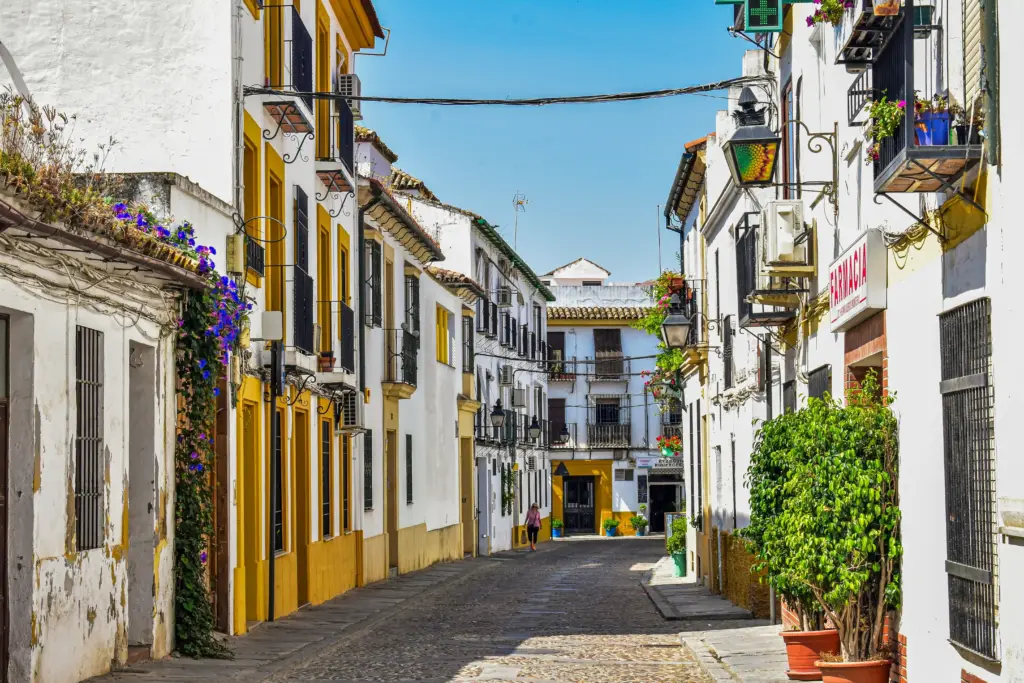
As you have probably realized by now, walking through the streets of Córdoba means stepping on the same stones once walked by Roman legionaries, Arab emirs, rabbis, medieval ladies, and knights. Every corner, every reused column, every horseshoe arch carries with it a story of conquest and coexistence, destruction and rebirth.
The itinerary I have prepared is designed to be a faithful travel companion. It will guide you from the heart of the city to the banks of the Guadalquivir, revealing not only the famous monuments but also hidden alleys, living traditions, and those small details that only those who walk slowly are able to notice.
Be prepared to get lost. It is the only way to find the real Córdoba.
The Historic Center
Whether you arrive in Córdoba by car, train, or bus, there is a good chance that your first entrance into the historic center will be through its ancient walls. And that, in itself, is already a gift.
The walls that frame the city today are not the work of a single era, but rather a palimpsest of overlapping cultures and centuries. Walking near the Puerta de Almodóvar, the Puerta de la Luna, or the Puerta de Sevilla, you can read this history with your own eyes: Roman stone blocks, Islamic construction materials, and Christian reinforcements layered within the same wall, forming a collage of stone that tells two thousand years of history without the need for explanations.
It is from these walls — and especially from the Puerta de Almodóvar — that our tour begins. Welcoming us, seated thoughtfully upon a pedestal, is Seneca, the great Stoic philosopher born right here in Córdoba, reminding visitors of the city’s Roman past.
But once you pass beneath the archway, you enter one of the most beautiful and best-preserved neighborhoods from the Arab period anywhere in Spain: the Judería.
The Judería
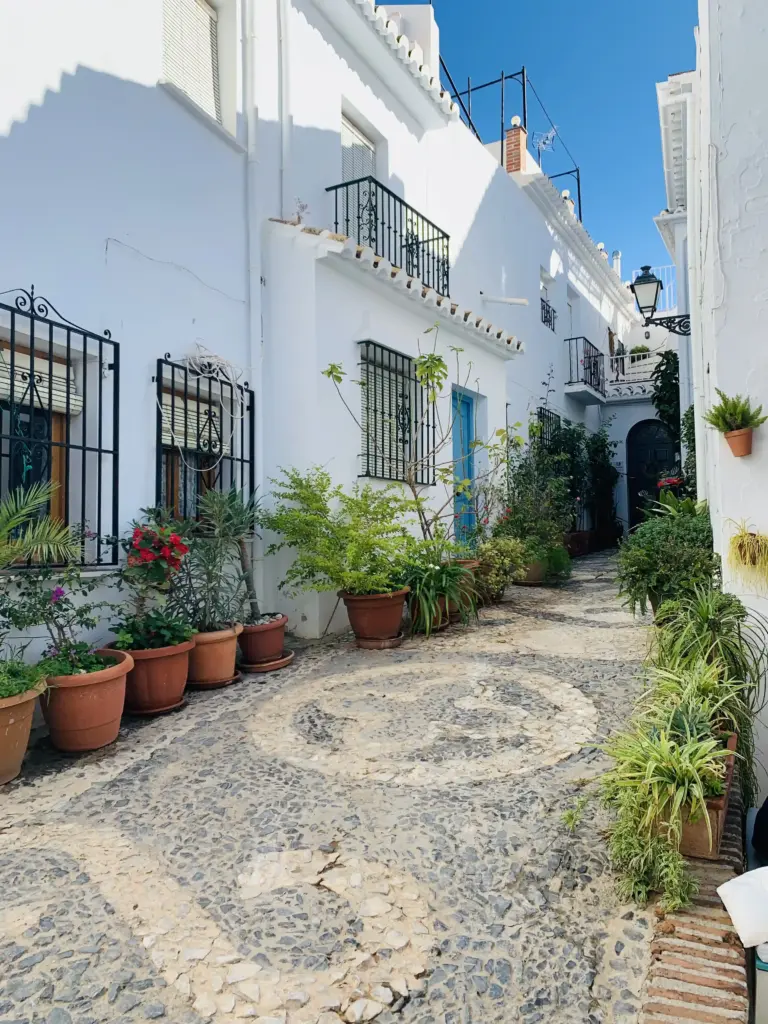
Stepping into the Judería feels like crossing a threshold in time. Córdoba’s Jewish Quarter is one of the best preserved in all of Spain, and its layout still reflects the urban morphology of the Islamic period: narrow, winding streets, often ending in cul-de-sacs, designed for privacy and protection from the sun. The houses are whitewashed, the walls immaculate, and the balconies overflowing with flowers and potted plants.
Yet the history of this neighborhood is far more complex — and far more fascinating — than its present-day tranquility might suggest.
During the Caliphate, Córdoba’s Jewish community expanded significantly and enjoyed an exceptional social position.
It was a period of extraordinary prosperity. Figures such as Hasdai ibn Shaprut, personal physician to Abd al-Rahman III and effectively his adviser on foreign affairs, wielded enormous influence. And it was here, in 1135, that Moses Maimonides was born — the greatest Jewish philosopher of the Middle Ages, whose statue can still be found in the quarter today.
In reality, the first Jewish community did not live in the present-day Judería. The original Jewish quarter was located further north, in the area of today’s Jardines de la Merced and the Church of Santa Marina — a funerary inscription dating from 845, discovered in that area, confirms this.
With the arrival of the Almohads, the Berber religious movement that took power in the 12th century and imposed a much stricter and less tolerant interpretation of Islam, Jews were forced to choose between conversion and exile. It was then that Córdoba’s first Jewish community was dissolved. Maimonides himself left the city for this reason.
When Ferdinand III reconquered the city in 1236, he allowed Jews to return and officially assigned them the neighborhood we know today, adjacent to the Mezquita-Catedral. It was a small but influential community, occupying key roles in administration and commerce at a time when Córdoba had lost the splendor of the Islamic period and was attempting to reorganize itself.
It was precisely this influence, exercised by a minority during a period of collective hardship, that generated growing suspicion and resentment among the Christian population.
In 1272, Alfonso X the Wise decided to delimit and enclose the quarter. The goal was twofold: to protect the Jewish population from increasingly frequent and violent attacks while simultaneously isolating and controlling a minority considered useful yet uncomfortable.
Tensions reached a breaking point during the 14th century. The plague and the wars of the period devastated the economy and plunged an already struggling population into despair. As so often happens in times of crisis, people searched for someone to blame. Jews were accused of spreading the plague — and, paradoxically, the accusation stemmed partly from a real observation: the hygiene practices of Jewish tradition were considerably stricter than those of contemporary Christian society, making interactions within the Jewish community statistically healthier. A difference that, instead of inspiring admiration, fueled suspicion.
In this way, Córdoba anticipated on a local scale what would later become a national policy. Long before the official expulsion of all non-Christians in 1492, the city’s Jewish quarter had already begun to empty.
Because of this history, visitors enter the district through Calle Judíos, which naturally leads toward the most emblematic places in the neighborhood.
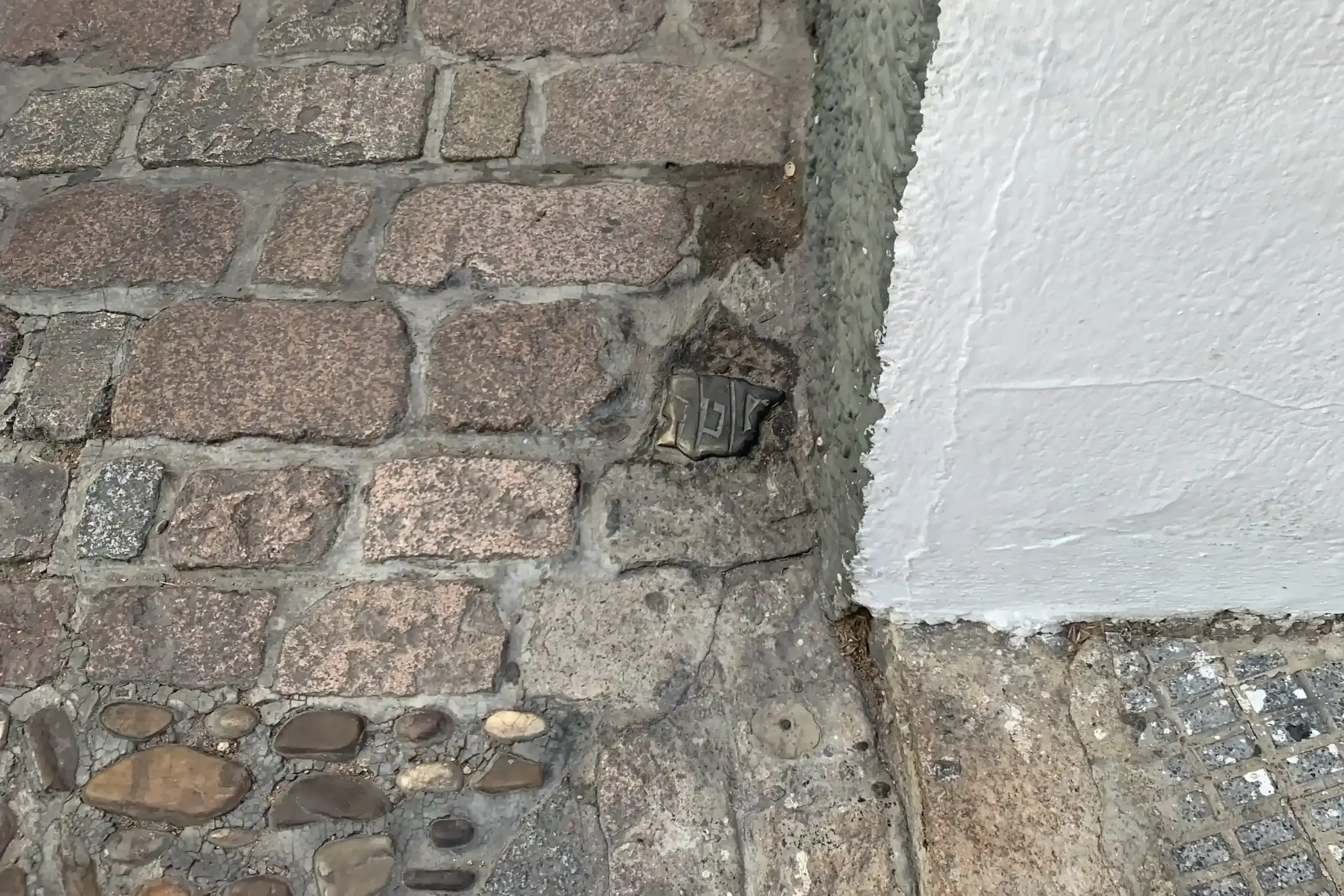
As you walk through the barrio, follow the metal plaques embedded in the pavement. They are among the markers used throughout the Judería de Córdoba to indicate the historic route of the Jewish Quarter. The symbols usually depict a Star of David or decorative elements associated with Sephardic identity.
Yet exploring the Judería ultimately means getting lost — and that is my real advice. Every corner hides something: a small square, an archway, a courtyard glimpsed through a gate, a faded sign that no travel guide has ever thought worthy of mention.
Calle Judíos is one of the most symbolic streets in Córdoba’s Judería, not so much because of its architecture but because of its name. It is considered the only street in the city to have preserved virtually the same name since medieval times.
Many Jewish families connected to the city’s artisan trades and commercial activities lived in this area. Leather, ceramics, precious metals, and silver were crafted here, while nearby streets were home to physicians, scribes, translators, and scholars who contributed to the intellectual prestige of medieval Córdoba.
Over the centuries, many of the city’s streets changed their names: some were dedicated to saints, others to religious figures or historical events. Calle Judíos, however, remained unchanged. And it is precisely this continuity that makes it special.
More than just a street, it is a form of urban memory. A small gesture of respect preserved by the city toward a community that, for centuries, contributed to Córdoba’s economic, cultural, and scientific prominence.
Walking along it today, between whitewashed walls and narrow alleyways, it is easy to feel that this name, which has survived the passage of time, tells us something important: some traces of history may change their shape… but they never truly disappear.
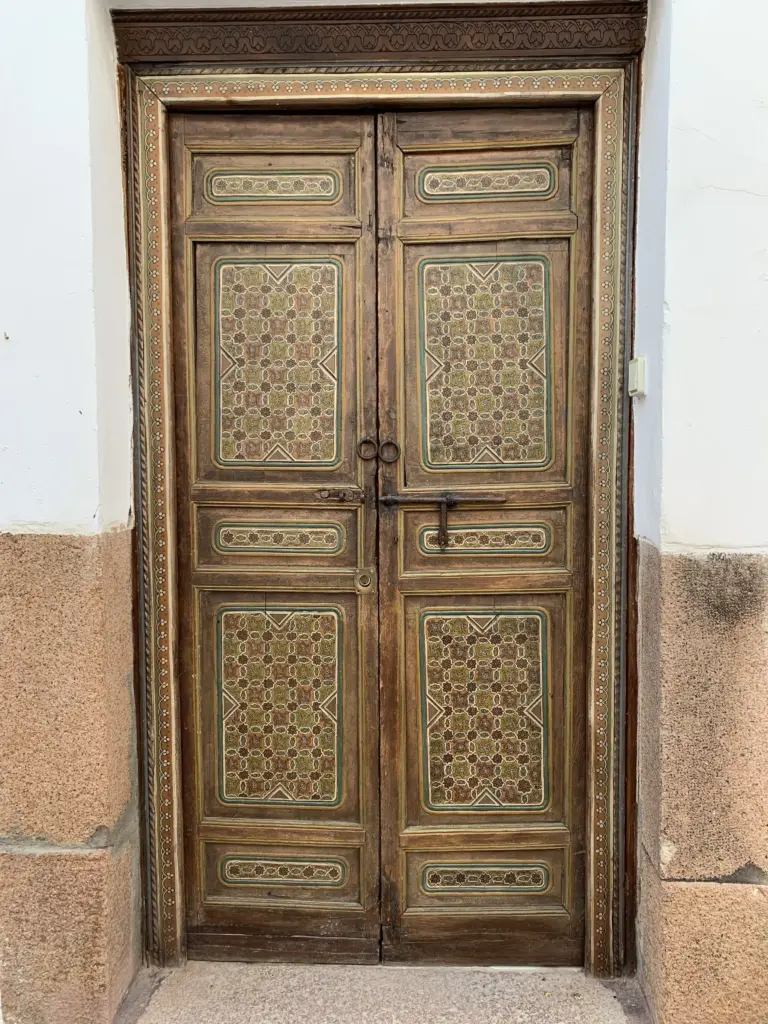
Casa Andalusí
The entrance fee is modest (around €3–4) and can be purchased directly on site or online. The booking process is not particularly intuitive, but it works. As a general guide, the house is open daily from 10:00 AM to 7:00 PM, although it is always worth checking the official website for updated opening hours. It is also possible to add a visit to the nearby Casa de la Alquimia Aliksir, bringing the total cost to approximately €8. Allow at least one hour to explore both at a relaxed pace.
The Casa Andalusí — also known as the 12th-Century House — is one of those places that visitors often overlook, distracted by the grandeur of the Mezquita or the colorful crowds of Calle de las Flores. That would be a mistake.
It is a small restored house open to the public, renovated not merely to preserve a historic building but above all to faithfully recreate the atmosphere and lifestyle of a Muslim family during the Caliphate period. And it succeeds remarkably well. The house follows the classic model of an Andalusí residence: compact, inward-looking, and organized around a central patio according to the fundamental principle of separating public and private space. The building itself is an authentic 12th-century Mudéjar structure — not a reconstruction, but a genuine house whose history is embedded in its walls.
Visitors enter through the zaguán, the transitional space typical of Hispano-Moorish houses, where guests could wait for the owner without penetrating the intimacy of the family home. It functions as an architectural filter between the street and the private world beyond — a concept that reveals much about the Islamic understanding of domestic space.
Beyond the zaguán lies the patio, the true heart of the house. Plants, decorated ceramics, and the sound of flowing water create an atmosphere that perfectly captures the contemplative and refreshing character of Andalusian Moorish homes. It served both as a natural cooling system and as the center of domestic life, the place around which everything else was organized.
The interior rooms reveal, one by one, the different rhythms of daily life.
The Main Hall — the Sala de Recepción — was the most richly decorated room, where the head of the household received guests. Today it is furnished with low furniture, cushions, carpets, and brass and colored-glass lamps.
The Bedroom recreates the family’s most private spaces, with low sleeping platforms, carved chests, and wooden screens known as celosías, designed to ensure privacy.
The Kitchen, equipped with ceramic and copper utensils, grain mills, and period tools, is perhaps the most unexpectedly evocative room of all. It is difficult not to feel transported to a morning in the 12th century, with the scent of spices lingering in the air.
The house also contains two thematic collections that deserve particular attention.
The Paper Museum tells a story that few people know. Córdoba was one of the earliest centers of paper production in Europe. It was through this city that the hydraulic paper-making technology of Arab origin reached the West, playing a decisive role in the spread of written culture. The exhibition illustrates the entire process, from preparing the paper pulp using old rags to the final polishing of the sheets, with a scale model and audiovisual presentation accompanying the displayed objects. It is a key piece of the puzzle for understanding why Caliphal Córdoba was so far ahead of the rest of Europe, and it also allows visitors to view the Guadalquivir and its mills with a deeper appreciation.
The numismatic collection, meanwhile, offers a fascinating way to explore the history of the Caliphate, the taifas, and the Muslim presence in Spain through the most tangible symbol of power: money. Gold, silver, and bronze coins spanning centuries of history form part of one of the most significant numismatic collections in Spain.
For someone like me, who loves simple places capable of telling history through all five senses, Casa Andalusí was one of the most memorable stops in Córdoba. It is not a large museum. It is small, intimate, and more evocative than academic in its approach. If you arrive here after visiting the Mezquita or battling the crowds of Calle de las Flores, stepping into this patio feels like taking a long, deep breath. The sound of water, the flowers, the filtered light, and the silence all contribute to a sense of temporal suspension that is difficult to find elsewhere in the historic center. If you visit it beforehand, it provides a more everyday and tangible understanding of the life that once unfolded around the city’s great monuments.
It is precisely because of this more intimate and domestic dimension that I appreciated it so much.
Near Casa Andalusí you will also find Casa de la Alquimia Aliksir. It is not an essential stop, but when visited together, the two houses tell not only how people lived in al-Andalus… but also how they studied, experimented, and sought to understand the world around them.
Beneath the Casa Andalusí, as in several nearby houses of the Judería, there are underground passageways that run beneath the buildings and cross part of the ancient city walls.
Their exact purpose remains uncertain, but they may have been used for the discreet movement of people, goods, or materials in a city whose life did not unfold solely above ground.
One of the underground rooms also preserves a Late Roman or Byzantine mosaic — a surprising detail that adds yet another layer to the visit. In Córdoba, even beneath a house museum, history continues to descend deeper into the ground.
Casa de Sefarad
The entrance fee is around €4.50 and tickets are purchased on site. There is an official website, but it does not offer a modern online ticketing system. It is mainly useful for checking opening hours (typically 11:00 AM–6:00 PM, Tuesday to Sunday, although these can change frequently) and learning about special events. One important detail: the museum is wheelchair accessible, with both a ramp and an elevator.
Just a short walk from Casa Andalusí, tucked away on a corner among the narrow streets of the Judería, stands the Casa de Sefarad.
It is a small museum dedicated to Sephardic memory, housed within an authentic 14th-century Jewish home, carefully restored and opened to the public as a place of culture and storytelling. Its existence is rooted in a simple but important idea: when visiting Córdoba, people tend to view the city through two lenses — the Islamic and the Christian. This house serves as a reminder that Córdoba was also profoundly Jewish, and that this presence is not a marginal chapter of its history but one of its richest and most dramatic layers.
The permanent exhibition is divided into several thematic rooms, each dedicated to a different aspect of Sephardic life and memory: the diaspora, the synagogue, Judeo-Spanish — or Ladino, the language of the Iberian Jews — the figure of Maimonides, the Inquisition, domestic life, women, festivals, and music. It is not an encyclopedic museum. Rather, it is a narrative museum designed to help visitors understand not only the Jewish presence in Córdoba, but also the daily life, traditions, and identity of a community that experienced centuries of both prosperity and persecution.
Its most unexpected strength is music.
The museum staff — often the very person who welcomes you at the entrance — occasionally offer short live performances of Sephardic music, singing in Ladino, Hebrew, and Spanish. These performances are not guaranteed at every hour, so it is worth asking at the entrance when the next one is scheduled. If you have the opportunity to attend one, it is unlikely you will forget it.
The staff, moreover, possess a rare kindness — the kind of kindness that transforms a visit into a genuine human encounter.
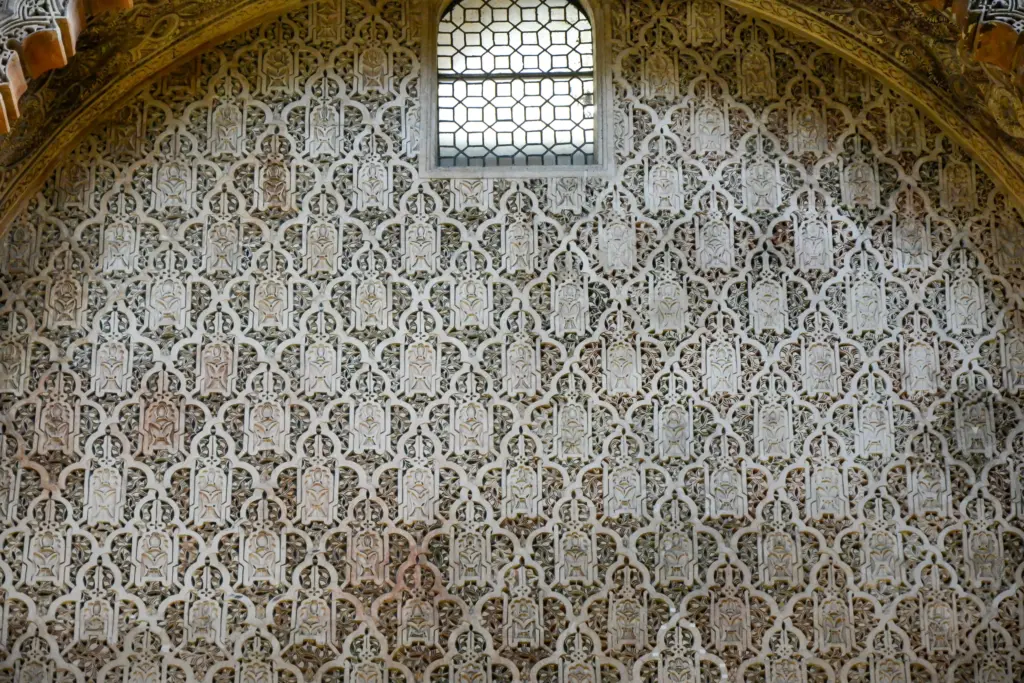
Synagogue
Admission is free from Tuesday to Sunday, from 9:00 AM to 3:00 PM. Closed on Mondays. Groups of more than six people must book in advance through the ARES portal of the Junta de Andalucía. The building is not wheelchair accessible. The synagogue is a very small site and, despite free admission, visitor numbers are regulated to preserve the integrity of the monument. I recommend arriving early in the morning, right at opening time, to enjoy the visit in a quieter atmosphere and avoid queues.
The synagogue was built between 1314 and 1315, during the period known as the Convivencia — a time when the Catholic Crown had, let us say, “graciously” allowed other religions to practice their faith. It was a fragile balance, but one that produced some of the most extraordinary artistic masterpieces of medieval Spain.
The entrance follows Jewish tradition: a small courtyard and a vestibule gradually lead visitors into the prayer hall, creating a kind of spiritual antechamber designed to encourage reflection before worship. It is a slow and intentional transition from the outside world into the sacred.
The interior is organized around two main spaces.
The Prayer Hall is the principal room: a square floor plan, ribbed vaults, and pointed arches in Mudéjar style, decorated with Hebrew inscriptions and geometric motifs that echo Andalusian Islamic architecture. On the eastern wall — facing Jerusalem, as tradition requires — stands the Hejal (or Ark), the richly ornamented niche where the Torah scrolls were once kept.
High on the southern wall are the women’s galleries, three richly decorated balconies reserved for women, who attended services separately from men according to Jewish custom.
It is also on the eastern wall that the original Hebrew foundation inscription survives, mentioning the name of the patron: Isaac Moheb, a wealthy and influential member of the local Jewish community.
But the true soul of the synagogue lies in its stucco decoration, and here words risk being inadequate. We are confronted with a dazzling display of lacería patterns — interlaced stars with four, six, and eight points — alongside vegetal motifs and Hebrew inscriptions that were once painted in blue, red, and black. The texts are drawn from the Book of Psalms and other sacred writings. The style is unmistakably Mudéjar, a fascinating fusion of Christian, Muslim, and Jewish artistic traditions, strongly influenced by the Nasrid art of Granada. Three cultures, one wall.
Everything changed in 1492, when the Catholic Monarchs ordered the expulsion of the Jews from Spain. The synagogue was confiscated and began a long series of new uses, each of which left its mark on the building.
It first became the Hospital of Santa Quiteria, specializing in the treatment of hydrophobia (rabies). Then, in 1588, it was converted into the Chapel of Saint Crispin and Saint Crispinian, the patron saints of shoemakers, whose guild established its headquarters there. Finally, in the 19th century, the former synagogue became a nursery school. It was during this period that the deteriorating roof was replaced with a brick vault, further obscuring the building’s original structure.
The turning point came in 1884 (some sources cite 1876), when a Catholic priest, Don Mariano Párraga, began renovation work on the chapel. Upon removing the altar of Santa Quiteria, the magnificent stucco decorations with Hebrew inscriptions appeared almost miraculously — preserved after centuries of neglect.
The first person to immediately grasp the importance of the discovery was Rafael Romero Barros, artist and art critic (and father of the famous painter Julio Romero de Torres). He campaigned tirelessly to ensure that the site received official recognition and protection. Thanks to his efforts, the Synagogue of Córdoba was declared a National Monument in 1885.
Today, it is the only preserved medieval synagogue in Andalusia and one of only three surviving pre-expulsion synagogues in all of Spain. The other two are located in Toledo: Santa María la Blanca and El Tránsito. That distinction alone makes it well worth the visit.
The Synagogue of Córdoba is also remarkable for its surprisingly small size. The prayer hall measures just 6.95 × 6.37 meters, with a total surface area of approximately 40 m² — a very modest space considering the importance of Córdoba’s Jewish community during the Middle Ages.
According to a widely circulated historical tradition, the Christian authorities of the time required that no Jewish place of worship could be larger than the smallest Christian church in the city. Although historians do not all agree on the existence of a specific regulation, this restriction may help explain the building’s compact proportions when compared with other medieval synagogues in Spain, contributing to its unique character.
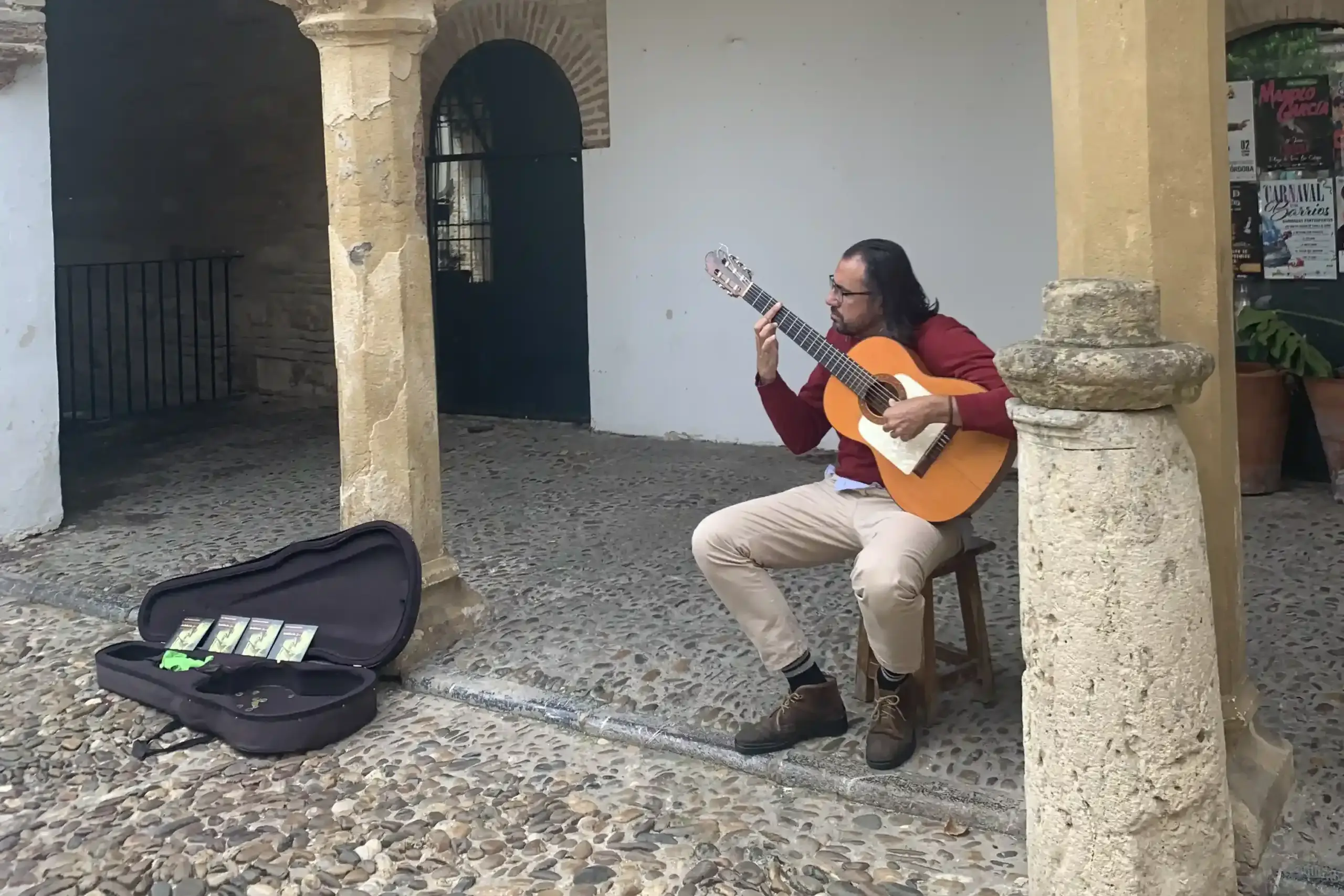
Zoco Municipal de Artesanía
Just a few steps from the synagogue, on the left-hand side, lies a courtyard that tells a different story of Córdoba — one far removed from the city’s major attractions.
The Zoco Municipal de Artesanía is a hidden gem in the heart of the Judería, tucked between Calle Judíos and Calle Averroes, just a few meters from Plaza de Maimónides, with the Mezquita peeking out nearby. It is not heavily signposted, nor is it always crowded — and that is precisely why it is worth stepping inside.
The history of this place is, in its own way, a reflection of Córdoba itself. Originally a noble residence, it became the Casa de las Bulas during the 18th century. Here, citizens could purchase papal indulgences for their sins or — a detail that raises a smile today — seek the annulment of a marriage. Over time, the palace fell into decline, was divided into small dwellings, and eventually became one of the city’s characteristic patios de vecinos: shared living spaces where up to 31 families lived together in conditions that were far from comfortable.
Around 1954, a transformation took place. The courtyard was redesigned as an artisan market, and from that conversion emerged something genuinely successful. The central space — bright, airy, filled with potted plants, lanterns, and welcome patches of shade — is exactly the kind of place where you end up lingering longer than expected, even on the hottest days.
The layout is that of a two-level courtyard square, with a ground floor and an upper gallery connected by arcaded walkways running along the sides. The pointed arches, columns, and capitals in the distinctive Cordoban Mudéjar style recall the original architecture of the Casa de las Bulas — a discreet thread connecting today’s workshops to the 16th century.
The atmosphere is intimate and authentic, often enlivened by live flamenco music, especially during the famous Festival de los Patios, when Córdoba transforms itself and every courtyard seems to become a stage.
Today, the Zoco — the Arabic word for “market” — is one of the best places to take home something genuinely local. Not mass-produced souvenirs, but unique examples of Cordoban craftsmanship: the famous cordobán, the embossed leatherwork that made the city renowned throughout Europe; delicate hand-crafted silver filigree; and ceramics in their unmistakable colors.
Along the galleries of both the ground and upper floors, workshops follow one another in succession: goldsmiths, ceramicists, leather artisans, and masters of filigree work. Yet the greatest pleasure is not necessarily buying something, but watching the artisans at work. Many create their pieces directly in their workshops, allowing visitors to observe how a filigree jewel is made, how a leather object takes shape, or how clay is transformed into a finished ceramic piece.
The courtyard is open every day, usually from 10:00 AM to 8:00 PM — convenient hours that make it easy to stop by between visits to the city’s major sights.
Statue of Maimonides
If you are walking through the Judería, leaving the Synagogue behind and heading toward the Bullfighting Museum, you will almost stumble upon him by chance: Maimonides.
It is not just any statue.
Maimonides was born in Córdoba in 1135. He was a philosopher and a court physician (see the A Curiosity box dedicated to medicine in al-Andalus), but he also treated the poor free of charge. His works, such as The Guide for the Perplexed, influenced not only Jewish thought but also Christian and Islamic philosophy. He was an intellectual who, in a sense, belonged to everyone — and whom his own city ultimately forced into exile when the winds of history changed.
The bronze statue was created in 1964. Maimonides is depicted seated in contemplation, a book in his hands, resting upon his own tomb — the one located in Tiberias (hence the name of the square). It is a symbolic and somewhat melancholic reference that makes the sculpture truly unique.
If you notice that certain parts of the statue shine more brightly than others, it is not the effect of the light. It is the result of tradition.
Touching the babuchas — the traditional oriental slippers at his feet — is said to bring good luck and, according to local legend, guarantees a return to Córdoba. Touching the book he holds is believed to transfer a little of his wisdom — excellent for studies, according to the parents who bring their children here. More recently, a third option has emerged: stroking his beard, which locals jokingly claim helps prevent baldness.
Needless to say, for one reason or another, everyone touches the statue.
Myself included!
There is also an interesting story connected to the statue of Maimonides. For several years, there was discussion about installing a replica in the Israeli city of Tiberias, where the great Jewish philosopher and physician is actually buried.
The project was eventually abandoned following objections from some local rabbis and groups within Orthodox Judaism. For part of the Jewish religious world, sculpted representations of particularly revered figures can conflict with the traditional interpretation of the biblical prohibition against creating images or statues.
The episode is fascinating because it shows how the figure of Maimonides remains deeply respected and, at the same time, religiously sensitive even today. In Córdoba, however, his statue has become one of the most photographed symbols of the Judería: a civic and cultural tribute to one of the most influential thinkers of the medieval world.
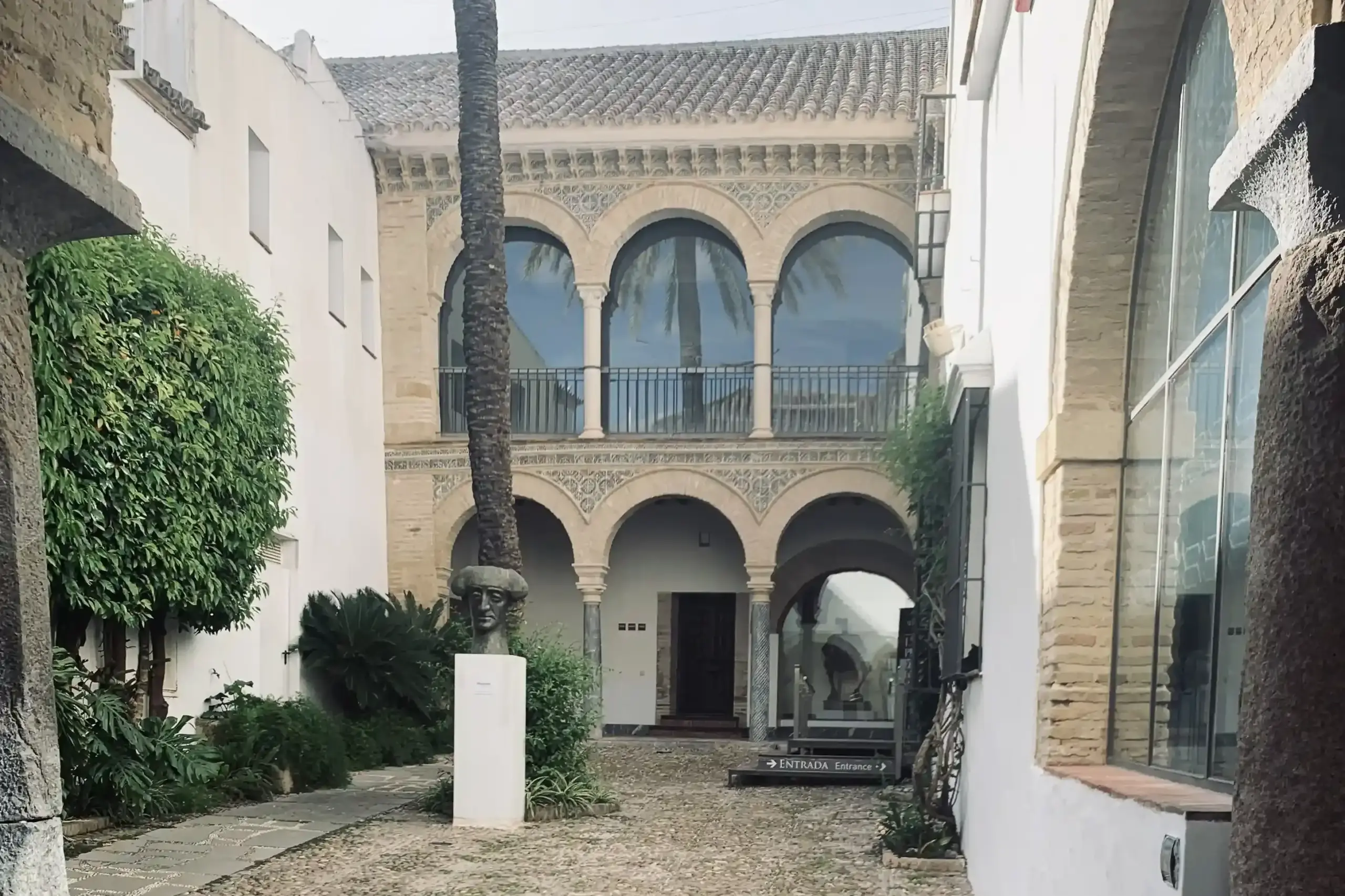
Taurino Museum
The entrance ticket costs around €5 and can be purchased either on the official website or directly at the museum. It is usually open from Tuesday to Sunday, all day during winter and mornings only during summer. Always check the official website for the latest opening hours. On Thursdays after 6:00 PM, admission is free on non-holiday days. Allow approximately 45 minutes for your visit.
Just a few steps from the Synagogue, Córdoba changes character once again.
The silence of the narrow streets gives way to something more passionate, visceral, and controversial: the Taurino Museum. The museum is dedicated to tauromachy — the art and history of the bullfighting — but not quite in the way you might expect. It is not simply a celebratory shrine. Instead, it is a space that invites visitors to view bullfighting as a social and cultural phenomenon, tracing its evolution from ancient Greek influences to the present day, with a level of reflection that I found surprisingly rare in museums of this kind.
The exhibition includes many of the iconic elements associated with the corrida: trajes de luces (the famous “suits of lights”), monteras, capotes, photographs, and works of art dedicated to Córdoba’s most celebrated bullfighters. Yet it does not avoid the more uncomfortable aspects of the subject: the ethical questions, the ongoing debate, and the contradictions of a tradition that continues to divide opinion today.
The museum is housed in a noble residence dating back to the Caliphal period, later granted to Catholic families after the Reconquista as a reward for fighting alongside the king — who, at the time, did not maintain a standing army of his own. Evidence of this history can still be seen in the bronze coat of arms mounted on the exterior wall near the entrance gate. Take a moment to look at it before going inside. You will find similar emblems on other historic buildings throughout the city, including the Conservatory, where they continue to symbolize these royal grants and donations.
Between the Middle Ages and the early modern period, bull spectacles were common across much of Europe: in Italy, France, Austria, and even England. They were, however, very different from the bullfighting we imagine today. The protagonists were not matadors on foot, but horsemen. The bull represented an aristocratic challenge, an exercise in courage and skill reserved primarily for the elites.
Then, between the 18th and 19th centuries, the rest of the continent moved in a different direction. In England, bull-baiting was banned in 1835, driven by changing moral sensibilities, Protestant influences, and an increasingly urban society that was becoming less willing to accept animal violence as public entertainment. In Italy and France, by contrast, there was no sudden prohibition but rather a gradual abandonment: what had once been considered celebration, challenge, and spectacle increasingly came to be seen as incompatible with a more modern and “civilized” vision of society.
Meanwhile, the Catholic Church also viewed such spectacles with suspicion. In 1567, Pope Pius V issued the papal bull De Salutis Gregis Dominici, threatening excommunication for anyone who organized or participated in bullfights. In Spain, however, the situation was different. Spanish monarchs — particularly Philip II, Philip III, and Philip IV — were deeply attached to these events and, through diplomatic pressure, succeeded in persuading subsequent popes to soften or relax those restrictions.
Bullfighting continued to thrive on the Iberian Peninsula because it was not viewed merely as entertainment. On many occasions, its proceeds helped fund hospitals, charitable institutions, and public welfare projects. In no other Catholic country did the Crown possess sufficient political strength and cultural continuity to resist ecclesiastical condemnation on such a sensitive issue for so long.
Leaving the museum behind, the walk continues toward Plaza del Cardenal Salazar through one of those narrow alleyways that represent the most authentic imprint of the Islamic city.
It is worth pausing for a moment to appreciate these streets. They were not narrow by accident. They were designed to promote air circulation and keep homes cool, but above all to ensure that the private areas of houses — bedrooms, family quarters, and spaces for prayer — never faced the main streets, with all their noise and activity. It was an urban logic that placed domestic life, silence, and contemplation at its center.
A city designed from the inside outward — exactly the opposite of how we tend to build today.
At the beginning of the street, on the corner to your left, you may notice a small column embedded into the edge of a building. It is one of those details that, once spotted, you will begin to see everywhere in Córdoba.
These features are known as esquinazos and are among the most distinctive elements of Cordoban architecture. Instead of a sharp 90-degree corner, the edge of the building is cut diagonally and decorated with a small column, a capital, or another ornamental architectural element. In many cases, these are reused materials from the Roman or Visigothic periods — pieces considered too beautiful to discard and perfect for finding a new life on a street corner.
The original reason was entirely practical. In centuries when the streets were even narrower than they are today, a sharp corner made it difficult for animal-drawn carts to turn. Rounding off the corner was a simple and effective solution.
But in Córdoba, as so often happens, the functional became beautiful. What began as a simple urban planning solution gradually evolved into a recognizable feature — a small but distinctive part of the city’s visual identity.
Chapel of Saint Bartholomew (Capilla de San Bartolomé)
The entrance fee is truly modest (around €2) and tickets can only be purchased on site. The chapel is open from Tuesday to Sunday, but because it is housed within an active university building, opening hours may vary. Always check the official website of Manmaku, a cultural association based in Córdoba. Access to the chapel is through the Faculty’s inner courtyard, so you will need to enter via the university building.
Many tourists discover it by chance, far from the usual sightseeing routes. Yet those who know it consider it an essential stop for anyone wishing to look beyond the Mezquita and understand how al-Andalus gradually transformed into a Christian city that still shines today with unmistakably Islamic forms.
The Capilla de San Bartolomé is located in Plaza del Cardenal Salazar, incorporated into the building that now houses the Faculty of Philosophy and Letters of the University of Córdoba — formerly the Hospital of Cardinal Salazar. It is a small but remarkably rich space, where medieval Christian Córdoba can be experienced in a more intimate and contemplative atmosphere than that of any grand church.
The history of the chapel is inseparable from one of the darkest episodes in the history of Spain’s Jewish community. In 1391, a violent pogrom (antisemitic revolt) struck Córdoba’s Judería, forcing much of the Jewish population to either convert or flee. The old Jewish quarter was subsequently repopulated by Christians, and a new parish dedicated to Saint Bartholomew was established.
The chapel was built between 1399 and 1410 in the Mudéjar style, although the church itself was never fully completed — most likely due to a lack of funds. In 1724, with the construction of the new hospital commissioned by Cardinal Salazar, the chapel became attached to the larger complex and its floor was raised to match the level of the surrounding structure. Closed for much of the 20th century because of deterioration, it was restored in 1953 and again between 2006 and 2008, before reopening to the public on March 20, 2010.
Small in size — barely 9 meters long and 5 meters wide — yet extraordinary in its details.
A simple portico with three arches introduces visitors to the interior, shaded by a century-old palm tree growing in the small courtyard outside. The structural framework is unmistakably Christian, with a ribbed vault, but the walls tell a different story. Stucco decorations feature geometric patterns (lacerías), vegetal motifs (atauriques), and Arabic inscriptions in both Kufic and Naskhī calligraphy, used here purely as decorative elements. Along the lower walls runs a magnificent dado of azulejos. Columns and capitals reused from Roman and Islamic buildings — true spolia — complete the ensemble, recycled both to reduce costs and to speed up construction.
What strikes visitors most, however, is the color.
The chapel has preserved part of its original polychromy, making it unique. It offers a rare glimpse into just how vibrant and colorful Mudéjar art once was. Paradoxically, it conveys this better than the Alhambra of Granada, which has lost almost all of its original colors over the centuries.
During restoration work in 1935, thirty-five Nasrid azulejos created using the exceptionally rare golden-lustre technique were discovered here. They originated from the last Muslim kingdom of Granada. To ensure their preservation, they were removed and are now housed in the Archaeological Museum of Córdoba.
If you have the opportunity to wander through the university building itself, do so. The structure has retained the layout of the former hospital: each classroom corresponds to one of the original rooms, including the old Pharmacy. In some of them, you can still see the metal tracks embedded in the floor that were once used to move stretchers carrying the deceased to the mortuary.
A little unsettling, perhaps.
But then again, that too is Córdoba.
The Chapel of Saint Bartholomew was almost certainly commissioned by a converso — a Jew who had converted to Christianity — named Diego Fernández Abencaçin. At the time, he held the position of veinticuatro in Córdoba, a municipal office reserved for the city’s most influential families, roughly equivalent to a city councilor.
He was no ordinary man. Diego also served as an alfaqueque, a negotiator responsible for arranging the ransom and release of Christians held captive in Muslim territories. It was an extremely delicate role that required frequent journeys to the Kingdom of Granada, knowledge of Arabic, and a remarkable ability to navigate between different cultures and worlds.
On the walls of the chapel, the coat of arms of the Order of the Band commemorates the distinction granted to him by the king in recognition of his services. It is an important detail, because it shows how deeply the family had become integrated into Christian Córdoba, despite its Jewish origins.
The family’s story, however, would take a much darker turn. In 1475, Diego’s son, Gómez Fernández, an important churchman and maestrescuela of the Cathedral, was buried here in the family chapel.
Eleven years later, in 1486, the Inquisition found him guilty of Judaizing — secretly practicing Judaism while outwardly professing Christianity. In 1499, his remains were exhumed and burned.
It is a harsh story, but it illustrates better than many explanations the fragile position of the conversos in late 15th-century Spain. One family had built a Christian chapel, served the Crown, bridged two cultures, and attained positions of prestige. Yet, in the end, it could not escape suspicion.
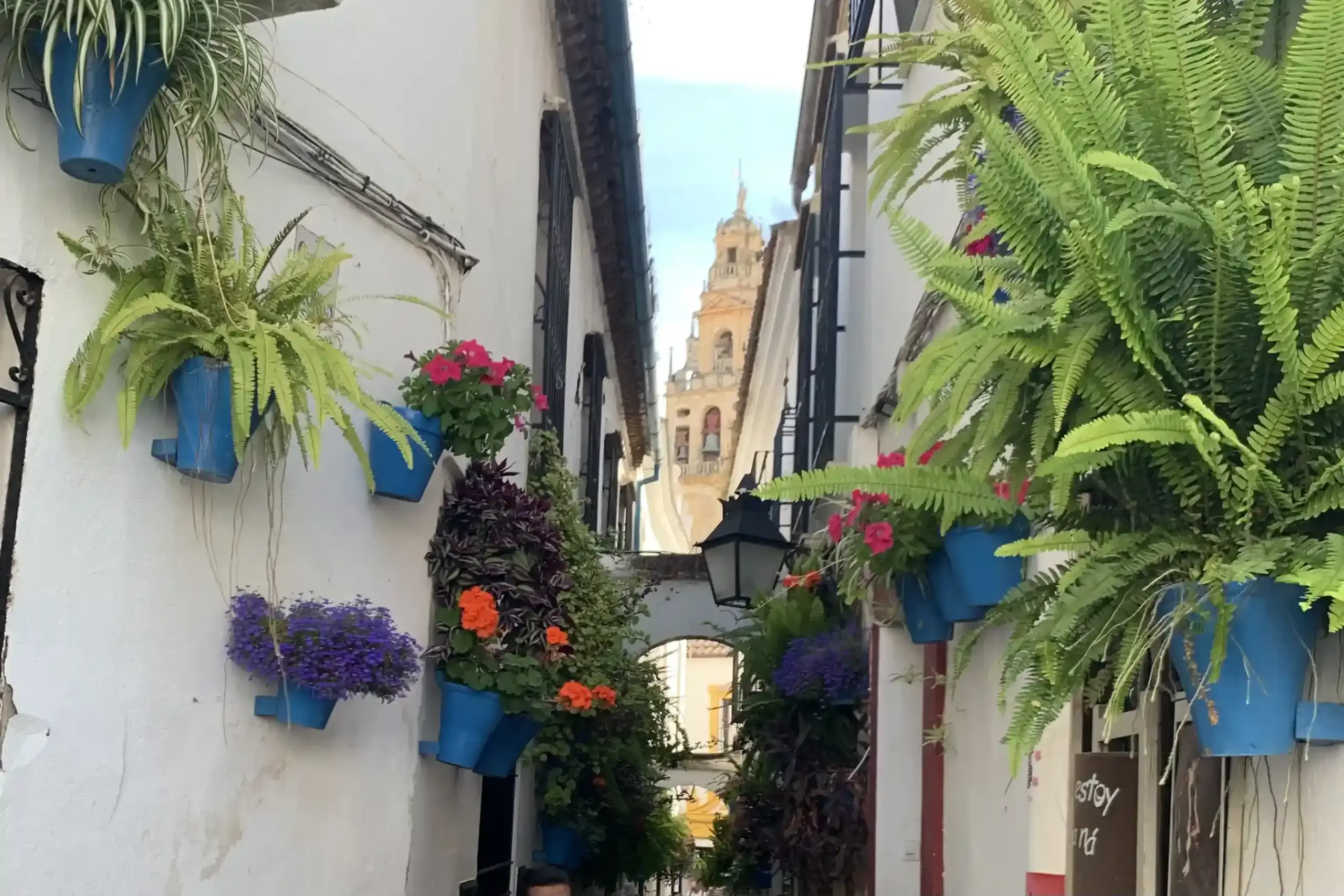
Calleja de las Flores
It is probably the most photographed alleyway in all of Spain, and the reasons are obvious: incredibly narrow, brilliantly whitewashed houses, and every window and balcony overflowing with colorful geraniums. Then, once you reach the end and turn around, you discover the bell tower of the Mezquita-Catedral, seemingly framed perfectly for your photograph.
The alley itself can be crossed in just a few steps.
Unfortunately, it is almost always crowded with tourists. If you can, come early in the morning: the light is at its best, and the alley still retains a sense of quiet authenticity.
Most people take the photo and leave without spending a single minute in the small square at the end of the passageway.
That is a mistake.
It is not really a square at all — it was once a patio de vecinos, a communal courtyard that gradually opened to the public — and it has far more stories to tell than it first appears.
At its center stands a simple octagonal fountain. Look closely: the column supporting it is Roman, complete with its original Ionic capital. The entire historic center of Córdoba rests upon layers of Roman history, and this small detail is one of the surviving traces — reused and incorporated into everyday life without much fanfare.
Then turn your attention to the surrounding façades. They are not aligned. Some project forward, others recede, creating a curious irregular rhythm. This is neither accidental nor the result of poor construction. Rather, it reflects a medieval urban practice that allowed homeowners to extend their properties by up to a meter into public space. With each renovation and each new owner, walls shifted a few centimeters. Over time, the courtyard gradually narrowed until it became the intimate space we see today.
There is another detail that almost nobody notices, yet it is surprisingly striking once you see it. On one of the façades, a coat of arms bearing the Eagle of Saint John — the heraldic symbol associated with the Franco regime — is still visible. It was placed there during the years of Córdoba’s urban restoration and redevelopment under Franco. Local legend claims that the dictator was so impressed by the beauty of this corner that he wanted to leave his own mark on it.
But there is one final detail that few people know — perhaps the most beautiful story of all.
Doña Felisa arrived in Córdoba from La Carlota in 1939. She had little space inside her home, so she began placing pots of geraniums outside her door, on the steps, and on the balconies. She was not trying to create anything iconic. She simply wanted a little color outside her house.
And yet, without realizing it, she created the image that would make this alley famous around the world.
One of the most photographed and Instagrammed places in Spain was born from the simple gesture of a woman arranging flowers wherever she could find room for them.
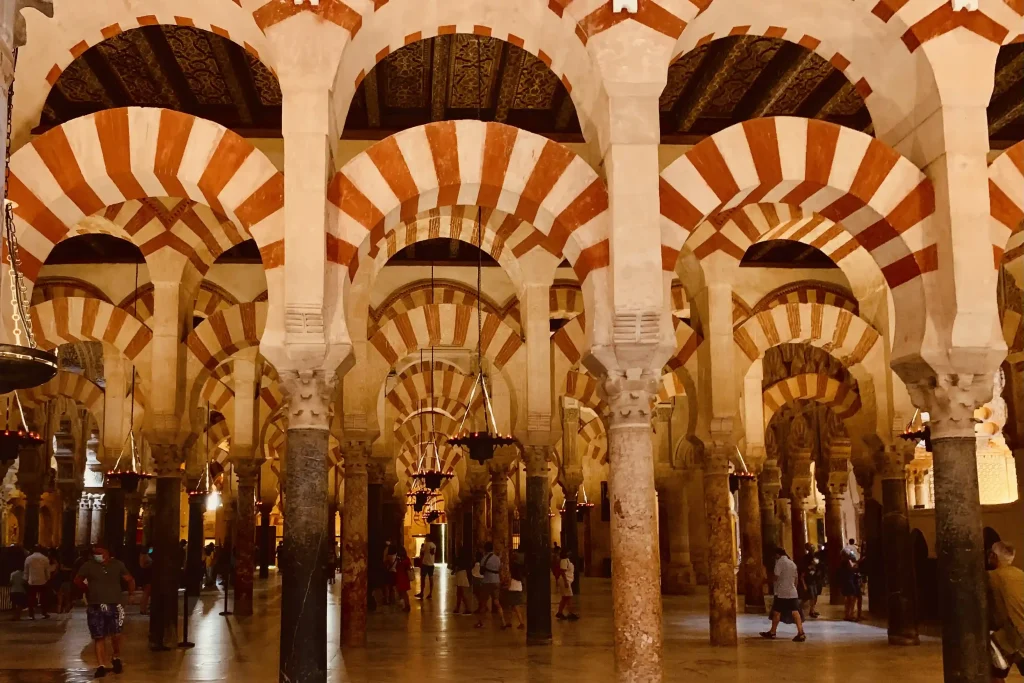
The Mezquita-Cathedral
Admission to the Mezquita-Cathedral of Córdoba generally costs around €15 and tickets can be purchased through the official website. I recommend booking online so you can choose the most convenient time for your visit and reduce waiting times. The monument is usually open every day from 10:00 AM to 6:00 PM, although opening hours may vary during religious celebrations or special events, so always check the official website before planning your visit. During certain early morning time slots (usually 8:00–9:00 AM), admission is often free. Several ticket options are available: standard admission, audio-guided visits, guided tours, admission including the bell tower, and the night-time experience “El Alma de Córdoba”. Tickets also include access to the Fernandine churches scattered throughout the city. Respectful clothing is required: it is best to avoid very short shorts and to keep your shoulders covered, as this remains an active place of worship. Access to the Bell Tower — which incorporates the original Islamic minaret — requires a separate ticket of approximately €4, in addition to the Mezquita admission fee. The visit to the tower usually takes 20–30 minutes, including the climb, time at the viewpoint, and descent. Entry is organized in small groups and follows the Mezquita’s schedule. Important: the tower is not accessible to visitors with reduced mobility, as it requires climbing approximately 203 steps, and there is no elevator.
What follows is only a brief introduction to the Mezquita-Cathedral of Córdoba, because this extraordinary monument deserves an entire article of its own. If you would like to discover all the hidden stories, curiosities, and details of this remarkable building, I invite you to read my article “The Mezquita-Cathedral of Córdoba: Much More Than a Cathedral, Much More Than a Mosque.“ There I explore its complete history, its most fascinating details, and the anecdotes that will make you fall in love with this unique place forever.
Because yes, if there is one place that encapsulates Córdoba in a few pages, it is this.
The Mezquita-Cathedral is one of those monuments that leaves you speechless, no matter how much you have read beforehand. Trust me: photographs never prepare you for the sense of wonder you feel when you step inside.
To enter, I recommend using the Puerta del Perdón (Gate of Forgiveness), the original entrance from the time of the Caliphate. Legend says that passing through it absolves you of your sins. Whether or not that actually works, you should walk through it anyway. It costs nothing, it is a beautiful gesture, and the entrance itself is magnificent.
As soon as you enter, you pass through the Patio de los Naranjos (Courtyard of the Orange Trees). In the past, worshippers performed their ritual ablutions here before prayer. Today, it is a courtyard planted with 96 orange trees, arranged to mirror the alignment of the columns inside the mosque, as though the garden continues seamlessly into the building itself.
Then you step inside.
You find yourself surrounded by endless rows of red-and-white double arches and columns that resemble a forest of stone. It feels like walking through a woodland, but inside a church. Or inside a mosque. Or somehow both at the same time.
The Mihrab is the most beautiful part of all: a small chamber covered in golden mosaics that were brought directly from Byzantium. It is an absolute masterpiece.
In 1236, the mosque was converted into a cathedral. Then, in 1523, it was decided that a Renaissance nave should be built right in the middle of the forest of columns. To make room for it, part of the original structure was demolished and a vast Renaissance chapel was erected. When Charles V saw the result, he is said to have remarked:
“You have destroyed something unique in the world to build something that can be found everywhere.”
Frankly, he had a point. Yet I must admit that the contrast remains fascinating.
Above the bell tower — which is actually the old minaret concealed within a Renaissance structure — stands a statue of the Archangel Raphael.
The people of Córdoba revere him in a way that goes beyond simple devotion. According to local tradition, he appeared twice to save the city from plague, and since then he has been regarded as Córdoba’s eternal guardian. Even today, you will find countless Triumphs of Saint Raphael throughout the city. An angel standing in the middle of the Roman Bridge — does that ring a bell?
I almost forgot one curious detail — not to say an obscure one, at least for most tourists. On the outer walls of the mosque, near a Triumph of Saint Raphael, stands an elevated doorway known as the Puerta del Sabat, the ancient passageway that once allowed the caliph to move directly from the Alcázar to the mosque. Look carefully for a small star embedded in the stone. Nobody carved it. It is actually a marine fossil, millions of years old. Locals call it the Star of Wishes. According to tradition, anyone who touches it may make a wish and receive protection in return. I touched it myself.
And if your wish does not come true, the worst that can happen is that you will have touched a star carrying millions of years of history in its stone.
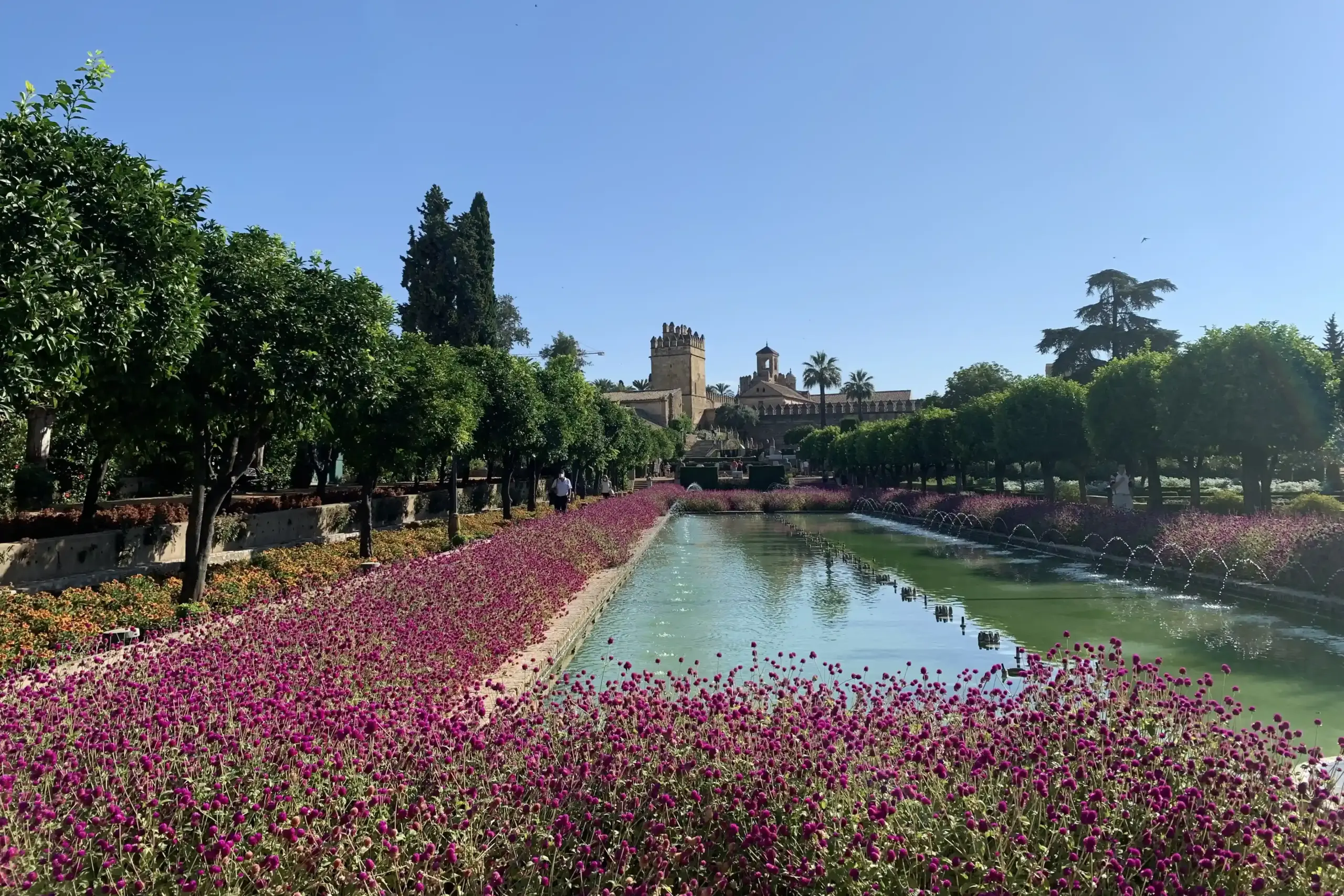
Alcázar de los Reyes Cristianos
The standard admission ticket usually costs around €5 and includes access to the towers, gardens, and royal baths. Tickets can be purchased in advance through the official website. The Alcázar is normally open every day, generally from 10:00 AM to 6:00 PM, although opening hours vary depending on the season (during summer it remains open later and sometimes offers night visits). Schedules may also change due to events or public holidays, so it is always worth checking the official website before your visit. In terms of accessibility, much of the complex has been adapted for wheelchair users through ramps and dedicated pathways.
IMPORTANT NOTICE: The Alcázar de los Reyes Cristianos will remain completely closed from January 7, pending confirmation of a new reopening date. The monument is currently undergoing a major restoration and redevelopment project. The works focus in particular on the roofs of the Salón de los Mosaicos and the Torre del Homenaje, as well as the technical installation of a new immersive light-and-sound experience planned for the gardens. During the structural work, new archaeological and historical remains of significant value were also discovered, requiring additional study and conservation measures. For this reason, the project has taken longer than originally expected: according to the restoration team, the condition of the main roof was far worse than initial assessments had indicated. This part of the itinerary will be replaced by a visit to the Caliphal Baths of the Alcázar and an exploration of the Alcázar Viejo district, including some of its most emblematic patios, at no additional cost and without any changes to existing bookings. The gardens will remain freely accessible during the day. However, from May 1, 2026, to January 10, 2027, visitors will be able to purchase an evening ticket to enjoy the spectacular Naturaleza Encendida: Navegantes event, which transforms Córdoba’s historic gardens into a visual journey inspired by one of the most important moments in history: the meeting between Christopher Columbus and the Catholic Monarchs.
As you approach the Guadalquivir, just a short walk from the Royal Stables, your attention is drawn to a solid mass of stone, sturdy towers, and straight defensive walls.
This is the Alcázar de los Reyes Cristianos, which has watched over the city for nearly seven centuries. It bears little resemblance to the other alcázars you may have seen elsewhere in Spain, such as those of Seville or Toledo. It is more compact, more austere, and far less extravagant.
Long before the Alcázar existed, however, this site was already important.
The oldest remains discovered in the Patio de las Mujeres belong to a section of the 1st-century Roman city walls, built after Córdoba was refounded as the capital of Baetica. At the time, this was a river fortress and trading hub. The Guadalquivir carried goods that were received here before being distributed throughout the city. A mosaic depicting fish, discovered beneath the site, still bears witness to this ancient relationship with the river.
With the arrival of Islam in 711, the fortress did not disappear — it evolved.
The Umayyad emirs, particularly Abd al-Rahman I, Al-Hakam I, and Abd al-Rahman II, transformed it into a royal residence. To appreciate its scale during the Caliphate, it is enough to know that the present-day Royal Stables and the Arab baths — now outside the palace grounds — originally formed part of the complex. The palace extended almost as far as the Mezquita, while the Episcopal Palace, which today stands beside the cathedral, once formed part of its defensive perimeter.
The Alcázar lost much of its importance when Abd al-Rahman III founded Medina Azahara in the 10th century and moved the court there.
A recent discovery made in February 2023 changed what historians thought they knew about the site. During accessibility works, archaeologists uncovered a large Almohad arch dating from the final third of the 12th century, hidden for centuries behind a Baroque doorway. The find demonstrated that the Almohads had not merely occupied the existing structures but had built a new alcazaba, dismantling many of the earlier Umayyad rooms. A six-meter wall and part of the original drainage system, still visible in the Patio de las Mujeres, date from that period.
After Ferdinand III the Saint conquered Córdoba in 1236, the grounds of the former Andalusi Alcázar were divided among the king, the bishop, the nobility, and the Order of Calatrava.
Yet it was under the Catholic Monarchs, Isabella and Ferdinand, that the palace experienced its most important chapter. They established their court here during the Granada War (1482–1492) and planned the conquest of the last Muslim kingdom of the Iberian Peninsula from within these walls.
Once Granada had fallen, the Catholic Monarchs no longer needed the Alcázar as their headquarters. In 1499, they handed it over to the Tribunal of the Holy Office of the Inquisition. For more than three centuries, its walls housed prisons, dungeons, and cells for those accused of heresy. The Hall of the Mosaics served as the chapel where autos-da-fé were held before the condemned were handed over to the secular authorities.
Following the abolition of the Inquisition in the 19th century, the Alcázar entered a long period of decline. It became first a civil prison and later a military prison, eventually containing 33 rooms, 20 prison cells, and 7 internal courtyards.
Declared a Historic-Artistic Monument in 1931, the building only experienced a true rebirth in the mid-20th century. In 1955, Mayor Antonio Cruz Conde secured its transfer to the city council and commissioned a major restoration project. It was during this period that the main hall was decorated with the magnificent Roman mosaics discovered beneath Plaza de la Corredera.
The Alcázar reopened to the public in 1960 and is now the second most visited monument in Córdoba after the Mezquita.
From the outside, the Alcázar is imposing: an almost perfect rectangle of cut stone walls surrounded by a dry moat that was never filled with water. At its corners stand four towers, each with its own story.
The Torre de los Leones (Tower of the Lions) takes its name from the lion carvings on its exterior. It is one of the oldest towers, and from its summit visitors enjoy spectacular views over the gardens and the Royal Stables.
The Torre del Homenaje (Tower of Homage) is the tallest structure in the complex. According to tradition, it was here that Christopher Columbus met the Catholic Monarchs in 1486. From this tower, guards controlled both the Roman Bridge and access to the city. Few visitors realize that beneath it lies the furnace that heated the water for the Mudéjar baths, using a hypocaust system remarkably similar to that of Roman bathhouses.
The Torre de la Inquisición (Tower of the Inquisition) evokes the darkest chapter of the palace’s history. Beneath it were the prisons and underground chambers where the accused were interrogated and judged.
The Torre de las Palomas (Tower of the Doves), the smallest of the four, rises above the Arab baths and owes its more pleasant name to its later use as a dovecote.
Walking along the battlements, visitors can follow the same route once patrolled by the guards of the Alcázar, enjoying privileged views over the gardens, the Royal Stables, and the city itself.
The climb is absolutely worth it.
Gardens
If the interior of the Alcázar speaks of power, war, and the Inquisition, the gardens speak of something entirely different.
Designed during the 20th century and inspired by the Islamic gardens of al-Andalus, they are the most photographed part of the monument — and it is easy to understand why.
The gardens are arranged across three levels.
The Upper Garden, closest to the palace itself, features geometrically trimmed hedges, orange trees, and cypresses. Here you will find the statue of Christopher Columbus standing before the Catholic Monarchs, a sculptural group commemorating their famous meeting in 1486.
The Lower Garden is a vast expanse of boxwood flowerbeds arranged in geometric patterns, interspersed with orange trees, palm trees, and cypresses. Water flows through channels and fountains, cooling the air even during the hottest Andalusian summers.
Further on, two large rectangular reflecting pools flank the central avenue, where ducks glide peacefully across the still water.
At one edge of the gardens, beside a mosaic and a pond, stands a tribute to the Roman poet Martial (1st century AD). It commemorates a curious anecdote: when Julius Caesar visited Córdoba in 65 BC as quaestor, he is said to have planted a plane tree on this very site. Today, a specimen of that species grows in the gardens, and the mosaic displays the poem dedicated to its memory.
Personally, while I found the site interesting from a historical perspective, I did not consider it one of the most evocative places in Córdoba.
The truly pleasant part is undoubtedly the Moorish-style gardens, which, however, are largely a relatively recent reconstruction and therefore less significant from a historical standpoint than many other places in Andalusia.
If your trip already includes visits to Seville or Granada, you may wish to consider skipping the Alcázar of Córdoba altogether and dedicating more time to the rest of the city, the alleyways of the Judería, or life along the Guadalquivir.
Baths of Doña Leonor
Admission costs approximately €3, and tickets can be purchased online. Opening hours generally follow those of the Alcázar, although it is always advisable to check before your visit.
Although the current entrance is located outside the Alcázar, in Plaza Campo Santo de los Mártires, the Royal Mudéjar Baths, better known as the Baths of Doña Leonor, are among the most atmospheric spaces in the entire complex.
They were built in the 14th century by Alfonso XI for his mistress, Leonor de Guzmán, following the classic model of an Arab hammam: three vaulted chambers — cold, warm, and hot — connected to the furnace beneath the Tower of Homage, which heated the water through a system of hot air circulating beneath the floor.
The hammam was much more than a place for bathing. It also offered massages, hair care treatments, and, more generally, every form of personal care that the caliph’s household might require.
Inside the various rooms, a small museum explains how the baths functioned. Each chamber is also equipped with informative panels that help visitors understand the importance of the hammam within Arab culture, where it represented far more than a place of aesthetic care.
In the most important room — the warm bathing chamber — meetings with distinguished visitors were often held because of its relaxing atmosphere. This space was also the setting for several assassination attempts against various caliphs, with outcomes ranging from successful to unsuccessful.
The star-shaped skylights were deliberately designed to project light differently depending on the time of day, creating a constantly changing play of shadows and reflections across the water.
If you manage to visit during a quiet moment, with few other visitors around, you may feel as though you have stepped into a palace from One Thousand and One Nights.
If your visit to the Caliphal Baths of the Alcázar leaves you wanting to experience a true Andalusian hammam, then Hammam Al Ándalus is a very appealing option. It is not an authentic historical site, but rather a modern recreation designed to capture the original spirit of the Arab bath: soft lighting, Moorish-style arches, hot, warm, and cold pools, mint tea, silence, fragrances, and barely perceptible music. More than just a contemporary spa, it is a true sensory immersion that offers a glimpse — if only for a few hours — into how deeply water, steam, and tranquility were woven into the culture of al-Andalus.
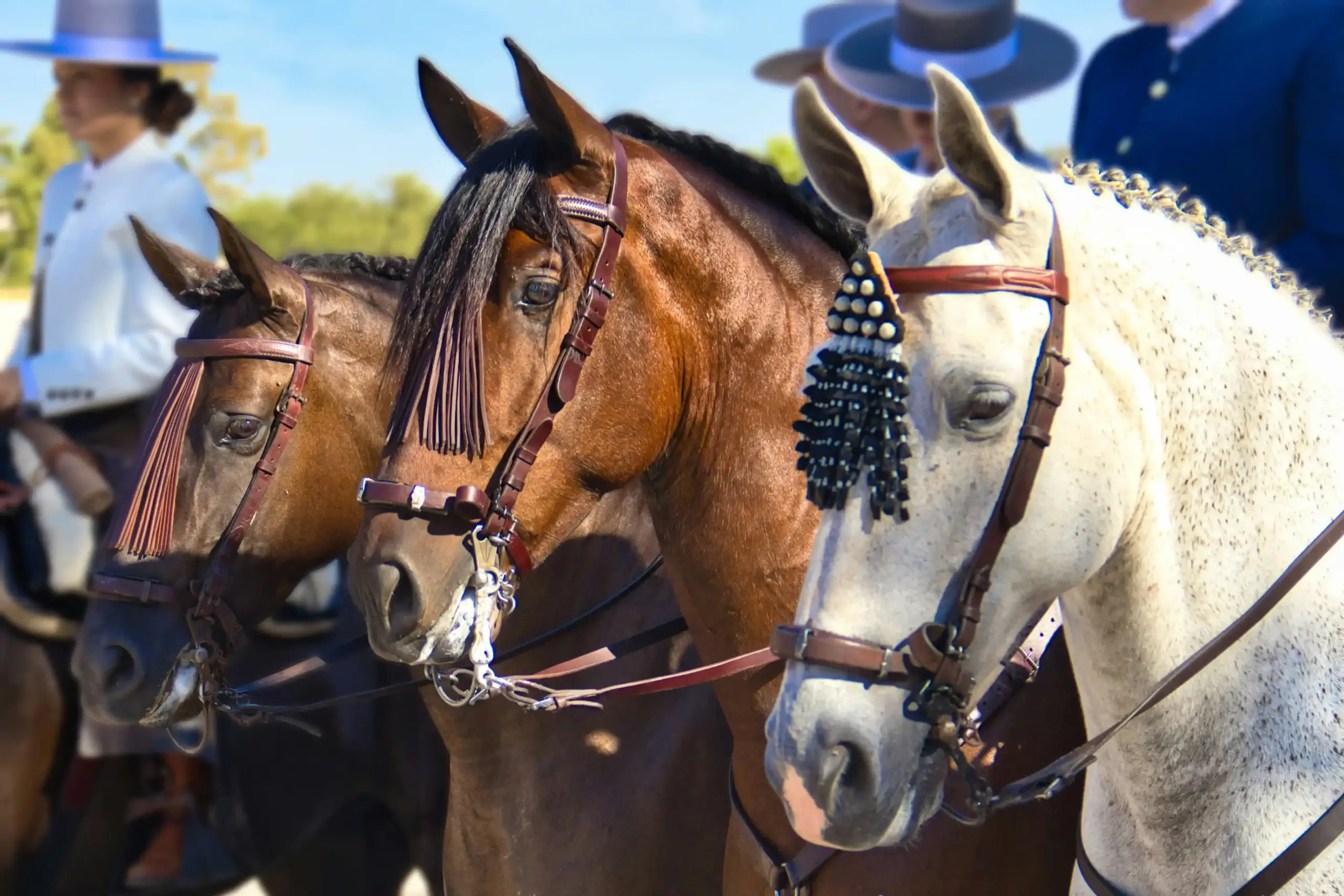
Royal Stables (Caballerizas Reales)
General admission costs around €5 and normally includes an audio guide for a self-guided visit of the accessible areas. Opening hours vary slightly depending on the day, but generally run from 10:00 AM to 9:30 PM, with a closure during the traditional siesta hours, from Tuesday to Saturday. If you would like to attend the famous Caballerizas Reales de Córdoba equestrian show, performances are usually held in the evening, around 8:00 PM. During certain periods of the year, there may also be an additional performance around 1:00 PM, so it is always worth checking the official Córdoba Ecuestre website before your visit. Tickets including the show cost approximately €18.50, while the Premium Ticket is around €24. The latter allows entry about thirty minutes before the performance begins and offers the opportunity to take photographs in a quieter setting. During the show itself, flash photography and video recording are generally prohibited so as not to disturb the horses and riders. Opening hours may also vary due to training sessions, special events, or show preparations, so it is always advisable to check online beforehand. During local festivals and special Andalusian cultural events, free activities or special openings may also be available.
Just outside the Alcázar stand the Royal Stables.
Long before King Philip II conceived his famous stables, this site was already dedicated to horses. It occupies the remains of the ancient Caliphal stables, which reached their greatest splendor during the reign of Al-Hakam I in the 9th century. Historical accounts suggest that they once extended all the way to the banks of the Guadalquivir and could accommodate more than two thousand horses. Centuries later, the Almohads further developed the area by building an albacara, a fortified enclosure designed for the keeping and protection of horses.
The complex we see today was created in 1570 at the request of Philip II.
The monarch who ruled the empire “on which the sun never set” had a very specific objective: to establish a breeding center dedicated to selecting and improving the Spanish horse for service to the Royal Household. He allocated 8,000 ducats to the project and entrusted it to Diego López de Haro y Guzmán, his first caballerizo, who selected the finest mares and stallions from across the Guadalquivir Valley.
Construction lasted eight years. Materials salvaged from the nearby Umayyad city of Medina Azahara were reused in the building process, and the irrigation system of the neighboring Alcázar de los Reyes Cristianos was incorporated into the design.
In 1734, a devastating fire almost completely destroyed the complex. Miraculously, only the exterior and interior façades survived. Reconstruction began eleven years later under Ferdinand VI. The architect preserved the original three-nave structure, added the coat of arms of Charles III above the main entrance — where it remains today — and restored at least part of the building’s former grandeur.
Federico García Lorca famously described the stables as the “cathedral of horses.”
It is a name that suits them perfectly.
Since 2010, the organization Córdoba Ecuestre has managed the complex, organizing visits and equestrian performances while pursuing a broader goal: the creation of an International Horse Center dedicated to preserving and promoting the culture and heritage associated with the Andalusian horse.
And the horse that emerged from these stables is indeed something extraordinary.
The origins of the Spanish horse disappear into antiquity. Roman authors such as Plutarch, Pliny the Elder, and Seneca already praised the horses of Hispania for their beauty, courage, and gentle temperament. Yet it was Philip II who laid the definitive foundations of the breed by bringing together the finest horses from the provinces along the Guadalquivir. From this selection emerged the Yeguada Real, the official origin of the Andalusian horse we know today. The official designation Pura Raza Española (PRE) was adopted in 1912 to reinforce the breed’s national identity.
For centuries it was the horse of Europe’s kings.
Balanced, noble, courageous, and exceptionally docile, it is renowned for its intelligence, its willingness to learn, and its remarkable sensitivity to a rider’s commands — qualities that make it a pleasure to ride. It excels in classical dressage, working equitation, haute école, and driving disciplines.
It is therefore no surprise that it was exported throughout the Spanish Empire, becoming one of the foundation breeds behind horses such as the Portuguese Lusitano, the Austrian Lipizzaner, and the Paso Fino. Today, the global population of registered PRE horses exceeds 180,000 animals, bred in more than fifty countries.
The highlight of any visit is undoubtedly the performances organized by Córdoba Ecuestre.
For approximately 70 minutes, the mastery of the Andalusian horse merges with the passion of flamenco in a spectacle that is difficult to describe with words alone.
The program combines several disciplines: classical dressage, featuring elegant and precise movements of the haute école; doma vaquera, showcasing techniques derived from cattle work; and the aires de la garrocha, where riders manipulate long poles in spectacular choreographed routines. All of this unfolds to the accompaniment of live flamenco music and dance, with riders often dressed in historical costumes.
The fusion of equine power and Andalusian artistry is simply mesmerizing.
It is a unique opportunity to appreciate up close both the intelligence and nobility of these animals — and the extraordinary bond they build with their riders.
A similar show can also be seen in Jerez de la Frontera.
Personally, I enjoyed them both: one because it is the true cradle of the breed, the other because it is pure art.
If you are passionate about horse riding or would like to experience the world of the Andalusian horse up close, one of the best times to visit Córdoba is often in September, when the historic Caballerizas Reales host CABALCOR — the Feria Morfológica del Caballo.
This is far more than a local fair. It is one of the most important equestrian events in Spain and on the international circuit dedicated to the Pura Raza Española (PRE). For several days, Córdoba becomes a meeting point for breeders, riders, and horse enthusiasts from across the world.
The event features numerous morphological championships, high-level competitions, demonstrations, and technical showcases dedicated to the Spanish horse. Alongside the competitions, a large exhibition and commercial area brings together specialized companies presenting equipment, saddles, riding apparel, and the latest innovations from the equestrian industry.
Perhaps the most fascinating aspect, however, is the atmosphere itself. Seeing the horses move through the ancient stables commissioned by Philip II makes the experience especially evocative. For a few days, the Caballerizas Reales cease to be merely a historic monument and return to life for exactly the purpose for which they were created more than four centuries ago.
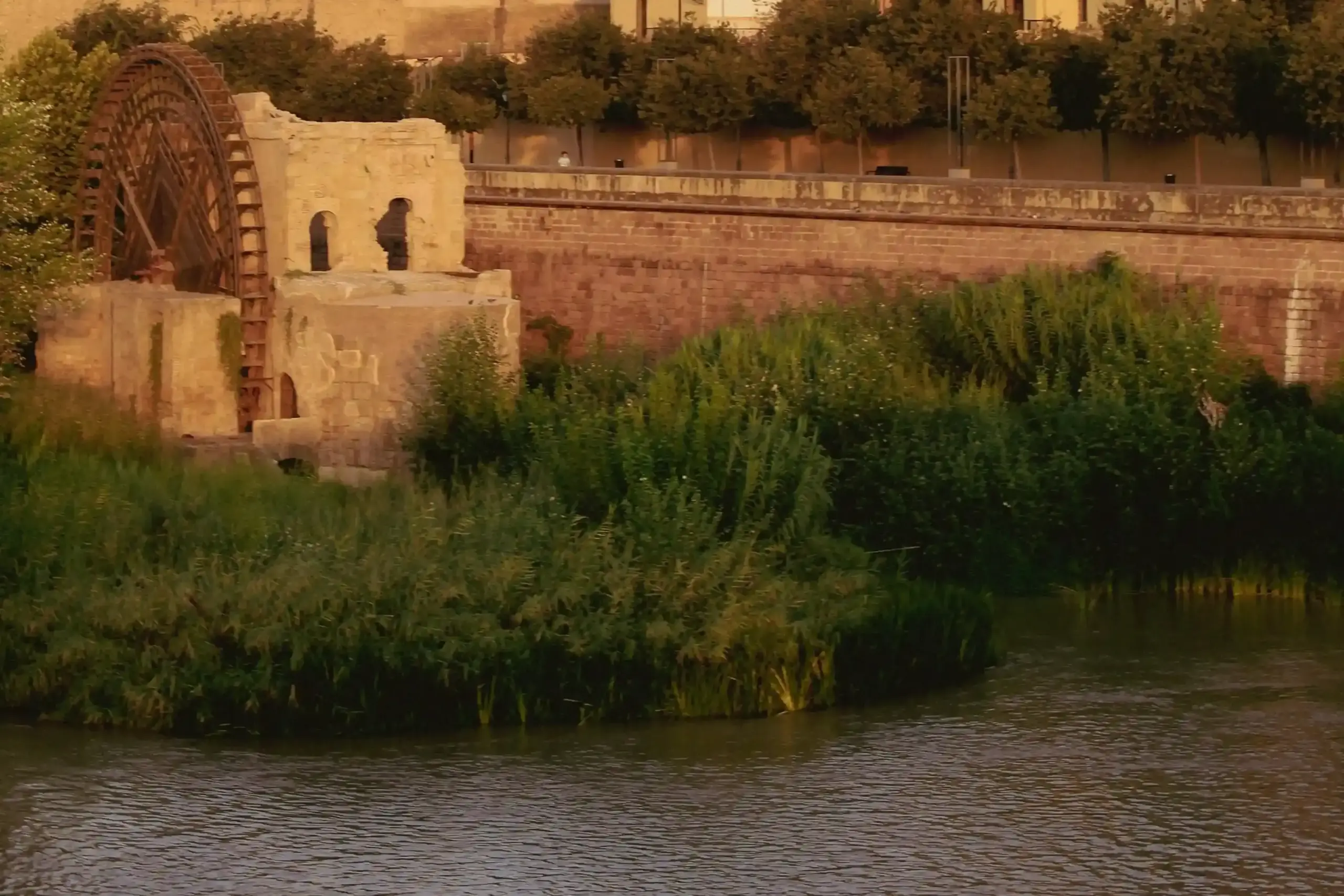
The Riverside Promenade and the Mills
Heading toward the Guadalquivir, along the riverside promenade on Avenida Fray Albino, you find yourself in what was once the port of Córdoba. The Guadalquivir once reached right up to the palaces visible on the left — difficult to imagine today, but the water used to be here.
Now the river flows more narrowly and slowly. On one side, the Mezquita is reflected in the water; on the other, the Torre de la Calahorra stands watch. It is one of those parts of the city where you inevitably stop to admire the view.
This stretch of water, surrounded by dense vegetation, forms part of a protected natural area known as the Sotos de la Albolafia, a nature reserve of just 21 hectares designated as a Natural Monument. Its size may be small, but its biodiversity is not: it is home to more than 120 bird species, some of them endangered. Remarkable for an area located right in the heart of a city. It is a perfect spot for birdwatchers — but also for anyone who simply wants to sit quietly by the river.
Continuing along the riverbanks, you can still see the remains of the Islamic watermills, built during the medieval period to harness the river’s current. It is estimated that there were once more than a dozen of them, used to manage the city’s water supply, grind grain, and produce paper from cotton — a process explained exceptionally well at the Casa Andalusí.
The most famous is the Molino de la Albolafia, whose large reconstructed waterwheel stands right beside the Roman Bridge. It was originally used to supply water to the royal gardens of the Alcázar.
The Arab mills of Córdoba were structurally similar to those found in Syria and Egypt, and represent some of the oldest examples of hydraulic engineering in Western Europe. The Molino de la Albolafia is so closely linked to the city’s identity that it even appears on the coat of arms of Córdoba.
If you would like to understand how these hydraulic systems worked, the Hydraulic Museum of the Molino de Martos is well worth a visit. It preserves the remains of the mill chambers and houses an interpretation center explaining the technologies and processes used. As of May 2026, it appears to be temporarily closed, but its website features an excellent video demonstrating how the mill operated.
According to local tradition, Queen Isabella I of Castile, during her stay at the Alcázar of Córdoba, ordered the Albolafia waterwheel to be stopped. This great hydraulic wheel supplied water to the palace gardens, but its constant noise allegedly prevented her from sleeping.
From that moment on, the story goes, the waterwheel ceased operating and the gardens lost their original irrigation system. Today, the wheel still stands beside the Guadalquivir, a silent witness to a decision that may have been made simply for the sake of a royal night’s sleep.
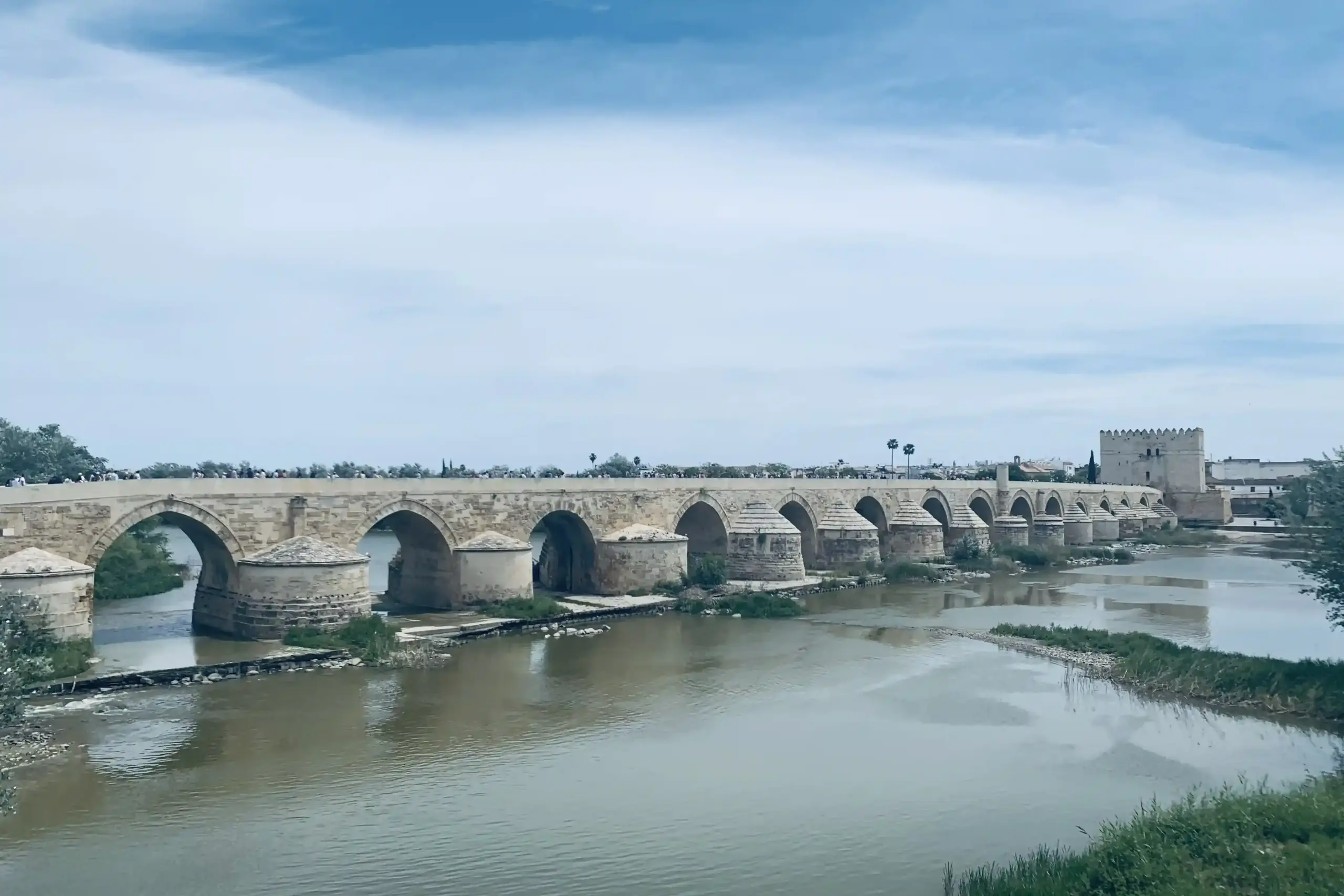
Roman Bridge
The Roman Bridge is one of the oldest structures still in use in Spain.
It was built by the Romans in the 1st century BC — possibly on the orders of Octavian Augustus, replacing an earlier wooden bridge — and was likely part of the Via Augusta, the great road that connected Rome to Cádiz.
Remarkably, for almost two thousand years it was the only crossing point over the Guadalquivir in Córdoba. The city’s second bridge was not constructed until the mid-20th century. Before that, the only alternative to the Roman Bridge was a system of paid rafts that ferried passengers across the river for a few pesetas. These remained in operation until the middle of the 1900s. If you speak with some of Córdoba’s older residents, they may tell you that they personally used these rafts to reach the opposite bank.
The structure visible today is largely the one rebuilt by the Muslims in the 8th century, upon the original Roman foundations. It consists of 16 arches — one fewer than the original 17 — and measures 247 meters in length and approximately 9 meters in width. Since 2004, it has been exclusively pedestrian.
Of all the arches, only the 14th and 15th arches, counting from the northern entrance, are genuinely Roman. The others were rebuilt during different periods, some featuring pointed Gothic arches — a detail that tells, arch by arch, a story spanning two millennia.
At the center of the bridge stands the statue of Saint Raphael, Córdoba’s guardian archangel, almost always surrounded by flowers and candles.
Walking across the bridge, leaving the Torre de la Calahorra behind while the Mezquita begins to glow in the evening light and the Guadalquivir reflects the colors of the sky, is one of those Córdoba moments that finds its way directly into your most cherished travel memories.
The recent restoration of the Roman Bridge sparked considerable debate among architects, historians, and archaeologists. The replacement of the old cobblestone surface with large reddish stone slabs, together with the new lighting system and modern railings, was criticized by many experts, who argued that the bridge had lost part of its original historic character.
Personally, I never saw the bridge before the renovation, so I cannot make a direct comparison. What I can say is that, despite the controversy, its charm remains intact — especially at sunset, when the Guadalquivir reflects the light of the Mezquita and the city seems to slow down around its arches.
For television enthusiasts, there is another interesting fact: in 2014, the bridge was chosen as the filming location for the famous “Long Bridge of Volantis” in the fifth season of Game of Thrones.
Torre de la Calahorra
Admission costs around €4.50 and tickets can be purchased on site. The tower is open every day from 10:00 AM to 6:00 PM, although opening hours vary depending on the season. Be sure to check the website of the Paradigma Foundation, which manages not only the tower and museum but also the Biblioteca Viva de Al-Andalus.
At the southern end of the bridge stands the Torre de la Calahorra, imposing and silent on the opposite bank of the Guadalquivir. It was built by the Moors as a defensive structure — a stronghold designed to protect both the bridge and the city’s southern entrance.
When the tower was first constructed, there was almost nothing on this side of the river: a cemetery, a few cultivated fields, and little else. The name Calahorra is said to mean “the solitary one,” and it must indeed have appeared exactly that way, standing alone on an otherwise empty riverbank.
Originally, the structure consisted of just two towers. In the 14th century, after the Reconquista, it was expanded with the addition of the lateral sections in order to accommodate a larger garrison. Today, the building contains fourteen rooms. A surrounding moat was also added, further reinforcing its defensive function.
Over the centuries, the tower served many different purposes. It was used as a prison — particularly for Morisco prisoners from Granada — and later became a girls’ school during the 19th century. In 1931, it was declared a Cultural Heritage Site. Today, it houses the Museo Vivo de Al-Andalus (Living Museum of Al-Andalus), also known as the Museum of the Three Cultures. The museum offers an interactive journey through 10th-century Córdoba, exploring the coexistence of Muslims, Christians, and Jews, as well as the science, philosophy, and daily life of the Caliphate.
The terrace at the top provides one of the finest views in the city: the Roman Bridge stretching out before you, the Mezquita rising in the background, and the Guadalquivir flowing quietly between them.
Crossing back over the bridge toward the Mezquita side of the river, you arrive at the Puerta del Puente, a 16th-century Neoclassical gateway designed by Hernán Ruiz II.
It is not a triumphal arch in the classical sense. Rather, it is a monumental city gate that once marked the boundary between the city and the bridge.
Today, it has become a small public gathering place where people sit, chat, and watch the river flow by.
On the Moorish-style wall of the building bordering the square, you may notice an unusual detail that is far more common in Córdoba than it first appears. There are actually two overlapping names: one written in large letters — Plaza del Triunfo — and another, smaller one, displayed on a traditional ceramic street plaque: Plaza del Puente.
This is not a mistake, but rather a distinctive feature of Córdoba’s urban toponymy. Throughout the city, it is quite common to find two names coexisting:
- the modern official name — the one you would typically find on Google Maps — usually written in black lettering on white ceramic tiles;
- the historical or traditional name, often displayed in blue and in a smaller format.
It may seem like a simple detail, but it reveals a great deal about the way Córdoba preserves its urban memory. Rather than erasing the past, the city often allows it to coexist with the present — even on the signs marking its streets and squares.
Two names, two eras, two identities that continue to share the same wall today.
Before leaving the river behind, one final recommendation: follow the riverbank all the way to the Puente de Miraflores.
At sunset, this spot offers one of the most beautiful views of the Roman Bridge — warm golden light, still water, and the silhouette of the Mezquita rising in the background. Try to plan your day so that you arrive here at exactly that time.
It’s worth it. Trust me.
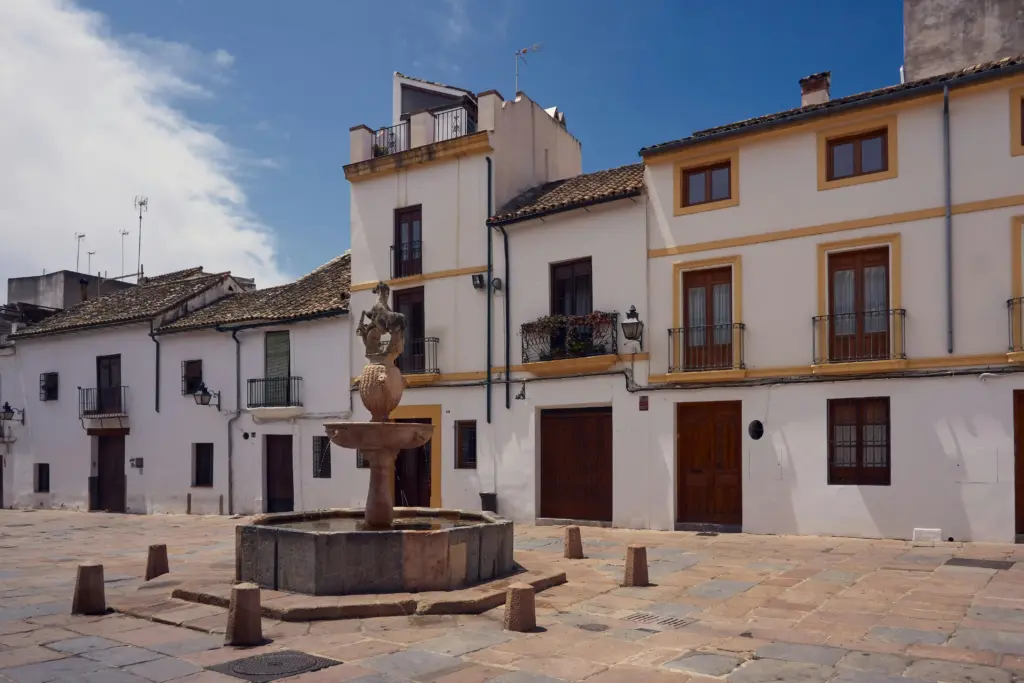
Toward Modern Córdoba
One thing you have probably already noticed while walking around: Córdoba is not a city of grand squares. Most of its plazas are small, intimate spaces, closely tied to the surrounding neighborhood and everyday life.
The exceptions — and they are wonderful exceptions — are found precisely along this part of the route.
Plaza del Potro
This small square is, for me, one of the most enchanting corners of all Córdoba.
We are in the heart of what was once the commercial district of medieval Córdoba. Plaza del Potro takes its name from the fountain at its center, crowned by a small horse — the potro, or foal — that has identified this space for centuries. It was a marketplace where merchants from across the province gathered with their horses and mules to trade handcrafted goods and livestock.
Overlooking the square is the Posada del Potro, which served as their inn and was considered one of the finest in the city. The building is mentioned in Cervantes’ Don Quixote, and Cervantes himself may well have stayed here. It still preserves the atmospheric livestock enclosure on the ground floor. Today, it houses the Centro Flamenco Fosforito (admission around €2), dedicated to the study and promotion of flamenco. It regularly hosts Café Cantante performances — concerts and shows open to the public that are particularly atmospheric. Check the center’s website to see the current schedule.
Two other buildings facing the square are also worth knowing about, and both share access through a beautiful courtyard.
The Museum of Fine Arts occupies the former Hospital de la Caridad. It is relatively small but contains several important works, including paintings by Murillo and a selection of modern artists such as Rodríguez de Luna.
The Julio Romero de Torres Museum is dedicated to Córdoba’s most famous painter. His style is distinctive — at times unsettling — and he was often criticized for his portrayal of nude women in situations considered demeaning. It is not exactly my favorite artistic style, but if you are curious, it is worth a visit to add a different perspective to your understanding of Córdoba.
Today, the square is one of the most photographed and beloved places in the city, and the people of Córdoba are particularly fond of it. But the real magic happens in the evening. As darkness falls, the lighting projects the shadow of the fountain’s horse onto the façade of the Museum of Fine Arts, enlarged and stylized as if it had appeared by magic. With the first light of dawn, it disappears.
Try to include it in your itinerary at sunset, right after enjoying the view from the Puente de Miraflores. You won’t regret it.
In this part of the city, it is worth paying attention to the street names. Many of the streets that run alongside the river or end near the Guadalquivir still preserve names linked to the city’s traditional trades:
- Bataneros, the craftsmen who worked with cloth and wool;
- Lineros, associated with the processing of linen;
- bakers and other artisans whose activities depended directly on water.
This is no coincidence. For centuries, the Guadalquivir was not merely a picturesque backdrop but a genuine economic and productive resource. Its waters were used for washing, dyeing, powering machinery, processing textiles, and sustaining industries that seem far removed from the tourist city we see today.
Even the street names tell the story of a different Córdoba: a more practical, more artisanal city, deeply connected to the river and to everyday work.
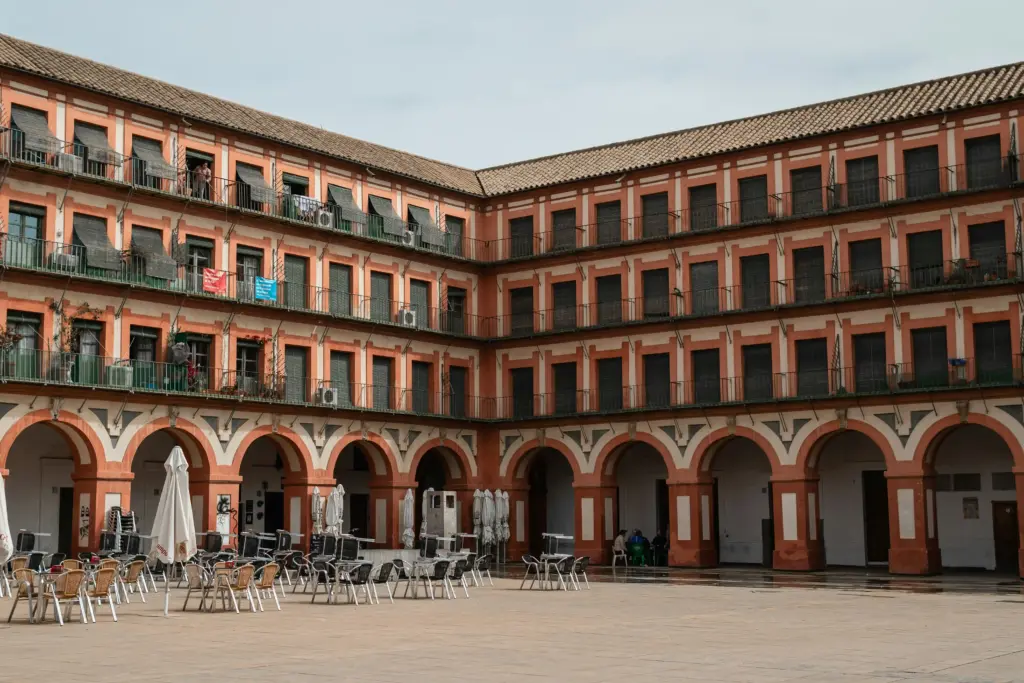
Plaza de la Corredera
Plaza de la Corredera is something completely different from everything we have seen so far.
With its 113 meters in length and 55 meters in width, its arcaded façades painted in shades of ochre, red, and green, it feels more like Madrid or Salamanca than Andalusia. In fact, it is the only rectangular plaza mayor in all of Andalusia, and the theatrical effect it creates is impossible not to associate with Spain’s great urban squares.
The square has had a remarkably eventful history. It hosted bullfights (from which the name Corredera derives), public executions carried out by the Inquisition, and for decades served as the site of a large covered market.
Today, it is filled with veladores — the characteristic outdoor café tables — and is the perfect place to stop, order something to drink, and watch life go by.
A tip: in the morning, the square feels somewhat sleepy. Its true spirit emerges in the evening, just before dinner, when the bars beneath the arcades come alive and the atmosphere becomes vibrant and energetic.
That is exactly why I have brought you here at sunset.
Beneath the arcades lies the Mercado de la Corredera, open from Monday to Saturday, housed in a building that is actually older than the square itself. It was constructed in 1583 and has reinvented itself many times over the centuries: it has served as a town hall and prison, a grain warehouse, a hat and textile factory owned by a man named José Sánchez Peña (hence its official name, Mercado de Sánchez Peña), and finally, from the late 19th century onward, a food market. Today, the upper floor also houses a Civic Center.
The roots of the square, however, go much deeper.
La Corredera stands precisely on the site of what was once Córdoba’s Roman Circus. During archaeological excavations, magnificent Roman mosaics were discovered here. They can now be admired in the Hall of the Mosaics inside the Alcázar.
During the restoration works of the 1950s, the original plan was to completely close the northern side of the square with a continuous and perfectly uniform façade, matching the arcaded buildings on the other sides. The goal was to create a symmetrical, orderly, almost theatrical space.
The project, however, encountered resistance from an elderly woman who owned one of the houses occupying precisely that section of the square. According to local tradition, she categorically refused to sell the property or allow it to be demolished.
Her opposition was so determined that the City Council — some accounts even mention pressure from circles close to the Crown — was forced to alter the original design.
The result is still clearly visible today. Next to the modern three-arched façade of the Casa de la Vivienda, the older Casa del Temple remains standing. It projects slightly beyond the surrounding buildings, breaking the symmetry envisioned by the urban planners of the time.
It is also said that the owners received financial compensation in exchange for preserving the house — a detail that was far from commonplace in Spain during those years.
It is a small urban story, yet it says a great deal about Córdoba: even in the midst of major redevelopment projects, the past often finds a way to endure, leaving a crack in the geometric perfection of the city.
Roman Temple
Just a short walk from Plaza de la Corredera, the city suddenly travels back two thousand years, to the days of Hispania Ulterior.
The Roman Temple of Córdoba is one of the few monumental remains of Roman Corduba still visible today, and it stands as a symbol of the city’s golden age as the capital of the Roman province of Baetica.
It was completed during the 1st century AD: a temple surrounded by a colonnade on all sides, with a main façade featuring six columns adorned with acanthus-leaf capitals, raised on a high podium at the center of a vast square. The structure measured approximately 32 meters in length and 16 meters in width and was built almost entirely of marble.
The remains were rediscovered in 1950, during the expansion of the City Hall (Ayuntamiento), which now stands immediately beside the columns. Of the original complex, only the foundations, altar, access staircase, and several Corinthian column shafts survive. The capitals and decorative blocks are preserved in the Archaeological and Ethnographic Museum of Córdoba. In recent years, an access walkway and a small interpretation center have been added, allowing visitors to approach the remains and better understand the temple’s role within the Roman city.
This is the perfect place to imagine the city that once stood here.
The area where you are standing was originally a vast square — approximately 80 by 60 meters — located on the northern edge of Colonia Patricia Corduba, where the Via Augusta met the axis of the old decumanus, the main road through which travelers and Roman legions entered the city. Today’s Calle Capitulares still roughly follows the course of that ancient route.
This was the provincial forum: a space for political gatherings, religious ceremonies, and the public display of power.
All around it stood porticoes with smaller columns and red-tiled roofs. Along the edges, market stalls bustled with activity. Men and women in togas and stolas crossed the square, while Roman officials debated affairs of state in nearby administrative buildings.
And at the center, dominating everything, stood the temple itself.
Dedicated to the Imperial Cult, it was positioned so that anyone entering Córdoba would immediately understand, without a single word of explanation, that this city belonged to Rome.
In other words, it belonged to the Emperor.
The forum was connected to the theater — located roughly where the present-day Archaeological Museum stands — and to the Roman circus, whose site is now occupied by Plaza de la Corredera.
It was a city designed according to a precise logic, where every building communicated power, order, and membership in something far greater than oneself.
If you would like a clearer understanding of Córdoba’s history, especially the periods before the Caliphate, I highly recommend a visit to the Archaeological Museum of Córdoba.
What many visitors do not realize is that, as you walk through its galleries, you are quite literally walking across history on two different levels. Beneath your feet, in the atmospheric crypt of the Renaissance palace that houses the museum, archaeologists uncovered the remains of an entire Roman street, complete with the characteristic grooves left by cart wheels, once part of the urban fabric of 1st-century AD Corduba.
Even more surprising is the Roman theater visible beneath the museum’s modern extension. Excavations revealed that, before the construction of the grand Augustan performance venue, the site was occupied by a Republican artisan district featuring pottery kilns and vats used for dyeing textiles.
A visit to the museum — free for EU citizens and costing just €1.50 for others — therefore becomes a true vertical journey through time: from 21st-century Córdoba, through the 16th-century palace that houses the collection, and down to the workshops of the 2nd century BC, immersed in a dim light that preserves the excitement of an almost untouched archaeological discovery.
Plaza de las Tendillas
Just behind the Roman Temple lies Plaza de las Tendillas — the main square of contemporary Córdoba and the place where the ancient city gives way to the modern one.
Its name comes from the small shops — the tendillas — that appeared here during the medieval period, in an area that was already a focal point of commerce and urban life, just a short distance from the ancient Roman forum. This continuity says a great deal about how certain parts of a city remain strategically important across the centuries, regardless of how much everything around them changes.
At the center of the square stands the equestrian statue of El Gran Capitán — Gonzalo Fernández de Córdoba, the military commander born in this city who, during the 15th and 16th centuries, helped transform Spain into the dominant military power in Italy and is widely regarded as the father of modern military tactics.
Take a moment to look at the statue carefully.
The body is made of bronze, while the head is carved from marble. This contrast is not merely an aesthetic or technical choice — facial details could be rendered more precisely in marble than in bronze — but also carries a symbolic meaning. White, luminous marble has long been associated with figures of exceptional prestige: emperors, philosophers, and saints. Using it for the head of El Gran Capitán was a way of acknowledging not only his military achievements but also his intellectual and cultural stature.
Las Tendillas is not a tourist square. It is a real square. Shops, cafés, locals going about their daily lives, and children who, on the hottest days, play in the fountains, where jets of water rise more than two meters into the air. For visitors, it is one of the best places to observe the city’s everyday rhythm — the Córdoba that still exists beyond the routes of mass tourism.
One detail not to miss is the Reloj de las Tendillas, the square’s famous clock. Throughout the year, whenever the hour strikes, it plays melodies based on traditional Spanish songs — an unexpected soundtrack accompanying your walk through the city. But it is on New Year’s Eve that it becomes truly special. The traditional chimes are replaced by guitar melodies and flamenco rhythms, turning the countdown to midnight into a small Andalusian serenade. A distinctly Cordoban way to welcome the new year.
From the square radiate the city’s principal shopping streets. Calle Cruz Conde is the liveliest of them all, with occasional traces of early 20th-century Modernist architecture appearing among the façades. The surrounding area is the perfect place for a break — a morning coffee, a vermouth — before diving once again into the medieval maze of streets that awaits beyond.
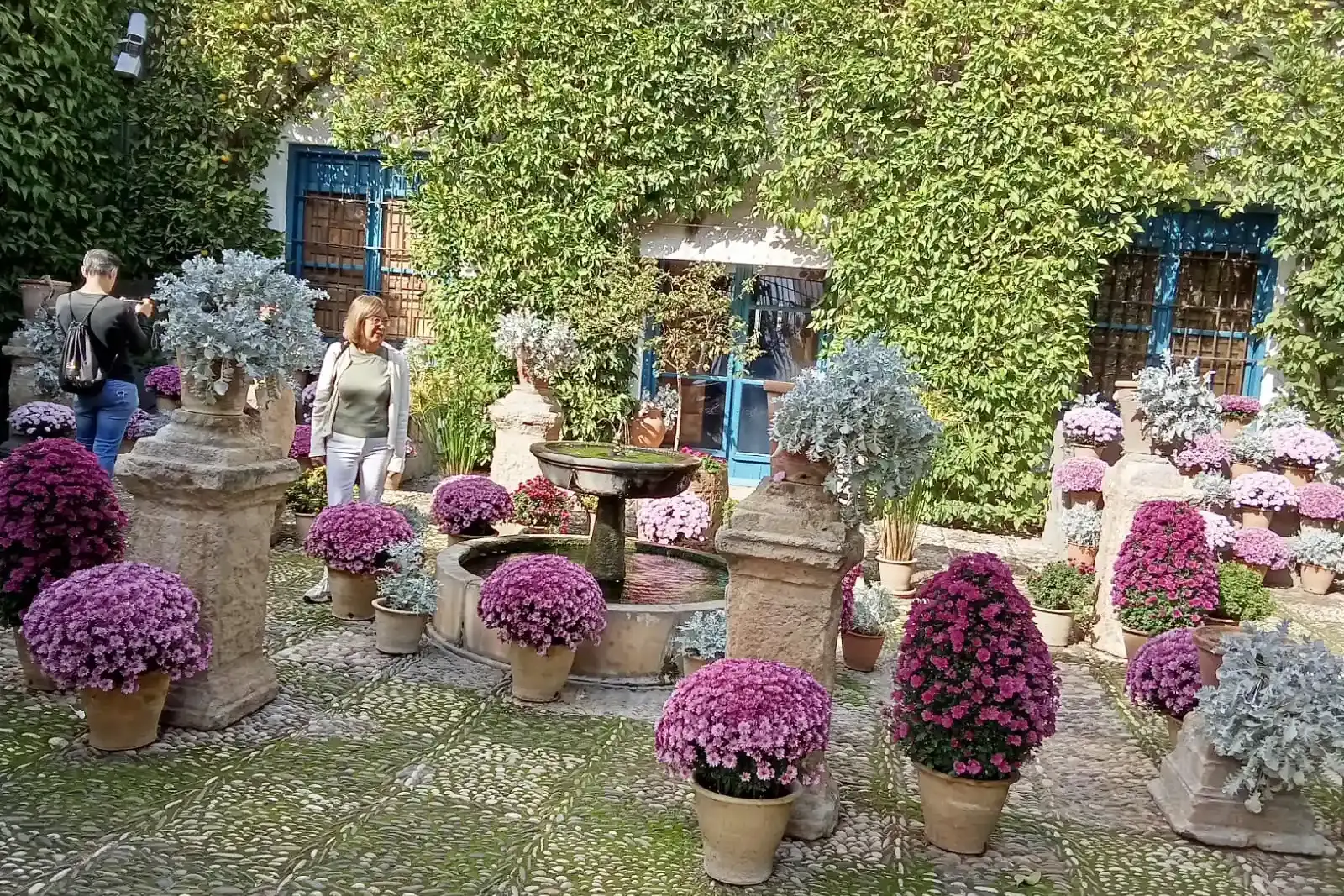
Palacio de Viana
Tickets can be purchased directly through the official website, and I recommend booking in advance to avoid queues or sold-out time slots. Visits are available in several formats: patios + noble rooms (around €8.50, approximately 1 hour); combined visit: patios + interiors (around €14, approximately 2 hours); or a guided tour of the interiors (around €9, approximately 90 minutes), which can only be purchased on site. Opening hours vary slightly throughout the year and during local festivals, so always check the official website, but as a general guideline, the palace is open Tuesday to Sunday from 10:00 AM to 3:00 PM. Highly regarded concerts are also organized here, and the schedule is available online. There is a small trick that many visitors do not know: on Thursday afternoons, between 2:00 PM and 5:00 PM, the ticket for the patios-only visit is usually available at about half price. Considering that the twelve patios are the palace’s most famous and enchanting feature, it is probably one of the best ways to visit while spending less.
If you want to understand what a Cordoban patio truly is — not just one, but all of them, in their evolution — from an aesthetic point of view, then you must visit the Palacio de Viana.
From its austere and discreet entrance, you would never guess what awaits inside. But the moment you step through the doorway, you discover the city’s most important collection of patios: twelve courtyards and a garden, unfolding one after another like a Chinese box of light, flowers, and water. A labyrinth you do not expect.
The Palacio de Viana is not a static museum. It is a genuine residence, continuously inhabited from 1425 to 1980, and every room still tells the story of the families who lived here — a total of eighteen owners over the centuries.
The family that gave the palace its name, the Marquises of Viana, acquired the property in 1871, when Juan Bautista Cabrera y Bernuy died without heirs and Teobaldo de Saavedra y Cueto was granted the title of Marquis of Viana. The name does not refer to a place: it is simply the noble title of its final and most influential owners.
For nearly five centuries, the palace remained private and inaccessible. Only invited guests and household staff could cross its threshold. Everything changed in 1980, when the last marchioness, Sofía Amelia de Lancaster, sold the entire property — building, furnishings, and art collections included — to the Caja Provincial de Córdoba. It opened to the public in 1981 and was declared a National Historic-Artistic Monument. Today, it is the second most visited secular monument in Córdoba after the Alcázar.
The true heart of the palace is the extraordinary sequence of its twelve patios, each completely different from the next, connected by a circular route. Walking through these spaces is a sensory experience that is difficult to forget: the fragrance of orange trees, the sound of water flowing from fountains, and the changing light around every corner. The noise of the street quickly disappears, replaced by a silence that feels almost unreal for a place in the center of a city.
After the final patio, the route opens into the garden: more than 1,200 square meters filled with roses, palm trees, and a magnificent centuries-old oak tree that makes you almost forget where you are. Concerts and outdoor events are regularly held here, adding even more charm to the visit.
If visiting the patios is already a wonderful experience, the guided tour of the interiors is essential if you want to fully understand the history of this place.
Unlike a traditional museum, the rooms remain furnished with the original possessions of the marquises: furniture, paintings, tapestries, and porcelain. Visitors gain access to both the noble apartments and the service areas — the kitchen with its wood-burning stove, the washroom, and cupboards still filled with tableware. In the stables, one of the palace’s 19th-century wedding carriages has been preserved: a true jewel.
On the upper floor are the art collections, including a room entirely dedicated to Julio Romero de Torres, Córdoba’s most celebrated painter, and masterpieces such as Mystical Love and Profane Love. The collection is complemented by Baroque paintings and the palace’s Historic Archive, considered the second most important in Andalusia, containing documents dating back to 1119.
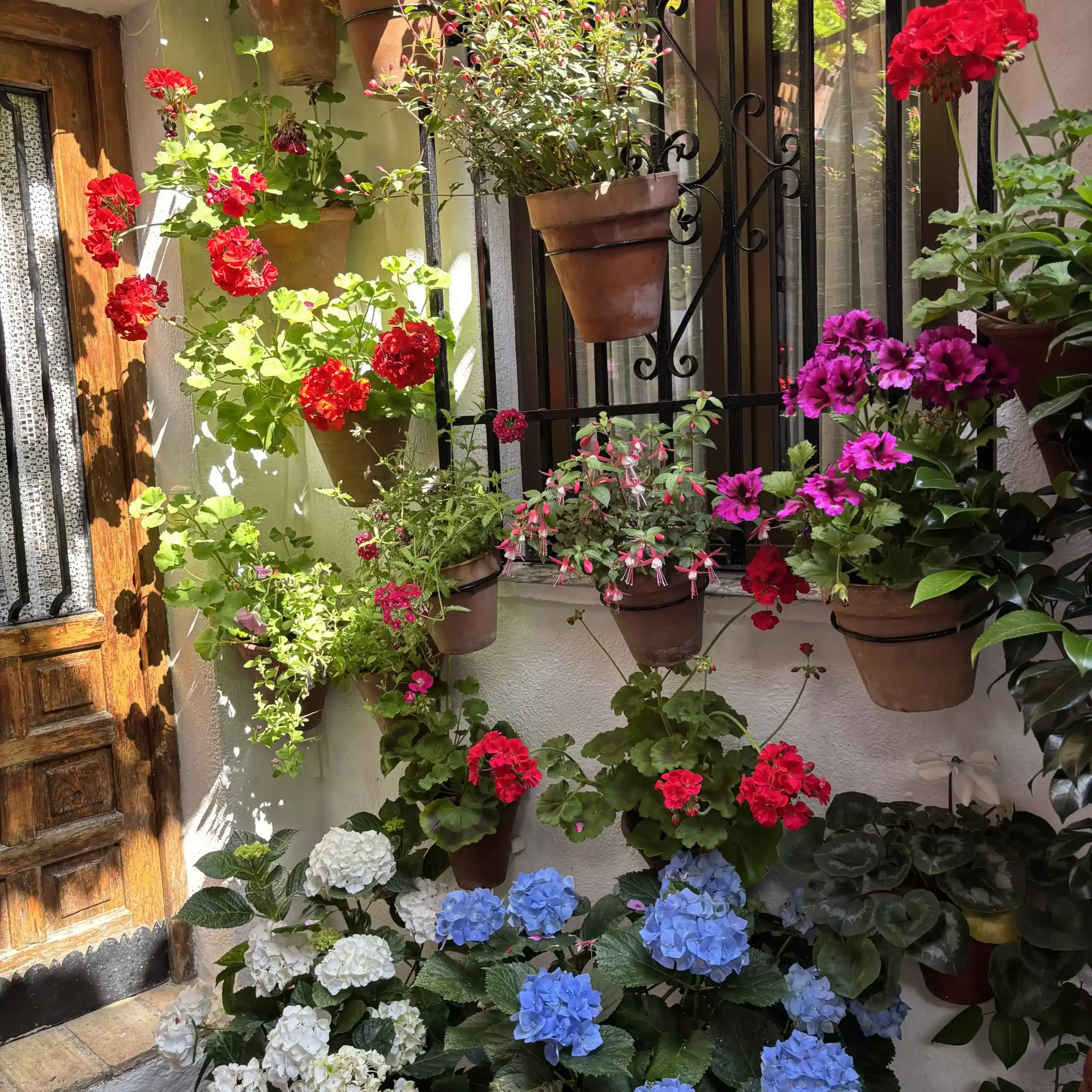
The Patios of Córdoba
The Palacio de Viana is undoubtedly a wonderful introduction to Córdoba’s patios. But the patios are much more than a palace. They are the soul of the city.
Born from the Roman heritage and perfected by the Arabs, these inner courtyards are cool oases where water flows through centuries-old fountains and whitewashed walls burst with geraniums, carnations, and cascading gitanillas. Each patio tells a story of family, tradition, and a devotion to beauty — not the kind meant to impress, but the kind woven into everyday life.
As you wander through the historic center, especially in the neighborhoods of Santa Marina and San Basilio, you will catch glimpses of them behind wrought-iron gates: some elegant and aristocratic, others humble and popular, yet all sharing the same magic. You have to learn to slow down, to look around, and not to rush. Patios do not announce themselves — they reveal themselves.
Once a year, during the famous Festival of the Patios, itself recognized as a UNESCO Intangible Cultural Heritage, these hidden corners of paradise open their doors to the world. It is one of those events that, if your visit happens to coincide with it, completely transforms the meaning of your trip to Córdoba.
I have explored the subject in much greater depth in my article dedicated to the patios of Córdoba, where you will find all the stories and secrets I discovered while wandering through the city during the festival.
If I can offer one piece of advice: give up something else, but do not give up the patios. Beyond their beauty, colors, and fragrances, they offer a glimpse into the most authentic and intimate side of Córdoba — the Córdoba that still preserves its true spirit.
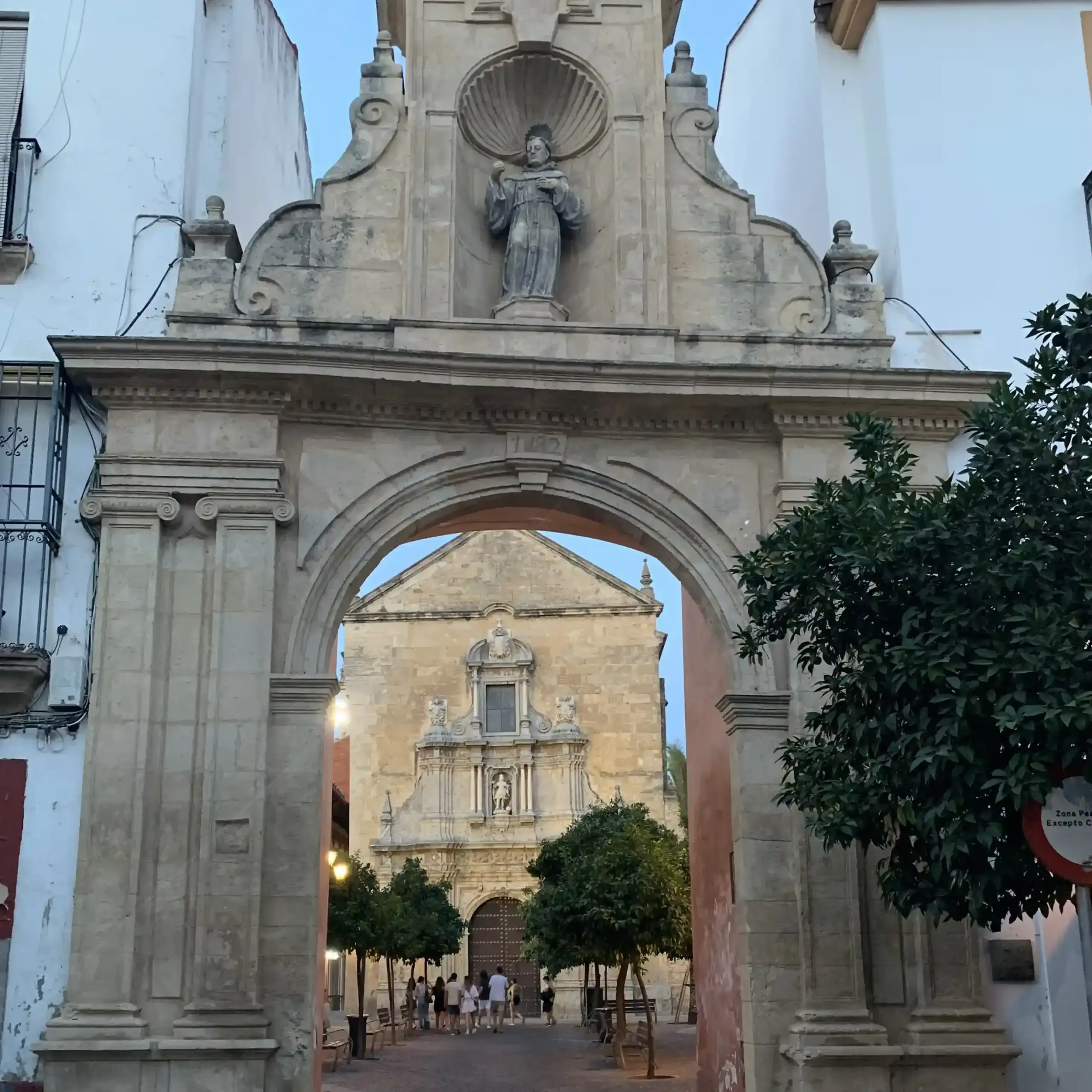
The Fernandine Churches
The Fernandine churches form one of the most beautiful and authentically Cordoban routes you can follow. They are not monuments designed to provoke a “wow” reaction — they are living buildings, transformed over the centuries and sometimes patched and repaired — and they tell the story of the city’s Christian rebirth with a sincerity that grand monuments often lack.
Their name comes from Fernando III. When “the Saint” conquered Córdoba in 1236, after five centuries of Muslim rule, he did not simply plant a cross on top of the Mezquita. He had a far more ambitious plan: to redesign the Christian city from within, transforming the urban fabric into a place where faith and power were inseparably intertwined.
Thus emerged a system of new parishes, organized into districts known as collaciones. These were not merely churches: they were administrative and social centers, the beating heart of the new Christian neighborhoods established in the Axerquía, the eastern part of the city. Their role was both religious and political, helping to organize the repoblación, the repopulation of the territory with Christians arriving from other kingdoms.
Ask around how many Fernandine churches there are and you will receive different answers: eight, eleven, sometimes seven. The most traditional answer is eight — those located in the Axerquía and designated as Bienes de Interés Cultural: San Pablo, San Francisco, San Pedro, Santiago Apóstol, San Lorenzo, San Agustín, Santa Marina, and San Andrés. But if you also include lesser-known churches, the convents founded by the king himself — such as San Pedro el Real of the Franciscans and San Pablo of the Dominicans — and the churches of the religious orders dedicated to ransoming prisoners, such as the Mercedarians and Trinitarians, the number rises to nineteen. There is also Santa María Magdalena, the only one no longer used for worship and now dedicated to cultural activities.
Not all of them, however, have survived intact.
Architecturally, the Fernandine churches combine Gothic, Mudéjar, and later Renaissance or Baroque additions. Their exteriors are often austere: simple façades, buttresses, modest rose windows, and tower-like bell towers. Inside, however, visitors may find soaring naves, pointed arches, wooden ceilings, and Mudéjar decoration.
The rose windows on the façades are their most distinctive feature. They are not merely decorative: they symbolized divine light triumphantly entering the city after five centuries of Islam. Architect and historian Juan José Primo Jurado, who dedicated an entire book to the subject, argues that nowhere south of Toledo can one find such a concentration of medieval rose windows in both quality and quantity. He is probably right.
To visit them, you can follow the information panels throughout the city or pick up a map at the tourist office. The best option, however, is the official route: the Cabildo Catedral organizes a Route of the Fernandine Churches, which is free for visitors who already hold a ticket to the Mezquita-Catedral; otherwise it costs around five euros. The route begins at the Mezquita and often includes the Basilica of the Oath of Saint Raphael and the Carmen de Puerta Nueva. Some organized tours also add visits to historic wine cellars or nearby patios.
Among visitors, the most popular are usually San Lorenzo, Santa Marina, San Pablo, and San Pedro.
My favorite, however, is another one — and I’ll tell you about it shortly.
San Lorenzo is considered one of the jewels of Córdoba’s medieval architecture. It stands out for its entrance porch with three arches surmounted by an impressive rose window and was built on the minaret of an earlier mosque, traces of which are still visible in the structure. Some scholars believe its forms anticipated the aesthetics of Seville’s more famous Giralda. Inside, the high altar area is covered with precious Italo-Gothic frescoes. The surrounding neighborhood is among the most authentic in the city.
Santa Marina, located in the square of the same name — one of the largest and most popular in Córdoba — is an extraordinary example of stylistic layering. Construction began in the late thirteenth century with a late Romanesque and Gothic layout; the tower is a sixteenth-century Renaissance addition, while the sacristy was remodeled in Baroque style during the eighteenth century. Its silhouette is one of the most recognizable in the city’s skyline: almost fortress-like, dramatic, and shaped by a history of fires and restorations that have only strengthened its character.
San Pablo is one of the most imposing churches, located directly opposite City Hall. The land on which it stands already hosted a Roman circus, a vast structure used for races and public spectacles connected to the monumental center of ancient Corduba, not far from the forum, theater, and Roman temple. During the Islamic period, the site was reused once again. An Almohad palace was built here, decorated with refined chambers, vaulted spaces, and richly ornamented walls. Some remains of this phase can still be seen inside the building, particularly behind the high altar, where an ancient chamber survives that may once have been a small qubba or private oratory. After Ferdinand III conquered Córdoba in 1236, the complex was entrusted to the Dominican Order, which between the thirteenth and fourteenth centuries built the Royal Convent of San Pablo and its adjoining church. For centuries it remained one of Córdoba’s most important convents, partly because of its strategic location near the city walls and the new Christian neighborhoods. Over time, the church underwent various expansions and transformations, but the convent’s great entrance facing Calle Capitulares still survives: a spectacular marble Baroque gateway dating from 1708, decorated with Solomonic columns and a niche containing a statue of Saint Paul. Passing through it leads into a small compás, a transitional courtyard that then opens into the church itself. On the opposite side, facing Calle San Pablo, stands a much older entrance: a magnificent Gothic-Mudéjar doorway with a pointed arch and reused Caliphal capitals. And this is where the story takes a curious turn. That doorway was originally the church’s main entrance until Leonor López de Córdoba, one of the most influential women in medieval Castile, decided to build her funerary chapel directly in front of it. The result? The principal entrance had to be moved to the other side of the building. An act of personal devotion, perhaps. Or perhaps a way of leaving her mark on the city and its sacred space. Either way, it permanently changed the geography of the church. The bell tower houses one of the three finest carillons in Spain.
San Pedro was elevated to the rank of Minor Basilica by Pope Benedict XVI in 2006. Located in the square that bears its name, near La Corredera, it has extremely ancient origins: many believe it stands on the site of a fourth-century Paleochristian basilica dedicated to Córdoba’s martyrs. Beneath the central nave, archaeologists discovered the remains of a tenth-century Mozarabic cemetery, evidence of the Christian community’s continued presence even during the Caliphate. The main façade was designed by Hernán Ruiz II in 1542, one of the great architects of the Spanish Renaissance. Inside, the Chapel of the Holy Martyrs preserves the relics of the martyrs discovered here in 1578. A final curiosity: in the square stands a statue dedicated to the sculptor Juan de Mesa, who was baptized in this very church in 1583.
My favorite, however, is San Francisco. It has an almost romantic atmosphere — difficult to explain, easy to feel. The church suffered severe damage during the nineteenth-century confiscations, was later restored, and today remains a place of great yet understated charm that many visitors pass by without realizing what they are missing. Its marble entrance façade features a niche containing the figure of Fernando III the Saint, honoring the founder, and overlooks a small, peaceful square that is not really a square at all: it is the former cloister of the Franciscan convent. Part of the original arches still survives — a medieval cloister opening directly onto the city, without gates or barriers. That detail alone makes the visit worthwhile. But there is something else worth noticing, this time by looking down. The square is paved with chino cordobés, a traditional Cordoban stone paving. Recognized worldwide since Roman times, this type of surface naturally drains both heat and water, and remains one of the most effective solutions for making outdoor spaces livable in the hot cities of the Mediterranean. Córdoba has always used it — and for good reason.
Fernando III, the monarch who founded Córdoba’s Fernandine churches after the Reconquista, was canonized in 1671. He is buried in the Cathedral of Seville and, according to tradition, requested to be buried wearing his Franciscan habit, symbolically renouncing his royal garments as an act of penance and humility.
For many people in Córdoba, Saint Ferdinand is more than just a historical figure: he is a saint deeply connected to the city’s identity.

Where to Get a Taste of Córdoba
Eating in Córdoba is, in many ways, like studying history through your palate.
What follows is just a small introduction, but if you want to discover more traditional dishes, additional restaurants worth trying, local markets, and the best breakfast spots, I invite you to read my article Flavors of Córdoba. There, I tell the whole story in much greater detail.
Let’s start in the historic center and the Judería, where I personally tried several places that are genuinely worth visiting.
Casa Pedro Ximenez was the first restaurant where I ate in Córdoba, and I still remember it fondly. It had been recommended to me by a restaurateur from Málaga, so I knew I was in good hands, but I did not expect to eat so well just a few steps from the Mezquita. The cuisine is traditional with a slightly modern touch, and the mango mazamorra was a wonderful discovery. The interiors are very traditional, the patio is perfect for tapas, and in summer there is a terrace overlooking the illuminated bell tower of the Mezquita. Even if you have not booked an outdoor table, go upstairs and take a look.
Casa Pepe de la Judería is a must if it is your first visit to Córdoba. Elegant without being pretentious, it offers an extensive menu of traditional Andalusian dishes. It is a little more tourist-oriented and slightly more expensive than average, but the prices are justified by both the quality and the location. If possible, ask for a table on the upper terrace — it is worth it.
If you are in Córdoba for a special occasion, all roads lead to Noor. It is probably the finest restaurant in the city and, according to some, in all of Andalusia. Its three Michelin stars are richly deserved thanks to chef Paco Morales. The tasting menu explores Andalusian history through food, with every dish telling a fragment of the city’s Moorish past. The location is deliberately understated, in a peripheral neighborhood chosen by the chef as a tribute to his roots. The atmosphere is minimalist, the service impeccable, and the prices high but understandable — expect around €285 for the tasting menu. Put it on your list and book well in advance.
And finally, breakfast. The classic Cordoban breakfast is tostada con aceite y tomate: toasted bread topped with olive oil and grated tomato. It is simple, delicious, filling without being heavy, and traditionally accompanied by a café con leche. If you want the authentic version, head to Cafetería Don Pepe. It is not in the Judería and not next to the Mezquita. Instead, it is located in a more local area near the modern center of the city. The atmosphere is simple, the service is fast, and there is absolutely no Instagram effect. Just good breakfast, done properly.
Córdoba is a city best explored on foot, among cobbled streets, patios, sun-drenched squares and monuments where you may spend quite a long time standing. For this reason, when packing your suitcase, it is better to think more about comfort and temperatures than quantity.
The sun is one of the main features of the city, especially from March to October, but it can also be intense during winter. A hat, sunglasses and a good sunscreen are therefore essential: you will not always find shade in the historic centre and, during visits, you may sometimes have to wait outside. I always carry this sunscreen with me. It is small, but very effective.
You will walk a lot, often along stone streets, uneven surfaces and narrow lanes where it is not always easy to find somewhere to sit. A pair of comfortable shoes that you have already worn before the trip is therefore essential. I would avoid travelling with brand-new shoes, especially if you are planning to visit the Mezquita, the Alcázar, the Jewish Quarter and the Patios on the same day.
A reusable water bottle is a great ally, especially during the hottest months, when walking around the city can become very tiring and shade is not always guaranteed. I bought a collapsible silicone one from Natura, although it is often unavailable. Alternatively, you can find a similar one here. Once empty, it takes up very little space.
Despite the generally mild climate, it is useful to carry a sweatshirt or a light jacket. It can come in handy in the evening, during spring and autumn, but also inside monuments, hotels and restaurants, where the air conditioning can create a significant change in temperature. Even when entering some patios, you will immediately notice the difference compared with the streets that are more exposed to the sun.
If you visit Córdoba in winter, do not be misled by the pleasant temperatures during the middle of the day. The city is located inland, and it can become quite cold early in the morning and after sunset. Bring a warmer jumper as well: it may remain in your backpack during the day, but you could really miss it in the evening.
Finally, small items such as a power bank may seem like minor details, but they make your days much easier, especially if you keep your navigation app running, check monument opening times and photograph every patio and corner of the city. I was given this one and I am very happy with it. Naturally, there are many different models available, but whichever one you choose, I strongly recommend bringing one.
When people ask me about Córdoba, I always say that, in my opinion, it is the deepest city in Andalusia.
Not because it is the most beautiful — Seville is more spectacular, Granada more romantic, Cádiz freer, Málaga more cheerful. Córdoba is deeper because behind everything you see, there is always something more. And the longer you look, the more layers it reveals.
Beneath the cathedral lies a mosque. Inside a synagogue is one of the finest examples of Islamic art in Spain. A small chapel turns out to be a Christian church commissioned by a converted Jew whose family was later condemned by the Inquisition. A wishing star embedded in the stones of the Mezquita is actually a marine fossil that became a local legend. And in a small square in the city center, what appears to be an ordinary stone pavement is, in reality, a drainage system that has been working for two thousand years.
Three cultures lived here — not always in harmony, not always as equals, but in a dialogue that produced some of the most beautiful things human beings have ever built. And that dialogue is not confined to the great monuments. It lives in the narrow streets designed to filter the sun, in the patios hidden behind wrought-iron gates, in the names of the streets, in Arabic inscriptions concealed beneath layers of plaster, in the chamfered corners of old houses, and in Roman columns given a second life as fountains.
Córdoba asks only one thing of you: Do not rush.
And if you can give it that time, you will leave with something that does not remain only in your photographs or souvenirs, but continues to grow within you long after you have returned home.