Costa del Sol beyond the beach: white villages, canyons and unusual places
When people think of the Costa del Sol, they all imagine the same thing: long beaches of fine sand, chiringuitos right on the shore and a sun that shines for more than 300 days a year. It is all true. But it is also, I can assure you, terribly reductive.
Because behind the most famous coastline in Andalusia lies an inland area that has little to envy the coast: white villages perched on dizzying hills, towns of Roman and Moorish origin, canyons cutting through the rock for hundreds of metres, paths suspended over the void. And the best part? Everything — absolutely everything — is less than two hours by car from Málaga.
Málaga and its coast are an ideal base for exploring this parallel world. In one week, you can easily alternate a day at the beach with a walk through pueblos blancos, a mountain hike or a visit to towns with centuries of history stitched into their stones.
Here is a practical guide to discovering the other side of the Costa del Sol.
Here are some practical tips on how to get to the Costa del Sol, when to go and how to travel between the coast and the inland areas. They are simple, but they can help you save time, money and a certain amount of frustration, especially when choosing where to stay and planning your journeys.
Show all tips ↓ Hide tips ↑
How to get to the Costa del Sol
- By plane: Málaga-Costa del Sol Airport is the most convenient option for travellers arriving from abroad or from other Spanish cities. It enjoys a particularly convenient location between Málaga and Torremolinos and is the main gateway to the entire Costa del Sol. From the airport, you can easily reach Málaga, Torremolinos, Benalmádena and Fuengirola on the C1 Cercanías suburban train. The railway station is located in front of the terminal, and tickets can be purchased from the machines or directly at the barriers using a bank card or contactless device. To check timetables and fares, visit the official Renfe website. To compare flights and prices across several dates, I use Google Flights.
- By car: this is a good option if the Costa del Sol is part of a wider trip around Andalusia. Málaga is well connected to the main coastal destinations and to the rest of Spain. Just bear in mind that traffic along the coast can be heavy during the summer months, and parking near the beaches or in the busiest town centres can become difficult.
- By train: the main railway station in the area is Málaga María Zambrano, which is connected to Madrid, Córdoba and other major Spanish cities by high-speed and long-distance services. Depending on the route, you can check timetables and tickets on the official websites of Renfe, iryo and OUIGO. To compare the different rail options in a single search, I normally use Trainline and TrainPal. Once you arrive at Málaga María Zambrano, you can continue on the C1 Cercanías train towards the airport, Torremolinos, Benalmádena and Fuengirola, or walk to the nearby bus station.
- By coach: Málaga can be reached by coach from many Andalusian and Spanish cities. For travellers arriving from relatively nearby destinations such as Granada, Seville, Córdoba or Almería, the coach can be a practical option, particularly when train times are inconvenient. From more distant cities such as Madrid, Barcelona or Valencia, journey times are much longer. In these cases, it is always worth comparing coaches, high-speed trains and flights. The main station is the Estación de Autobuses de Málaga, located a few minutes’ walk from Málaga María Zambrano. To check departures and destinations, you can consult the official station website and then search for the connection on the websites of Avanza or ALSA.
In practical terms, Málaga is the best-connected base, even for travellers without a car. The C1 train is particularly convenient for exploring the section of coast between Málaga and Fuengirola, while buses are essential for reaching Marbella, Estepona, Nerja and many other destinations without a railway connection.
How to get around the Costa del Sol
- By car: this is the option that offers the greatest freedom, especially if you want to alternate between beaches, white villages and inland destinations. The distances are not enormous, but traffic along the coast should not be underestimated, particularly in summer, at weekends and during rush hour. The A-7 is free, but it passes through the most heavily developed areas and can become congested; the AP-7 is faster along several sections, but it is a toll road and is certainly not cheap. A car is especially useful for reaching places such as Casares, Istán, Ojén and Genalguacil, as well as less central beaches and small villages without direct public transport connections.
- By train: the C1 Cercanías suburban line connects Málaga Centro-Alameda with the airport, Torremolinos, Benalmádena, Arroyo de la Miel and Fuengirola. It is a simple and affordable way to travel along this section of the coast, but the railway terminates at Fuengirola and does not reach Mijas Pueblo, Marbella, Estepona, Nerja or the eastern Costa del Sol. From Málaga María Zambrano station, you can also find rail connections to Antequera, the Caminito del Rey and other Andalusian cities. Before travelling, always check the timetable on the Renfe website.
- By public bus: this is the most important form of transport for reaching places that are not served by rail. Avanza operates numerous services along the western coast, including routes to Mijas, Marbella and Estepona, while ALSA is particularly useful for the eastern section and destinations such as Nerja. Frigiliana is normally reached by a local bus from Nerja. To consult Málaga’s metropolitan routes, timetables and stops, you can use the Málaga Metropolitan Transport Consortium website.
- With an organised tour: this is a good option for travellers who do not want to hire a car or worry about timetables, changes and parking. Excursions depart from Málaga, Torremolinos, Benalmádena, Fuengirola, Marbella and other coastal destinations for places such as the Caminito del Rey, Ronda, Nerja, Frigiliana, Granada, Córdoba and Gibraltar. I always check the available experiences on GetYourGuide and Civitatis. Before booking, always check the departure point, the length of the excursion and whether the price includes transport, admission tickets and a guided visit. They are certainly not a budget option, but it always depends on how you want to organise your holiday.
How to plan a trip to the Costa del Sol
- Choose your base carefully: Málaga is the most practical place for travellers who want to visit the city and use public transport; Torremolinos, Benalmádena and Fuengirola are convenient for the beach and are connected by the C1 train; Marbella and Estepona are better suited to those looking for a mainly seaside holiday and who do not need to travel towards Málaga every day. If you mainly want to explore Nerja, Frigiliana and the Axarquía, it may be more convenient to stay directly on the eastern side of the coast, particularly in Nerja.
- Not every destination can be easily combined in a single day: distances may look short on the map, but traffic, parking, inland roads and bus timetables can add considerably to journey times.
- July 2026 update: since 15 July 2026, routine document checks have been removed at the land border between Spain and Gibraltar. However, you should still carry a valid travel document, as you may be asked to show it during occasional checks.
- Book the most popular attractions in advance: for the Caminito del Rey, it is advisable to purchase your tickets as soon as your travel dates are confirmed.
- During the high season, book your accommodation and car in advance as well: between June and September, during Holy Week, public holiday weekends and the Christmas period, the best-known destinations can fill up quickly and prices increase.
- Restaurants normally serve lunch between 1:30 pm and 3:30 pm and dinner approximately between 8:00 pm and 10:30 pm. In the most tourist-oriented resorts, many restaurants offer longer opening hours, but in inland villages kitchens may follow Spanish dining times more closely. It is worth booking the best-known restaurants and those located by the sea.
- Food markets generally close at around 2:00 pm. If you want to visit them, shop or eat inside, try to arrive during the morning.
- Free museum opening times vary from one venue to another: in Málaga, several museums offer free admission periods, often on Sunday afternoons, but there is no single rule that applies throughout the Costa del Sol. Always check the museum’s official website before planning your day and reserve your ticket when required.
When to visit the Costa del Sol
- Along the coast, the climate is generally mild throughout the year, whereas inland areas experience much greater differences between summer and winter. During July and August, inland temperatures can frequently exceed 35°C, and visiting towns, villages or walking routes during the middle of the day can become exhausting. In winter, however, mountainous areas and higher towns such as Ronda can be considerably colder than coastal destinations.
- Spring, especially from March to May, is probably the best time to explore the Costa del Sol: temperatures are pleasant, the inland landscape is greener and the weather makes it possible to alternate between cities, walks and days on the coast.
- Autumn, particularly between late September and October, is also an excellent season. Temperatures are normally more pleasant than in summer and visitor numbers tend to decrease.
- Summer is the ideal period for travellers primarily interested in the sea, beach clubs and nightlife. However, July and August are also the hottest, busiest and most expensive months, with heavy traffic and greater difficulty finding parking.
- Winter is suitable for travellers who are not mainly interested in beach life. Along the coast, days can still be mild and bright, there are fewer visitors and the towns have a more relaxed pace. Remember, however, that evenings can feel cool and that inland temperatures are considerably lower.
- What should you pack in your backpack? Read the The smart suitcase section at the end of the article, where you will find all the items that are genuinely useful for enjoying your holiday comfortably and practically.
What to see on the Costa del Sol
And so our journey through the Costa del Sol you do not expect begins.
As always, I will tell you about the strengths, the limits and why each place is worth stopping for. In some cases — I admit it — I will move quite far away from the most common opinions, and I will be more than happy to change my mind if you want to share your point of view.
Málaga
Málaga is the natural starting point for exploring the Costa del Sol, but it would be a shame to treat it only as a logistical base. Because Málaga is one of those cities you fall in love with, with its light, its noise, its contagious joy and that unmistakably Andalusian ability to enjoy life.
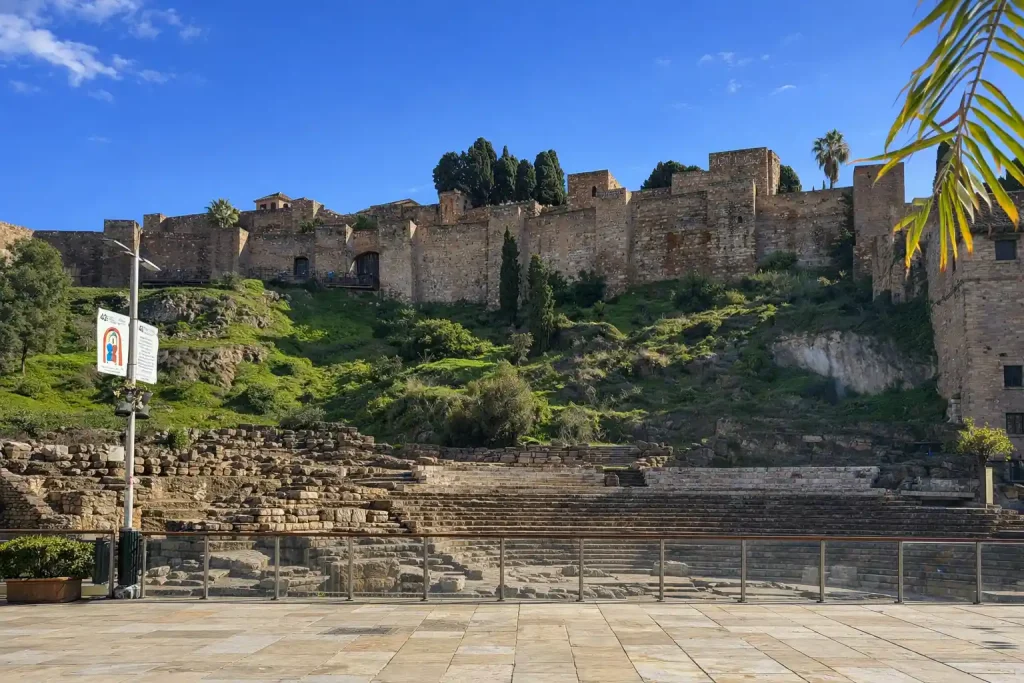
The historic centre is a pleasure to explore on foot: the Alcazaba, the Roman Theatre, the Cathedral that malagueños affectionately call “La Manquita” — the one-armed lady — because one of its two towers was never completed. But Málaga is not only history.
It is also one of the liveliest art cities in Spain, with a surprisingly high concentration of museums. It is the Soho district, with huge murals on the sides of buildings, markets scented with fresh fish and spices, bars where people drink sweet wine at the counter at eleven in the morning without anyone finding it strange. It is that feeling — hard to explain but very easy to recognise — of being in a place where people truly know how to feel good.
So that you do not miss anything, I have written a complete guide on what to see in Málaga, and in the section dedicated to this city you can also find everything about its best restaurants, its 30 museums and the best places for non-touristy shopping. Because Málaga really deserves it. Do not give up the chance to experience it.
Pueblos blancos
Mijas Pueblo
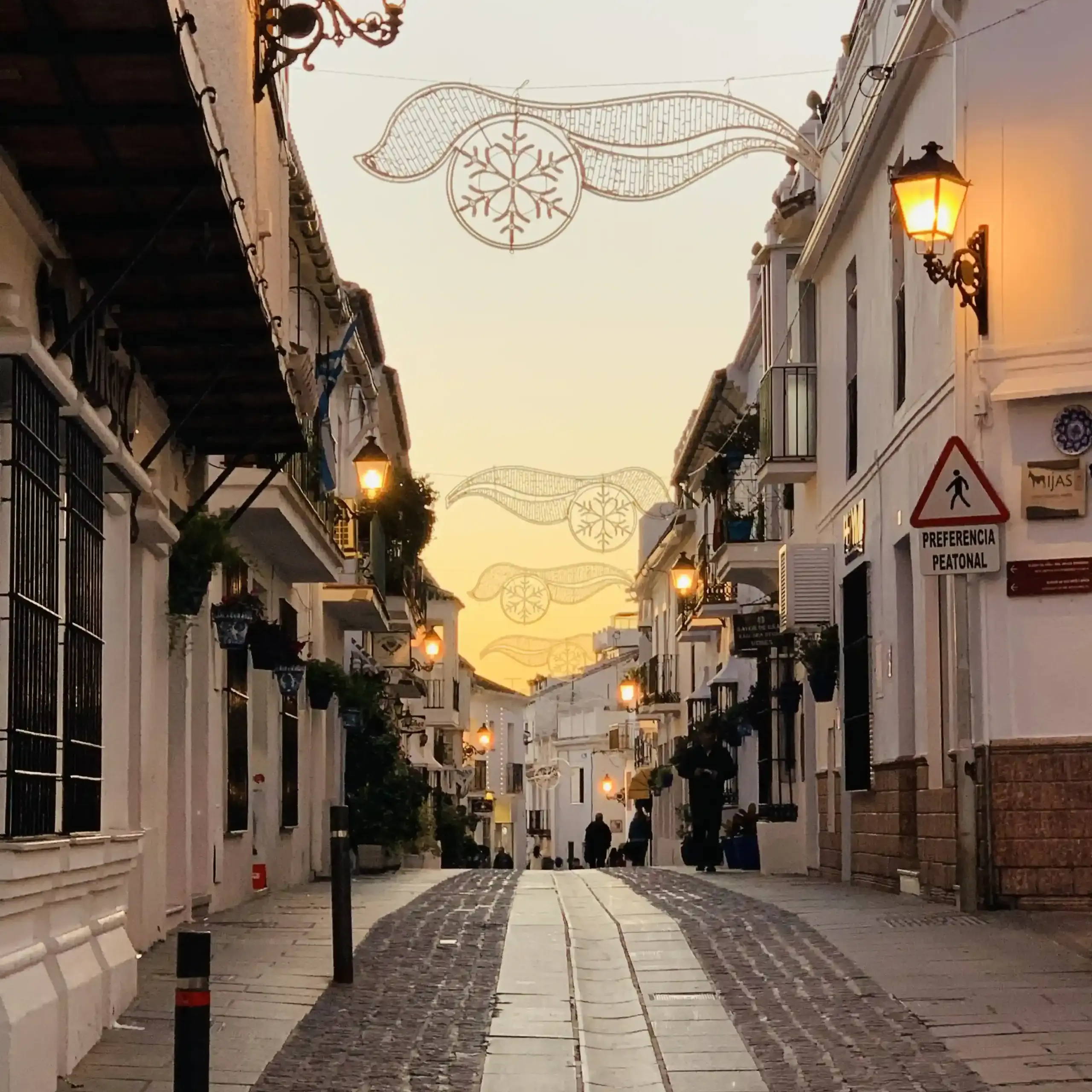
Thirty minutes from Málaga, and you are already in the first white village of the Costa del Sol. Mijas is the postcard image everyone expects: flower-filled alleys, donkey taxis, a viewpoint offering one of the widest views over the Mediterranean. It is undoubtedly picturesque, but it is also very touristy — in high season it gets extremely crowded, and the restaurants on the main square are expensive and more aimed at tourists than locals.
That said, if you go slowly, avoid the busiest hours and lose yourself in the side streets, you can still sense something authentic. An old Andalusian village, beneath all that organised tourism.
It is suitable for those who want a first taste of a white village without making a long trip, for those who have little time and are looking for an easy half-day visit, and for those travelling with children: it is small, safe and easy to explore on foot.
Frigiliana and Nerja
This is my favourite combination, and I recommend it without hesitation.
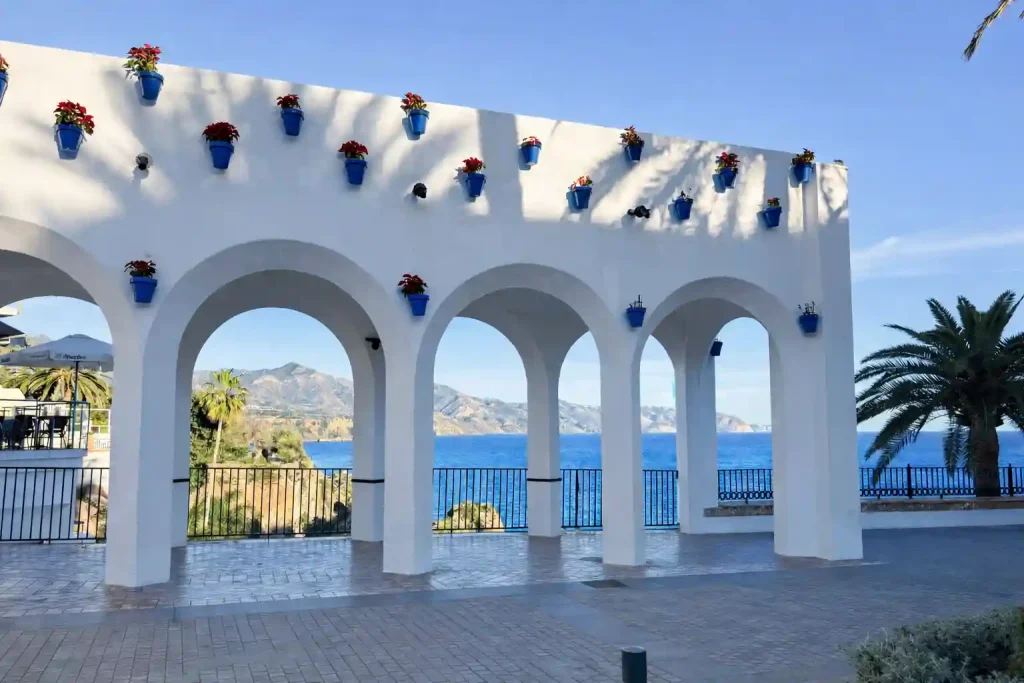
Start the morning in Nerja: the Balcón de Europa is a viewpoint overlooking the sea that is worth the trip on its own — if you want to go deeper, I have written a complete guide to Nerja where you will find everything you need to know. Then give yourself a few hours by the sea in Maro, one of the most beautiful coves in the area, before heading up in the afternoon to Frigiliana, which is only 6 km away.
Frigiliana is often described as one of the most beautiful villages in Spain, and for once it is not just marketing. It is a maze of climbs and descents where ceramic tiles guide you towards the Barrio Mudéjar almost like a map drawn on the walls. I have dedicated a separate article to Frigiliana, because it really deserves more than a quick mention.
Both villages are small — in just a few minutes you can walk from one end to the other — but the beauty here is not in the main attractions. It is in the side streets, the small hidden courtyards, the viewpoints you discover by chance, turning a corner without expecting anything.
They are the right destination for those who love photography and traditional architecture, for those looking for an iconic but not too large white village, and for those who want to combine the two stops in a single day without wasting time.
Just a few kilometres from the centre of Nerja is one of the most surprising places on the Costa del Sol: the Cueva de Nerja. Discovered by chance in 1959 by a group of local boys, this enormous cave contains spectacular chambers, natural columns and limestone formations that seem to have been slowly carved by time.
It is a perfect visit to combine with Nerja and Frigiliana, especially if you want to add something different from the sea to your day: a small underground journey into a Costa del Sol much older than we imagine.
Casares
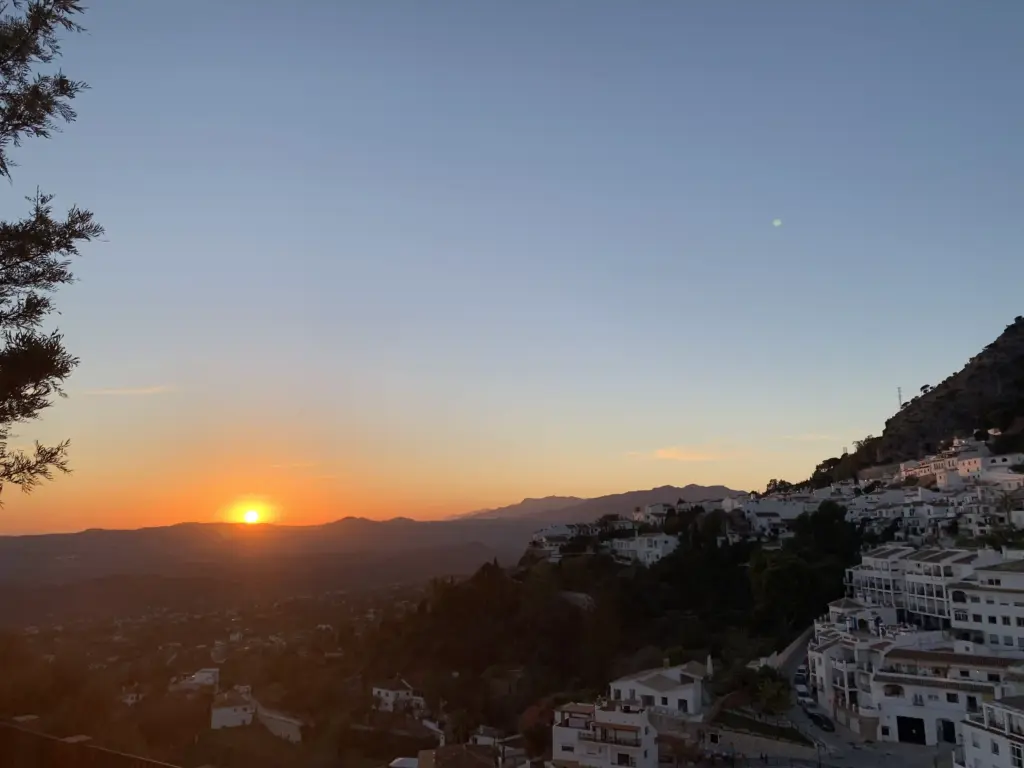
Casares is farther from Málaga, but it is worth it — especially if you are looking for something less touristy and more authentic. Perched on a hill at 1,400 metres, it overlooks the coast with a ruined castle that offers incredible views: on clear days, you can even see the African coast.
The centre is quieter, less “staged” for visitors. The alleys are less decorated than in Frigiliana, but this makes it feel more real, more lived-in. You feel the pressure of mass tourism much less. One tip: do not go during the day, but at sunset. I went in the early afternoon, in summer, and during the central hours of the day it feels a little sleepy, whereas at sunset it is wonderful.
It is the right choice for those who want a white village without queues and crowds, for those looking for wide views and a quiet atmosphere, and for those who are not afraid of driving along narrow, winding roads.
Just a few kilometres from Casares are the Baños de la Hedionda, ancient natural baths already used in Roman times. Legend has it that even Julius Caesar went there to treat an annoying skin condition thanks to the properties of the sulphurous waters.
Even today, you can bathe in the historic pools surrounded by nature, enjoying an experience that is very different from the classic beaches of the Costa del Sol. They are tiny and, in summer, they fill up with tourists and lose all their charm, but during the rest of the year they are an interesting stop.
Casares is also the birthplace of Blas Infante, considered the “Father of Andalusia”. He promoted many of the symbols that identify the region today, from the white and green flag to the Andalusian anthem. For many Andalusians, Casares is not only one of the most beautiful pueblos blancos in the region, but also a place deeply linked to their cultural identity.
Iznájar
The only white village on the water. Iznájar stands on a peninsula overlooking the large artificial reservoir of the Embalse de Iznájar, and its historic centre, with the castle at the top, looks like an island surrounded by blue. It is not very touristy, very genuine, and ideal for a quiet break away from the usual routes.
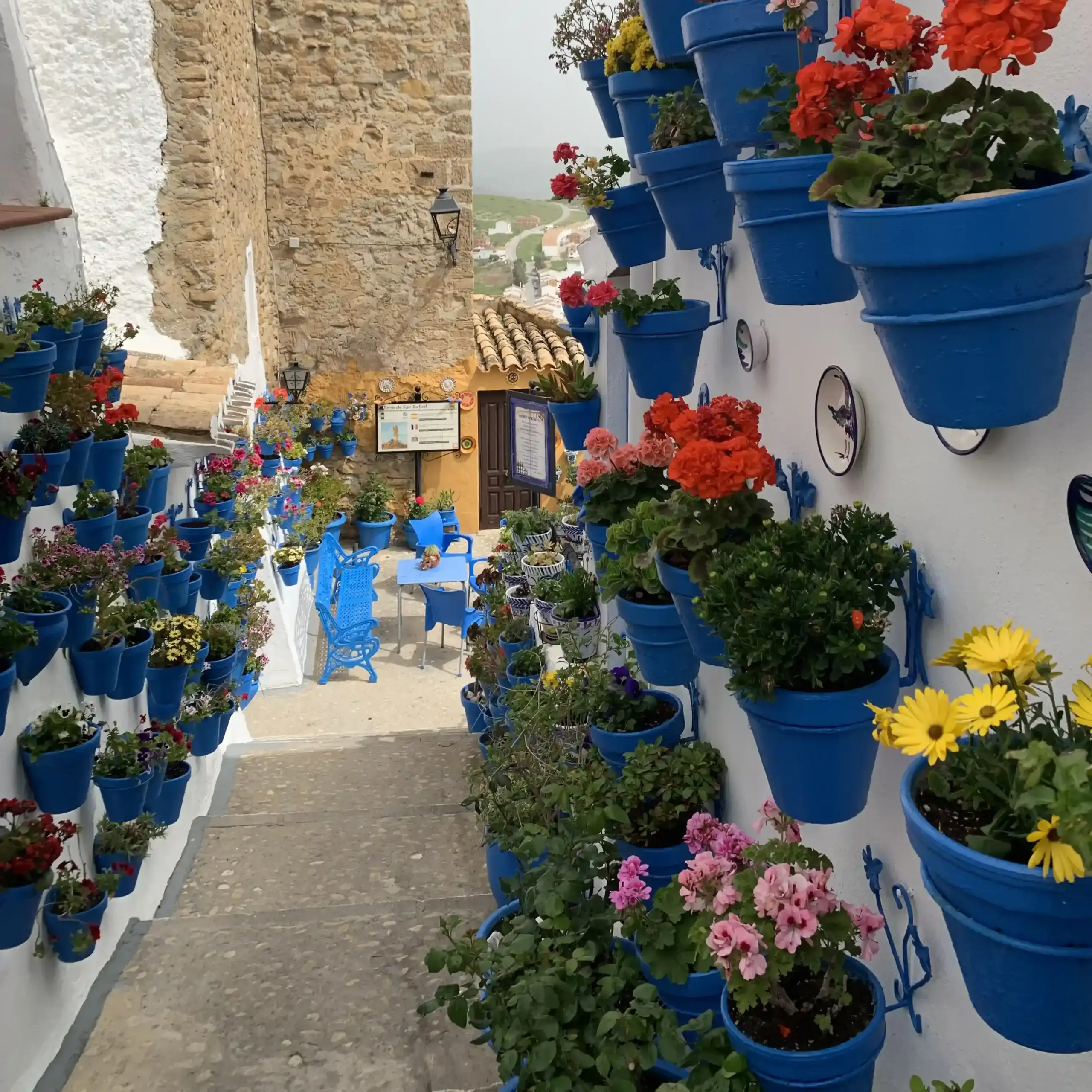
The village is small — you can walk around it in just a few minutes — but the combination of the lake and the surrounding landscape makes it truly interesting. The blue pots filled with flowers, the castle overlooking everything, an almost provincial atmosphere: there is something suspended about this place, as if time moved at a different pace.
It is suitable for those looking for a pueblo without too many tourists, for those who love peace and quiet, and for those who want a calmer alternative to Frigiliana and Mijas. Sunday is the best day for a bit of activity, with boats and chiringuitos open, but it always remains much quieter than the coast. During the week, on the other hand, it is an oasis of absolute peace.
The real surprise of Iznájar is that you can literally go down to the water. Just a short walk from the centre, the Paraje de Valdearenas turns the “Lake of Andalusia” into a proper freshwater beach.
Here you can rent a kayak to explore the hidden bays, take a boat trip to see the castle from a unique perspective, or simply enjoy a refreshing swim far from the crowds of the sea. If you prefer to stay on land, the El Cañuelo trail offers an easy 9 km hike with breathtaking views.
Setenil de las Bodegas
Setenil de las Bodegas is one of the most unusual villages in Spain — and this time the word “unusual” is fully deserved.
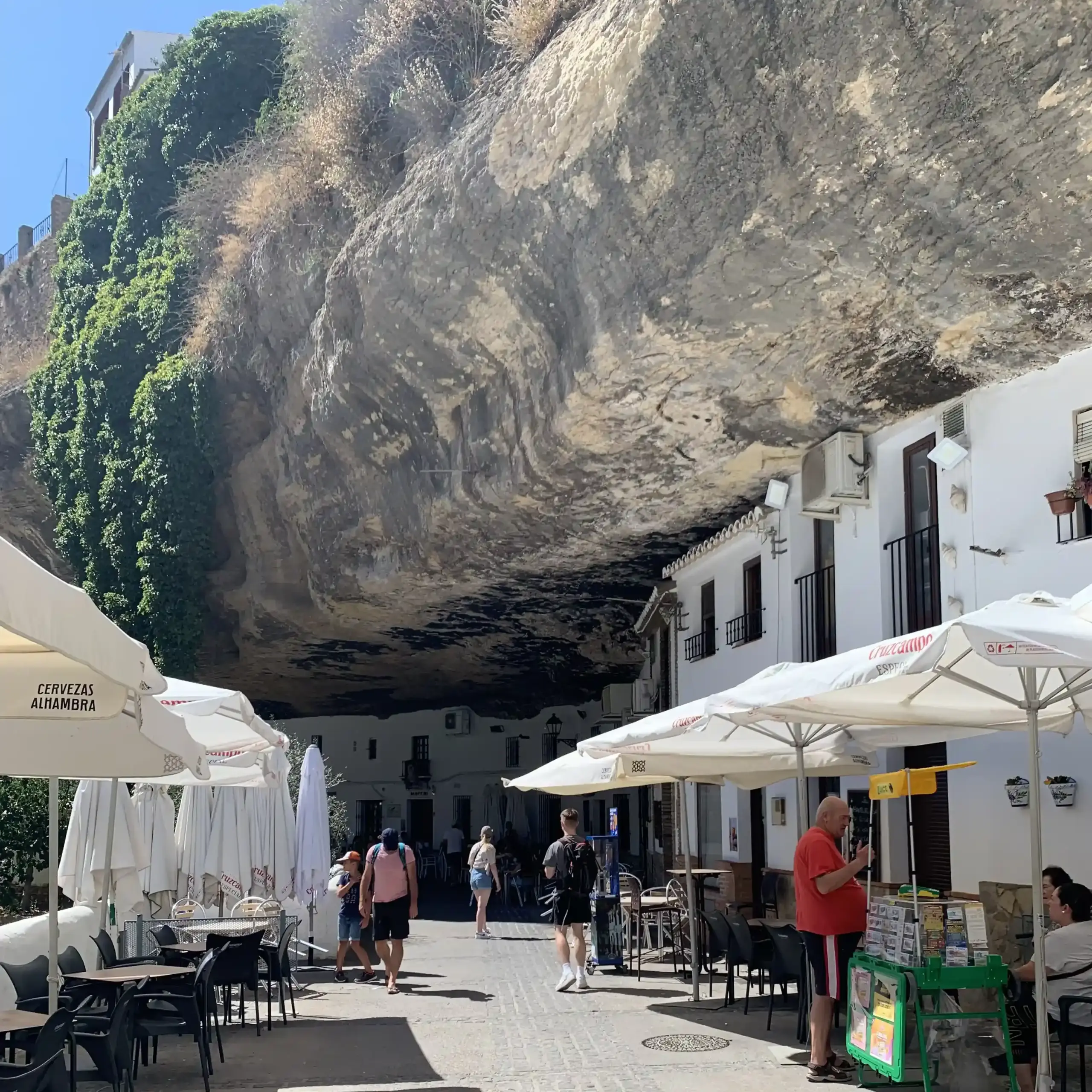
Here, the houses are not built on the rock, but beneath it: huge overhangs of tuff create a natural shelter that, over time, first became a refuge, then a home, and later bars and restaurants. The most famous street is Calle Cuevas de la Sombra, where the rock literally serves as a roof. It is one of those places where nature and architecture have merged so well that they seem to form an ancient, almost inevitable agreement.
It is about one hour and forty-five minutes from Málaga and can be explored in just a few minutes, so it is probably not worth going there just for that. But if you are already in Ronda — which is only a few kilometres away — adding it to your itinerary is an obvious choice. Stop for lunch or tapas in one of the places carved into the rock: eating with a rock above your head has a charm that is hard to explain, but easy to remember.
The name Setenil is said to derive from the Latin expression Septem Nihil, which means more or less “seven times nothing”. According to tradition, during the Reconquista the Christians tried to conquer the village seven times without success.
Only in 1484 did the troops of the Catholic Monarchs manage to capture the Muslim fortress. This is where the town’s name is said to come from, recalling the extraordinary resistance of the village built among the rocks.
The jewel towns
Ronda
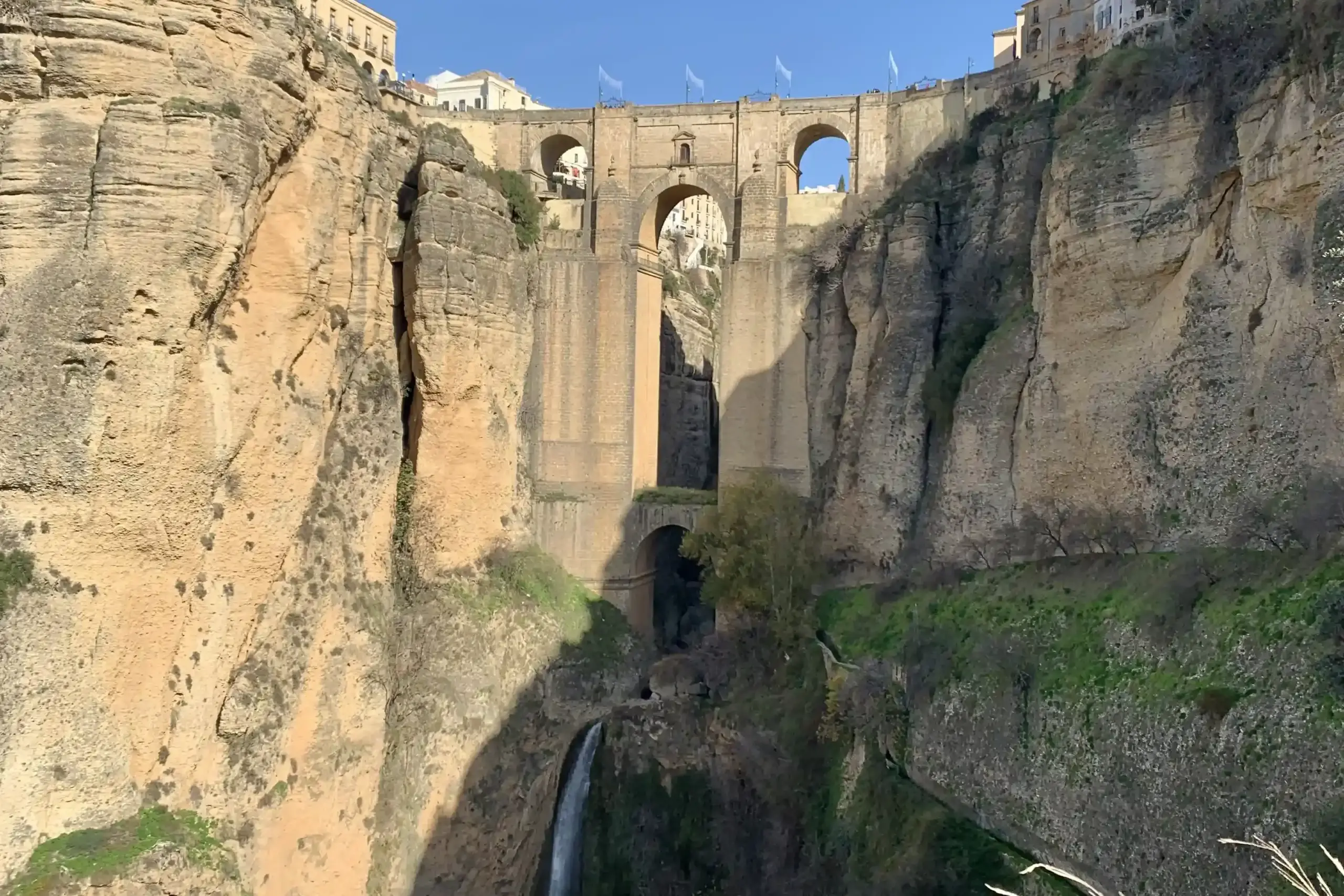
Impossible not to mention it. Ronda is described as one of the most spectacular towns in Europe, suspended above the Tajo, with a canyon 140 metres deep that divides the town in two. The Puente Nuevo, built in the 18th century, is its symbol: you can see it from afar, and it almost seems impossible that it can stand. History is everywhere — one of the oldest bullrings in Spain, the Arab baths, the old town to explore entirely on foot, with the Alcazaba, the Church of Santa María, squares and whitewashed streets.
This is where I become unpopular: personally, I did not find it as “wow” as everyone describes it. The most beautiful part is undoubtedly the view of the bridge from the canyon, but the rest of the town left me a little indifferent. Perhaps because it had been described to me as an experience with an almost palpable dramatic atmosphere, while I found something more ordinary. It is worth visiting, I am not saying otherwise, but if you are there, you should absolutely take advantage of its surroundings, such as Setenil de las Bodegas or Júzcar — see below — or the wineries with tastings.
The area around Ronda is, in fact, part of the Málaga Designation of Origin and the Ronda and Málaga Wine Route, and produces not only the traditional sweet wines of Málaga, but above all quality red wines — Tempranillo, Petit Verdot. That is how I discovered my favourite, Seis + Seis by Doña Felisa. But there are also other wineries that organise guided visits, such as Bodegas Vetas and Bodega Lunares.
About one hour and forty minutes from Málaga, it is the right stop for those looking for an iconic view, a historic atmosphere and — not least — a good glass of wine. In winter, remember that you are in the mountains: temperatures are not the same as on the coast, so wrap up well.
Few people know that in Ronda there is a route that allows you to see the famous Puente Nuevo from a completely different perspective from the one known by most tourists. It is the Camino del Tajo (Camino del Desfiladero del Tajo), a walkway opened in 2024 that allows you to walk inside the gorge, at the level of the Guadalevín River.
The most interesting thing is that this is not a modern invention. The route actually follows the old path used in the 18th century by the stonemasons and workers who built the Puente Nuevo, carrying the necessary materials along the canyon walls. Today, that same route allows visitors to admire the rocky walls of the Tajo up close, up to 120 metres high, and to see the bridge from a perspective that for centuries remained accessible to very few people.
At present, the route is about 250 metres long and takes around thirty minutes there and back. Access is limited and the ticket costs about 5 euros. To avoid queues, especially at weekends and during busy periods, I recommend booking online a little in advance. The price also includes the protective helmet, which is compulsory during the visit.
But the real new development is still to come. In 2026, according to the information currently available, the second phase of the project is expected to open, extending the route from the current 250 metres to about 750 metres in total. The new section will pass under the Puente Viejo, reach the neighbourhood of Padre Jesús and allow visitors to explore a part of the gorge that until now has been practically unknown to visitors.
A curious detail? The new extension was designed by the same architect who designed the famous Caminito del Rey. If you love panoramic walks and unusual places, it could become one of the most interesting attractions in Ronda in the coming years.
Antequera
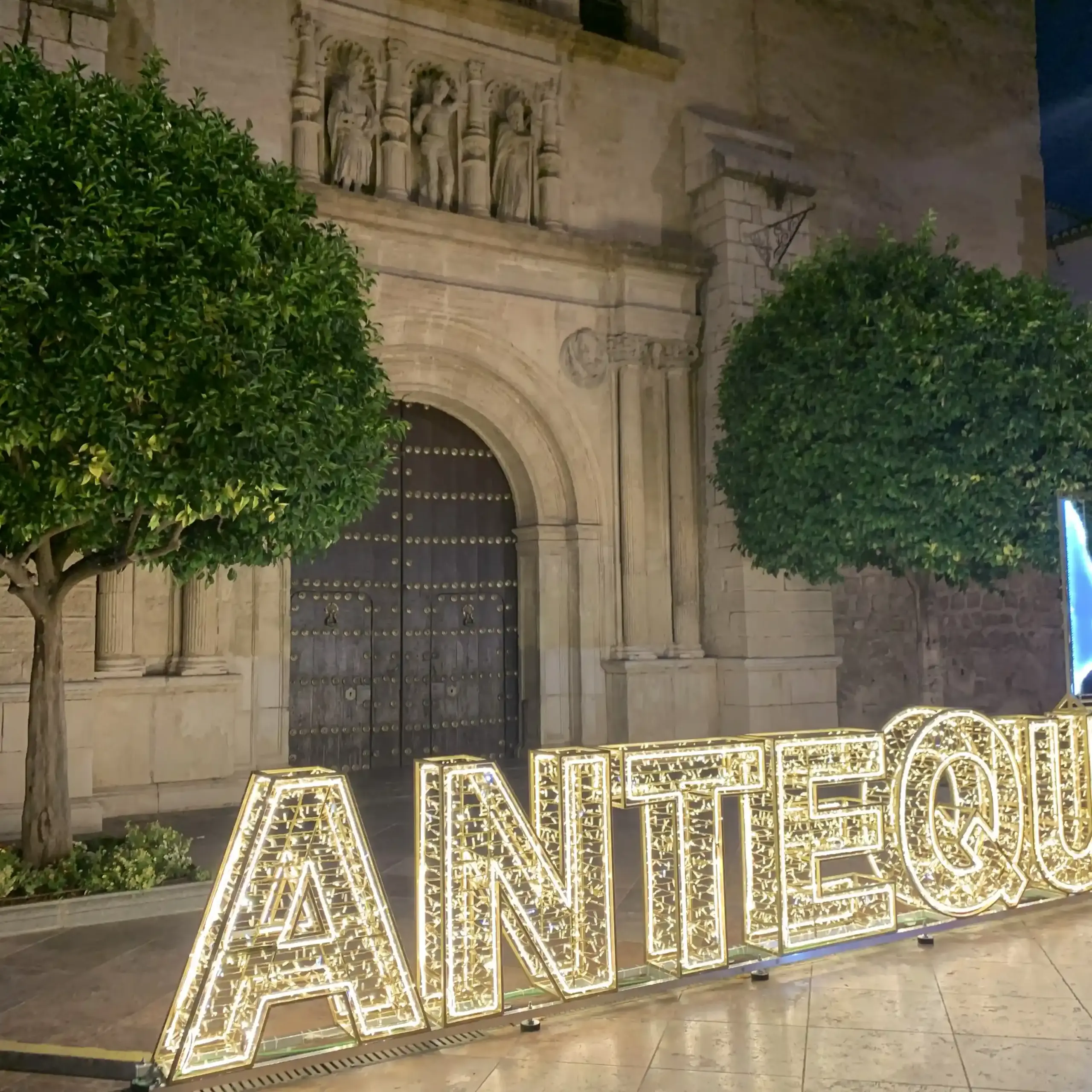
Antequera is less well known than Ronda, but it has a surprisingly rich heritage. It is not a “postcard” destination, but it is more authentic and less touristy. The centre is easy to explore on foot, and there are good restaurants at affordable prices. In summer, it also hosts some interesting events, such as the Velada, when the city is lit up with candles.
It is often called the “heart of Andalusia” because of its central location, and it boasts three treasures not to be missed: the Dolmens of Menga and Viera — one of the most important megalithic complexes in Europe, a UNESCO World Heritage Site, with free admission for all EU citizens — the majestic Collegiate Church of Santa María la Mayor, and the nearby Torcal, which I will talk about shortly.
This mix of attractions makes it perfect as a base for combining history and nature in the same day.
One of the most curious images of Antequera can be seen by looking up towards the Peña de los Enamorados, the mountain that dominates the landscape around the city. Seen from a certain perspective, its silhouette resembles the profile of a reclining human face, so much so that it is also nicknamed El Indio de Antequera.
Its official name, however, is linked to a medieval legend. It is said that a young Christian woman from Antequera and a young Muslim man from Granada fell in love during the Reconquista and tried to escape together.
Caught by their pursuers at the top of the mountain, they decided never to be separated: they embraced and threw themselves into the void. From that day on, the mountain has been known as the “Rock of the Lovers”.
Marbella
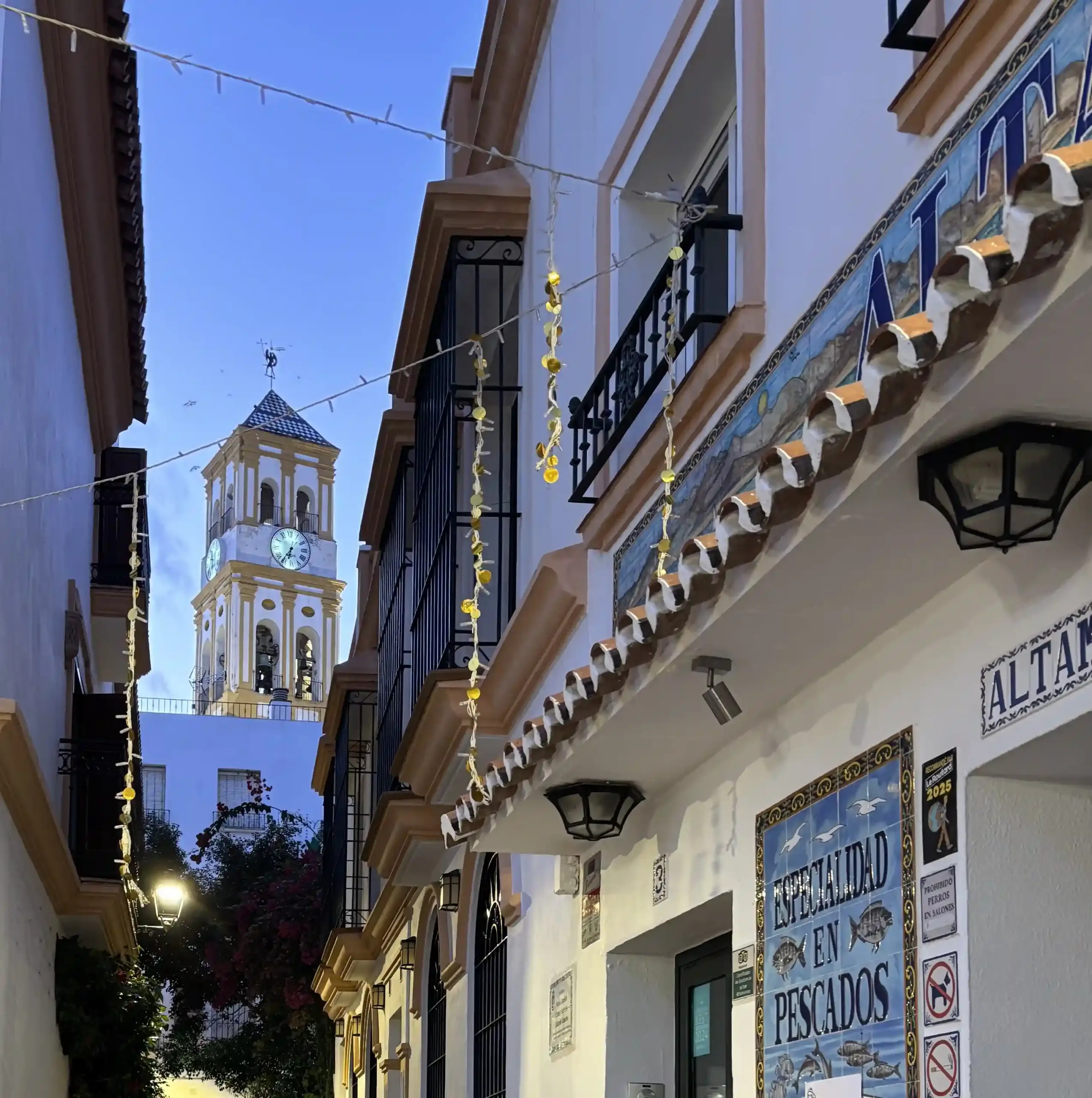
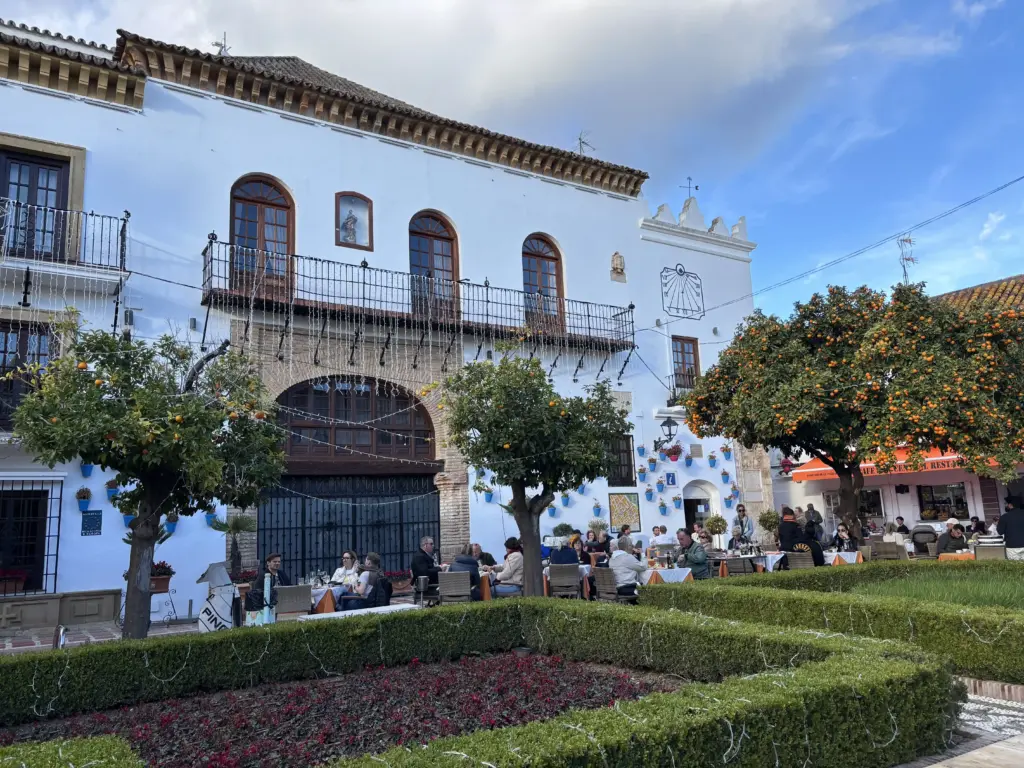
Do not be fooled by its reputation for yachts and luxury boutiques. The true heart of Marbella beats in the Casco Antiguo: an elegant network of cobbled streets around Plaza de los Naranjos, where the most authentic Andalusia meets glamour.
From my point of view, this is exactly the most interesting part of the city: you can visit it in two or three hours and combine it with a walk along the seafront.
If, on the other hand, you really want to give in to the temptation of the boutiques, a few kilometres from the small Arab town you will find the famous Puerto Banús, where the glossy world proudly shows itself off.
Marbella is suitable for those who want to see the glamorous side without neglecting the historic one, for those looking for a day by the sea with a touch of Arab architecture, and for those who simply want to understand what lies beneath the most luxurious surface of the Costa del Sol. I always like it very much, so I recommend it 100%.
Along Avenida del Mar, the pedestrian promenade that connects Marbella’s historic centre to the beach, there are ten bronze sculptures attributed to the famous Surrealist artist Salvador Dalí.
Among the best-known works are Naked Woman Climbing the Stairs, Cosmic Elephant and Don Quixote Seated. However, their authenticity has long been the subject of debate.
According to many critics, in fact, these are not original works created directly by the Catalan master, but rather sculptures produced in series from small wax and plaster sketches left by the artist. The casts are said to have been made in a foundry in Verona and have never been officially recognised by the Fundación Gala-Salvador Dalí.
Regardless of the controversy and endless discussions about their origin, these sculptures are now considered one of Marbella’s most curious and photographed attractions. And, although they were not personally made by Dalí, they help give an artistic touch to a seaside resort too often associated only with luxury, yachts and the jet set.
Estepona
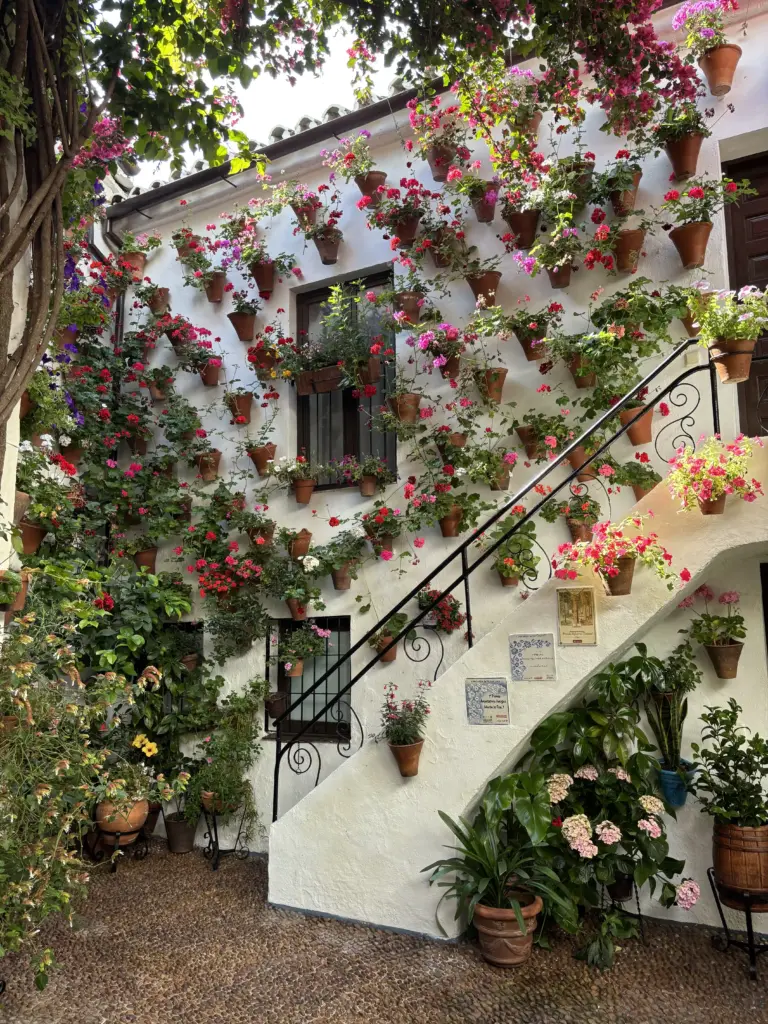
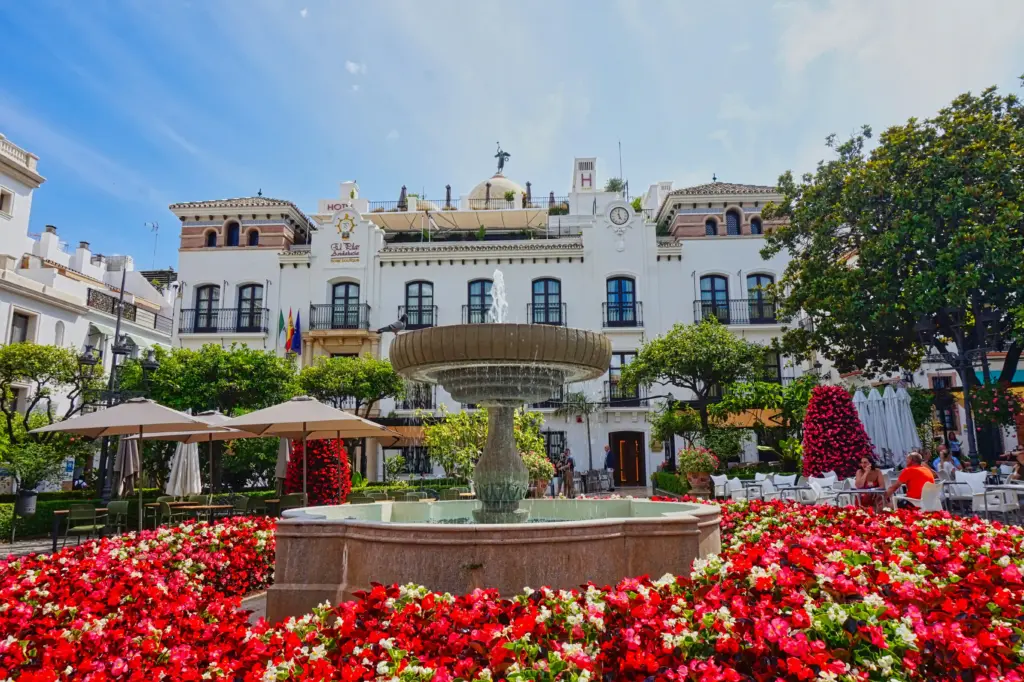
Estepona is a quieter coastal town than Marbella, nicknamed “the garden of the Costa del Sol” for good reason. In recent years, its historic centre has been completely revitalised: façades covered with vertical flowerpots, orderly pedestrian streets and one of the longest and most pleasant seafront promenades on the coast. The centre is well kept, with gardens, fountains and colourful walls, and it is a pleasure to walk around. The beaches are wide and well maintained.
It is not a monumental town like Ronda or Antequera, but it has a successful balance between the sea and neighbourhood life. Less snobbish than Marbella, more carefully maintained than many other places along the coast.
It is perfect for those looking for a coastal town without the chaos of Torremolinos or the luxury of Marbella, for those travelling with family, and for anyone who simply wants a relaxed day between the sea and the historic centre.
But Estepona is not just flowers and whitewashed walls. Walking through its historic centre is like entering a street art museum that no one expects — and this, I can assure you, is the most beautiful surprise.
It all began almost by chance in 2012, when the town council decided to regenerate the oldest neighbourhood, which had fallen into neglect. Instead of simply whitewashing the façades, it invited artists to paint the walls. No one imagined that this small experiment would become one of the most important urban art collections in Spain: today there are more than 70 murals scattered through the streets of the centre, and the number grows every year thanks to international competitions.
Among the most spectacular works are two record-breaking pieces by José Fernández Ríos: Reflejos del jardín, the largest vertical mural in Europe created by a single artist, and Día de pesca, one of the largest murals on the continent. But the one that most often ends up on visitors’ phones is perhaps another: La casa de la buena gente by Conchi Álvarez, a mural that tricks the eye: it portrays neighbourhood characters leaning out from balconies with such realism that it looks like a real façade.
The artists left some empty spaces, so that anyone who comes closer can play with perspective until they seem to become part of the painting — and it is almost impossible not to give in to the temptation to have your photo taken there.
The town council distributes a free map with all the numbered works, also available online, but my advice is to keep it in your pocket and get lost in the centre without a precise plan. The best surprises always come when you turn a random corner.
The full itinerary takes two or three hours on foot, and the largest murals are also found in working-class neighbourhoods such as Barriada Primavera, which can be reached on foot or by bike.
Estepona has never been considered an essential stop on the Costa del Sol. Perhaps the time has come to reconsider it.
A little nature and hiking
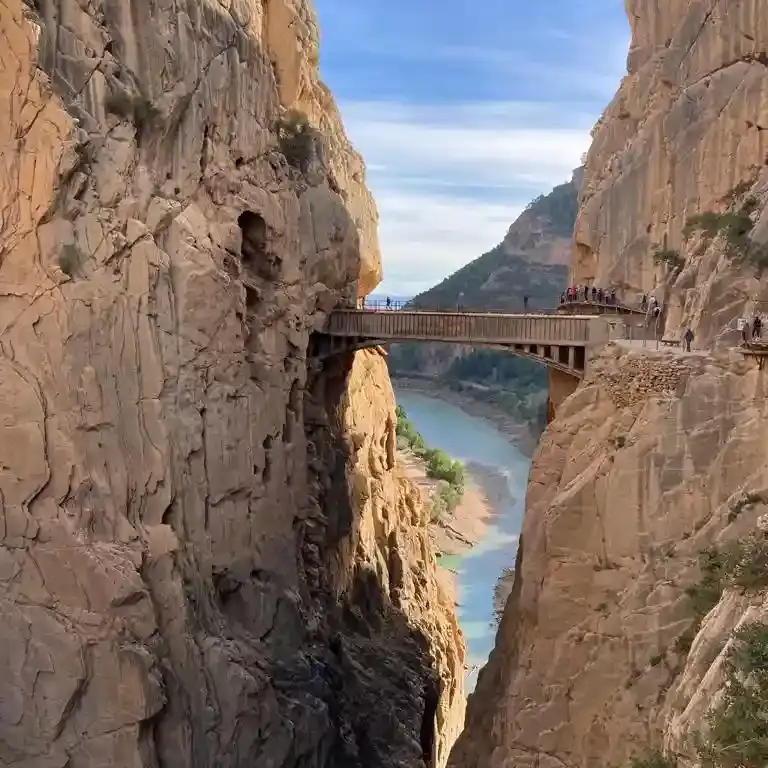
Caminito del Rey
It was once famous as “the most dangerous path in the world”. Today it has been completely restored, is safe and accessible, but the emotion remains unique.
You walk along walkways suspended up to 100 metres high along the walls of the Desfiladero de los Gaitanes, and the view alone is enough to justify the trip. But since 10 June 2026, there has been one more reason to go: the longest suspension bridge in all of Spain has opened, 110 metres crossing the void and — I can tell you already — it is not for the faint-hearted.
But do not stop only at walking over the void and looking down: the rocky walls hide small secrets worth looking for. Among the rocks, you can find marine fossils — silent proof that these lands were once submerged by the sea. And if you are lucky, along the route you may meet some unexpected guests: hares, wild goats, every now and then one appears from the rock and disappears before you manage to take a photo.
If you are looking for nature and adventure, without extreme hiking, this is an experience of about three or four hours that you will still be talking about months later.
And since there is a lot to know before setting off, between bookings and a few practical tips, I have dedicated a separate article to the Caminito del Rey, where you will find everything.
Tickets must be booked online several weeks in advance, especially in spring, during long weekends and in summer. You can buy them directly on the official Caminito del Rey website. The standard ticket costs about 10 euros, while the guided visit starts from about 18 euros.
Organise yourself with a packed lunch and plenty of water, especially in the warmer months. Along the route, you will not find any refreshment points, and the kiosks are only located at the exit of the Caminito.
If you can, I recommend booking a guided visit. Besides the spectacular views, the route hides a fascinating history made of engineering works, hydroelectric power stations, marine fossils and curiosities that often go unnoticed. With a guide, the walk becomes much more interesting and engaging.
Río Chíllar
July 2026 update: the famous hike along the Río Chíllar remains closed to the public. A project to introduce regulated access is currently under development, but until the reopening is officially announced, recreational access to the riverbed is not permitted. Before visiting, always check the latest updates published by Nerja Town Council and the Regional Government of Andalusia.
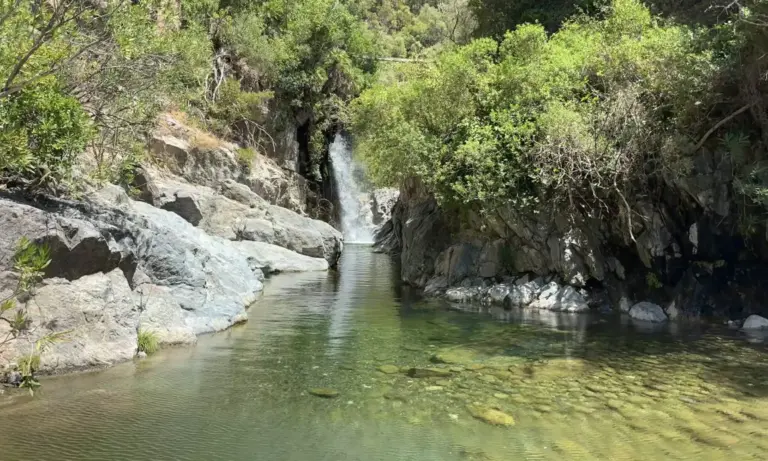
A water hike, literally. You walk in and along the Chíllar River, among natural pools and small waterfalls. It is not a technical route, but you will get your feet wet — and not only your feet — so it is better to come equipped with river shoes or sandals with good grip. The full route is about 8 km there and back. Access is free, but parking is limited.
It is a different experience from the usual hike, but it does require a minimum level of physical endurance: you walk on slippery stones, often under intense sun. The best period is late spring, when the water is still high and nature is at its best. I have not tried it yet myself, but a friend warmly recommended it to me.
An alternative to the Río Chíllar
If a water hike is what you’re after but the Chíllar isn’t an option, all is not lost: just outside Marbella, the Río Verde in Istán offers an equally refreshing water trek, with natural pools and a waterfall at the Charco del Canalón.
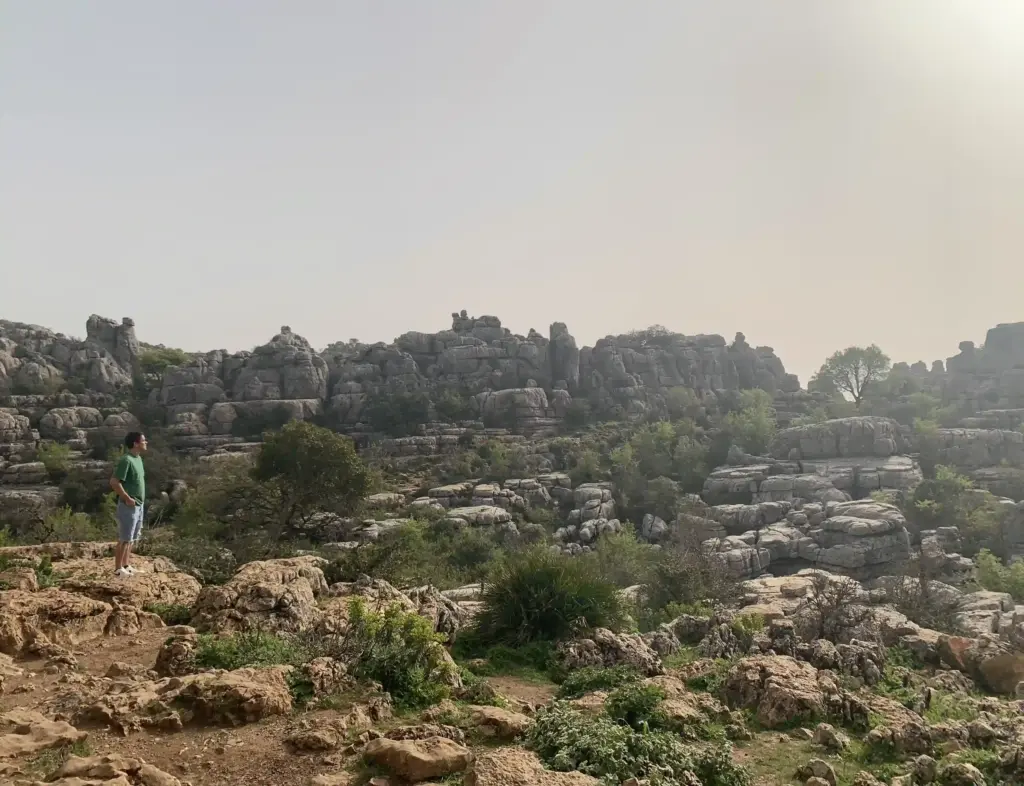
El Torcal de Antequera
A landscape that looks lunar — and that is no exaggeration. This natural park is famous for its karst formations: limestone rocks shaped by wind and rain over millions of years, taking on bizarre forms — animals, human figures, objects. There are short trails of about 1.5 km and longer ones of about 4 km, all well signposted. You can visit it as a day trip from Málaga, ideally with your own car.
It is a unique place in Europe, less well known than other Spanish parks, but with a huge visual impact. Access is free, although very interesting guided visits are also organised. Take a look at the official website.
It is ideal to combine with Antequera if you want to bring together history and nature without ever taking your eyes off the landscape. On GetYourGuide and Civitatis, you’ll find plenty of organised and combined tours.
Today, El Torcal de Antequera is known for its almost lunar landscapes, but for centuries it was above all a gigantic stone quarry. Blocks of limestone used to build important monuments such as the cathedrals of Málaga and Cádiz were extracted from its rocks.
The stone was transported on carts through the Puerto de las Escarihuelas and from there reached Málaga, where it was loaded onto ships bound for Cádiz. A remarkable logistical feat, considering the difficulties of transport at the time.
Near today’s natural park there was also the so-called Poblado de las Sepulturas, a small settlement inhabited at least since the 16th century by quarrymen and their families. Numerous legends and superstitions grew around this village: people spoke of marriages between close relatives and of tuberculosis sufferers sent up there from the city in the hope that the pure mountain air could heal them.
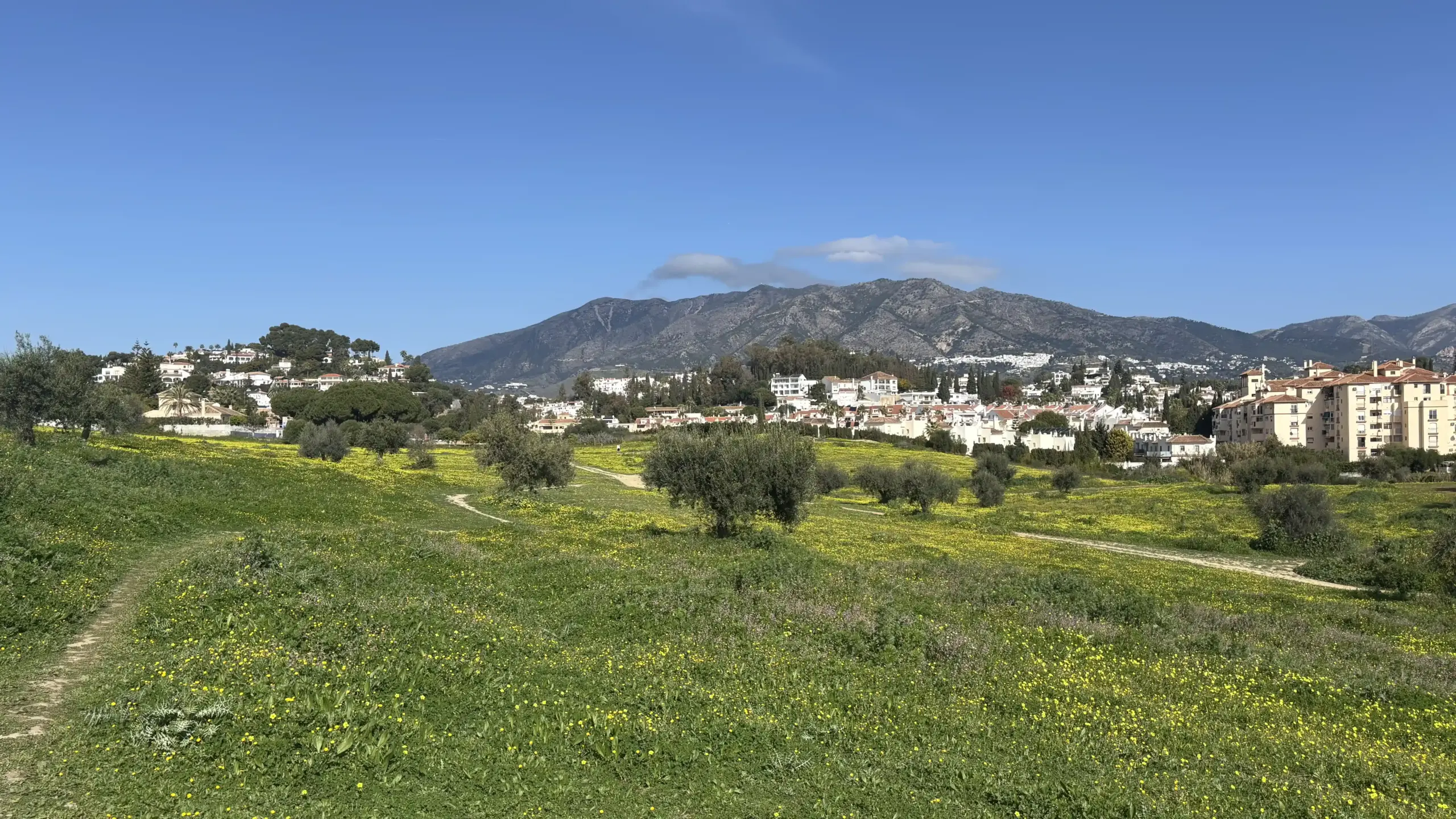
Sierra de las Nieves
The Sierra de las Nieves is a national park declared a UNESCO site in 2021, less visited than El Torcal, but just as spectacular. Here you will find forests of pinsapos — an ancient fir tree endemic to this area — deep gorges and trails of varying difficulty. In June 2026, UNESCO approved the expansion of the Sierra de las Nieves Biosphere Reserve, which reached an area of approximately 98,100 hectares, incorporating new territories within the municipalities of Benahavís and Igualeja.
The best base villages are Yunquera or El Burgo. In summer, the heat can be intense, so spring and autumn remain the best times to visit.
It is the right choice for those looking for real nature, less “staged” for tourists, and for those who love mountain hiking away from the crowds. I recommend checking the official website for up-to-date opening hours, access conditions and any other useful information before your visit.
The name Sierra de las Nieves (“Mountain Range of the Snows”) is no coincidence. Although snow is now relatively rare on its peaks and usually melts quickly, large amounts once accumulated during winter and remained on the highest summits for much of the year.
This unique feature gave rise to a thriving industry: the snow trade. Men known as neveros collected snow in the mountains and stored it in specially dug pits called neveros, ventisqueros, or snow wells.
The snow was compacted and covered with straw and branches to preserve it for months. During the summer, it was transported by mule to towns along the coast and inland. It was used for medicinal purposes, food preservation, and even for preparing cold drinks and ice creams.
This profession survived until the early decades of the twentieth century and gradually disappeared around 1931 with the arrival of artificial ice production and mechanical refrigeration.
Unusual places
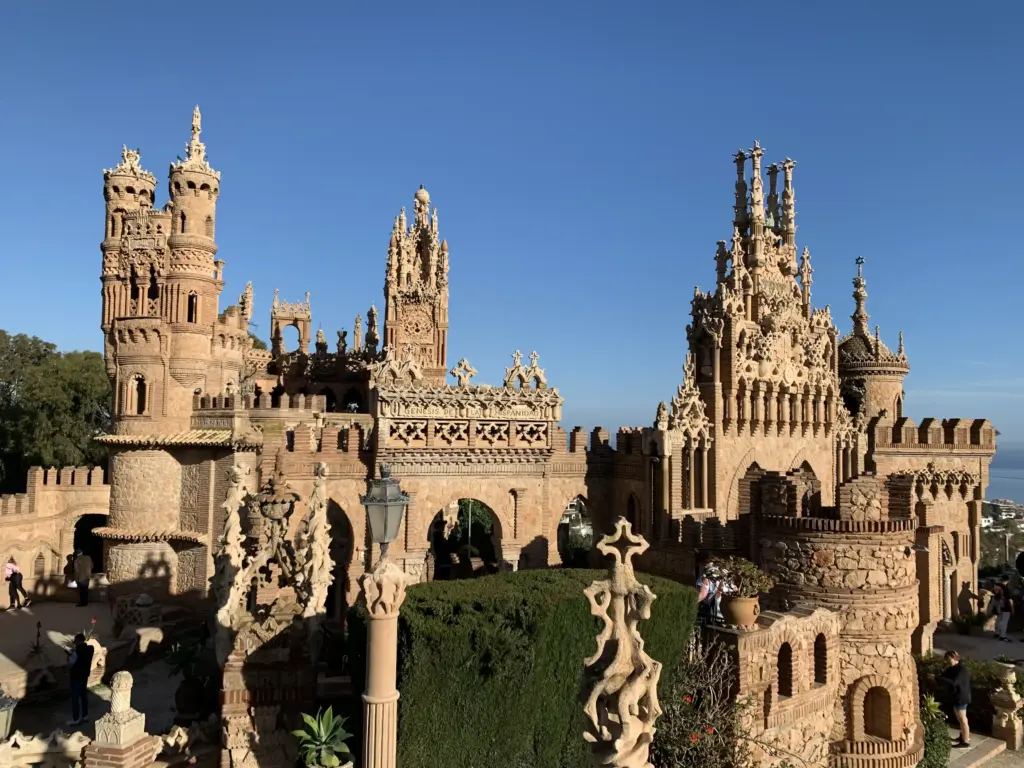
Castillo de Colomares
Do not be fooled by the name. The Castillo de Colomares is not a medieval castle — and it would be a mistake to expect one. It is a monument unlike any other in the world, built between 1987 and 1994 as a tribute to Christopher Columbus and the discovery of America. Its architecture is a delirious mix of styles: Romanesque, Gothic, Byzantine, Mudéjar. Inside, there is also a tiny chapel certified as the smallest in the world.
It can be visited in thirty or forty minutes at a cost of around €3.50. It is not an essential stop, but it is very photogenic and fun. There is no need to book, so you can even decide to visit it at the last minute, as a curious stop on your way back from a day at the beach.
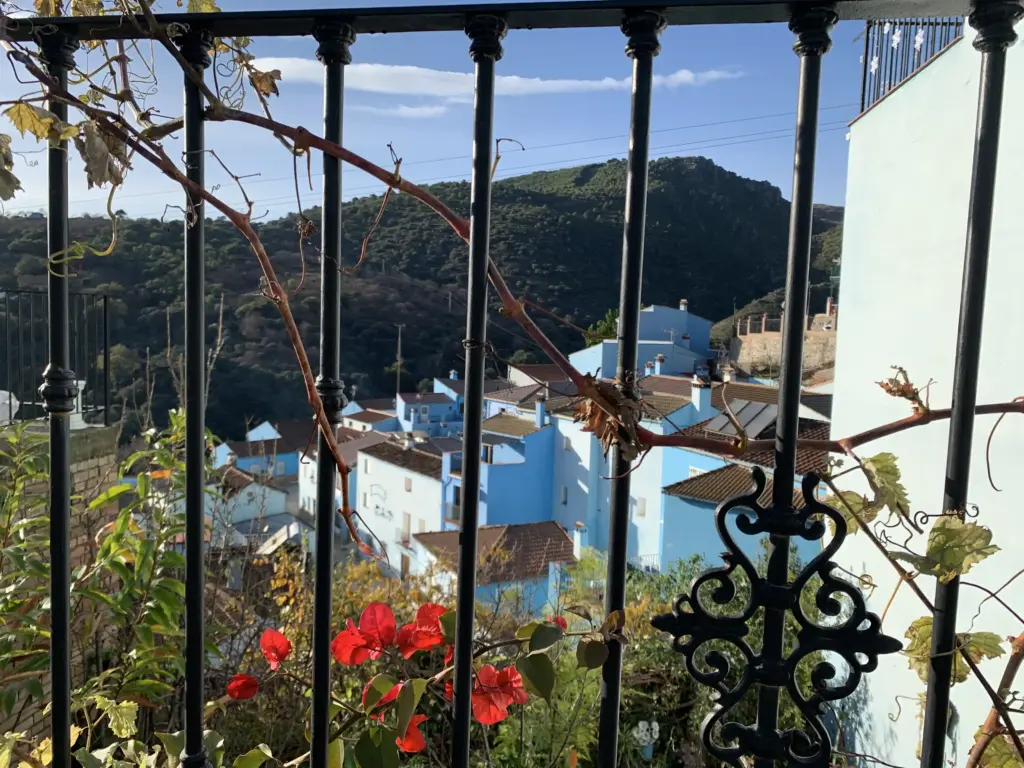
Júzcar
A few kilometres from Ronda, hidden among the folds of the Serranía, there is a village that made a bold choice: breaking away from Andalusian white and completely reinventing itself, each in its own way.
The first is Júzcar, now officially renamed “Aldea Azul”, just 25 minutes by car from Ronda. The story is almost absurd: in 2011, Sony Pictures chose it as a location to promote The Smurfs 3D, and after 9,000 kilos of blue paint, the façades — including those of the church and the cemetery — turned blue. Once the advertising campaign was over, the inhabitants held a referendum and decided to keep it that way. Today, walking through its little streets means coming across murals of Smurfs and Gargamel on every corner, with a cartoon-like atmosphere that especially entertains children — but that, let’s be honest, also brings a smile to adults.
It is a tiny village — about 200 inhabitants — and can be visited in an hour or two. My advice is to combine it in the same day starting from Ronda.
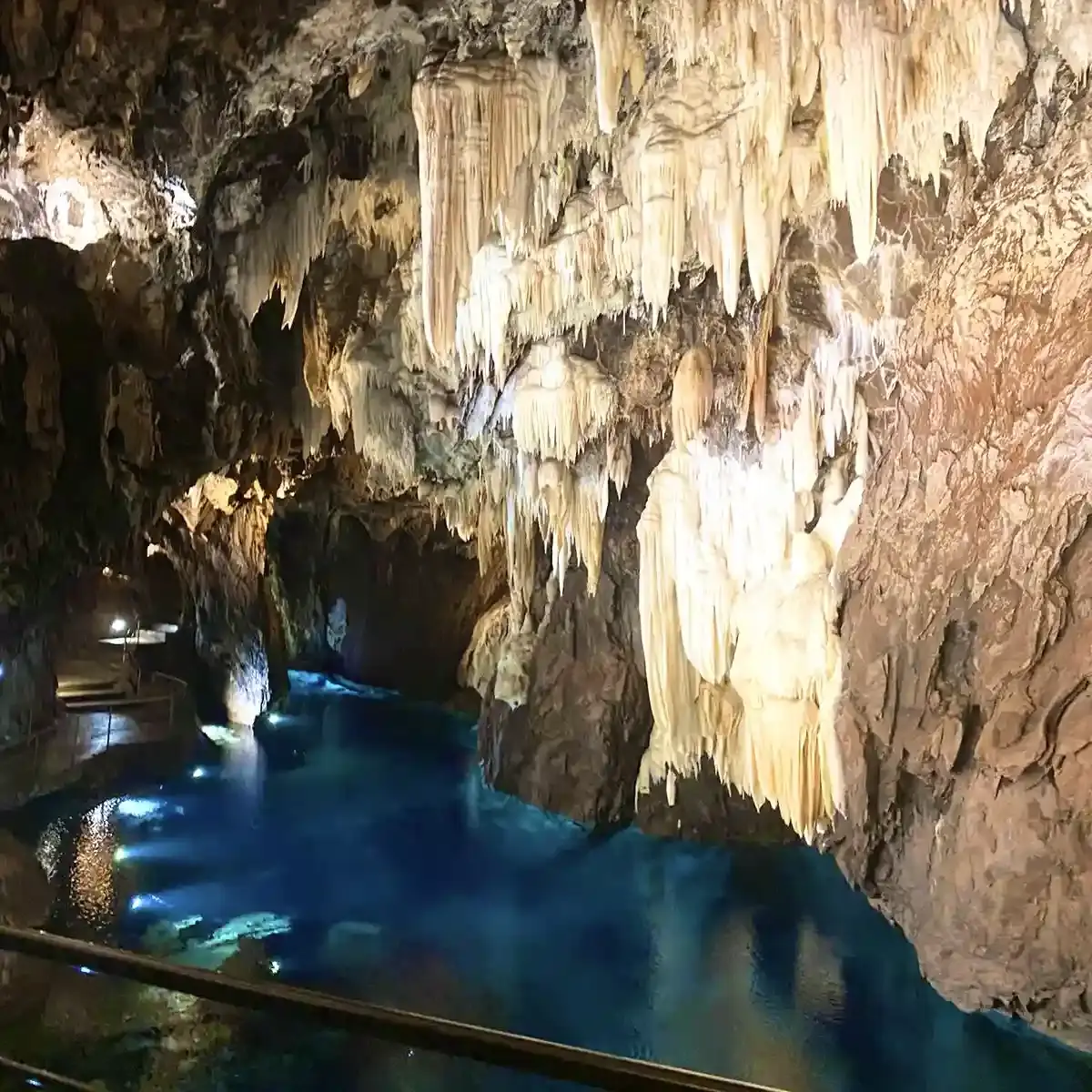
Cueva del Tesoro
Just 15 km from Málaga, in Rincón de la Victoria, one of those places you do not expect and struggle to forget is hidden away. The Cueva del Tesoro is one of only three sea caves open to visitors in the world — and the only one in all of Europe. That fact alone is enough to justify half a morning.
The visit lasts about 35–45 minutes and follows 500 metres of galleries, among internal lakes and stalactites that grow in eccentric shapes, almost like curls, as if the rock had decided to do things its own way. Along the route, you come across cave paintings and archaeological remains that tell of 25,000 years of human presence: one of those moments when you stop and struggle to truly understand how much time has passed.
The name is no coincidence. Legend has it that in 1145 the Almoravid king Tesufín ibn Alí hid his treasure here before dying, and since then the cave has never stopped feeding people’s imagination. Over the centuries, six gold coins from the 12th century and some ceramics from the same period have been found — enough to keep the story alive, but not enough to close it. The real treasure has never been found, and there is still something amusing in the idea that every visitor, even unconsciously, enters with a small hope of changing history.
The ticket costs around €5 and can be purchased online. Free parking is also available.
Opening hours are usually from around 10:00 a.m. to 6:00 p.m., but I recommend always checking the official website, as they may vary depending on events.
From Monday to Friday, during the first hour of opening, admission is free, but booking is mandatory and must be made on the town council website.
There would obviously be much more to say. We have not talked, for example, about the Acantilados de Maro-Cerro Gordo, Moclinejo or Jubrique at Christmas. But there will be time for that too! For now, let’s enjoy these first 18 stops off the tourist beaches of the Costa del Sol.
The Costa del Sol is a place that invites you to spend time outdoors, walk without rushing and enjoy your days among historic centres, the sea, mountains and authentic neighbourhoods. For this reason, when packing your suitcase, it is better to think more about comfort than quantity.
The sun is one of the main features of the Costa del Sol at any time of year. A hat, sunglasses and a good sunscreen are essential even in winter: the Andalusian light is intense and is particularly noticeable during long walks. I always carry this sunscreen with me. It is small, but very effective.
You will walk a lot, often along stone streets or routes with gentle slopes, so a pair of comfortable shoes that you have already worn before the trip is essential.
A reusable water bottle is a great ally, especially if you plan to go hiking or visit areas where shade is not always guaranteed. I bought a collapsible silicone bottle from Natura, although it is often unavailable. Alternatively, here you can find a similar one that takes up very little space once empty.
If you are planning to go to the beach, there is no need to bring half your home with you: a lightweight beach towel —I bought this one so that I can always carry it with me when travelling to a seaside city—, a pair of sandals and a practical bag are more than enough. The beaches of the Costa del Sol are generally informal and perfect for an unplanned break between one visit and another.
Marbella’s urban beaches and some areas of the western coast are, however, a little more glamorous. This is the perfect opportunity to wear the elegant outfit that you have almost certainly packed in your suitcase.
Even though the climate is mild, it is worth carrying a sweatshirt or a lightweight jacket for the evening, when the sea breeze can make the air feel cooler. I use this waterproof and windproof jacket, which is lightweight and takes up very little space. It is also useful on windier days or during boat trips.
If you plan to visit inland areas in winter, I also recommend bringing a heavy jumper, especially if you are planning a visit to Ronda, the Sierra de las Nieves or other towns located at higher altitudes. Temperatures can be noticeably lower than along the coast.
Small items such as a power bank may seem like minor details, but they make your days much easier, especially if you use navigation to find your way around and want to photograph all the most beautiful places and moments of the trip. I was given this one and I am very happy with it. Naturally, there are many different models available, but whichever one you choose, I strongly recommend bringing one.
I often hear people say that the Costa del Sol is “too touristy”, “too crowded”, “not the real Spain”. I hear it very often, and I partly understand where it comes from. But I hope this article has made you feel at least a little doubt and curiosity.
Behind the wonderful coast, there is an authentic Andalusia: white villages with Moorish roots, natural parks where the rocks are millions of years old, canyons cutting through the mountains, villages that have reinvented themselves with courage and irony. And then there is Málaga, which alone would be worth the trip.
So yes — go for the sea, for the sun, go for the fried fish to eat with your feet in the sand. But while you are there, lift your eyes from the beach and look at the landscape behind you. The real Andalusia is right there, just a few steps from your beach umbrella.
And if, after this coast, you feel like exploring further, know that there is still so much to discover — from the Costa de la Luz to the whole of Andalusia. Do not let it slip away!