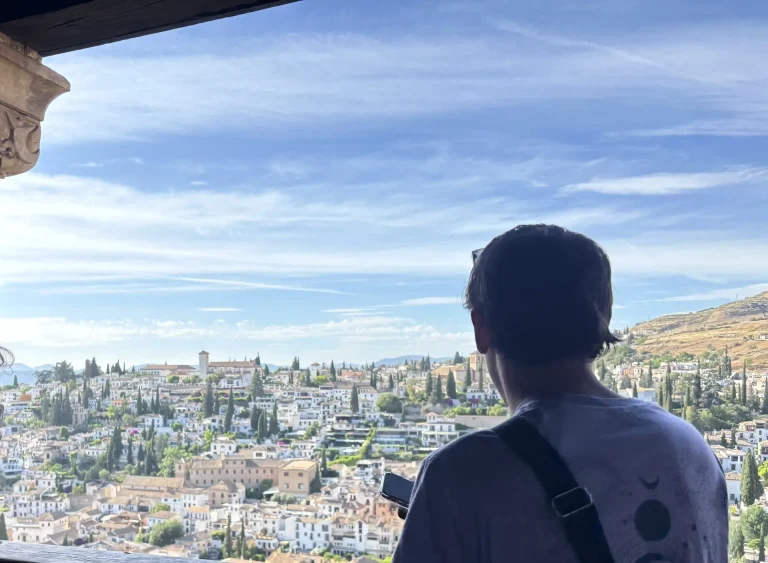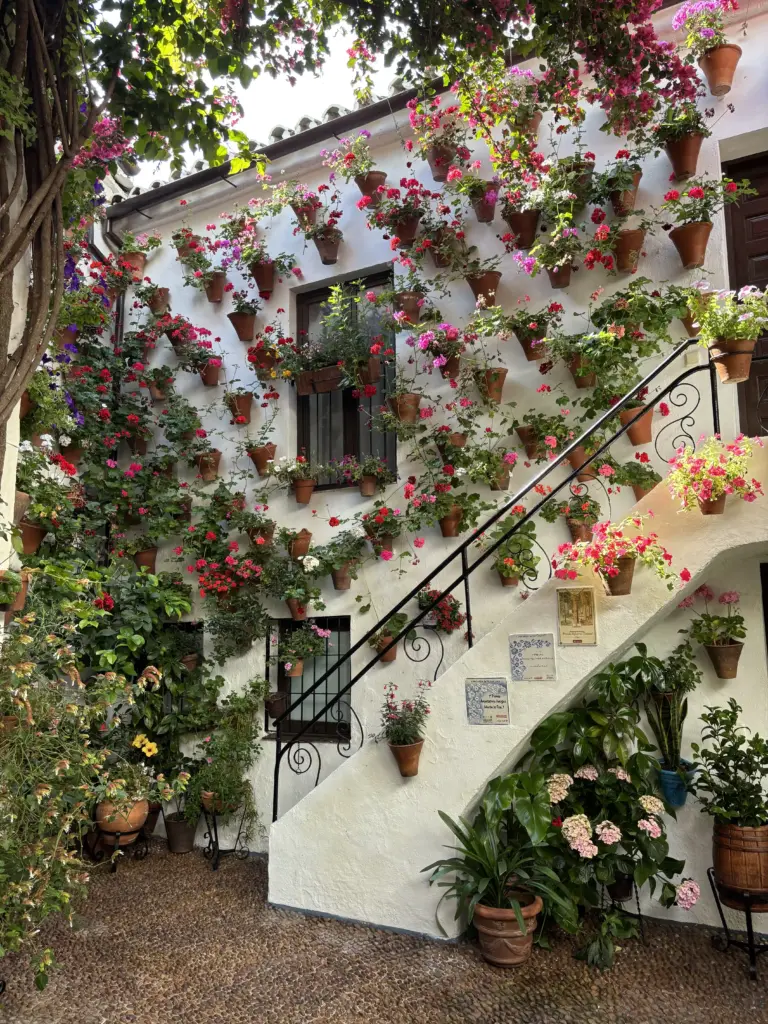
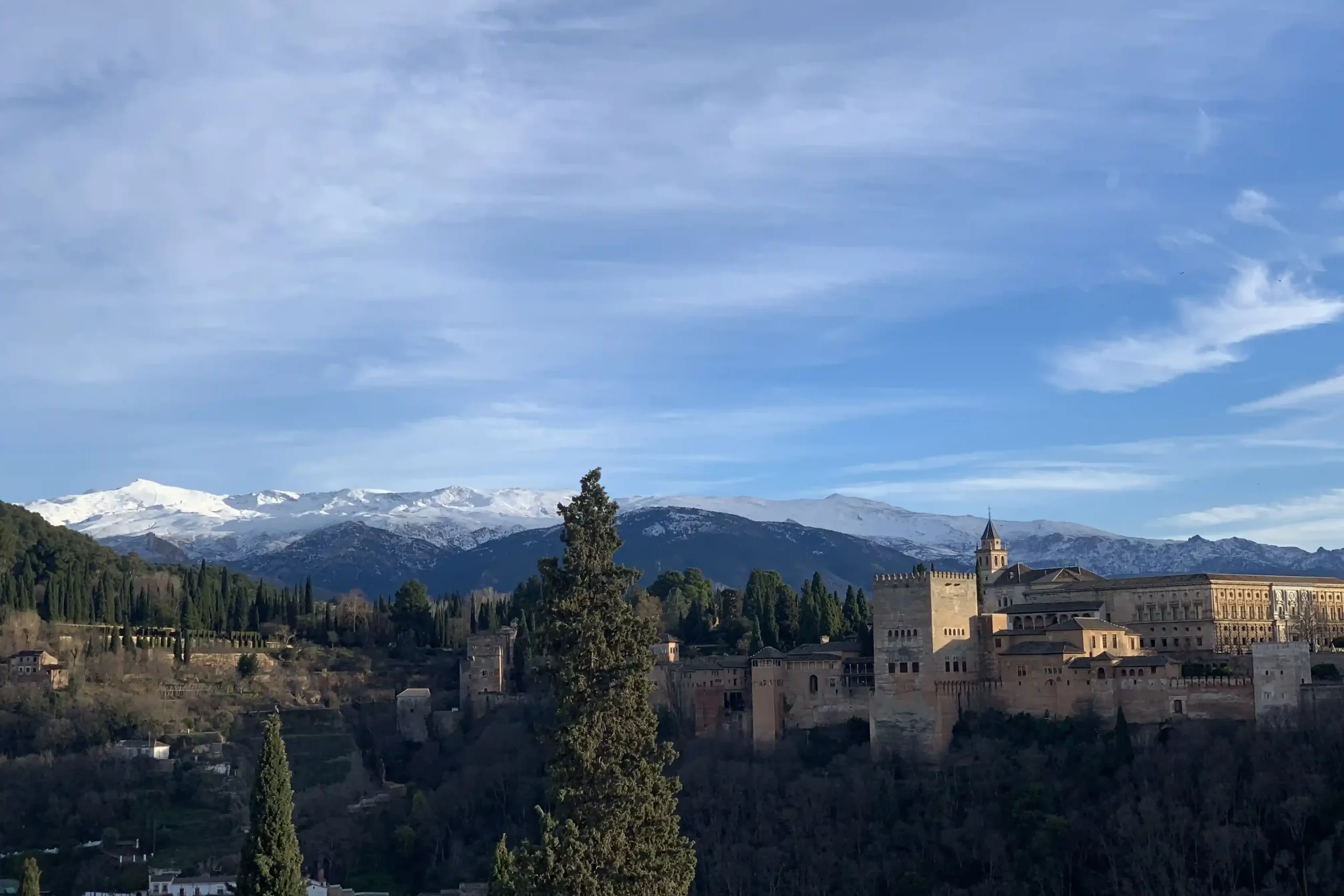
Granada: a land of light, blood, and love
Before starting our adventure and taking you around Granada, I have to make a confession: I am completely and madly in love with the Alhambra.
The first time I saw it, I was in Andalusia on a short trip with my sister, and I had to seriously fight the temptation to spend the entire stay simply admiring it: from every possible angle, at every hour of the day, letting the light tell its story to me.
For me, it was the most beautiful human creation I had ever seen: romantic, sensual, almost unreal.
In my eyes, only the Taj Mahal manages to surpass it. Perhaps because of the stories I had read before arriving, perhaps because of the colors, perhaps because of the Sierra Nevada rising in the background, but the Alhambra is, to me, an extraordinary spectacle gifted to us by Al-Andalus.
I will therefore try to be as objective as possible and give the right attention to all of Granada. Because in reality, Granada has so much to offer: neighborhoods steeped in history, walls that still bear the marks of those who crossed them over the centuries, the tomb of the Catholic Monarchs… in short, a city that tells far more than it seems at first glance.
Granada is a rich and intense city. But it is not a simple one.
Granada,
a blood-stained land
in the evening by bulls,
a woman who preserves the charm
of dark eyes,
of a rebellious, gypsy dream,
covered in flowers,
and I kiss your crimson mouth,
juicy apple
that speaks to me of love,
as Plácido Domingo once sang.
Its long history has shaped its character, making it reserved, guarded, at times difficult to decipher, especially for those who rush through it.
But don’t worry: Granada, too, knows how to open itself—if approached with the right steps and the time it deserves.
So get ready, because we are about to cross the last Islamic stronghold of Europe.
Here are some practical tips to experience Granada at its best. They are simple, but they can help you save time, money, and a bit of frustration. So keep in mind that:
- Lunch and dinner start late: usually from 2:00 pm and 9:00 pm onwards; many places therefore open a bit later than what you might be used to.
- The day starts later than in England, so there’s no point in waking up too early if you want to see bars open, people walking around, and street life in general.
- Markets close at 2:00 pm, so if you plan to eat in these places, make sure to organize yourself in advance.
- Many museums offer free entry on Sundays after 4:00 pm.
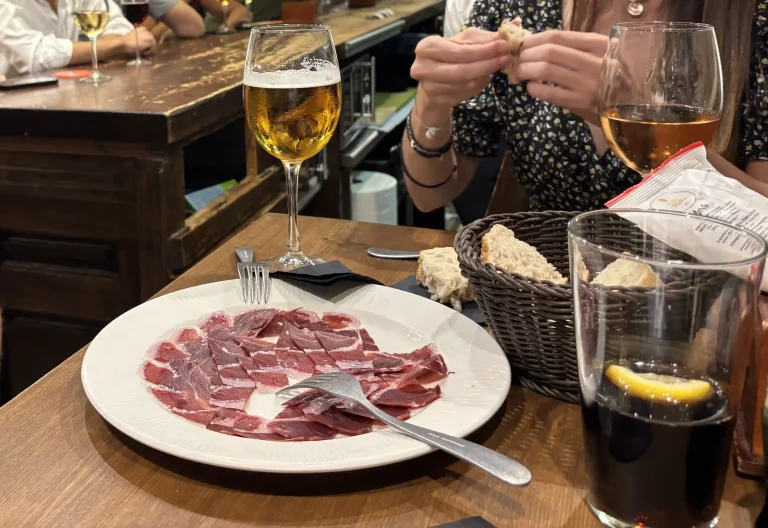
- Here, tapas are free when you order a drink.
- If during your trip to Granada you plan to visit the main monuments of the Andalusi and Nasrid heritage of the city — such as El Bañuelo (ancient Arab baths), Corral del Carbón, Casa Morisca Horno de Oro, and the Palacio de Dar al-Horra — my suggestion is to buy the Dobla de Oro, a “pass” which, for about €8 more than the Alhambra ticket alone, gives you access to the red city and other historic sites linked to Granada’s Nasrid history. Check the official website of the Alhambra Patronage.
A bit of history about Granada
Granada was founded in one of the most suggestive—and also one of the most intelligent—locations in Spain.
If you visit it in winter, it’s hard not to be struck by the contrast between the city bathed in the intense Andalusian sunlight and the snow-covered peaks of the Sierra Nevada rising in the background.
This position, however, is not just a gift for the eyes; it is also logistically perfect.
Granada lies at the foot of the Sierra Nevada, in the heart of a fertile plain—the Vega de Granada—and is crossed by three rivers: the Darro, Genil, and Beiro. It is also naturally protected by hills and changes in elevation that make it easy to defend.
Above all, for centuries it was self-sufficient in water, a crucial detail in a region where heat and drought have always been constant companions.
This is why, despite being located inland in Andalusia, you may be surprised to see how water plays a central role in the city: underground channels, acequias, fountains, public baths, and gardens.
Before the arrival of the Muslims, however, Granada played a rather marginal role. During Roman and Visigothic times it remained a prosperous agricultural center, but in the shadow of more important cities such as Córdoba, richer and strategically more relevant. The limited importance of this period is also evident in the near absence of Roman remains within the city, especially when compared with other Andalusian cities.
The real Granada—the one we still recognize today—was born with Al-Andalus.
If you know anything about the history of Andalusia, or if you’ve read my article on Andalusia, you’ll know that the Moors arrived in Spain in the 8th century and unified most of the Iberian Peninsula under a single great realm: Al-Andalus.
For centuries, this political and cultural reality profoundly transformed Spain—and especially Andalusia—turning it into one of the most advanced and sophisticated centers of Western Europe.
The Moors introduced new agricultural and irrigation techniques, refined architecture, surprisingly modern hygiene systems, and a new way of thinking about the city, space, and daily life.
With the gradual advance of the Christian kingdoms from the north, Al-Andalus slowly began to shrink. It was not a sudden collapse, but a centuries-long process, marked by military defeats, temporary treaties, fragile alliances, and continuous territorial retreats.
Moreover, the fact that Al-Andalus was not a single unified empire, but rather a collection of emirates—politically, militarily, and administratively independent territories that nonetheless recognized the authority of the caliph (both political and religious)—gave the Catholic kingdoms a significant military advantage.
City after city, Muslims were forced to retreat further south, losing control of the great historic capitals such as Toledo, Córdoba, and Seville.
Yet what remained—from the 13th century onward—was anything but marginal.
In 1238, Muhammad I ibn Nasr founded the Nasrid Kingdom of Granada, which occupied part of what is now eastern Andalusia. A small kingdom, surrounded by powerful enemies, yet surprisingly resilient.
Granada thus became the last stronghold of Al-Andalus: a political capital, but also a refuge for artists, craftsmen, scholars, and families fleeing from cities conquered by the Christians. With them came knowledge, architectural styles, traditions, and practical skills accumulated over centuries of Muslim presence on the Iberian Peninsula.
In this context, a city emerged that was deeply aware of its own fragility: beautiful and refined, yet constantly on alert.
Tension increased when the marriage between Isabella of Castile and Ferdinand of Aragon made the Reconquista more coordinated and inevitable. At that point, the Reconquista was clearly entering its final phase.
This constant tension—this way of living while knowing you were “the last”—shaped Granada profoundly: its urban layout, its culture, and above all the Alhambra, built to defend the new Nasrid kingdom.
It was not erected as an aesthetic whim, but as a fortified city atop the hill, capable of containing power, daily life, defenses, warehouses, baths, and streets. A place that had to be self-sufficient, elegant, and impregnable. A perfect contradiction—and precisely for that reason, unforgettable.
If you lose yourself in the Albaicín, the oldest neighborhood of the city, you’ll understand this sense of constant alert even in everyday life: narrow streets, sudden turns, non-linear routes, small and irregular squares. This is no coincidence. Such a city is harder to conquer and easier to control for those who live within it.
The fall of Granada, in fact, was not the result of a single battle, but the outcome of a slow political, military, and economic erosion.
The Reconquista became possible thanks to a combination of decisive factors, first and foremost the capture of Málaga in 1487. With the loss of its main Mediterranean port, Granada was cut off from commercial routes, deprived of essential resources, and—above all—isolated from Africa, from which men, aid, and support had arrived for centuries.
To this isolation was added an even more destructive element: internal divisions.
Within the Nasrid Kingdom, a violent struggle for power erupted among members of the same royal family. Two brothers fought for the throne, further weakening a state that was already fragile and surrounded by enemies.
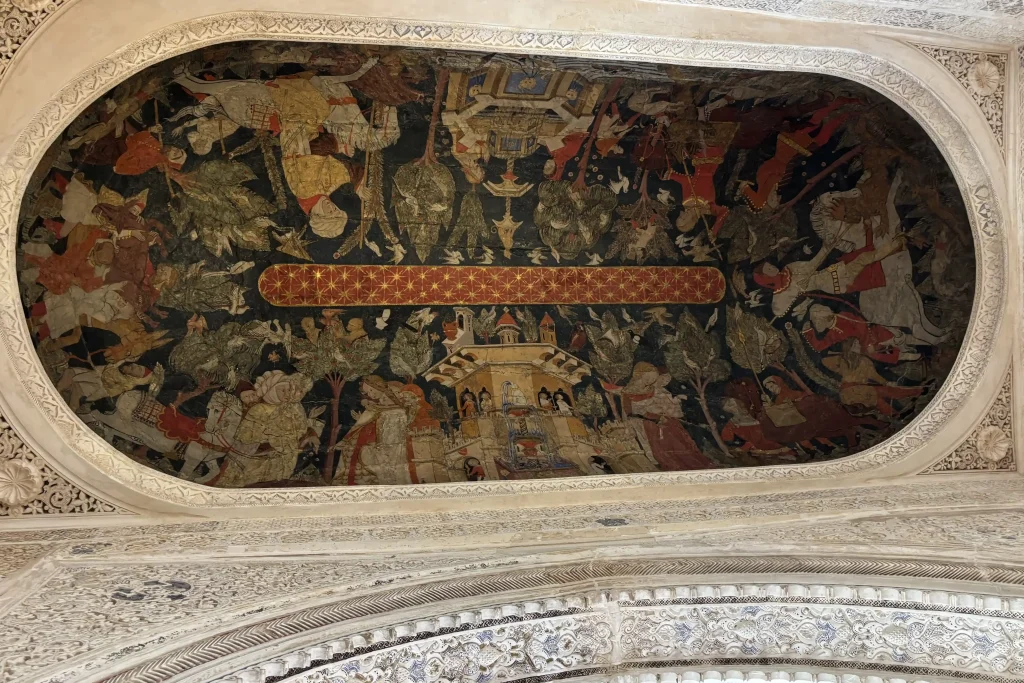
One of them, defeated and exiled, chose a desperate path: to strike a deal with the Catholic Monarchs. In exchange for their military support to overthrow his brother, he obtained the promise of being allowed to rule Granada. It was a choice that would prove fatal.
The agreement was nothing more than a temporary truce, useful to the Christian rulers to complete the siege and wear the city down from within. Granada, now isolated, starving, and without allies, no longer had the strength to resist.
On January 2, 1492, Granada surrendered.
That day Isabella of Castile entered the city on horseback, holding a cross in her hand, as she had done in every other conquest. A solemn, symbolic gesture, destined to mark the end of an era.
The fall of Granada carried enormous historical and symbolic weight. With it, Muslim presence in the Iberian Peninsula came to a definitive end, closing a chapter that had lasted almost eight centuries. At the same time, it opened the way to the birth of one of the largest empires in modern history.
It is no coincidence that Isabella of Castile and Ferdinand of Aragon chose Granada as their burial place: their tomb still lies next to the cathedral today, as if to seal forever the meaning of that conquest.
The promises of tolerance initially made to the Muslim population were short-lived.
Repression was swift and brutal: many Arabs were reduced to slavery, others expelled or scattered across different cities of the kingdom. Granada, deprived of its cultural and economic elite, slowly began to lose importance.
Meanwhile, the center of gravity of the new empire shifted toward the Atlantic and the Americas. Trade with the New World reshaped Spain’s political and economic priorities, relegating Granada to an increasingly marginal role, while Seville became the great commercial hub of the empire.
Persecutions grew progressively harsher.
Increasingly rigid bans were imposed: speaking Arabic in public, visiting the baths, maintaining customs and traditions all became illegal. Thousands of works of literature, medicine, and science—the priceless legacy of Al-Andalus—were burned, erasing centuries of knowledge.
This constant pressure led to numerous internal revolts. The most violent were those of the Alpujarras, the mountains south of Granada, where the Moriscos—Muslims converted in order to survive or never fully integrated—took refuge and attempted to resist. The rebellions were crushed with extreme violence, leaving deep scars in the region’s collective memory.
The Napoleonic era also left visible marks.
Napoleon’s troops turned the Alhambra into a military headquarters and, during their retreat, blew up parts of the complex. The wounds left by those explosions are still visible today—permanent scars on one of the city’s most precious symbols.
Few people know this, but if today we can still admire the Alhambra, we also owe it to the courage and quick thinking of José García.
When Napoleon’s French troops abandoned Granada at the beginning of the nineteenth century, they left behind a series of explosive charges, intending to blow up the Alhambra during their retreat. Some parts of the complex were indeed damaged, but total destruction was avoided.
According to historical accounts, it was José García — at the time the military officer in charge of the area — who identified and defused the remaining active explosives, preventing the entire citadel from being destroyed. A silent, swift, almost invisible act, yet a decisive one.
It is one of those moments when history changes because of the actions of a single person. Without him, the Alhambra we know today — its palaces, towers, courtyards, and gardens — would probably no longer exist.
Walking among these walls, it is impossible not to think about how fragile beauty can be. And how, sometimes, it only takes one person to save it.
Another particularly dark chapter was that of the Francoist era.
Granada was one of the places most harshly affected by the regime’s repression, with arrests, executions, and systematic persecution. Among the most emblematic victims was Federico García Lorca, who more than anyone else was able to give voice to the deep, fragile, and passionate soul of Andalusia.
Perhaps it is because of this long history made of resistance, loss, and pride that people from Granada often appear reserved, deeply attached to their homes and their identity. A people who do not forget easily, but who fiercely guard their memory.
It is not uncommon, during a guided tour, to hear a Granadino firmly restate what makes their city unique—especially when someone dares to compare it to other Andalusian cities. In these comparisons, the Alhambra admits no rivals.
After understanding this context, we can finally immerse ourselves in the Granada of today: a city of Nasrid palaces and Catholic cathedrals, of narrow alleyways and casas cueva, of bridges over water and stone streets.
Let yourself be guided among acequias, fountains, and mosaics—you will come out of it, inevitably, a little spellbound.
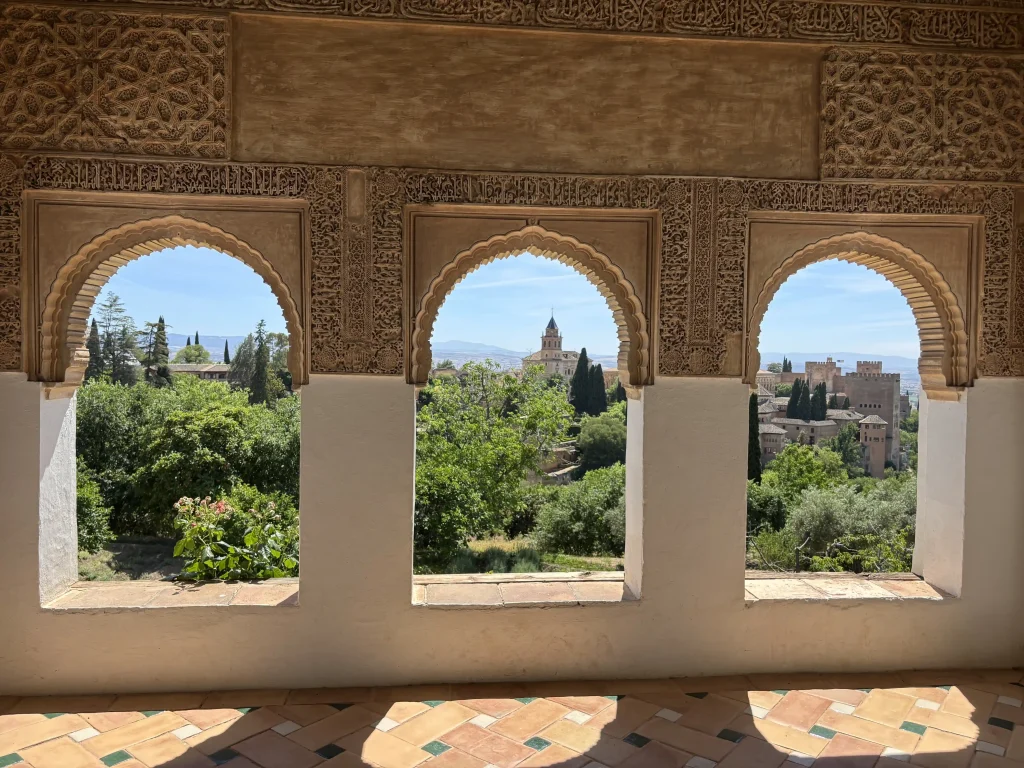
What to See in Granada
As you’ve probably gathered by now, Granada is a city meant to be experienced slowly.
From our experience, 2–3 days is the right amount of time to truly discover it without rushing. In these pages, we’ll walk with you through its streets, neighborhoods, and monuments, helping you shape your days with balance and pleasure: where to eat, what is truly worth your time, and what you can comfortably skip.
So warm up your legs—and your heart—because Granada cannot begin unless both are ready.
The Alhambra
Tickets to the Alhambra should be purchased only from the official website. Be careful: many other sites try to sell guided tours or bundled packages, but prices are almost always higher than the official ones.
To be an official Alhambra guide, a specific license is required—one of the most sought-after in Spain. This is a mark of respect for an architectural masterpiece of this level. For that very reason, don’t let yourself be fooled by improvised or shady street “guides”. Booking well in advance is essential. The Alhambra is visited by millions of people every year, and tickets often sell out months ahead, especially in spring, autumn, and peak holiday periods. The Alhambra demands time. This is not a visit to squeeze in between other plans. Ideally, you should dedicate at least three hours, and even more if you enjoy stopping, observing, and taking photos. The most important ticket is the one that includes the Nasrid Palaces. Without it, you would miss the emotional and artistic heart of the entire complex. When you book, you’ll be assigned a specific entry time for the palaces—and it is strictly enforced. Entry before or after that time is not allowed.
As I mentioned earlier, the Alhambra is a magical place for me. That’s why I dedicated an entire in-depth article to it: The Alhambra: the Pearl of Andalusia.
That said—since it’s always a pleasure to talk about the Alhambra—I won’t hold back from giving you a very condensed overview here. It’s by no means exhaustive, so I wholeheartedly recommend visiting the Alhambra either with the detailed article in hand or with a guided tour.
So… let’s begin!
A tip that truly changes the experience: if you can, reach the Alhambra on foot from the center of Granada, walking up from Plaza Nueva to the Gate of Justice. This is the historic route—the one once taken by travelers, ambassadors, and officials. You’ll pass towers, walls, and control gates, gradually entering the logic of a fortified city.
If you prefer a more convenient option, you can arrive by car or take bus C32 up to the parking area on the hill. In this guide I’ll follow that route, but you can easily reverse it if you enter through the Gate of Justice.
Although the Alhambra is often associated with a single palace, when we speak of the Alhambra we are actually referring to a true fortified city, built on the hill that dominates Granada.
It is often described as the pearl of Andalusia: an elegant fortified city that brings together power, beauty, and history in a single place.
As we’ve seen, in 1238 Muhammad I ibn Nasr founded the Nasrid Kingdom of Granada—a small kingdom, yet one destined to become the most famous Arab dynasty in Spain.
To secure his rule, Muhammad I chose to establish his residence on the hill, on the remains of an earlier 11th-century fortress. From there, the Alhambra watched over the city, the fertile Vega, and every possible access route.
The name Alhambra comes from the Arabic al-Ḥamrā’, meaning “the Red One.” This likely refers not only to the reddish color of its walls at sunset, but also to the nickname of Muhammad I himself, al-Ahmar—“the Red”—because of his reddish beard. Once again, power, identity, and symbolism intertwine.
The Alhambra as we see it today is the result of roughly 250 years of history, from 1238 to 1492. Over this period, around twenty sultans of the Nasrid dynasty succeeded one another, and each of them left a mark—large or small—on this city suspended between power and beauty.
As you can imagine, 800 years ago, when the Alhambra was built, there were no advanced machines like those we have today. In an unstable political context and on a complex hillside site, sourcing materials and labor for such a monumental construction was anything but easy.
The solution was brilliant in its simplicity. Nasrid architects adopted an extremely effective technique: the walls were built with rammed earth and clay, excavated directly from the hill next to the Alhambra site. This meant there was no need to transport stone over long distances or use large lifting equipment.
The same logic was applied throughout the entire city. Columns were often made of white marble from Macael (in today’s province of Almería, then part of the Emirate of Granada). Walls were built with compacted earth and lime; decorations, with the exception of the columns, were crafted from plaster and small mud mixtures. Even the wood came from within Nasrid territory, mainly from pine forests in the mountains of Cazorla and the wooded areas around Granada.
Everything was extracted and worked locally: a kind of “zero-kilometer” architecture avant la lettre. Simple materials, yet perfectly suited to Granada’s climate, with its cold winters and extremely hot summers.
While much of Europe was building with carefully cut stone, often imported from afar, at high cost and over very long timeframes, the ingenuity of Nasrid architects made it possible to create buildings that were quick to construct, economical, and climatically intelligent, often completed in just two or three years.
After all, in an era when a sultan’s reign could be short and uncertain, every ruler wanted to live to see his own works completed. And the Alhambra, in this too, is the result of clear-headed, practical, and surprisingly modern choices.
To help you find your way during the visit, the Alhambra provides audio guides and maps (although, it must be said, the audio guides are not always working or available).
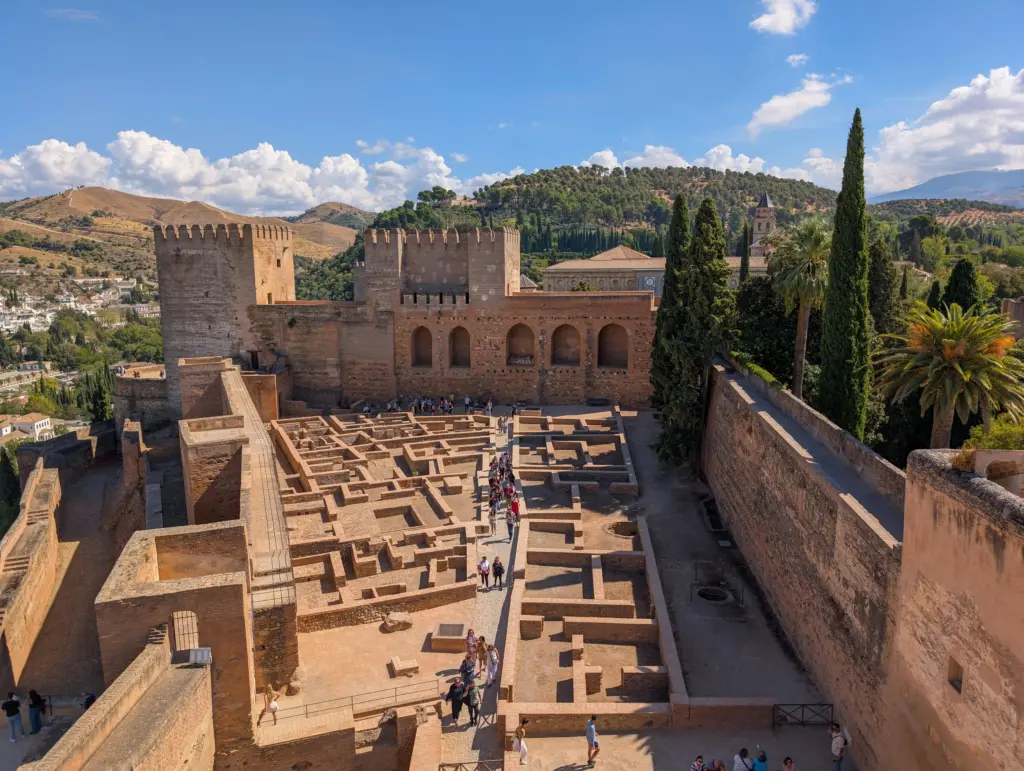
The Alcazaba
The visit often begins at the Alcazaba, the oldest and most military part of the complex. It is here that the original function of the Alhambra becomes immediately clear: not only a royal residence, but a fortified city designed to control Granada from above. Towers and walls speak of strategy, defense, and visual dominance over the surrounding territory, while also offering some of the widest views over the city and the Sierra Nevada.
But the Alcazaba was not only a place of war. In the early decades of the Nasrid kingdom it also served as the residence of the sultan and his court, before the Nasrid Palaces were built. This explains the presence of living spaces, small courtyards, and structures for daily life—now largely lost, but still legible in the remains of the walls and the layout of the spaces. It was a compact, functional city, designed to live under constant pressure.
Climbing the main towers, such as the Torre de la Vela, the Alhambra reveals what it originally was: a fortress that controlled the land, yet at the same time dialogued with it. From here you can see everything—and at the same time understand how isolated, exposed, and fragile this place once was.
Visiting the Alcazaba is essential because it restores the true scale of the Alhambra. Before poetry, before water and stucco, there was the need to endure. And without this hard, essential, protective core, the enchantment that comes later could never have existed.
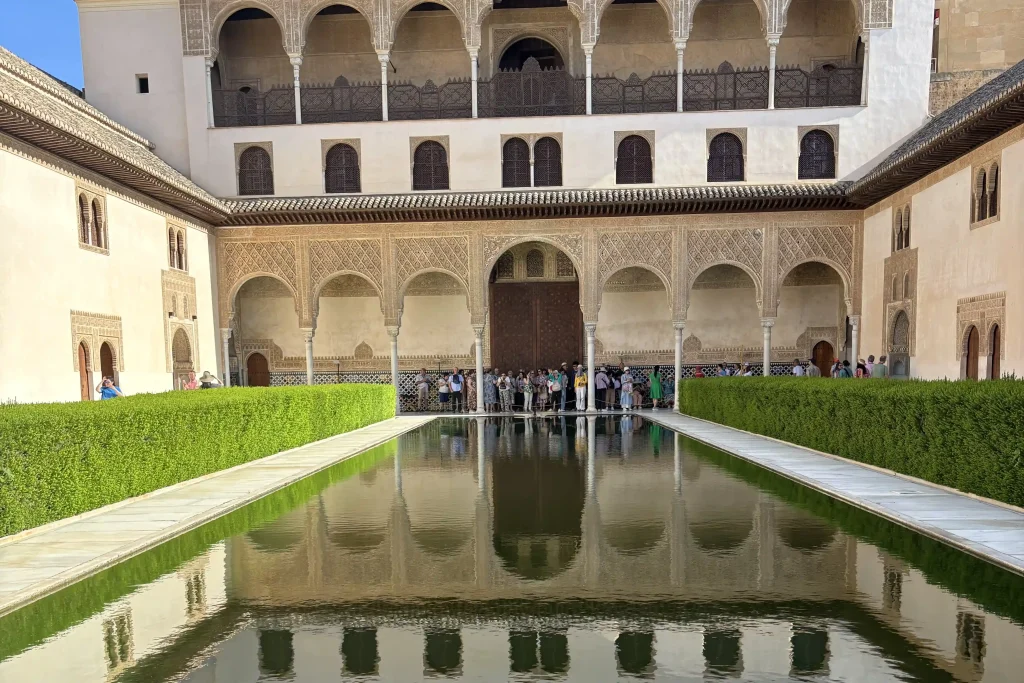
The Nasrid Palaces
The emotional and artistic heart of the visit lies in the Nasrid Palaces, accessible only with a timed ticket. Here, the Alhambra completely changes its language: stone becomes decoration, light takes center stage, and every room seems designed to amaze without ever being excessive. The spaces are not grand in size, but in refinement—stuccoes, inscriptions, arches, and domes interact with natural light, creating environments that invite silence and slow contemplation. Without this section, the Alhambra would lose its most intimate and poetic soul.
The Nasrid Palaces are divided into three main areas, distinct in function and atmosphere, yet deeply connected to one another:
- The Mexuar, the public and administrative area, was where the sultan received audiences and administered justice. It is a more sober space, yet already rich in details that introduce visitors to the Nasrid decorative philosophy.
- The Palacio de Comares, with its famous Patio de los Arrayanes (also known as the Court of the Myrtles), became the ceremonial heart of the court. This is where the renowned Throne Room is located, a space in which politics and court life intertwined under the watchful eyes of viziers and dignitaries.
- The Palacio de los Leones, a masterpiece by Muhammad V, is the most private and refined area of the complex. It was designed not to impress through monumental scale, but to create harmony on a human level. Around its courtyards open some of the most extraordinary rooms of the Alhambra: the Hall of the Two Sisters, the Hall of the Abencerrajes, and the Hall of the Kings.
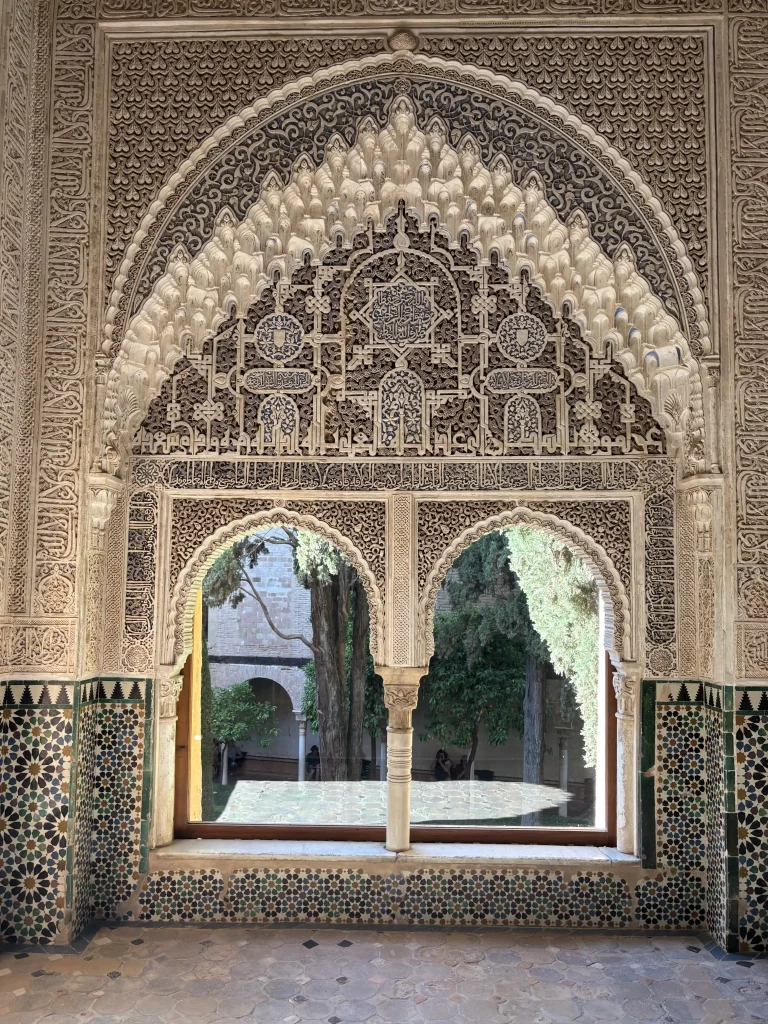
What truly strikes visitors in the Nasrid Palaces is not spectacle in the Western sense of the word, but the richness of detail: every surface is a poem of stucco, mosaics, calligraphic inscriptions, colorful tiles, and geometric patterns that seem to float in the light.
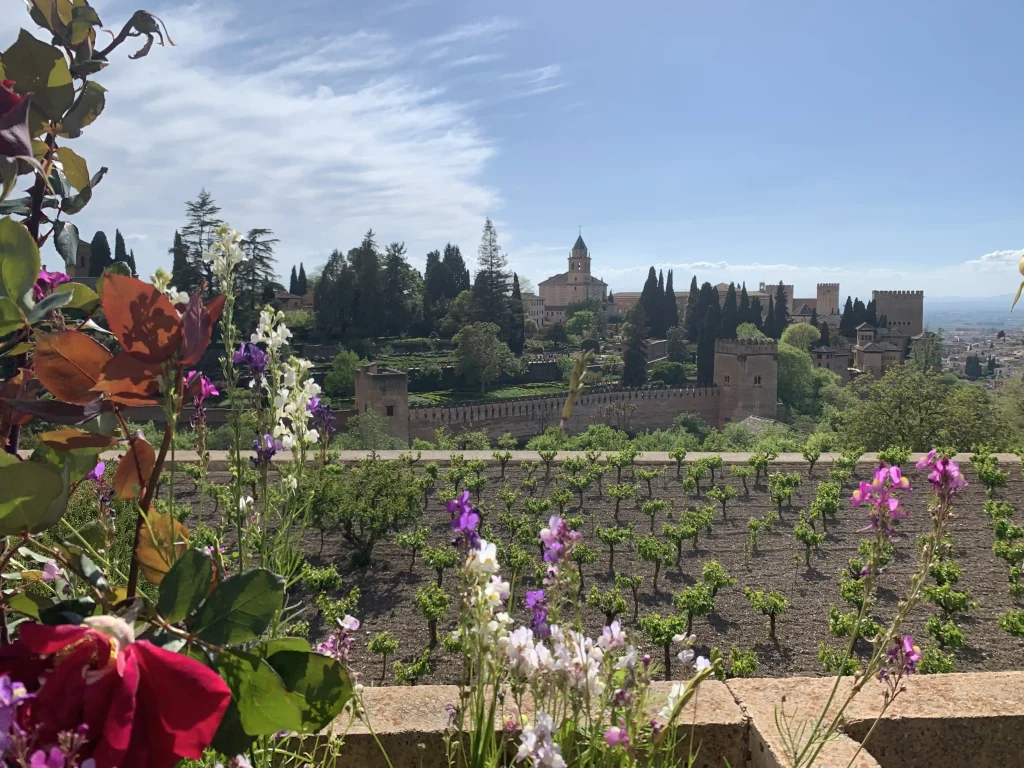
The Generalife
After the density of the palaces, the experience opens outward into the gardens and the Generalife, the lightest and most contemplative area of the complex. The Generalife is not just a garden, but a place conceived for rest and reflection, where the Alhambra seems, at last, to slow its breath.
The Generalife is not a simple ornamental garden. It is a complex system of green spaces, pavilions, and water paths that translates the Islamic idea of paradise into architecture: an ordered, fertile place, crossed by flowing water and protected from the chaos outside. Water, once again, is the central element. It runs along narrow channels, fills basins, rises in small jets. It is not meant to astonish, but to cool the air, guide the eye, and slow down time.
The heart of the Generalife is the Patio de la Acequia, a long central pool flanked by hedges, flowers, and aromatic herbs. It is a space designed for walking slowly, almost in silence, letting the sound of water become the natural soundtrack of the experience. Here you truly understand how the Alhambra was conceived for the senses as well: sight, hearing, smell. Everything contributes to a delicate balance, never ostentatious.
The gardens surrounding the Generalife tell the story of a landscape that was not only decorative, but also productive. Vegetables, fruit trees, herbs, and plants useful to daily court life were cultivated here. Beauty and function were never separate: the order of the garden reflected an ideal order of the world.
Visiting the Generalife therefore means allowing yourself a pause—not only a physical one, but a mental one as well. It is the moment when the Alhambra lightens, opens up, and allows the visitor to gather themselves before returning to the complexity of the real city. A place that does not demand attention, but presence. And precisely for that reason, it leaves a deep and lasting impression.
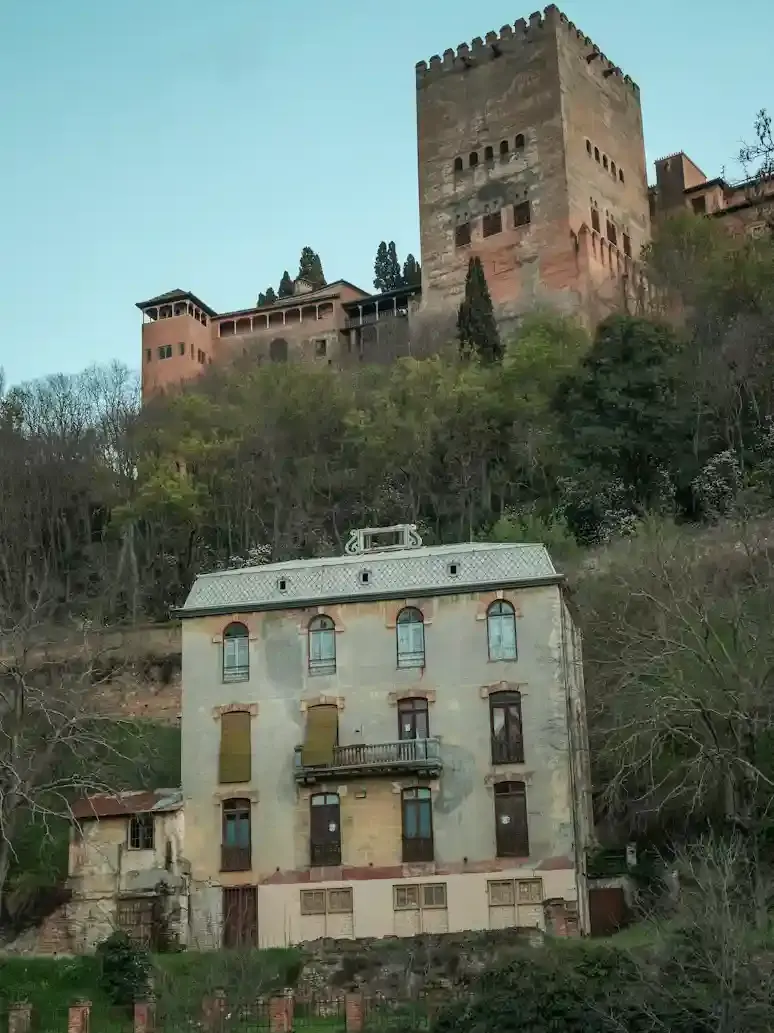
From the Alhambra to the city of Granada
If you don’t have a car and have just finished visiting the Alhambra, my heartfelt advice is to head down to the city center on foot, descending the hill.
From Plaza de los Aljibes, keeping the Wine Gate on your left, follow the path that leads you toward the Gate of Justice, the true access point to the fortified city.
The Gate of Justice (in Spanish Puerta de la Justicia, in Arabic Bāb al-Sharī‘a) was built in 1348, during the reign of Yusuf I, one of the sultans who contributed most to the monumental development of the Alhambra. It was the ceremonial entrance to the citadel, reserved for ambassadors, officials, and distinguished guests. The gate is massive, imposing, deliberately severe.
As you pass through it, you’ll immediately notice that the passage is not straight. As often happens in Islamic military architecture, the entrance is bent at an angle: a defensive solution designed to prevent frontal attacks and force anyone entering to slow down, change direction, and expose themselves.
On the outer arch, a carved hand stands out, while on the inner arch a key appears. These two symbols have fueled interpretations and legends for centuries.
- The hand is often interpreted as a symbol of divine protection and justice, as well as a reference to the Hand of Fatima, a protective figure in the Islamic world.
- The key represents access to power, but also the idea of the Alhambra as a “closed” city, accessible only to those deemed worthy.
According to a popular legend, the day the hand were to grasp the key, the Alhambra would fall. A prophecy that, of course, speaks more of fear and reverence than of any real destiny.
The name itself is not accidental. This gate was associated with the idea of law and order: crossing it meant entering a regulated space, where the sultan’s power was exercised in the name of divine justice.
Once past the walls, you enter the Bosque de la Alhambra, a 19th-century tree-lined avenue that wraps around the hill and is crossed by the Cuesta de Gomérez, a gentle, continuous path that connects the city with the Alhambra, or vice versa. Along the way you’ll find fountains, benches, and green viewpoints.
Continuing on, you reach the Puerta de las Granadas, named after the two pomegranates on its façade that welcome you to the city. Unlike the Nasrid gates, this one is not Islamic: it was built in the 16th century, after the Christian conquest, during the reign of Charles V. The Gate of Granada was not conceived as a defensive structure. It is a Renaissance monumental arch, designed to mark a symbolic rather than military passage: the entrance from the city to the hill of the Alhambra. On its façade appear the imperial eagle, the coat of arms of Charles V, and celebratory inscriptions.
Here you also find the Palacio del Marqués de Cartagena. It is not a particularly significant palace from an artistic or historical point of view, but it immediately gives an idea of how the city of Granada differs from the Alhambra. Much of the Nasrid art was lost after the Reconquista, when many palaces and places were assigned to Catholic nobles or adapted to new religious customs and practices.
Continuing along the Cuesta de Gomérez, and before immersing yourself in the historic center, take a look at the workshops of Granada’s famous guitar makers. If you peek through the windows, you’ll see master craftsmen at work and musicians rehearsing.
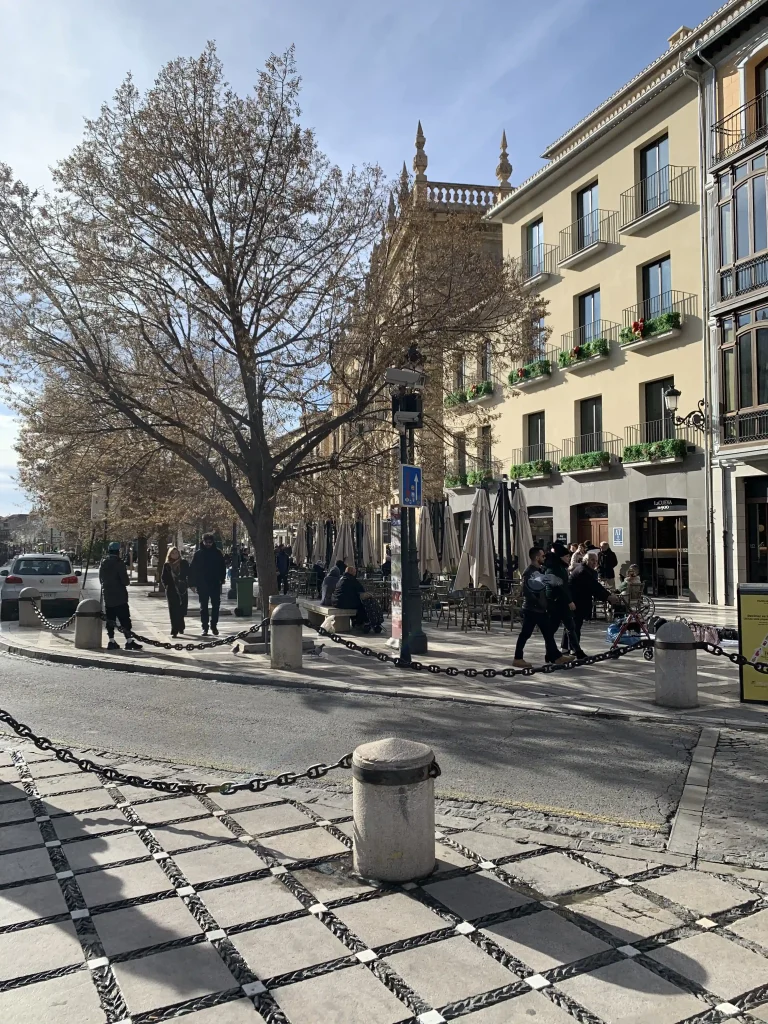
Welcoming us into the casco antiguo—even though this is actually the most recently reshaped part of the city—is Plaza Nueva, right where the Darro River disappears beneath Granada. It is the natural meeting point of all the city’s layers: the monumental historic center, the Albaicín, and the hill of the Alhambra.
In medieval times, there was no square here at all, but the riverbed of the Darro, with bridges, mills, and buildings pressed tightly against the water.
After the Christian conquest, between the 16th and 17th centuries, this stretch of the river was covered for hygienic and urban reasons. And so this central hub of Granada was born. Its post-Reconquista origin is immediately evident in the buildings that surround it, all marked by a distinctly “European” Renaissance style.
Honestly, the square does not impress for its scenic beauty. Its truly meaningful elements are few, but heavy with symbolism.
The first is the 16th-century fountain, the Pilar del Toro—discreet, almost shy, as if it were there more to mark a historical presence than to draw attention to itself.
The second—and by far the most important—is the Real Chancillería, the former royal court of justice. Its Renaissance façade, built in white stone, is no accident: at sunset it reflects the light and turns golden, becoming, for a few minutes, unexpectedly solemn.
At the center stands the coat of arms of Charles V, flanked by two allegorical figures. On one side, Strength, recognizable by the column and the lion at her feet; on the other, Justice, holding the sword and the scales. Above everything, a Bourbon clock—still working—marks the passing of time, as if to remind us that justice never stops, at least in intention.
But it is when you move to the side that the square reveals its harshest face.
On Calle Cárcel Alta—a name that leaves little room for interpretation—there is a secondary door, known as the entrance to the royal prisons. From here entered, in chains, those awaiting judgment by the Chancillería. They did not pass through the main entrance, as if to protect the idea of an impeccable justice from being contaminated by the reality it produced.
Inside, the building follows a Tuscan Renaissance style, arranged over two floors with walls decorated with frescoes evoking royal power and the principles of justice. Across the two levels are six rooms, divided by function (civil cases, criminal cases, or minor matters), each with wooden doors adorned with motifs inspired by the world of justice.
There is also a small chapel, where judges and magistrates would retreat before delivering the most difficult sentences.
Granada feels as if it were divided into four main areas: the Alhambra, the Albaicín, the Sacromonte, and the historic center.
Plaza Nueva is the central point for exploring the whole city: behind you the Alhambra, in front of you the Albaicín and Sacromonte, and to the left the historic center.
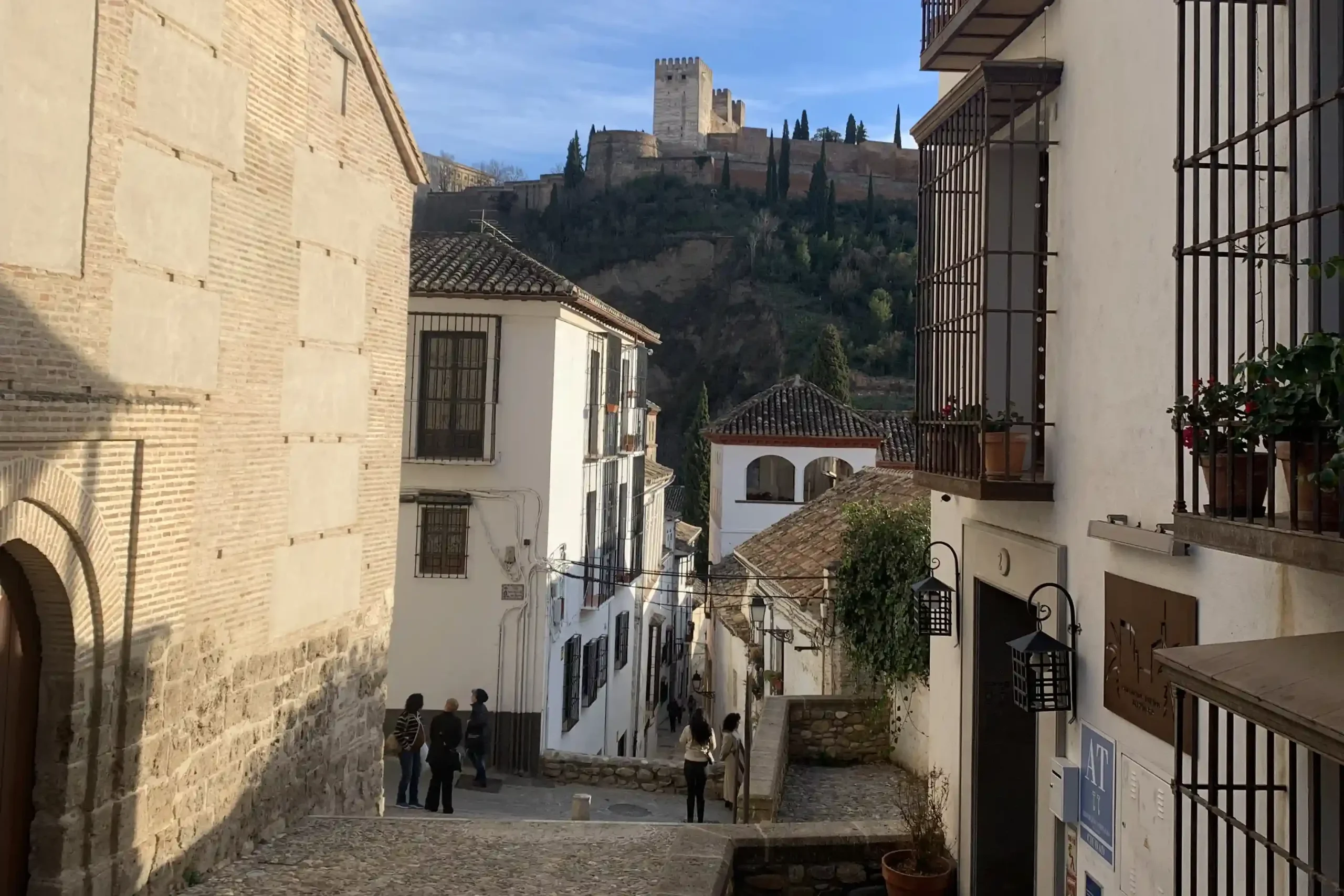
El Albaicín
🚶 Walking tour of Granada: the Albaicín
The Albaicín is not a neighborhood to simply “see,” but a place to discover on foot. It is the oldest part of Granada—the very nucleus from which the city was born—and it still preserves the urban structure of al-Andalus: narrow lanes, uneven climbs, defensive walls, hidden patios, and a surprisingly advanced water system. It is no coincidence that it has been declared a UNESCO World Heritage Site.
Founded at the end of the 13th century as a refuge for Muslim populations arriving from Baeza—according to some sources the origin of the name Al-Baezin—the Albaicín quickly became the heart of Islamic Granada. At its peak it counted around 40,000 inhabitants and more than 30 mosques: not just a neighborhood, but a true city within the city—lively, noisy, productive. After 1492 the area changed its face, yet never lost its identity: mosques were converted into churches, the finest houses were assigned to the new Christian nobility, while the urban fabric remained almost intact.
The ideal route begins at Plaza Nueva and continues along the Paseo de los Tristes, following the Darro River with the Alhambra towering above. Here you immediately encounter El Bañuelo, one of the best-preserved Islamic hammams in Spain, dating back to the 11th century. It was not merely a place for hygiene, but a true social hub—proof of the central role of water in daily life.
Wandering deeper through the alleys, you come across places that reveal a lesser-known yet remarkably advanced Granada, such as the Maristán of Granada, a 14th-century public hospital where even mental illnesses were treated with a surprisingly humane approach, and the Casa de Zafra, now the Albaicín Interpretation Center—essential for understanding how homes, patios, aljibes (cisterns), and everyday life were organized.
Walking between Calle Carnero and the Cobertizo de Santa Inés, the Albaicín shows its most intimate side: popular legends, covered passageways, Christian names layered onto Islamic structures. Climbing higher, you reach Plaza Aljibe del Trillo, a key node in the water system where rainwater was collected and distributed to nearby homes.
The ascent eventually leads to the Mirador de San Nicolás, the highest point of the Albaicín and one of Europe’s most celebrated viewpoints: the Alhambra straight ahead, the Sierra Nevada rising behind it. Just a short walk away, for those seeking more quiet, the Mezquita Mayor of Granada offers a similar view with a far more contemplative atmosphere.
Following the walls, you reach one of the most important yet least touristy places in the neighborhood: the Carmen del Aljibe del Rey, home to Granada’s largest Islamic cistern—vital infrastructure for the Albaicín. A little further on stands the Palacio de Dar al-Horra, a 15th-century Nasrid royal residence linked to Aixa al-Horra, mother of Boabdil, which tells the story of court life outside the Alhambra and the palace’s transformation after the Christian conquest.
Descending toward the center, you begin to grasp another side of Granada thanks to the viewpoints you encounter along the way—from the Ojo de Granada to the Mirador de la Lona. It is also on the way down that the Albaicín reveals its most everyday dimension in Plaza de San Miguel Bajo, one of the neighborhood’s most authentic and lived-in squares, before reaching Calle Calderería Nueva, now famous for its teterías. Here, the old commercial soul of the quarter blends with a modern reinterpretation of the Andalusi past—between authenticity and reinvention.
In the end, the Albaicín is made of water, alleys, gates, patios, walls, and silences. Not by chance did Manuel de Falla sum it up with a simple, perfect line: “El Albaicín guarda el alma de Granada.”
And after walking it, it’s hard not to agree.
If you like, I’ve also prepared an even more detailed guide to the Albaicín—the soul of Granada. There you’ll find deeper insights into the places mentioned here, their stories, and a few tips to truly experience the neighborhood.
The Historic Center
🚶 Walking tour of Granada: the Historic Center
Here we discover a different Granada: more exposed, more eager to display its grandeur outwardly, even if it still preserves some Arab traces—arches, azulejos, and paving.
Starting from Plaza Nueva, we head toward the Cathedral, passing along Calle Oficios, one of the most historically charged streets in Granada. In just a few meters it brings together some of the city’s most important landmarks: the Capilla Real, the Alcaicería, and the Cathedral.
Along this street, we encounter many signs of Arab Granada, reinterpreted through a Christian lens.
The first is undoubtedly the Palacio de la Madraza.
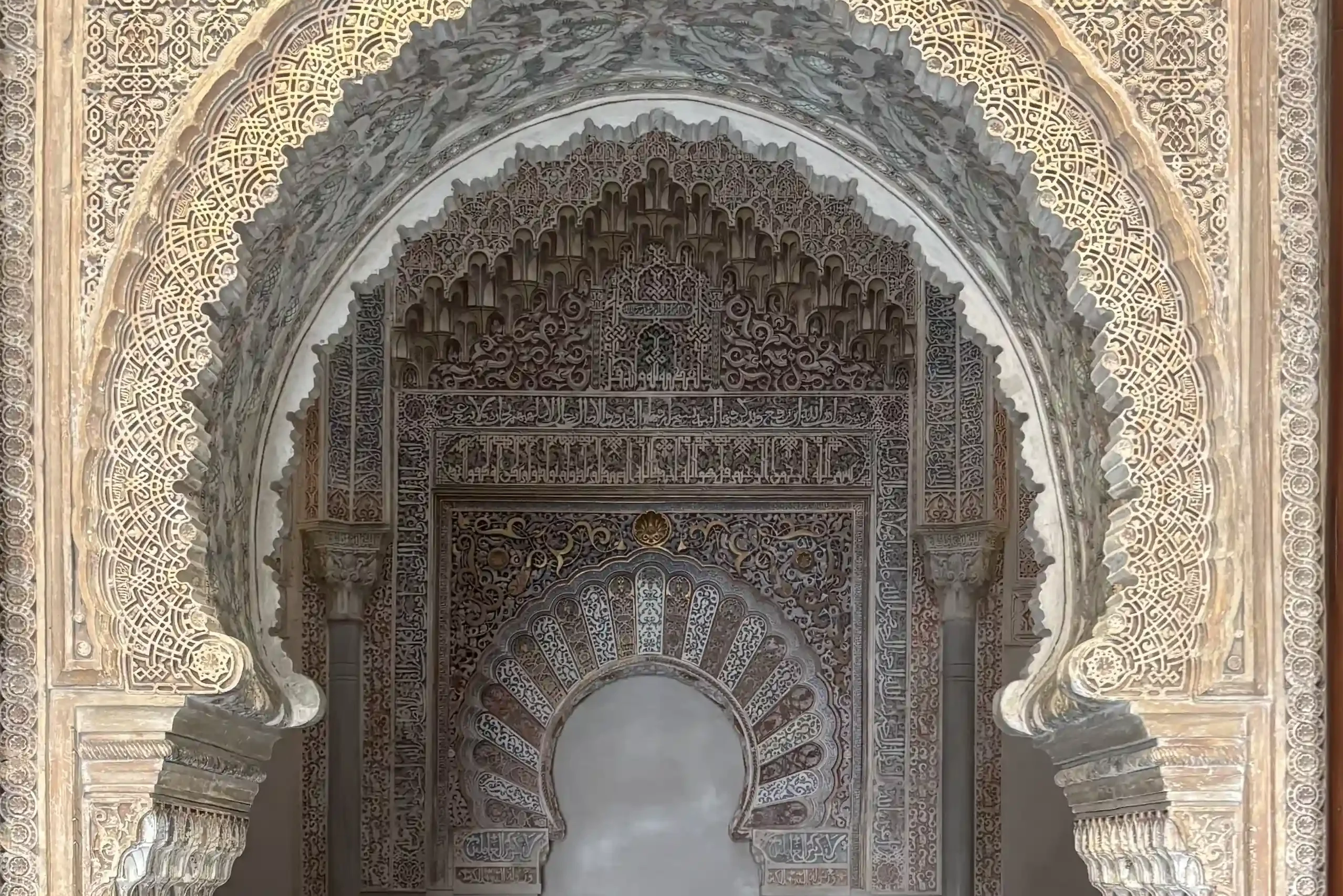
Palacio de la Madraza
Many people walk past this building almost absent-mindedly, often just waiting for their turn to enter the Capilla Real. Few realize that they are standing in front of an Arab palace with over 700 years of history, also a witness to one of the most dramatic episodes of the clash between cultures and religious extremism: the burning of its library, in which more than 80,000 books were destroyed in the nearby Plaza Bib-Rambla.
The name Palacio de la Madraza comes directly from the Arabic word madraza (مدرسة), meaning school or place of learning. And this is no poetic label: real study took place here.
The building was founded in 1349, during the reign of Sultan Yusuf I, as the official madraza of the Nasrid kingdom, known as the Madraza Yusufiyya.
It was, in every sense, the university of Granada.
Here subjects such as Islamic theology, law (fiqh), medicine, mathematics and astronomy, philosophy, poetry and rhetoric were taught.
It was a place of knowledge and debate, where the elites of the kingdom were educated, frequented by students and scholars from across the western Islamic world.
The choice of location was no coincidence: the Madraza stood next to the Great Mosque (today the area of the Cathedral and the Church of the Sagrario), the silk market—today’s Alcaicería—and right in the heart of the medina.
The message was clear: knowledge, faith and economic power were meant to stand side by side.
The façade you see today is not the original one. In fact, it is set back a few meters from its original position and is the result of numerous alterations after the Christian conquest. Among the details, the initials Y and F of the Catholic Monarchs stand out, a clear sign of the change in power and function of the building.
In 1850 the palace was sold to a family of textile merchants, who used it as a warehouse and private residence. Only in the early twentieth century did the building return to a public function: it was recovered by public institutions and, after restoration, assigned to the University of Granada, which still uses it today for cultural activities.
The most precious part of the palace is found in the patio, where the Madraza’s oratory has been preserved almost intact. It is a surprising space which, in atmosphere and decoration, recalls the Salón de los Embajadores in the Tower of Comares—no coincidence, as it was built by the same sultan.
In the floor, protected by a glass surface, archaeological remains are visible, bearing witness to the oldest phases of the building and of the area on which it stands: a small window onto the deepest history of the site.
Climbing to the upper floor, you enter a completely different environment, shaped by later transformations: Renaissance and Baroque art coexist in spaces once reserved for civic power. Here you will find the Salón de los 24 Caballeros, where nobles and prominent figures gathered to govern the city after the Reconquista.
The detail that most deserves attention, however, is the elegant Mudéjar-style ceiling. The walls were once covered with red tapestries, now lost, which made the room even more solemn.
Admission to the Palacio de la Madraza is free.
For this very reason, don’t miss it. In just a few minutes you can step into one of the most important places of Islamic Granada, a testament to the cultural openness and intellectual superiority of its time.
And now, let’s head toward the Capilla Real.
The Capilla Real
Entrance to the Capilla Real is ticketed. Tickets can be purchased on the official website. You can buy a single ticket or combined tickets (Capilla Real + Cathedral and other religious monuments). The indicative price of a single ticket is around €5–6 (it may vary slightly). In some periods there are free admission slots with reservation, but places are limited. Always check the official website.
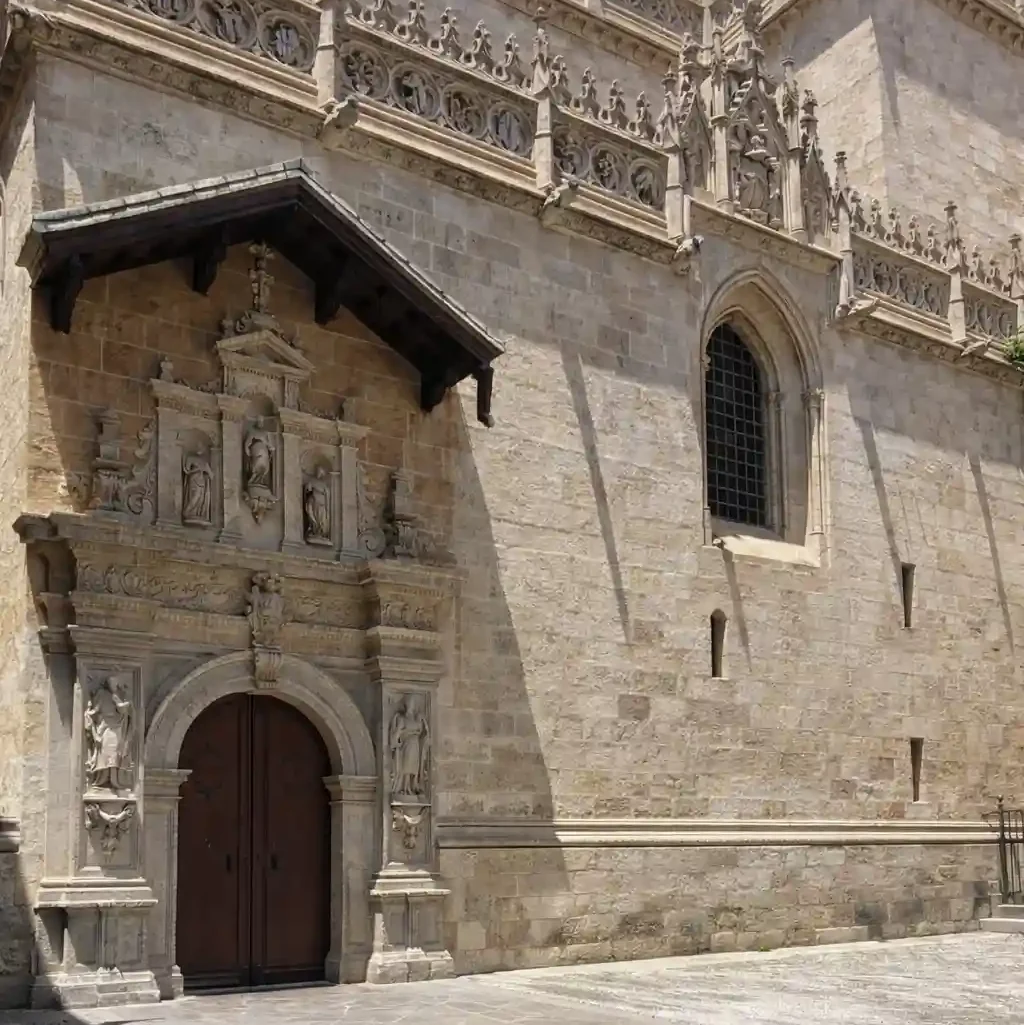
The Capilla Real is not, in fact, a simple chapel. It is a royal mausoleum, one of the places with the greatest political and symbolic weight in all of Spain.
Inside the Capilla Real rest Isabella of Castile and Ferdinand of Aragon, their daughter Joanna the Mad, her husband Philip the Handsome, and the lesser-known Miguel, grandson of the Catholic Monarchs, who died very young and who—had he survived—was destined to unite the crowns of Castile, Aragon, and Portugal.
Looking at the façade, which corresponds to the monument’s original entrance, you immediately notice an interesting dialogue between different styles. On one side, late Gothic, recognizable in the slender pinnacles and gargoyles; on the other, the first hints of the Renaissance, evident in the arched portal, more balanced and restrained. Together, these elements seem to perfectly reflect the personalities of the two monarchs: Isabella’s austere solemnity on the one hand, and Ferdinand’s cultural and artistic openness on the other. You can also admire the classic symbols of the Catholic Monarchs: the coat of arms, the eagle of Saint John, and the familiar initials Y and F within the shields.
The current entrance passes through a structure that was attached to the chapel at a later time: the Lonja building, added to make room for an important museum of Catholic art housed within the complex, with paintings and reliquaries donated over time by various kings. Most notably, it preserves several personal objects belonging to Queen Isabella—such as the crown she is said, according to tradition, to have worn on the day Granada was taken. Her deep faith and austerity were already well known to her contemporaries and have remained central to her historical legacy up to her death.
In her will, Isabella expressed a very clear wish: to be buried in the Monastery of San Francisco within the Alhambra, in a low, simple tomb devoid of pomp—unless her husband decided otherwise. In that case, she wished to be buried with him.
It was Ferdinand who ultimately chose burial in the Capilla Real. Yet, fully respecting the spirit of Isabella’s wishes, he maintained an austere approach for the exterior in her honor, chose a Renaissance-style tomb—a style he personally favored—and commissioned a crypt of almost disarming simplicity. This is perhaps the most striking detail of all.
The two large Renaissance sculptures that form the tomb—one dedicated to the Catholic Monarchs and the other to the rest of the family—cover the royal crypt, which represents one of the most intense moments of the visit. They are extraordinarily rich in religious symbolism: Saint John, the Baptism of Christ, and many other key moments from the Gospels.
Descending into the crypt, you are faced with five extremely simple wooden coffins, without decoration and without symbols of power.
What struck me most is the stark contrast between the modesty of the burial and the magnitude of their achievements. It is almost astonishing to think that these are the remains of the monarchs who completed the Catholic Reconquest, financed the voyage that led to the discovery of the Americas, and laid the foundations of the largest Hispanic empire. Incredible.
The chapel was not conceived as a grand celebratory monument, but as an intimate and restrained space. What we see today is the result of the union of two separate buildings: the original chapel and the Lonja building, incorporated later.
Originally, the Capilla Real was also directly connected to the Cathedral by an internal passage, now closed. The access portal, however, is still visible inside the cathedral, a silent trace of that former connection.
The chapel houses remarkable works of art, such as the beautiful wrought-iron screen depicting the life of Christ, and the splendid altarpiece showing Saint John, scenes of the conversion of Arabs to Catholicism, and the monarchs themselves reinforcing their devotion.
If you can, visit early in the morning. With fewer people around, the silence and simplicity of the crypt are felt much more deeply, and the contrast between historical greatness and the modesty of the burial becomes even more powerful.
Iglesia del Sagrario
This was once the main mosque of Granada. It is a church deeply cherished by locals, yet it is often left out of classic itineraries—overshadowed by the size of the Cathedral or because many people assume it is part of the Cathedral itself.
In reality, this church did serve as Granada’s cathedral for a time, while the construction of the actual Cathedral was underway beside it, some 60 years later, when the new Cathedral was inaugurated.
For this reason, it is not a structure that was ever fully completed, and in fact it took 300 years to finish the main façade. Today it is not particularly elaborate, but the depiction of Saint Peter as the first pope, holding the keys to heaven, is especially interesting.
Its square layout already sets it apart and makes it distinctive.
Granada Cathedral
A visit to the Cathedral must be booked by purchasing a ticket and according to the liturgical celebrations (tourists may have to wait or return later, and during the Christmas period there are often days of complete closure). Tickets can be purchased online on the official website and may also be combined with other religious monuments (Capilla Real, monasteries, the Abbey of Sacromonte, etc.). Prices may vary slightly depending on whether tickets are bought individually or as part of a combined pass, but they are generally around €6–7 each. The price often includes a digital audio guide (in several languages), which helps you better explore the spaces and artistic details. The Cathedral also offers some free access options, if you have time and want to save money. In addition to days reserved for residents (Tuesdays), on Wednesday afternoons all visitors—regardless of citizenship or residence—can obtain free tickets for the visit. As places are limited, free entries must be booked in advance on the dedicated website. Free access is not always automatic or guaranteed, especially during high season or religious events, so it is best to check and book online in advance.
In Granada, the Cathedral is far more than a church built over an ancient mosque.
It is the true symbol of the end of the Reconquista and the beginning of a new era.
The idea for its construction came directly from the will of the Catholic Monarchs, Isabella of Castile and Ferdinand of Aragon, who after the capture of Granada in 1492 wanted to leave a powerful and definitive mark of the Christian victory over Al-Andalus. Not just a cathedral, but a monument capable of representing Spain’s new political, religious, and cultural order.
Many believe it was built on top of Granada’s main mosque, but in reality—as we have seen—it was built right beside it.
Construction did not begin immediately. Work only started about thirty years later, once the Capilla Real—the place intended to house the monarchs’ tombs—was completed. The Cathedral was therefore built starting in 1523, and construction continued for over 150 years, spanning styles, fashions, and generations of architects.
Few people know that, although it is commonly called the “Granada Cathedral,” its official and complete name is: Santa Apostólica Iglesia Catedral Metropolitana de la Encarnación de Granada.
A name so long that, in all likelihood, no one has ever truly had the time to pronounce it in full. And yet, the dedication to the Encarnation is clearly visible on the main façade, reminding visitors of the building’s deep theological meaning.
The original project was Spanish Gothic: solemn and vertical, based on superimposed arches and a rather severe monumental layout. Originally, the floor plan was inspired by the Church of the Holy Sepulchre in Jerusalem, with the symbolic intent of linking the place where Christianity was born to the place where, according to the worldview of the time, its reconquest in the West was completed.
The turning point came with Diego de Siloé, freshly returned from Italy. He radically transformed the building: he adopted a Latin cross plan, opened the spaces to light, and turned Granada Cathedral into one of the first fully Renaissance churches in Spain. Due to issues related to the foundations and the nature of the ground, it became necessary to reduce the overall height of the building, lowering it from six to five levels compared to the original design.
When compared to the almost overwhelming grandeur of Seville Cathedral, the fascinating mix of styles of the Mezquita-Cathedral of Córdoba, or even the unfinished elegance of Málaga’s “Manquita,” Granada Cathedral may initially leave a slight sense of disappointment. Even compared to the luminous simplicity of Cádiz Cathedral, the comparison is not immediate.
And yet, once inside, the impression changes.
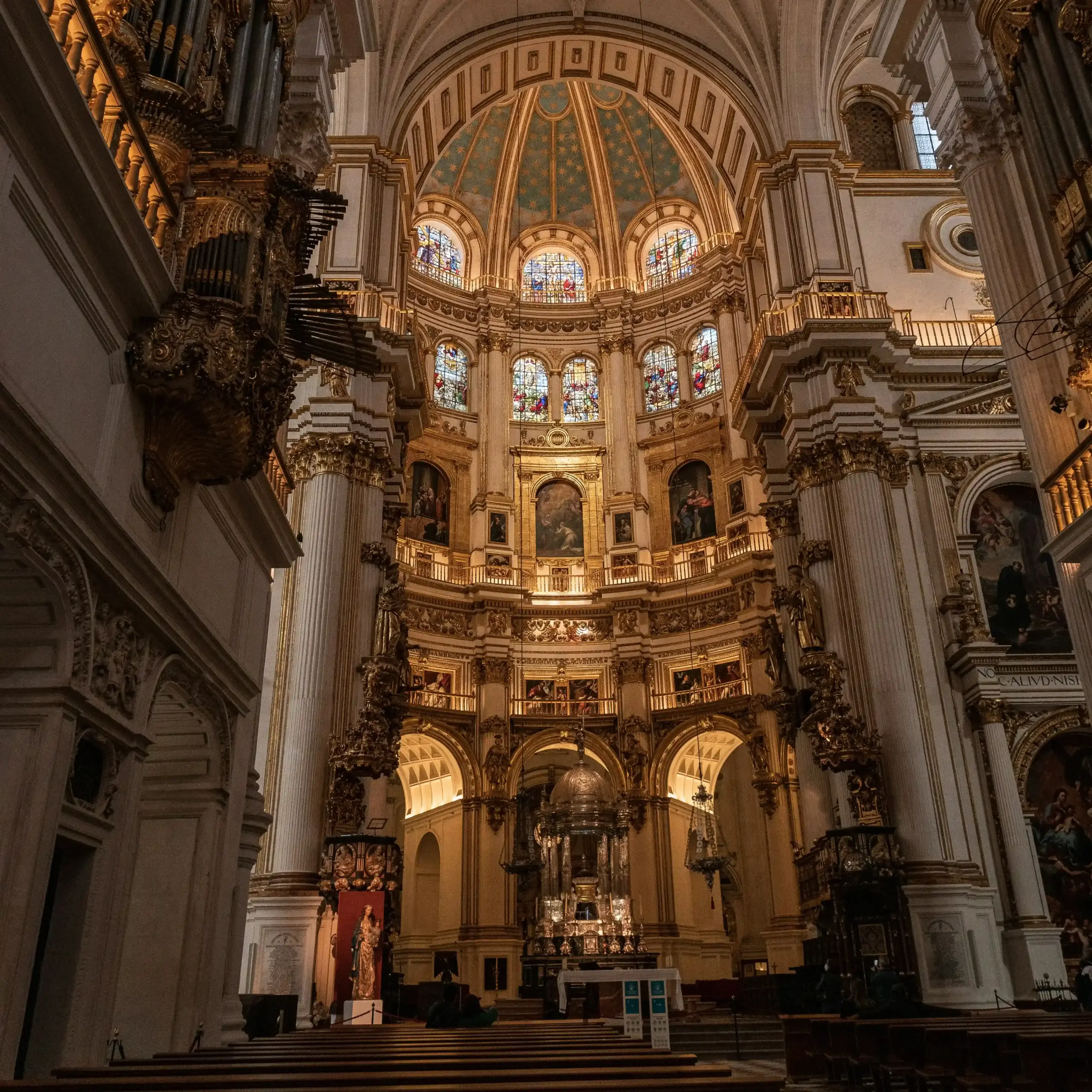
The interior is airy, luminous, and balanced, supported by twenty white marble columns that define five harmonious naves. Andalusian light filters in everywhere, softening the proportions and guiding the eye toward the heart of the building.
Everything converges toward the Capilla Mayor, the true spiritual and visual core of the cathedral. It is crowned by a surprisingly light, almost suspended dome, the work of the renowned Alonso Cano, who added a Baroque touch to the building.
One of the most fascinating details is its color: blue with golden stars, a direct reference to the firmament. Around the dome open windows through which intense light pours in, symbolizing the divine presence and transforming the space into a representation of paradise. The chapel is surrounded by a circular ambulatory, designed so that the faithful could move around without ever interrupting worship, regardless of their point of observation.
Along the naves open numerous chapels, richly decorated and dedicated to figures fundamental to Granada’s religious history, finely crafted by the masters of the time, including Cano himself.
Among the most beloved by locals is the chapel dedicated to the Virgin of the Antigua, whom tradition credits with a symbolic role during the conquest of the city, said to have guided the monarchs during the Reconquista. Her chapel, adorned with marble and gilding, is one of the most emotionally significant devotional spaces.
Also particularly important is the Chapel of Our Lady of Sorrows (Nuestra Señora de las Angustias), patron saint of the city. Nearby is the ancient portal that once directly connected the Cathedral to the Capilla Real, now accessible only from the outside.
In the crypt beneath the Cathedral also rests one of the most emblematic figures of Granadan freedom: Mariana Pineda, a symbol of resistance and local identity.
A lesser-known detail concerns the bell tower: the one we see today was not meant to be the only one. The original project envisioned two twin towers, each over 80 meters high, but due to structural and economic problems, the second was never built.
And perhaps—at least in my opinion—the Cathedral’s true magnificence is best appreciated from above.
Observe it from the city’s miradores—Ojo de Granada, Mirador de la Lona, or even from the Alhambra—and you will understand how this building is a true masterpiece.
I’d like to tell you about two monuments not far from Granada Cathedral: the Hospital of San Juan de Dios and its church, whose construction was also financed by the people of Granada. Not so much for their architectural beauty—although the basilica is one of the finest examples of Andalusian Baroque—but to pay tribute to their founder: Saint John of God.
San Juan de Dios is a figure deeply cherished in Granada for the extraordinary human contribution he left to the city. He was born in 1495 in Portugal under the name Juan Ciudad, but it is in Granada that his life changes completely… and it is here that he becomes a central presence in the city’s history.
As a young man he tried his hand at many things: shepherd, soldier, and above all a restless traveler. An irregular life, without a clear direction, marked by constant wandering—until, as an adult, he settled in Granada and opened a bookshop not far from the church.
It is precisely in Granada that he experiences a profound spiritual crisis, after listening to the sermon of a wandering preacher. From that moment on, he begins to share his possessions with the poor and to live with very little. His behavior is interpreted as madness, and Juan is confined to the Hospital Real, which housed one of the first mental asylums in Europe. And it is there that something decisive happens.
After that experience, Juan comes to understand a simple yet shocking truth for the time: the sick, the poor, and the “mad” do not need isolation, but care, dignity, and humanity.
He then begins to gather abandoned sick people, the wounded, the poor, and those with mental disorders from the streets, without distinction of origin or faith. He brings them into his home, washes them, feeds them, and cares for them as best he can—placing his body and heart where before there had only been exclusion.
At first, the city looks at him with suspicion. Then, slowly, something changes.
San Juan de Dios thus founds what would become one of the first modern hospitals in Europe, based on principles revolutionary for the 16th century: hygiene, attention to the individual, and respect for the mentally ill, finally treated as human beings rather than outcasts. An approach that anticipated modern medicine by centuries.
His order, the Hospitaller Order of Saint John of God, still exists today and is active all over the world, continuing the same idea of care that was born here, in Granada.
San Juan de Dios died in 1550, after attempting to save several people from a fire along the Darro River. He fell gravely ill and never recovered, dying in the Palacio Casa de los Pisa in the Albaicín, where the rooms and a small museum dedicated to him can still be visited today.
For this reason, he is now the patron saint of hospitals, the sick, and firefighters. And it was for his concrete, everyday commitment to the people of Granada that the population decided to build a church in his honor and to name him co-patron of the city.
Alcaicería Market
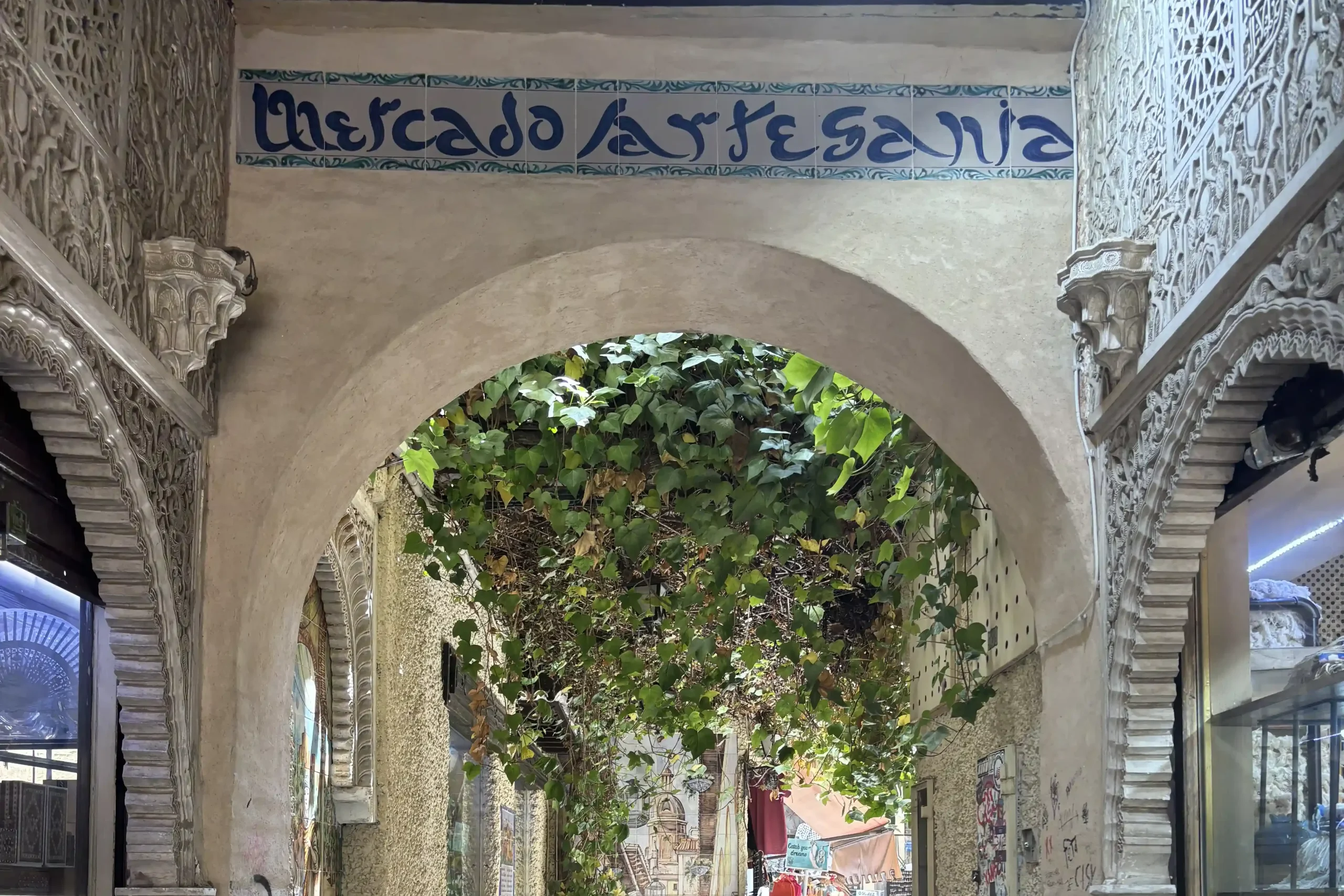
What we walk through today in search of souvenirs or Fajalauza ceramics was once the ancient silk market of Granada.
The name Alcaicería comes from the Arabic al-Qaysariyya and means “place of Caesar”: a term that evokes imperial authority and the privilege over the silk trade. According to tradition, this name was adopted after the Reconquista, when a new ban stripped local merchants of the right to trade silk with the Arab world. I’ve heard different versions of this story, so I can’t guarantee its accuracy, but it is certainly a change of name that—somewhere between spite toward the new order and nostalgic praise of the past—perfectly captures how history and legend constantly intertwine in Granada.
In Nasrid times, the Alcaicería was a closed, guarded commercial enclosure, one of the most important in all of Al-Andalus. It had ten richly decorated entrances—among them the famous Arco de las Orejas—which were closed at night and during prayer times. Market guards, part of the sultan’s army, kept watch; tradition even says they were accompanied by finely trained guard dogs.
The complex stretched for about 250 meters (roughly as far as today’s Calle de los Reyes Católicos) and housed more than 150 shops. The corridors bustled with carts, apprentices loaded with goods, and merchants specializing above all in silk—the true gold of Granada—but also in wine and other valuable products. The streets were narrow, just like those you see today, and this was no coincidence: the design made theft harder, provided shade during the hottest hours, and forced customers to pass close to the merchandise, encouraging purchases.
The market was governed by strict rules, overseen by the alcaide, the authority with the final say on disputes, prices, and conduct. This wasn’t just a place to sell goods: it was a place where administration, control, and economic policy were exercised.
At the beginning of the 19th century, a massive fire that lasted eight days destroyed much of the original structure. What we see today is a smaller, partial reconstruction—faithful in spirit, but very different in scale and materials. And yet, the Alcaicería remains a place I always enjoy walking through in Granada, imagining it alive with haggling voices, bargaining for the best price on colorful silks and handcrafted ceramics.
Shops still observe the siesta. If you want to find them open, go in the morning after 10:00 or in the late afternoon, after 17:00. It’s also the best time to enjoy the atmosphere, when the light softens and the alleyways fill with voices again.
Plaza Bib-Rambla
One of the entrances to the market leads directly into Plaza Bib-Rambla. The name comes from the Arabic Bāb al-Raml, meaning “Gate of the Sand.” In Islamic times, this was one of the city gates opening toward the sandy areas outside the medina.
Even then, it was an open, lively space and the city’s main marketplace. Everything was sold here: food, spices, textiles (with the exception of silk, which had its own dedicated market), handicrafts, and agricultural products from the fertile Vega of Granada.
Today, Plaza Bib-Rambla is a vibrant pedestrian square, animated by cafés, flower stalls, and outdoor terraces. It is a natural meeting point for both locals and visitors, especially during major city celebrations such as Holy Week or the Corpus Christi festivities.
Few people realize, however, that after the Christian conquest the face of the square changed dramatically. Bib-Rambla did host official celebrations and bullfights, but it was also, above all, a place of public executions. Capital punishments ordered by the Inquisition took place here, as well as public burnings—including the destruction of thousands of manuscripts from the Madraza library in 1499.
It is one of those places in Granada where the rupture between the world before and after 1492 is felt most strongly.
Granada is not made only of beauty: it is also made of memory. And one of the harshest chapters in the city’s history is tied precisely to its historic center.
After the Christian conquest, in 1499, Cardinal Francisco Jiménez de Cisneros ordered the collection and public destruction of thousands of manuscripts written in Arabic: not only religious texts, but also works of science, philosophy, and culture. In just a few hours, a vast part of Nasrid Granada was reduced to ashes, before everyone’s eyes.
This bonfire is an episode often absent from tourist narratives, yet essential to understanding what happened after 1492: it did not only change who held power, but also who had the right to write, read, and pass on knowledge.
It is striking to think that, while today Granada lives on art and visitors, for a moment in its history it chose to extinguish knowledge in the most symbolic way possible: by burning it.
Corral del Carbón
If there is one place in Granada that almost everyone walks past without stopping, it is the Corral del Carbón.
And yet, once you cross its threshold, you find yourself inside one of the best-preserved Islamic commercial buildings in all of Spain.
The Corral del Carbón dates back to the 14th century, in the heart of the Nasrid period, under the name Alhóndiga del Carbón (al-funduq in Arabic). It was built when Granada was at the height of its splendor and, as a key stop along western Mediterranean trade routes, it welcomed merchants from every corner of Al-Andalus.
This place functioned as a fondaco, or caravanserai: a warehouse for goods, an inn for merchants, and a resting place for animals and carts. People slept here, stored their merchandise, and struck business deals.
Its location was strategic: the Corral stood at the entrance to the Silk Market, and from here passed silk, spices, grain, wine, and coal—the latter giving the building the name by which we know it today.
The first thing that strikes you is the large arched portal, built in the same period as the Palace of Comares in the Alhambra. The style is immediately recognizable: muqarnas, Arabic inscriptions dedicated to Allah, and an architectural layout that blends beauty and function.
This was the only entrance to the building, designed to control access and prevent the escape of any thieves tempted by the merchants’ goods. Two windows open onto the façade; the lower ones were fitted with gelosías and reserved for female guests.
Once past the entrance, you step into a rectangular courtyard. On the ground floor were water sources for animals and travelers, while beneath the small porticoes were warehouses and stables. The upper floors housed the merchants’ rooms. It was a practical, essential layout, perfectly suited to commercial life.
The Corral was directly connected to the market by a bridge—no coincidence that the street linking it today to the Alcaicería is called Calle Puente del Carbón. The bridge is no longer visible, as the Darro River was later covered and transformed into today’s Calle de los Reyes Católicos.
After 1492, the building was not destroyed—and this alone is a small exception in the city’s history. Over the centuries it changed function many times: it became a corral de comedias (a popular theater with the audience arranged in the upper galleries), then an inn, a shared residential building, a coal warehouse, and even a tenement for poor families.
Today, the Corral del Carbón is managed by the Patronato de la Alhambra y Generalife and the University. Admission is free, and just a few minutes are enough to walk through it and discover a monument of everyday life in Nasrid Granada.ada.
The Sacromonte
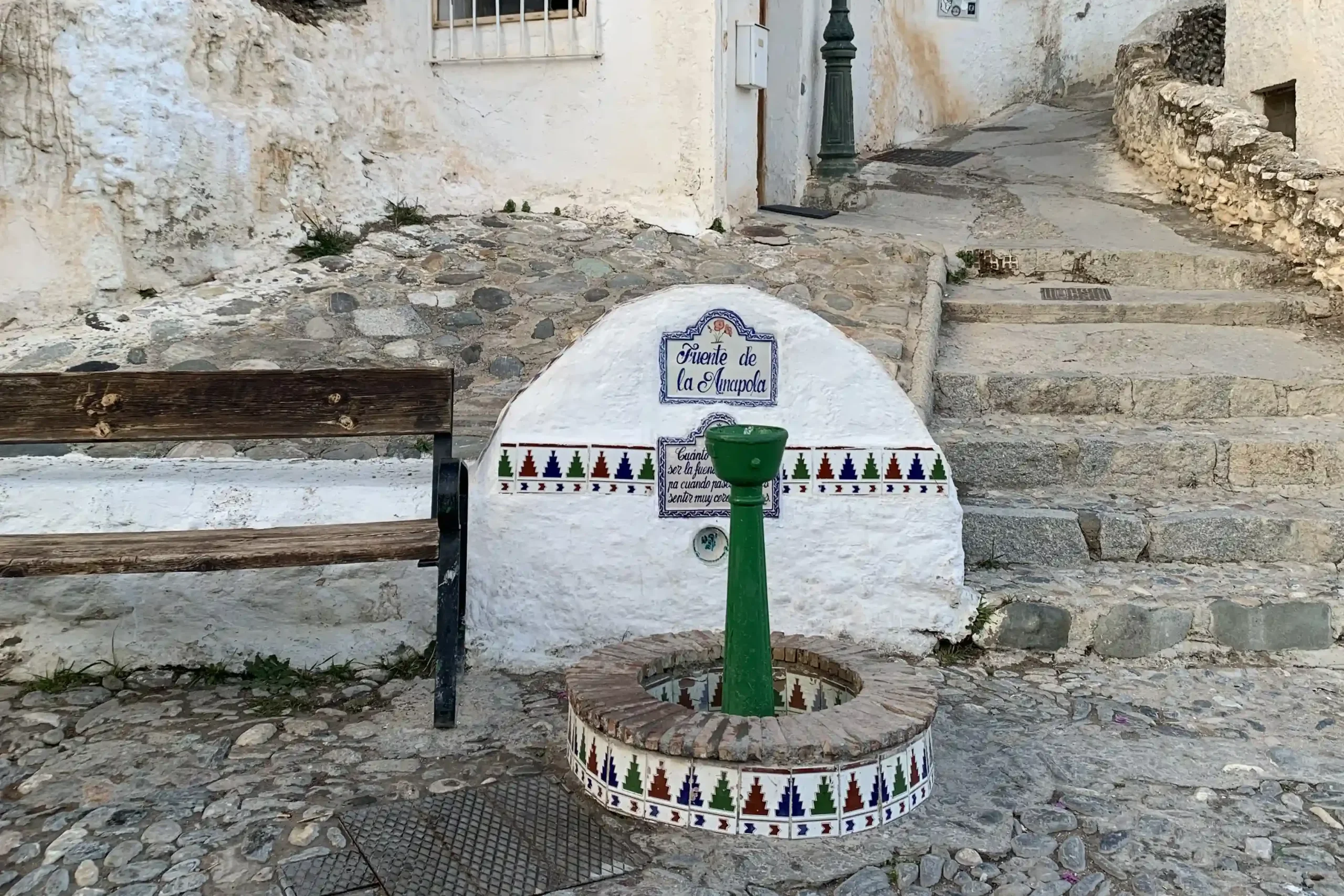
The Sacromonte is a historic neighborhood of Granada, located just beyond the Albaicín, developing along the street Camino del Sacromonte. Known for its cave houses, strong Gypsy traditions, and its role in the birth of flamenco, it represents one of the most unique and defining spaces of Andalusian cultural heritage. Here, history, music, dance, and popular art intertwine.
After the Christian conquest of Granada by the Catholic Monarchs in 1492, many communities were gradually marginalized and pushed outside the city walls. It was in this area that moriscos (Muslims forced to convert or left on the margins), Gypsies, and freed slaves settled, building their makeshift homes by digging caves into the rock. This was not a folkloric choice, but a practical and necessary solution.
The casas cuevas are a brilliant example of environmental adaptation: they use the natural terrain to create living spaces that stay cool in summer and mild in winter, maintaining a constant temperature of around 18–22°C throughout the year. Many of these homes are still inhabited today, naturally updated with modern amenities, and remain part of the neighborhood’s daily life.
If you really want to understand what living in the Sacromonte—and particularly in the casas cuevas—means, the Museo Cuevas del Sacromonte is a must-see. The museum features 11 restored original caves, each dedicated to a different function: living space, kitchen, stable, and work areas. Through workshops in ceramics, basketry, and blacksmithing, it tells the story of daily life on the hill, traditional crafts, cave construction techniques, and the roots of Gypsy culture and local customs.
The entrance fee is approximately €6 (standard rate) and includes audioguides in Spanish and English, with informative material also available in other languages.
Beyond its cultural value, the museum offers extraordinary views of the Alhambra, from a perspective often quieter and different from the more famous miradores.
The Sacromonte is considered the cradle of the zambra, a type of celebration that combines flamenco singing and dancing, with Moorish and Gypsy roots. The zambras—originally spontaneous celebrations tied to weddings and family events—are now performed for visitors inside the caves to keep the tradition alive. Places like Cueva de María la Canastera, La Rocío, or Venta El Gallo offer performances that aim to reflect the soul of the neighborhood.
Personally, I found them a bit “staged.” This doesn’t mean they’re not worth visiting, but it’s important to manage expectations: experienced from the right distance, they can still be interesting and evocative.
The central element of flamenco is the cante, particularly the cante jondo, considered the oldest and deepest. The lyrics are short, often repetitive, sometimes improvised, and speak of prison, hard work, loss, love, and marginality. The dance was not born as a decorative element, but as a physical response to the singing.
Flamenco dance is about control more than virtuosity. Body movements are often sensual for women and strong/virile for men, but always focused, requiring extremely high professional and artistic maturity. The arms shape the space, the hands speak, and the feet — with the zapateado — build the rhythm on the floor. Nothing is accidental: every gesture comes from listening to the cante and the tension of the moment.
Unlike other dances, flamenco does not follow a fixed choreography. It is a dance of dialogue and improvisation, where the body reacts to the voice, the guitar, and the silence. This is why it requires rigorous technique, built over years of practice, but also a strong emotional presence. It is a dance expressed not only with the body but also with the soul. Without one, the other does not work.
Flamenco has many different styles called palos. It also has variations depending on the city where it is sung and danced. Seville, for example, became one of the main flamenco centers because it was home to Gypsy, port, and artisan communities, all connected to a strong oral tradition that influenced its style.
Only between the late 19th and early 20th centuries did flamenco enter the café cantantes and later the tablaos, gradually transforming into a performance.
Today there are many venues offering flamenco shows aimed mainly at tourists. My advice is instead to look for a Peña Flamenca and attend an authentic evening. Peñas are cultural associations created by flamenco enthusiasts (cantaores, guitarristas, bailaores, and simple aficionaos) with the goal of preserving traditional flamenco, passing on cante jondo to new generations, and offering spaces where flamenco is lived without tourist filters.
Some historic and still active examples are the Peña Flamenca Juan Breva in Málaga, the historic Peña Flamenca La Platería in Granada, the Peña Flamenca Tío José de Paula in Jerez de la Frontera, and the Peña Flamenca Fosforito in Córdoba.
These are places run by members, often with an annual fee, that organize evenings of cante, conferences, competitions, and tributes to great masters. In many peñas, non-members can also enter by paying a small contribution or participating in open events. Moreover, they are often an excellent place to taste some traditional local tapas.
Amid chumberas (prickly pears), jasmine, and bougainvillea, the narrow streets of the Sacromonte lead to unforgettable views of the Alhambra, such as those from the Mirador de la Vereda de Enmedio, and the Museo de la Mujer Gitana.
Climbing further, you reach the top of the hill, where the Abbey of Sacromonte stands, preserving the relics of Granada’s patron saint and offering one of the most panoramic views of the city.
In 1595, right on this hill, the supposed relics of Saint Cecilio and the famous “lead books” were discovered—texts later revealed to be false, yet enough to inspire the construction of the abbey in 1600. From that moment, the Sacromonte also became a center of Christian devotion and a religious symbol for Granada, adding further significance to an already complex neighborhood.
In any case, the Sacromonte is truly to be explored by wandering its uphill streets, starting from the Camino del Sacromonte. You will find fountains, windows carved into the hill walls, and elderly people sitting outside their houses, as was once customary.
To be completely honest, the Sacromonte, while representing Granada’s Gypsy and flamenco heritage, is also known for occasional minor crimes, mostly petty thefts targeting tourists. Nothing apocalyptic, but not to be ignored either. This should absolutely not discourage you from visiting: just take normal precautions, especially in the evening and at night, when the neighborhood changes mood and becomes a bit more unpredictable.
If we set aside a lady who tried to sell me a bunch of rosemary, claiming it was a love amulet (it didn’t work, in case you were wondering), I have never experienced anything unpleasant.
For the more cautious, during the day, with a minimum of attention, the Sacromonte remains one of the most authentic, intense, and genuine places in all of Granada.
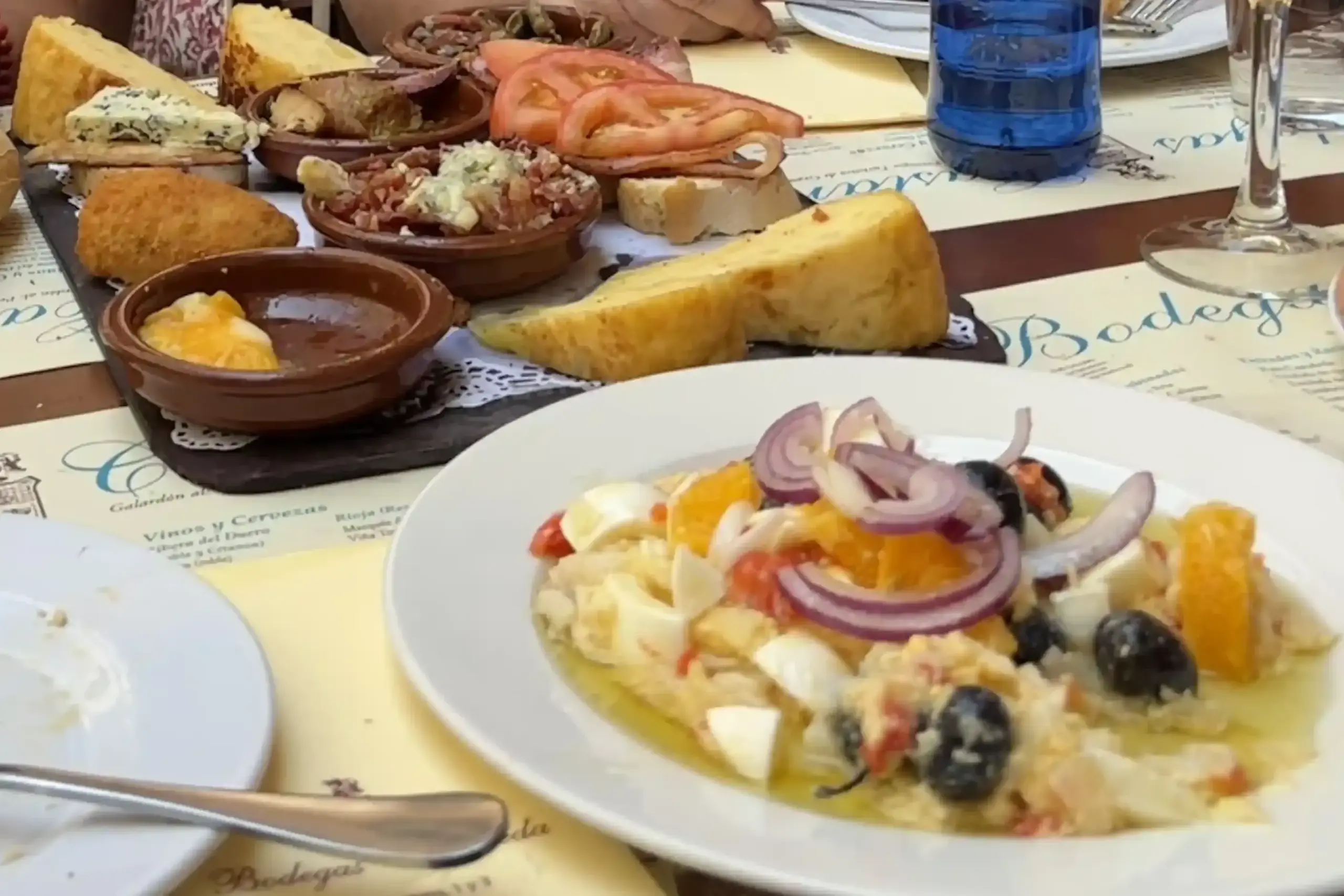
Where to savor a taste of Granada
If there is a city where going for tapas is not an option but a true moral duty, that city is Granada.
Here, a sacred, simple, and wonderfully democratic rule applies: one beer = one tapa.
Each drink comes accompanied by a small gastronomic gem, either Granadian or Spanish, and the result is that a “quick break” between visits easily turns into a full meal, where your taste buds literally start dancing flamenco.
Here are some trusted spots to start off on the right foot (and with the right appetite), depending on where you are:
- Bodegas Castañeda (near the Cathedral): an absolute certainty. If you don’t know what to order, go for one of their platters: cheeses, cured meats, tortillas… You won’t regret it!
- Carmen Verde Luna: probably the most panoramic restaurant in the Albayzín, located at the Mirador de San Nicolás. The menu focuses on traditional Andalusian cuisine, but people mostly come here for the atmosphere.
- Los Diamantes: right in Plaza Nueva, it is the undisputed kingdom of seafood tapas. Yes, I know… Granada isn’t on the coast, yet here they cook fish superbly. Incredible prawns, perfect boquerones, textbook puntillitas. Trust me: you won’t miss the coast!
- Restaurante El Trillo (Albaicín): dine inside a patio full of plants and flowers, with a view of the Alhambra. The cuisine is typical Andalusian and Granadian, but carefully revisited. Prices are perhaps above average, but everything is delicious!
- Al Sur de Granada (Lower Albaicín): technically an eco-friendly shop, but in practice one of those places that make you want to stay. Simple, genuine dishes with quality ingredients. A perfect mix of modern and homemade. I love it!
If you’re visiting Granada, there’s one dessert you absolutely must try: the pionono. Born in the nearby town of Santa Fe and dedicated to Pope Pius IX, it’s a small masterpiece of Andalusian pastry: a soft sponge cake roll soaked in syrup and topped with lightly caramelized custard cream. It’s meant to be eaten in one or two bites, perfect with a coffee. To taste the most authentic version, stop by Casa Isla, the historic pastry shop that invented it (with several locations in Granada), or look for it in the best pastry shops in the city center, where it’s always displayed in the window.
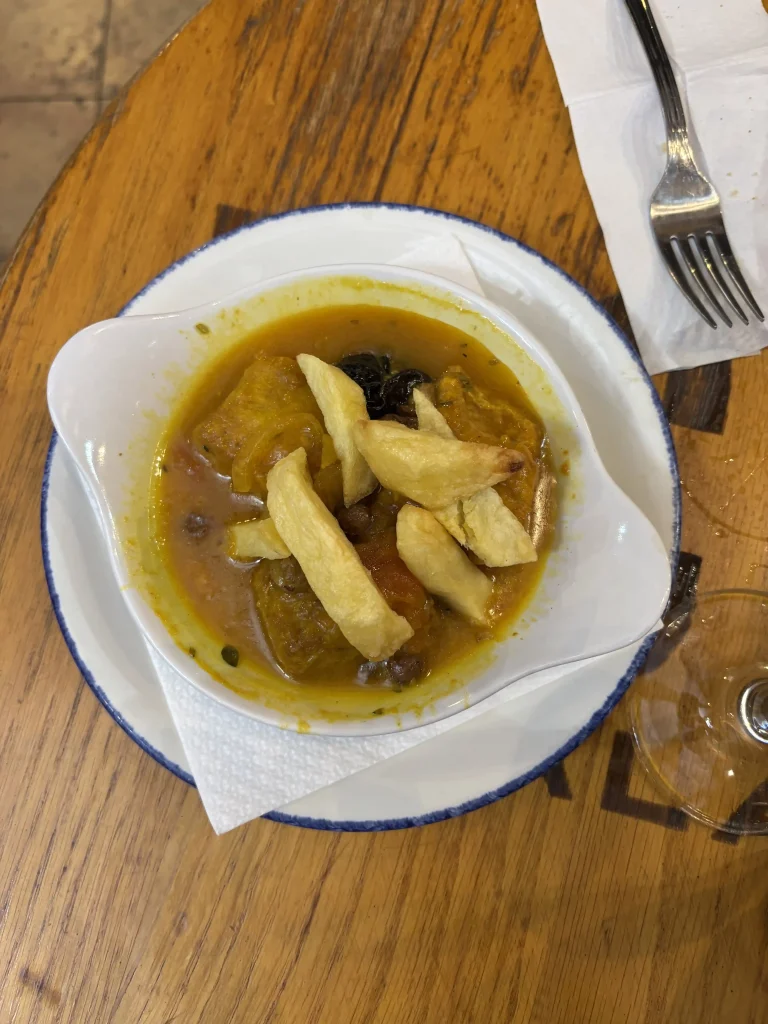
But beyond my recommendations, the truth is that in Granada, if you avoid the tourist traps, you will eat well anywhere. Meat, fish, the famous caracolas of the Albaicín… here, food is a show. Almost like the Alhambra.
And above all, going for tapas is not just about eating and drinking.
It’s about stopping, chatting, laughing, leaning on a bar counter, letting yourself be surprised by simple yet authentic flavors, just like Granada itself.
Granada is a city to explore without limits. Being well prepared is essential so you don’t have to give anything up. Below are a few tips to make sure your suitcase doesn’t end up limiting your trip. As in the rest of Andalusia, during summer the sun is one of the main characters. A hat, sunglasses and good sunscreen are essential even in winter: Andalusian light is intense and especially noticeable during long walks.
You’ll walk a lot, often on cobbled streets or gentle slopes, so wearing a pair of comfortable, well-broken-in shoes is essential. A reusable water bottle is a great ally, especially if you visit the Alhambra or the Albaicín, where there is shade but the uphill streets can be tiring. I bought a collapsible silicone one at Natura, but I can’t seem to find it on their website anymore. In any case, here you can find a similar one: it helps save space once it’s been used. In Granada, there are also plenty of public fountains where you can refill it whenever needed.
Even though the climate is generally mild, it’s a good idea to bring a sweatshirt or a light jacket for the evening, or when visiting the Alhambra in spring. The air coming down from the Sierra Nevada can bring a bit of chill… and a few goosebumps.
In fact, due to its altitude (around 700 m) and its proximity to the Sierra Nevada, winters can be cold, especially compared to the Andalusian coast. Days can be sunny and pleasant (with highs of around 15–16 °C when there’s a high-pressure system), but as soon as the sun sets, temperatures drop quickly. Bring a scarf, gloves and a hat.
Complete your backpack with a bit of useful tech. As always, I brought my power bank. It might seem like a small detail, but you’ll have so many things to photograph that your phone battery can drain quickly. I was given this one and it works great for me. There are countless models out there, but whichever you choose, I highly recommend having one.
And with this suitcase, you’ll be ready to enjoy Granada and let yourself be carried away by the beauty of this romantic city.
And here we are at the end: Granada holds no more secrets… or almost none.
In reality, it guards one of the most beautiful and surprising provinces in all of Spain, full of landscapes, stories, and contrasts that absolutely deserve to be discovered!
For now — but only for now — let’s stop at the city.
We have crossed it through its most iconic places, its most authentic neighborhoods, and its daily life.
I truly hope this journey has left you with a special memory, the same one I carry with me every time I think of this city.
And if, one day, back home, you find yourself looking at a building or monument that thrilled you yesterday and now suddenly feels dull, don’t worry: it’s normal.
Granada — and the Alhambra more than anything else — have this power: they raise the bar. They manage to captivate even the most seasoned traveler and, once you have truly experienced them, they never let you return home exactly the same as before.
If you’re planning a broader trip through southern Spain, you can read my dedicated Andalusia page, where I’ve gathered cities, itineraries and practical tips.