Frigiliana: one of the most beautiful white villages in Spain
Frigiliana is considered one of the most beautiful white villages in Andalusia.
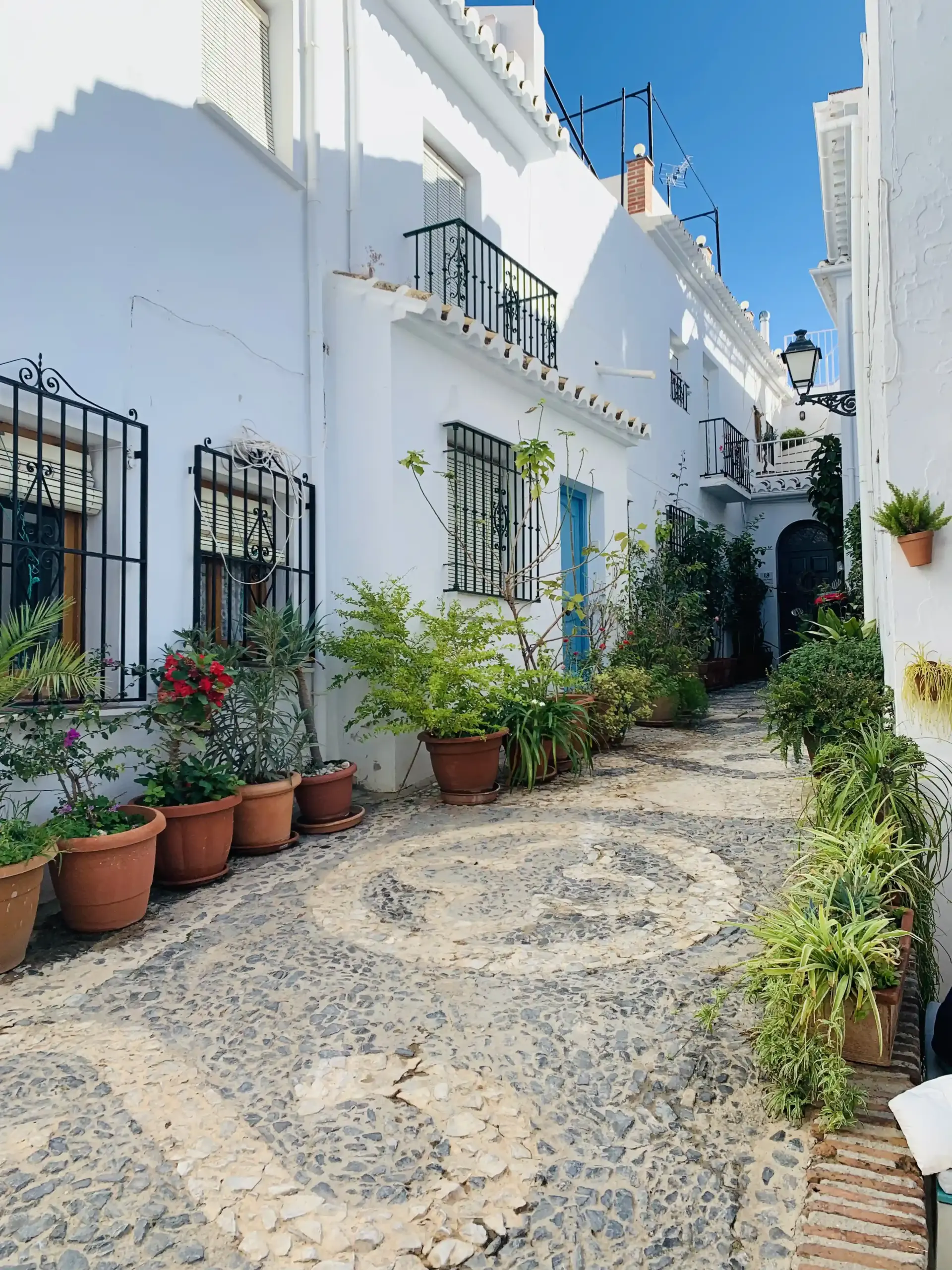
It is famous for its bright white historic centre, with a clear Moorish influence, blue doors and windows that, at first glance, might almost make you think of Greece. Then you look closer: the arches, narrow passageways and the geometries of the houses immediately bring you back here, to the south of Spain.
I visited it during a trip to Málaga, also because since 2015 Frigiliana has officially been part of Los Pueblos Más Bonitos de España and is often mentioned among the most beautiful villages in the country.
I’ll admit it: I didn’t have particularly high expectations. And yet, yes, it really is that good. Frigiliana is one of the most charming villages in Andalusia, without any need for exaggeration.
It lies at the foot of the first mountains of the Sierra Almijara, in the province of Málaga, and is just 6 km from Nerja. A location that explains much of its character: mountainous, agricultural, yet always with the sea there in the background.
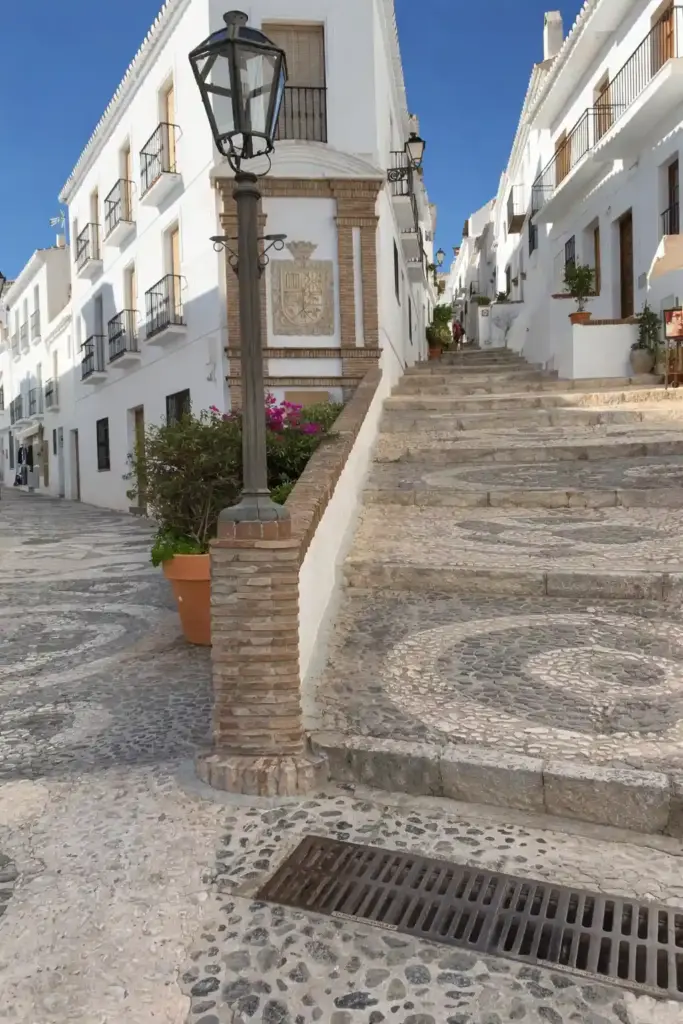
It is a small village — just over 3,300 inhabitants — and yet its reputation is huge. Its fame comes almost entirely from the Barrio Alto, the historic quarter with a strong Mudéjar-Moorish imprint. Here Frigiliana shows its most authentic side: steep cobbled lanes, steps, arches, narrow alleys, white houses framed by bougainvillea, and viewpoints that suddenly open up towards the Mediterranean Sea.
It’s true, Frigiliana is compact. But precisely for that reason, it manages to offer a lot in a small space. The beauty of it is that you can combine a walk through the village, a few historical visits and some light hiking in the surroundings, all comfortably within a single day.
Whatever you decide to do in Frigiliana, look around and enjoy one of the most harmonious Andalusian settings you can imagine.
Here are some practical tips for organising your visit to Frigiliana: how to get there, where to park, how to get around, how to plan your visit and when to go. A few useful things to know when choosing between car and public transport, exploring the steep streets of the historic centre and deciding how to combine Frigiliana with Nerja and the surrounding area.
Show all tips ↓ Hide tips ↑
How to get to Frigiliana
- By plane: the most convenient airport is Málaga-Costa del Sol Airport, which offers numerous connections with many European cities. However, there is no direct connection from the airport to Frigiliana. To find the best flights and fares, I use Google Flights: it allows you to compare prices across several dates and find the most convenient option.
- By car: this is definitely the most convenient and flexible way to reach Frigiliana, especially if you want to combine it with Nerja, Maro, the Nerja Cave or other destinations in the Axarquía. From Málaga, the journey takes approximately one hour, depending on traffic. Follow the A-7 motorway towards Almería, take the exit for Nerja and then follow the signs for Frigiliana. The historic centre consists of narrow, steep and mostly pedestrian streets, so do not try to drive into the Barrio Mudéjar. The most practical solution is to leave your car in the underground car park beneath Plaza de las Tres Culturas, just a few steps from the beginning of the historic-centre route. The car park is subject to a fee, but it saves you from wasting time looking for free spaces, which can be difficult to find, especially at weekends and during the high season.
- By bus from Málaga: there is not normally a direct bus between Málaga and Frigiliana. The easiest option is to take an ALSA bus from the Estación de Autobuses de Málaga to Nerja and then change to the local Nerja–Frigiliana bus. The Málaga–Nerja journey can take around 1 hour and 15 minutes, but check the number of stops, as some services are much slower. You must also add the waiting time and the approximately 15–20 minutes needed to reach Frigiliana from Nerja. For this reason, the complete journey often takes between 1 hour and 20 minutes and almost 2 hours.
- By bus from Nerja: this is the easiest public transport connection. Buses depart from Nerja’s main stop on Avenida de Pescia and arrive in Frigiliana near Plaza del Ingenio, at the foot of the historic centre. The journey takes approximately 15–20 minutes. Services are more frequent from Monday to Saturday and more limited on Sundays and public holidays. Additional evening services are also introduced during the summer. Always check the latest timetables on the official Frigiliana Town Council website, as they may change depending on the season, public holidays and local events.
- By bicycle: I have seen several people cycle from Nerja to Frigiliana, so I assume it is possible, but the route is practically all uphill and I strongly suspect that an untrained person might not survive beyond the first bend. But if you are really determined, I would definitely choose an e-bike.
- On an organised excursion: numerous day trips combining Nerja and Frigiliana depart from Málaga and the main towns along the Costa del Sol. I always check the available activities on GetYourGuide or Civitatis. These are convenient because they include transport and, in some cases, a guide. However, they can be less cost-effective if you are travelling as a family or in a group. In that case, renting a car often gives you more freedom and a more reasonable cost per person.
How to get around Frigiliana
- On foot: Frigiliana is a small village, and the historic centre is explored almost entirely on foot. The Barrio Mudéjar consists of narrow alleyways, stairways, covered passages and steep cobbled streets. The distances are short, but the climbs can be more demanding than they appear on the map. Wear comfortable shoes and take your time: the best way to discover Frigiliana is to walk at a leisurely pace, stopping at the viewpoints and small squares.
- By tourist road train: Frigiliana also has the Tren Turístico de las Tres Culturas, which departs from the Plaza del Ingenio area and allows you to see the village without tackling all the uphill streets on foot. It can be a useful option for families with children, people with reduced mobility or anyone who simply wants an initial overview of the village. The route, frequency and availability may change throughout the year.
- By tuk-tuk: short tuk-tuk tours are also available, normally departing from Plaza del Ingenio. The tour lasts approximately 25 minutes and is a pleasant alternative for seeing parts of the village without constantly walking uphill.
- By bicycle: a bicycle is not very practical in the historic centre because of the stairways, cobbled streets and narrow alleyways. I strongly advise against it.
How to plan your visit to Frigiliana
- The day generally begins a little later than many international visitors expect. If you arrive very early, you may find that some shops, workshops and cafés are still closed. To find more activity in the streets, the best time is normally from mid-morning onwards.
- Frigiliana can be visited in a few hours, but it is worth allowing at least half a day. The village is small, but the pleasure of the visit lies in getting lost among its alleyways, stopping at the viewpoints and noticing the details of the houses. If you want to combine it with Nerja, you can visit Frigiliana in the morning and spend the afternoon by the sea, or do the opposite and arrive in the village in the late afternoon.
- Restaurants generally serve lunch from around 1:30–2:00 pm and dinner from 8:30–9:00 pm. Arriving at 6:30 pm and expecting a full dinner may mean finding the kitchen still closed. The most tourist-oriented establishments may have more flexible opening hours, but do not assume that every restaurant serves food throughout the day.
- During the summer, try to avoid the middle of the day. The historic centre is steep, the sun can be intense and not every street is shaded. The morning and late afternoon are the best times for walking, taking photographs and enjoying the viewpoints in more comfortable temperatures.
- To discover the history of the village, you can follow the route of the twelve ceramic panels dedicated to the Morisco revolt, which are distributed throughout the historic centre. In this way, the walk also becomes a journey through the history of Frigiliana.
- The village is a good starting point for nature trails and walks in the nearby Parque Natural de las Sierras de Tejeda, Almijara y Alhama. Before setting out, always check the difficulty, elevation gain, temperatures and availability of water. The Frigiliana tourist office provides information on several hiking routes in the area.
- There are numerous organised tours and guided visits available for exploring Frigiliana and its surroundings. I always check the available activities on GetYourGuide or Civitatis, especially when I want to combine the visit with Nerja or travel directly from Málaga.
When to visit Frigiliana
- Spring is one of the best times to visit Frigiliana. Temperatures are pleasant, the vegetation is greener and walking along the uphill streets is less tiring than in summer.
- Summer is the liveliest season, but also the hottest and busiest. In July and August, walking during the middle of the day can be demanding, particularly along the steepest and least shaded sections. During this period, it is better to arrive in the morning or late afternoon.
- Autumn is another very pleasant season. Temperatures remain mild, the village is less crowded and you can combine the visit with Nerja, where the weather often still allows you to spend a few hours on the beach.
- Winter is generally mild during the day, but temperatures can drop quickly after sunset. Bring a jacket and remember that some establishments may reduce their opening hours during the low season.
- In my opinion, the best time to visit Frigiliana is between March and May or from late September to October, when temperatures are suitable for walking, the flowers are at their best and the village is less crowded than during the height of summer.
- A particularly atmospheric time to visit is during the Festival de las Tres Culturas, which fills the village with music, performances, markets and activities connected with the three cultures that shaped its history. However, it is also one of the busiest times of the year, so it is advisable to organise transport and parking in advance.
A bit of history about Frigiliana
The history of Frigiliana closely follows the path of Andalusia itself, from prehistoric times to the tourism transformation of the 20th century.
As with Nerja, the earliest traces of human presence date back to the late Neolithic and the Copper Age, with archaeological finds in the Cueva de los Murciélagos, located in the very mountains that still separate Frigiliana from the sea today.
Later on, Phoenicians first and Romans afterwards took strategic advantage of this natural continuity between mountains and coast: Nerja as a maritime access point, Frigiliana as an agricultural area and a means of controlling the inland territory. The Romans occupied the area from 206 BC, at the same time they conquered Málaga, integrating the territory into their commercial and agricultural routes without destroying local communities, instead establishing agreements with them.
Even the name Frigiliana seems to reflect this continuity: it likely derives from an ancient Roman landowner, Frexinius, combined with the suffix -ana, meaning “estate” or “property of Frexinius”.
The true settled core of the village, however, emerged between the 9th and 10th centuries, when a castle was built on the hill — now disappeared — around which houses gradually clustered. The location was far from accidental: from here it was possible to control mountain passes and maintain visual contact with the coast, including the area of Nerja.
During the Andalusí period, Frigiliana became part of the Nasrid Kingdom of Granada and shared in the splendour of the era, functioning as an agricultural and defensive village within a wider territorial system.
In 1485, however, the village surrendered to Christian troops without major clashes. As happened in many nearby settlements, the population remained largely Morisco — Muslims forcibly converted to Christianity — who were forced to live under increasingly harsh restrictions.
Tensions erupted in 1568, when the great Morisco rebellion broke out across the former Kingdom of Granada, beginning in the Alpujarras and later spreading west and north, eventually reaching the Axarquía and Frigiliana in the following months. Thousands of Moriscos, including those from surrounding villages, took refuge on the Peñón de Frigiliana, the rocky outcrop where the fortress stood.
On 28 May 1569, an initial Christian assault failed, causing heavy losses among royal troops. But on 11 June, an army of around 6,000 soldiers led by Luis de Requesens arrived: the battle of the Peñón de Frigiliana marked the definitive defeat of the rebels, the destruction of the castle, and the deportation of much of the Morisco population.
Today, in the historic centre, twelve ceramic tiles scattered through the streets recount these events, forming a kind of historical itinerary that guides visitors through the village.
After the revolt, the Crown launched several attempts at repopulation. The most successful, in the 17th century, introduced the cultivation of sugar cane, which went on to become the economic engine of the area, closely linked to Nerja and its ports. As early as 1508, the lordship of Frigiliana had passed to the Manrique de Lara family, who built the large Renaissance palace now known as El Ingenio, using stones taken from the destroyed Arab castle.
In 1640, Frigiliana was granted the title of Villa by Philip IV: the municipality was established, the first census recorded 160 inhabitants, and public works were carried out, including the Fuente Vieja, decorated with the family coat of arms. The Church of San Antonio, completed in 1676, strengthened the role of the Church in social life, while sugar cane cultivation continued to expand along the Río Mármol.
At the beginning of the 19th century, during the War of Independence against Napoleon, the priest Antonio Muñoz led the local guerrilla. In response to the disappearance of several French soldiers, the occupying army hanged a number of villagers in a place that became known as “La Horca” — an episode that deeply marked the collective memory, as it did in neighbouring villages. Today, that area roughly corresponds to the lower part of the village, along the historic route descending towards Nerja: when arriving in Frigiliana, you have probably passed through it without realising.
Throughout the 20th century, Frigiliana began to stand out for the care given to its urban appearance. Between 1961 and 1988, it received numerous awards encouraging the preservation of whitewashed façades, flower-filled alleys and cobblestone pavements, and tourism became one of the area’s main sources of wealth.
What to see in Frigiliana
To truly enjoy Frigiliana, there’s just one thing you need to do: get lost in the Barrio Morisco, also known as Barribarto.
I explored it without any specific destination, letting myself be guided only by the alleys and by curiosity. And that’s exactly how Frigiliana shows its best side.
Walk slowly up the cobbled lanes — Calle Real, Calle Zacatín, Callejón del Peñón — follow the ceramic tiles that tell the story of the Morisco rebellion, and stop at the first miradores overlooking the sea. Don’t rush: here, every detour is worth it.
Below you’ll find the places you’ll come across along an imaginary route. Use them as reference points to orient yourself, but allow yourself to take a wrong turn too: it’s part of the experience.
Museo Arqueológico de Frigiliana Casa del Apero
Everything begins at the Casa del Apero. The Casa del Apero is one of the best places to start understanding Frigiliana — not the postcard version, but its agricultural, everyday soul.
It is a 16th-century historic building, originally created as a service structure linked to the rural economy. The term aperos refers to farming tools: ploughs, harvesting equipment, and tools used to work the land and survive in a territory as demanding as this one.
It was neither a noble house nor a stately residence, but a functional warehouse, solid and practical.
When traditional agriculture went into decline, the building lost its original purpose. The decision to turn it into a museum was no coincidence: the Casa del Aperos was already, in itself, a container of history.
Today it houses the Frigiliana Archaeological Museum, which tells the story of:
- the prehistoric period of the area,
- the Roman era,
- the Andalusí period,
- the Morisco rebellion and the Battle of the Peñón,
- the agricultural and economic transformation of the village.
Admission is free all year round, and I truly recommend taking advantage of it. It’s not a large international museum, but a direct and tangible narrative that helps you read the village not just as a pretty postcard, but as a lived history. I’ve noticed that the museum sometimes closes temporarily, so it’s a good idea to check the official website before planning your visit.
Today, if you ask someone about the Casa del Apero, it’s quite likely they’ll answer by talking about aperitifs and tapas. Don’t be surprised.
Around this historic building, in fact, several bars and restaurants have developed in recent years, perfect for a quick break, a drink at sunset, or a plate to share.
In a way, it’s almost ironic: Casa del Apero… a name, a destiny.
Palacio El Ingenio
Continuing along the route, you’ll come across one of Frigiliana’s most striking buildings: the Palacio El Ingenio, also known as the Palace of the Counts of Frigiliana.
It’s not a palace you “visit” in the classic sense, but it’s essential to understanding the town. The name Ingenio has nothing to do with ingenuity. In colonial times, both in Latin America and here in Andalusia, an ingenio referred to the estate or complex dedicated to processing sugar cane.
By the 17th century, a small trapiche (mill) already stood here. In 1725 the installation was expanded, turning it into a proper ingenio that has run without interruption ever since — built, among other materials, with stones from the old Arab castle destroyed after the Battle of the Peñón de Frigiliana in 1569. In 1928 it passed into the hands of the De la Torre family, who renamed it Ingenio Nuestra Señora del Carmen — the name it still operates under today.
This is where cane honey is made, and it’s the only active factory of its kind in Europe. The product is exported across the continent and is one of Frigiliana’s gastronomic symbols, as well as a great souvenir to bring home.
Barrio Morisco
After the Palacio El Ingenio, we continue along Calle Real, the true backbone of the historic centre. The name is no coincidence: in Spain, Calle Real referred to the main street, where authorities passed and lived, where business took place, and where everyday life unfolded.
In Frigiliana, Calle Real connected the area of economic power (El Ingenio), the religious spaces (the Church of San Antonio), the most important residences, and the gateways leading out of the village.
That’s why it is wider than the surrounding alleys: it needed to allow the passage of people, animals and goods. It is the only street in the old town accessible to vehicles (although narrow and almost pedestrian), winding uphill in a zigzag between white houses, craft shops, bars with small terraces, and flower-filled corners.
Paved with cobblestones, it links the lower part of the village (the Plaza de las Tres Culturas area) to the upper quarter (towards the mirador and the ancient castle), with steep climbs, arches, and passageways that evoke Moorish architecture. Along the way, side streets branch off, such as Calle Zacatín, Callejón del Peñón, and the street dedicated to Hernando el Darra. Explore them without hesitation — they’re wonderful.
Along the route you may also come across El Torreón, a small tower now incorporated into the houses, probably once used for coastal lookout duties.
On Calle Real, you’ll also find the famous ceramic tiles that recount the history of the village and the symbols of the three cultures: they form a true open-air museum.
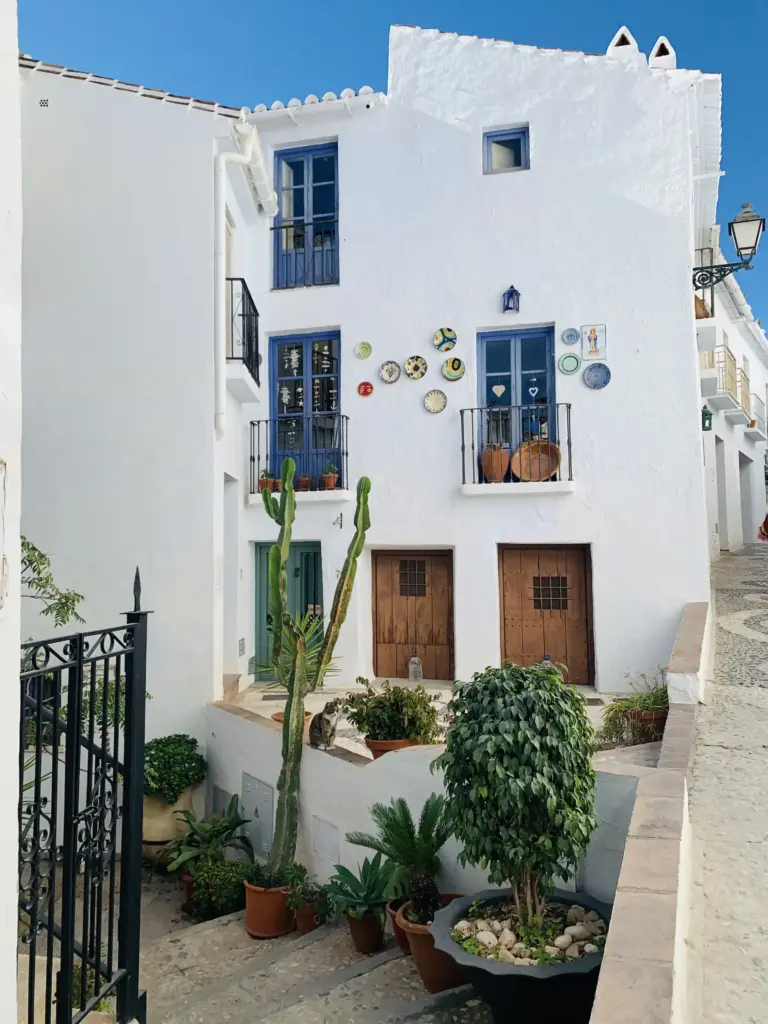
When you reach the corner between Calle Real and Calle Hernando el Darra, you’ll recognise one of the most photographed spots in Frigiliana. Although almost no one realises it, this corner is actually a powerful historical and political statement: on one side runs Calle Real, the street of power; on the other, a street bearing the name of Hernando el Darra, a Morisco leader involved in the great rebellion against the Spanish Crown. It’s one of those places where history intersects, if you know where you’re standing.
Continue along Calle Zacatín, another of the most photographed streets in the village. The name comes from the Arabic saqqāṭ, referring to markets or squares dedicated to the sale of textiles, clothing and wool; during the Andalusí and Morisco periods, it was likely the street of textile merchants and craftsmen. Other streets called “Zacatín” exist in Granada and Córdoba, confirming this shared Arab commercial origin.
As you walk uphill, in addition to enjoying this narrow, steep alley, paved with cobblestones and lined with flower pots and balconies, notice the presence of steps, sudden bends and light filtering from above. This layout was no coincidence: it helped slow down potential invaders approaching from the hillside.
Here you’ll find one of the 12 ceramic panels that recount the Battle of the Peñón of 1569, as well as several adarves (dead-end alleys) typical of Moorish defensive architecture. From certain points, views open up towards the bell tower of the Church of San Antonio and over the valley.
This brings us to the Church of San Antonio de Padua, the village’s main religious building. Its construction was authorised in the 16th century and completed in 1676, under the direction of Bernardo de Godoy, as stated on the plaque on the façade, with funding from the Manrique de Lara family, the wealthy lineage of Frigiliana.
It probably stands on the site of an ancient mosque, with the minaret converted into a bell tower, a common practice in post-Reconquest Andalusia. The Renaissance façade is monumental yet sober, while inside there is a three-nave structure with a Mudéjar wooden ceiling and Baroque frescoes that re-emerged during recent restorations.
From here, continue straight on, climbing towards the Mirador Alto. From this point, your gaze opens out over the Sierras of Tejeda, Almijara and Alhama, the terraced fields that speak of the area’s agricultural labour, and, on clear days, even the sea.
The location of the Mirador Alto coincides with the oldest and most defensive areas of the village, along the routes that once led towards pastures and the mountains. It’s a short climb, steady but easy.
The best time to enjoy it is late in the afternoon, when warm light bathes the mountains, or early in the morning, when the village is still quiet.
It’s one of the few places in Frigiliana where time truly seems to slow down.
Descending back towards the heart of the village, you’ll come across the Fuente Vieja, an icon of the historic centre thanks to its Baroque architecture and its historical role as both a watering trough and a source of drinking water. Built in 1640 as a public fountain and trough, it is one of the symbols of Frigiliana and has been a meeting point for centuries.
It is very likely that the fountain stands on the site of an earlier Andalusí fountain, a sign of the continuity in the use of water that has never truly been interrupted in Frigiliana. By 1830, it was already an integral part of the municipal water network, and the coat of arms of the Counts of Lara, the Manrique de Lara family, featured on its pediment, reminding visitors who controlled the power and resources of the village.
Even today, it remains one of the most photographed places, but it’s worth stopping to read it, not just to look at it.
A bit of sea and sunshine
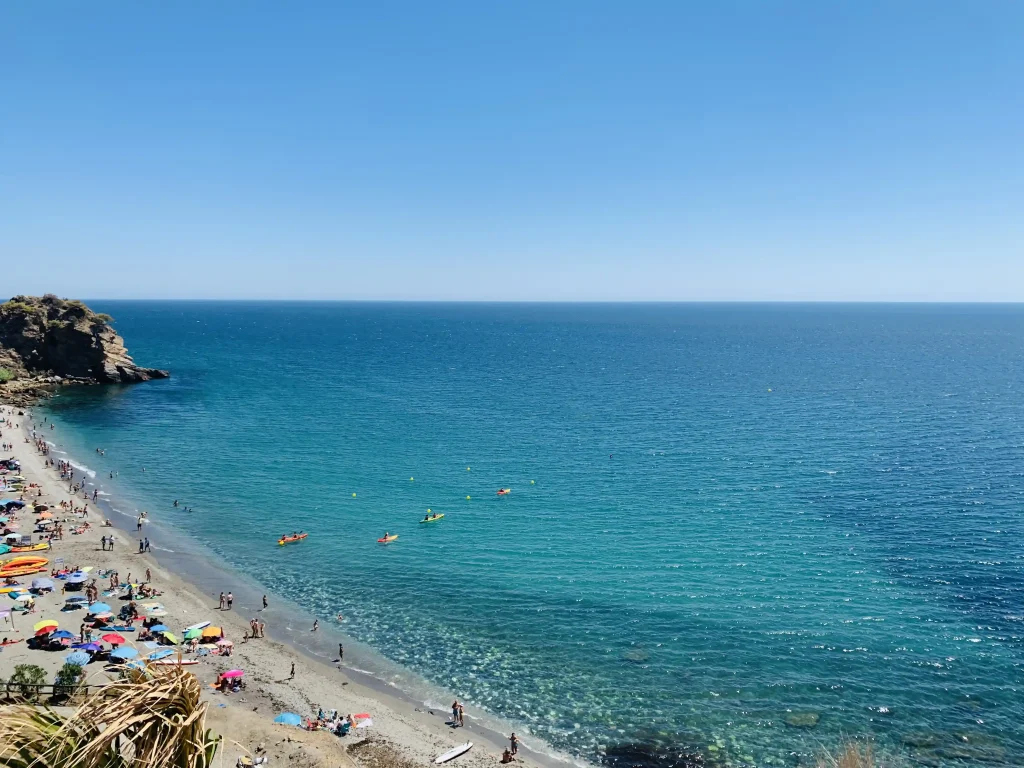
From the centre of Frigiliana, it’s very easy to reach the coast, which unfolds along a string of small coves, both wild and more accessible.
The best known are the town beaches of nearby Nerja, such as Playa de Burriana, Playa de Calahonda, and La Caletilla. These are small, scenic, photogenic beaches tucked between the rocks. Space is limited, so it’s worth arriving early, but the setting more than makes up for it.
Another good option is Playa El Chucho, also lovely for sunset walks and very family-friendly. Less famous and quieter, it has that relaxed atmosphere so typical of the Costa del Sol.
Leaving Nerja’s town centre behind, you’ll find some of the most beautiful beaches in southern Spain.
The most famous is undoubtedly Playa de Maro, also known as Cala de Maro. It lies within the Maro–Cerro Gordo Cliffs Natural Park, also recognisable for the old Arab-era watchtowers dotting the coastline.
The water here is crystal clear, deep blue, and perfect for snorkelling and diving, with surprisingly rich marine life. It’s well sheltered from the wind and ideal for a relaxed day lying on its pebble beach.
The one real downside? It’s so beautiful that it draws huge crowds. The nearby car park is small (around 50 spaces), so you need to arrive very early in the morning. Alternatively, you can park about 1 km away, uphill, where there are public car parks (paid or free). There’s also a shuttle bus that goes straight to the beach; check current schedules and fares on the Nerja Town Council website before your visit.
A truly unique feature of Playa de Maro is the waterfall that flows into the sea, visible by renting a kayak: a small hidden marvel that makes the experience even more special.
Still within the natural park is Playa del Cañuelo, a beach set in surroundings of extraordinary beauty. The water is so clear that you can often spot fish even without a mask. It’s easy to find, well signposted, and even accessible to people with reduced mobility — unusual for such a wild beach.
You’ll need to leave your car in a dirt car park at the top of the cliff. From there you can take a summer shuttle minibus — check the official Junta de Andalucía schedule before you go — or walk down a path (about 2 km, a steep 30–45 minute descent through hills and vegetation). As with the other coves in the area, proper footwear is recommended.
Finally, for those after more secluded coves, there’s Cala del Pino. It’s a small beach about 350 metres long, surprisingly uncrowded even at peak season — probably because reaching it means walking down a path of a few hundred metres through the pines. I nearly got my dad to break a leg here! 😅
You can leave the car near the watchtower on the cliff; the path starts from there. It’s not impossible, but I’d strongly advise against flip-flops and strollers: closed shoes and a bit of care are best. Once down, though, the view and the quiet more than make up for the effort.
If you’re in Frigiliana, take an hour to visit El Acebuchal: a small mountain rural village, now reborn, a few kilometres away, within the Natural Park of the Sierras of Tejeda, Almijara and Alhama, between Frigiliana and the coast of Nerja (it administratively belongs to the municipality of Cómpeta, but is easily reached from Frigiliana).
El Acebuchal is not just a pretty village: above all, it is a story of abandonment and return.
For centuries it was a small agricultural settlement, inhabited by families who lived from shepherding, olive harvesting, charcoal production and subsistence farming.
After the Spanish Civil War, El Acebuchal was completely evacuated, as the area was considered dangerous: the surrounding mountains were a refuge for anti-Franco guerrillas (maquis), and the regime decided to empty the village to cut off their support.
For decades, El Acebuchal was a ghost village.
Starting in 1998, a slow and respectful rebirth began, led by descendants of the village’s former inhabitants. They restored the old houses, reopening rural guesthouses, small restaurants and accommodation for those seeking silence and nature — though electricity and running water didn’t arrive until 2003.
Today, El Acebuchal is home to only a few people, but it has come back to life as a rural village linked to sustainable tourism.
Low houses, stone, mountains, silence. And the clear feeling of being in a place that disappeared… and then returned.
A bit of mountain
Right on the edge of the village, in continuity with the Mirador Alto, you’ll find the Acequia del Lizar, one of the most authentic and least touristy hiking routes in Frigiliana.
It’s not just a path: it’s a historic piece of infrastructure turned into a walking trail, and it tells the story of the relationship between water, mountains and survival better than any museum.
An acequia is an irrigation channel of Andalusí origin, dug and maintained for centuries to carry water from the mountains to cultivated fields.
Today, the Acequia del Lizar has become a linear hiking trail, much appreciated by those looking for scenic walks with moderate slopes and a bit of shade and coolness, even during the hottest months.
It’s easy to walk, and you can also choose to turn back at any point and return the same way.
Walking along the Acequia del Lizar, you’ll come across ancient agricultural stone walls, remains of terraced cultivation, vegetation adapted to the presence of water, and of course continuous views of the mountains and the inland landscape. It’s not uncommon to encounter goats or flocks, but otherwise you’ll be walking in almost complete silence.
Where to taste a bit of Frigiliana
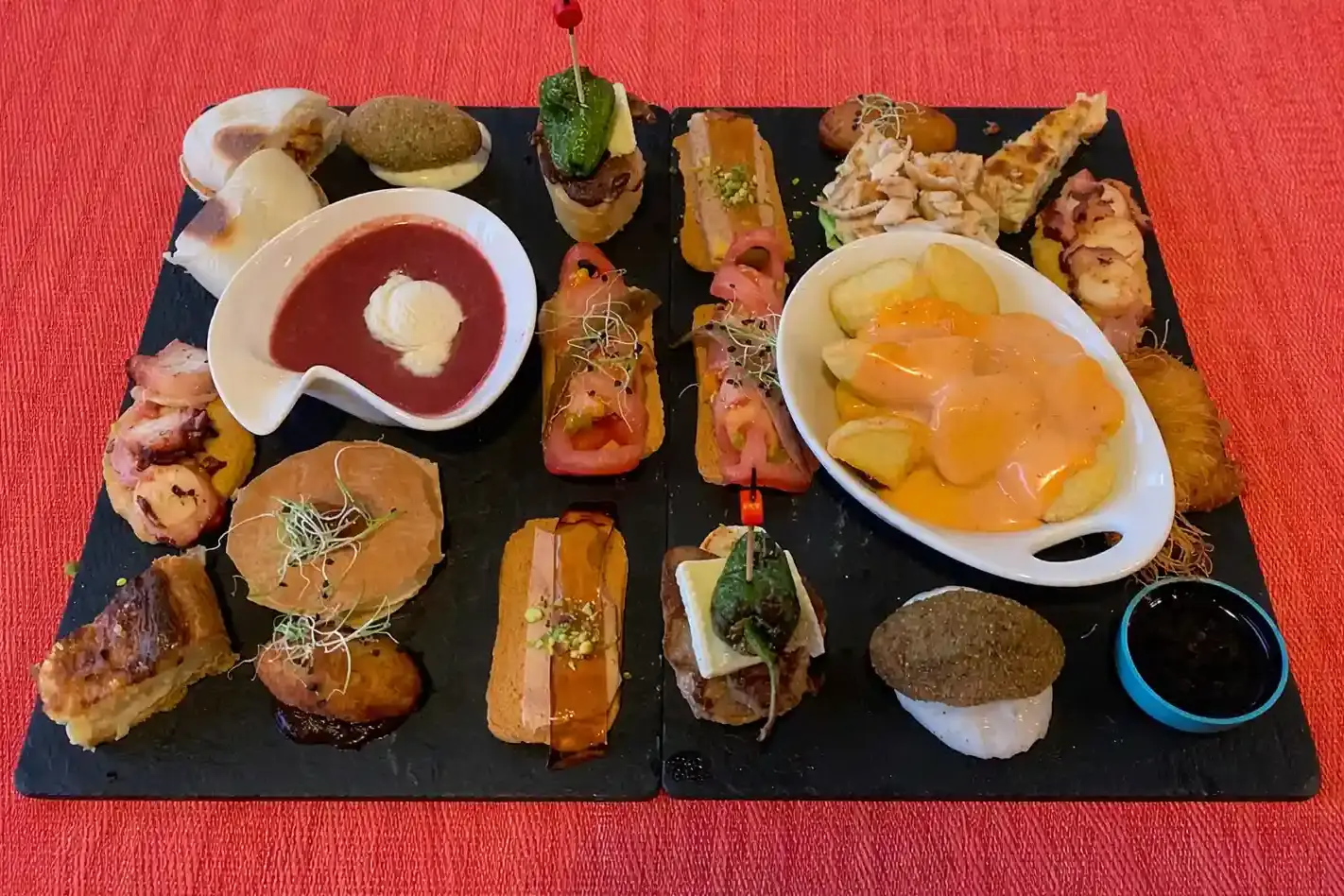
If you’re wondering where to eat in Frigiliana, the good news is that, despite the village’s small size, the food is good and offers a decent variety. Here you’ll find traditional Andalusian cuisine, well-prepared tapas, and a few tables with views that are worth the stop on their own.
Below is an honest and tried-and-tested selection, sure to keep your stomach happy.
- Restaurante El Mirador: You come here mainly for the view. Simple, well-executed cuisine, with traditional dishes and grilled meats. Perfect at sunset, even just for a single dish and a glass of wine. I had a goat’s cheese salad that was absolutely delicious!!
- Plaza 45: If you’re looking for something slightly different from the classic Andalusian menu, this is the right place. Relaxed atmosphere and Mediterranean cuisine with modern touches. It’s not ultra-traditional, but it’s very well done. We ordered a mixed tapas board and they were excellent!
- La Tahona del Zacatín: An informal spot, ideal for tapas, simple dishes, and a quick break during a walk through the village. It’s quite no-frills, but it was my favourite.
In any case, around the Casa del Aperos and Calle Real you’ll find plenty of bars where you can order a caña accompanied by simple but well-made tapas.
Frigiliana is one of those villages best discovered by walking without rushing, among whitewashed alleyways, staircases, cobbled streets and panoramic viewpoints. It is small, but the uphill sections can feel more demanding than they appear on the map.
For this reason, if you are planning to visit Frigiliana, the first thing to pack is a pair of comfortable shoes with a good grip. Sandals can work, provided they have a stable sole, but I would avoid completely smooth shoes or anything unsuitable for steep streets. A lightweight, practical bag is also useful, as it will not get in the way while you climb the steps and explore the narrowest alleyways.
As in the rest of Andalusia, the sun is one of the main features of Frigiliana at any time of year. A hat, sunglasses and a good sunscreen are essential even in winter: the light reflects off the whitewashed façades and can feel particularly intense while walking uphill. I always carry this small but very effective sunscreen with me.
Especially in spring and summer, it is also worth carrying a reusable water bottle. You will find bars and cafés in the historic centre, but during the hottest hours it is better to have water with you, particularly if you plan to continue towards the highest viewpoints or walk in the surrounding countryside.
Although the climate is generally mild, it is worth bringing a sweatshirt or a lightweight jacket for the late afternoon and evening. Frigiliana lies in the hills behind the coast and, once the sun goes down, the air can feel noticeably cooler. I bought this lightweight jacket, and I find it particularly convenient because it takes up very little space in a backpack.
Frigiliana has a beautifully maintained and very photogenic atmosphere, but it is still an informal village. There is no need to dress elegantly: fresh, comfortable clothes suitable for walking uphill are a much better choice. However, if you would like to take some lovely photographs among the colourful doors, flower-filled balconies and whitewashed houses, this is certainly the right place to wear something you particularly like.
Small items such as a power bank may seem like minor details, but they can make your day much easier, especially when you are using your phone’s navigation system, checking bus timetables or photographing every corner of the Barrio Mudéjar. I was given this one and I am very happy with it. There are, however, countless different models. Regardless of the model you choose, I strongly recommend taking one with you: sooner or later, it may genuinely save your day.
Frigiliana, you’ll see, is undoubtedly beautiful, but reducing it to that alone would be a mistake. Here you find history, mountains and sea all in a single glance: the alleys tell centuries of stories, behind you rise the first slopes of the Sierra, and ahead, just a little lower down, lies the Mediterranean of Nerja.
That’s why Frigiliana works so well as a stop during a seaside holiday, but also if you’re staying in Málaga or Nerja. In a single day, you can stroll through one of the most well-kept villages in Andalusia, understand its history, admire the views from the miradores, perhaps extend your trip to El Acebuchal, or head back to the sea in the afternoon. No rushing, no stress.
Just treating yourself to a few hours of beauty, all at once.
If you’d like to continue the journey and discover these small great treasures, below you’ll find a few articles I’ve prepared for you:
Cueva de Nerja: Andalusia’s underground giant between geology and prehistory
Nerja: a balcony over Europe and a special corner of Andalusia
Málaga: a surprise flavoured with culture, sunshine and Mediterranean rhythm
I hope you’ll find them useful!