Bilbao beyond the Guggenheim: Aste Nagusia, history and Basque tradition
To get to Bilbao, I have to say it was quite an adventure! Not because Bilbao is poorly connected to the airport or because public transport doesn’t work — on the contrary: it’s excellent! But simply because, upon our arrival, an unimaginable surprise was waiting for us.
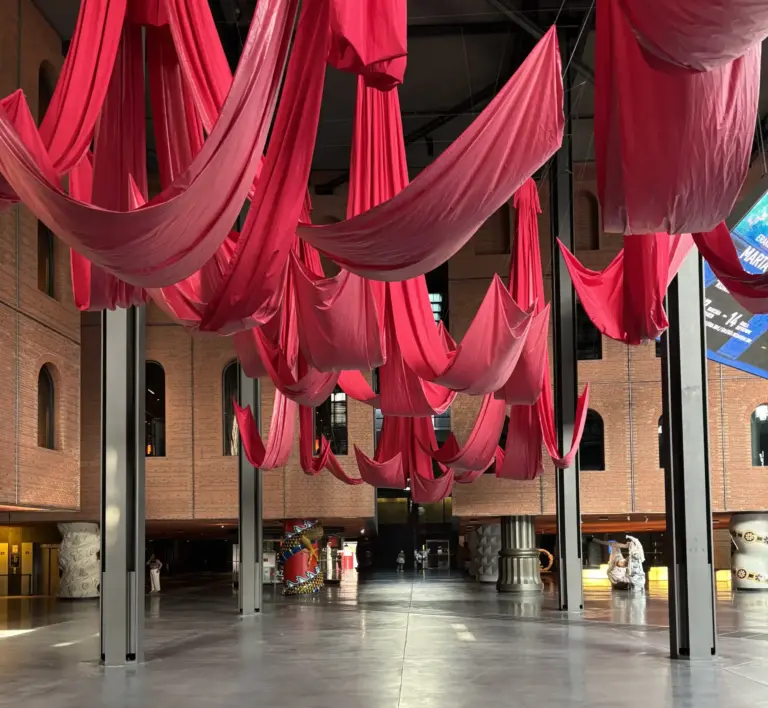
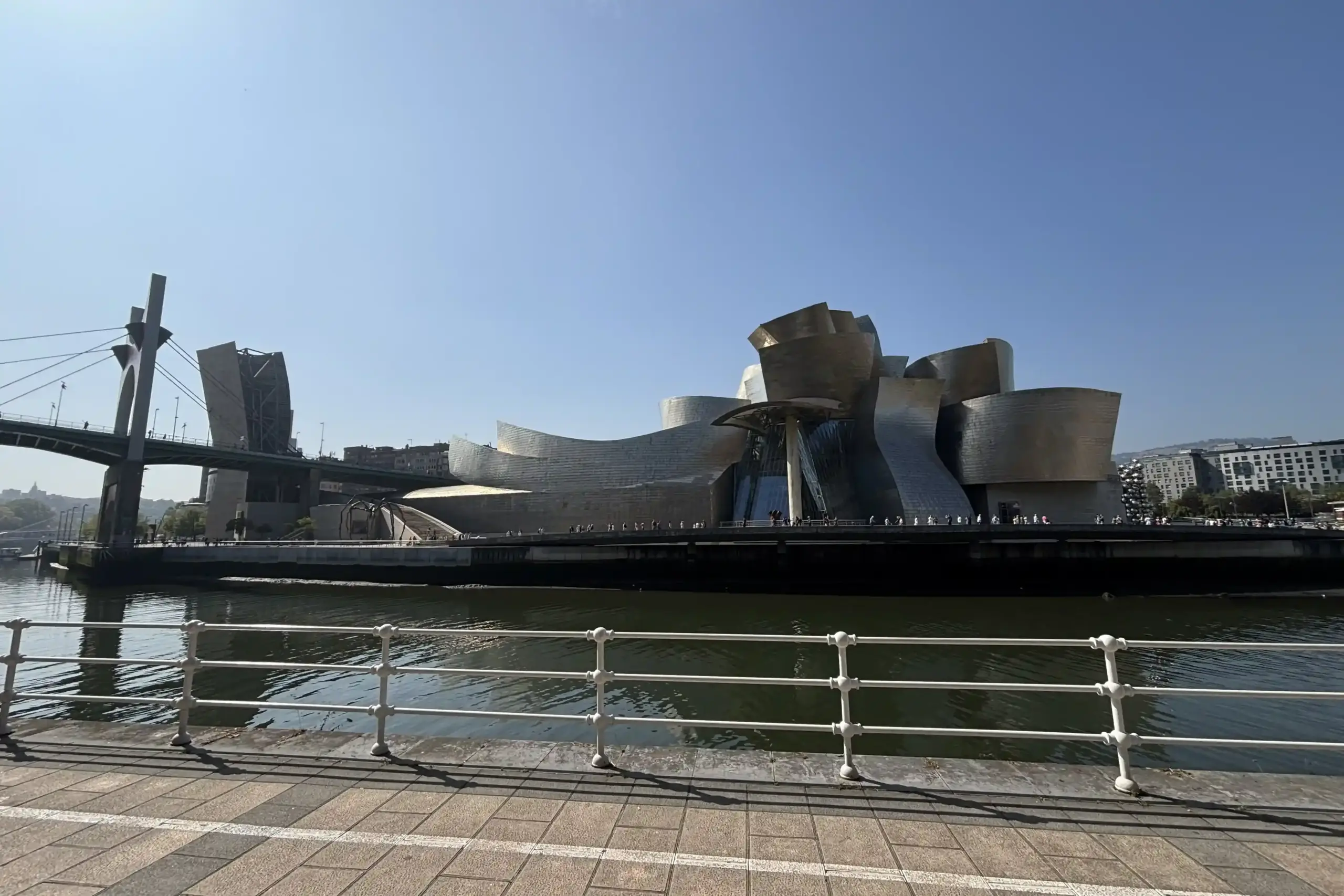
The entire historic center, where we had booked our stay, was closed to traffic. We had to park near the Guggenheim Museum and walk the two kilometers to the hotel, dragging our suitcases through a crowd of Gigantes y Cabezudos (giant figures and “big heads” parading through the city), food and wine stands, and verbenas (open-air stages blasting all kinds of music), along with barracas and casetas where people were eating and drinking.
Without knowing it, we had arrived on the very weekend of Bilbao’s Big Week!
Have you ever seen a photo of Bilbao filled with people, music, and color at the end of August? That’s not an ordinary local fair. It’s Aste Nagusia (in Spanish, Semana Grande), the annual explosion of joy that transforms the cultural capital of the Basque Country into an open-air celebration for nine consecutive days.
I swear, it’s a total experience! During the day it’s very family-friendly, with events for everyone. After dinner, the energy rises and turns into a joyful urban festival that goes on until late at night.
It’s a wonderfully chaotic celebration where it’s impossible to get bored. The city is divided into comparsas (neighborhood associations) that organize hundreds of events: parades of the Cabezudos, traditional Basque rural sports (Herri Kirolak) such as log cutting and stone lifting, open-air dance floors, and free concerts. The program is so extensive that there’s a dedicated page on Bilbao’s cultural portal and an official app updated every year. You can find everything on the website of the Bilbao City Council.
Every night there are fireworks — not just simple pyrotechnic shows, but a true international competition. Each evening, a company from a different country paints the sky above the Guggenheim and the audience votes for the best display. Tip: find a spot between Etxebarria Park and the riverside at least half an hour in advance!
Officially born in 1978, Aste Nagusia is Bilbao’s joyful and popular response to the need for a great summer festival. It is dedicated to the Virgin of Begoña, the city’s patron saint, although the atmosphere is anything but religious :-D!
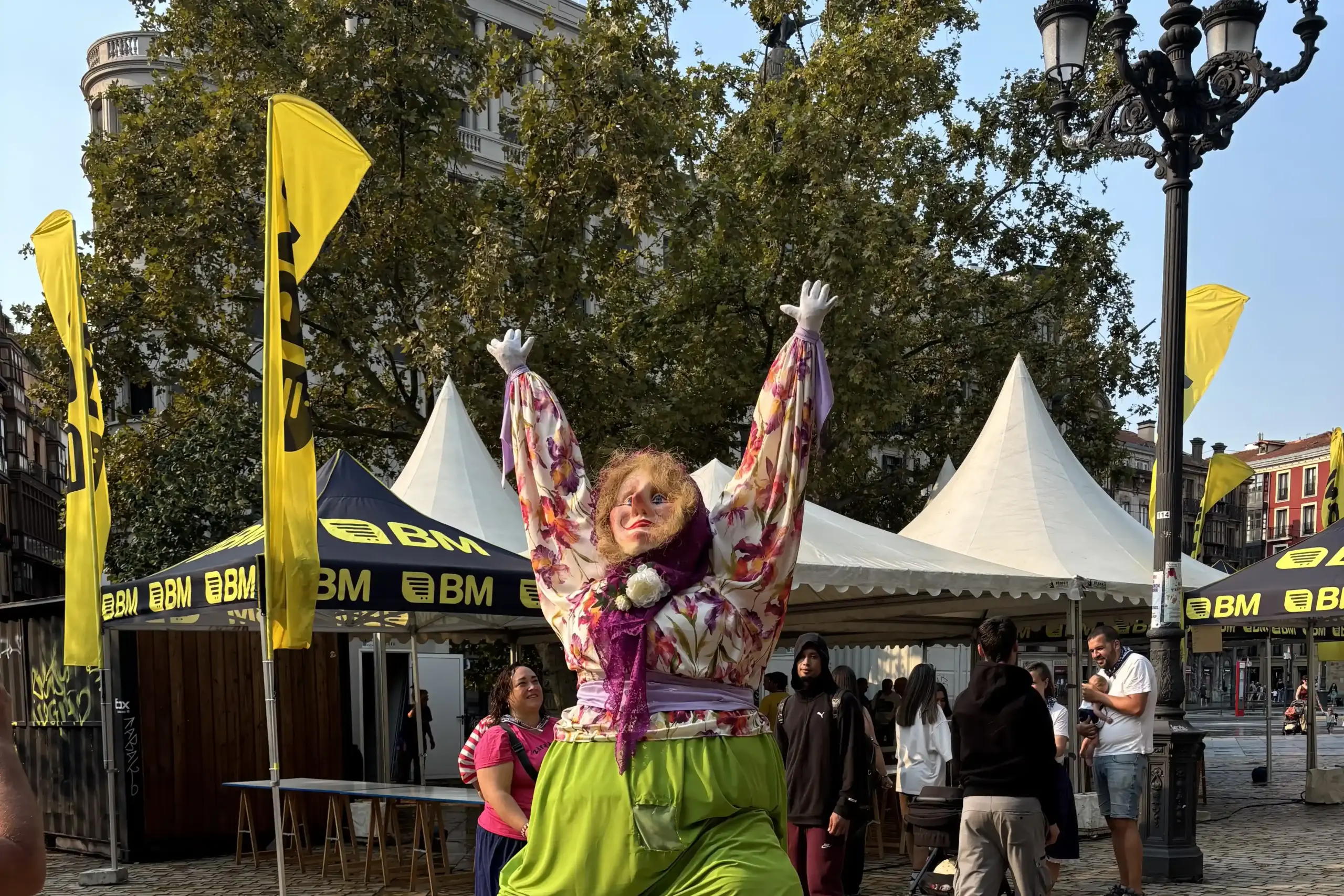
The spirit of the festival has a face (and a song): Marijaia. A plump female figure, with her arms always raised in celebration. Her anthem, “Badator Marijaia”, can be heard everywhere. She appears at the Txupinazo (the opening rocket), displayed from the balcony of the Arriaga Theatre, marking the start of the festivities. Watch the videos on YouTube! It’s incredible.
On the final night, Marijaia is set adrift on the river, on a raft that glides toward the sea, wrapped in flames.
The music is solemn and powerful, the fire lights up the ría, and the emotion is palpable: it’s the symbolic gesture that marks the end of the celebrations… until next year.
It was a surprisingly intense and deeply moving moment.
It’s a festival to be lived, danced, sung, and savored like no other. The most popular, traditional, and exuberantly joyful heart of Bilbao reveals itself in its entirety. An unforgettable experience for anyone who loves authentic local cultures!
In any case, with or without Aste Nagusia, you’ll see… Bilbao is a wonderful city.
Here are some practical tips for organising your visit to Bilbao: how to get there, where to park, how to get around, how to plan your visit and when to go. A few useful things to know when choosing your transport, exploring the city and organising your days around local rhythms, food, events and the weather.
Show all tips ↓ Hide tips ↑
How to get to Bilbao
- By plane: Bilbao Airport is located in Loiu, around 12 kilometres from the city centre, and is the main airport serving the Basque Country. To check flights, services and up-to-date information, visit the official Bilbao Airport website. To compare airlines, dates and prices, I also use Google Flights. The Bizkaibus A3247 connects the airport with Bilbao and makes several stops in the city centre, including Alameda Recalde and Gran Vía, before reaching Bilbao Intermodal. The journey takes approximately twenty minutes, although it may take longer when traffic is heavy. For up-to-date information about stops and connections, you can also consult the Bilbao Tourism page dedicated to the airport connection.
- By train: the main railway station is Bilbao-Abando Indalecio Prieto, which is centrally located and convenient for walking to the Ensanche and the Old Town. Bilbao is connected mainly with Madrid and Barcelona by the long-distance services operated by Renfe. To compare the different railway options, I also use Trainline and TrainPal.
- By long-distance coach: coaches connect Bilbao with Madrid, Barcelona, San Sebastián, Vitoria-Gasteiz and many other Spanish cities. Many services are operated by ALSA and arrive at Bilbao Intermodal, near San Mamés. The station is connected with the rest of the city by metro, tram, Cercanías trains and city buses.
- By car: Bilbao is well connected with the rest of Spain and the other Basque cities, but you do not need a car to visit the centre. Traffic, paid car parks and regulated access areas can make it more of a problem than an advantage. When arriving by car, consider using the park-and-ride facilities near Leioa, Etxebarri and Ansio-BEC metro stations. You can leave your vehicle outside the centre and continue by public transport. Information and conditions are available on the official page dedicated to parking in Bilbao. As I visited during the Aste Nagusia, I ended up parking, whether I liked it or not, in the car park at Zubiarte Shopping Centre, close to the Guggenheim. We paid approximately €45 for three nights.
How to get around Bilbao
- On foot: Bilbao is a very pleasant city to explore on foot. The Old Town, Mercado de la Ribera, Arriaga Theatre, the Ensanche, the Guggenheim Museum and the Abandoibarra area can all be linked by a long walk beside the river. The centre is not enormous, but bear in mind that some attractions are located on opposite sides of the river and the city also has several hilly neighbourhoods.
- By metro: the Bilbao Metro is particularly useful for longer journeys and for reaching places in the metropolitan area such as Getxo, Portugalete and Santurtzi.
- By tram: the tram passes through some of the city’s most interesting areas and can be useful for reaching the Guggenheim, Abandoibarra, San Mamés, Mercado de la Ribera and the edge of the Old Town. You can check maps, stops and timetables on the official Bilbao tram website.
- By city bus: the Bilbobus network serves the city’s different neighbourhoods and is particularly useful for areas not directly reached by metro or tram.
- By bus around Bizkaia: to reach places outside the city, such as the airport, San Juan de Gaztelugatxe, Gernika, Bermeo or other destinations in the province, consult the Bizkaibus routes. Always check the exact stop, route number and timetable for the day, as services may be less frequent on Sundays and public holidays.
- By local train: Euskotren and Renfe Cercanías trains make it possible to reach several destinations in the metropolitan area and throughout Bizkaia. You can check routes and timetables on the official Euskotren and Bilbao Cercanías websites. Euskotren also connects Bilbao with San Sebastián-Donostia, but the journey is quite long. For a direct journey between the two cities, the bus is generally faster.
- By the Artxanda funicular: to see Bilbao from above, take the Artxanda Funicular. The lower station is in Plaza del Funicular, a few minutes’ walk from the Zubizuri bridge. The journey takes only a few minutes, and services normally depart every fifteen minutes.
- With the Barik card: when planning to use public transport frequently, it may be worth buying a Barik card. It is a rechargeable card accepted on the main forms of public transport in Bizkaia, including the metro, tram, Euskotren, Bilbobus and Bizkaibus. It generally offers lower fares than repeatedly purchasing single tickets. One little-known advantage is that the anonymous Barik card can be used by several people travelling together. Simply validate the card once for each passenger. With the official Barik NFC app, you can check the balance and top up the physical card with a compatible phone.
- By bicycle: in good weather, you can combine walking with a few bicycle journeys, particularly along the river and in the flatter areas. Some neighbourhoods are built on hills and can be quite demanding. The municipal electric bike-sharing service is Bilbaobizi. You can register in person at the Bilbaobizi Office, on the ground floor of Bilbao Intermodal station, or, more simply, download the Bilbaobizi app. Create an account, enter your personal details and payment method, and then choose the most suitable subscription. The occasional subscription, costing €10, is normally the most suitable option for visitors staying in Bilbao for only a few days. The service is normally available every day, although some docking stations may be temporarily suspended during major festivities. This happened to me during the Aste Nagusia.
- By sightseeing bus: the Bilbao City View service can be useful for getting an initial overview of the city. Honestly, Bilbao is fairly compact, so I do not think it is essential, except perhaps when travelling with children.
How to plan a trip to Bilbao
- Two or three days are enough for a first visit. In two days, you can explore the Old Town, Mercado de la Ribera, the Ensanche, the Guggenheim Museum and the area beside the river. With a third day, you can go up to Artxanda or organise an excursion to Getxo, Portugalete or another nearby destination. When using Bilbao as a base for exploring Bizkaia, allow at least four or five days.
- The day begins later than in many other European cities. Early in the morning, the streets can still feel quiet and many shops do not open before 10:00 am. You can use the early hours to walk beside the river, photograph the Guggenheim from outside or enjoy a relaxed breakfast, leaving museums, markets and shops for later in the morning.
- Lunch is generally served from 1:30-2:00 pm, while dinner often begins from 8:30-9:00 pm onwards. Pintxo bars tend to have more flexible opening hours than restaurants and often allow you to eat something at other times of day.
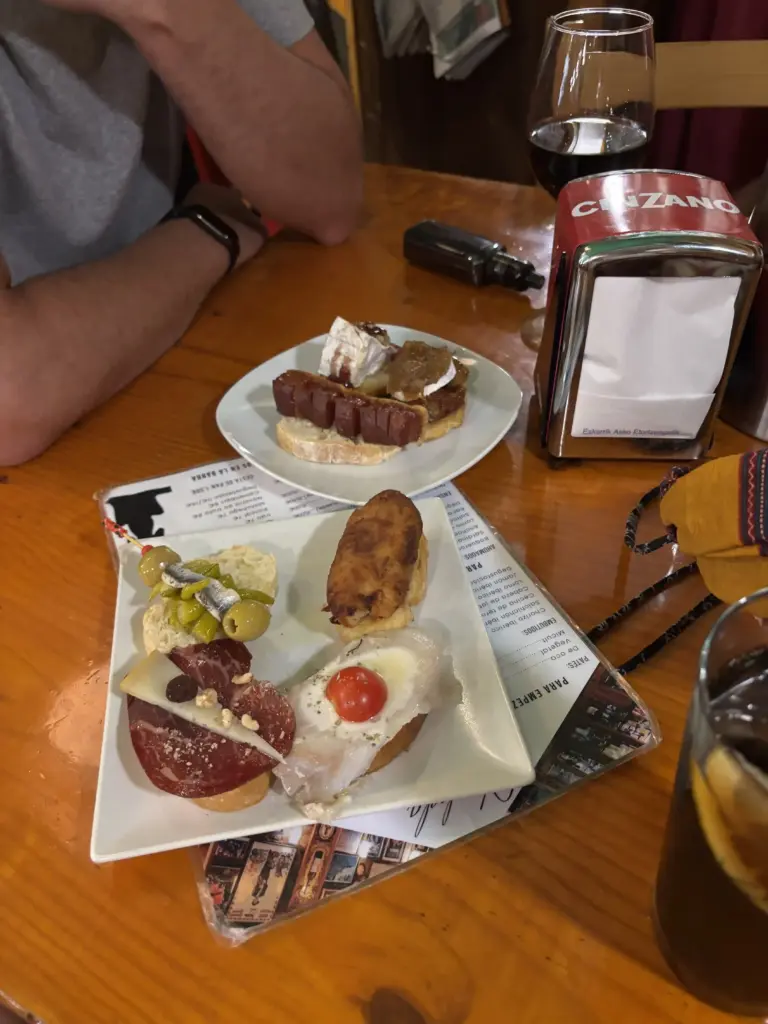
- In Bilbao, you eat pintxos, not simply tapas. One of the best ways to discover the local cuisine is to create a small route through the bars of the Old Town, Plaza Nueva, Ledesma and other areas popular with local people. You do not need to order everything in the same establishment: people normally have one or two pintxos with a drink and then continue to another bar.
- It is better to book the best-known restaurants. Bilbao has an important gastronomic tradition, and some establishments fill up quickly, especially at weekends, during public holidays and around major events. Traditional pintxo bars do not normally take reservations, while it is advisable to book restaurants, tasting menus and particularly popular venues in advance.
- Some cultural venues may offer free admission days, discounts or promotions, but the conditions vary. Always check opening times and admission prices on the official websites.
- Bilbao and Bilbo refer to the same city. Bilbao is the Spanish name, while Bilbo is the Basque name. Stops and signs may also appear in both languages. The Old Town may also be shown as Alde Zaharra, while Casco Viejo metro station often appears as Casco Viejo/Zazpikaleak.
- The weather can change quickly, so pack carefully.
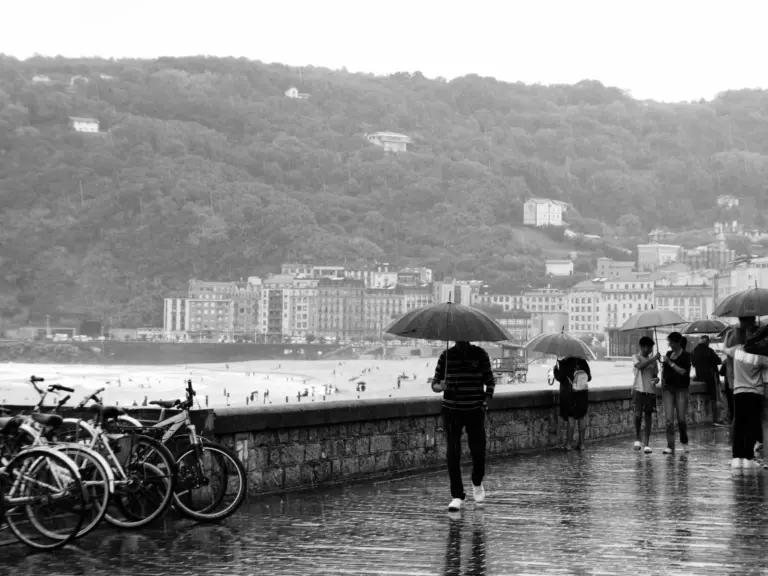
- Do not automatically cancel an entire day because of the rain: showers can alternate with brighter spells, and Bilbao offers many indoor alternatives, including museums, markets, pintxo bars and cultural venues. I have also written an article about this.
- To explore the surrounding area, you can also consider an organised tour. I always check the activities available on GetYourGuide or Civitatis, particularly when I want to visit several places in the same day without using a car.
- During the Aste Nagusia, book well in advance and perhaps stay outside the Old Town, or you may not sleep until five in the morning. The festival normally takes place during the second half of August and fills the city with concerts, performances, fireworks, food-related events and traditional txosnas. Check for updates and the programme on the official Bilbao website by searching for “Aste Nagusia”. During the festival, an app is normally released for visitors to download.
- Make use of the public Wi-Fi network. Free access points are available in several squares, tourist areas and municipal buildings. Simply look for Bilbao WiFi among the networks available on your phone.
- Consider buying the Bilbao Bizkaia Card, which should not be confused with the Barik card, as the latter is primarily a rechargeable transport card. The Bilbao Bizkaia Card is a personal tourist card that includes transport and other cultural or tourist benefits. Before buying it, compare the price of the card with the actual cost of the journeys and activities you have planned.
When to visit Bilbao
- Spring is a good time to visit Bilbao. Temperatures are generally mild, the vegetation is very green and the city is less crowded than during the main summer months. Rain remains possible and the weather can change quickly, so always carry something waterproof.
- Summer offers long days, generally pleasant temperatures and numerous events. July and August are, however, the busiest and most expensive months. Rain cannot be ruled out even in summer. August is particularly lively during the Aste Nagusia, but travellers looking for peace and quiet may prefer another time.
- Autumn can be particularly atmospheric. September often still offers pleasant temperatures, while October brings fewer visitors and intense colours to the parks and surrounding green areas. It is an excellent time to combine culture, food and nature, provided you are prepared for the possibility of rain.
- Winter is generally wetter and windier, although temperatures in the city are not normally extreme. It is an interesting period for visiting museums, markets and gastronomic venues with fewer tourists, although the days are shorter and the damp cold can feel quite biting.
- In my opinion, the best times to visit Bilbao are May to June and September to early October. The days are fairly long, temperatures are pleasant and visitor numbers are generally lower than in August.
- The Christmas period can also be a good opportunity to discover Bilbao. The city is illuminated and decorated, markets and events are organised, and food becomes even more important in local life. Bring warm clothes, a waterproof jacket and footwear suitable for the rain.
A bit of history about Bilbao
Although prehistoric and Roman traces (remains from 300 BC on Monte Malmasín) are scattered throughout the area, the true urban history of the city begins in 1300, when it became a strategic port.
The original core was not today’s Casco Antiguo, but the ancient fishing village of Begoña (around the current Basilica, in the upper part of the Old Town) and the area of San Antón (built right on the riverbank), along the shores of the Ría del Nervión.
This dual location already represented a perfect combination: a protected settlement on higher ground and a commercial landing point by the water. What was missing, however, was an official act recognizing Bilbao as a city.
On June 15, 1300, Diego López V de Haro, Lord of Biscay, granted the Fuero (Charter of Rights) to the village of Bilbao. The document formalized its status as a town and granted commercial privileges, officially establishing its mercantile soul.
The city was built around the famous Siete Calles (Seven Streets) on the left bank of the river.
In the 16th century, the urban area expanded with new walls and churches, such as the Catedral de Santiago (also famous for being an important stop on the Camino de Santiago).
Thanks to the granting of the Fuero, Bilbao quickly became the main port of the Crown of Castile in the north. Its prosperity was based on two types of trade:
- Wool: Bilbao was the maritime outlet of the Mesta, the powerful guild of Castilian shepherds. It exported raw wool to Flanders and Northern Europe, importing fine fabrics and luxury goods in return. An elite trade.
- Iron: the true “black gold” of the Basques. The mines in the area, especially in Somorrostro, produced iron of extraordinary quality, free of phosphorus and sulfur. It was so highly sought after that it was exported throughout Europe to manufacture weapons, tools, and nails.
- It is difficult to imagine today, but until the early 20th century, some iron mines were located within what is now modern Bilbao. An emblematic example is the area of Miribilla and the Iglesia de San Antón: neighborhoods that are now fully urbanized but were once crossed by mining tunnels and structures connected to iron extraction.
In 1511, Queen Joanna of Castile (“la Loca”) established the Consulado de Bilbao. It was not just a commodity exchange: it was a commercial court that created the Ordenanzas, a maritime and mercantile code so advanced that it became an international reference, often compared to the famous code of Amalfi. For three centuries, this consolidated Bilbao as a global trading power.
If the previous centuries were marked by mercantile prosperity, the 19th century became the era of the Industrial Revolution, and Bilbao turned into its Spanish epicenter.
British demand for iron caused the mines to boom. That iron, which had previously been exported in raw form, began to be processed locally. Thus the Basque steel industry was born between 1850 and 1880, along with the colossal steel mills lining the Ría, such as the legendary Altos Hornos de Vizcaya.
This industrial growth attracted thousands of immigrants from all over Spain, causing the population to surge and transforming Bilbao into an overcrowded and unhealthy city.
So, across the river, the new industrial bourgeoisie enriched by mining and steel — the so-called “iron barons” — sought a new area to build a Bilbao worthy of its wealth. The Ensanche (Expansion District) was born: an elegant grid of wide avenues and grand buildings (such as Plaza Moyúa and the Gran Vía) in stark contrast to the old Casco Viejo. Theaters, the Stock Exchange, and railways were constructed.
Bilbao became the richest and most modern city in Spain. One could even call it a true “Spanish Manchester,” whose skyline was no longer dominated by bell towers, but by chimneys. A prosperity that would paradoxically lay the foundations for both the great achievements and the deep crises of the following century.
Few people know this, but there is a red thread — or rather, an iron thread — linking Bilbao’s industrial history to its football myth.
It is no coincidence that the San Mamés stadium, and the bars during matches, echo with the powerful chant “¡Alirón, alirón, el Athletic campeón!” every time Athletic Club wins.
This word has a unique origin, rooted in the region’s iron mines and in its close commercial ties with England. In the late 19th century, British engineers working in the mines marked the purest and richest veins with the inscription “All iron”.
Basque miners adopted that sign of good fortune, pronouncing it exactly as it was written: “A-li-rón”. From an expression of joy in the tunnels that received this mark, it became the victory cry of the working-class city’s team: a true sonic bridge between the industrial past and the sporting present.
Another curiosity about Athletic Club: it is the only team in the world that fields players born or raised in the Basque Country. It is a choice of identity, an unwritten pact with its people.
So, the next time you hear “¡Alirón!”, remember that this chant celebrates more than just a goal. It tells a story of mines, community, and pride: it is the true sound of Bilbao.
The 19th century, in fact, left Bilbao a legacy of elegant theaters, the railway station, and wide avenues paved in gray stone, which still give parts of the city their severe and majestic appearance.
But the 20th century opened like a hurricane, sweeping away that prosperity.
Bilbao, a republican stronghold during the Spanish Civil War (1936–1939), endured a harsh siege by Francoist troops. It suffered devastating bombings, such as the one in Durango, and, after its fall, fierce repression. The famous “Cinturón de Hierro” (the 80 km defensive line built in just a few months by 10,000 anti-Franco Basque workers, with 180 reinforced concrete bunkers up to 70 cm thick, trenches, machine-gun nests, artillery, and shelters) could not stop the advance.
The Franco regime exploited Bilbao’s industrial power for the country’s reconstruction, but Spain’s international isolation and outdated economic policies laid the groundwork for crisis. A new wave of low-cost labor immigration led to chaotic and disordered urban growth.
The final blow came in the 1970s and 1980s. The oil crisis and global competition caused the collapse of heavy industry, the heart of the Basque economy. Steel production and shipbuilding shut down. Unemployment rose above 25%. The Ría del Nervión, once a vital artery, was biologically dead, poisoned by decades of industrial waste. Bilbao became a national symbol of post-industrial decline, pollution, and conflict, overshadowed by the terrorism of ETA. The city reached its lowest point.
Yet from despair emerged a bold and visionary reaction. In 1989, local authorities conceived an ambitious plan: no longer subsidizing dying industries, but pursuing a total transformation — shifting from heavy industry to services, culture, and design.
The flagship project, the gamble that would change everything, was the construction of the Guggenheim Museum Bilbao, entrusted to star architect Frank Gehry. Its opening in 1997 was a global event. The “Guggenheim Effect” was immediate and overwhelming: it not only attracted tourists, but transformed the self-confidence of citizens and drew investment from around the world. That titanium structure became the universal symbol of rebirth.
The transformation was systemic.
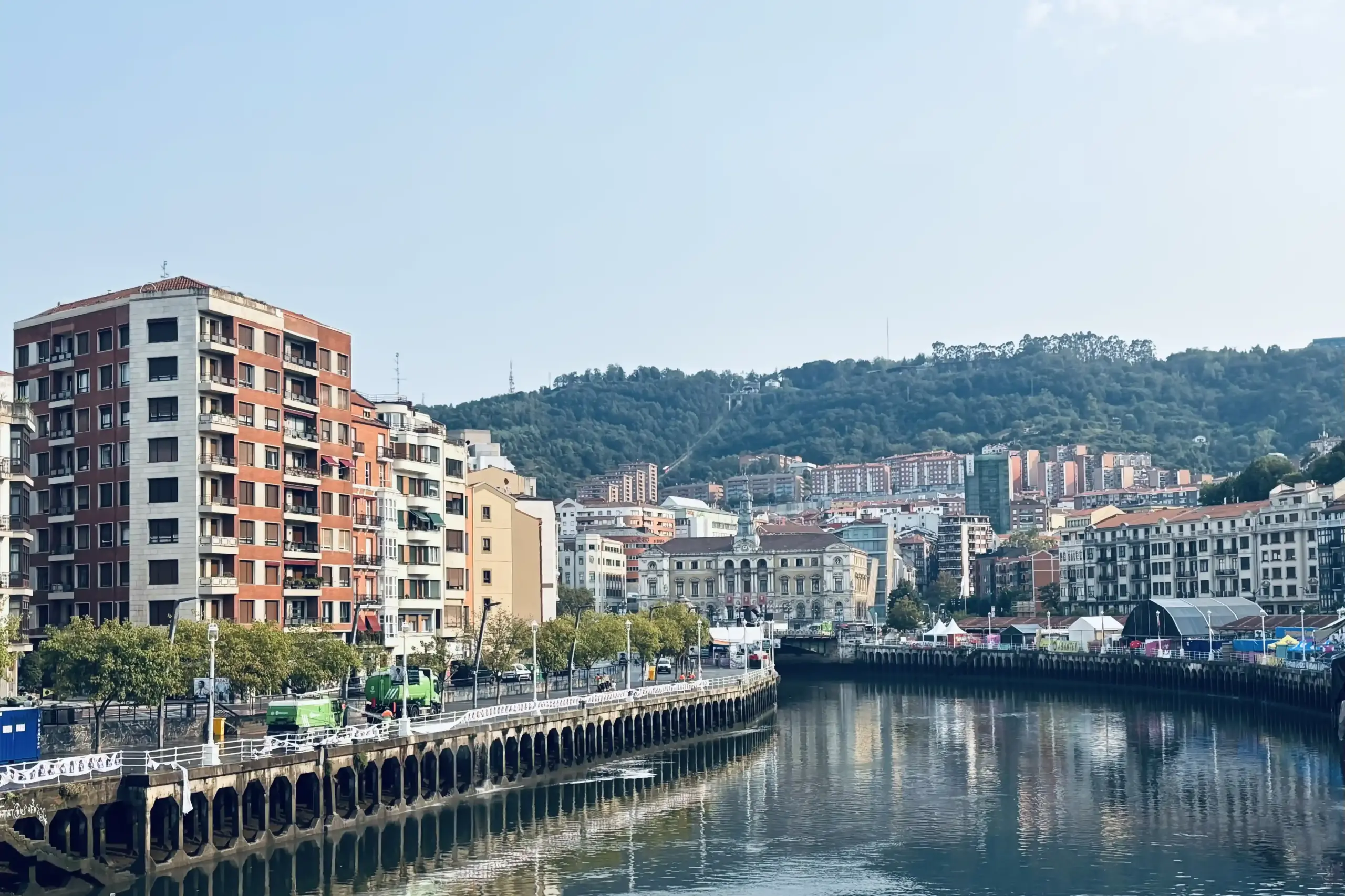
The Ría was completely cleaned and today even hosts seals and seagulls. Former industrial docks were turned into parks (Campo de Volantín), futuristic bridges (the Zubizuri Bridge by Calatrava), and upscale residential neighborhoods (Abandoibarra). New iconic public buildings, such as the Euskalduna Conference Centre and the Iberdrola Tower, completed a skyline oriented toward the future.
Today, Bilbao is a post-industrial city — clean, livable, and cosmopolitan. Quality tourism is one of its pillars, but it is also a dynamic hub for services, technology (with the Zamudio Technology Park), and design. Even its vibrant pintxos culture reflects this new open and creative spirit.
The success has been so extraordinary that it gave rise to a term now used in urban planning worldwide: the “Bilbao Effect.” It defines a city’s ability to radically regenerate itself through an iconic cultural project, transforming its destiny. Bilbao is no longer the city of gray, but the city of titanium shining under the Atlantic rain.
What to see in Bilbao
Bilbao — you will see it with your own eyes — is a city that combines majestic contemporary architecture, a charming historic heart, and a vibrant gastronomic culture.
Bilbao is neighborhoods, museums, panoramic viewpoints, modern art, and pintxos. You cannot say you truly know it if your visit doesn’t include all of this.
And what if it rains? Don’t worry… read here! The city is ready to surprise you even in bad weather, revealing treasures that sunshine often hides.
But there’s no point just talking about it… let’s begin. Bilbao is waiting for us!
The Casco Viejo
🚶 Walking tour of Bilbao: the Casco Viejo
If the Guggenheim is Bilbao’s famous and futuristic face,, the Casco Viejo is its historic soul, beating strongly for seven centuries. Crossing into this district means immersing yourself in a maze of medieval streets where every stone tells a story. Among lively squares, centuries-old churches, and hidden corners, history here is not a museum — it is a lived experience.
The Casco Viejo is the original nucleus of Bilbao, the “villa” founded in 1300 by Diego López de Haro. At the time, it was little more than a commercial outpost overlooking the Ría, but its position was already strategically perfect.
Bilbao’s maritime role is still easy to sense today, even in the names of its squares and churches.
Our tour begins in Plaza del Arenal, a large open space of 29,000 square meters — the green lung of the city — located between the Old Town and the river. Families, street musicians, Sunday flower stalls: the atmosphere is lively yet relaxed. But its name reveals a different past. “Arenal” comes from arena (sand), and indeed, until the 19th century, this area consisted of sandy ground and river dunes shaped by the tides of the Ría. It lay outside the city walls and was used for unloading boats filled with fresh fish, for markets, and even for bullfights.
Confirming this unbreakable bond with the sea, the square is overlooked by the sober façade of the Iglesia de San Nicolás, dedicated to Saint Nicholas of Bari, the patron saint of sailors. It stands where once there was a hermitage-hospital for seafarers, attached to a cemetery outside the walls.
From the outside, the church appears modest, almost squeezed between surrounding buildings. But you should remember that originally the church stood much closer to the water than it does today. It was positioned in the space available at the time of its construction.
Over the centuries, it endured many hardships: look for the marks of past floods on its walls, imagine a lightning bolt striking it directly, and picture it being turned into a military warehouse. Despite all this, it survived and eventually became an important concert venue thanks to its monumental organ.
Do not be deceived by its exterior. Inside, the church reveals a fascinating heart: a central Greek-cross plan inscribed within an octagon — a bright, unified space that is extremely rare in Basque religious architecture. Also, at the entrance on the left, look for an ancient medieval tombstone engraved with a cross. It comes from the old cemetery and is an object of popular devotion — considered miraculous if touched… it never hurts to try!
Admission is free. So step inside if you’d like to touch the maritime essence of Bilbao’s origins.
Look closely at the façade of the Church of San Nicolás: you will notice a heraldic shield supported by two lions. It is not a simple decoration, but the official coat of arms of the Villa of Bilbao, placed there as a true seal of belonging.
This small stone masterpiece is a symbolic map of the medieval city. By decoding it, all the pillars of Bilbao’s identity emerge:
- The bridge (and the wolves): at the center appears the Puente de San Antón, which for centuries was the only crossing over the ría and the heart of the city’s trade. On its sides stand two rampant wolves, the heraldic symbol of the powerful López de Haro family, founders of the city.
- The church and the waves: in the background you can recognize the silhouette of the Church of San Antón, built right beside the river. Beneath it, the waves of the Ría del Nervión represent the vital artery that brought wealth and connected Bilbao to the world.
- The guardians: the two lions holding the shield symbolize the city’s strength and sovereignty.
Placing this coat of arms on the façade of a church was a gesture with powerful meaning: it signified that civil authority and religious life were united, and that this church was an integral — and protected — part of the urban community.
With the arrival of the railway in the 19th century, the city gained a new gateway. The La Concordia railway station was built on the opposite bank of the Ría, facing the old Arenal.
This location transformed the entire area into Bilbao’s calling card — the first image that travelers and entrepreneurs saw when stepping off the train. It was the golden age of industrialization, and the city wanted to present itself at its best.
Thus, the Arenal became a showcase of prestige. Majestic buildings housing banks and insurance companies rose up, symbols of the new economic power. But among so many institutions of finance, the enlightened bourgeoisie also wanted a temple of culture. And so, in a dominant position, the Teatro Arriaga was born — one of the most elegant and recognizable buildings in all of Bilbao.
It was not just a theater: it was a statement of intent. It told the world that Bilbao, while being the capital of steel, also aspired to be a beacon of elegance and performance.
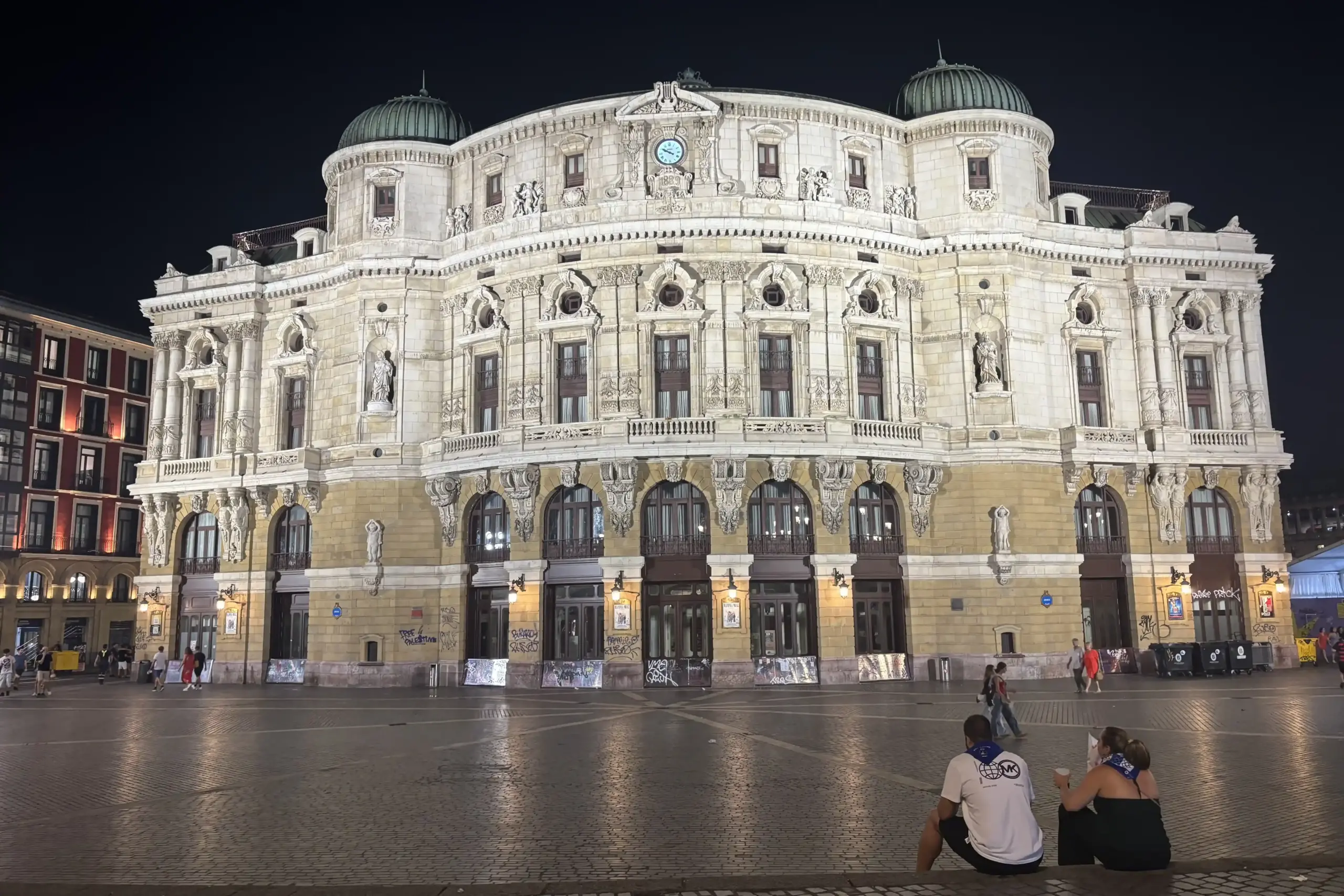
Teatro Arriaga
Inspired by the Paris Opéra Garnier, the Arriaga Theatre is a triumph of eclecticism that dominates the square. Its façade tells a story in stone: the attic level crowned by a clock, polygonal towers and, above all, balconies supported by caryatids and atlantes. These sculpted figures, with their generous, maternal forms, earned the theatre the affectionate popular nickname “Casa de Maternidad” (Maternity House).
But behind the historic façade lay a surprisingly modern soul for the late nineteenth century. It was one of the most technologically advanced buildings in Europe: equipped with electric lighting when it opened, replacing gas, and even with a telephone service that, for the price of 15 pesetas, allowed wealthy residents to listen to the opera from the comfort of their own homes. A nineteenth-century precursor to streaming!
Originally called “Nuevo Teatro de Bilbao”, in 1902 it received its current name in honour of the local genius Juan Crisóstomo de Arriaga. A child-prodigy composer nicknamed the “Spanish Mozart”, whose brilliant life came to an end at just 19 years old.
The theatre’s history has not been an easy one: a devastating fire in 1914 and a serious flood in 1983 destroyed its original interiors. Subsequent restorations managed to preserve its spirit: today it features a horseshoe-shaped auditorium (following the Italian tradition) that can accommodate 1,200 spectators, with iron supporting structures recalling the resilience of the city.
Today, the theatre is more alive than ever. It hosts a prestigious programme of opera, ballet and theatre, and offers guided tours to discover its secrets, from the gilded foyer to the underground spaces. A symbol of elegance that has survived both fire and water, while preserving its role as a cultural beacon for Bilbao.
The main balcony of the façade is stage zero, the official and emotionally charged starting point of Aste Nagusia, Bilbao’s Semana Grande.
It is from there, on Saturday, that the nine days of festivities officially begin. The famous Txupinazo (the opening rocket) is launched and, immediately afterwards, Marijaia, the symbolic queen of the festival, appears with her arms raised in celebration.
That moment unleashes an explosion of energy in Plaza del Arenal, which fills with a festive crowd, throwing thousands of plastic cups into the air (a symbolic txikiteo), while the anthem “Badator Marijaia” rings out for the first time.
So yes, if you visit Bilbao during Semana Grande, this place is not simply a beautiful building: it is the beating heart from which the city’s joyful, organised frenzy begins. It is the epicentre of collective emotion.
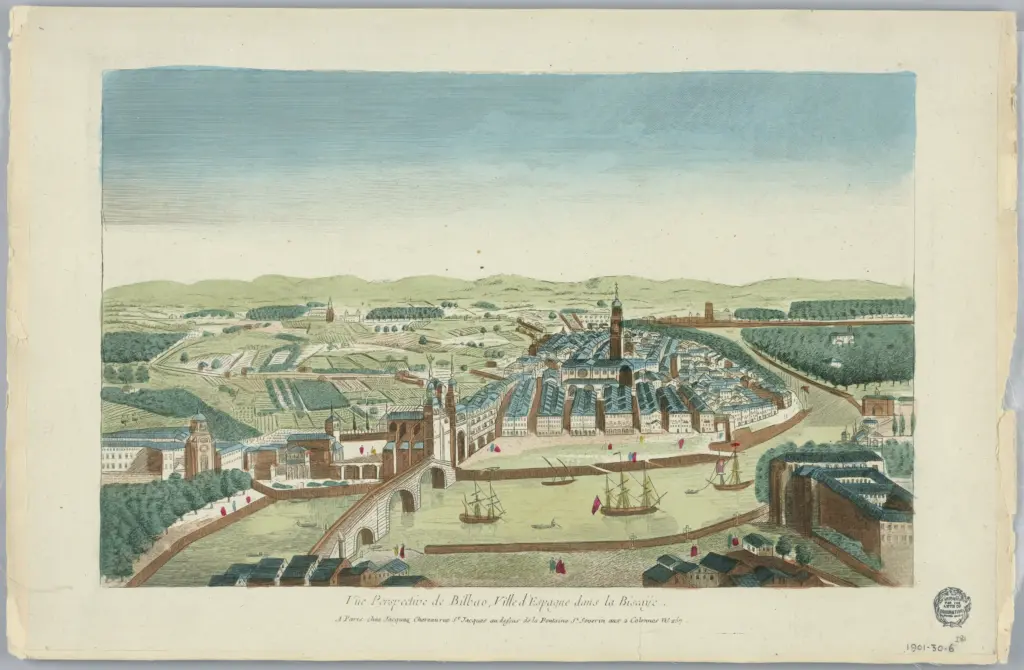
Plaza Nueva
From the Teatro Arriaga, we continue toward Plaza Nueva. This square is not just a square: it is an ambitious project conceived at the end of the 18th century to give a growing Bilbao a “living room” worthy of its wealth. Where once there were unhealthy alleys, the goal was to create a functional, hygienic, and above all elegant space.
Its construction was a true epic: 65 years of work (from 1786 to 1851), marked by bureaucratic delays and wars. It was originally given a regal name, Plaza de Fernando VII, but after the king’s death and the Basque liberals’ dislike of the monarchy, the people of Bilbao simply renamed it “Nueva,” to distinguish it from the old Plaza Vieja (today the Mercado de la Ribera).
The square was designed for the rising bourgeois class: merchants, bankers, and shipowners. Its ingenious structure of 64 arcades created a covered commercial gallery, perfect for doing business 365 days a year, sheltered from Bilbao’s famous rain.
On the upper floors, luxury apartments were intended for that same elite. A curious detail: to ensure that only the truly wealthy could live there, it was possible to purchase only the entire three-story property. This required not only substantial capital, but also space for servants on the top floor — clear signs of the buyer’s wealth.
At the beginning, Plaza Nueva had a central pond with a well (whose trace can still be seen in the paving). Once it was filled in, the open space began to host all kinds of remarkable events, including bullfights and temporary theatres, with wooden stands erected for the occasion. Try standing exactly in the centre (where there is a map set into the pavement) and clap your hands: the perfect echo created by the enclosed acoustics of the arcades is surprisingly clear.
To give you an idea of the kind of events the square once hosted, in 1871, to honour King Amadeo I of Savoy, it was even transformed into a “Basque Venice”, with an artificial pond in the centre and gondolas gliding across it.
If you walk beneath the arcades, keep in mind that Plaza Nueva is the perfect place for the classic “txikiteo” (a bar-hopping route) – read my article Sabor a Bilbao to choose the right places – but in the meantime, take a close look at the different arches. You will spot historic signs in wrought iron or stone indicating old shops or professions.
At number 7, you will find the former courthouse, now the headquarters of the Academy of the Basque Language (Euskaltzaindia), with the royal coat of arms above the doorway.
And then there is a corner of Plaza Nueva that is worth more than a thousand monuments: the one that, I was told, local residents call the “Rincón de los Solitarios” — right next to Víctor Montes, the historic restaurant opened in 1846. Every day, a small group of elderly single men from the neighbourhood gather here — almost all of them men — sitting beneath the arcades, chatting and watching life go by. You will not find plaques or references in official guides: no historical value, no artistic value, but a touch of authentic everyday life that alone makes the journey worthwhile. Unfortunately, during the Aste Nagusia I was not able to see them in person — too many people, too much celebration, too little quiet for their bar-side conversations. But if you pass by on a calmer day, let me know if you manage to spot them with your own eyes!
The real weekly appointment in Plaza Nueva, however, is Sunday morning (10:00–14:30), when the square turns into a market for collectibles, crafts, natural products and second-hand books. A real treasure for enthusiasts. The market is suspended during the Aste Nagusia, so I did not get to enjoy it… but that is the price to pay for an unforgettable festival!
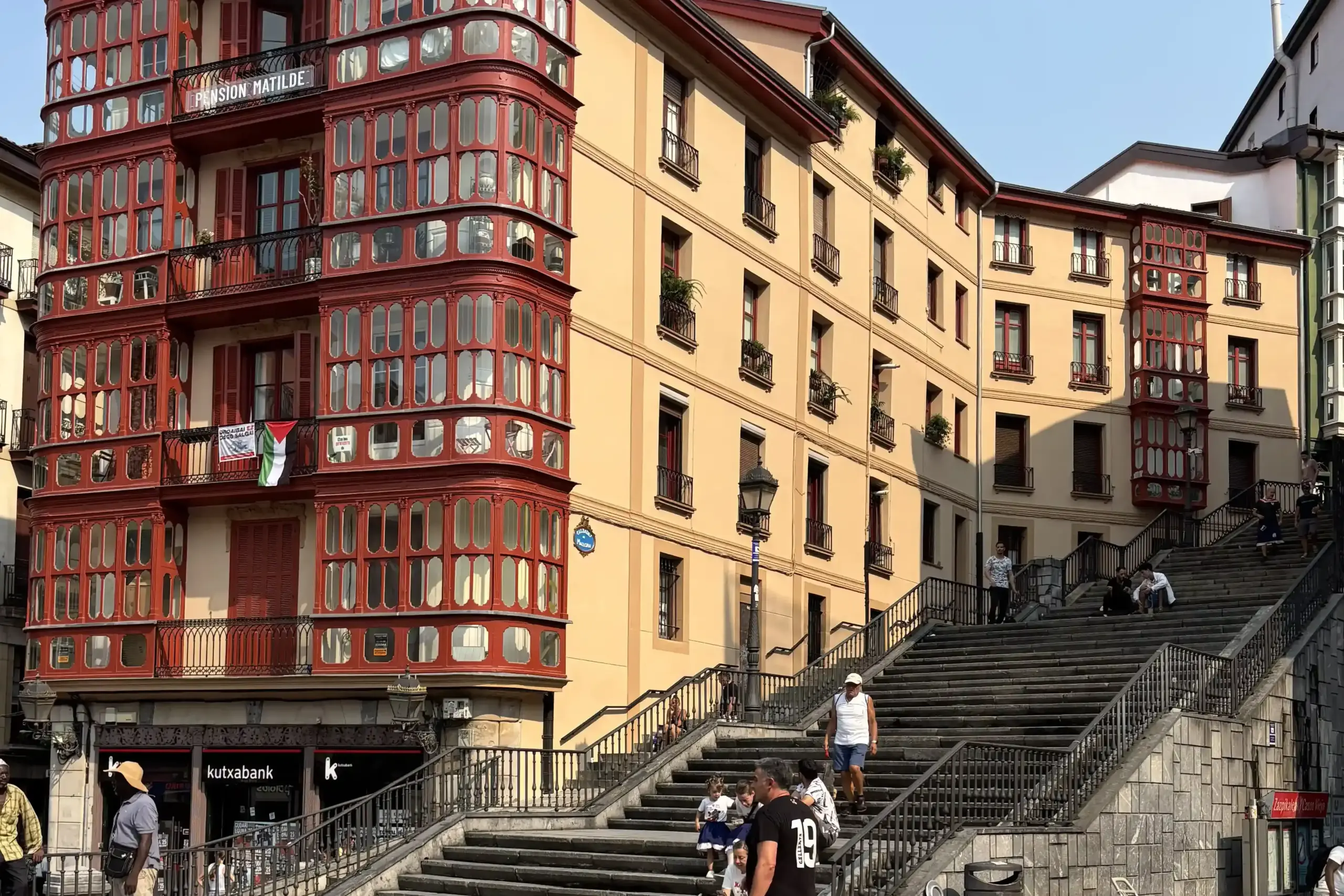
Plaza Unamuno
Leaving behind the arcades of Plaza Nueva, we head toward another key crossroads: Plaza Unamuno. This irregular square, with its trapezoidal shape that reveals the ancient perimeter of a former convent cloister, is much more than a simple intersection. It is a symbolic gateway to the Casco Viejo and a tribute to one of the giants of Spanish culture.
At its center, atop a column, the bust of Miguel de Unamuno watches over the square. This Bilbao-born philosopher and writer, one of the sharpest minds of the 20th century, is renowned for his civic courage. In 1936, facing Franco’s supporters at the University of Salamanca, he uttered the historic phrase: “Venceréis, pero no convenceréis” (“You will win, but you will not convince”). A powerful warning about the force of arms versus the strength of ideas — a stance that cost him his freedom.
The square is a true hub of connections:
- From here branch out the Siete Calles, the medieval heart of Bilbao.
- The steep Calzada de Mallona begins here — a staircase dating back to 1745 that, with its roughly 400 steps, climbs all the way up to the Basilica of Begoña. If you have the stamina to tackle it (I took the elevator!), halfway up you will find an arch marking the entrance to the city’s first cemetery — a hidden piece of history.
- Housed in the former Colegio de San Andrés (17th century), the Basque Museum (Euskal Museoa), it is considered an essential stop for anyone who wants to understand Basque culture and the history of the Basque people. During my visit in 2025 it was closed for a long renovation, but it reopened its doors on 10 June 2026 — and its new look, after four years of work and more than €20 million invested, promises to be even more spectacular than before. If it is even half as good as the San Telmo Museum in San Sebastián, then do not miss it for any reason: it is a key place for delving into Basque traditions and culture through its objects. Admission is free on Wednesdays, so take advantage of it!
Plaza Unamuno also has two distinct faces: a daytime one (quiet and transitional) and an evening one, when it turns into an informal gathering spot for university students, who sit on the steps chatting and sipping a beer.
If the student atmosphere doesn’t appeal to you, from here you can easily head along Erronda Kalea towards one of Bilbao’s most iconic landmarks: the Church of San Antón and the adjacent San Antón Bridge, which together form part of the city’s coat of arms.
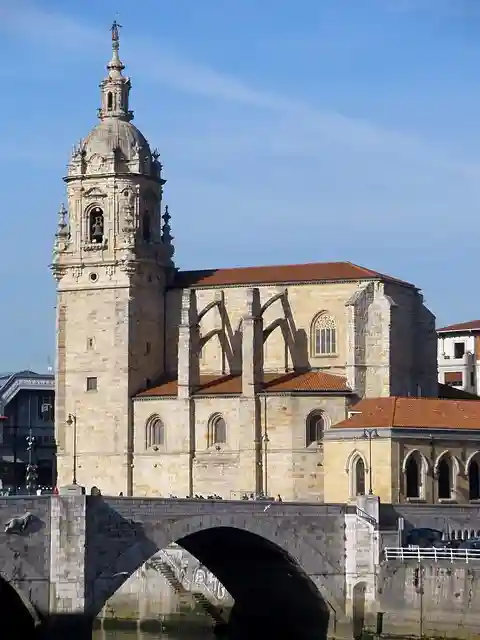
Iglesia de San Antón and the Puente de San Antón
The church is open to visitors every day, but check the official website for opening times, as they often change. The visit is part of the tourist circuit managed together with Santiago Cathedral. If you are planning to visit both churches, buy the combined ticket. It is definitely the most economical option.
Do you remember the city’s coat of arms — the one we saw on the façade of San Nicolás? These two monuments do not merely represent it: they embody it. The Iglesia de San Antón and the Puente de San Antón are the symbolic image of Bilbao, carved into its history and even into the logo of Athletic Club.
The Church of San Antón stands clinging to a rock along the Ría, perhaps at the oldest point in Bilbao. Beyond the former mine, excavations in 2002 uncovered 12th-century remains: traces of a riverside market, warehouses, and structures confirming a settlement that predates the official founding in 1300. The church you see today is a true palimpsest of styles, expanded and remodeled until the early 20th century, telling centuries of transformation in remarkable harmony.
Beside it, the Puente de San Antón is far more than just a crossing. Its first version, possibly wooden, dates back to before 1300 and for centuries it was the only bridge over the Ría. This gave it enormous power: it was the mandatory passage for all trade between Biscay and Castile, a monopolistic position that the people of Bilbao defended fiercely, even opposing — sometimes violently — the construction of other bridges.
The Gothic two-arched bridge that appears in historic coats of arms dates from 1463. The current bridge, built in the early 20th century, faithfully respects its form and position. Its history also has a darker side: in the 15th century, beneath its arches, the practice of empozamiento took place — a grim form of execution in which the condemned were drowned by being thrown into the river with a stone tied around their neck.

Mercado de la Ribera
On the same square as the church stands the Mercado de la Ribera.
The Mercado de la Ribera is more than just a market. With its 10,000 m², it is the largest covered market in Europe, a title it proudly holds. It stands on the right bank of the estuary (and La Ribera literally means “the riverbank”), exactly where Bilbao’s first market was established between the 13th and 14th centuries, shortly after the city was founded.
For centuries, fishermen practised the “venta a la boatada”, selling fish directly from their boats, while farmers came in from the surrounding countryside.
The current building, inaugurated in 1929, is a masterpiece of industrial Art Deco. Its imposing glass-and-steel façade, topped by a large clock and decorated with geometric motifs, was a true statement of modernity and hygiene. And hygiene here had an ingenious system: look at the fish stalls, each one has a trapdoor in the floor. During cleaning, waste is dropped through it onto an underground conveyor belt that takes it directly to a collection point — a remarkably advanced system for the 1930s that still helps keep the market impeccably clean, without waste ever having to be carried through the public areas.
There are two gems you should definitely look for if you visit the market. First, the 1930 ceramic mural: on the north wall of the ground floor, admire the huge mural depicting fishing scenes with traditional traineras, allegories of the seasons and typical local products. Hidden for decades, it was rediscovered during the market’s restoration. It is a true fresco of Basque life. The second is the tide clock: on the east wall, look for the original clock that showed not only the time, but also the cycles of high and low tide. For the fishmongers, it was essential, as it told them exactly when the boats would arrive at the quay with fresh fish. A small detail that tells the story of a city whose rhythm was once dictated by the river.
Today, although it is a modern market, its bright aisles offer not only an extraordinary selection of fresh fish from the Bay of Biscay, but also stalls selling Idiazábal cheese, seasonal vegetables and pintxos ready to enjoy. I also talk about it in my article on where to eat in Bilbao.
On the opposite side of the Mercado de la Ribera, across the road, you will find the evocative Porticos de la Ribera. This covered walkway, dating back to the 18th century, once bordered the old Plaza Vieja, which stretched from the porticoes all the way to the estuary. Today, the road cuts through what was once the square, but the porticoes still preserve the charm of old Bilbao.
They are a must-see when walking through this area, especially because all you need to do is look up: during restoration work in the 2000s, beautiful polychrome ceilings decorating the vaults were brought back to light, featuring figures of deities, animals and allegories. A small hidden treasure that is easy to miss if you walk past without paying attention.
From here, we finally step into Bilbao’s most authentic maze: the legendary Siete Calles (Zazpi Kaleak), the medieval heart where it all began.
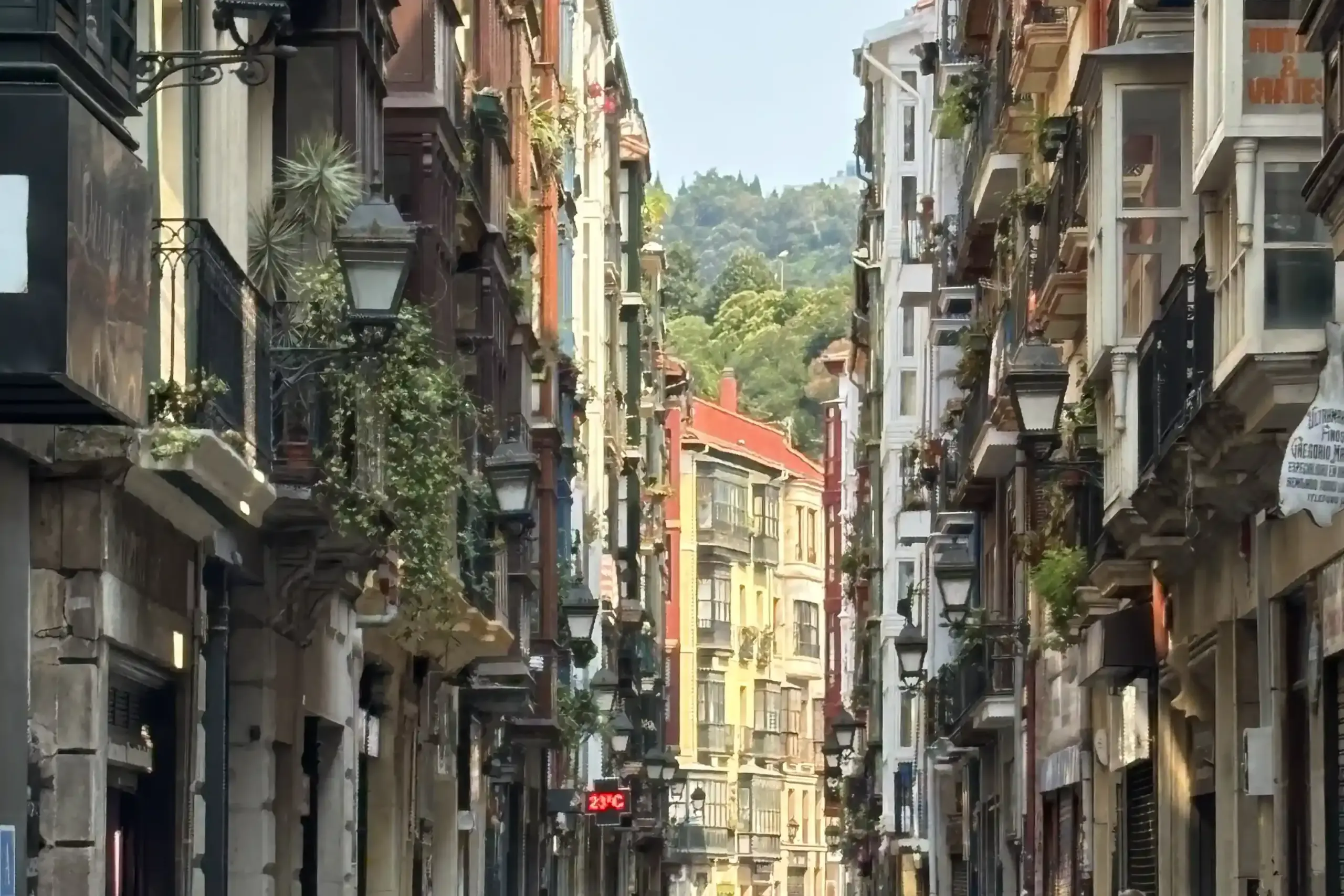
The Siete Calles
Before diving into the details, here’s an essential tip: forget the map. The true spirit of the Siete Calles can only be captured by getting lost. Let your instinct guide you among the colorful buildings with their miradores reminiscent of classic English bow windows, linger in artisan shops, follow the aroma of pintxos.
In short, don’t just visit this neighborhood — live it.
When we talk about the Siete Calles (Zazpi Kaleak), we are referring to seven medieval streets once enclosed within the city walls. They were originally laid out as three streets running parallel to the river, with four more added as the city expanded.
Their routes followed ancient transhumance paths leading to the ford of San Antón, and they were built narrow to protect against the Atlantic wind and rain. Today, as you walk along them, you tread the exact same path as people did 700 years ago.
Here are the details:
Calle Somera: “Goienkale” (in Basque, “upper street”). The wealthiest merchants lived here. It has the steepest slope because it follows the hill toward Begoña. Today it still feels elegant, with design shops and historic pharmacies.
Calle Artecalle: “Artekale” = middle street. Goldsmiths, gunsmiths, and blacksmiths once worked here. Look for the doorways with original iron grilles. It is home to artisans and historic shops — there are watchmakers’ ateliers that have been operating for more than three generations!
Calle Tendería: “Dendarikale” = street of shops. This is the commercial area par excellence. Here the “Vara de Bilbao” (a local unit of measurement, 0.836 m) was engraved into stone for official use. Today it is the most touristy street, full of souvenir shops and bars.
Calle Carnicería Vieja: “Harakindekale” = street of the butchers. This is where public butcher shops and old slaughterhouses were located (to keep blood away from the main streets). Look for the iron rings on the walls where animals were once tied.
Calle Barrenkale: “Barrenkale” = lower street. Sailors, workers, and servants lived here. This is perhaps the street that has preserved the most authenticity. Look for the inner courtyards (by stepping through open doorways), where laundry was once hung out to dry.
Calle Barrenkale Barrena: “Barrenkale Barrena” = inner lower street. The narrowest and darkest of them all and, paradoxically, it is said that the Cofradía de la Luz (Brotherhood of Light), which managed night lighting, met here. Today you will find small hidden venues and artists’ studios.
And finally, Calle Belostikale: “Elizatekale” = street of the church. It leads directly to the Catedral de Santiago. Today it is filled with bars and religious shops, but in the past it was walked by pilgrims heading to the Cathedral for a stop along their Camino de Santiago.
And, like the pilgrims, we will walk it too — to reach the Catedral de Santiago, the cathedral of Bilbao.
The streets of the Casco Antiguo are characterized by their “Casa-Puente” (bridge houses): homes that are very narrow on the street (3–5 meters wide), yet long and deep — sometimes up to 40 meters. Through portals often topped with a noble or guild coat of arms, you enter the Zaguán, an entrance hall leading to an inner courtyard.
Here, a well or fountain provided water and coolness. A solemn wooden Escalera Noble led to the upper floors, which opened onto a Galería de Madera, an internal wooden gallery that allowed family life to unfold within the block.
With a careful eye, you will also notice that the façades are adorned with so-called Rótulos (wrought-iron or ceramic signs bearing the owner’s name and trade), Miradores (enclosed balconies made of glass and wood, later iron), and Aleros (projecting wooden eaves that protected the façades from the relentless rain).
On the corner stones of these calles, especially in Artecalle, look for engraved marks such as Δ, ○, †. These were the true “signatures” of medieval stonemasons, used to calculate payments: each family had its own symbol.
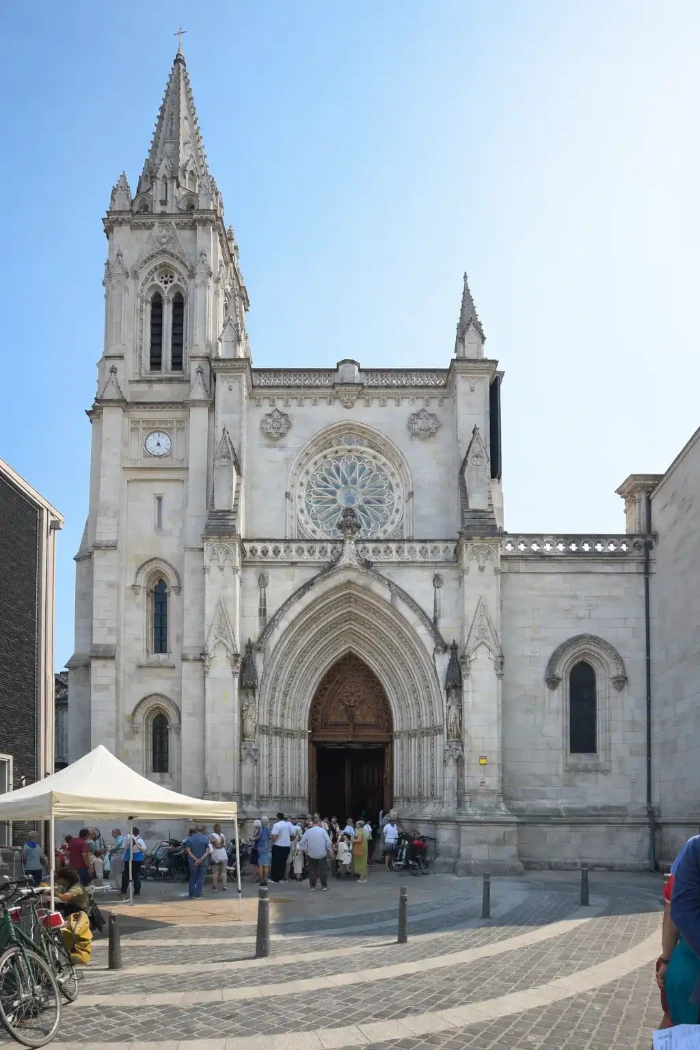
Bilbao Cathedral
Entry to the church is always free: you can walk in during opening hours without a ticket. If you wish to visit the cloister and the archaeological remains, however, a ticket is required (from €5 to €10). In that case, you have two options: purchase it directly on site at the entrance to the museum route, or buy it online through the official website. There you will also find updated opening hours, types of visits, and any available guided tours. It usually also includes the Church of San Antón. If you plan to visit both, the combined ticket is definitely the most economical option.
The Bilbao Cathedral, officially the Catedral de Santiago, is much more than the city’s oldest monument.
Before 1300, a small pre-Romanesque church dedicated to Saint James already stood here — the spiritual heart of the fishing village. With the official founding of the city, it became the focal point of the new town. Earthquakes and fires reshaped its appearance (the last major restoration dates to the 19th century), but its soul has remained unchanged.
Many visitors head straight to the main square to admire the principal façade in Isabelline Gothic style, with its portal featuring statues of the apostles and the central figure of Santiago Pilgrim, or the 1890 neo-Gothic spire rising above the Casco Viejo.
But instead of stopping at the main entrance, let’s walk toward Calle del Correo (on the left side of the church, facing the façade). Here you will find a smaller, richly decorated double portal topped with a shell. It is the “Puerta de los Peregrinos” (officially the “Puerta del Ángel,” with an announcing angel in the tympanum) — the sacred passage for those walking the coastal route of the Camino de Santiago.
Once inside, on the right, you will find the book for stamping your pilgrim credential. In addition to the official stamp, ask the volunteers for the “sello especial” — a non-official stamp that cathedral volunteers sometimes provide, featuring a special design for those who specifically request the “Puerta de los Peregrinos.”
This was no ordinary door. It was the official entrance through which pilgrims were recognized and could receive assistance. Nearby, a public fountain (now gone) once offered refreshment and a place to wash tired feet. Just a few steps away, on Calle de la Cruz, a plaque marks the former Hospital de Peregrinos, the hostel that once welcomed them.
Do not miss the Pilgrim’s Mass, celebrated every Friday at 7:00 pm (times may vary in summer): a deeply moving experience, with a special blessing that will accompany pilgrims all the way to Compostela.
Nearby, at the intersection of Santa María, Pelota, and El Perro streets, you will find the “Amatxu de Begoña.” It is a small statue placed on the wall of a building facing the former Stock Exchange, created in honor of the Virgin of Begoña, affectionately called in Euskera (Basque) Amatxu, meaning “mother.”
But the truly interesting detail is right below: on the ground, you will notice a white star with a yellowish tint marking the only exact viewpoint from which you can frame the Basilica of Begoña between the buildings of the Casco Viejo.
From that precise spot, if you look up between the medieval façades, the profile of the patron basilica of Vizcaya appears — an alignment, intentional or accidental, that fascinates every traveler.
With the Cathedral of Santiago, our journey through Bilbao’s medieval heart comes to an end. What is still missing, of course, is the adventure among the pintxos of the Old Town — but they deserve a space all of their own, which you can find in my article on where to eat in Bilbao.
Now the modern city unfolds before you, ready to reveal its many identities. Which side of Bilbao would you like to explore first?
The choice is yours:
- Abando – The Bourgeois Bilbao
Across the river lies the district shaped by 19th-century industrial growth. Wide avenues, elegant buildings, theaters, and the Museo de Bellas Artes define this area. It is the Bilbao of refined shops and Belle Époque architecture. - Abandoibarra and the Guggenheim
Follow the course of the Ría toward the Guggenheim, the futuristic bridges by Calatrava, and the new skyline. This is the emblem of rebirth, design, and modern art. Or, for a breathtaking panoramic view, take the funicular to the Mirador de Artxanda and watch the city unfold at your feet. - Bilbao La Vieja
Cross the Puente de San Antón to discover this authentic, multicultural neighborhood — a realm of street art and trendy bars.
The city is ready. Which direction would you like to take next in your adventure through Bilbao?
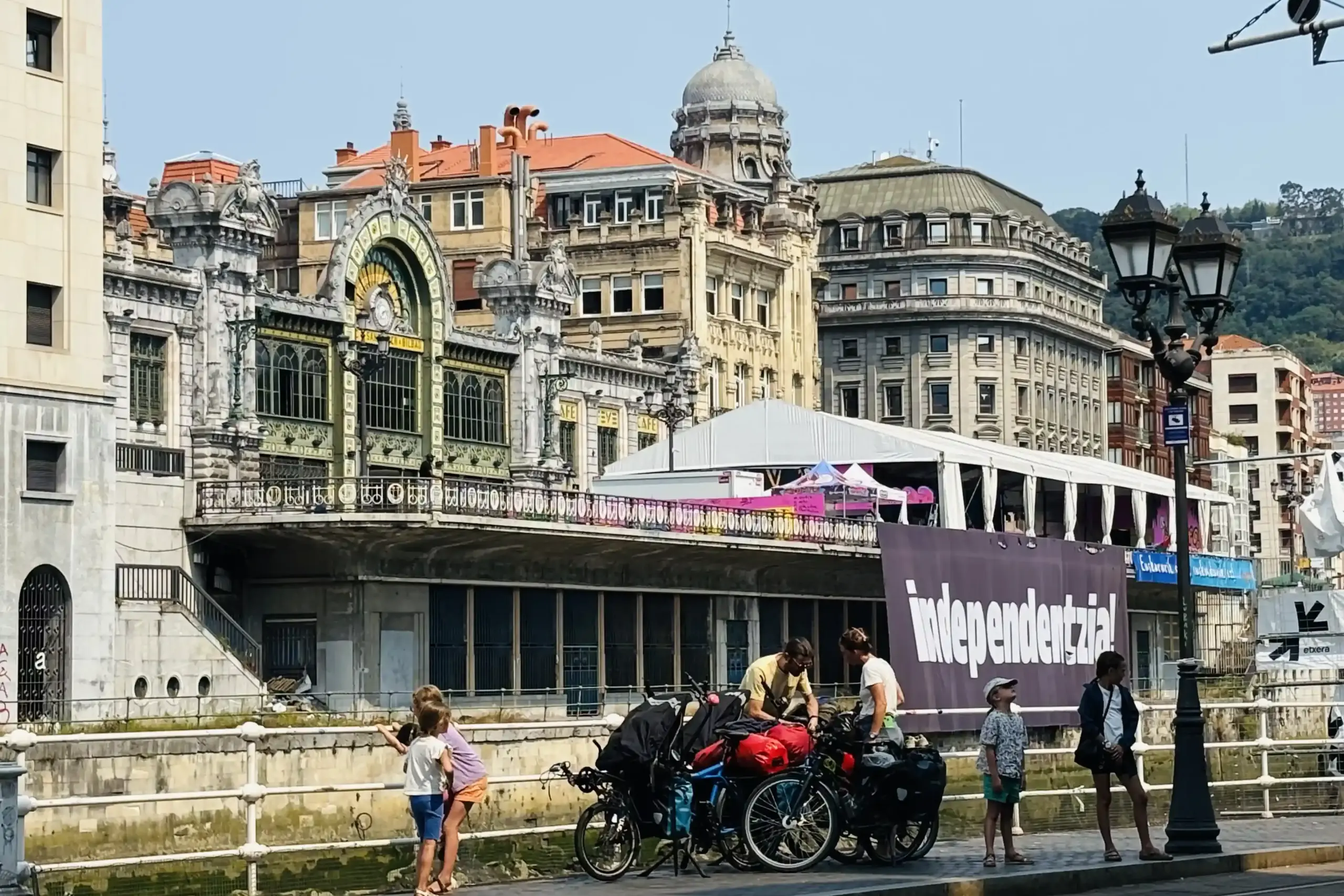
Abando – The Bourgeois Bilbao
🚶 Walking tour of Bilbao: the Abando
Crossing the Nervión River, from the Casco Viejo to Abando, is not just about walking over a bridge. It is a leap through time — from medieval Bilbao to the city that, in the 19th century, decided to become a metropolis. Because Abando was not always a neighborhood: it was once an independent rural municipality, with its fields, mills, and the famous “Pradera de Abando,” a vast meadow. Its only link to Bilbao was the Puente de San Antón. The inhabitants of Abando were reluctant to be annexed, but the outcome was inevitable.
In 1879, Bilbao — suffocating within the medieval belt of the Old Town — officially annexed Abando. Thus was born a visionary project: the Ensanche (Expansion District), designed by engineer Pablo de Alzola. An ambitious plan inspired by Barcelona and New York, creating a perfect grid of wide, orthogonal streets with the aim of building the financial and residential “city” for the new rulers of Bilbao: the “iron barons,” the industrial bourgeoisie enriched by mines and steel.
On the former fields of Abando rose the Gran Vía Don Diego López de Haro, lined with Modernist and eclectic buildings. It became the temple of the new “enlightened” bourgeoisie: bankers, industrialists, and professionals.
From the Teatro Arriaga, you can glimpse the beginning of this transformation: the “Rascacielos de Bailén” (1929). It was Spain’s first skyscraper (52 meters, 15 floors), a symbol of the new Bilbao’s race toward the sky.
Leaving behind the lively bustle of the Casco Viejo and the theater, we cross the river to enter the district.

Concordia Station
The first real stop is the old Concordia Station (now Abando), which overlooks the estuary and once welcomed travellers with the Teatro Arriaga just ahead. The station was built in an English railway style, and its iron-and-glass façade is one of the earliest examples of its kind in Spain.
But that is not what makes curious travellers like us stop here. Beneath it once stood the baraja, the old informal sardine market, whose arches can still be seen today along the estuary. There is even a famous folk song, “Desde Santurce a Bilbao”, which describes a sardineira making her way “por toda la orilla” (along the estuary), with her skirt hitched up, corset tightly fastened and basket balanced on her head, selling sardines from Santurtzi door to door.
But the truth is that I have brought you here for another reason. You do not need to rush inside to catch a train, I promise. What you need to do is enter and head towards the ticket area of the new station. Look up. Above you stretches an enormous stained-glass window celebrating Basque industries: the sea, mining and steelmaking. It is a monumental work that welcomes thousands of travellers every day, yet very few actually stop to notice it.
From the station, we continue towards Gran Vía for a pleasant walk to Plaza Moyúa, surrounded by elegant buildings and centred around a fountain.
From there, we enter Parque Doña Casilda Iturrizar, the city’s great park, perfect for a relaxing break.
This large park, donated to the city by the philanthropic heiress Doña Casilda Iturrizar, is an oasis of peace and order. With its ponds, geometric flowerbeds, shaded paths and gentle hum of insects, it is the perfect place for a restorative break after immersing yourself in history. Sit on a bench, take a breath and get ready for the next stop: one of the most important art museums in Spain, waiting for you right on the edge of the park.
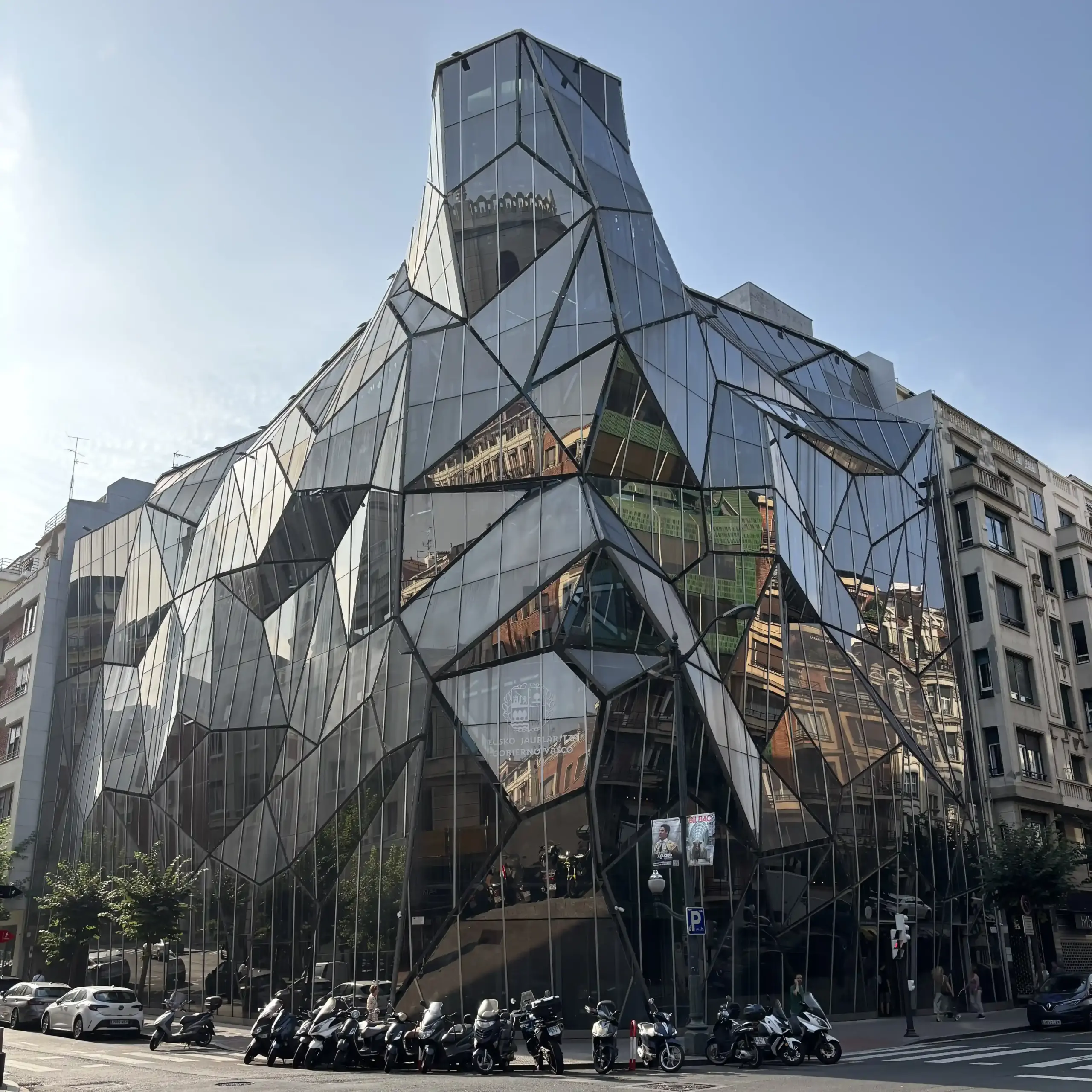
If you are interested in contemporary architecture, wander through the streets branching off the Gran Vía. You will find many examples of modern and contemporary design, such as the Eusko Jaurlaritza – Basque Government Headquarters and the Azkuna Zentroa.
To reach them, you will pass through an elegant residential area with English-style buildings, private gardens, and charming little boutiques. It is truly delightful.
In this area, and more generally throughout Abando, you’ll find stylish restaurants that are less touristy than those in the Old Town and have a more trendy atmosphere. The food is excellent, and you’ll also find the famous Pastelería Martina de Zuricalday. This one is my favourite, but let’s be clear: in Bilbao, you’re certainly not short of great pastry shops to choose from. Take a look here!
The Azkuna Zentroa perfectly sums up the Bilbao of today. Built in 1909 as a wine warehouse (La Alhóndiga), it went through decades of abandonment before being reborn in 2010 under the creative vision of Philippe Starck.
Its heart is the Atrium of Cultures, an extraordinary space supported by 43 columns, each one different — a true architectural statement about the beauty of diversity and the dialogue between eras.
Today, it is not just a monument but a cultural district under one roof: it hosts exhibitions, cinemas, a library, a gym, events, and even a spectacular glass-bottom suspended swimming pool. It symbolizes a city that has transformed its history into a vibrant, open space for everyone — and it is a perfect destination on a rainy day.
Museo de Bellas Artes
Tickets can be purchased on the official website. Special situation (updated July 2026): admission is currently free for everyone due to the ongoing expansion works. However, only a reduced selection of the collection can be visited. Following the construction plan, all activities open to the public have been moved to the 1970 building, the one overlooking Plaza Chillida, with entrance from Alameda del Conde Arteche. Closed on Mondays, except during July and August. The full reopening of the renovated museum is scheduled for 5 October 2026. From then on, if the previous policy is maintained, admission will be free every Wednesday (be prepared for considerable queues). The full museum is huge. Allow at least 2 hours for an essential visit. For a more satisfying experience, plan for 3–4 hours. Buy the audio guide for around €3: it is worth every cent! It does not simply describe the paintings, but also provides historical and critical context, turning the visit into a crash course in art history.
As you leave the soothing greenery of the Parque de Doña Casilda, you will find yourself facing one of Bilbao’s greatest treasures. Do not be misled by its quieter reputation compared to the Guggenheim: the Museo de Bellas Artes is one of the most important art galleries in Spain, with a collection ranging from the Middle Ages to contemporary art.
The museum displays works by El Greco, Goya, Zurbarán, Van Dyck, Gauguin, and Francis Bacon, as well as Luis de Morales (“El Divino”), José de Ribera, and modern masters such as Juan Gris and María Blanchard, making the collection truly extraordinary (around 7,000 pieces, among the finest in Spain).
The museum itself also contains a work of art: when it fully reopens, look for the small “Sala de Arte Decorativo.” It is a true cabinet of curiosities, featuring 18th-century clocks, ivories, and exquisitely crafted jewelry. Few visitors enter, but it is a genuine hidden treasure.
As it was closed during my last visit, I can’t give you much first-hand information, but I found a guided tour on Civitatis that might be useful.
Abandoibarra and the Guggenheim
The Guggenheim
For tickets, the best solution is to purchase them online through the museum’s official website. This allows you to avoid queues, which can be quite long on weekends and during the spring–summer months. Alternatively, you can buy them on site, but waits are common during the middle of the day. The standard ticket price is around €15. The ticket includes both the permanent collection and the temporary exhibitions on display at the time of your visit. On special occasions (anniversaries or major events), the museum may open for free or with extended hours, but these are exceptions and are always announced on the official website. At the moment, there is no city card that includes the Guggenheim Museum Bilbao in a truly cost-effective way. Sometimes combined tickets with other museums, such as the Museo de Bellas Artes, are offered, but they are not always available. In most cases, the single ticket remains the simplest option. The museum is closed on Mondays, except in summer and on certain holidays, and it is also closed on December 25 and January 1. Before visiting, a quick check on the website is always a good idea. The Guggenheim Museum Bilbao is a visit worth planning in advance, especially if you have limited time in the city or are traveling in high season. Allow at least 1.5 hours, but if you want to explore it properly and include temporary exhibitions, 2–3 hours is ideal. Even if you decide not to go inside, the exterior is always freely accessible and absolutely worth seeing.
To understand the Guggenheim, you must remember what Bilbao was like before 1997: a gray city of smokestacks and rust, a biologically dead and toxic Ría, unemployment at 25%, nationalism that had turned into terrorism — in short, a symbol of decline.
The response of local politicians was a bold gamble: instead of saving dying industries, they invested in a global cultural icon. They contacted the Guggenheim Foundation in New York and chose the most visionary architect of the time: Frank Gehry (the same architect behind the Walt Disney Concert Hall in Los Angeles and the Dancing House in Prague). On October 18, 1997, they inaugurated not only an extraordinary museum, but also what urban planners now call the “Bilbao Effect” — the ability of an architectural masterpiece to regenerate an entire city.
Beyond all this, the Guggenheim represented something even deeper: proof that, despite everything and in spite of its past, the city could truly reinvent itself. And that is why the people of Bilbao love it so deeply.
The Exterior
Before talking about what is inside the museum, we must pause outside and look at some numbers — astonishing in themselves:
- 24,000 m² of surface area.
- 33,000 titanium panels (0.3 mm thick), which change color with the light.
- 11,000 m² of Spanish limestone.
- 2,500 curved glass panels, each one unique.
- Cost: 100 million dollars at the time (around 180 million today).
Many interpretations exist about the museum’s unusual shape. For some, it resembles a merchant ship or a fishing vessel facing the Ría, a clear tribute to the city’s port heritage. For others, it looks like a flower: the titanium scales appear like petals catching the light (perhaps a subtle reference to the carnation, a Basque symbol?). Seen from above, the most evocative interpretation is that of a blooming rose, with volumes opening like a corolla.
Frank Gehry, the genius behind its design, has never settled the debate with a single explanation. Perhaps he did it on purpose — to add even more fascination to his creation.
As soon as you arrive, you are welcomed by two very different guardians, now part of the city’s family.
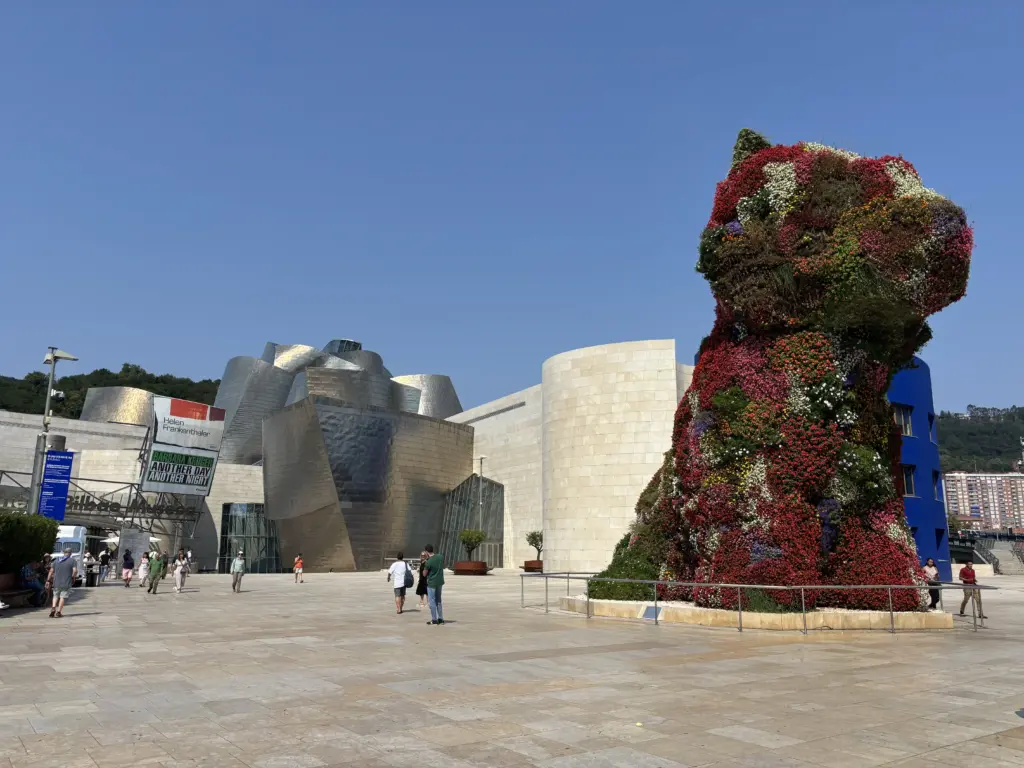
The first is “Puppy” by Jeff Koons, the giant floral dog facing toward the city. It is a 12-meter-high West Highland Terrier (about the height of a four-story building), covered with 70,000 plants — begonias, lobelias, pansies, and more. Originally meant to be temporary in 1997, the people of Bilbao adored it so much that it became permanent.
It even has its own wardrobe: in winter it is fitted with a kind of thermal “sweater,” and it is replanted twice a year (in May and October) using special scaffolding.
On the other side, overlooking the river, stands “Maman” by Louise Bourgeois. A nine-meter-tall spider made of bronze, marble, and steel, carrying a sac of marble eggs beneath its abdomen — a symbol of creativity and protection. It may seem intimidating, but in reality it is a tribute to all mothers (the artist’s mother was a weaver — hence the spider), protective and hardworking. For Bilbao, it has become the Mother watching over the reborn city.
At night, the museum comes alive: the eight “Fuentes de Luz” by Yves Klein intermittently shoot flames and vapor into the darkness, creating a hypnotic spectacle.
During the day, another artwork transforms the building. The 1,300 nozzles of Fujiko Nakaya’s installation, “Looking toward the sky,” generate artificial fog that envelops the museum, making it appear like a ghost emerging from the water. Pure magic.
Also on the river side, you will notice another major outdoor artwork that dialogues with the museum and has, over time, become inseparable from it: “Arcos Rojos” by Daniel Buren, the great red arch embracing the Puente de La Salve. Technically, it is not part of the Guggenheim collection, but today it is impossible to imagine the museum without it.
You may have read in other guides or blogs about additional outdoor artworks. The information is likely correct, but there is one important detail to keep in mind: many installations are temporary and are moved or replaced to make room for new artistic expressions.
For this reason, when you arrive at the Guggenheim Museum Bilbao, the view you encounter may be different from that of anyone who saw it before you. And that is part of its magic: a museum that changes, breathes, and continually renews itself — just like the city that surrounds it.
The Interior
Crossing the threshold of the Guggenheim is a dramatic moment. You expect to enter a museum, and instead you find yourself in a 55-meter-high vertical plaza, crossed by staircases that seem to float and bridges suspended in midair. Light pours in from every direction. It is a masterpiece of architectural genius.
This atrium is the crossroads from which the three souls of the museum unfold.
- The Classical Galleries (South Wing):
Here, architecture steps back. These are rectangular, traditional rooms designed to give space to more “conventional” paintings and sculptures, without distractions. - The Arata Isozaki Gallery (East Wing):
It resembles a stone ship stretching 130 meters in length. A monumental space, ideal for installations that need breadth, length, and a sense of horizon. - The Whale Gallery (West Wing):
This is where the museum truly explodes. An enormous, curvilinear space, 24 meters high and without a single pillar. It is the belly of the whale, designed to swallow and host the most colossal works — those that would not fit anywhere else in the world.
Don’t miss these experiences, if they are on display:
- “The Matter of Time” by Richard Serra:
- If it is on display, be ready. These are not sculptures to look at, but vast labyrinths of weathered steel that you walk through. You feel lost, compressed — and then suddenly free again. It is a physical and emotional experience unlike any other in the world.
- “Installation for Bilbao” by Jenny Holzer:
- Words that become water and light. Aphorisms and poems projected onto a cascade or across the walls. It is poetry in motion — flowing, enveloping, immersing you.
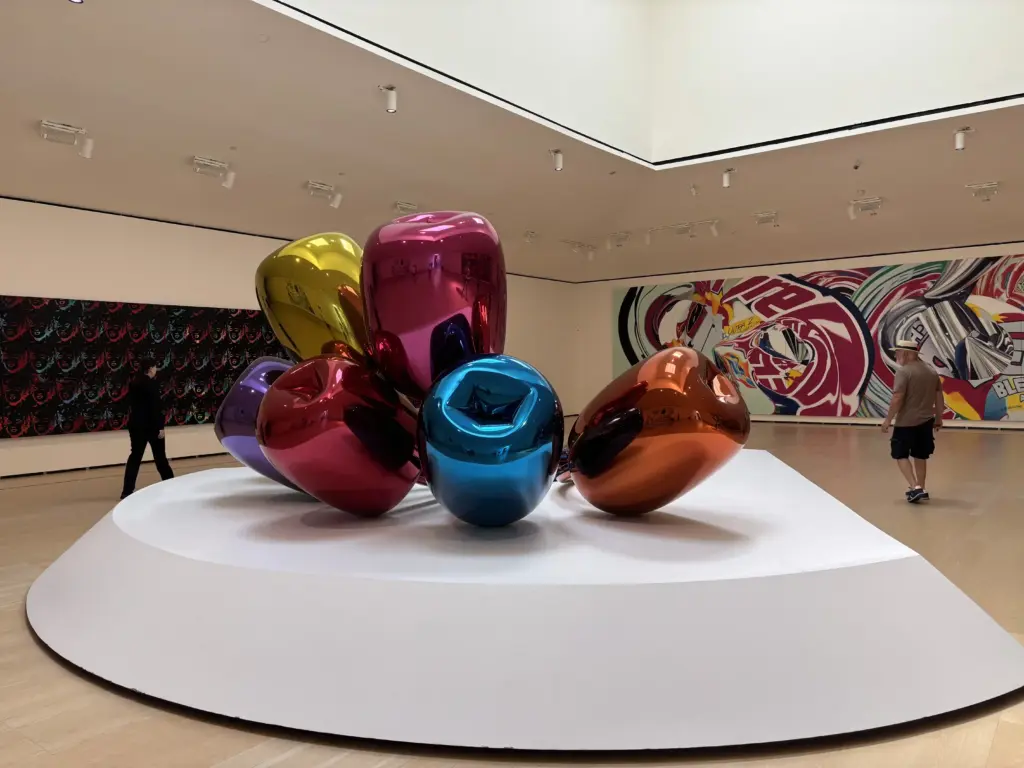
- The Masters: the permanent collection offers a powerful journey through the 20th century: Kandinsky, Picasso, Modigliani, Warhol, and the joyful, vibrantly colored “Tulips” by Jeff Koons.
Here is the trick: outside, the form amazes you; inside, it changes your perspective. Literally.
Many people ask me whether the Guggenheim Museum Bilbao is truly worth it.
In my opinion, absolutely yes — but not only because of the artworks it contains. To truly appreciate it, you need to look at it through a different lens. This museum is not just a container of modern art. It is the monument to Bilbao’s rebirth, the symbol of the moment when a city at the end of its road bet on beauty to rise again. Stepping inside means walking through that miracle. If you visit it with this awareness, every curve of titanium and every installation will tell a story that goes beyond aesthetics.
My advice is to visit it with a guide, because the experience changes completely. I’ll say it straight away: they are not exactly cheap, but I, for example, found a discounted tour on Civitatis, which helped me enormously to understand the meaning of the museum and its works — some of which I have already told you about above. Of course, there are all kinds of guided tours on GetYourGuide too, if you want to compare prices.
A little-known detail concerns the cladding of the Guggenheim Museum Bilbao.
No one initially knew how to properly clean the 33,000 titanium panels. Various methods were tested, but the solution came from the city itself: the famous Bilbao rain.
The Atlantic rainwater, with its slight natural acidity, turns out to be perfect. It flows over the surface, carrying away dirt and leaving the titanium sheets shining. In practice, the building cleans itself. It is almost poetic: the same rain that shaped life here for centuries now preserves the symbol of the city’s rebirth.
There is, however, another equally curious effect. Over time, that rain has changed the museum’s color. At the beginning, the titanium had a more warm, golden tone; today it appears as a cool, bright silver. Experts speak of the natural oxidation of titanium, accelerated by atmospheric agents. Some also suspect that past air pollution may have played a role — an ironic reminder of what Bilbao once was, and what it had to overcome to become what it is today.
That said, a practical note. The Guggenheim is large, and the visit can be demanding. It is normal to leave feeling a little tired, especially if you include the temporary exhibitions. My advice is simple: before continuing your tour of Bilbao, stop in the nearby Abandoibarra Park and take a break.
Sitting on the grass or on a bench, with your gaze following the Ría, you will see the University of Deusto and, just beyond it, the Librería Campus Deusto, particularly atmospheric in the evening when illuminated. It is one of those simple moments that helps you piece the whole city together — and truly understand Bilbao.
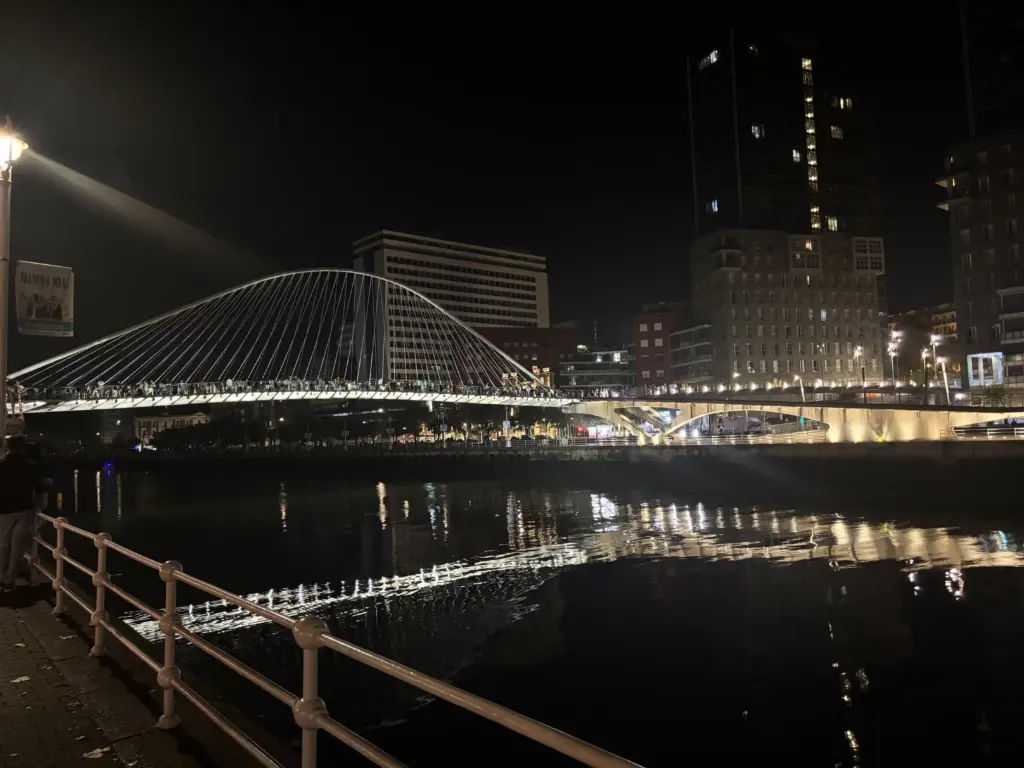
Once you have regained your energy, head back toward the river and cross the Zubizuri Bridge by Calatrava, one of the symbols of contemporary Bilbao.
From there, take Calle Múgica y Butrón to reach the Funicular de Artxanda.
Funicular de Artxanda
To reach it comfortably, you can take the metro, getting off at the Begoña stop and following the signs to the funicular, or the bus, using lines 18, 28, or 58.
Operating hours are generally from 7:15 am to 10:00 pm, with extended evening service during the summer months. Cabins depart every 15 minutes, so there is no need for strict planning — you arrive and, at most, wait just a few minutes.
The ticket costs €4.10 round trip, with a useful detail to keep in mind: you only pay for the ascent. The return trip is free if taken within a certain time frame, usually around two hours. You can easily pay by credit card at the automatic machines.
If you use the Barik card (Bilbao’s public transport card), the cost is significantly lower than the standard single ticket. The fare is deducted directly from the card when you tap it on the reader.
In terms of timing, allow at least one hour for the ride up, panoramic photos, and the return trip. If you prefer to stroll, sit down for something to eat, or simply enjoy the view without rushing, plan for 2–3 hours.
Regarding accessibility, the funicular is fully equipped: the cabins have space for wheelchairs, and the experience is suitable for visitors with reduced mobility.
At the beginning of the 20th century, Bilbao grew at an astonishing pace. Industry brought wealth to the city, but it also made it noisy, crowded and smoky. The industrial bourgeoisie therefore began looking for clean air, peace and green spaces just outside the centre. Mount Artxanda, overlooking the city and constantly refreshed by the breeze, became the ideal destination — at the time it already had bars, restaurants and even a casino. There was just one practical question left: how to get there?
In 1915, the first funicular was inaugurated, a true revolution for its time. It was built by the Swiss company Von Roll, specialised in mountain railways — the same company that also built the Tibidabo funicular in Barcelona — and the Bilbao project was directly inspired by the Igeldo funicular in San Sebastián, inaugurated three years earlier. On opening day, 7 October 1915, more than 2,800 tickets were sold: an extraordinary success for the time. I read on the official website that, in its early years, it was steam-powered, and that it only switched to an electric system much later, with its modern revival in 1983. During the Civil War it was bombed — and on that occasion the historic casino at the top of the mountain was also destroyed, never to be rebuilt — but the funicular was back in service the following year. It was instead a technical accident in 1976, during the replacement of the traction cable, that brought it to a halt for seven long years: only in 1983 was it reborn, completely renovated and electrified, as we know it today.
The journey is very short but spectacular: 770 metres long with a vertical rise of 226 metres, and a maximum gradient of 45%. Two red carriages, each carrying around 70 passengers, operate as counterweights. The lower station is located in Plaza del Funicular, on Calle Castaños, not far from Calatrava’s Zubizuri bridge. The building is modern, made of glass and steel, but it preserves the memory of its past: a plaque and several historic photographs recall the old carriages.
A practical tip: try to get a seat in the front row, right by the large window. It is absolutely worth it.
During the first 30 seconds, the view opens up over the Deusto district and its university. Halfway up, the Casco Viejo appears compact and easily recognisable: you will be able to spot the tower of Santiago Cathedral and the Mercado de la Ribera. In the final seconds, the estuary reveals itself almost in its entirety, from Deusto to the Guggenheim, with the modern Abandoibarra district on the right.
Once at the top, you will find yourself facing Bilbao’s most famous panorama. From the main viewpoint, the entire city lies below you. Following the estuary inland from the sea, you will recognise San Mamés stadium, the tall buildings of Abando, the Museo de Bellas Artes and Parque de Doña Casilda, the Guggenheim, the Casco Viejo, the Teatro Arriaga and, once again, the Mercado de la Ribera.
The best time to go up is about an hour before sunset. The light turns golden, the monuments begin to light up and you will still have time to explore the park at the top, with its trenches and artworks. Staying until dark will reward you with a Bilbao transformed into a carpet of lights. In winter, if you are lucky, the landscape changes completely: snow is not uncommon here, and this is one of the few corners of Bilbao where you can see it with some regularity.
A sincere warning: if the weather is bad, do not go up. With low clouds or fog, all you will see is a white expanse. This is no exaggeration: I know from personal experience — I could barely see anything.
The name Artxanda has uncertain origins — as often happens with the oldest Basque place names, its etymology is still debated among scholars. I was told that it might derive from the Basque arte handia (“great oak”) or from harri gainda (“above the stone”), but I have not found either of these expressions confirmed by official sources. I did, however, find an academic hypothesis linking the suffix -anda to the root arte (holm oak, an evergreen oak typical of the Basque Country) — so the “oak” theory has at least some basis in Basque toponymic studies, although it remains just one hypothesis among many, not a certainty. The oak, after all, has long been an almost sacred tree in Basque culture.
In its early years, the funicular was known as the “funicular of the rich”: this is how it was described to me, although I have not found the expression documented anywhere — it is nevertheless plausible, given that Bilbao’s industrial bourgeoisie were among its earliest and most regular users. From this also comes a popular anecdote, handed down orally and never found by me in written sources: it is said that, in the early 20th century, the funicular was the setting for clandestine encounters between people from different social classes — the rich went down, the poor went up, and they crossed paths halfway up the hillside. A forbidden love… with a view.
Bilbao La Vieja: the realm of unfiltered street art
To truly understand Bilbao, you have to cross the river. Literally.
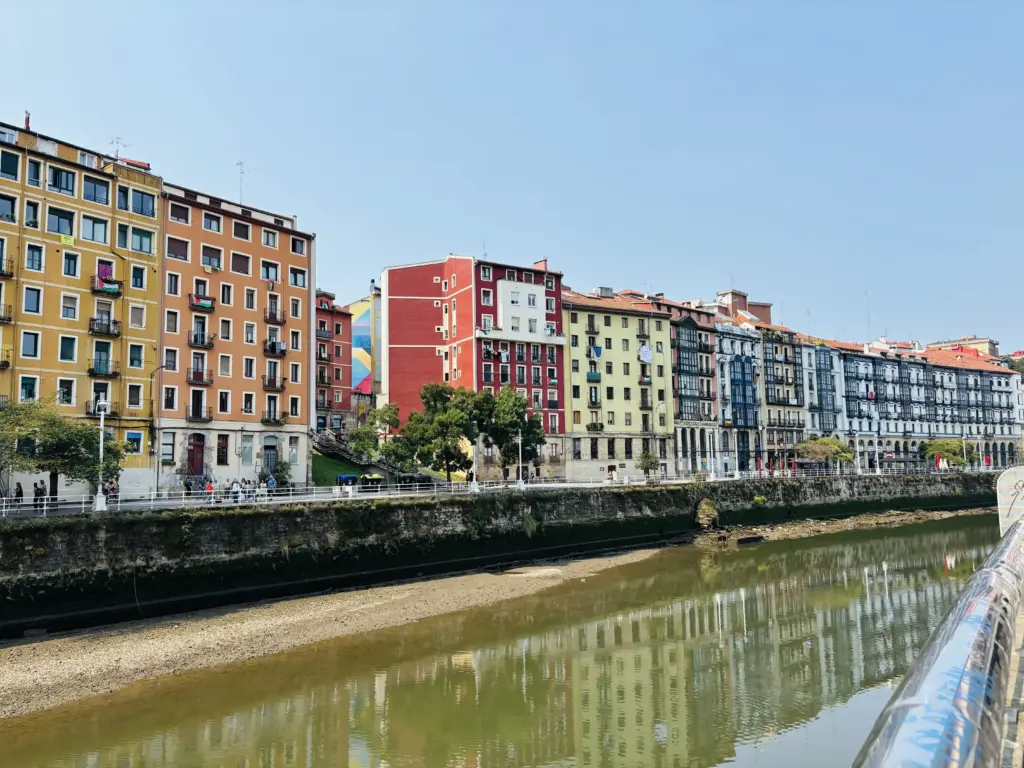
After exploring the polished Casco Viejo, walking across the Puente de San Antón takes you into a different world: Bilbao La Vieja. This is the oldest neighborhood outside the medieval walls — the other side of the city’s historical coin.
While the San Antón side was the mercantile heart, here on the opposite bank of the Ría lived the working city. It was the domain of dockworkers, artisans, and immigrant laborers who kept Bilbao’s machines running. A poor, noisy, crowded district — yet vibrant.
Time has transformed it, but not erased its spirit. Today, Bilbao La Vieja is one of the most multicultural and authentic neighborhoods in the city. Languages intersect, aromas from different cuisines fill the air, and lifestyles blend together. It is not a polished postcard, but a living place — sometimes with its tensions, but always genuine. This is the Bilbao that works, that reinvents itself from below, that is not afraid to show its wrinkles.
If you are looking for street art, this is where you will find the real thing. Forget commissioned and “pretty” murals. In Bilbao La Vieja, urban art is direct social commentary: intense portraits that stare back at you, political messages, bitter irony, and street poetry.
The most interesting areas — without drawing a rigid map (which would not make sense here) — are Calle San Francisco, Olano, Cortes, and Santiago Aznar Kalea. But the real advice is simple: get lost. Let the alleys, painted façades, and atmosphere guide you.
To discover specific works, as always I rely on the collaborative platform StreetArtCities, where street art enthusiasts from all over the world (and you too, if you like) geolocate murals. But if you want to learn more, I found this guided tour with excellent reviews!
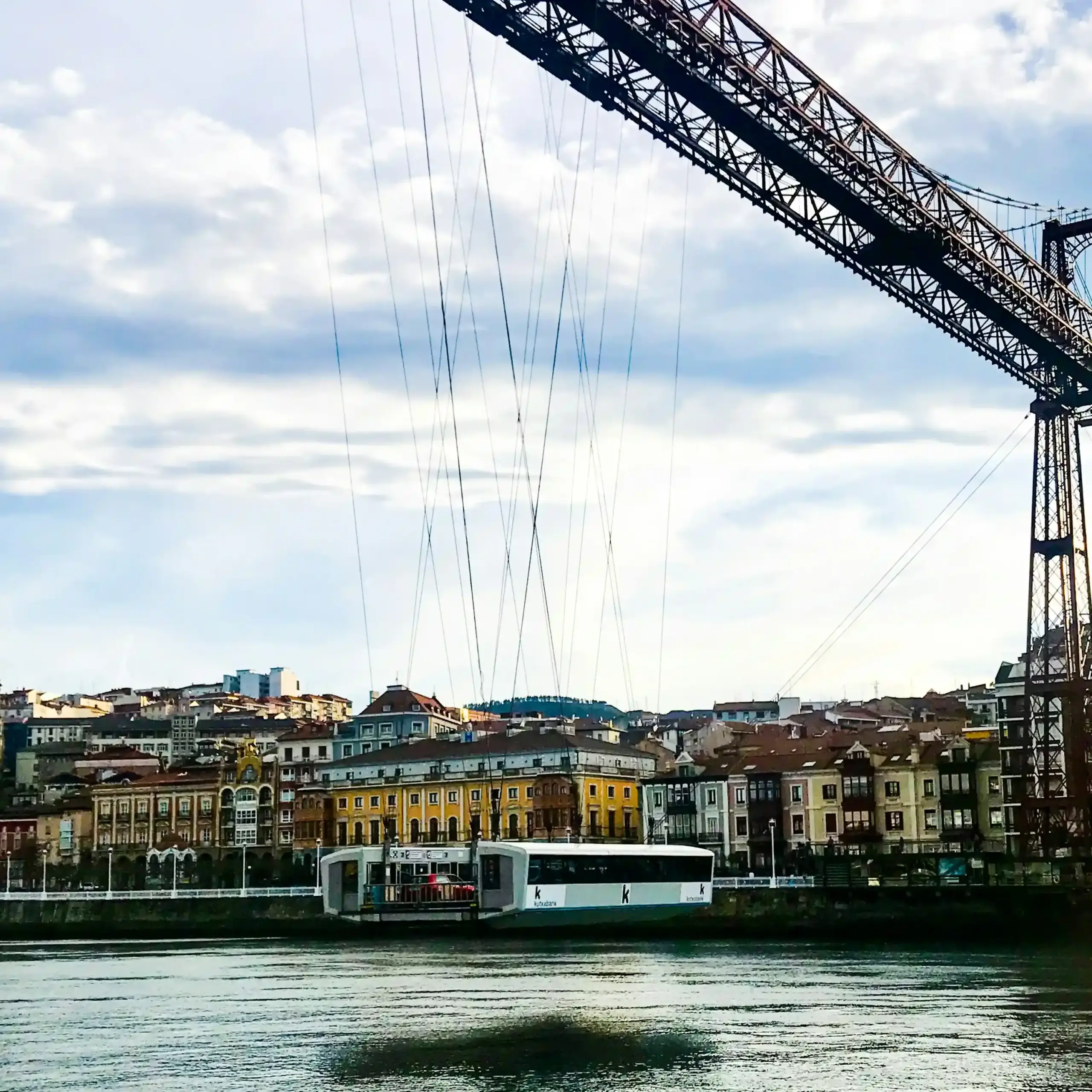
A final glance: a walk along the Ría and the Vizcaya Bridge
Before saying goodbye to Bilbao, treat yourself to one last, slow walk along both banks of the Ría. It is the perfect summary of the journey.
On one side, the medieval past of the Casco Viejo, the Ayuntamiento, the University, and the stately buildings. On the other, the popular and industrious soul of Bilbao La Vieja, the Guggenheim, and the modern districts. Seeing the city from this perspective — with the river uniting what once divided — is the best way to feel its true heartbeat.
If you feel like venturing a little farther, you will find another iconic attraction: the Vizcaya Transporter Bridge (Puente Bizkaia), the 1893 suspended transporter bridge declared a UNESCO World Heritage Site. This iron giant connects the two banks of the Ría del Nervión and is a fascinating feat of engineering. Step onto the suspended gondola: the view over the Cantabrian Sea and the river’s mouth is the perfect beginning — or ending — to your adventure.
We made the mistake of trying to cross it on foot in bad weather. Unfortunately, the panoramic walkway (50 meters high) is open only in good conditions (wind below 50 km/h and light rain), and that day the weather was truly unfavorable, so we had to give up. I was told, however, that the vehicle gondola operates regardless of weather, so you should not have problems if you choose to cross “by driving.” Still, from experience: check the forecast — it’s better!
The walk to get there is a little long (around 10 km), but you can easily use public transport instead (for example, take Bilbao Metro – Line 2 towards Kabiezes and get off at Portugalete). Alternatively, if the weather is good, the best way to reach the area is to combine cycling and walking. Use the bidegorri (the Basque cycle paths, which are very well signposted) to ride as far as the edge of the city, then continue on foot for around 4 km. Download the Bilbaobizi app: it is also a great service for getting around Abando and Parque Doña Casilda Iturrizar. Take a look at the If only I had known before section to see how it works.
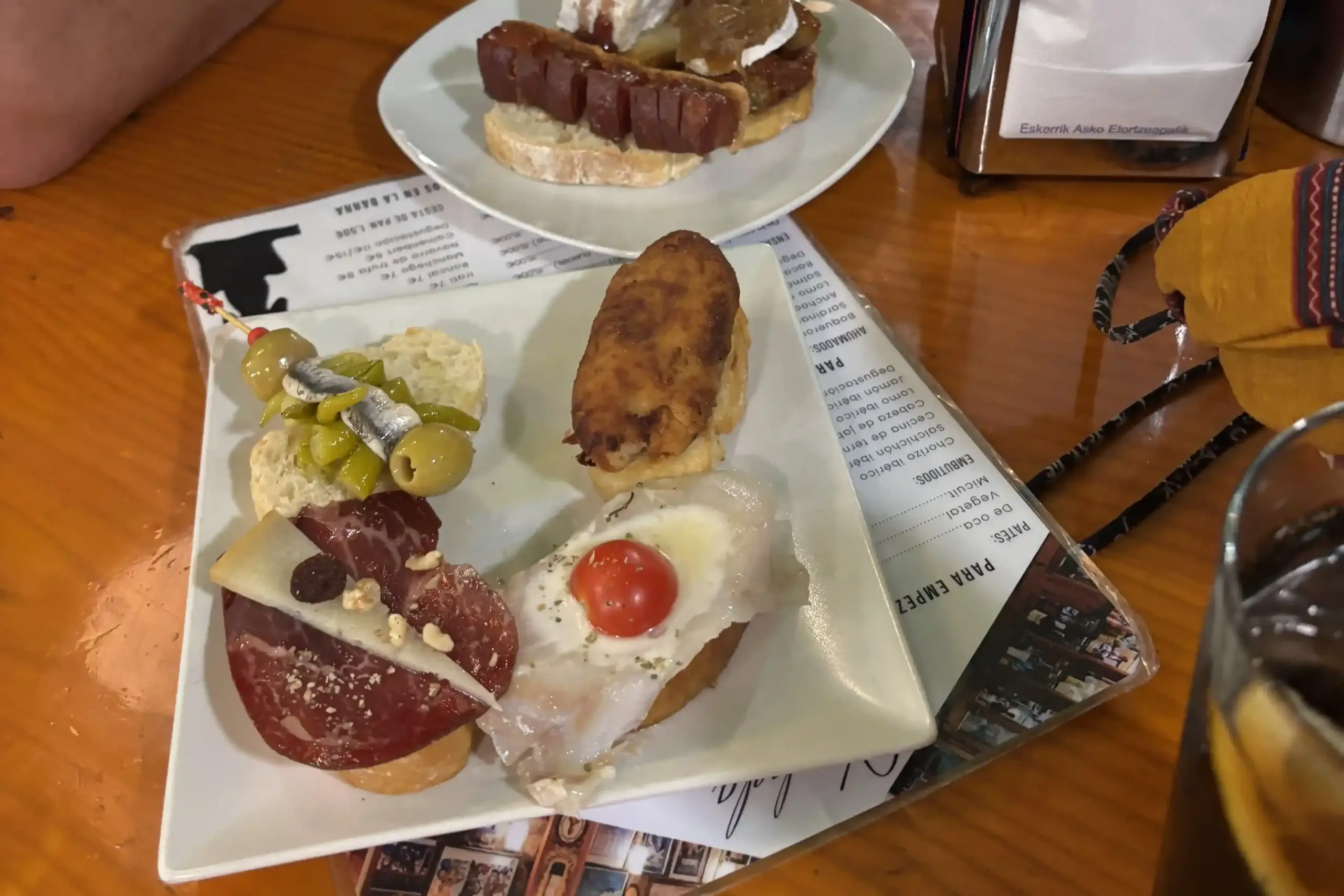
Where to savor the true taste of Bilbao
Well… now we’re finally talking about flavor. In Bilbao, you don’t just eat — you fall in love with food. Lunch or dinner are not ordinary, boring meals. Here, you go for txikiteo (pronounced chee-kee-TEH-oh): a gastronomic pilgrimage from bar to bar, where each stop means a different pintxo and a small beer (zurito) or a glass of wine.
Pintxos are not simple tapas. They are small works of culinary art, balanced on slices of bread and skewered with a toothpick (hence the name pincho), or served in small dishes — where tradition (like tortilla de bacalao or creamy croquetas) meets innovation. The best advice? Start around 1:00 pm or 8:30 pm and simply follow the crowd.
Here are four unmissable bars for tasting the city, one bite at a time.
In the Casco Viejo, without a doubt:
- Café Bar Bilbao (Plaza Nueva, 6)
- Here, tradition feels at home. Authentic atmosphere, a counter overflowing with pintxos, and perfectly executed classics. You absolutely must try their quintessential Bilbao pintxo: the “Gilda” (olive, anchovy, and pickled chili pepper — considered the very first pintxo in history), and the plate of champiñones rellenos (stuffed mushrooms), best paired with a chilled glass of Txakoli, the light, slightly acidic white wine of the Basque Country.
- Victor Montes (Plaza Nueva, 8)
- Located just opposite the previous bar, yet offering a different experience. A historic and refined venue, with a wooden counter and shelves lined with antique bottles. Here, pintxos are more elaborate. Ask for the foie a la plancha (grilled foie gras) or the shrimp pintxos. Perfect for an elegant aperitif. Sit in the restaurant section if you want a full dinner featuring exceptionally fresh seafood.
In Abando, don’t miss:
- El Globo (Calle Diputación, 8)
- Just a few steps from the Gran Vía, this is a modern temple of the pintxo. The counter is a triumph of creativity and color. Explore their innovative creations, often featuring raw fish, bold sauces, and contemporary presentations. Try their cod pintxo in any variation — and anything topped with Idiazábal cream (the smoked Basque cheese).
- Ledesma N°5 (Calle Ledesma)
- The specialty of Ledesma N°5 is not a single dish, but a concept: high-quality ingredients transformed into modern, shareable plates, perfectly suited to the venue’s informal atmosphere. Discover their creative proposals — again, often with raw fish, daring sauces, and stylish presentations. Try the croquettes, the “must” fried calamari, their cod pintxos in any version, and even their burgers. I haven’t personally tasted them, but they say they’re among the best in the city.
Whatever bar you choose and whichever pintxo you taste, I highly recommend embracing the ritual: walk in, order a drink, grab a plate, and help yourself to the cold pintxos from the counter — or order the hot ones directly from the waiter. Keep the toothpicks, as the staff will use them to count how many you’ve had when it’s time to pay.
And if you still haven’t had enough, read “Flavour of Bilbao: where to eat in Bilbao, between Txikiteo and the flavors of one of the capitals of the Basque Country.” There, you’ll discover even more true cathedrals of taste.
Travelling through the Basque Country means accepting one simple truth: the weather here is part of the adventure. Sunshine, wind and rain can alternate within just a few hours, so your suitcase needs to be ready for anything.
The best strategy is to dress in layers. Always carry a sweatshirt to wear over your T-shirt. I bought this waterproof and windproof jacket, and it was one of the most useful things I packed. Even in summer, the Atlantic wind can feel surprisingly sharp, so a lightweight scarf or a neck warmer never goes amiss.
Choose practical footwear. When leaving Bilbao to explore the coast, you will need comfortable walking boots for the coastal trails, as well as a pair of water shoes for the rockier beaches. Pack your swimming costume and a lightweight beach towel too. I bought this one so that I could always carry it with me when visiting seaside cities. The Atlantic may be cold, but the temptation to take a brave dip or walk with your feet in the water is always there.
Do not be deceived by the cool breeze: the sun can still burn your skin. A hat and high-protection sunscreen are essential. I always carry this sunscreen with me: it is small but very effective.
I almost forgot: pack a wind-resistant umbrella. I had a Samsonite umbrella with me, which survived two full days of rain, but a woman from Bilbao recommended one by Lendoo. She had it with her, and it looked very sturdy. You can find a similar umbrella with the same features here.
Complete your packing with a little useful technology: offline maps and a reliable weather app that you check regularly can make a real difference. As always, I also packed my power bank. It may seem like a minor detail, but it makes long days much easier, especially when you are using your phone’s navigation system to find your way and want to photograph all the most beautiful corners and moments of the trip. I was given this one and I am very happy with it. There are countless different models, but whichever one you choose, I strongly recommend taking one with you.
With these items in your suitcase, you will be ready to enjoy the Basque Country without too much stress, adapting easily to the changing weather and the rhythm of this distinctive region.
Arriving in Bilbao at the height of Aste Nagusia and suddenly finding ourselves inside a celebration we had never planned was the best confirmation I could have received: Bilbao is bigger than its Guggenheim. It is a strong city, where every stone tells a story of resilience.
I discovered a city that faced deep decline and rose again — not by denying its past, but by transforming it into energy for the future. It is a lesson in how openness to the new, authenticity, identity, and community can rewrite the destiny of a place.
And now it’s your turn! Discover which of its many souls speaks to you the most — and tell me in the comments!
I can’t wait to get lost in this city again with you — or, if you’re curious, to guide you through its surroundings as well. Because within just one hour from Bilbao, you can discover so much more about San Juan de Gaztelugatxe, San Sebastián and the Basque Country — a land with a truly unique heart.