Cádiz: a city of distant riches, of light, of sea and of wind
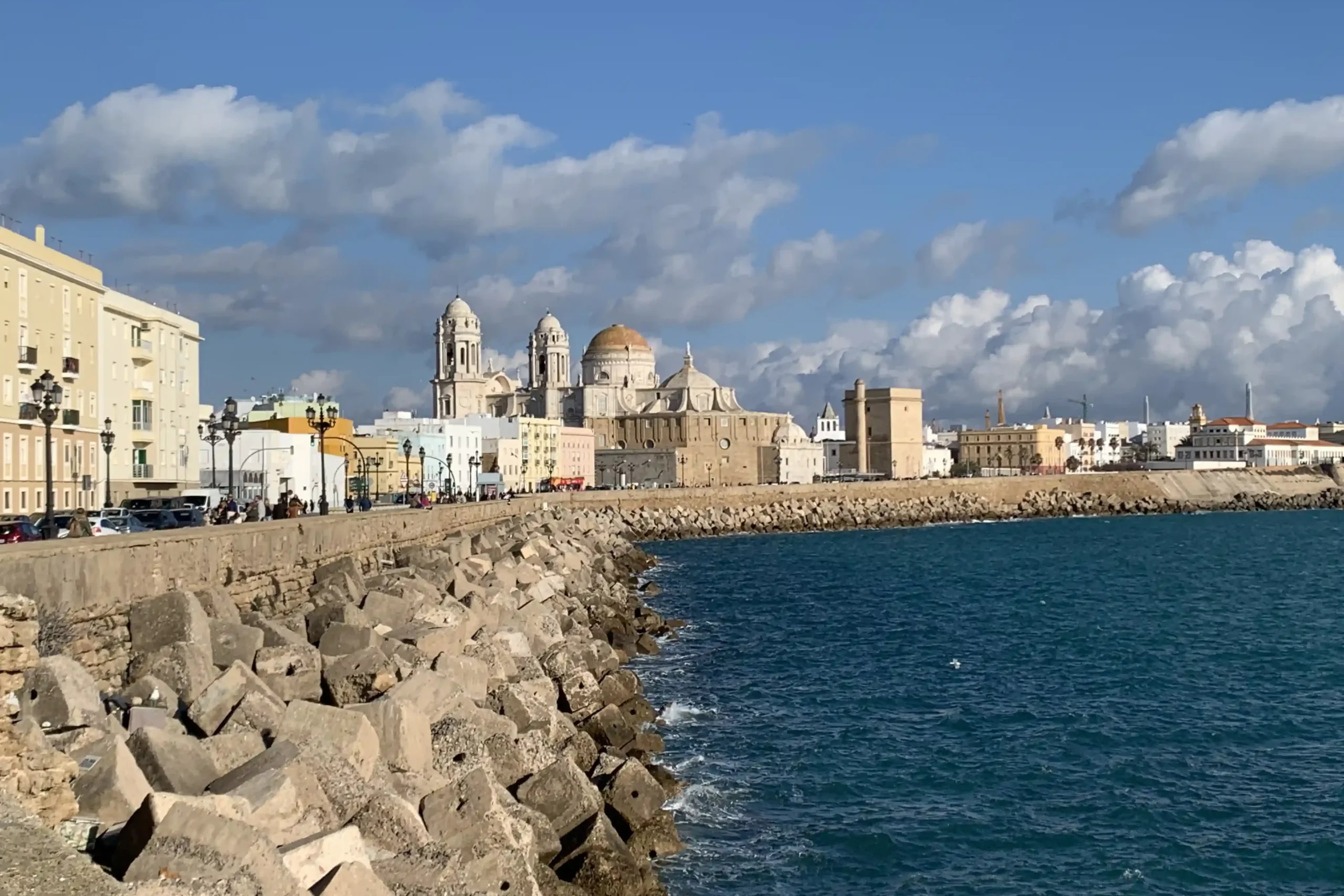
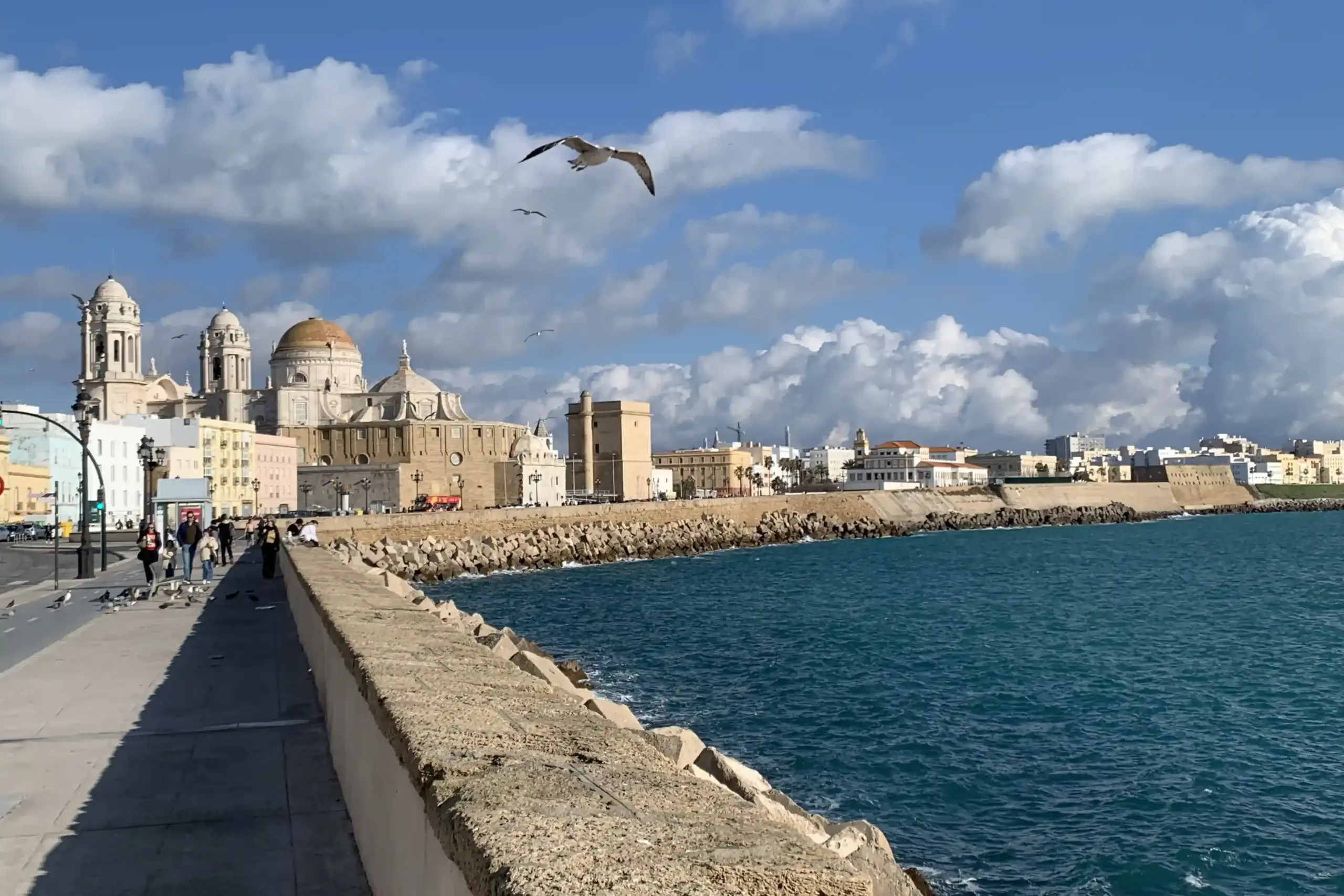
Cádiz is a city immersed in a bright light, surrounded by the blue of the sea and crossed by a constant wind that makes it feel alive in every season.
It is a city that has known distant splendors, thanks to its continuous symbiosis with the sea. For centuries it has been a gateway open to theworld: a point of departure and return, crossed by routes, merchants, different languages and dreams. In its palaces, in the watchtowers that still scan the horizon and in the courtyards hidden behind discreet doors, you can feel the elegant legacy of a prosperous past, when the Atlantic was not a boundary, but a promise.
Walking through its streets, you will perceive that subtle, almost a feeling of the awareness that its time has passed. A bit like in Palermo, in Sicily, if you have ever visited it.
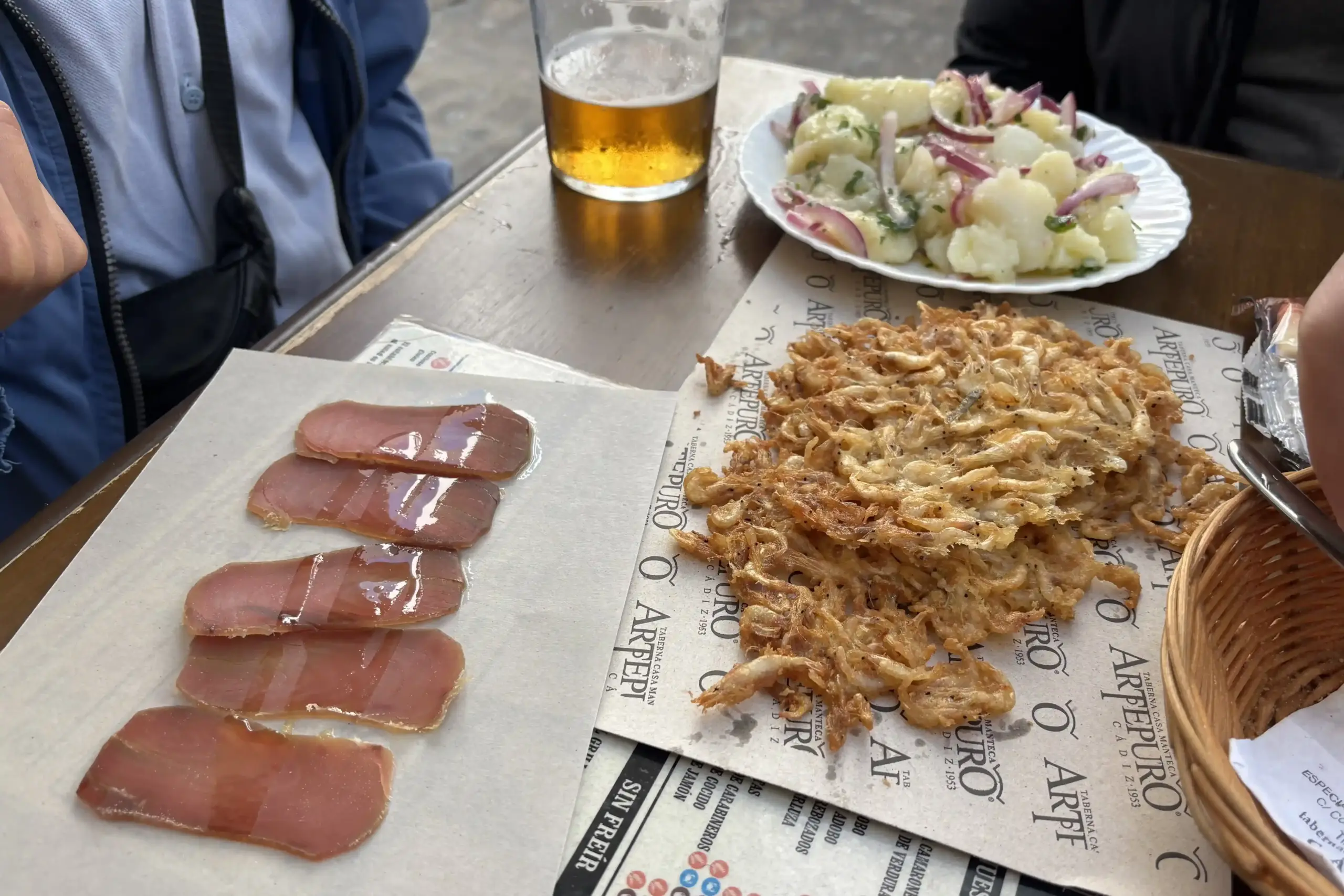
And yet, if like me you have the chance to stop and talk with a gaditano (as the inhabitants of Cádiz are called), you will discover a wonderful contrast. Cheerful, ironic, theatrical. Guardians of the most irreverent Carnival in Spain, the gaditanos embody the art of simple and luminous living, revolving around freshly caught fish, endless conversations in the squares and air scented by the sea.
This is why Cádiz enchanted me. For the dignity of a city that knows it is no longer the center of the world, yet has chosen to remain cheerful, serene, deeply alive, in constant symbiosis with the sea, the sun and the wind.
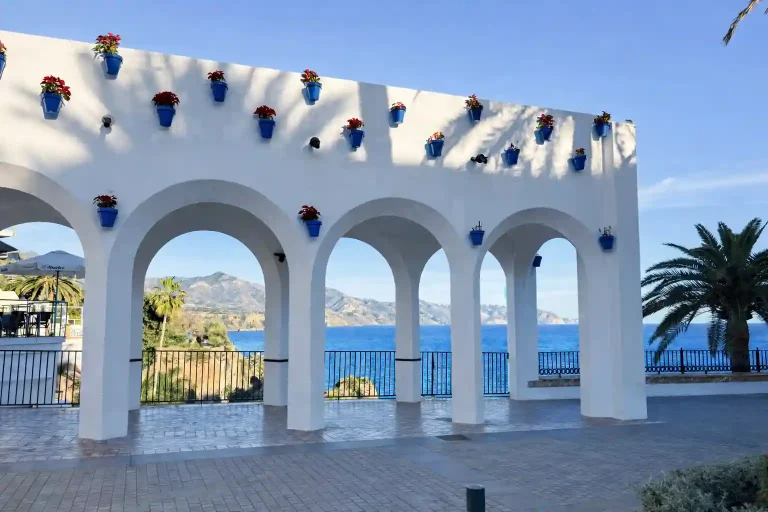
The same spirit can be found in the white villages of the province, such as Jerez and Vejer de la Frontera, where the light enhances the whitewashed facades, the view over the sea confirms its openness to the ocean and the rhythm remains slow.
It is no coincidence that its coastline is called Costa de la Luz. Here, light truly takes center stage. And perhaps it is precisely this clarity that makes Cádiz so special: a profound city, made of light, sea and wind.
🌿 If only I’d known this before…
Here are some practical tips for organising your visit to Cádiz:
how to get there, where to park, how to get around, how to plan your visit and when to go.
A few useful things to know when choosing your transport, exploring the city
and organising your days around local rhythms, the beach and the wind.
Show all tips ↓Hide tips ↑
How to get to Cádiz
By plane: the nearest airport is
Jerez de la Frontera Airport,
located about 45 kilometres from Cádiz.
It is connected to the city by the Cercanías C1 suburban railway line, which reaches Cádiz station and stops in towns such as Jerez de la Frontera and El Puerto de Santa María.
Services are not particularly frequent, so always check the
official Renfe website.
Another option is to fly into
Seville Airport,
which generally offers a much wider range of domestic and international connections.
Reaching Cádiz from there by public transport is slightly less straightforward, but you can take the EA city bus from the airport to Seville’s railway station or bus station and continue from there to Cádiz by train or coach.
To search for flights and compare fares, I recommend
Google Flights.
It makes comparing different dates and prices simple and intuitive.
By train: Cádiz railway station is located in
Plaza de Sevilla, just outside the walls of the old town.
This means that, once you arrive, you can walk to most accommodation and attractions.
Cádiz is connected to Seville by regional and Media Distancia trains, while direct services or journeys requiring a connection may be available from Madrid and other Spanish cities, depending on the day and timetable.
Always check availability and buy tickets through the
official Renfe website.
To compare the different rail options quickly, I also use
Trainline
and
TrainPal,
as they allow you to view the available alternatives in a single search.
By coach: Cádiz bus station is located in
Plaza de Sevilla, next to the railway station and just a few minutes’ walk from the old town.
The city is directly connected to Seville by
Transportes Generales Comes
coaches.
It is also possible to reach Cádiz by coach from Málaga without necessarily travelling through Seville.
Avanza operates the
L-501 Málaga–Cádiz route
and the
L-530 semi-direct route,
which travels via Marbella and Algeciras.
The journey is fairly long, so before buying your ticket it is worth comparing the duration, departure times and number of stops offered by the different services.
By car: you do not need a car if you are only planning to visit Cádiz, although, as you may already have gathered, it can be a very practical option if you are flying into Seville or even Málaga.
A car becomes almost essential, however, if you want to explore the Costa de la Luz freely, reaching beaches, white villages and places such as Vejer de la Frontera, Conil, Zahara de los Atunes, Bolonia or Tarifa.
Finding free parking near the old town is difficult.
Many on-street spaces are regulated or reserved for residents, and the rules may vary from one area to another.
Free options can mainly be found around the port area, at the entrance to the city, for example near Avenida de Astilleros, but spaces are very limited and slightly farther from the centre.
Alternatively, you can look for parking areas near Playa de la Victoria, about 2 kilometres from the city centre.
If you arrive by car, the easiest option is often to use one of the public car parks near Plaza de Sevilla, the port, Campo del Sur or La Caleta and continue on foot.
Parking is not particularly expensive, with rates of around €1 per hour, so there is no need to worry too much.
Before leaving your car, always check the colour of the road markings, the signs and the applicable parking hours.
How to get around Cádiz
On foot: this is the best way to explore the city.
The old town occupies a small peninsula and the main attractions are fairly close to one another.
You can walk from the Cathedral to the Mercado Central, continue to La Viña, La Caleta beach,
Parque Genovés and the seafront without using public transport.
Walking will also allow you to discover lesser-known streets, hidden squares and the city’s most authentic neighbourhoods.
By bus: buses can be useful, especially for travelling between the old town,
the station and the modern part of the city, where you will find Playa de Santa María del Mar
and the long Playa de la Victoria.
The lines that are generally most useful for visitors are line 1, which runs along the main avenue;
line 2, which passes near the Cathedral, Mercado Central, La Viña and La Caleta;
and line 7, which connects the Playa de la Victoria area with the city centre.
You can check routes and stops on the
official Cádiz Tourism website.
Coaches also leave Cádiz bus station for Jerez de la Frontera,
San Fernando, Chiclana, Conil, Vejer de la Frontera, Tarifa and many other places in the province.
For local transport connections, also check the
Bahía de Cádiz Transport Consortium.
By bicycle: Cádiz is almost completely flat and has long sections
of cycle lane along the seafront and through the modern part of the city.
Cycling is particularly enjoyable for following the promenade, reaching Playa de la Victoria
or exploring areas outside the old town.
In the historic centre, however, many streets are narrow, pedestrianised or crowded, so walking is often more practical.
By public catamaran: public ferry services leave from Cádiz Maritime Terminal
and connect the city with places such as El Puerto de Santa María and
Rota.
The crossing takes around 30 minutes and is a very pleasant way to enjoy a day trip and see Cádiz from the sea.
I wholeheartedly recommend it!
Fares range from approximately €3 to €6 each way, depending on the destination and whether you have a public transport card.
Services depart roughly every hour and twenty minutes and may be changed or suspended in strong winds or adverse sea conditions,
so always check the latest service updates and timetables on the
Transport Consortium website.
If you plan to use intercity buses, suburban trains and catamarans regularly, it may be worth checking the conditions of the
Consortium Transport Card.
It is a rechargeable card that offers discounted fares on public transport throughout the Bay of Cádiz.
How to plan your visit to Cádiz
The day generally begins at around 10:00 am.
You therefore do not need to get up particularly early if you want to find shops open, see people in the streets
and experience the true atmosphere of the city.
Naturally, getting up early can still be a good idea if you want to walk along the seafront,
photograph the city without the crowds or visit the beach during the quietest hours.
Restaurants usually serve lunch between 1:30 pm and 3:30 pm
and dinner approximately between 8:30 pm and 11:00 pm.
Arriving at 6:30 pm and expecting a full dinner may mean finding the kitchen still closed.
In tapas bars and traditional fried-fish restaurants, you can often eat more informally, ordering portions
to share at the bar or at a table.
Booking is recommended for the best-known restaurants and at weekends.
The Mercado Central and many traditional markets are particularly lively in the morning
and tend to empty after lunch.
If you want to see the fish stalls, buy fresh produce or eat inside the market,
try to visit before 2:00 pm.
The food court may have different opening hours from the traditional market stalls.
There are many organised tours available for exploring the city.
I always check websites such as
GetYourGuide
or
Civitatis
to see whether any interesting guided visits, free tours or excursions are available.
Finding free parking near the old town is difficult.
Many on-street spaces are regulated or reserved for residents, and the rules can vary
from one area to another.
If you arrive by car, the easiest solution is often to use one of the public car parks
near Plaza de Sevilla, the port, Campo del Sur or La Caleta and continue on foot.
Before leaving your car, always check the colour of the road markings, the signs and the applicable parking hours.
When to visit Cádiz
The best season for combining cultural sightseeing with time at the beach generally runs from
April to October.
July and August are the hottest, busiest and most expensive months, especially at weekends,
although Cádiz usually has slightly milder temperatures than inland Andalusian cities
thanks to the Atlantic Ocean and the wind.
In my opinion, the best times to visit the city are
April to June and September to October,
when the weather is generally pleasant, the days are long and the city is less crowded
than during the height of summer.
Autumn and winter can also be wonderful, especially for walking,
eating well and experiencing the city at a more authentic pace.
You should, however, be prepared for rainy days and, above all, the possibility of very strong winds.
Cádiz is, in fact, a city that is highly exposed to the wind.
The Levante can blow very strongly and make a day at the beach less enjoyable,
while the Poniente is generally cooler and more humid.
If you visit Cádiz during Carnival, book your accommodation and transport well in advance.
The dates change every year, generally falling between February and March.
During the main celebrations, the city becomes extremely crowded and there may be changes
to traffic circulation, bus diversions and road restrictions.
Before travelling, check the
official Cádiz Tourism website
and its
events calendar.
A bit of history about Cádiz
Cádiz is not just an ancient city. Here, we are not talking about “a few centuries of history,” but about over 3,000 years of peoples, traditions, cultures and stories. It is one of the very few cities in Europe that can say it has been inhabited without interruption from the Phoenician era to the present day.
Legend tells that Heracles (that is, Hercules for the Romans), after killing the giant Geryon on the island of Erythea (today’s Island of San Fernando, where the Bay of Cádiz stretches), founded a city right here.
Documented history, on the other hand, speaks of Phoenician merchants and of a temple dedicated to Melqart, later identified by the Greeks with Hercules. That sanctuary became one of the most famous places of the ancient world. Hannibal stopped there before departing against Rome. Pilgrims arrived there from all over the Mediterranean.
Its origins date back to between 1100 and 800 BC, when the Phoenicians from Tyre — in present-day Lebanon — chose this archipelago of small islands as a trading base and called it Gadir, which means “fortified enclosure.”
The Phoenicians were looking for a strategic point from which to control the metal routes (British tin, amber from northern Europe, silver and copper from the Iberian Peninsula) and because of its proximity to the kingdom of Tartessos (perhaps the biblical Tarshish).
Very little remains from this period. Today you can see some remains in the Yacimiento Gadir (free), on Calle San Miguel.
From the 5th century BC, the city came under Carthaginian control. During the Punic Wars it was a strategic base, but Carthage never invested in the city’s development. For this reason, in 206 BC, the people of Cádiz allied themselves with Rome, thus freeing themselves from Carthage. It was a decisive choice.
Renamed Gades, the city experienced a golden age under the Romans.
In 49 BC, Julius Caesar granted it Roman citizenship and the privileged status of municipium. Under Augustus it became a colony and prospered as one of the richest ports in the Empire. For a time, it was among the most populous cities inHispania, with hundreds of wealthy equites (citizens rich enough to afford a war horse) residing there.
Strabo described it as lively and full of trade. It was even famous for its gaditan dancers, considered exotic and sensual in Rome. A detail that reveals how cosmopolitan it was… and how certain artistic traditions, such as dance, have roots much further back than we imagine.
The Romans built an aqueduct, an amphitheatre, a circus and above all the Roman Theatre, one of the largest in ancient Spain, capable of holding over 10,000 spectators. The economy flourished thanks to fish processing and the production of the famous garum, the fermented sauce that in ancient times was worth gold.
With the crisis of the 3rd century and the invasions that followed, Gades entered into decline. The trade networks collapsed. The great city withdrew into a small fortified settlement. But it did not die.
In 711, the troops of Tariq ibn Ziyad landed on the peninsula after the Battle of Guadalete. Cádiz fell and the legendary Temple of Hercules was demolished.
Under Islamic rule, the city became Jezirat Qadis, “the island of Cádiz.” Walls, an alcazaba and a mosque were built. However, it never returned to being the great oceanic port of Phoenician and Roman times. The society of Al-Andalus was less oriented toward Atlantic maritime trade: the political and economic center lay elsewhere.
The years of Al-Andalus represented a period of relative quiet for Cádiz. The Arabic chronicles mention it very few times. When they do, it is almost always in relation to the conquest of 711 or the Viking raid of 844, when the Norsemen used it as a temporary base to plunder Seville.
For the rest, silence. The city waited.
In 1262, with the Reconquista, Alfonso X the Wise reconquered the city for the Crown of Castile. A cathedral was built on the remains of the mosque and in 1265 it officially received the title of “city.”
But for centuries it remained a fragile outpost, exposed to attacks by pirates and enemy fleets. It suffered numerous assaults from corsairs and enemy armies. For this reason, it was somewhat left on the margins… until the fateful 1492.
The real turning point, in fact, came with the discovery of America.
Columbus departed from Palos in 1492, but it was from Cádiz that he set sail for his second and fourth voyages. The city began to grow as a key stop for trade with the Indies.
The decisive event came in 1717: the Casa de Contratación, the institution that controlled trade with the Americas, was moved fromSeville to Cádiz.
Two thousand years earlier, Roman ships sailed up the Baetis (the ancient name of the Guadalquivir) and docked in Seville as if it were a seaport. But over time the river silted up. Ocean-going ships, increasingly large, could no longer sail up it.
In 1717, the Crown acknowledged reality: the port of Seville was by then unsuitable. The center of trade shifted definitively to Cádiz.
Thus began the Siglo de Oro of Cádiz.
Silver, gold, spices. Genoese, English, Flemish and French merchants settled here. The population exploded: 30,000 inhabitants in 1656 and 85,000 in 1810.
The Castle of Santa Catalina (1634), San Sebastián (1706), the new Cathedral (1722), the Surgical College (1748), the watchtowers — including the famous Torre Tavira — and the elegant merchants’ houses such as the Casa del Almirante and the Casa de las Cinco Torres were built.
Cádiz was nicknamed the “Tacita de Plata.”
The Atlantic, which had once been a boundary, was now wealth.
When Napoleon managed to force the King of Spain to abdicate, the War of Independence against France (1808–1814) began. Cádiz was besieged by the French between 1810 and 1812, but thanks to the protection of the sea and its walls, it resisted.
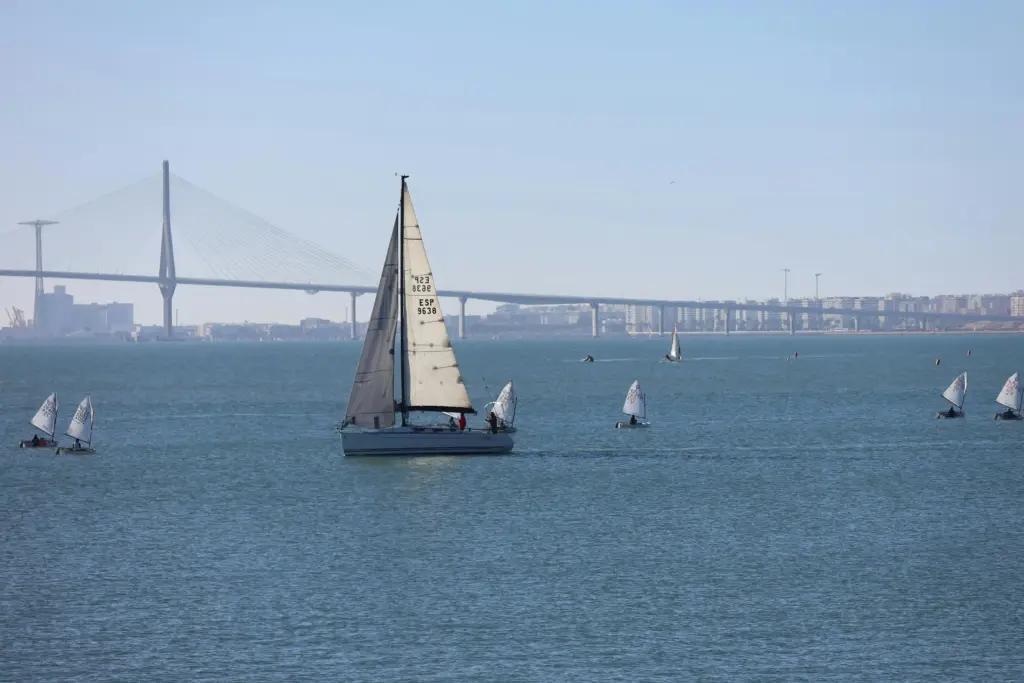
Sailboats in the Bay of Cádiz with the Puente de la Constitución de 1812 in the background
And since Cádiz was the only major city free from French occupation, it was right here, in 1812, in the Oratorio de San Felipe Neri, that the Cortes of Cádiz gathered.
In the absence of a recognized king, this assembly did three things that no one had ever done in Spain:
It declared that national sovereignty meant that power did not belong to the king, but to the people
It drafted a Constitution to limit the powers of the monarch, establish the separation of powers (legislative, judicial and executive) and introduce indirect universal male suffrage (that is, through electors appointed by groups)
It also called representatives from the American colonies
The result was “La Pepa” — so called because it was promulgated on March 19, the day of Saint Joseph. It was one of the most liberal, modern and revolutionary constitutions of its time, and its model influenced half of Europe and Latin America.
📍 A curiosity
When talking about the Cortes of Cádiz, people often imagine a united front against Napoleon.
In reality, inside that hall there was an entire world: different ideas, different interests, opposing visions of what Spain should become.
It was not a single block, but a fragile balance between very distant political orientations.
There were the so-called serviles, the absolutists, convinced that no Constitution was needed:
the king had to return and rule as before, without limits and without new rules.
Then there were the moderates, who wanted reforms but in a gradual way,
without revolutionary breaks.
And finally the liberals, who supported a radical principle for the time:
national sovereignty, a written Constitution and clear limits on the power of the king.
In the end, the liberals prevailed. But one fact still surprises today:
a significant part of that front was made up of clergy.
It was not an anti-clerical revolution in the classical sense.
It was rather an alliance born in an exceptional situation,
a political pact with an anti-Napoleonic function to give legitimacy to a new order
while Spain was, in fact, without a recognized sovereign.
In the Cortes sat 90 clergymen, 56 jurists, 30 military men and 14 nobles.
The assembly represented much of the political and cultural elite of the time, not only bourgeois or revolutionary circles.
The decisions taken reflect this complexity well.
On one hand, the Cortes abolished the Inquisition, a very strong symbolic act.
On the other, they maintained Catholicism as the only permitted religion,
written in black and white in the Constitution.
Modernity and tradition coexisted in the same text.
The most fascinating aspect, however, is the Atlantic dimension of that experiment.
The Cortes of Cádiz were, in fact, the last parliament of the still united Spanish empire.
For the first and only time, deputies from the Iberian Peninsula and deputies from the
American colonies —
and even from the Philippines — sat together in the same assembly to decide the future of a nation
defined as that of the “Spaniards of both hemispheres”.
The majority remained peninsular, about two hundred deputies against around sixty from the Americas.
Yet those American representatives, often referred to as the partido americano,
demanded real equality, proportional representation,
freedom of trade and the end of colonial status.
They achieved important results: the recognition of legal equality
between Spaniards of the peninsula and those of the Americas,
the abolition of the indigenous tribute and of forced labor systems such as
encomienda and mita,
greater freedom of the press and economic initiative.
But when it came to the decisive issue — the political and economic control of the empire —
the peninsular majority did not accept giving up real power.
Here lies the contradiction that would shape the future:
it was proclaimed that everyone was equal, but not everyone decided in the same way.
Within a few years, this fracture helped fuel the
wars of independence in Spanish America.
The experiment ended, the Cortes were dissolved and the empire began to break apart.
It was the last time Spain and America tried to remain united through a shared law,
not through force.
The Constitution of 1812, composed of 384 articles,
established highly modern principles for the time:
national sovereignty,
the separation of powers,
a constitutional monarchy
and a system of indirect universal male suffrage.
At the same time, it maintained Catholicism as the official religion
and granted the king a temporary veto power.
It was a liberal constitution, but cautious.
Promulgated on March 19, 1812,
while much of Spain was still occupied by the French,
it was abolished in 1814
upon the return of Ferdinand VII,
who restored absolutism and persecuted many liberals.
It briefly returned into force during the Liberal Triennium (1820–1823),
then disappeared definitively.
But its myth survived.
In Latin America, many constitutions of the new independent states looked to Cádiz as a precedent:
the proof that even an empire could attempt to transform itself through a written law.
And for two years, in a city besieged by the sea and cannons,
political modernity spoke with an Andalusian accent.
I imagine you can’t wait to find out if and where you can see it. For those who travel, this is the point. Unfortunately, the original manuscript is not in Cádiz, it is kept in Madrid, in the collections of the Congreso de los Diputados, and it is not permanently on display to the public.
But by visiting the Oratorio de San Felipe Neri you will be able to see the hall where the Cortes met and where La Pepa was promulgated.
The Constitution of 1812 defined the Spanish nation as “the union of all Spaniards of both hemispheres”. For the first time, deputies from the American colonies sat in the Spanish parliament.
But representation was never fair. While the peninsula elected one deputy for every 50,000 inhabitants, the American viceroyalties — vast and populous — elected one each, without any demographic criterion. The result was an overwhelming peninsular majority (200 against 60) artificially constructed.
The American deputies demanded full equality: more seats, freedom of trade, access to positions.
They obtained individual rights and the abolition of the abhorrent working conditions (comparable to slavery) in which their peoples were forced to live (encomienda and mita). But every time the political or economic control of the motherland was touched, the peninsular majority shut the door.
When Napoleon was expelled and the king returned to power, his first act was to abolish the Constitution in 1814 and send a military expedition to the Americas. These actions were the definitive proof: Spain would never share power.
This began to bring out forms of self-government (which had begun in an embryonic way during the king’s absence) and over time they created their own armies, territories, leadership and clear objectives. They no longer accepted being “Spanish provinces”. They wanted to be independent states. And they became so.
With the loss, therefore, of the most important colonies in 1898 (Cuba, Puerto Rico, Philippines), the trade of Cádiz collapsed. And the city entered a long economic decline.
But, paradoxically, just like during the period of Al-Andalus, this saved it.
There were neither funds nor reasons to demolish the historic center and rebuild it in a modern style. So the city remained almost intact.
Although in recent years it has found its place within international tourism, Cádiz still remains authentic… far from tourist speculation.
And deep down, we are glad: Phoenicians, Romans, Carthaginians, Byzantines, Visigoths, Muslims, Vikings passed before us and Cádiz has remained true to itself.
When we look at it, there is no strong trace of any of these cultures… there is only and uniquely Cádiz.
What to see in Cádiz
When talking about Cádiz, my honest advice is to focus your visit on the historic center, because modern Cádiz has little to offer a curious traveler. The historic center is a labyrinth of stone and light stretching into the Atlantic. A narrow peninsula enclosed by the ancient 18th-century walls, built when the city was one of the richest ports in Europe and had to defend itself from English attacks and pirates.
Below you will find, as always, all the most important monuments and buildings, with a suggested route to follow, but what Cádiz offers is not architectural richness or indescribable art. What it offers is its ocean soul, its forgotten beauty, its desire to live lightly.
So don’t worry about seeing everything listed below. Instead, try to keep some time to visit the Costa de la Luz, with its white villages such as Vejer or Jerez de la Frontera and their beaches, or for a scenic drive around the Bay of Cádiz.
📍 A curiosity
If you feel like extending your trip a little, you can take the opportunity to visit El Puerto de Santa María, just a short distance from Cádiz. It is part of the famous Sherry Triangle, together with Jerez de la Frontera and Sanlúcar de Barrameda — I tell you more about it in my article dedicated to the Costa de la Luz.
You can easily get there by sea — you’ll also find all the details about the ferry connections (the Vaporcito and the B-042 catamaran) in the “If only I’d known sooner” section — or you can opt for an organised tour with Civitatis or GetYourGuide, which also offer excursions to other white villages in the province, such as Vejer de la Frontera and Arcos de la Frontera.
Simply organize your visit so that you can stroll through the streets and squares during the lively hours of the day (during the siesta the city empties, so plan accordingly) and experience its rhythm! That’s when Cádiz truly shines!
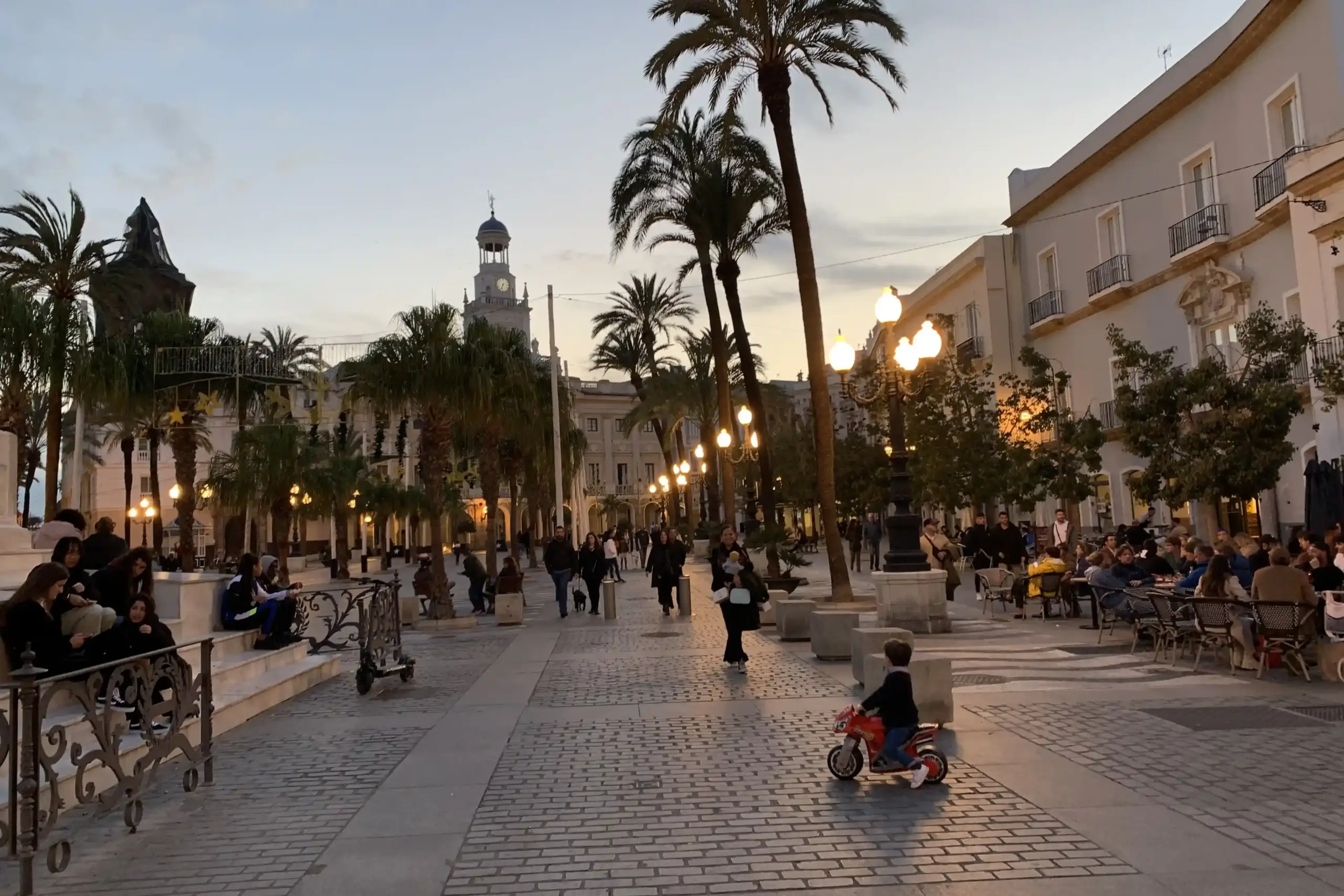
Sunset at Plaza de San Juan de Dios, in the heart of Cádiz: the perfect time for tapas
The historic center
Before starting to show you this wonderful city, I need to make a clarification. Most visitors imagine that the port of Cádiz faces the ocean. Nothing could be more wrong. From the very beginning, the port was located between the peninsula on which the city stands and the mainland, in order to always guarantee protection from both the forces of the sea and enemy military forces.
This premise is essential to understand the squares we will encounter, the main monuments and the direction they face, and more generally to understand the city.
With this in mind, let’s begin our visit.
Plaza de San Juan de Dios
Our discovery of Cádiz begins at Plaza de San Juan de Dios, the beating heart of the city and the ideal starting point for any visit. The history of the square is inseparably linked to the sea.
You must imagine that until the 18th century, the waters of the bay almost reached this space, which was located extramuros, outside the medieval walls (the Arco del Pópulo is proof of this). Originally, in the 16th century, it was a natural inlet, the mouth of a small canal, which was later filled in to create an open area.
Its irregular shape, narrow near the Town Hall and widening like a funnel toward the port, actually follows the ancient coastline and the mouth of the canal that once opened to the sea here.
Originally, the square was known as “Plaza de la Corredera” and, together with Plaza de San Antonio, it was one of the very few large squares in the historic center of Cádiz until the end of the 18th century. Its strategic position, facing the Puerta del Mar (the ancient gateway to the city from the port, now replaced by the Arco del Pópulo), made it from the very beginning the nerve center of trade and exchange.
For centuries, until much of the 19th century, the city’s main market was held here. Already in the 1500s, it was a lively commercial hub, especially with the Americas, and this is where exotic goods brought by the fleets of the Indies were sold. The arcades that can still be glimpsed today in some buildings are a testimony to this ancient commercial function.
The current name, “San Juan de Dios”, comes from the church and the former hospital of the same name overlooking the square. For a period, however, the square changed its name in honor of the queen, becoming Plaza de Isabel II.
The present appearance of the square is the result of a long evolution. The walls that separated it from the sea were demolished starting in 1906, and the last major redevelopment, completed in 2012 (with further adjustments in 2014), made it almost entirely pedestrian, adding the characteristic palm trees, linear fountains, and restoring the Moret monument to its place.
The most imposing building is undoubtedly the Town Hall, which rises over the square with its elegant façade overlooking the port.
Attached to the Town Hall is the Church of San Juan de Dios, the only remaining trace of the ancient Hospital de la Misericordia, dedicated to the poor and the sick. The Hermandad was inspired by the works of Saint John of God, founder of the Hospitaller Order, and provided assistance during plagues and sieges.
📍 A curiosity
San Juan de Dios is a deeply revered figure in Spain for the extraordinary human contribution he left behind. He was born in 1495 in Portugal with the name Juan Ciudad, but it is in Granada that his life completely changes… and it is here that he becomes a central figure in the history of Spain.
As a young man, he did everything: shepherd, soldier and above all a restless traveler. An irregular life, without a clear direction, marked by constant movement. Until, as an adult, he settled in Granada and opened a bookshop not far from the church that would later be dedicated to him.
In Granada, he experienced a deep spiritual crisis, after listening to the sermon of a wandering preacher. From that moment on, he began to share his possessions with the poor and live with very little. His behavior was interpreted as madness and Juan was confined to the Hospital Real, which housed one of the first mental institutions in Europe. And it is there that something decisive happens.
After that experience, Juan understood a simple and shocking truth for the time: the sick, the poor and the “mad” do not need to be isolated, but to be treated with care, dignity and humanity.
He then began to gather abandoned sick people, the injured, the poor and people with mental disorders from the streets, without distinction of origin or belief. He brought them into his home, washed them, fed them, cared for them as best he could, putting body and heart where before there had only been exclusion.
At first, the city looked at him with suspicion. Then, slowly, something changed.
San Juan de Dios thus founded, in Granada, what would become one of the first modern hospitals in Europe, based on revolutionary principles for the 16th century: hygiene, attention to the person and respect for the mentally ill, finally treated as human beings and not as outcasts. An approach that anticipated modern medicine by centuries.
For this reason, he is today the patron saint of hospitals, the sick and firefighters.
His order, the Hospitaller Order of Saint John of God, is the one that inspired the Hospital de la Misericordia of Cádiz.
The square was completely pedestrianized and renovated in 2012, with new paving and ornamental elements. At the center you will find the Moret statue, dedicated to Segismundo Moret, a politician from Cádiz and several times president of the Spanish government, originally inaugurated here in 1909. There is a fountain that at night creates light and music shows, and the arcaded bars make it a good place to stop and observe the flows and perspectives toward the port.
The square is always lively. It is the perfect place to sit down for a coffee or for an outdoor aperitif, perhaps watching the flow of different people depending on the time of day: fishermen and port workers in the morning; tourists and locals during the day; and in the evening anyone who feels like spending time in good company.
And it is by leaving Plaza de San Juan de Dios, walking along Calle San Juan de Dios, that we enter the oldest barrio of Cádiz.
An authentic glimpse of the Barrio del Pópulo in Cádiz, among wrought iron balconies, limestone and Atlantic light.
El Barrio del Pópulo no es solo el barrio más antiguo de Cádiz, sino que muchos lo consideran el más antiguo de Europa occidental. Sus orígenes se remontan a la fundación de Gadir por los fenicios alrededor del 1100 a.C., aunque su configuración actual, con murallas y calles estrechas, es de época medieval.
El nombre “Pópulo” tiene un origen fascinante y devocional. En el siglo XVI, en una de las puertas de la muralla, se colocó una pintura de la Virgen con la inscripción latina “Ora pro populo” (“Reza por el pueblo”), invocando así la protección divina sobre la ciudad. De ese gesto nació el nombre del barrio y la devoción por la Virgen del Pópulo, considerada la patrona de Cádiz, cuya festividad se celebra el 8 de septiembre.
Históricamente, el Pópulo fue el núcleo originario de la ciudad medieval, una ciudadela fortificada encerrada dentro de las murallas. Aquí vivieron y se entrelazaron las historias de mercaderes, nobles, pescadores y artesanos. Sufrió saqueos, como el del corsario inglés Francis Drake en 1596, y resistió con valentía los asedios franceses durante la Guerra de Independencia.
El barrio es un laberinto de callejones, arcos y plazas pequeñas donde el tiempo parece haberse detenido. Se cuenta que entre sus calles todavía vaga el espíritu de una monja fugitiva, la beata del Arco de la Rosa, condenada a vagar hasta que encuentre la paz.
Es un lugar perfecto para perderse al atardecer, cuando las farolas encienden un resplandor dorado y las taperías se llenan de voces y aromas.
Entrar en el Pópulo es un ritual que se realiza a través de una de sus tres puertas medievales, cada una con una historia única:
• Arco del Pópulo: es la entrada principal y la que da nombre al barrio. Originalmente se conocía como Puerta del Mar, porque a través de ella se accedía directamente a la zona portuaria. De probable origen almohade, su aspecto actual se remonta a los siglos XIII–XV. Su fisonomía es particular porque en el siglo XVII, delante de él, se construyó una pequeña capilla dedicada a la Virgen del Pópulo, que hoy lo convierte en un profundo pasaje cubierto.
• Arco de la Rosa: la más alta de las puertas medievales, tiene un arco de ladrillo con matacán superior para la defensa. El acceso era originalmente en ángulo, protegido por una torre hoy desaparecida, según la clásica arquitectura militar árabe.
• Arco de los Blancos (que atravesaremos nosotros): situado cerca del Teatro Romano, toma su nombre de la familia Blanco, que tenía aquí sus casas. También conocido como Puerta de Tierra por su papel como entrada principal desde la tierra firme al castillo de la Villa.
El barrio es un auténtico museo al aire libre, donde se concentran los principales monumentos de la ciudad.
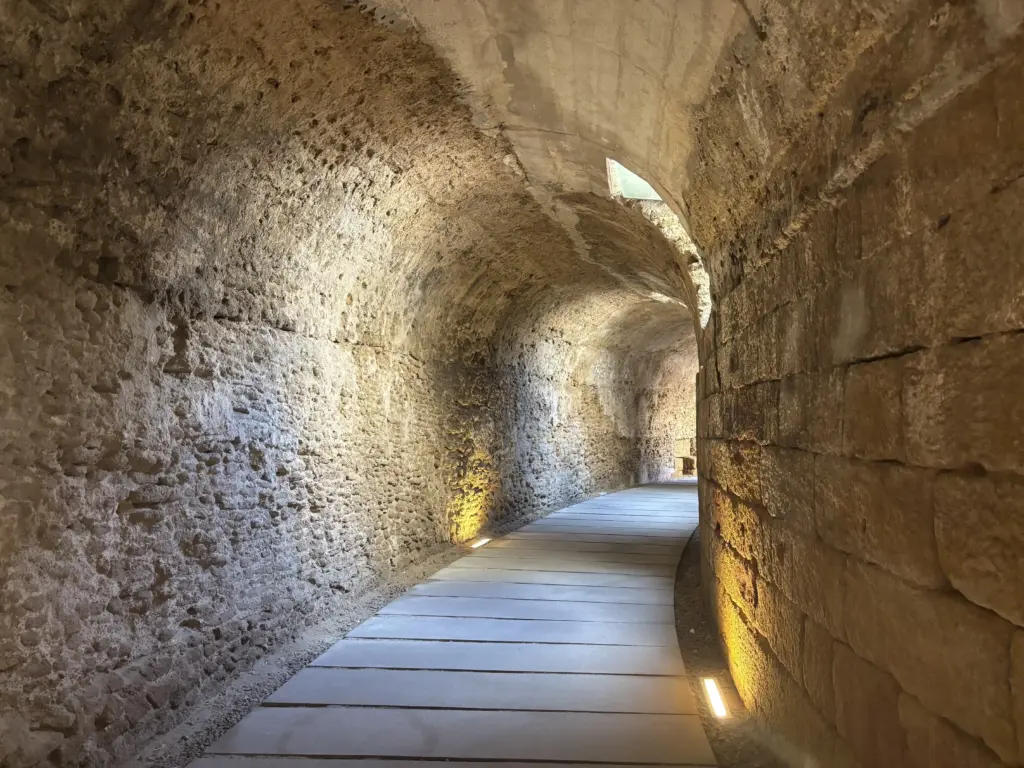
Internal corridor (vomitorium) of the Roman Theatre of Cádiz, one of the oldest and largest in Roman Hispania.
Roman Theatre
The visit to the Roman Theatre and its Interpretation Center is free. The excavated area is accessible, although some parts may present architectural barriers. Check the opening hours on the official website, as they change depending on the season. On Google Maps, enter the address Calle Mesón 11-13, because if you simply search for “Roman Theatre”, it often takes you to the back of the theatre, which faces the Paseo Marítimo. The entrance is set into a portal that looks like the doorway of a house, so don’t be surprised if you don’t find it on your first attempt.
Halfway along Calle San Juan de Dios you will find one of the access arches to the Barrio del Pópulo: the Arco de los Blancos. Just a few meters from here is the Roman Theatre of Cádiz. Hidden for centuries beneath the houses of the Barrio del Pópulo, it was discovered by chance in 1980.
It is considered the oldest Roman theatre in all of Spain and the second largest in the Iberian Peninsula by capacity, after the one in Córdoba (not open to visitors). It was built around the 1st century BC, at a time when the city, then called Gades, was experiencing a period of enormous prosperity and wealth thanks to trade.
Just think that its dimensions were colossal: the cavea (the seating area for the audience, now only partially visible) had a diameter of over 120 meters and could hold around 10,000 spectators. A huge capacity, considering that the population of Gades at the time was about 50,000 inhabitants.
It is a theatre, not an amphitheatre like the Colosseum, for example. No gladiators: here, tragedies and comedies were performed.
Its construction was commissioned and financed not by the Roman state, but by a private citizen: Lucius Cornelius Balbus the Elder. Balbus was an extremely wealthy man from Cádiz, a close friend and financier of Julius Caesar, who obtained Roman citizenship and achieved an extraordinary political career for a provincial. He had the theatre built to embellish his hometown and, probably, also to increase his personal prestige.
It is said that Caesar himself attended performances here during one of his military visits to Hispania.
The most fascinating story, however, is perhaps that of its rediscovery in 1980. For centuries, the existence of this theatre was known only thanks to references by classical authors such as Cicero and Strabo, but no physical traces had been found. The reason is simple: over the centuries, the area had been completely rebuilt. After its abandonment in the 4th century AD, its stones were reused for the construction of the Islamic Alcazaba, and in the Middle Ages, buildings were constructed on top of it.
Thus, when in the 13th century King Alfonso X the Wise ordered the construction of a fortress (the Castle of Villa), it was built directly on top of the remains of the theatre, using its foundations and incorporating its structures. And it was precisely while searching for the remains of that medieval castle that, in 1980, archaeologists came across the Roman remains.
Today, therefore, you can see a Roman theatre inside a 13th-century castle, with houses and buildings from later centuries built above it, such as the Posada del Mesón or the Casa de Estopiñán. It is a true “layer cake” of history.
The visit to the theatre takes place through a modern Interpretation Center located at Calle Mesón, 11-13, right in the heart of the medieval district of El Pópulo. Inside, information panels, artifacts and an audiovisual projection will help you reconstruct the original appearance of the monument.
Personally, I think the most interesting part is walking through its vomitorium, one of the entrance corridors, where you will follow the same path that Roman inhabitants of Cádiz used to access the galleries and attend the performances.
It is not the best preserved or most visible theatre in Spain. But the entrance is free, and the fact that it is attached to the walls of more recent houses gives it a unique charm.
📍 A curiosity
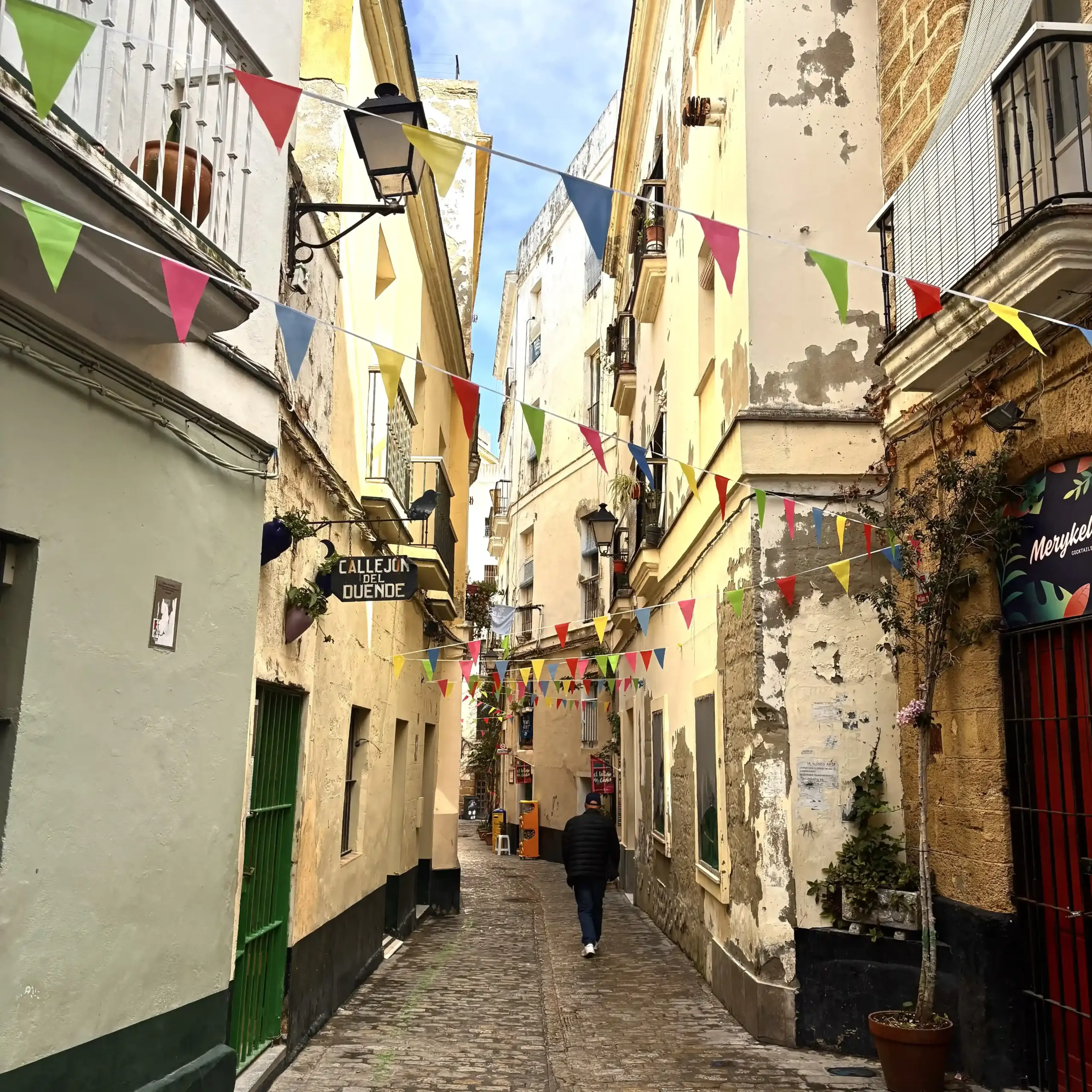
Right next to the entrance of the Theatre, you will also find the Callejón del Duende: the narrowest street in Cádiz, a dead-end alley in the heart of the Barrio del Pópulo.
Once frequented by smugglers, including the famous “El Duende”, who gave it its name. Another story tells of a gaditana and a French captain during the Napoleonic invasion: the two lovers used to meet here in secret, were discovered and killed; it is said that their laments can still be heard on the Night of the Dead.
Continuing along Calle Mesón, you will notice that the architecture becomes increasingly medieval: narrow streets, small squares with palace portals opening directly onto the street.
The first you will notice will be the Casa del Almirante: one of the most beautiful baroque palaces in Cádiz. Its red marble façade is a triumph of decorations that tell the story of the power of one of the most important merchants of the Indies in the city. It is currently under renovation to become a 4-star hotel. Hopefully it won’t be changed too much—staying here could be an opportunity to experience Cádiz even more closely.
Plaza San Martín is the heart of the district, and it is also an excellent starting point for our explorations. You will notice that the sign in front of you essentially indicates all the main monuments of the city within less than 300 meters from here.
The Callejón del Duende in the Barrio del Pópulo in Cádiz, among cobbled alleys, colorful houses and Gaditan joy
Old Cathedral (Iglesia de Santa Cruz)
The entrance is free but only during worship hours. When I went, the hours were 8:30–13:30 and 16:30–21:00, but I can’t guarantee they are always the same, especially during religious holidays. In fact, I personally never found it open.
Here stands the Old Cathedral, also known as the Church of Santa Cruz. It is the oldest church in Cádiz and was the city’s cathedral until 1838, when the title passed to the New Cathedral. Its history is a fascinating layering of civilizations, and its architecture holds unexpected secrets and treasures.
The origins of this sacred place are lost in time. According to archaeological studies, the area on which it stands may have been occupied in earlier periods by an early Christian temple or even part of the Roman Theatre of Gades. But there is more: some scholars hypothesize that an ancient Phoenician temple dedicated to Moloch (identified with the Greek Kronos) may have stood here, while others place it on the islet of San Sebastián.
The documented history begins in the 13th century, when King Alfonso X the Wise ordered the construction of a church around 1262–1263. The Castilian ruler wanted to build the temple on the remains of an ancient Arab mosque, and he even wished to be buried here, although he was eventually interred in Seville.
The turning point in the building’s history came in 1596, when Cádiz suffered a terrible sack by an Anglo-Dutch fleet commanded by Admiral Charles Howard and Robert Devereux, Earl of Essex. The city was set on fire and the church was almost completely destroyed by the flames.
Miraculously, only two elements survived: the ancient entrance arch and the ribbed vault of the baptismal chapel, the only remains of the 13th-century structure. The building we see today is therefore the result of a reconstruction in a late Mannerist and Baroque style, which incorporated the few surviving parts of the medieval temple.
The façade is deliberately austere, enlivened only by some glazed ceramic elements. The real jewel is the bell tower, built in the 15th century and separate from the main body of the church. Its shape, with the pointed roof (chapitel) covered in polychrome tiles, recalls a minaret, a clear reference to the site’s Muslim origins.
The interior is quite simple, but it is worth visiting for some remarkable works of art:
• The main retablo, a work by Alejandro de Saavedra. • The Genoese Chapel (Capilla de los Genoveses): a true treasure chest of Baroque art. The retablo, made of jasper, alabaster and Carrara marble, reflects the power and wealth of the Ligurian community in Cádiz. It was dedicated to Saint Mary and Saint George, patrons of Genoa, and housed the statues of the protector saints of the Ligurian city. The four original sculptures (Saint George, Saint Lawrence, Saint John the Baptist and Saint Bernard) have been located, since the 18th century, in different chapels of the New Cathedral. • The Chapel of the Biscayans (Capilla de los Vizcaínos), which houses the painting of the Last Communion of Saint Ferdinand, painted by Antonio Hidalgo in 1683. • The side portal, made of Genoese marble by Andreoli. • The Sagrario tower, added in the second half of the 18th century by Torcuato Cayón.
The church is located in the small Plaza Fray Félix, which for centuries was the religious center of the city.
Today it may seem abandoned and a bit insignificant, but like everything in Cádiz, it is not what it seems.
Considered the oldest square in the city, this urban space opened in the Middle Ages as a natural extension of religious power, hosting from the very beginning the most important buildings of the diocese: the cathedral, the bishop’s palace and the Contaduría (the headquarters of the church’s economic affairs).
It was expanded in the second half of the 17th century, when the cardinal bought and demolished some houses to give more space to the square and therefore to the cathedral. It was at this time that the characteristic staircase was designed to overcome the difference in level between the two parts of the square.
The square has changed its name several times over the centuries: it was “Plaza de la Catedral” (1623–1838), “de la Catedral Vieja” (1838–1856), “del Zaporito” (1856–1873) and “de Herrera” (1873). Only in 1880 did it take its current name, in honor of Fray Félix María de Arriete y Llano (1809–79), a Capuchin bishop much loved by the people of Cádiz for his piety and pastoral dedication, who led the diocese from 1864 to 1879.
One of the most fascinating curiosities of this square is its pavement. If you look closely, you will notice that it is paved with rounded river stones of various colors and sizes. These stones are not local, but come from the American continent. They were the ballast of the holds of the galleons that returned loaded with precious goods from the colonies of the New World. Once unloaded in the ports of Cádiz, the stones were abandoned and reused to pave streets and squares. Walking here means, quite literally, walking on the remains of the city’s maritime history.
In addition to the majestic Old Cathedral, the square is a concentration of monuments and architectural details:
The staircase of Felipe Gálvez: beyond overcoming the difference in level, it is a work of art in itself. The parapet (pretil) is decorated with vegetal motifs and the front part is articulated with Tuscan-order pilasters.
The Aljibe (cistern): at the center of the square, on the lower level, stands a small and curious circular structure with a hemispherical dome topped by a wrought iron cross. Often mistaken for a humilladero, it is actually the covering of a water cistern, built in 1822–24 based on a design by Torcuato Benjumeda to collect rainwater and distribute it to the poor of the parish.
Casa Contaduría (Casa de la Contaduría): a three-story building dating back to the late 15th century, it now houses the Cathedral Museum. Its façade, with a sandstone portal and diamond-point decorations, is a fine example of late Renaissance Mannerist architecture. The museum is worth a visit (ticket included with the visit to the New Cathedral). In addition to a rich collection of paintings, sculptures, ivories and precious goldsmith works, it preserves the table on which, according to tradition, the text of the Constitution 1812, known as “La Pepa”, was signed.
The bell tower of the Old Cathedral: the bell tower, separate from the body of the church, rises directly above the Casa de la Contaduría. Originally, it was the minaret of the Almohad mosque and, with its pointed roof covered in polychrome tiles, it dominates the square.
Casa Estopiñán: an imposing 17th-century Baroque palace, with a beautiful stone portal topped by a noble coat of arms. Inside, it houses an evocative patio with wooden galleries and columns with “castagnole” capitals. Try to go inside if it is open.
Nearby you will find places where you can enjoy tapas and experience the authentic movida of the Pópulo. The square itself is sometimes the setting for small local events.
Let’s now return to Plaza San Martín and head towards the Arco del Pópulo.
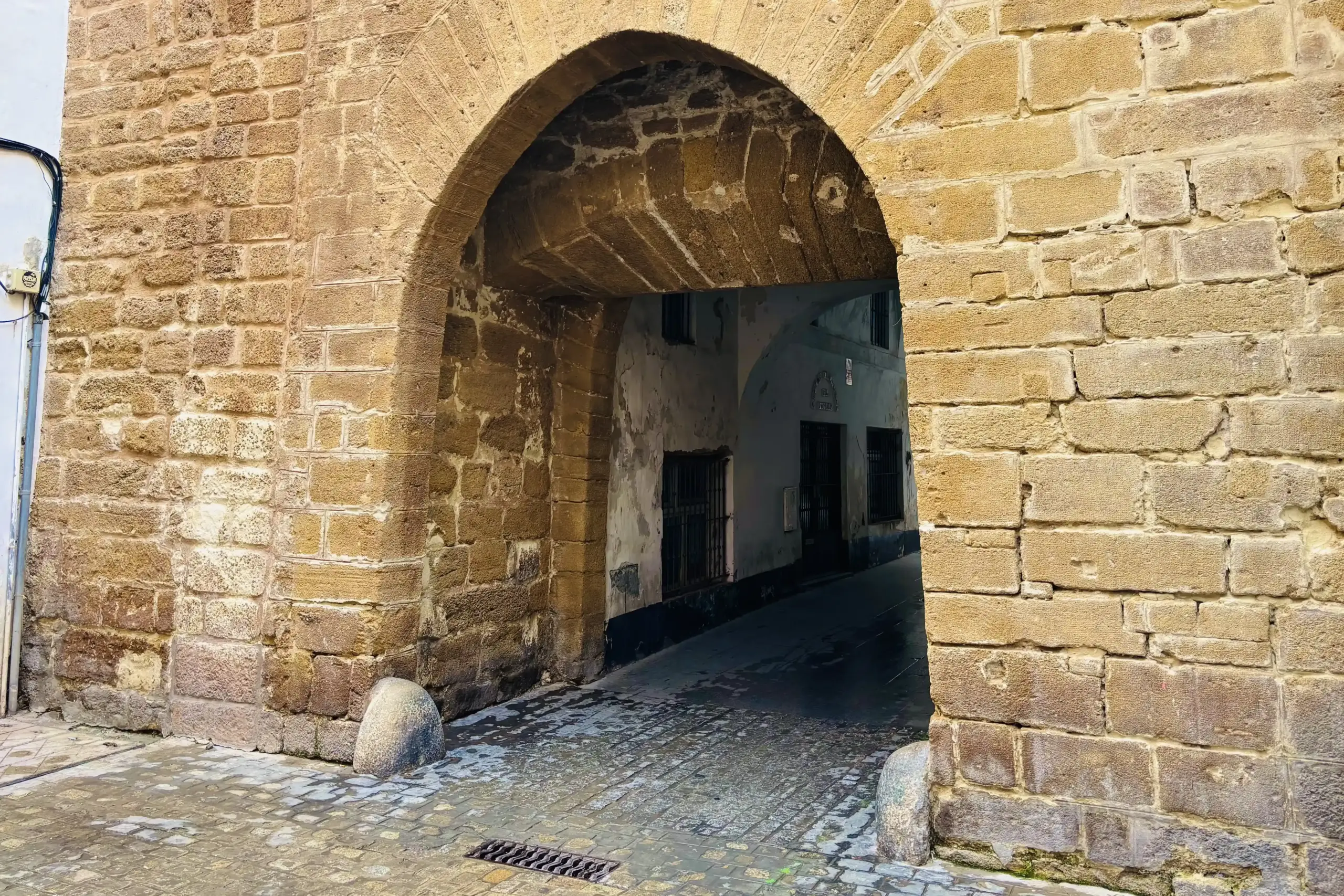
The Arco del Pópulo marking the entrance to the Barrio del Pópulo, the oldest district of Cádiz.
Arco del Pópulo
The Arco del Pópulo is one of the oldest gates in Cádiz. Originally known as the Puerta del Mar, it dates back to the 12th century, during the Arab period, and provided access to the medieval port (today’s Plaza de San Juan de Dios, where we started).
In 1587, an image of the Virgen del Pópulo with the inscription “Ave María, ora pro populo” was placed here, later desecrated in 1596 by the Anglo-Dutch forces of Essex. Between 1598 and 1600, the chapel of Nuestra Señora del Pópulo was built above it, transforming it into a devotional passage for sailors and merchants.
The Arco del Pópulo was not only a passageway, but also a place rich in civil and religious meaning.
It was through this gate, in fact, that new Bishops made their solemn entrance, welcomed by the civil council which, after passing through the arch, handed the Prelate over to the ecclesiastical authority, in front of the houses of the ruling family.
Moreover, when the two councils (civil and ecclesiastical) had to participate together in celebrations or religious functions, their meeting point was precisely at the exit of the Arco del Pópulo, in the nearby Calle Pelota.
But the reason I chose to bring you here is another. The towers and rooms attached to the arch housed the public prisons. It was a place of detention, a warning of temporal power for those entering the city. This somber function adds yet another layer of meaning to a place already dense with history.
With this awareness, we now retrace our steps and head towards the Arco de la Rosa and Plaza de la Catedral… following the same path that prisoners had to walk before their execution.
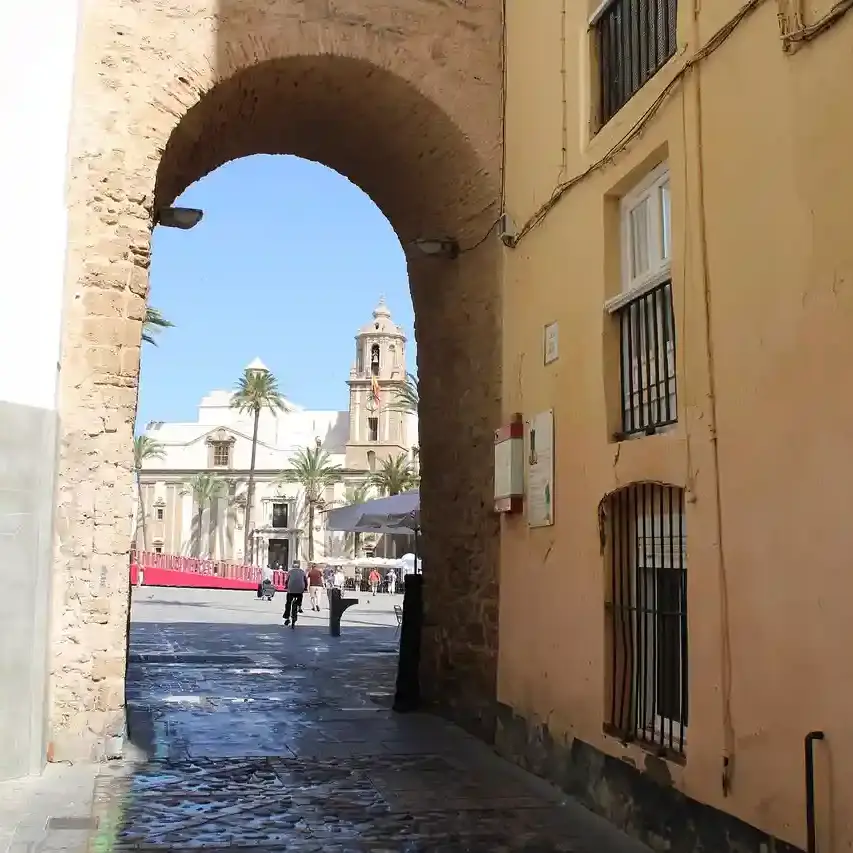
View of Plaza de la Catedral in Cádiz framed by the Arco de la Rosa, in the heart of the historic center.
Arco de la Rosa
The Arco de la Rosa is one of the best-preserved medieval gates in Cádiz. It connects the historic heart of the city to the Plaza de la Catedral Nueva and represents an important passage not only physically, but also historically.
The Arco de la Rosa probably owes its name to Captain Gaspar de la Rosa from the 18th century, or to a family of rose growers who had their shop nearby.
But the most plausible version is that its name is linked to the chapel above, dedicated to the Virgen de la Rosa (or Rosario de los Milagros), where, according to tradition, prisoners (who were held in the prison above the Arco del Pópulo) received the last rites before execution.
From the Arco de la Rosa, in fact, one accessed the Plaza de las Mesas (now Plaza de la Catedral Nueva), where a pillory, a gallows and the scaffold for capital punishments were set up, with the condemned passing through the Arco de la Rosa (formerly known as Puerta de la Rosa). The opening of the square in 1867 put an end to these practices, transforming it into an elegant urban space.
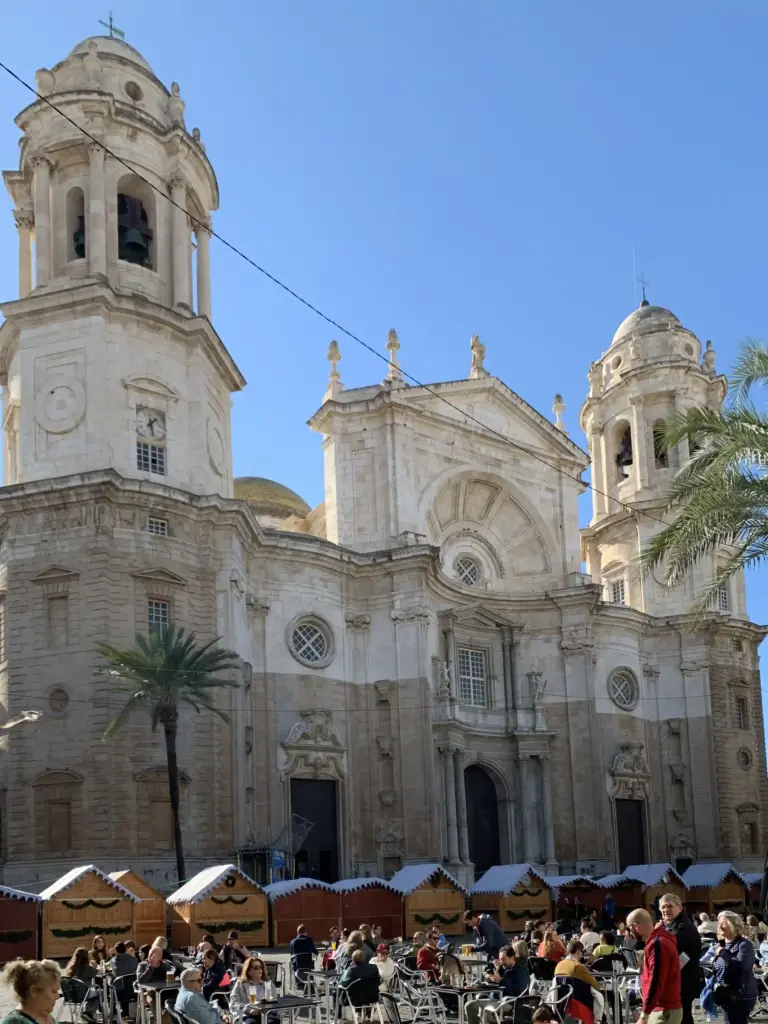
Cádiz Cathedral dominates Plaza de la Catedral with its twin towers and golden dome.
Beyond the walls
Outside the walls of the Barrio del Pópulo, Cádiz offers some of the most beautiful places in the city.
Before the current square, the area was occupied by a dense medieval urban fabric. Between the Barrio del Pópulo and today’s Calle San Juan stood the barrio Escuelas, a district that took its name from the schools run by the Jesuits, where people were taught to read and write thanks to teachers paid by them.
The decision to build a new cathedral, made necessary by the transfer of the Casa de la Contratación from Seville to Cádiz in 1717, required a central and sufficiently large space. For this reason, it was decided to completely demolish the barrio Escuelas, together with the houses of the ancient streets Marrufo (named after an old Cádiz family) and Virreina. It was a massive urban operation that erased centuries of minor history to make room for the new symbol of the city.
In addition to hosting the Church of Santiago, in a small secondary square next to the Clock Tower (Torre de Levante), in the alley that runs alongside the Cathedral, you might notice an ancient sundial carved into the stone, dating back to the 18th century, with a characteristic eight-pointed star of clear Andalusian influence. The alley is often closed to the public, but if luck is on your side, you might catch a glimpse of this small tribute to time that escapes many tourists.
New Cathedral and Clock Tower
The entrance ticket can be purchased on the official website. The ticket is cumulative and includes the visit to the Cathedral, the crypt, the Cathedral Museum and the climb to the Clock Tower. I recommend buying it online because it will also give you priority access. It is generally open from Monday to Saturday from 10:00 to 19:00, and on Sunday from 13:00 to 19:00. The monument is part of Cádiz Sacra, so if you plan to visit other religious sites such as the Oratorio de la Santa Cueva, the Oratorio de San Felipe Neri, etc., it is worth buying the combined pass, which will cost less. It is always advisable to check updated opening hours on the official website or at the tourist office, especially during special periods such as Carnival or Christmas.
Also known as the Holy Cross Cathedral on the Sea (Catedral de Santa Cruz sobre el Mar), its construction was a turning point for the city, driven by two main reasons: the poor condition of the old medieval cathedral and, above all, the need to provide Cádiz with a more monumental temple, worthy of its new role as a key center of trade with the Americas after the transfer of the Casa de la Contratación from Seville in 1717.
An undisputed symbol of the city, its yellow dome, shining like a lighthouse, is recognizable from every point in the city and from the sea. For centuries, it was the last farewell and the first welcome for sailors traveling to the Americas.
Its construction lasted 116 years (from 1722 to 1838): begun in a lavish Baroque style, it was completed in a more sober Neoclassical style, creating a unique and majestic architectural combination that reflects the changing aesthetic tastes over time.
This long construction period gave rise to a local popular saying: the cathedral, due to its enormous costs and endless construction, was compared to a “child” that “consumed” all the resources of the city, so much so that it was said that the people of Cádiz had to choose between “feeding the child (the cathedral) or their own children.”
The succession of as many as five architects in charge of the construction, combined with the city’s fluctuating economic fortunes, resulted in a surprisingly coherent building, where Baroque, Rococo and Neoclassical styles coexist harmoniously.
A popular legend tells that the dome was originally made of gold, but that its current color comes from the oxidation of materials. In reality, it is covered with golden azulejos, which shine under the sun of the Costa de la Luz.
Crossing the threshold, you will be welcomed by a white and solemn space.
What is definitely worth seeing up close are the wooden works of the Choir, the Main Altar and the chapels.
Descending into the crypt, you will discover a circular, intimate and secluded environment that houses the tombs of some bishops of the diocese and, above all, two illustrious sons of Cádiz: the great composer Manuel de Falla (1876–1946) and the writer José María Pemán.
The interesting thing about this crypt is that it is designed to withstand marine pressure, but not the seawater, which almost always floods it by filtering from the ground. It also has a particular acoustic effect, where the echo of the waves can be heard. Personally, I didn’t hear it because of the number of people present, but I’ve read many testimonies about it… so give it a try!
Climbing the Clock Tower is an unmissable experience.
The tower takes its name from the clock that was added in the mid-19th century, one of the oldest mechanisms still visible in Spain.
Unlike many bell towers, there are no narrow spiral staircases: you go up via comfortable ramps, just like in the Giralda of Seville, designed to allow people to ascend on horseback.
The reward at the top is a 360° view over Cádiz. On one side, the rooftops and domes of the historic center, with its hundred watchtowers; on the other, the vastness of the Atlantic Ocean.
Now let’s head towards the Mercado Central, passing through Plaza de las Flores or Plaza de Topete. It is a very charming and colorful square, thanks to the flower stalls. I discovered it by chance while looking for the central market, which is actually just around the corner.
Although it is not rich in history, it is one of my favorite places in Cádiz… because it is full of people, chatter, noise… in short, real life.
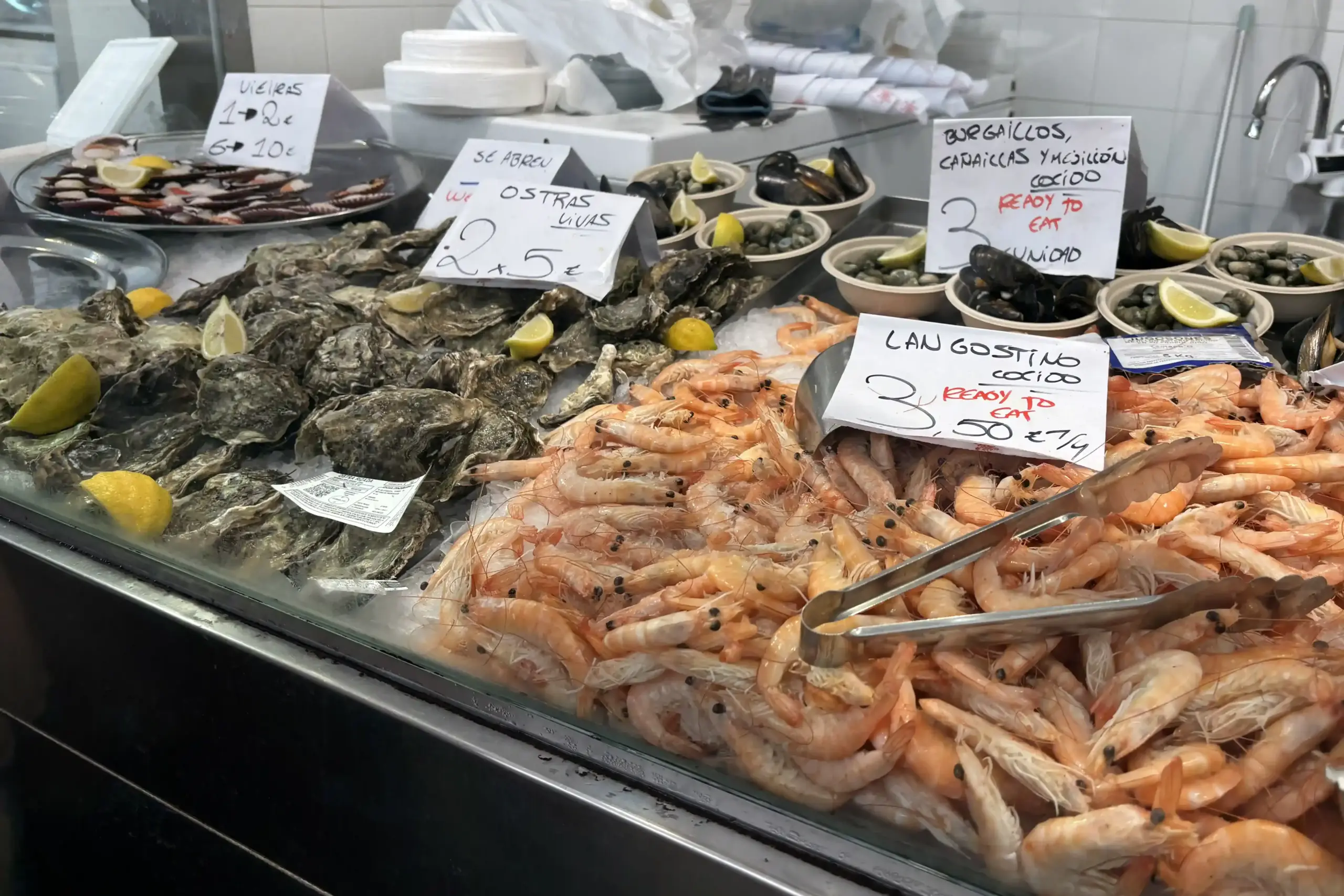
Fresh fish stall at the Mercado Central de Abastos in Cádiz, with shrimp, oysters and local catch.
Mercado Central de Abastos of Cádiz
The Mercado Central de Abastos of Cádiz is the oldest covered market in Spain, inaugurated in 1838 in Plaza de la Libertad.
It replaced an ancient vegetable garden that belonged to the convent of the Discalced Franciscans, acquired after the confiscation of ecclesiastical assets. Over time, it has been continuously expanded to meet the needs of the city, growing from the original 72 stalls to the current 173 stands.
After the latest renovation, the market took on its current appearance: a modern and airy building that has managed to preserve its historical character.
Early in the morning (8:00–11:00) is the best time to see the market in its most authentic form, with fresh fish just arrived and the locals of Cádiz doing their shopping. The atmosphere is more genuine and less touristy.
The market has also become an important tourist attraction thanks to its dining area, the Rincón Gastronómico.
Don’t be misled by the name “corner”, because it is actually a widespread restaurant area, with numerous stalls and counters where you can sit or eat standing, tasting local specialties and more.
A unique experience I discovered by talking to people near our table is the “buy and cook” option: you can buy fresh fish directly from the fishmongers in the morning and take it to one of the places in the Rincón Gastronómico, where they will cook it for you on the spot for lunch.
In short, at any time of the day it is the beating heart of the old town, full of fresh products, local flavors and real life.
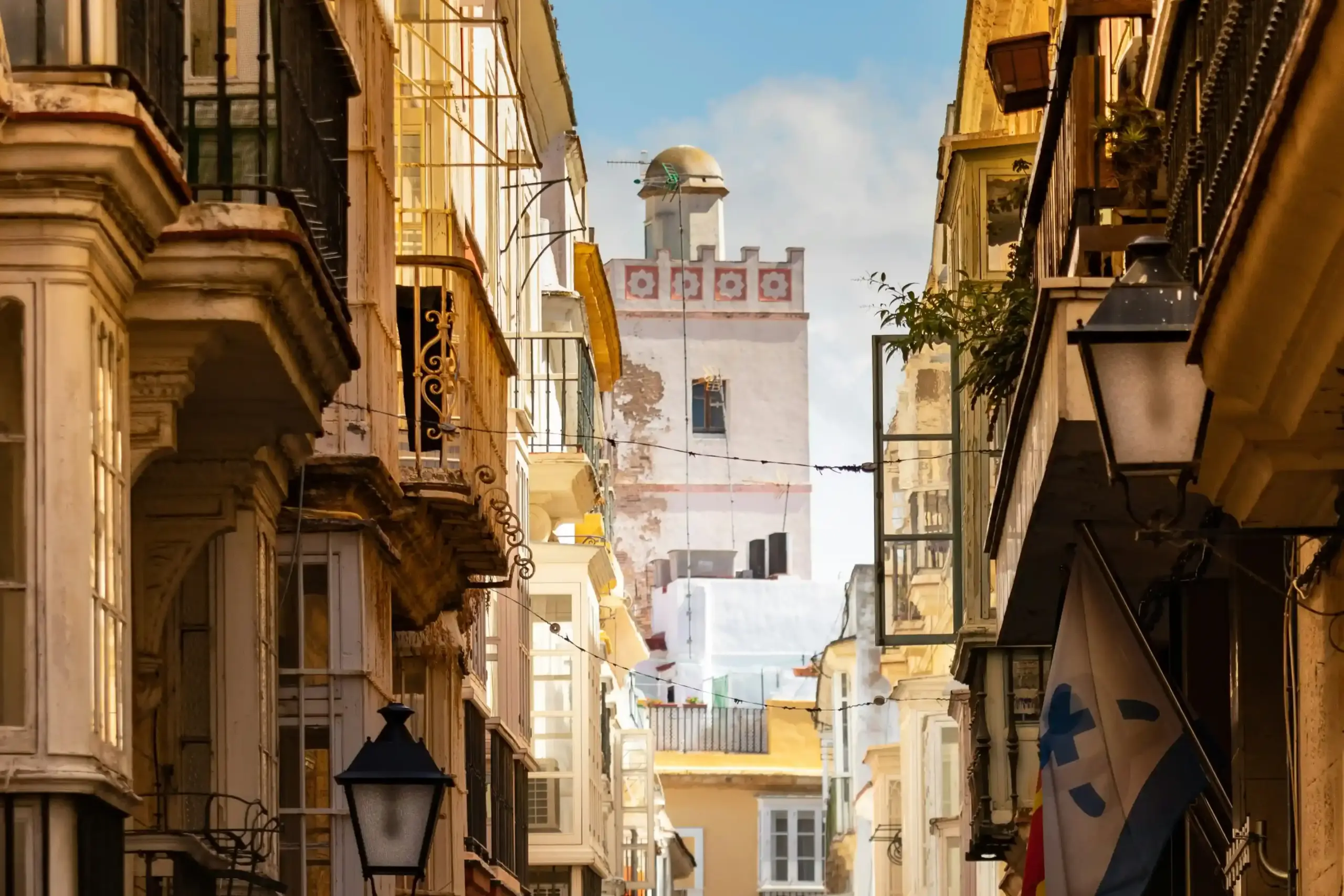
Glimpse of an alley in the historic center of Cádiz with Torre Tavira rising among the rooftops.
Torre Tavira
To access the tower, it is advisable to book your visit on the official website, especially during peak seasons, due to limited capacity. Online booking, however, only reserves your spot. I have never had any problems and have always found availability even without booking, but reserving costs nothing and will give you peace of mind. Not all available slots are published on the website. If you don’t find availability at your desired time or in your preferred language, don’t hesitate to contact them: they are very kind. Payment for the visit is made upon arrival at the reception. The cost is around €8 per person if you also want to see the Camera Obscura, otherwise €5.50. Guided tours of the Camera Obscura are available in Spanish, English, French, and German. The tower has no elevator, so it is not accessible for people in wheelchairs or with strollers (although the installation of an elevator has been planned for years).
In the eighteenth century, Cádiz was “the window to the Americas”: the silver fleets passed through here.
In the seventeenth and eighteenth centuries, Cádiz merchants built over 160 watchtowers (atalayas) on their palace-houses. These towers had a very specific function: they allowed merchants to scan the horizon and be the first to spot ships loaded with precious goods from the Americas, securing the best cargo before their competitors. It was a sort of commercial “arms race,” and the tallest tower guaranteed a decisive advantage.
In 1778, the Torre Tavira was officially designated as the official watchtower of the port of Cádiz. It was chosen precisely because it was the tallest and offered the best view over the bay and the port. The first to hold this official position was Frigate Lieutenant D. Antonio Tavira, from whom the tower takes its name.
From that moment on, the tower became the nerve center of maritime traffic control. On its terrace, a mast was raised with a complex system of flags and signals that informed the population and merchants about the arrival, departure, and nature of incoming ships. It was an incredibly advanced communication system for the time!
The Torre Tavira is not just a tower, but a true symbol of the city, the highest point in the historic center and a privileged window onto Cádiz’s maritime history. At 45 meters above sea level (33 from the city) and with 173 steps to climb, it represents the very essence of eighteenth-century Cádiz, the gateway to the Americas.
The tower stands on the Palace of Recaño (or Marquises of Riaño, according to some sources), a typical Cádiz palace-house from the mid-eighteenth century, declared a Cultural Heritage Site with Monument status in 2005.
The building is a magnificent example of classical baroque architecture, with a rectangular layout organized around an elegant central patio with galleries and marble columns. In this patio, at the center, stands a votive column with the image of the Virgin of the Rosary.
Over the centuries, the palace has had many “lives”: it has been the seat of the Supreme Court, a school, a Conservatory of Music, and today it also houses the House of Carnival, a museum/exhibition of photographs from the Cádiz Carnival across different editions. Entry is free and offers insight into what the palaces of the time were like.
Once at the top of the tower, it becomes immediately clear that Cádiz is almost an island, a peninsula entirely surrounded by the Atlantic Ocean. A visual experience that instantly reveals the deep bond between the city and the sea.
From the terrace, you can also count as many as 134 watchtowers that still dot the historic center. This is tangible proof of Cádiz’s glorious past as the capital of trade with the Americas, a unique architectural heritage in the world.
But the attraction that makes the Torre Tavira truly unique is the Camera Obscura, installed in 1994 and officially inaugurated in 1995. It was the first camera obscura in all of Spain and represented an absolute innovation in the national tourism scene.
The story behind its creation is fascinating and entirely female-driven. The idea came from Belén González Dorao, an entrepreneur from Cádiz, after her brother Ignacio, on his honeymoon, visited the camera obscura in Edinburgh and was amazed by it. Belén went to see it in 1992 and decided to pursue the idea, even though many initially thought they were “crazy.” Her reasoning was simple and brilliant: if a camera obscura worked in gray and cloudy Edinburgh, how could it not work in Cádiz, the city of light?
After extensive research and contacts with lens experts in England, the choice fell on the Torre Tavira, which at the time was closed and unused. With the support of the local administration, the project became reality and, on December 22, 1994, it opened to the public. On the first day, no one showed up, but through passion and promotion, the Camera Obscura has become one of the most loved and original attractions in Cádiz.
The experience is astonishing: in a dark room, you see the life of the city projected in real time, with a realism and sharpness that leave you speechless.
Belén González Dorao even “exported” her know-how, installing camera obscuras in other Spanish cities (such as Jerez, Seville, Santander) and around the world, including Lisbon (in the Castle of São Jorge) and Havana.
Oratorio de San Felipe Neri
Admission to the monument can be purchased on the official website (around €5) and it is part of Cádiz Sacra. If you plan to visit other religious monuments such as the Cathedral, Oratorio de la Santa Cueva, etc., it is worth buying the combined pass, which will cost less. It is always advisable to check updated opening hours on the official website or at the tourist office, especially during particular periods such as Carnival or Christmas. Access to the Oratory is paid, but on Sundays entry is free from 10:00 to 14:00. I was in Cádiz on Andalusia Day and it was surprisingly closed. So check the website before planning your visit.
The Oratory of San Felipe Neri is a must-see stop on your itinerary in Cádiz.
The Oratory is a jewel of Baroque architecture with a troubled history and immense political significance. It was built between 1685 and 1719 based on a design by Blas Díaz, with a distinctive elliptical layout. Its spectacular dome (with a double drum and eight large windows) was later rebuilt following an earthquake that significantly damaged it.
But its true importance lies in its role during the Napoleonic invasion. The Oratory became the seat of the General Cortes, where Spanish and American liberal deputies gathered to draft and proclaim, on March 19, 1812, the Constitution of Cádiz, affectionately known as “La Pepa.”
Imagine the church space transformed into a parliamentary hall: • In the center, the deputies seated. • Where the priest usually stands, the president and the government. • On the sides and in the galleries, the public watching.
This layout made the Oratory perfect for hosting a large assembly (around 200 deputies) at a time when Cádiz was the only Spanish city free from Napoleonic occupation.
The interior is an explosion of baroque and rococo art, with two absolute masterpieces not to be missed: the main altar and the Immaculate Conception by Murillo (one of the finest works by the famous Sevillian painter Bartolomé Esteban Murillo, particularly valuable because it is said to have been the last canvas he painted before his death).
On the external façade, numerous commemorative plaques honor the “doceañista” deputies who supported it, placed on the occasion of the first centenary in 1912.
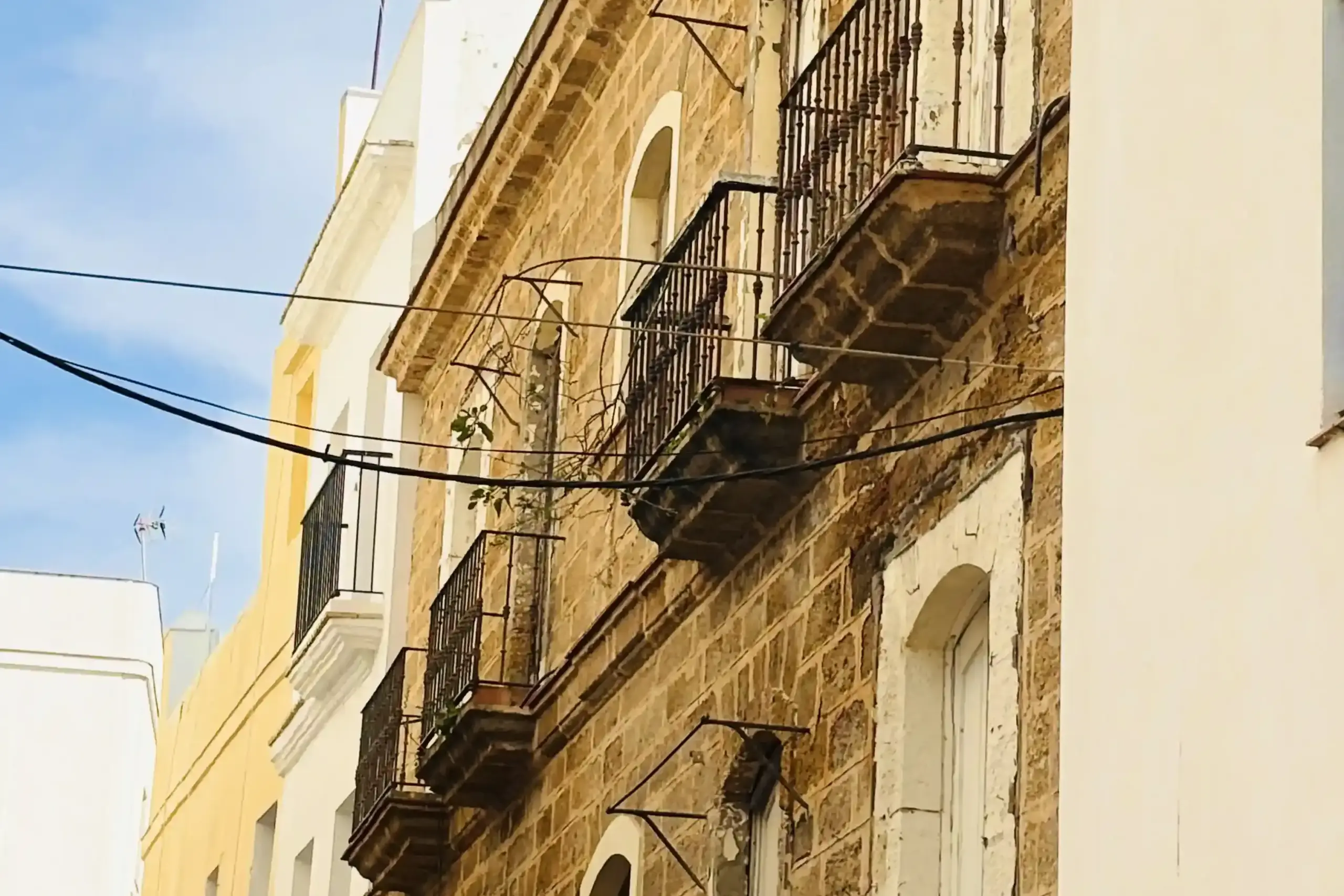
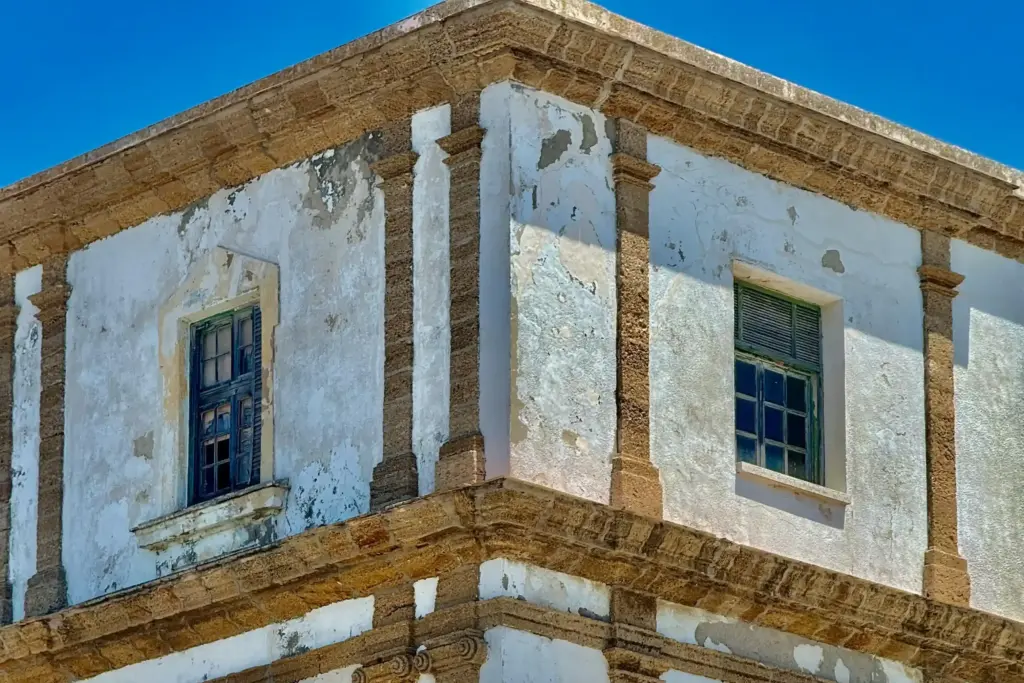
Typical weathered façade in the historic center of Cádiz.
Oratorio de la Santa Cueva
Admission to the monument can be purchased on the official website (around €5) and it is part of Cádiz Sacra. If you plan to visit other religious monuments such as the Cathedral, Oratorio de San Felipe Neri, etc., it is worth buying the combined pass, which will cost less. It is always advisable to check updated opening hours on the official website or at the tourist office, especially during particular periods such as Carnival or Christmas. Access to the Oratory is paid, but on Sundays entry is free from 10:00 to 14:00. I was in Cádiz on Andalusia Day and it was surprisingly closed. So check the website before planning your visit.
The Oratorio de la Santa Cueva is one of the most precious and lesser-known gems of Cádiz, a place that holds an extraordinary concentration of art and music within a unique architectural setting.
Its history begins with an enlightened priest, Don José Sáenz de Santamaría, who in 1766 was responsible for the spiritual direction of the congregation of the nearby Iglesia del Rosario. The existing oratory was too small to accommodate the many faithful who gathered there, so Sáenz de Santamaría decided to build a new chapel.
After the death of his father and only brother, he inherited the title of Marquis Valde-Iñigo and a considerable fortune, which he generously used to embellish the Church of the Rosary and, in particular, to create this oratory.
The Oratory is considered one of the greatest examples of Neoclassical architecture in Andalusia and was declared a Historic-Artistic Monument of national importance in 1981.
The building features a deliberately simple façade, with a public painting of the Virgen del Refugio. But it is inside that its true essence is revealed, divided into two completely different and complementary spaces.
The lower chapel is an underground space of great austerity and introspection, designed for meditation and penance. Here you will find a striking marble Calvary depicting the Passion and death of Christ. It is in this intimate and bare space that the Good Friday tradition took place.
Ascending to the upper chapel, the contrast is total. This space is extraordinarily rich and luminous. It has an oval layout and is richly decorated with stucco, fine marbles, and paintings by various artists. This is where the most precious treasures are concentrated.
The true jewel of the upper chapel, however, is the three lunettes frescoed by Francisco de Goya, considered his most successful group of religious works: The Parable of the Wedding Feast of the King’s Son, The Last Supper (La Santa Cena), and The Multiplication of the Loaves and Fishes.
📍 Una curiosità
Per gli appassionati di musica, la composizione “Le sette ultime parole del nostro Redentore sulla croce” (Die sieben letzten Worte unseres Erlösers am Kreuze) del celebre compositore austriaco Franz Joseph Haydn fu scritta per essere eseguita proprio nella suggestiva atmosfera della cappella bassa dell’Oratorio, su richiesta del sacerdote (una volta diventato marchese). La tradizione di eseguire Le Sette Parole il Venerdì Santo nell’Oratorio si è mantenuta viva fino ai giorni nostri.
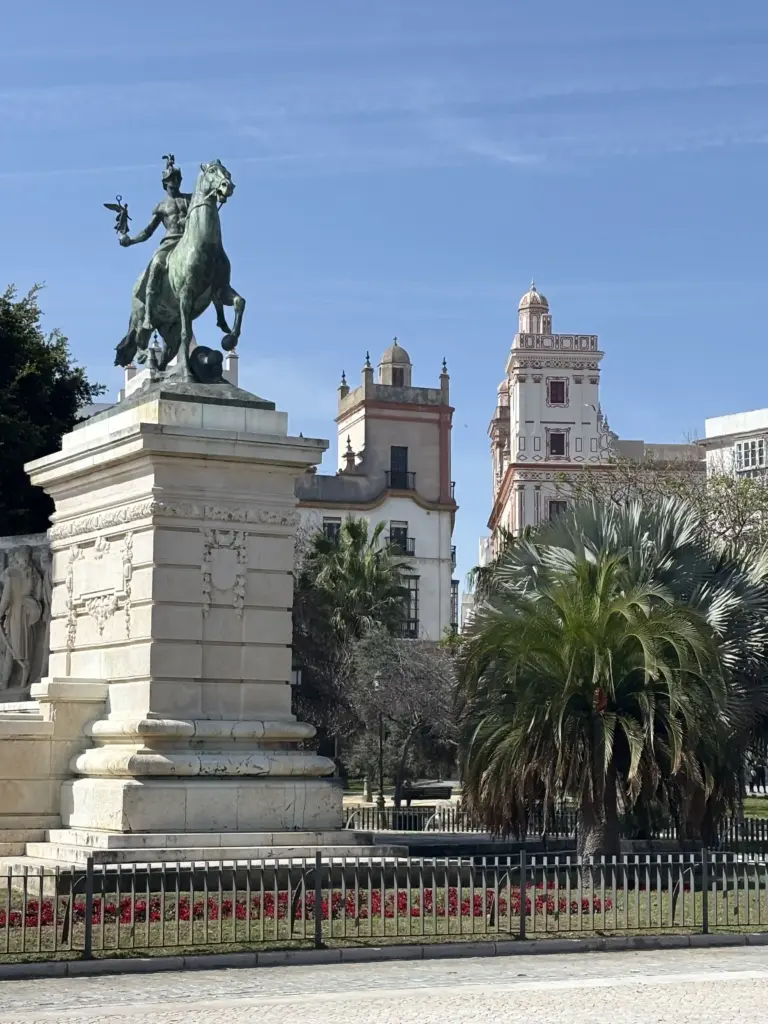
The Monument to the Constitution of 1812 in Plaza de España in Cádiz, dedicated to the Cortes of Cádiz.
Plaza de España and Monument to the Cortes
This spacious square celebrates the Constitution 1812, a symbol of Spanish freedom. The large central monument, with allegorical statues representing War and Peace, was built in honor of La Pepa (the Constitution of Cádiz). According to a curious tradition, every March 19—Saint Joseph’s Day—locals bring flowers to the base of the monument shouting “¡Viva La Pepa!”, the exclamation that became synonymous with independence and Cádiz pride.
It is a solemn, almost theatrical square, different from the intimate and poetically chaotic soul of Cádiz. To be honest, it wasn’t the one that captivated me the most. Fortunately, right next to it, there is Plaza de Mina, more intimate and pleasantly shaded.
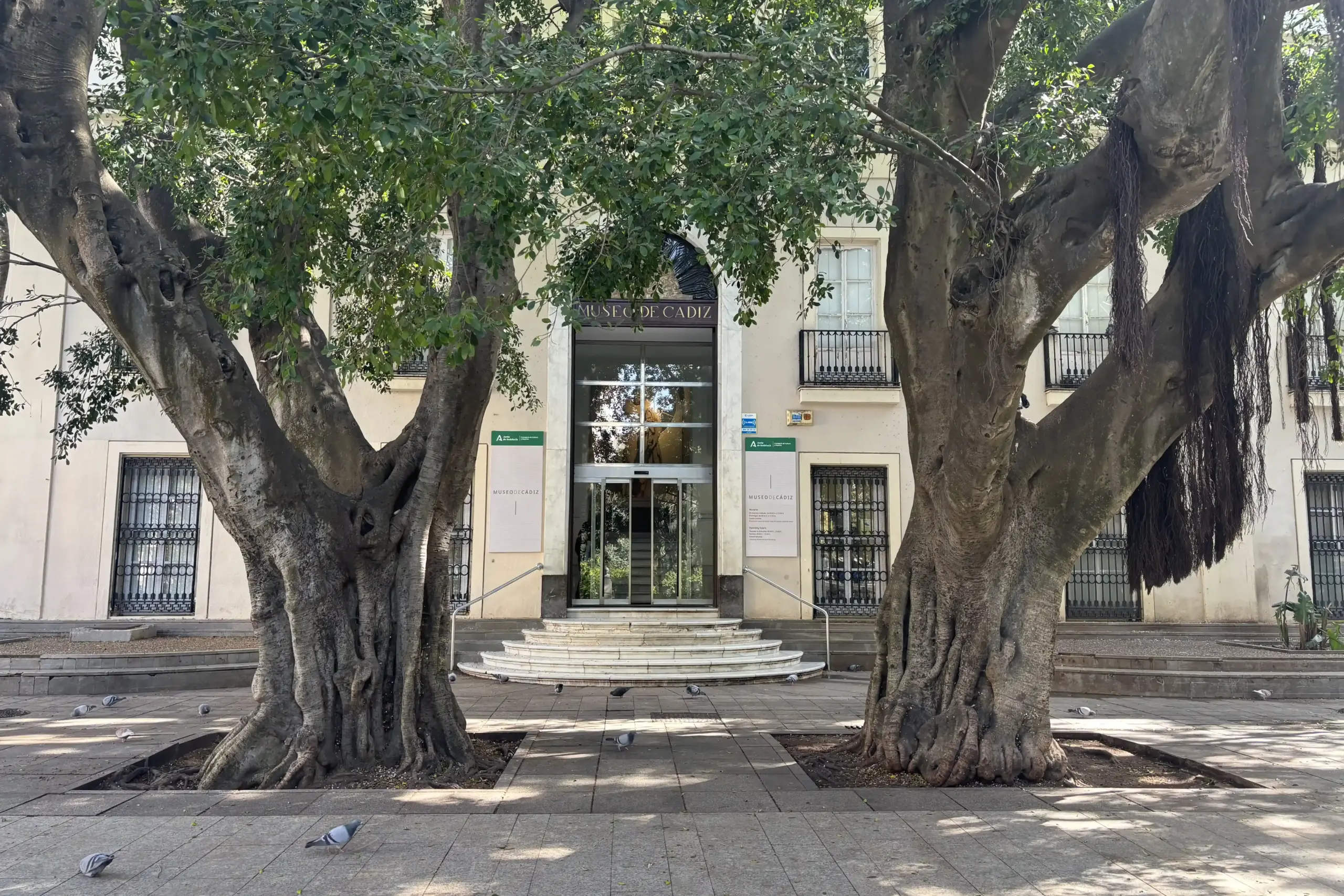
Museo de Cádiz in Plaza de Mina, among monumental trees in the historic center of Cádiz.
Museo de Cádiz
Before planning your visit, it is essential to keep in mind that the museum has undergone and is still undergoing major renovation and expansion works. Parts of the museum are closed and I myself was only able to see a small portion of it. Check the official website for all updates. Keep in mind that admission is free (for EU citizens), so the visit is a low-risk opportunity: even if a section is closed, you will still spend quality time.
It is located in Plaza de Mina, considered the most beautiful square in Cádiz. It is a romantic 19th-century garden surrounded by Isabelline palaces. It really is very charming.
The Museum of Cádiz houses three sections: Archaeology (ground floor), Fine Arts (first floor), and Ethnography (second floor), and is one of the most important museums in Andalusia.
If you are passionate about archaeology, you absolutely should not miss it. The Phoenician finds and Roman remains, including the sarcophagi, are of extraordinary importance. It is a unique opportunity to see some truly exceptional pieces. I was particularly impressed by the sarcophagi, but also by the two-dolphin ring, which even today would look perfectly wearable.
If your main interest is art (especially Zurbarán), I recommend checking the status of the renovation work shortly before your trip, perhaps by calling the museum or checking online, to find out whether the section has reopened.
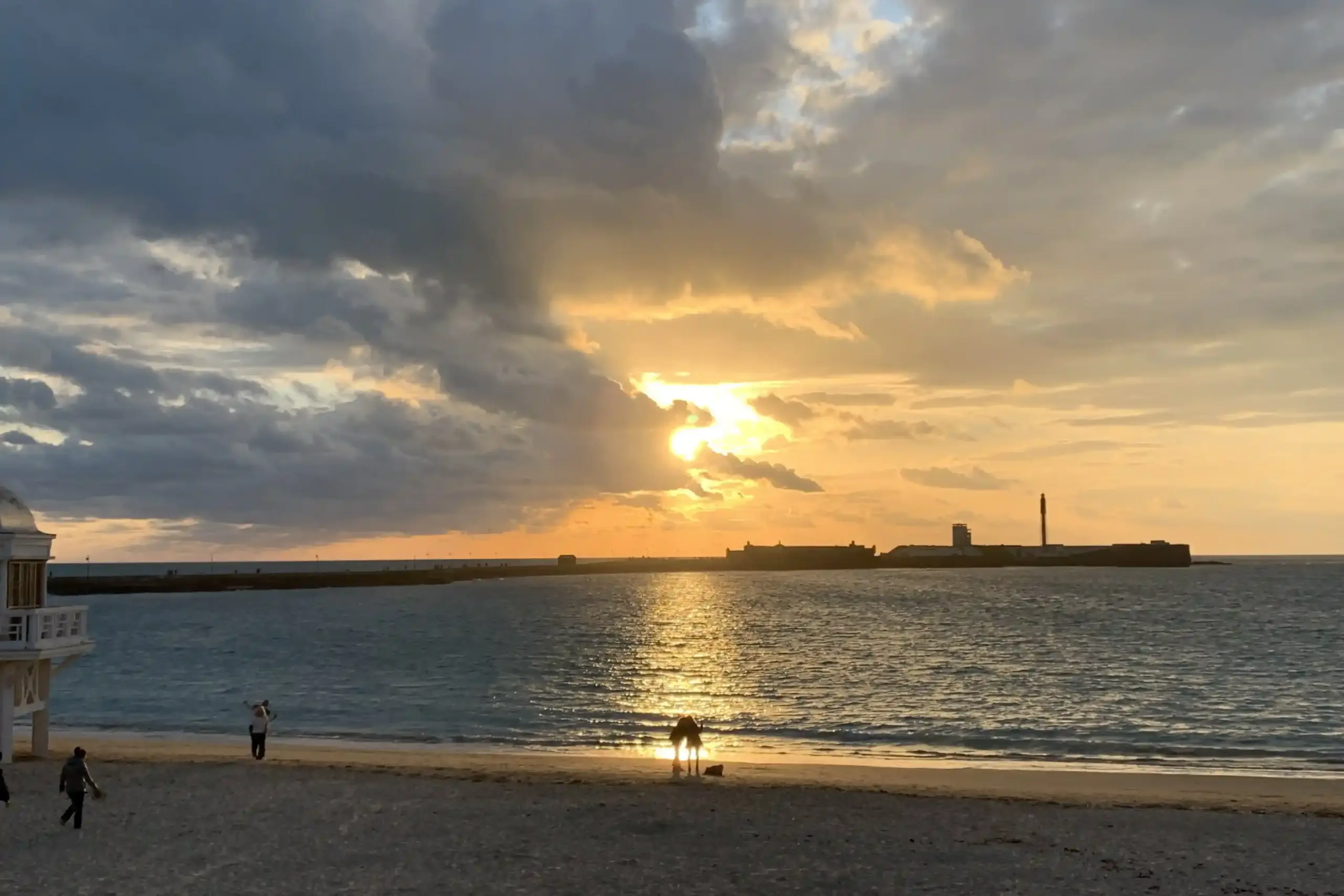
Sunset at Playa de la Caleta, with the silhouette of Castillo de San Sebastián standing out against the golden light of the Atlantic.
The sea and the popular soul
Once you have finished exploring the historic center, all that remains is to approach another pillar of the city: the sea.
The real destination is the Campo del Sur, the wonderful seafront of Cádiz, but to get there we will slightly extend our walk to follow the edge of the city and admire the sea from every side.
I recommend continuing your itinerary toward a place that is its perfect complementary opposite: the Alameda Gardens Hermanas Carvia Bernal y Clara Campoamor. If the theater is the temple of culture and the noise of Carnival, this is the green living room of Cádiz, the perfect place for a relaxing walk with a sea view.
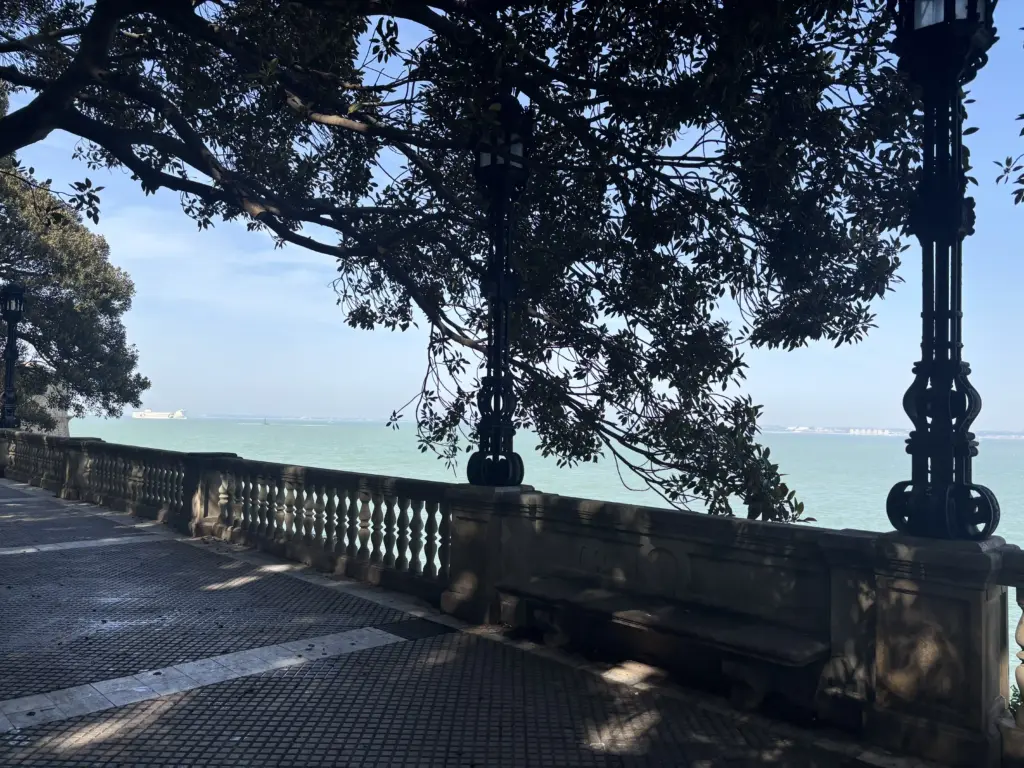
View of the Atlantic Ocean from Alameda Hermanas Carvia Bernal, an elegant promenade in Cádiz.
Alameda Hermanas Carvia Bernal y Clara Campoamor Garden
This beautiful paseo-garden, which runs along the sea parallel to the ancient walls, is actually the union of two spaces that were once separate and are now combined into a single botanical wonder.
The Cádiz City Council decided to rename these gardens to give visibility to important female figures among the people of Cádiz: Clara Campoamor (a politician and strong supporter of women’s suffrage) and the Carvia Bernal sisters (activists for women’s rights and founders of a progressive women’s association in the early 20th century).
Walking here means immersing yourself among monumental trees, such as the two Ficus macrophylla, native to Australia and planted in the early 1900s, whose grandeur no photograph can truly capture. In addition to the ficus trees, you will find specimens of ombú, Indian laurel, California and Mexican palms nearly 100 years old, and even a dragon tree. It is a true open-air botanical garden.
The garden was redesigned by the architect Juan Talavera y Heredia, the same who worked on the Murillo Gardens in Seville. His regionalist style is unmistakable: wrought iron benches and lampposts, glazed ceramics from Seville decorating fountains and flowerbeds, adding vibrant touches of color, and the characteristic “escaragüaitas”, watch posts which here, unlike usual, are positioned at ground level rather than elevated.
The garden is also an open-air art gallery, with monuments and busts dedicated to historical figures from Cádiz and Latin America. This connection reflects Cádiz’s importance as a port to the Americas.
It is the ideal place for a refreshing break away from the bustle of the center, yet just a few minutes’ walk from all the main landmarks. Sitting on a bench under the shade of a century-old ficus, with the sea breeze and views over the Bay of Cádiz (with Rota and El Puerto de Santa María on the horizon), is an experience that will stay with you.
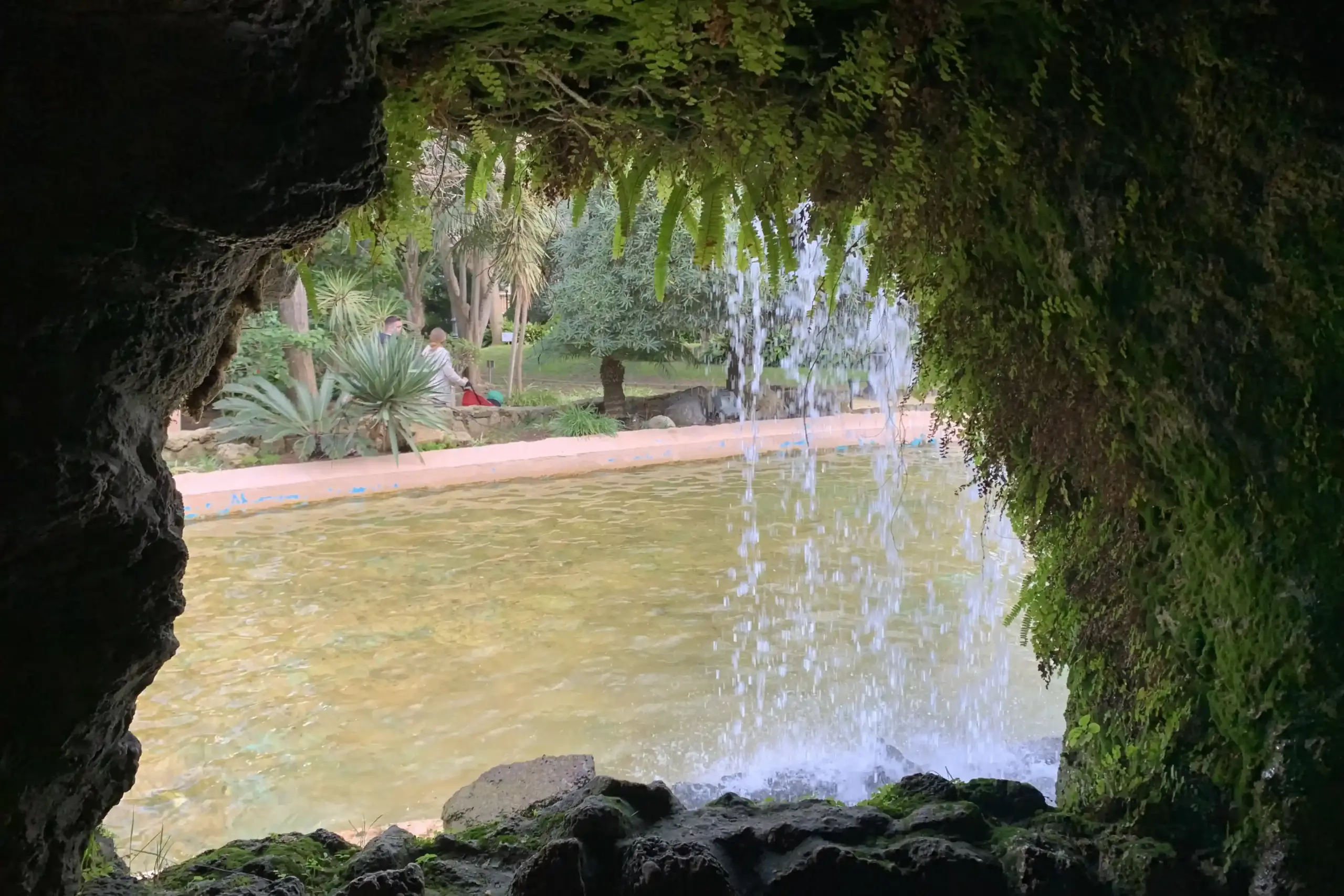
The small waterfall of Parque Genovés, seen from inside a quiet, green grotto.
Paseo de Santa Bárbara and Jardín Genovés
Keeping the sea on our right, we continue our walk toward the Campo del Sur, passing through the Paseo Santa Bárbara, which runs across the Jardín Genovés.
The Paseo de Santa Bárbara is a historic tree-lined promenade along the sea, perfect for relaxing and admiring breathtaking sunsets. Created in 1909 as a garden promenade, it has always been the “urban living room” of the neighborhood, a meeting point for the local community.
Adjacent to the paseo, the Parque Genovés is much more than a simple park: it is a historic 19th-century romantic garden, declared a Cultural Heritage Site by the Junta de Andalucía.
I discovered that many people think the park is linked to the Genoese, given the mercantile and maritime soul of Cádiz, but that is not the case. The park takes its name from the mayor Eduardo Genovés y Puig, who in 1892 carried out the most important renovation, creating its current appearance.
There is a very recent and spectacular addition that connects these two spaces even more. It is the Pérgola Mirador de Santa Bárbara, a modern structure inaugurated recently which, unfortunately, I have not yet seen: a pergola-walkway that acts as a bridge between the Parque Genovés and the new Paseo de Santa Bárbara.
It has a covered and glass-enclosed lower level (hosting spaces for cultural activities, a café, public restrooms, and facilities for gardeners) and an open upper level that serves as an elevated promenade-viewpoint.
At night, the double translucent layer is backlit, creating a striking band of light facing the bay. I definitely need to come back to see it!
Continuing our walk, we will encounter the Parador de Cádiz (staying here is a dream!) first, and the Castillo Santa Catalina immediately after.
One of the iconic sentry boxes on the walls of Cádiz overlooking the Atlantic Ocean.
Castillo de Santa Catalina
The Castillo de Santa Catalina is the oldest fortress in Cádiz and represents an exceptional example of Early Modern military architecture that has survived to this day without major alterations. It was built starting in 1598 by order of Philip II, two years after the devastating sack of the city by Anglo-Dutch troops.
Its most fascinating feature is its star-shaped layout with three points facing the sea. The land-facing side, on the other hand, is protected by two semi-bastions and a moat that was once filled with water through a system of sluices. A bridge leads to the only entrance, protected by an upper guardhouse.
In 1693, Charles II ordered the construction of a chapel dedicated to Saint Catherine of Alexandria and the Immaculate Conception. Inside the castle, the sculpture of the Virgen del Buen Camino (or del Buen Viaje) is still preserved. A curious detail: the Child Jesus she holds is missing both feet. Legend has it that a sailor, wanting to take the statue with him for protection during his travels, and unable to steal it entirely, decided to take only a small part.
Like many historic buildings, this castle has changed function over the centuries. It served as a military prison until 1991 (notable figures such as independence heroes from the colonies or opponents of Franco’s regime were imprisoned here), and today it has been restored and transformed into a large cultural space.
It is a perfect stop along the seaside walk and an ideal place to end the day, admiring the sunset, with the castle silhouetted against a fiery sky.
Playa de la Caleta
Playa de la Caleta is located in the heart of the La Viña district, nestled between two historic fortresses: the Castillo Santa Catalina (on the right facing the sea) and the Castillo San Sebastián (on the left). It is the smallest and most secluded of the city’s beaches.
This place has been used as a natural harbor since Phoenician times, later by the Carthaginians and Romans. It stood near the channel that separated the ancient islands on which Cádiz was built. Its beauty has inspired musicians and poets and is a recurring theme in the songs of the famous Cádiz Carnival.
La Caleta has been the backdrop for several films, including the famous 007 – Die Another Day (with Halle Berry emerging from the water), Alatriste, Manolete, and El amor brujo.
In addition to the two castles, the beach overlooks a very distinctive building: the former spa complex of Nuestra Señora de la Palma y del Real, inaugurated in 1926. With its characteristic shapes stretching out toward the sea, it is now home to the Underwater Archaeology Center of Andalusia.
The beach is also the setting for a curious local tradition: the Burial of the Mackerel (Entierro de la Caballa). At the end of August, as a farewell to summer, a large mackerel figure is carried in procession through the La Viña district to La Caleta beach, where it is finally burned. The celebration is accompanied by performances from Carnival groups, music, and food-related activities. It is an ironic and joyful ritual that blends satire and folklore.
In summer, you won’t be able to resist a swim in the blue waters of the Atlantic Ocean. At sunset, it reveals its best side, offering you a bath in gold.
Monumental gate that provides access to the path leading to Castillo de San Sebastián.
Castillo de San Sebastián
After exploring the Castillo de Santa Catalina and La Caleta beach, it is time to discover the other fortress framing this corner of Cádiz: the Castillo de San Sebastián. While Santa Catalina is the oldest, this one is the most legendary and mysterious, a place where history blends with myth and the views are absolutely breathtaking.
The history of this place reaches back to very ancient times.
According to classical tradition, the islet on which the fortress stands was once home to the ancient Phoenician temple of Melkart, later dedicated to the Greek god Kronos (the Roman Moloch). A sacred place since the very beginnings of Cádiz’s history.
In 1457, a group of sailors from Venice, stricken by the plague, were given permission to stop on the islet to recover. In gratitude for their survival, they built a chapel dedicated to San Sebastián, from whom the castle takes its name. It is said that they also carved the arms of Venice as a sign of gratitude for the hospitality they received in Cádiz.
After Cádiz was sacked by the Anglo-Dutch forces, as happened with Santa Catalina, it was decided to fortify the islet. In 1613, a watchtower (which had already existed during the Muslim period) was rebuilt for defensive purposes and to serve as a lighthouse.
In 1860, the present raised walkway was built, permanently connecting the islet to the mainland and making it accessible at all times.
On the foundations of the old tower, the present lighthouse was erected in 1908, an iron structure designed by Rafael de la Cerda. It is unique in Spain and was the country’s second electric lighthouse. It rises 41 metres above sea level and was restored in 2017.
Today the castle has a dual role, cultural and scientific: cultural, because the casemates host exhibitions and the outdoor spaces are used for concerts and events, and scientific, because it is home to LABIMAR, the University of Cádiz’s Marine Research Laboratory.
Access is not always guaranteed: the entrance is sometimes closed for a few hours during the day for reasons that are not always clear, so if that happens, be patient.
Although you will find mixed opinions (some people find it a little bare and lacking in information, while others consider it a magical place because of the views and the walk), for me the real treasure of the Castillo de San Sebastián is the experience itself of walking over the water towards a legendary fortress. I crossed it in incredibly strong winds and rough seas. It was a fun experience, but above all one I will always remember!
In addition, this raised walkway over the sea offers a complete view of Cádiz, the Atlantic Ocean and the Atlantic coastline. It is the perfect place for an unforgettable sunset, perhaps after exploring La Caleta.
Glimpse of an alley in the La Viña district in Cádiz, among houses and traditional bars.
La Viña District
The Barrio de La Viña is the most authentic and popular neighborhood in Cádiz’s historic center, between Playa de La Caleta and Plaza de las Flores, a guardian of the city’s most genuine traditions, the temple of Carnival, and the kingdom of good seafood.
The name “La Viña” tells the story of its origins: this area was once covered with vineyards, which gave way to urban expansion in the 18th century. Unlike the more aristocratic areas of Cádiz, the neighborhood became home to the working classes connected to fishing, thanks to its proximity to La Caleta. This authentic maritime spirit can still be felt today in every narrow street.
If you have little time and want to capture the essence of the neighborhood, head to Calle Virgen de la Palma, its main artery. Here you will find colorful walls and the typical hanging flower pots that create that postcard-perfect Andalusian atmosphere. Neighborhood life unfolds naturally: women returning from their shopping, spontaneous flamenco on summer nights, cantaores leaning out from balconies to sing the alegrías typical of Cádiz.
During the Cádiz Carnival, recognized as intangible heritage, the chirigotas (satirical musical groups) fill the streets with ironic verses and biting songs.
If you have made it this far, you will already have understood that La Viña is where Cádiz reveals its most authentic side. Forget the monuments (although there are some) and simply let yourself go: wander aimlessly through the narrow streets, order some fried fish with a beer (a cazón tapa in adobo at Casa Manteca, a legendary bar covered in photos of bullfighters and artists, is practically a must), listen to the locals chatting and let their sense of humor rub off on you.
As they say here: “El barrio de la Viña es donde late el corazón de Cádiz”. And after visiting it, you will find it hard to disagree.
The silhouette of Cádiz Cathedral seen from Campo del Sur, with the Atlantic crashing against the walls.
Campo del Sur
Returning to La Caleta, we now head towards Avenida Campo del Sur.
The Campo del Sur is the great southern seafront of Cádiz’s historic center, a promenade stretching for around 1,300 metres from the former Cárcel Real (now Casa de Iberoamérica, near Puerta de Tierra) to the Baluarte de los Mártires, where La Caleta beach begins.
Also known as the “Cádiz Malecón” (malecón gaditano) because the brightly painted façades of its houses recall Havana’s Malecón, it offers one of the city’s most iconic views, with the Atlantic crashing against the ancient walls, the golden silhouette of the Cathedral in the background, and pastel-colored buildings lining the waterfront.
The origin of the name “Campo del Sur” follows a historical and practical logic. In the Early Modern period, the term “campo” referred to open spaces outside the city walls, areas kept free of buildings to allow surveillance and defense. This “campo” extended south of the walled enclosure, exposed to the Atlantic Ocean, and from here it was possible to monitor the approach of enemy ships.
As you can imagine, the Campo del Sur was not originally conceived as a recreational promenade, but as an essential defensive infrastructure. The waterfront is dominated by an imposing continuous system of defensive walls, with bastions and platforms designed to withstand the force of the waves. In 1948, the characteristic concrete blocks (tetrapods) were installed to protect the walls from marine erosion.
The section known as “Paseo del Vendaval” bears a name that is anything but accidental: this is one of the areas most exposed to storms and fierce winds (vendaval meaning a strong, violent wind). It is said that the walls had to be rebuilt almost 20 times and that part of the La Viña district was swallowed by the sea. In 1915, a violent storm surge opened a breach more than 30 metres wide just behind the Cathedral, exposing the foundations of the building.
Today, the Campo del Sur is a civic space, a promenade and popular viewpoint loved by both locals and visitors. It is the perfect place for a sunset walk, when the sun sinks into the Atlantic and the centuries-old walls still tell the story of a city that has learned to withstand both the sea and war.
Traditional tapas in Cádiz: shrimp fritters (tortillitas de camarones), mojama, and potato salad in a tavern in the historic center.
Where to taste a bit of Cádiz
The sea is Cádiz’s true guiding star. It shapes its history, its character and, inevitably, its cuisine.
Cádiz cuisine is deeply rooted in ultra-fresh fish, which takes center stage in both tapas and main dishes.
And you can say many things about Cádiz… but when it comes to cooking fish, few places do it as well.
Below are a few quick suggestions on where to go and what to order, but keep one thing in mind: if you really want to taste the soul of the city, do it in its most authentic neighborhoods, such as La Viña. There are so many bars here that going from one tapas stop to another, sipping wine or beer while standing at the counter, almost becomes a natural ritual.
Taberna Casa Manteca: I have already mentioned it in the La Viña section as one of Cádiz’s most iconic places to eat. Here you can try tortillitas de camarones, chicharrones and other classics such as cazón en adobo, all in an authentic setting with walls covered in photographs and local memorabilia.
Taberna El Tío de la Tiza: a small, authentic tavern where you can sample tapas and local dishes in a traditional atmosphere. The bluefin tuna from the almadraba, when in season (April-June), whether served as tataki or grilled a la plancha, is worth the trip alone.
El Faro de Cádiz: if you want a more “special” dinner in Cádiz, this is the place. A city classic for enjoying fresh fish and seafood, including some of the best versions of tortillitas. It is often mentioned as one of the must-visit restaurants on the local food scene. Prices are a little higher than average, but the quality is guaranteed.
Asador Puntaparrilla: for meat lovers, this restaurant is a perfect choice in the relaxed setting of the Paseo Marítimo. It also offers excellent fish options, but trust me… don’t miss the Carne de La Janda and the presa ibérica!!!
Casa Lazo: this restaurant has a more contemporary style, with carefully prepared Mediterranean cuisine that never feels pretentious. It is ideal if you want somewhere elegant but relaxed. I tried the red prawn tartare… it simply melted in my mouth!
Above all, remember that eating in Cádiz means sitting down without rushing, hearing laughter from the next table and realizing, once again, that everything here feels simple, but never ordinary.
🎒THE SMART SUITACASE
Cádiz is a city that invites you to spend plenty of time outdoors, wander without rushing and enjoy your days between the historic centre, the seafront and some of the most beautiful urban beaches in Andalusia.
For this reason, when packing your suitcase, it is better to focus on comfort and practicality rather than quantity.
The sun is one of the city’s main attractions throughout the year.
A hat, sunglasses and good sunscreen are essential even in winter: the light reflected by the ocean is intense, especially during long walks along Campo del Sur or Playa de la Victoria.
I always carry this
sunscreen
with me. It is small but very effective.
Cádiz is almost completely flat, but you will walk a great deal, often along cobbled streets and through the narrow lanes of the historic centre.
A pair of comfortable shoes that you have already worn in is therefore essential, especially if you are planning to walk along the entire seafront or explore the area between the Cathedral, La Viña, La Caleta and Parque Genovés.
A reusable water bottle is a very useful companion, especially when walking along Campo del Sur and the seafront, where shade is not always guaranteed.
I bought a collapsible silicone bottle from
Natura,
although it is often out of stock.
Alternatively,
you can find a similar one here.
It takes up very little space in your bag once it is empty.
If you are planning to go to the beach, there is no need to take half your home with you:
a
lightweight towel
—I bought this one specifically so that I could always carry it with me when visiting a seaside city—,
a pair of sandals and a practical bag are more than enough.
Cádiz’s urban beaches are informal, easy to reach and truly beautiful: perfect for an unplanned break between sightseeing stops.
The most important item, however, is probably a
waterproof and windproof jacket
.
The climate is generally mild, but Cádiz is completely exposed to the Atlantic and the wind can become very strong even on a sunny day.
The jacket will be particularly useful along the seafront, at La Caleta and during a catamaran crossing to El Puerto de Santa María or Rota.
When travelling in autumn or winter, you should also pack a light scarf or neck warmer and a hat.
The Atlantic wind can feel surprisingly sharp and make the temperature seem much lower than the weather forecast suggests.
Finally, small items such as a power bank may seem unimportant, but they can make your days much easier, especially when you are constantly using maps to find your way around and taking photographs of the city’s most beautiful corners.
I was given
this one
and I am very happy with it.
There are, of course, countless different models available, but whichever one you choose, I strongly recommend bringing one.
Cádiz is not like other cities in Andalusia. It doesn’t have the Giralda, the Alhambra, or the Mezquita: Cádiz has the ocean, the light, and a slow rhythm.
Here, monuments matter, yes. But they are never the heart of the city. Its heart lies in the weathered façades of its buildings, in the worn paving of its streets, in the wind that messes up your thoughts, in the gaditanos who fill the squares with a voice that always draws you in.
It is the city that challenged Napoleon, that gave birth to La Pepa, that welcomed merchants from every port.
The greatest gift Cádiz gives you is not a perfect photo, nor a “must-see” place. It is that rare feeling of true lightness, of openness to the world, of calm. The kind that stays with you even after you’ve already left.
And in the end, you realize that the right way to describe it already exists—and it’s said by the gaditanos themselves: “Cádiz no es una ciudad, es una forma de entender la vida.”
If Cádiz has stayed with you for its sea and its light, know that it doesn’t end here. It’s only the beginning of something bigger: an entire coastline waiting to be discovered, where the ocean, the light, and history set the pace—and you can only follow it. Continue the journey along the Costa de la Luz: the brightest (and perhaps truest) coast in Spain.
Did you find something useful?
Save it or share it with someone who loves travelling.😉
What to buy in Nerja: shopping among craftsmanship, art and modern design When you walk among the white houses in the center of Nerja, it’s easy to be enchanted by the beauty of its streets. But if there’s one place where you can admire the mastery of Andalusian artisans, art, and modern design… it’s definitely…
Nerja: a balcony over Europe and a special corner of Andalusia If you arrive in Nerja expecting to find only beaches, sea and chiringuitos… get ready for a surprise!Because this little white town overlooking the Mediterranean hides far more treasures than it first appears. It is the easternmost pueblo blanco in the province of Málaga…
What to buy in Málaga: the city you don’t expect, between markets, craftsmanship, and local design If you’re looking for a unique souvenir to take home and look back on with nostalgia once your trip is over, Málaga is a surprisingly rich treasure trove. Beyond its best-known sights, there is a lively network of markets,…
Córdoba: the deepest city in Andalusia, between the Mezquita, the patios, and the memory of al-Andalus The first time I visited Córdoba was almost by chance — a stop during a road trip to Portugal. It wasn’t a planned destination, but I had been so captivated by the way Ildefonso Falcones describes it in The…
Málaga told through novels: stories to read before (or after) the trip If you’re planning a weekend in the capital of the Costa del Sol and wondering which books are set in Málaga—or what to read to truly step into the spirit of Andalusia—here you’ll find a selection of titles where the city and the…
Cueva de Nerja: the underground giant of Andalusia between geology and prehistory Arriving in Nerja, visiting its beaches, and enjoying fresh fish in its restaurants is not enough if you haven’t seen its Cueva. Just a few kilometers from the town center, one of the most surprising places in Andalusia is hidden: the Cueva de…