
San Sebastián Donostia: a journey through the Lady of the Atlantic, between sea, beauty and gastronomy
When we arrived in San Sebastián (Donostia in Euskera), it was a real surprise.
It is not what you would expect from a city in the Basque Country, it is not what you would expect from Spain, and it is not even what you would imagine from a destination famous for surfing.
As soon as you arrive, the first thing that strikes you is its Belle Époque elegance. Rather than being in Spain, you will almost feel as though you are in France: beautiful buildings, flower-filled gardens, elegant cafés and chic shops. Everything appears orderly, refined and understated.
Then, however, you begin to give it time. And you discover that this elegance coexists perfectly with the surfing energy, with the smell of the salty sea air and with the sound of the waves breaking along La Concha as the sun sets over the Atlantic Ocean. You discover that all this blends with the aroma of pintxos, cheesecakes considered among the best in the world, and an impressive concentration of Michelin-starred restaurants: one of the highest numbers of Michelin restaurants per square metre in the world.
If you search for “things you absolutely must not miss in the Basque Country” expecting a list of monumental attractions, San Sebastián may disappoint you. There are no great iconic museums like those in Bilbao, no churches rich in history and beauty like those in Seville, and no unforgettable palaces like those in Madrid.
But if you are looking for elegance, atmosphere and authenticity, prepare to fall in love with a city marked by a troubled history and a beauty from another era.
Here are some practical tips for organising your visit to San Sebastián: how to get there, where to park, how to get around, how to plan your visit and when to go. A few useful things to know when choosing the most convenient transport, getting around the city and organising your days around local rhythms, meals and the weather.
Show all tips ↓ Hide tips ↑
How to get to San Sebastián
- By plane: Bilbao Airport is often the most practical option for travellers arriving from Europe, thanks to its considerably wider range of flights. Direct buses run from here to San Sebastián, with a journey time of approximately 1 hour and 15–30 minutes, depending on traffic. The buses arrive at Donostia Geltokia station, located beneath Atotxa railway station. I recommend purchasing your ticket in advance on the official Avanza Gipuzkoa website, especially at weekends and during the summer. San Sebastián actually has its own airport, located approximately 20 kilometres from the city centre. It is a small and convenient airport, with good connections to the main Spanish cities, but with a limited number of European flights. To reach Donostia, you can take the Lurraldebus buses that connect the airport with the city centre. Routes and frequencies change depending on the time of year, so always check the official Lurraldebus website before departure. Another alternative is Biarritz Airport, especially if you find a convenient flight. Direct connections with Donostia are less frequent, however, and may vary according to the season. Before booking, check timetables, prices and stops on the ALSA and FlixBus websites. To find the best flights and fares, I use Google Flights: it allows you to compare prices across several dates and identify the most convenient combination.
- By car: this is the simplest option, but parking in the city centre can be expensive and inconvenient. San Sebastián has paid underground car parks, regulated parking areas known as OTA, and several park-and-ride facilities connected to the city centre by urban buses. Since the city is much easier to explore on foot or by bicycle, and is also fairly flat, my recommendation is to park outside the centre — we parked here — and then use the public bike-sharing service, which offers both traditional and electric bicycles. You will find all the details in the dedicated section below.
- By train: the main station is Donostia–San Sebastián/Atotxa, served by Renfe trains. It is connected to the bus station and is located just a few minutes’ walk from the city centre. Renfe offers long-distance connections with Madrid and other Spanish cities. Journey times and frequencies vary according to the route, so check timetables and tickets on the official Renfe website. Euskotren trains connect San Sebastián with numerous destinations along the Basque coast, including Zarautz, Zumaia, Pasaia, Irún and Hendaye, as well as Bilbao. The main station for these services is Amara-Donostia. You can check timetables and tickets on the official Euskotren website. To search for the most convenient rail options, I always use Trainline and TrainPal.
- By coach: the Donostia Geltokia bus station is located at Paseo Federico García Lorca 1, beneath Atotxa railway station. Regional and long-distance coaches depart from and arrive here, serving destinations including Bilbao, Vitoria-Gasteiz, Pamplona, Madrid and Barcelona. For regional connections, check Lurraldebus; for national services, also check the websites of the individual operators, such as ALSA and Avanza.
How to get around San Sebastián
- On foot: San Sebastián is a relatively compact city, and many of its most interesting areas can easily be reached on foot. The Old Town, the city centre, La Concha Bay and Gros are all close to one another. On a first visit, walking is often the best way to experience the city’s atmosphere, stop at its markets, step inside its bars and discover its less touristy streets.
- By urban bus: this is a convenient alternative, especially for reaching more distant places such as the Peine del Viento, Monte Igueldo, Amara, Anoeta or hilly neighbourhoods such as Miraconcha. You can check routes, stops and timetables on the official Dbus website or through the Donostia Transport app, available for both Android and Apple. If you plan to use public transport frequently, it may be worth checking the conditions of the San Sebastián Card, which may include public transport journeys and discounts on certain attractions. Before purchasing it, compare the price with the number of journeys you realistically expect to make.
- By bicycle: this is my preferred way of getting around. San Sebastián has an extensive network of cycle paths, known in Basque as bidegorri, connecting the city centre, Gros, Amara, Antiguo, the beaches and several residential neighbourhoods. Most of the main tourist routes are flat and can also be cycled by those who are not particularly fit. You can use the public dBizi bike-sharing service, which offers both traditional and electric bicycles. An electric bicycle is particularly useful if you want to reach the hilly neighbourhoods or cover longer routes. To use the service, you must download the PBSC app ( Android version or Apple version). After creating an account, you will need to choose one of the available subscriptions and access the dBizi service. An occasional subscription is also available for visitors staying in the city for only a short period. The app also displays the existing cycle paths, allowing you to reach the most interesting places without too much effort. Bicycles must be collected from and returned to dBizi stations. Before setting off, therefore, check in the app that bicycles are available at your departure station and that there are free spaces at your destination.
How to plan your visit to San Sebastián
- Restaurants normally serve lunch between 1:30 p.m. and 3:30 p.m. and dinner approximately between 8:00 p.m. and 10:30 p.m. Arriving at 6:30 p.m. expecting a full dinner may mean finding that the kitchen is still closed.
- Bars generally serve pintxos from late morning until the evening, but the atmosphere changes considerably depending on the time of day. For a more authentic experience, try going between 12:30 p.m. and 2:00 p.m., before lunch, or between 7:30 p.m. and 9:00 p.m., before dinner. If you want to avoid the crowds, go slightly earlier: at around 12:00 p.m. or between 7:00 p.m. and 7:30 p.m.
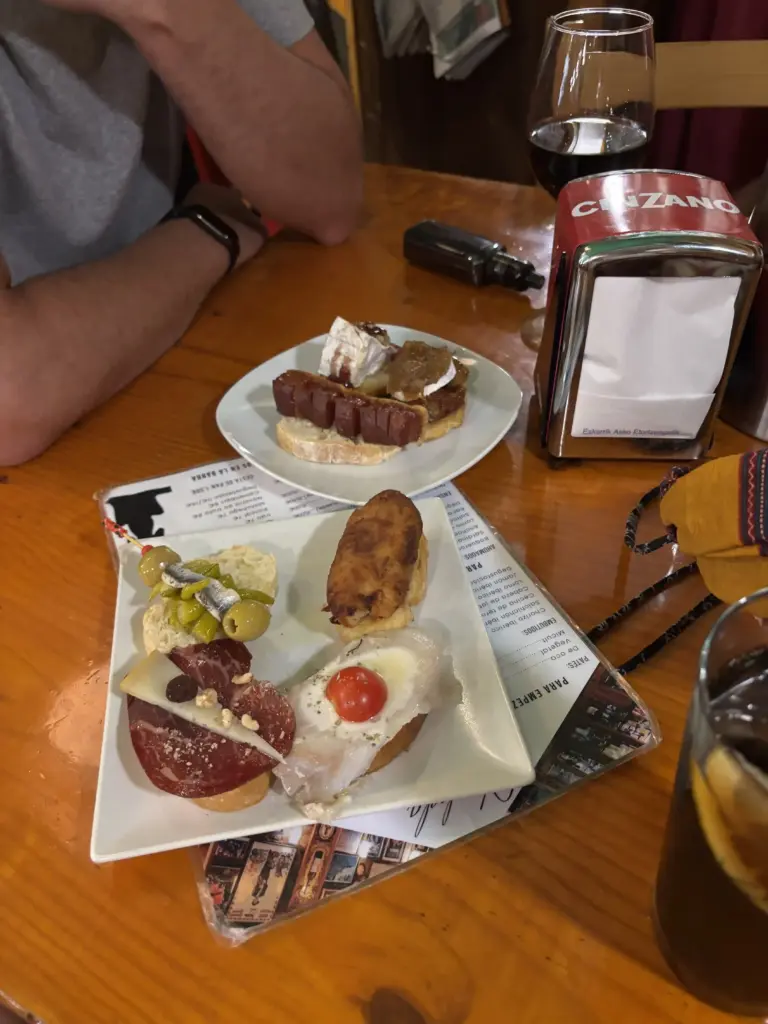
- Cold pintxos are often displayed on the counter, while hot ones are ordered from the staff. The traditional way to go out for pintxos is to have one or two pintxos and a drink in each establishment before moving on to another bar.
- Some restaurants, markets and bars close on Mondays, while others close on Sunday evenings or on another day of the week. If you have a particular place in mind, always check its current opening hours.
- For the best-known restaurants, cider houses and establishments offering tasting menus, it is advisable to book well in advance. Pintxos bars do not normally accept reservations, and people often eat standing up, although some establishments have tables or a separate restaurant area.
- Markets generally close at around 2:00 p.m., so plan ahead if you want to shop or eat inside them.
- There are plenty of organised tours available for exploring the city. I always check websites such as GetYourGuide or Civitatis to see what is available.
- Before swimming, especially at La Concha, take the tides into account. At high tide, a considerable part of the beach may disappear.
- The day in San Sebastián generally begins at around 10:00 a.m. There is therefore no need to wake up too early if you want to find shops open, people in the streets and, more generally, experience the atmosphere of the city.
- However, get up early on at least one morning. Between 8:00 a.m. and 9:30 a.m., the Paseo de la Concha is much quieter. You will see people running, swimming or walking their dogs, and you will be able to enjoy the bay without the crowds of the busiest hours. It is also one of the best times to take photographs.
When to go to San Sebastián
San Sebastián can be visited throughout the year, but the best time to go largely depends on the kind of trip you have in mind. The city has an oceanic climate, with generally mild temperatures and changeable weather: even in summer, a bright day can suddenly turn cloudy or rainy.
- May and June: these are probably the best months to visit San Sebastián at a relaxed pace. The days are long, the temperatures are comfortable for walking and the city is less crowded than during the height of summer. It is an excellent time to explore the different neighbourhoods, climb the hills surrounding the bay and stop at pintxo bars without finding them too busy.
- July and August: these are the liveliest and busiest months. Temperatures are usually pleasant and, on fine days, you can enjoy La Concha, Ondarreta and Zurriola beaches. August, however, also brings the Semana Grande festivities and some of the largest crowds of the year. The atmosphere is festive, but accommodation is more expensive and the best-known bars can become very busy.
- September: this is another excellent choice. The city still has a summery feel, the sea may remain pleasant and events connected with Basque culture and traditional rowing regattas make this an especially interesting time to visit. Visitor numbers also begin to decrease gradually as the weeks go by.
- Autumn and winter: these seasons reveal a quieter, more authentic and sometimes spectacular side of San Sebastián, particularly when powerful waves crash against the seafront. You should, however, be prepared for shorter days, wind and frequent rain. A particularly special occasion is 20 January, when the city celebrates the Tamborrada. It is an unforgettable experience, but accommodation should be booked well in advance.
Whatever time of year you choose, always carry a lightweight waterproof jacket. Rain in San Sebastián does not necessarily mean changing your plans: it is part of the city’s character and quite often you only need to wait a little for the weather to change again. And if the rain decides to stick around, no problem: I’ve gathered all my ideas for making the most of it in things to do in San Sebastián when it rains.
A little history of San Sebastián
Since ancient times, as in much of the Basque Country, in San Sebastián it was the sea, the Urumea River, the protective hills of Urgull and Igueldo, and the coastal wetlands that encouraged the presence of settlements and villages devoted mainly to fishing, gathering and hunting.
The earliest evidence of human presence in the area dates back as far as the Palaeolithic, between 20,000 and 10,000 years ago, as demonstrated by the finds in the caves of Altxerri and Ekain, not far from San Sebastián. These preserve engravings and cave paintings that are now part of the UNESCO World Heritage of prehistoric rock art.
From this point onwards, however, sources become extremely scarce. I searched for a long time, online and even in some libraries, but for the millennia following the Palaeolithic I was unable to find almost anything specific about this area: no significant settlement apart from a small Roman settlement, no direct evidence, only generic maps and vague descriptions of a territory that remained on the margins of major historical events.
Even for the Roman, Visigothic and Islamic periods — which had an enormous impact on Spain — there are no important urban remains here. The main roads and centres of power of these peoples were concentrated further inland, around Pompaelo, modern-day Pamplona, while the Basque coast remained on the margins of the principal routes. This does not necessarily mean that the area was isolated — it is plausible to imagine coastal routes and small-scale trade connecting it with the rest of Spain — but it is only honest to say that, based on the sources I found, no true urban centre, Roman or otherwise, ever emerged here, and the historical record remains silent for centuries.
It was probably precisely this near absence of peoples with such strongly defined cultures that gave the native Basque society the opportunity to consolidate itself without too much outside interference.
Indeed, despite this historical “void”, the Vascon population of these lands never disappeared: it simply left behind no great monuments or chronicles. People lived in small rural and coastal communities, devoted to fishing and agriculture, organised according to proto-feudal territorial structures connected with the local valleys — a continuous social fabric that remained invisible to historians until the appearance of the first written record.
This first record concerns a monastery dedicated to Saint Sebastian, in the area now known as San Sebastián el Antiguo, mentioned in medieval documents.
The permanent settlement for which we have concrete evidence, however, developed not far from this monastery, mainly thanks to a fishing community that used the estuary of the Urumea River and the natural protection of Monte Urgull for fishing and even for apple orchards intended for cider production. The simple wooden houses grew around the religious buildings — the predecessors of San Vicente and Santa María — creating the true nucleus of the “city” we know today.
For a while, this small village lived a quiet existence, but it gradually evolved into a fortified town of the Kingdom of Navarre, intended to control the coast and protect a strategic port that was valuable from both a commercial and military point of view.
With its gradual expansion, in 1180, Sancho VI of Navarre officially recognised the town by granting it a fuero. In the carta-puebla, the official document through which the right of fuero was formalised at the time, the official birth of the new “villa” was established and, at the same time, it was decided that the new settlement would bear the name Sanctus Sebastianus in Latin, which would later evolve in Castilian into San Sebastián.
The origin of the city’s Basque name, Donostia, has been debated by historians and linguists for centuries. There are four main theories that attempt to explain where it comes from, but one is considered the most reliable in academic circles.
The most widely accepted theory, made famous by the philologist Koldo Mitxelena, argues that Donostia is the result of a phonetic evolution of the Basque name of the patron saint: Done Sebastiáne.
The term Done is believed to derive from the Latin Domine, meaning “Lord” or “Saint”, and its evolution would have followed a gradual process:
Done Sebastiáne → Donasebastiai → Donasastia → Donastia → Donostia
This hypothesis is reinforced by the presence of similar forms in other Basque names, such as Donibane for Saint John, Doneztebe for Saint Stephen and Donejakue for Saint James.
A second theory, linked to the Roman city of Ostia, suggests that the name may mean “the lord who came from Ostia”, since Saint Sebastian is said to have been buried there. According to this interpretation, Don would derive from the Latin Domine, while Ostia would refer to the Roman city.
A variation of the same theory suggests instead that the name may refer to the mouth of the River Urumea, since in Latin ostia can mean “gate” or “river mouth”.
The fourth theory, which is more speculative, links the name to pre-Christian Basque mythology. According to this hypothesis, Donostia would derive from the Basque god Urtzi, also known as Ostri, a deity associated with the sky.
His name is also believed to appear in the Basque words osteguna, Thursday, and ostirala, Friday. From this perspective, “Don Ostia” could be interpreted as “Saint Urtzi”.
With the advance of the conquests of the Catholic Kingdom of Castile, in 1200 San Sebastián passed to the Crown of Castile: a change that strengthened its defensive role, further reinforcing its “military” vocation and therefore encouraging the construction of walls and fortifications. For Donostia’s merchants, however, the transfer to Castile proved advantageous: instead of being the port of a small kingdom in difficulty, Navarre, the city became an outlet to the sea for a much richer and more expansionist Castilian monarchy.
In the following centuries, the port thrived on tangible trade: Castilian wool exported to Flanders and England, goods arriving from Northern Europe, and a strong Basque shipbuilding tradition that supplied Castilian fleets for a long time, including those engaged against the English, Dutch and French in the Bay of Biscay. Whaling also began to develop on a large scale, becoming one of the most lucrative — and most controversial — activities in the Basque Country for years to come. For centuries, in short, the city lived with this dual identity: maritime and commercial excellence on the one hand, and military stronghold on the other.
In January 1489, a fire — accidental in origin, not an enemy attack as is sometimes claimed — devastated the medieval city. On the recommendation of the Crown, reconstruction from that moment onwards favoured stone over wood: an initial urban “reset”, long before the famous events of 1813, which I will tell you about shortly.
Later too, between the sixteenth and early eighteenth centuries, San Sebastián remained a contested stronghold, whose strategic position made it a highly desirable target.
After several invasions that had already had significant consequences for the city, the real siege came in 1719, when French troops under Marshal the Duke of Berwick occupied the stronghold during the War of the Quadruple Alliance, triggered by the expansionist ambitions of the then King Philip V.
The city prepared its defences, but its fortifications proved inadequate against heavy artillery. The French marshal, commanding approximately 16,000 men, opened the campaign by conquering Irun, Fuenterrabía (Hondarribia) and the Bay of Pasaia, before turning towards San Sebastián.
King Philip V, instead of coming to the city’s aid, withdrew to Pamplona, leaving it to its fate.
An intense bombardment by French artillery then began. The main target was not so much the city itself as its defences: the shells opened breaches in the walls, particularly on the eastern side, near the River Urumea, at a point that has since been known as “La Brecha” — although it was probably not literally a crack, but rather a weak point in the walls, especially in the face of new military technology.
The real turning point came on 31 August 1813. On that fateful day, during the Spanish War of Independence, the city — then occupied by the French — was besieged and captured by Anglo-Portuguese troops. A huge fire broke out and San Sebastián was devastated, largely destroyed. It was not merely a military defeat: once they had taken control of the city streets, it was the allied Anglo-Portuguese troops themselves who looted and set fire to the city, committing violence against the civilian population in the days following the conquest. In the months that followed, the British commander Wellington tried for a long time to place responsibility for the fire on the retreating French, but a local investigation carried out at the time collected testimony that clearly pointed to his own soldiers.
It is a trauma that the people of Donostia still remember today with a commemorative ceremony every 31 August — a sign of how deeply that wound remains embedded in the city’s collective memory.
Calle 31 de Agosto, formerly Calle de la Trinidad, is the only main street that survived, spared by the Allies so that they could use it as their headquarters. Its name commemorates that tragic date.
The survivors gathered in Zubieta, a small rural village near the city, and decided to rebuild Donostia almost from scratch.
After the destruction of 1813, San Sebastián found itself facing a decisive crossroads: rebuild a city designed around trade and the port, or imagine a more orderly, representative and elegant urban centre. The choice was not merely technical, but also political and urban-planning related, and involved the city authorities and the groups that held the greatest influence over Donostia’s rebirth.
According to a widely repeated tradition, the plan that aimed to create a more beautiful and attractive city, capable of developing a residential and tourist vocation, prevailed by just one vote over the rival proposal, which was to remain primarily tied to its mercantile and military function.
It was precisely from this vote that San Sebastián slowly began to build the image that still defines it today: a city designed not only to be lived in, but also to be admired.
The direction of the works was entrusted to the architect and military engineer Pedro Manuel de Ugartemendía, who had already drawn up a first reconstruction plan in 1814 that was fairly avant-garde for its time. The problem was that it would have required a radical redesign of the urban layout, with a large octagonal central space, and above all a complete reorganisation of residents’ property boundaries. The major landowners therefore preferred to follow the old medieval street plan, with only a few adjustments to straighten the most winding streets: this is how the area we now know as the Parte Vieja came into being.
With the end of the Carlist Wars in the mid-nineteenth century, the walls lost their military function and became an obstacle to urban development. In 1863, royal authorisation was granted to demolish them — the famous Ensanche, the Expansion — and demolition work began the following year, in 1864, bringing the city’s purely military role to a definitive end. It was one of the most important events in the modern history of San Sebastián: the city could finally expand towards the magnificent Bay of La Concha and southwards.
Amid the intense reconstruction efforts that followed 1813, there was no shortage of radical ideas for redesigning the heart of the city, including the possibility of creating new public spaces in place of buildings that had by then become absorbed into the medieval urban fabric.
The church of San Vicente, built against the ancient walls, thus found itself at the centre of a broad process of urban rethinking.
Fortunately, it was ultimately decided to preserve it, allowing it to become one of the most recognisable symbols of the Parte Vieja.
It is at this point — around fifty years after the great fire — that the architects who would give Donostia its nineteenth-century appearance enter the scene: Antonio Cortázar drew up the first plan for the Ensanche, begun in 1864–65, with the orthogonal grid inspired by Parisian boulevards that you can still recognise while walking through the city today; José Goicoa oversaw the subsequent phases during the 1880s, extending the expansion as far as Calle Easo.
At the same time, the “heavy” commercial port gradually moved to Pasajes (Pasaia), towards the French border, which became the main port in the area, while San Sebastián was finally able to focus on its own urban transformation.
This new Belle Époque appearance began to attract aristocratic visitors. In 1845, at the age of just 15, Queen Isabella II — who suffered from skin problems, perhaps psoriasis, perhaps herpes: the sources differ — was advised by her doctors to take so-called wave baths, meaning immersion in the cold, rough waters of Playa de la Concha, which were believed to have therapeutic properties.
The royal presence acted as a catalyst and transformed the small coastal fishing town into a luxury beach resort, a true seaside destination for the Spanish monarchy. The casetas de baño appeared, bathing cabins mounted on rails and pulled by oxen into the water, and aristocratic summer stays became increasingly fashionable.
Although it was not literally “the summer capital of Europe” — a title also claimed by nearby Biarritz and Deauville — Donostia became an elite European hub in the late nineteenth century: thanks to Isabella II, certainly, but above all thanks to Queen María Cristina, regent from 1885, who consolidated San Sebastián’s status as a royal summer destination.
The relationship between Queen María Cristina of Austria-Lorraine and San Sebastián was profound from the very beginning. Her decision to spend her summers in the city from 1887 onwards transformed it into one of the most exclusive and elegant destinations in Europe, shaping both its architecture and its society.
The queen was the key figure who turned San Sebastián into a fashionable destination. After the death of her husband, the regency and the poor health of the young King Alfonso XIII led her to choose Donostia every year, for around 40 years, as the place where she would spend her summers, thanks to the healthy air and sea bathing. Her loyalty to the city, which lasted until 1929, attracted the court and the aristocracy every summer, consolidating San Sebastián’s image as an elegant and cosmopolitan enclave. Her popularity in the city was such that in 1926 she was granted the title of Alcaldesa Honoraria — Honorary Mayoress — no small distinction in a Basque city.
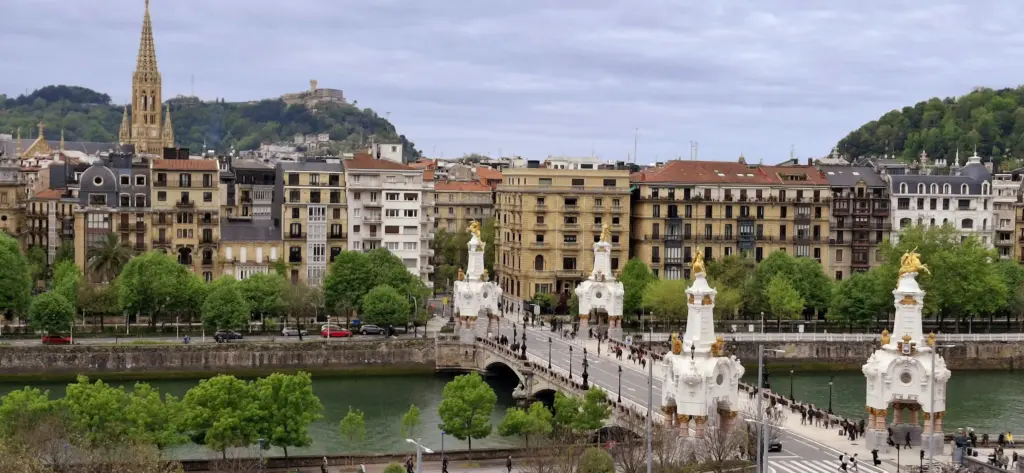
The queen’s presence encouraged the construction of buildings that are now symbols of the city. Among them are Miramar Palace, the English-style royal summer residence overlooking La Concha Bay, the Hotel María Cristina, named after her, and the Victoria Eugenia Theatre, dedicated to her daughter-in-law. In 1904, it was also decided to name the bridge then under construction in front of the Northern Railway Station after her; it was inaugurated in 1905.
The royal family of the time had a special relationship with the Basque Country.
Although San Sebastián had also paid tribute to Victoria Eugenia of Battenberg, María Cristina’s daughter-in-law, with the Victoria Eugenia Theatre, the two queens had very different tastes when it came to choosing where to spend their summers.
María Cristina always remained loyal to San Sebastián, while Victoria Eugenia preferred to spend her summers in Santander, earning the nickname “the sardine queen”.
Victoria Eugenia was greatly loved by the people of Santander for her modern outlook and her commitment to social causes. The affection, moreover, appears to have been mutual: her granddaughter, Queen Sofía, supported the publication of a book devoted to her, and even today there is a strong desire in Santander to rediscover and promote her story.
Meanwhile, the seafront became increasingly established as a spectacular urban setting, while buildings and services in the Belle Époque and Second Empire styles multiplied, strongly influenced by France.
The city’s social life revolved around the Gran Casino — now converted into the City Hall — which attracted international visitors.
The concentration of openings around 1912 was remarkable: the Monte Igueldo Funicular, La Perla — which replaced an earlier late-nineteenth-century bathing establishment —, the Hotel María Cristina and the Victoria Eugenia Theatre became the icons of this elegant seaside Donostia.
Strengthening this glamorous vocation even further, the Gran Kursaal was inaugurated in 1921–22, a large seaside and entertainment complex that attracted international visitors and helped finance public works such as the Paseo Nuevo.
In this atmosphere, Donostia established itself as one of the most refined destinations in Europe, earning the image of the “Lady of the Atlantic”, with a harmonious, orderly and highly scenic urban identity.
In the second half of the twentieth century, before consolidating its reputation as a cultural and gastronomic city, San Sebastián also went through the dark years of the Spanish Civil War: on 12–13 September 1936, the city fell into the hands of Francoist troops after weeks of tension and repression. Despite the regime, in the years that followed the city preserved its bourgeois and tourist character — an identity that survived the conflict and would only become fully established again with the return of democracy.
San Sebastián thus consolidated its reputation not only as an elegant city, but also as an international cultural centre, thanks to the International Film Festival.
At the same time, it strengthened its image as a tourist and gastronomic destination. Today, San Sebastián — considering the entire Donostia-Gipuzkoa area — holds an impressive record: 19 Michelin stars across 11 restaurants, according to figures updated in July 2026, with three three-star restaurants: Arzak, Akelarre and Martín Berasategui.
The surfing and creative side of the city, centred around Zurriola and Gros and for which San Sebastián is now often known, is actually a phenomenon of recent decades, one that has opened Donostia to a younger and more international form of tourism.
San Sebastián is the product of a history typical of the Basque Country: a disaster, the fire of 1813, became a unique opportunity to transform itself into a city of extraordinary beauty. Its charm arises from an alchemy between a favourable geography, a precise and unrepeatable historical moment, and a community that, both in the past and today, has consciously chosen to rebuild its future through beauty.
Let us now step into this fullness of beauty, emotion and sensory experience. Prepare yourselves for a subtle feeling that may lead you to think that, without even realising it, you have discovered one of the most beautiful small cities in Europe.
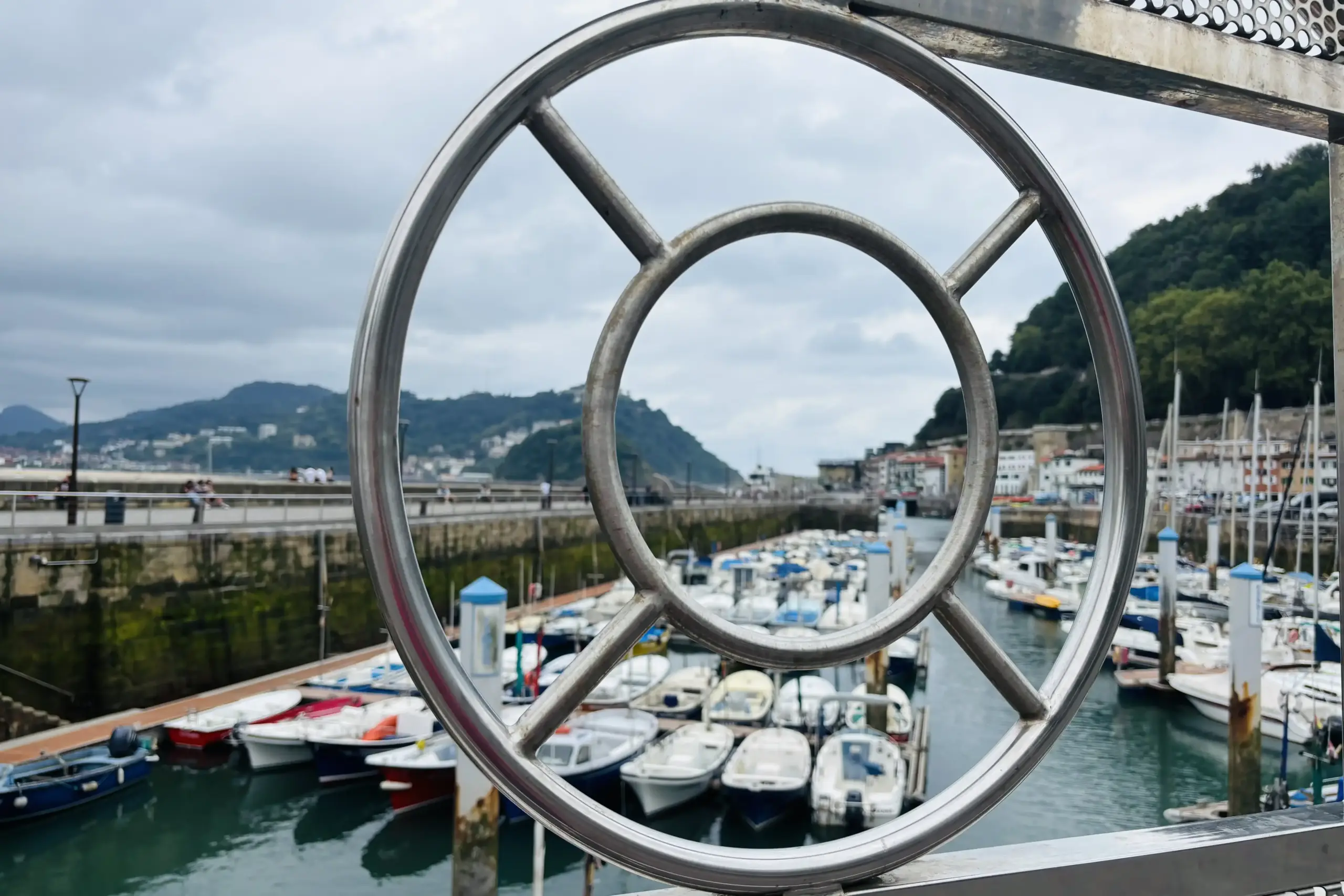
What to see in San Sebastián
Before beginning our journey to discover San Sebastián, you should prepare yourselves for a city with a thousand different faces: the Parte Vieja, more traditional and Spanish; the Ensanche, more elegant and refined; Gros, with a distinctly surfing soul; and the surrounding hills, Urgull and Igueldo, mirroring one another yet completely different.
In short, whatever your tastes may be, Donostia will have something that wins you over.
So, everyone into the saddle! Our journey through Donostia begins.
The Parte Vieja
The old quarter of San Sebastián, known as the Parte Vieja (Alde Zaharra in Basque), forms an almost perfect quadrilateral. To the north, it is protected by Monte Urgull; to the west, it overlooks the port; to the east, it is bordered by the Urumea River; while to the south, it meets the Boulevard, the broad avenue that separates the historic centre from the nineteenth-century city.
This is where the memory, social life and gastronomic soul of Donostia are concentrated.
The character of the neighbourhood unfolds along just a few main streets: Calle Mayor (Nagusia), Calle San Jerónimo, Calle Fermín Calbetón and Calle 31 de Agosto. It is a very small area — in theory, you could walk through all of it in less than an hour. In practice, it is impossible to do so without stopping constantly: historic shops, wine bars, jewellery stores, pintxos bars, artisan workshops, bookshops and alternative spaces follow one another without interruption.
I will give you a few tips below, but my real recommendation is another one: wander through its calles, let yourselves be carried along by the constant bustle of people, follow the aromas drifting out of the bars, let the voices overlap and allow the flavours to call you from one counter to the next. This is the true Parte Vieja experience!
But if you are short on time and need to know where to go, here are a few practical suggestions.
First, we leave our bicycles near the City Hall, at one of the Dbizi stations, and enter the historic centre along Calle Mayor.
The street is wider, brighter and more elegant than the other streets in the old town, and it is best admired with your eyes raised: here you will find noble buildings with finely worked wrought-iron balconies, decorated façades and imposing doorways. Lower your gaze and you will come across traditional, high-quality shops — designer ceramics, Basque textiles, fine jewellery, historic wine shops and liquor stores.
About halfway along Calle Mayor, take a short detour into Bilintx Kalea. You will find yourselves in Plaza Lasala, where a curious bronze lion stands at the centre, one of the oldest inhabitants of San Sebastián.
The sculpture was not originally created as a simple decoration: it formed part of a public fountain installed in 1848 near the Puerta de Tierra, where it distributed water from the Morlans aqueduct.
After the city walls were demolished, the lion was moved to Plaza Lasala in 1882. Today, the fountain is no longer in use, but the sculpture continues to watch over the square, with its mouth open and its prey held beneath one paw.
But what truly catches your eye is not the street itself: it is what appears at the far end, like a theatrical backdrop — the Basilica of Santa María del Coro, a symbol of Donostia’s Baroque architecture.
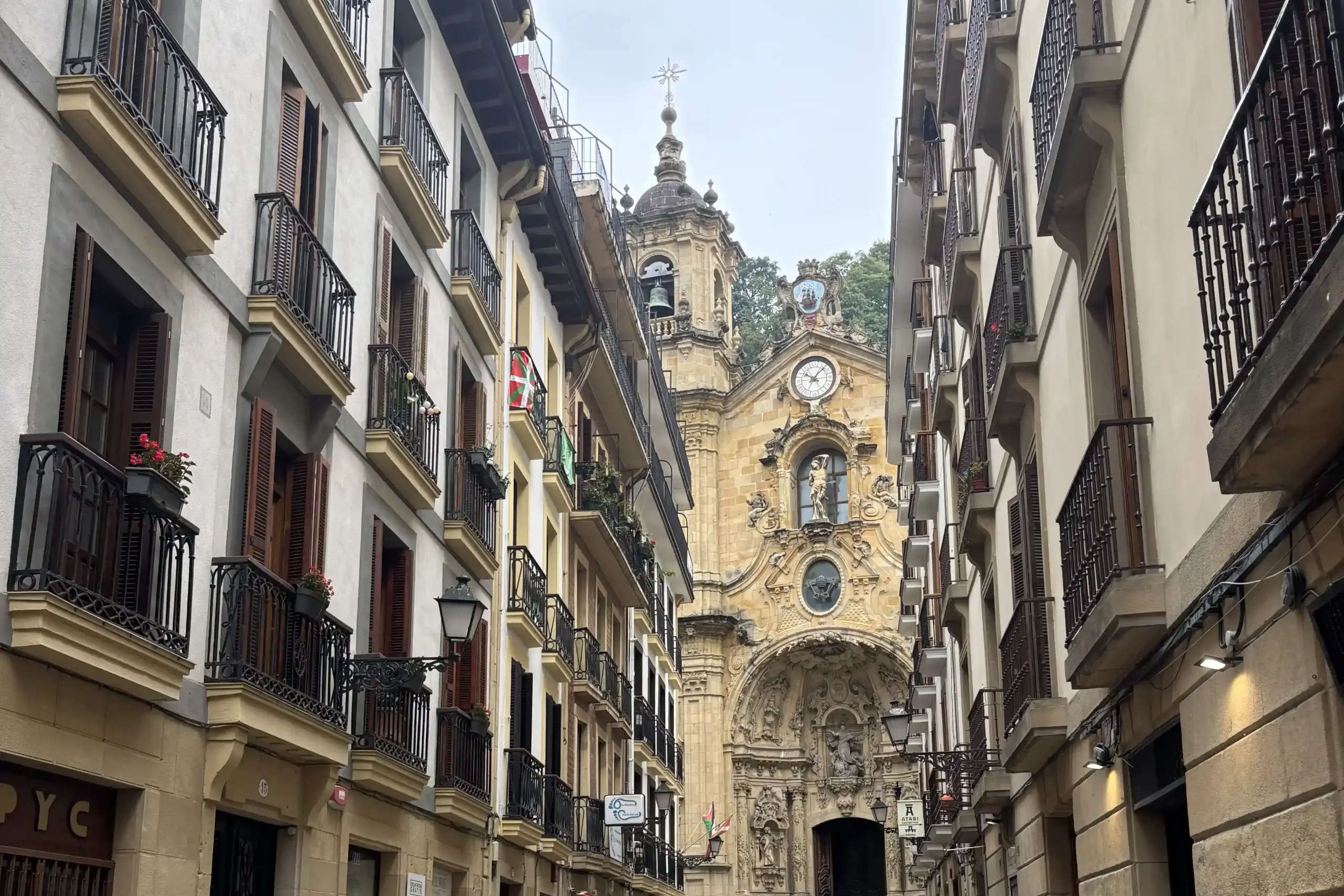
Basilica of Santa María del Coro
Admission to the basilica is free, although donations are encouraged to help with its maintenance. There are no precise opening hours, but as a general guide you can try to visit between 10:00 a.m. and 7:00 p.m., except during religious services.
The Basilica of Santa María del Coro is the most important church in the Parte Vieja and one of the places that best tells the deep-rooted maritime history of San Sebastián.
A Romanesque church already stood here, later replaced by a Gothic one, closely linked to the community of fishermen and sailors who represented the economic and social heart of the city for centuries. The present building was constructed in the eighteenth century, between 1743 and 1774, after the earlier structures had been damaged by fires and conflicts. During the devastation of 31 August 1813, almost the entire Parte Vieja was destroyed: the basilica also suffered extremely serious damage, but it was completely rebuilt and restored, becoming one of the pillars of Donostia’s urban and spiritual rebirth.
The basilica’s Baroque façade is spectacular: an extraordinary example of late Baroque and Rococo architecture, with strong influences from the Churrigueresque style — a Spanish architectural and decorative style from the late Baroque period.
Its secret? It seems to tell the story of two churches in one. The main façade is, in fact, a true narrative sculpted in stone. At the top stands the city’s coat of arms, depicting a ship sailing across the sea. Above the main portal is the Martyrdom of Saint Sebastian: the saint, pierced by arrows, is surrounded by Roman soldiers and angels in a scene filled with tension. Slightly lower down appears the papal coat of arms, with the tiara and crossed keys. Below this, the Virgin Mary in glory, gentler and more solemn, intercedes in the saint’s martyrdom. This is how the church brings together its two dedications — to the sea and to the Virgin — in a single powerful image.
The two eighteenth-century bell towers frame the façade, with rose windows and restrained yet imposing Churrigueresque decorations.
The large white form on the side façade of the Basilica of Santa María del Coro looks almost like a rock smoothed by the sea, but it is actually a contemporary sculpture entitled Soinuaren Harmonia, meaning “Harmony of Sound”.
Created by Maximilian Pelzmann and installed in 2014, it plays on the contrast between the basilica’s Baroque stonework and a soft, irregular surface filled with openings. Its forms evoke sound, wind and the outline of the mountains between San Sebastián and Hondarribia, transforming a false opening in the church into a small dialogue between ancient and contemporary art.
Inside, however, the atmosphere changes completely.
Near the entrance stands a massive wooden chest reinforced with iron, dating from the seventeenth–eighteenth century, which belonged to the brotherhood of Donostia’s fishermen, known in Basque as the Koxkeroak. It was used to store silverware, relics and valuable donations, and is now displayed as a historical artefact, a symbol of the wealth and importance of the local maritime community.
As you continue, you will notice the absence of ostentation: the Baroque here is restrained, far removed from the decorative exuberance found in other regions of Spain. The light enters softly filtered, creating a warm and protective atmosphere.
Do not miss the side chapels, especially those on the right near the presbytery: here you will find small ex-votos on wood or canvas, often painted in a simple style, depicting ships in storms that escaped shipwreck. They are offerings from grateful sailors and fishermen, direct testimonies of a practical and deeply lived faith.
But the most important feature of the church is the Virgin of the Choir. Positioned at the centre of the main altar, beneath a large painting depicting Saint Sebastian, the Virgin is the patron saint of Donostia and the protector of sailors, who once came here to ask for protection before setting sail.
Her origins are shrouded in mystery: according to one tradition, she may have come from Coro, in Venezuela, brought by sailors from Donostia in the sixteenth century. The documents were lost in the great fires of 1689 and 1813, but devotion to her has remained alive over the centuries, fuelled by stories of miracles.
One of the best known tells how the statue of the Virgin, originally placed in the upper choir, was to be moved. An elderly priest, tired of climbing the stairs to pray before her, tried to take her to his cell. As he left the choir, the statue suddenly became extremely heavy, as though refusing to leave the church. From then on, it was placed on the main altar, symbolising its importance to the city and its deep bond with this church.
Another episode is linked to 23 January 1738, during a fire that broke out in Plaza Nueva, today known as Plaza de la Constitución. During the fire, a procession with the Virgin was organised. The procession was followed by a sudden downpour that extinguished the flames, saving much of the area.
Even today, this figure plays a central role during city festivals and religious celebrations.
In addition to the religious building, the church houses the D’Museoa Diocesan Museum, where admission costs approximately €3. Its collection traces around ten centuries of sacred art from Gipuzkoa through sculptures, paintings and liturgical objects from churches and hermitages across the region. It is an interesting visit, especially for those who wish to explore the religious and artistic history of the city in greater depth.
Back outside, we continue along Calle 31 de Agosto, whose name preserves the memory of the tragic fire of 1813. Here too, noble buildings, wrought-iron balconies and elegant façades stand alongside high-quality shops, wine bars and historic establishments.
One detail worth knowing: it is the only street that survived that devastation, and this is one of the reasons why today it has an atmosphere unlike any other street in the Parte Vieja.
Continuing to the opposite end, we will reach the San Telmo Museum.
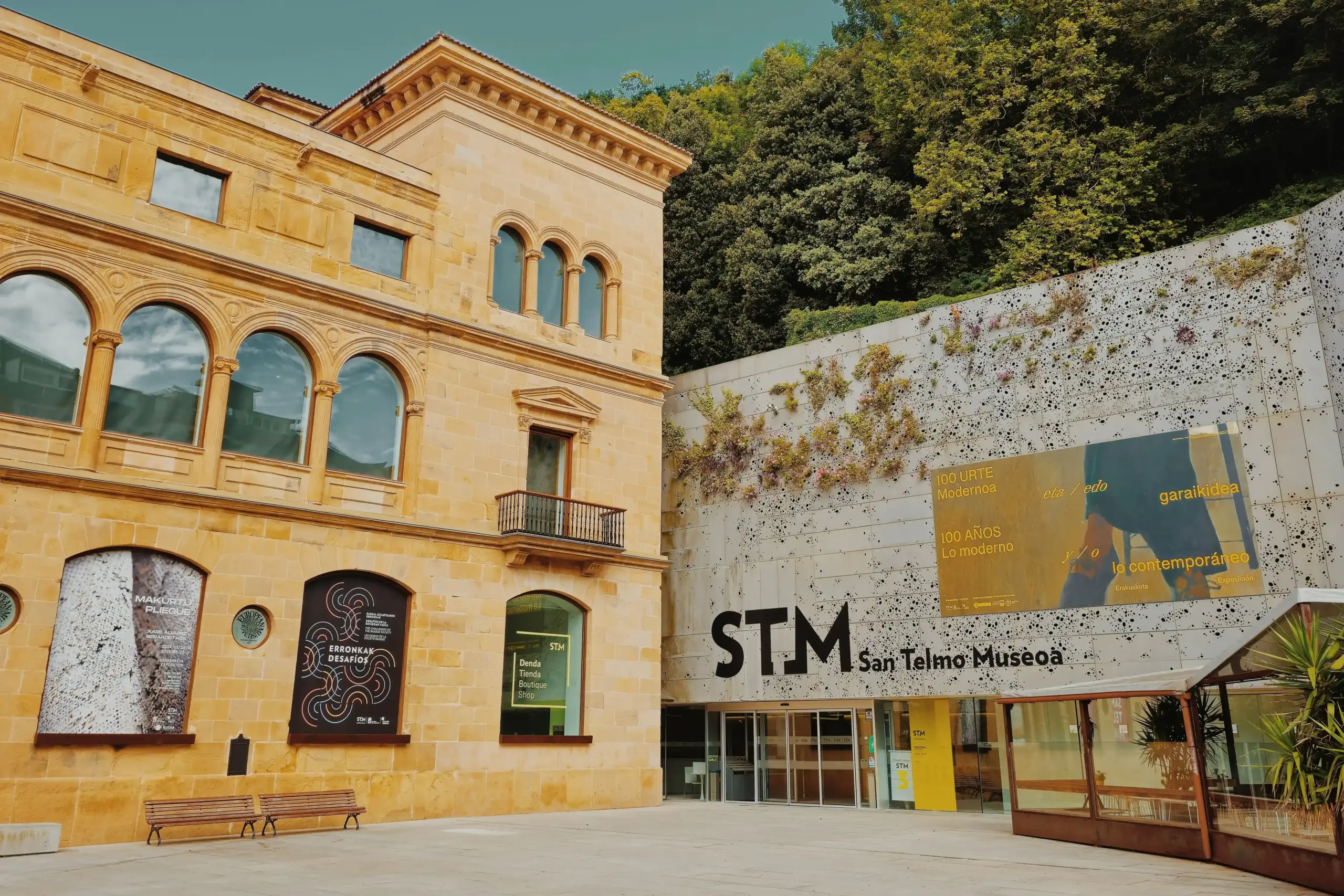
Entrance to the San Telmo Museum in San Sebastián, where historic architecture meets contemporary design.
San Telmo Museum
Tickets can be purchased on the official website or directly from the ticket office at the entrance and cost approximately €10. Admission is free every Tuesday, although I still recommend booking in advance. In general, the museum offers several concessions for certain categories of visitors, including young people, senior citizens and unemployed people, so always check them before purchasing a full-price ticket. You can also download the audio guide free of charge through the museum’s official app.Access to the Renaissance cloister and the church of the former convent, with the frescoes by Sert, is always free. This area is separate from the paid section of the museum: if you only want to admire this masterpiece — and it is truly worth it — you can do so without a ticket. Ask at the entrance how to access it directly.
The San Telmo Museum is a museum of anthropology, history, archaeology and art, with a strong focus on Basque identity. It is the result of the fusion of two structures separated by five centuries:
- The Dominican Convent of San Telmo (sixteenth century): founded in 1544 as a convent outside the city walls, after the desamortización — the confiscation of Church property — of 1836, the building was used for several different purposes, including as a barracks and a stable, before becoming a museum in 1902. It is a magnificent example of Renaissance architecture, complete with a cloister that alone would make the visit worthwhile. The walls of the church are entirely covered by the monumental frescoes of José María Sert (1930), painted in a dark and imposing style and depicting episodes from Basque history and mythology: work, traditions and religion. They are hypnotic and powerful.
- The Modern Extension (2011): designed by Nieto Sobejano Arquitectos, it is a bold work of contemporary architecture. It is recognisable by its perforated black stone façade — which evokes the forests of the Basque Country and blends into Monte Urgull — and by the aluminium slats that merge directly with the rock. It is a project that is both respectful and radical, and one that has breathed new life into the entire complex.
If you have not visited any other museums in the Basque Country, such as the Basque Museum in Bilbao, you absolutely must go inside. It is probably the best place to understand the complex Basque identity, beyond the usual stereotypes. It tells a story shaped by work, faith, resistance, conflict and modernity. Much of what I have shared about the history of the Basque Country and San Sebastián is something I learned during this visit.
Personally, what struck me most about the San Telmo Museum is that, once again, in the Basque Country you find yourself facing an extraordinary example of how a historic monument can be given new life through respectful and highly impactful contemporary architecture. In my opinion, it perfectly reflects the journey of a society that looks to the future without forgetting its roots. It is truly a physical synthesis of Basque culture.
Immediately after the museum, you will find the Church of San Vicente.
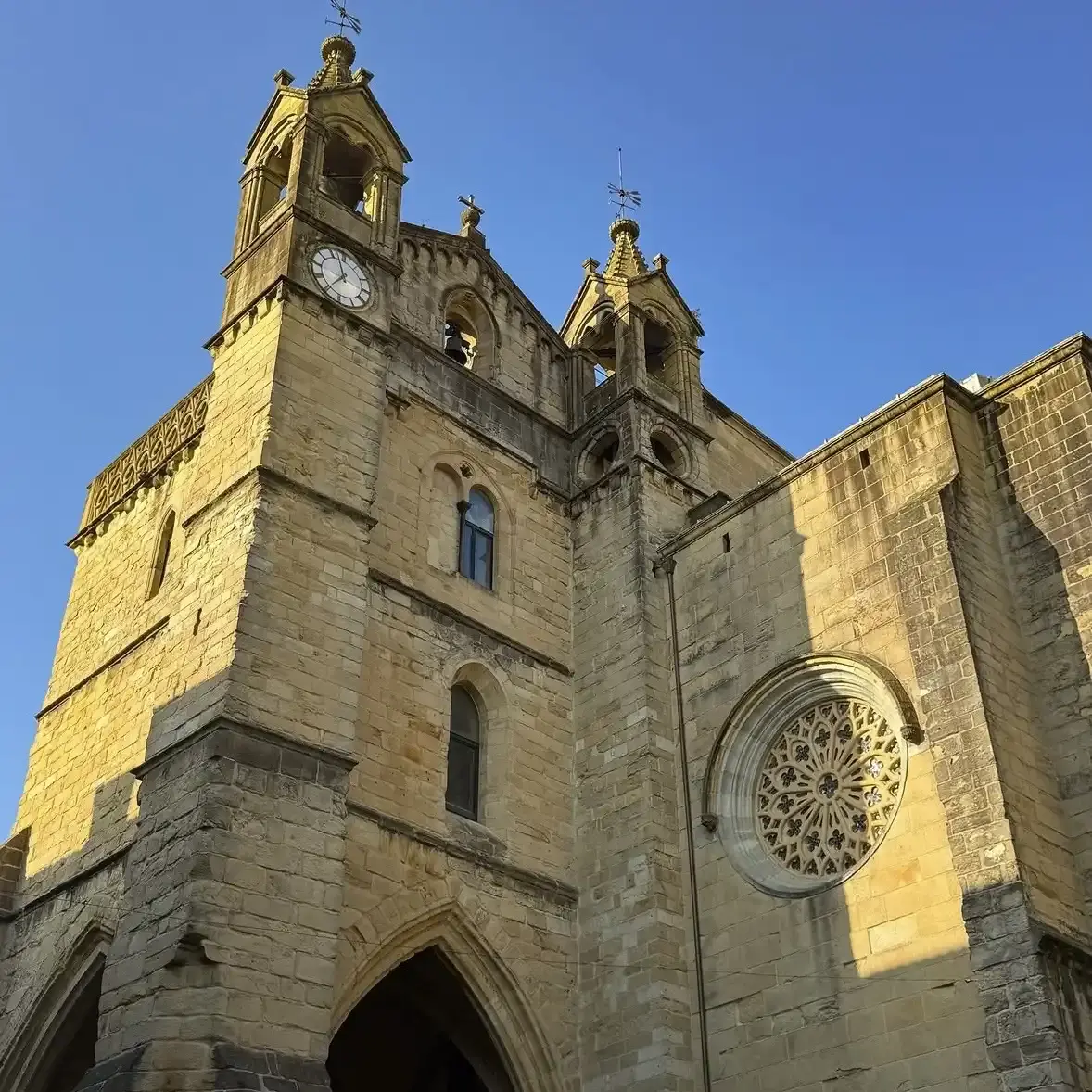
Church of San Vicente
Until the construction of the Buen Pastor Cathedral at the end of the nineteenth century, San Vicente was the city’s main parish church. It remains a very active parish today, especially because of its miraculous Crucifix. According to legend, it was the only religious image to survive the fire of 1813, miraculously found intact among the ruins. The people of Donostia are deeply devoted to it. While Santa María del Coro is the church of fishermen and the port, facing the sea, San Vicente was historically the church of the bourgeoisie and the mainland.
From the outside, its sobriety is immediately striking. Its imposing grey-stone façade, austere and almost completely devoid of decoration, blends perfectly into the urban fabric of the Parte Vieja and makes it look more like a fortress than a church. This lack of ornamentation is due both to the restrained style of Basque Gothic architecture and to the fact that the church originally stood against the city walls, so it was not designed to be viewed from the front. The bell tower rises like a massive watchtower: not particularly tall, but solid and imposing.
This “military” appearance is its first and most obvious distinguishing feature. Even today, you can still see marks left by bullets and, more generally, by the attacks suffered during the various armed conflicts.
During the siege and fire of 1813, which almost completely destroyed San Sebastián, the Church of San Vicente was the only religious building to survive the flames. Its massive walls withstood the destruction, turning it into a true symbol of resilience. All the interior furnishings, however, were lost. Over the centuries, it has undergone several restorations, the most important recent one taking place in 2002, when the structure was reinforced and previously hidden architectural features were brought back to light.
It is not open all day like a cathedral. If you are in the area at around 6:00 p.m., you can try to go inside and have a look, provided no religious service is taking place. It is not an essential visit, nor does it contain works that you absolutely must see. The interior is spacious and bright, articulated by Gothic columns and arches that draw the eye upwards, but there is no excess and no Baroque decoration: only stone and natural light. And yet it creates a strong sense of contemplation, in sharp contrast with the noise and energy of the pintxos bars just a few metres away.
After leaving the Church of San Vicente, we continue down Calle Narrika.
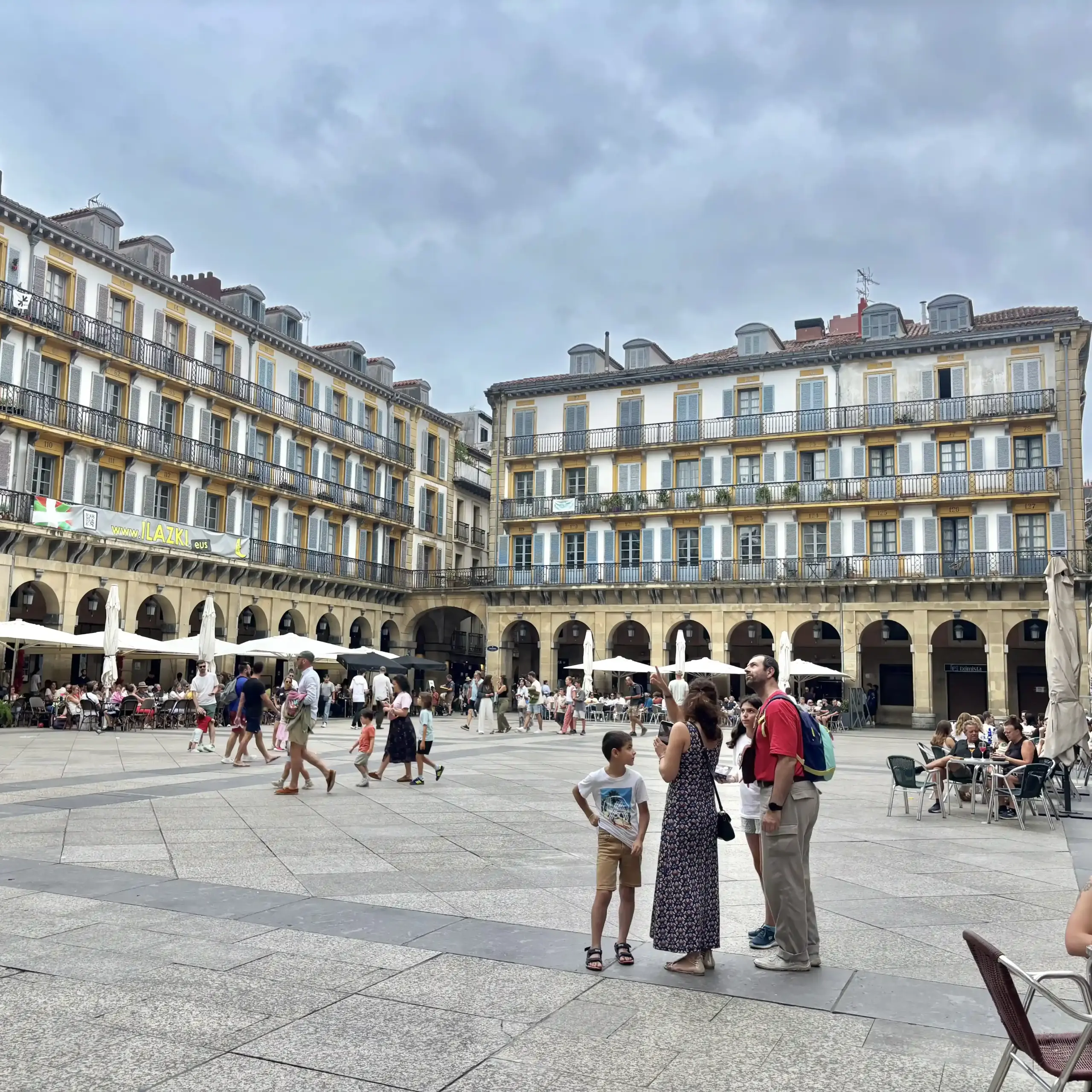
Halfway along the street, on the right, you will notice an arch between two buildings. Passing through it, you will find yourselves in Plaza de la Constitución — which everyone here simply calls “La Consti”.
Plaza de la Constitución
It is the true drawing room of the Parte Vieja. Completely pedestrianised, with benches and arcades, it is the ideal place to stop and rest. Beneath the porticoes, historic cafés and bars follow one another, perfect for a break at any time of day: a coffee in the morning, a glass of txakoli in the evening.
The space was first occupied by a square designed by the engineer and architect Hércules Torrelli around 1723. Even then, it was the city’s main public space and included the arcaded area and the Casa Consistorial y del Consulado, the building that housed both San Sebastián’s town hall and commercial consulate.
That eighteenth-century square was almost completely destroyed during the siege and fire of 31 August 1813. It was Pedro Manuel de Ugartemendía who designed the new Neoclassical square, rebuilt on the same site and following the footprint of the previous one: work officially began in 1817.
The square was called Plaza Nueva until 1820, when it was named Plaza de la Constitución for the first time, in honour of the Spanish Constitution of 1812, known as “La Pepa”. Its name changed several more times over the years — Plaza Berria in 1897, Plaza del 18 de Julio from 1937 — until, in 1979, it was finally given back the name it still bears today.
The square we see today is therefore a post-fire reconstruction, although it preserves the original layout of the arcaded square.
Looking at the ochre-coloured façades that surround it, you will notice large black numbers framed in white panels, from 1 to 48, with one curious detail: numbers 13 and 22 do not exist, but I have not been able to discover why! If you find out, let me know!
You may find it hard to believe, but in the nineteenth century the square was used as a bullring. The balconies of the buildings, owned by the municipality, served as boxes, and the numbers were used to identify the individual seats, which were rented to residents so they could watch the bullfights. Its rectangular shape makes it one of the few square bullrings known to have existed in Spain.
Today, those balconies belong to homes and commercial premises, but the numbers remain as a silent reminder of the past.
The most imposing building is the one occupying the entire northern side of the square, recognisable by its Neoclassical façade. It served as the old Town Hall until 1947; it later housed the library and today contains cultural and institutional spaces.
The square is the beating heart of the city’s celebrations: Santo Tomás, the night of San Juan. It also regularly hosts concerts by the San Sebastián Municipal Txistulari Band. On some Sundays, generally around midday, you may hear the sound of the txistu, the traditional three-holed Basque flute. The concerts are not always guaranteed, but if you happen to be in Donostia on a Sunday, it is worth trying.
There is, however, one moment when Plaza de la Constitución becomes truly unique: the Tamborrada, the city’s most important festival! In particular, on the night of 19 January, the square becomes the absolute epicentre of the celebrations.
At exactly midnight, the city flag is raised on the main building, while the leader of the Tamborrada beats the first drum roll. From that moment on, for 24 full hours, the square knows no silence: it echoes continuously with the marching and drumming of dozens of companies — thousands of drummers and cooks — who either set off from here or parade beneath its arcades.
The Tamborrada is not just a festival: it is the soul of San Sebastián taking shape, sound and rhythm. It is celebrated every 20 January, the feast day of Saint Sebastian, the city’s patron saint, and lasts exactly 24 hours. Twenty-four hours of drums, barrels, marches and Donostian pride.
Its origins date back to the nineteenth century. According to the most widely accepted version, it all began spontaneously and humorously: local people imitated the Napoleonic soldiers occupying the city, mocking their movements and the way they marched to the sound of drums. Residents, particularly women and water carriers (aguadores), reproduced those rhythms using barrels and water buckets at public fountains, such as those of Kanoieta or the Koxkas de San Vicente.
There is no direct connection with Napoleon in the origins of the Tamborrada, which began to take shape in the 1830s, but over time that mockery became a tradition, then a collective ritual, until it developed into one of the strongest expressions of identity in the Basque Country. For the occasion, participants still wear uniforms inspired by the Napoleonic army.
The Tamborrada begins promptly at 12:00 a.m. on 20 January, during the night between the 19th and 20th, with the izada de la bandera, the raising of the flag, in Plaza de la Constitución, and ends 24 hours later, at midnight on the 21st. The 20th of January is, indeed, the feast day of the city’s patron saint, Saint Sebastian.
The festival involves around 18,000 participants divided into more than 140 groups, including neighbourhood companies, associations and gastronomic societies, who parade for 24 hours until the arriada, the lowering of the flag at midnight on the 20th, dressed as soldiers or cooks. Each company has its own uniforms, a treasurer and a clearly defined history.
Within the Tamborrada, there are two clearly distinct roles:
- The Drummers (Tamborreros): they wear Napoleonic uniforms, whose style and colour vary depending on the company but are always inspired by nineteenth-century French troops. They march in tight formation, beating complex and powerful rhythms on drums and bass drums. They represent the more “military” side of the festival.
- The Cooks and Water Carriers (Cocineros y Aguadores): they wear white cooks’ aprons and caps and carry barrels (herradas) instead of drums, striking them with sticks. They march in a more disorderly and joyful manner, often singing. They represent the more popular and civilian side of the celebration.
To give you an idea of the event’s popularity, the hotel where we stayed told us that rooms sell out as much as a year in advance.
Crossing the square from one side to the other, we enter Calle San Jerónimo, my favourite!
More authentic, less touristy and more intimate, this is where you will find restoration workshops, independent music shops, small studios and historic bookshops such as Librería San Jerónimo.
Over time, this street has changed both name and function several times. It was once known as Calle de las Escotillas — meaning the portholes of a ship — because its narrow, sloping shape recalled the interior of a vessel; later, it became Calle de la Tripería, because it was home to the butchers’ market and the sale of offal, typical of the lower and damper areas of the medieval walled city.
Today it bears the name of the Church of Saint Jerome, which no longer exists, dedicated to a saint associated with study and writing. It is no coincidence that this street still preserves a natural connection with books, culture and quiet spaces: it seems to have retained its original vocation over time.
From here, we move on to Calle Fermín Calbetón. Make a note of this street! Today it is famous as one of the most “gastronomic” streets in the city. During the day, it is quiet and unremarkable, crossed by people exploring the neighbourhood at a leisurely pace. But in the evening, it changes completely, filling with laughter, music, improvised drumming on tables — yes, it often happens — and conversations in Basque, Spanish and English, all blending together. Add it to your evening walk: it is the gastronomic epicentre of the Parte Vieja, the pintxos street par excellence.
Admire the small shops and start making a list of the bars you want to try in the evening.
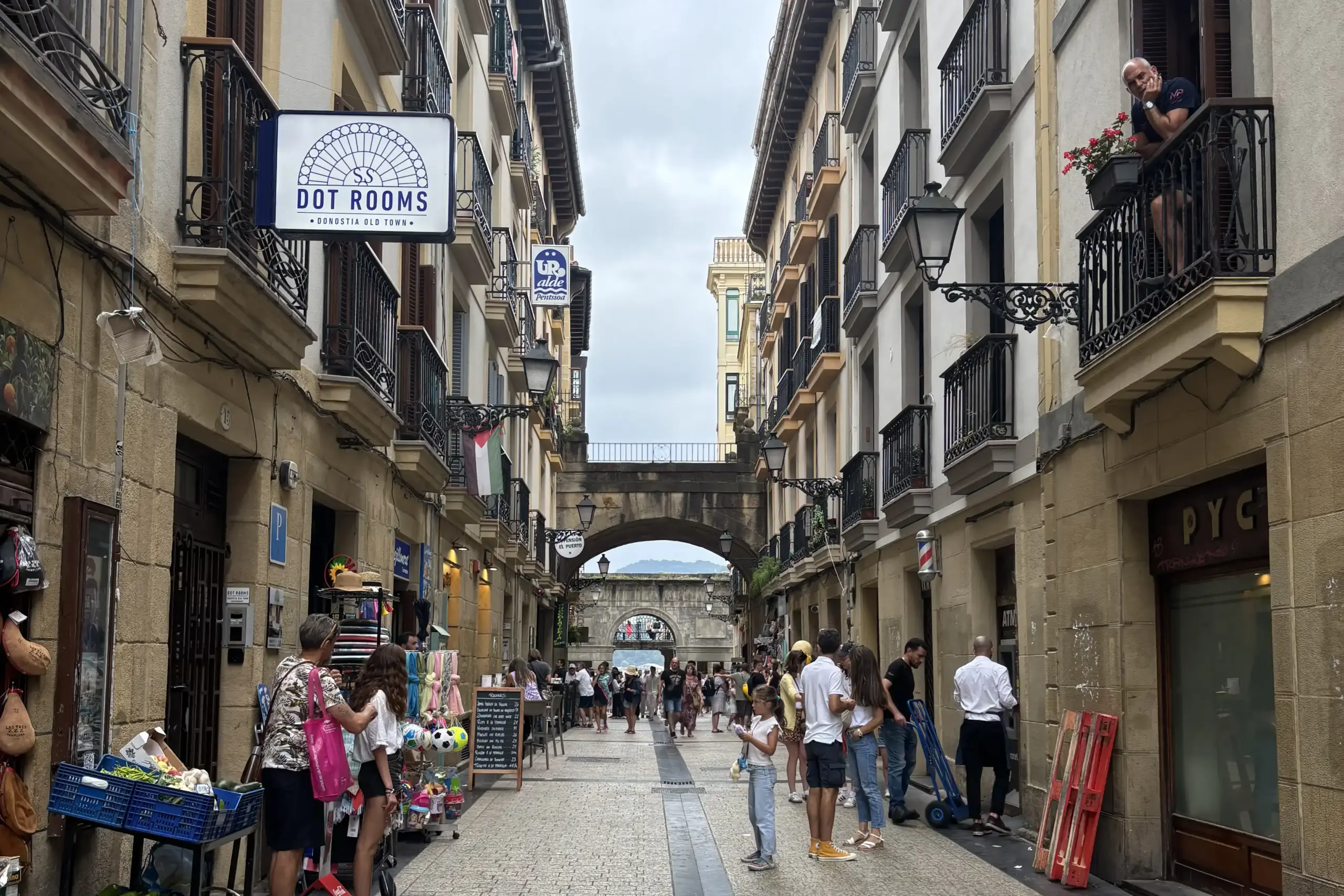
Following it all the way to the end, we arrive directly at the Mercado de la Bretxa, the final stop on our tour of the Parte Vieja.
Mercado de la Bretxa
The Mercado de la Bretxa is one of San Sebastián’s most emblematic historic markets, a daily reference point for fresh produce and everyday life in Donostia.
The name “Bretxa” — or “Brecha” in Spanish — means “breach” and recalls the openings made in the city walls during the French and English sieges. The market was established just beyond that gap, immediately becoming a symbol of openness and rebirth after the destruction.
The bars on the ground floor serve excellent tapas, should you start to feel a little hungry during your visit.
The real treasure, however, lies below.
Descending to the underground level, you find yourselves among the ancient city walls, now perfectly integrated into the market. This is where the people of Donostia really do their shopping: stalls filled with incredibly fresh fish — tuna, cod and anchovies — local vegetables, Idiazabal cheese and much more. It is a concentration of colours, aromas and authenticity, because in San Sebastián food is a serious matter.
This is a market that is genuinely used: local residents shop here, but so do chefs carrying shopping lists, people who come because they know exactly what they are looking for.
Online, you will find many photographs of the famous “mujeres de la Bretxa”, the market women: traders known for their strong character, absolute expertise and straightforward courtesy, without unnecessary fuss. Speaking with them is a small lesson in produce, seasonality and exceptional quality.
Personally, I found it a little expensive, but the prices are perfectly in line with the quality displayed on the stalls. It is not the cheapest market in the city, but it is certainly one of the most reliable: here, quality is not a promise, but a certainty.
If you want to spend a little less while still enjoying the experience of shopping at a market, head to the Mercado de San Martín, near the Paseo de la Concha. It is a smaller covered market and less touristy than La Bretxa, housed in a renovated historic building — an excellent place to buy high-quality local products in a quieter atmosphere.
Also remember that markets close at around 2:00 p.m., so plan your day carefully before scheduling your visit.
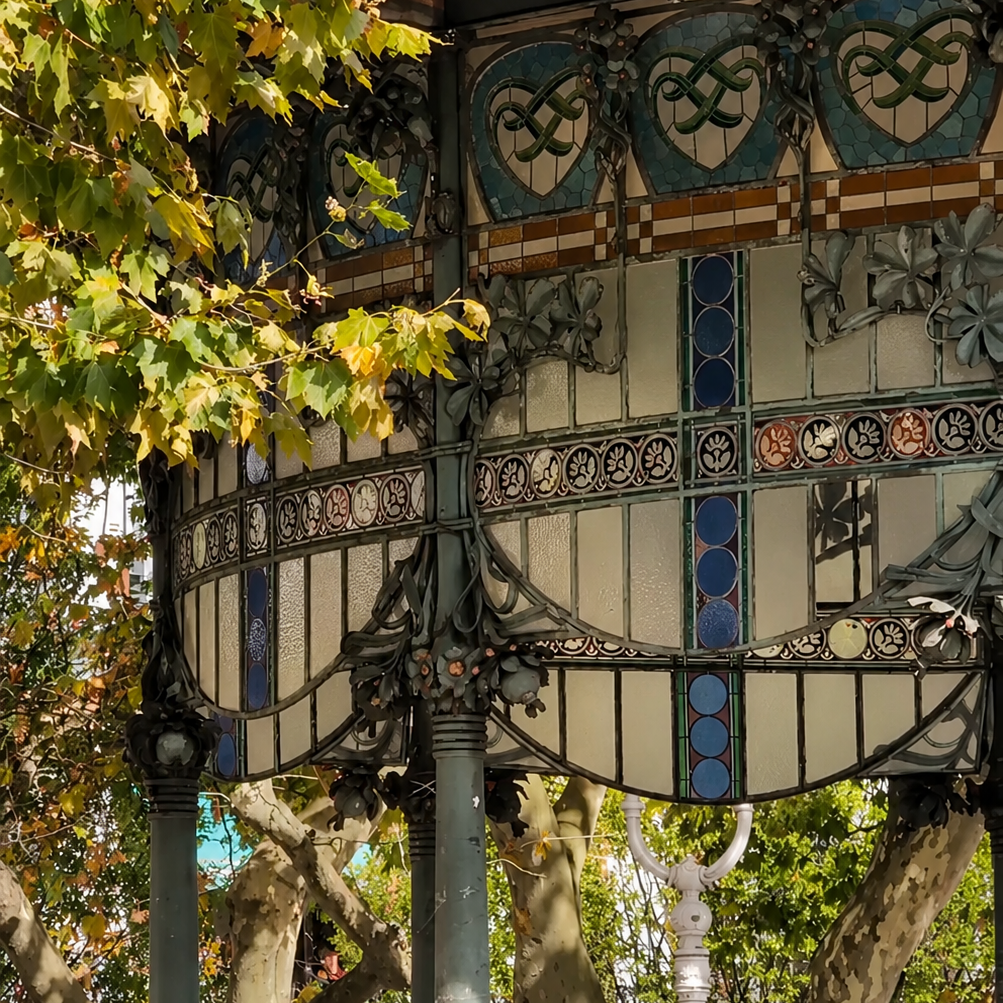
Paseo del Boulevard
After completing our tour of the Parte Vieja, we naturally move towards San Sebastián’s Boulevard (Paseo del Boulevard or Boulevard Zumardia).
It is a wide pedestrian avenue that physically and symbolically separates the Parte Vieja — the old city — from the Centro Romántico, the nineteenth-century Ensanche. It runs directly over the remains of the ancient medieval walls, marking the boundary between two different eras.
It was the first major pedestrian public space created in San Sebastián after the city was rebuilt following the fire of 1813.
Designed with French-inspired gardens, the Boulevard guides both the eye and the footsteps from the former Casino — now home to the San Sebastián City Hall — to the Victoria Eugenia Theatre, creating an elegant and airy axis. It was deliberately conceived as a fashionable promenade modelled on the boulevards of Paris, with carefully maintained flowerbeds, benches and streetlamps. Even its name reflects this influence: boulevard, borrowed directly from French.
Today, the Boulevard is a permanent pedestrian area, an enormous open-air drawing room that is always full of people. At almost any time — especially at weekends and during the summer — you will find musicians, portrait artists, mime performers and small spontaneous shows. Temporary markets also sometimes appear, selling everything from crafts and second-hand books to products supporting charitable initiatives.
Walking along it from La Concha Bay towards the Urumea River, you will encounter several details worth noticing: the small historic Las Sirenas kiosk-bar, with its unmistakable architecture; the sculpture El Constructor de Barcos; and the Kiosko del Árbol de Guernica.
But perhaps the real attraction is the simplest one: the façades of the buildings lining the avenue, in Belle Époque and Neoclassical styles, painted in pastel colours and remarkably well preserved.
The geometric paving of the Boulevard, with its pattern of octagonal and hexagonal modules, recalls the city’s urban-planning history: according to a widely accepted interpretation, it is an elegant tribute to the more radical reconstruction plan that, after 1813, was set aside in favour of a more traditional layout.
The Centro Romántico (the Ensanche)
If the Parte Vieja is the historic and vibrant heart of San Sebastián, the Ensanche — also known as the Centro Romántico — represents its most elegant and cosmopolitan soul.
This is the district that tells the story of the city’s golden age, when San Sebastián became the summer capital of the Spanish royal court. Here, the atmosphere changes: nineteenth-century architecture, elegant townhouses, historic cafés and a distinctly Basque version of the good life.
Imagine San Sebastián in 1864: a city compressed within its medieval walls. Their demolition was a true act of liberation. On that newly opened space, the architect Antonio Cortázar designed a new district based on an orderly grid, with broad avenues and regular city blocks.
But the real boom, as we know, came when Queen María Cristina chose San Sebastián as her summer residence. Nobles, industrialists and artists followed her, transforming the Ensanche into a stage for luxury, culture and high society, especially during the Belle Époque.
This is the perfect area for elegant and refined shopping. You will find art galleries, high-quality clothing shops, bookshops and bars frequented by the people of Donostia, places not designed for hurried tourism but for those who enjoy taking their time. It is a discreet and extremely refined form of elegance.
From the Parte Vieja, head towards Plaza de Gipuzkoa: a small urban oasis, orderly and peaceful, with a pond, carefully maintained trees and benches that are perfect for stopping for a moment. It is one of the places that enchanted me most. At the centre of the park stands a large and colourful floral clock. Its faces are created with thousands of seasonal plants and flowers, which are replaced several times a year. It is the meeting point par excellence — I discovered that among the people of Donostia it is very common to say: “See you at the clock!”
As you continue along Calle Prim, Calle Urbieta, Calle San Martín, Calle Loyola, Fuenterrabía and the surrounding streets, there is only one piece of advice: look up. Wrought-iron balconies, ceramic panels, glass and slate domes, allegorical statues — every building tells of the ambition of a city that wanted to be modern, elegant and international.
Buen Pastor Cathedral
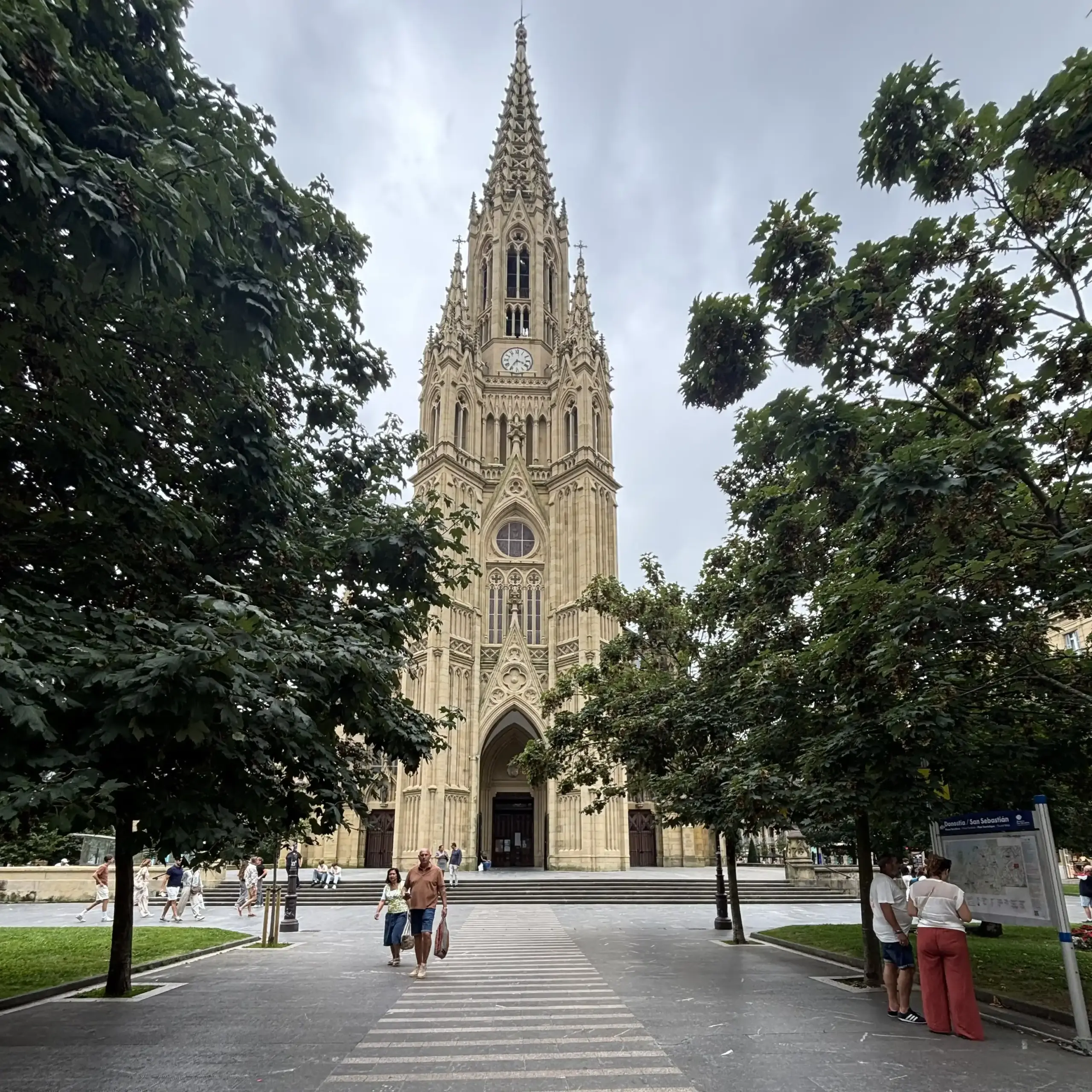
At the centre of this orderly grid stands the Buen Pastor Cathedral.
We are at the end of the nineteenth century: the walls are now only a memory, the Ensanche is taking shape, and San Sebastián wants to stop being a fortress city and become an elegant capital, worthy of the Spanish court and international tourism.
Construction of the cathedral began in 1888 and was completed in 1897. It was not built in the Parte Vieja, but in the centre of the Ensanche: it is the church of the city’s future.
Its style is Neo-Gothic, inspired by the great cathedrals of northern Europe, particularly Cologne Cathedral. The façade is slender and vertical, dominated by an extremely tall spire that seems to pierce the sky. And that was precisely the intention: to make it stand out.
Indeed, its imposing Neo-Gothic stone silhouette is visible from many parts of the city. For decades, its bell tower served as a visual landmark for fishermen returning to the port and for residents finding their way around the city.
Although the interior is restrained, do not limit yourselves to photographing it from outside. Admission is free — voluntary donations for maintenance are welcome — so go inside, even if only for five minutes. Sit down. Watch the light filter through the stained-glass windows.
It is the place that best tells the story of a deliberate choice: that of a city which, at a certain point in its history, decided to become elegant in every respect. Even in its spirituality.
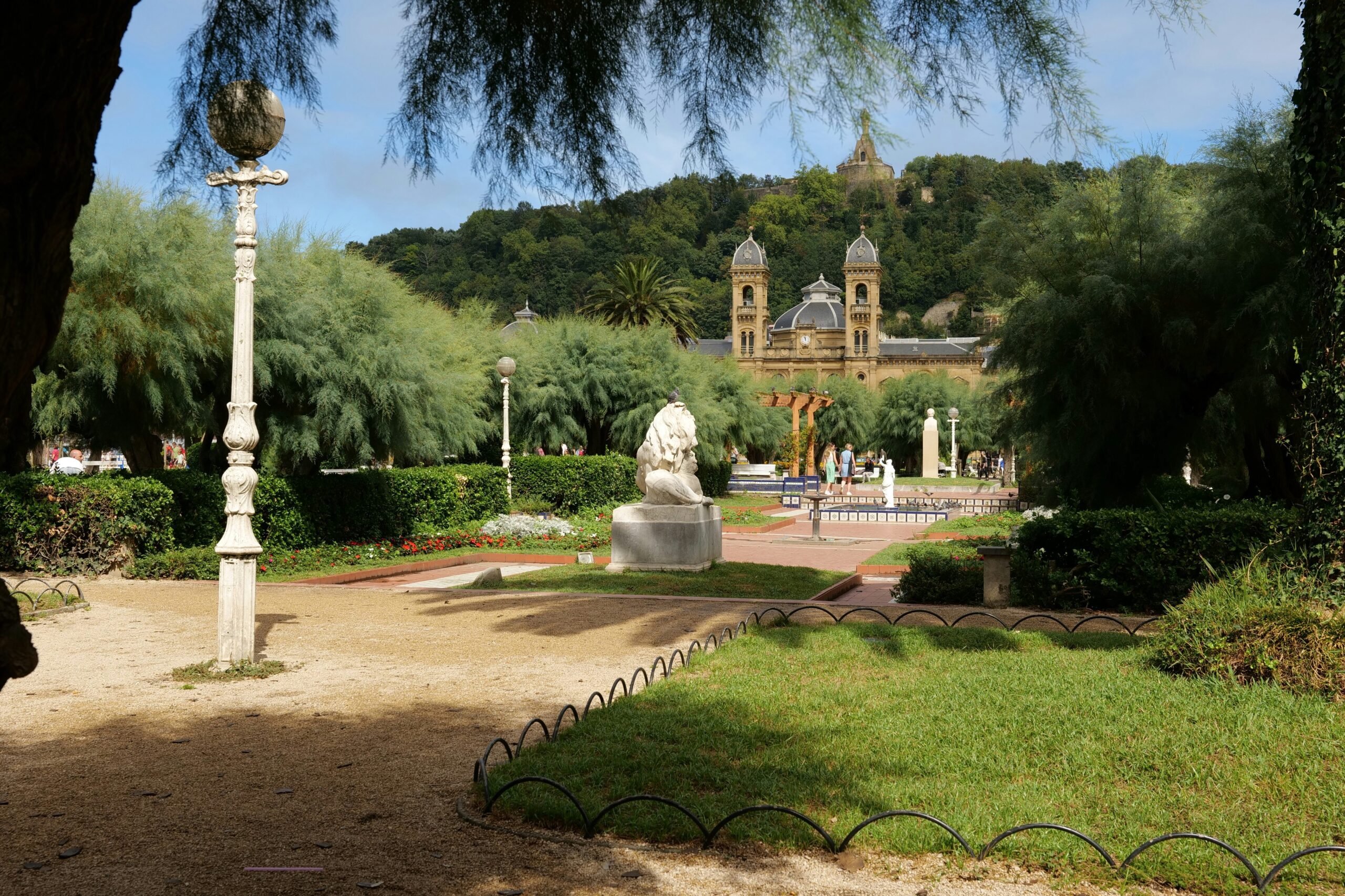
Alderdi Eder Park
Now all that remains is to cross the road and enter Alderdi Eder Park, the “beautiful garden”.
If there is one place where the Ensanche truly shows itself at its best, it is here. It is almost impossible not to come across these carefully maintained and orderly gardens, located directly in front of San Sebastián City Hall and La Concha, in a position so perfect that it seems deliberately designed.
And in fact, it was. This is not simply a park: it is San Sebastián’s official balcony overlooking La Concha, the place where the city puts itself on display and offers visitors one of its most recognisable postcard views.
In Basque, the name literally means “the beautiful area” or “the beautiful side”. With the construction of the Casino, now the City Hall, in 1887, and the Buen Pastor Cathedral in 1897, the area was reclaimed and transformed into a formal garden for a city aspiring to become the “Cannes of northern Spain”.
The main reason to stop here is the panoramic view from above the distinctive white balustrade:
- In the foreground, the golden sands of La Concha, the turquoise waters and, if you are lucky, the patterns drawn in the sand that have become a true signature of San Sebastián.
- At the centre of the bay, Santa Clara Island, covered in lush greenery.
- In the background, the perfect silhouette of Monte Igeldo, with its amusement park appearing to float between the sky and the sea.
The feeling is that of standing on a theatrical stage, with a breathtaking natural spectacle unfolding before you.
One of the best things to do in San Sebastián is undoubtedly a visit to Santa Clara Island. The island lies in the centre of La Concha Bay, between Monte Urgull and Monte Igueldo. It is small, green and can easily be explored in half a day.
The easiest way to reach it is by taking the Motoras de la Isla from the port of San Sebastián, in the Paseo del Muelle area.
For a basic visit, around two hours are enough, including the journey there. In 2026, the direct service operates approximately from 1 June to 30 September, from 10:00 a.m. to 7:00 p.m., with departures every 30 minutes or every hour, depending on the time of year and subject to weather and sea conditions.
The price is approximately €5 return. The direct crossing takes less than ten minutes. Tickets for the direct service are normally sold at the ticket office on the same day.
There is also a panoramic route that takes a tour of approximately 30 minutes around the bay before docking on the island; it costs around €8.
If you are fairly sporty, you can also reach the island by kayak or stand-up paddleboarding. Some people swim to the island from Ondarreta Beach, but the distance is approximately 400–500 metres in open water: this should only be attempted in favourable conditions, with proper training and suitable safety measures.
On the island, you will find a tiny beach that changes considerably with the tide. At high tide, much of the beach disappears, leaving a kind of natural swimming pool protected by stone walls.
From the landing stage, an uphill path crosses the vegetation and leads to the highest part of the island. The lighthouse was built in 1864 on the site of an earlier chapel. From the path, you can see La Concha Bay on one side and the more open and rougher Cantabrian Sea on the other.
The climb is not particularly long, but it includes steps and several sloping sections.
Inside the former lighthouse keeper’s house is Hondalea, Cristina Iglesias’s artistic installation inspired by geology and the action of the sea. The visit is not automatically included in the standard ferry ticket: access must be booked separately, when available. Before visiting, check the official San Sebastián tourism website .
During the summer season, there is a bar where you can buy drinks, ice creams and something to eat. There are also equipped areas with tables and spaces where you can stop for a picnic. The bar is normally open from June to September.
The park’s design is simple and elegant: geometric paths, symmetrical flowerbeds, tall palm trees that add an exotic touch — a reminder of the city’s seaside and high-society origins — and wrought-iron benches that are perfect for stopping and observing.
Hidden in the middle of the park is also one of Alderdi Eder’s most delicate symbols: the historic carousel. It is not a major tourist attraction, but rather a detail that adds a nostalgic charm. When it turns, with music drifting through the trees, it really does feel like taking a small step back in time. It is one of those details that does not change the journey, but makes it sweeter.
And, let’s be honest, once you are here it is practically impossible to resist: sooner or later, you will walk down the park’s steps and sink your feet into the golden sand of La Concha.
This beach has something special. Perhaps it is its shell-like shape — after all, it is called Concha, meaning “shell” in Spanish — or perhaps it simply feels as though it has something to tell you. It is the kind of beauty that forces you to stop, look and listen, making you feel part of something greater. It does not have the same powerful, sporty energy that you will find at Zurriola, on the other side of the river: here, the atmosphere is completely different, more urban and almost theatrical, as though the city itself were welcoming you onto the stage.
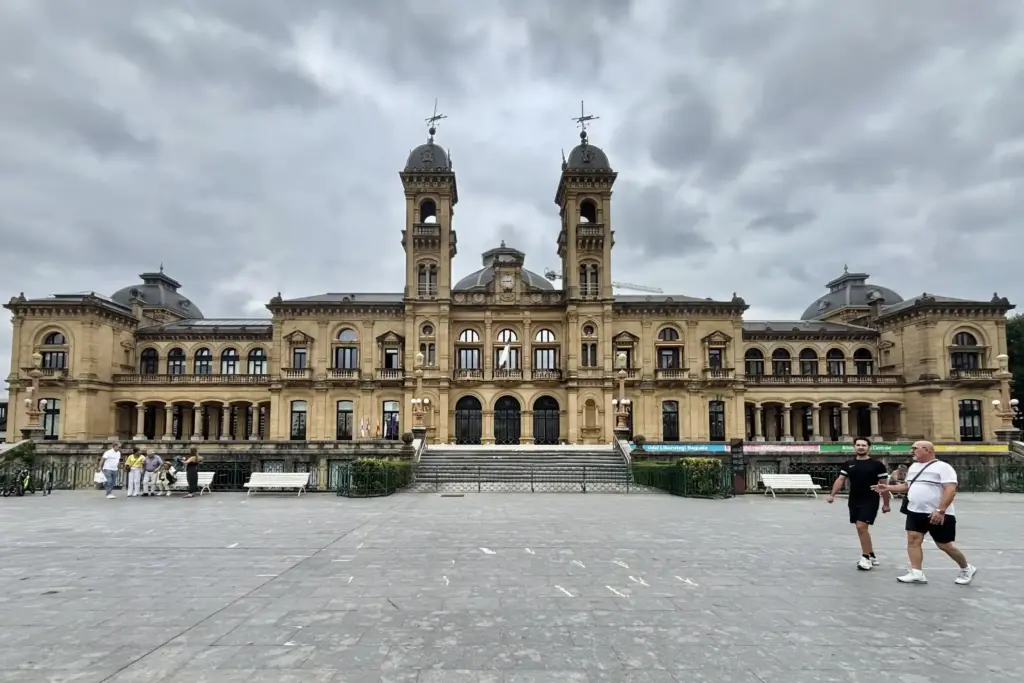
San Sebastián City Hall
I imagine that, having come this far, you cannot have failed to notice the magnificent building standing before you.
The park forms the perfect front garden for San Sebastián City Hall, an imposing Beaux-Arts building that naturally dominates the scene.
The contrast between the orderly greenery of Alderdi Eder, the bright façade of the building and the blue waters of La Concha Bay creates one of the most striking views in all of San Sebastián.
The building was originally constructed as a casino, inaugurated in 1887, at the height of the Belle Époque. It immediately became the symbol of a city determined to be modern, sophisticated and international: elegant evenings, aristocracy and luxury summer holidays.
In 1924, however, gambling was banned in Spain, and the casino lost its original purpose, later becoming the city hall. An elegant way of saying that even administrative power can inhabit beauty.
The interior is not always open to the public like a museum, but free guided tours are organised from time to time, so ask at the tourist office in Plaza de Gipuzkoa.
If you have the chance to join one, you will discover spaces that still preserve the atmosphere of the old casino: large halls, dramatic staircases and decorations that are restrained yet highly effective. Nothing excessive, everything perfectly measured. During the casino years, Queen María Cristina had a private entrance and a reserved room — the Salón de la Reina — so that she did not have to mingle with the crowds.
Outside, you will notice several statues representing Prudence, Temperance, Justice and Fortitude. An almost ironic detail, considering that roulette was played here for years.
On the side of the building facing the city, meanwhile, there is a flagpole. It is always empty: any flag flying there would cover the clock on the façade. And here, visual balance comes before everything else.
That said, when you are in front of La Concha, the best advice is always the same: stop. Sit down, especially at sunset, when the light softens, the sea becomes calmer and the building takes on golden tones. It is one of those simple moments, without attractions or explanations, that ultimately becomes the most evocative image you will take home from the trip.
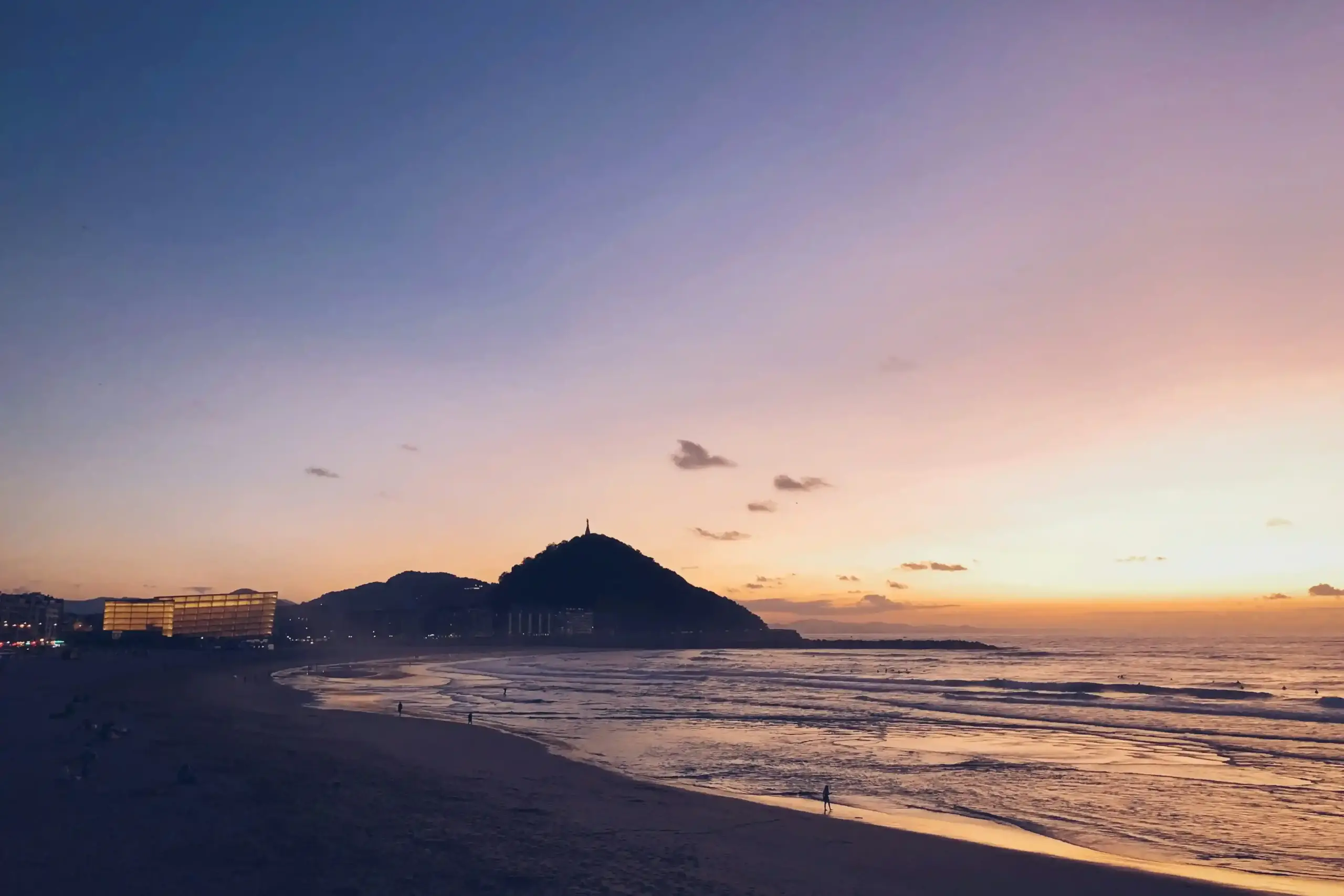
The Gros District and Zurriola Beach
Ready to change pace and discover another side of San Sebastián?
If the Parte Vieja is about gastronomy and history, and the Centro Romántico represents nineteenth-century elegance, Gros is the natural counterpoint: young, sporty and creative. A district that lives looking towards the future and, above all, towards the ocean. Its heart beats on Playa de la Zurriola, the beach of powerful waves and surfers.
From La Concha, reaching Zurriola is easy: simply get on your bike, cross the Centro Romántico and ride over the river. My suggestion is to follow the Urumea River, passing the beautiful Santa Catalina Bridge, the Victoria Eugenia Theatre and the iconic Hotel María Cristina — if you can, step into the lobby: entry is free, and for a moment it really feels as though you have returned to the 1920s.
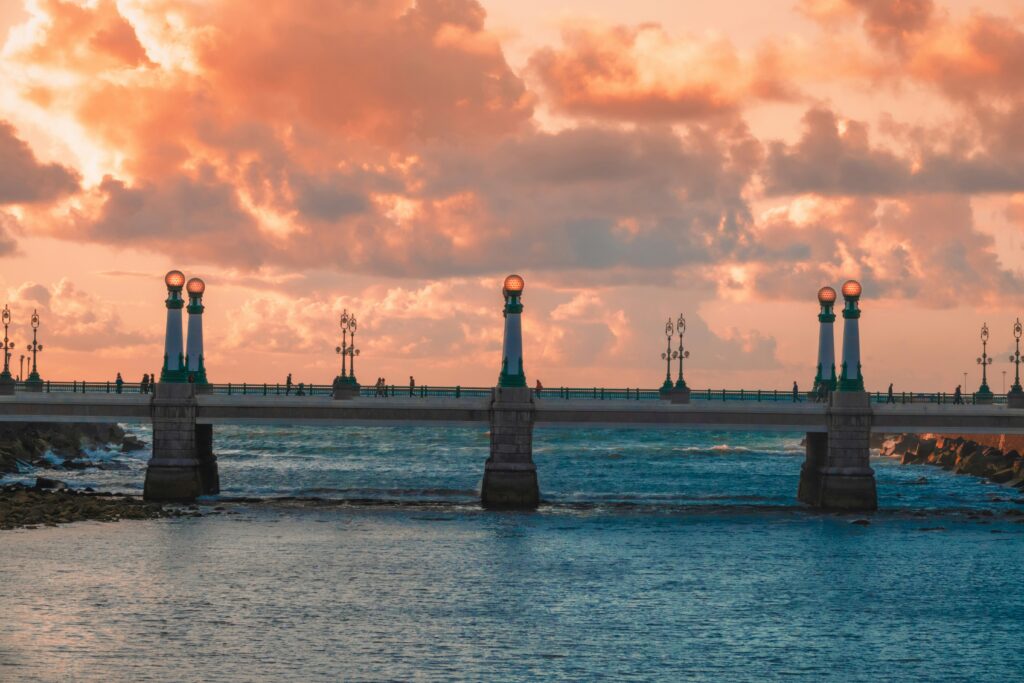
Then we cross the river, this time over the Zurriola Bridge, also known as the Kursaal Bridge. It is the last of the four bridges crossing the Urumea before the river reaches the sea, and it was built specifically to connect the city centre with the new district of Gros, which at that time was expanding over reclaimed dunes. The detail that makes it instantly recognisable is its six Modernist-style lamps, designed by the engineer Víctor Arana: they became so iconic that the bridge earned the nickname “seis de bastos” — the six of clubs in Spanish playing cards. One more curious detail: apparently, the first vehicle to cross it on the day of its inauguration had a Barcelona number plate. Who knows what it was doing there that day.
Once across the river, we find ourselves in front of Zurriola. The atmosphere changes immediately: stronger waves, wind, darker sand and a completely different energy from La Concha. This is the surfers’ beach, filled with young people carrying boards under their arms, wetsuits drying in the sun and spontaneous games taking place on the sand.
If you are not a natural-born surfer but still feel drawn to the waves, the best thing to do here is take a surf lesson. At Zurriola, group lessons for beginners lasting around 1 hour and 30 minutes are available. They generally include an instructor, board, wetsuit, insurance and use of the changing rooms. We took one with Zurriola Surf Eskola, which allows you to choose the number and duration of the lessons, including private sessions or lessons in small groups.
But even if you do not go into the water, Zurriola works perfectly: watch the sea, watch the waves, watch the people. Something interesting is always happening. We watched a surfing lesson for children… they spent more time in the water than on the board, but they were so entertaining!
At the eastern end of the city, beneath Monte Ulia, lies a little-known hidden gem: a more secluded and wild corner, much appreciated by those looking for a break from the main beach.
The clear transition between the historic centre and Gros is marked by the Kursaal: two large glass cubes overlooking the ocean, often debated, sometimes criticised, but impossible to ignore. Designed by Rafael Moneo, it is an absolute must for architecture enthusiasts — two prisms of opalescent glass that reflect the sky and clouds during the day and light up at night, becoming glowing lanterns facing the sea. It is an architecture that does not try to blend in, but instead engages boldly with the landscape; at night or at sunset, the buildings are truly beautiful.
Even if you are not attending an event, it is worth going inside: the lobby is accessible, and as you climb the interior stairs, a beautiful view opens over the Urumea River and Zurriola. There is also a little-known detail: the Kursaal terrace, on the roof of the smaller building, the Sala Kubo. It is not always open, but during events or special openings it becomes one of the finest viewpoints over Zurriola Bay and Monte Ulia. Access varies considerably depending on the events taking place. Give it a try — you never know!
Behind the beach lies the actual district: less touristy and more lived-in. Students, young families and creative people live here, and the streets are full of informal bars, music venues, modern restaurants, bakeries and “real” neighbourhood cafés. It is the right place if you want to eat well without formality and understand how San Sebastián lives away from the postcard views.
And yet, walking through its streets today, among surfers returning from the beach and fashionable venues, it is difficult to imagine that until the mid-nineteenth century this area was an immense expanse of deserted sandbanks. The Urumea River marked a clear boundary: on one side stood the bourgeois, fortified city; on the other, wild and flood-prone land.
The history of the district began in 1849, when José Gros, an entrepreneur of French origin, purchased the entire area on the right bank of the river from the City Council. Gros was an industrialist who had already launched several businesses in the city — a confectionery shop, a factory producing Parisian tacks, and a liqueur company — and his family, originally from Mont-de-Marsan in the French Pyrenees, perfectly represented the entrepreneurial bourgeoisie that was transforming the city.
The dunes purchased by José Gros were immediately put to use: the sand was sold for railway embankments and, after the demolition of the walls in 1864, for the construction of the new ensanches. The real urban development came later, however, with the plan drawn up by municipal architect José Goicoa in 1891, who designed the new district on land that had by then been reclaimed. The project was carried forward by Tomás Gros, José’s son and a trained architect: in 1894, his expansion plan was approved, giving shape to the neighbourhood.
The name of the district, however, was not chosen by the City Council. The authorities would have preferred to call it “Miracruz”, after the caserío that stood on the hill from which the cross of the Santo Cristo de Lezo could be seen. But the residents, with the stubbornness often associated with the Basques, continued to call it by the surname of the landowner: Gros. And that is what it has been called ever since.
Despite its strategic position, Gros struggled for a long time to become fully integrated into the city: for centuries, the only connection with the centre was a wooden bridge that the Urumea regularly destroyed during floods. It was the inauguration of the Santa Catalina Bridge in 1866 — the city’s first iron bridge — that finally made the crossing permanent. But for a long time, Gros remained the district of workers, factory labourers and fishermen, separated from the elegance of the bourgeois Ensanche. To me, it is somewhat reminiscent of the relationship between Brooklyn and New York.
This separation was also symbolic: Zurriola Beach itself was considered “the ugly one”, exposed to wind and waves, in contrast with the calm and aristocratic La Concha. Only with the arrival of surfing in the 1960s did the beach begin to change identity. But the real turning point for the entire district came in 1999, with the inauguration of the Kursaal: those two glass cubes were not merely a new building, but brought energy, investment and a new identity to the whole area.
Today, Gros is the city’s most dynamic face: young, sporty and creative, and a reference point for surfers from all over Europe, who find at Zurriola the most consistent and high-performance waves in the city. It is also the place to walk along the seafront as far as Sagüés, where you can admire one of the most beautiful sunsets in San Sebastián. From here, the view opens out over the sea and the city skyline, dominated by Monte Urgull and, further away, Santa Clara Island and Monte Igeldo.
The streets around Calle Zabaleta and Calle San Francisco are among the liveliest, filled with modern pintxos bars, bistros, cocktail bars and pubs — here, the pintxos are often more experimental and less traditional, but still of excellent quality. This is the kingdom of the pintxopote — a pintxo plus a drink at a fixed price — especially on Thursdays, when the streets fill with young people and the food scene becomes more informal.
Gros and Playa de la Zurriola are, in essence, the perfect break from the elegance of the city centre, which can sometimes feel a little too chic. Here, you can breathe in the youthful, vital energy of a city looking towards the ocean and the future. Whether you want to ride a wave, try a different cocktail or simply see where the real people of Donostia live, this is the right district for you.
San Sebastián has a creative side that often goes unnoticed by those who limit themselves to the Parte Vieja and La Concha Bay. The most interesting murals are found mainly between the city centre, Loiola and Martutene, where large colourful works tell the story of the neighbourhoods, nature, work and the city’s relationship with the Urumea River.
Some local agencies also offer guided street art tours and cultural itineraries that include murals and contemporary works.
To check whether guided visits or alternative tours are available during your stay, you can browse the options offered by GetYourGuide and Civitatis . I always use these platforms and they never disappoint me.
Those who prefer to explore independently can follow the Ruta de Murales proposed by the tourist board: a route of approximately 4.5 kilometres, with 12 stops and an estimated duration of one and a half hours.
You can view the complete map and information about the individual works on the official San Sebastián Tourism website .
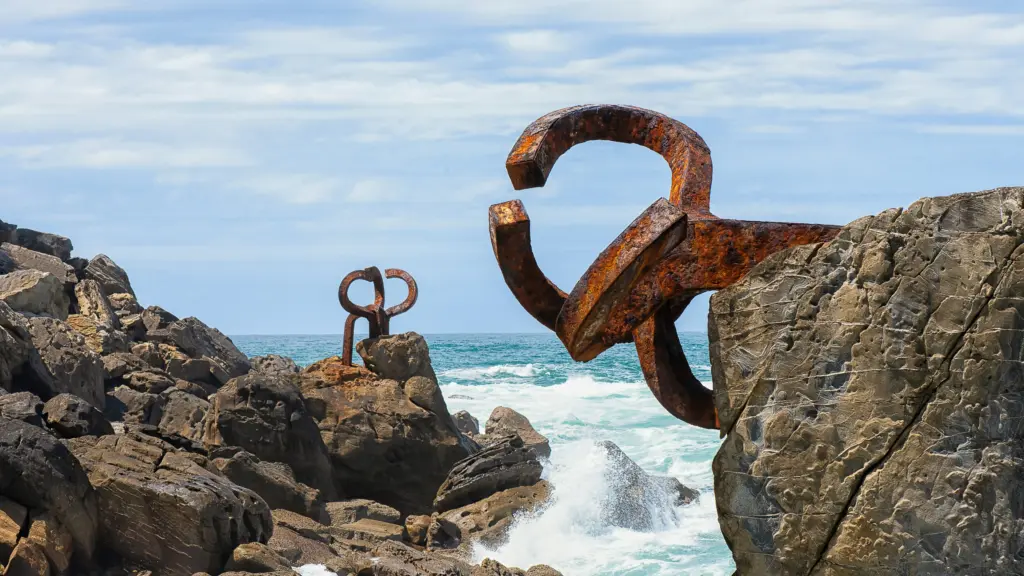
From Playa de la Concha to the Peine del Viento
Cycling in San Sebastián feels like a small waking dream: well-organised cycle paths, breathtaking views and a route along the bay that has now become a true classic.
The route I suggest is probably the simplest and best-known cycling itinerary in the city, but it is absolutely worth it. From the Paseo de La Concha, we will reach the Peine del Viento, following the sea for almost the entire way.
Allow around one hour for the return journey, without including stops. The route is mostly flat, does not require any particular level of fitness and is also suitable for families and children who already cycle confidently. So you really cannot say no!
The starting point is the Paseo de La Concha, the famous seafront promenade overlooking the bay, instantly recognisable by its elegant white balustrade.
The Paseo de La Concha, as we see it today, also exists thanks to a genuine gift. Not a gift in a metaphorical sense, but an actual donation made to the city.
At the end of the nineteenth century, Carmen Manso y Pérez de Tafalla, Countess of Llobregat, owned the Baicaitzegui estate, which occupied part of the Miraconcha hillside and extended all the way to the sea. In 1886, she decided to give the city the strip of land closest to the coast, making it possible to extend the public promenade along the bay.
The donation, however, came with one precise condition: nothing was ever to be built on that stretch of land. A fundamental clause, thanks to which we can still enjoy this magnificent view over the sea today.
Along this first stretch, the cycle path shares some areas with pedestrians, so the ideal pace is slow and respectful: ride carefully, smile and use your bell politely. This too is part of the experience.
The view is sublime: golden sand, turquoise water, Santa Clara Island at the centre of the bay and, ahead of you, the silhouette of Monte Igeldo.
When you reach La Perla, the historic bathing establishment now converted into a spa centre, stop for the first great photographic classic of the day. It may be one of the most photographed views in the city, but it is still worth stopping for: no guilt required.
Along the paseo, you will also come across the so-called Bicentennial Balcony. In 1882, a resident named Ulpiano Campión asked the City Council for permission to install, at his own expense, an iron balcony at a point along the promenade that at the time had no protection.
His intention was to demonstrate that a structure of that kind could be not only useful, but also decorative. Seven years later, in 1889, Campión decided to remove the balcony, but the City Council suggested leaving it in place. In the end, he transferred it to the city for the amount he had spent on its installation: 50 pesetas.
That first experiment anticipated the idea of equipping the seafront with an elegant protective railing, although the famous white balustrade that has since become one of the symbols of San Sebastián was designed and built later.
After passing La Perla and the Bicentennial Balcony, continue cycling along the curve of the bay.
A little further on, the route passes through the Antiguo tunnel: a small scenic passage marking the transition from La Concha Beach to Ondarreta Beach.
Beneath the Loretopea promontory, commonly known as Pico del Loro, you will also find MiramArt, a small pedestrian tunnel decorated with an installation inspired by the underwater world.
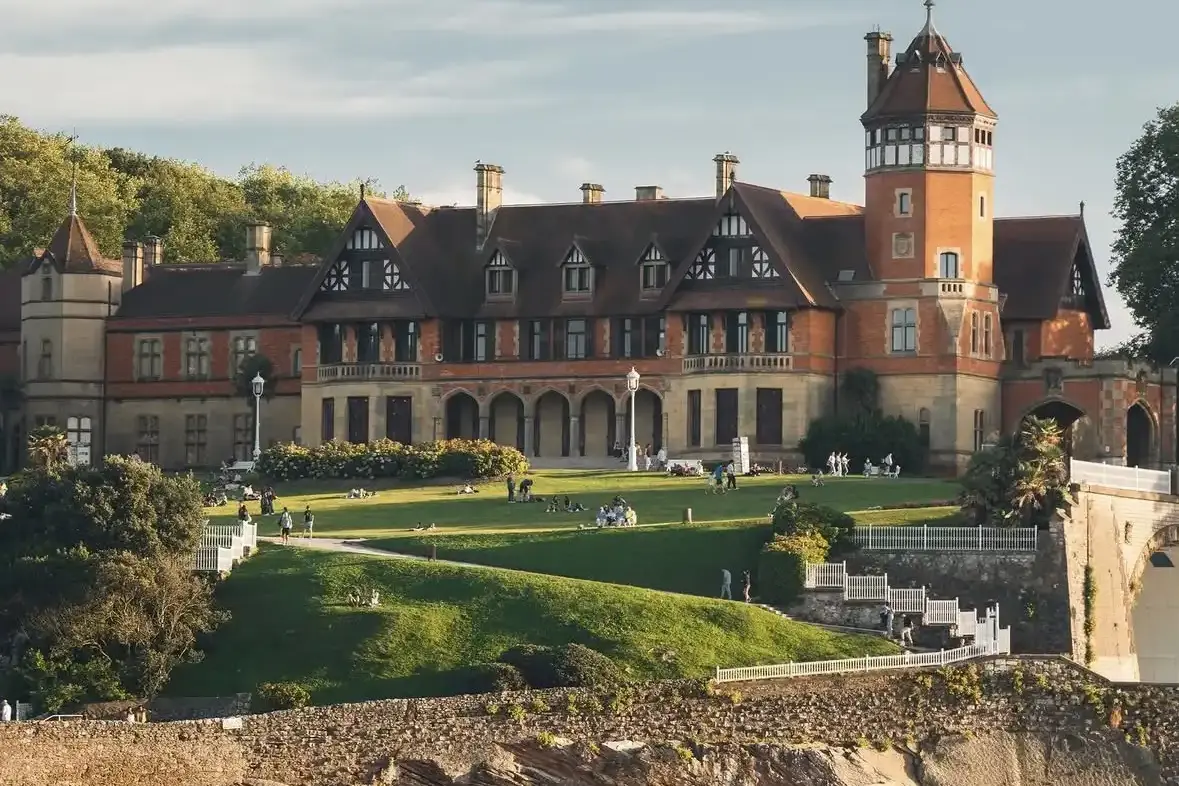
Emerging from the tunnel, you will reach the area around Miramar Palace, built at the end of the nineteenth century as the summer residence of the Spanish royal family. The palace dominates the promontory separating the two beaches and offers one of the most beautiful views over the bay. It is worth slowing down, entering the gardens and stopping for a few minutes to admire the panorama. The gardens are freely accessible and offer one of the finest perspectives over the bay, while the interior of the palace is not normally open to visitors except during events or special openings.
Then rejoin the cycle path along Ondarreta Beach. Here, the atmosphere changes: the seafront becomes quieter, Monte Igeldo appears ever closer, and the urban skyline gradually gives way to rocks and the open sea. Continue along the Paseo de Eduardo Chillida, following the beach as far as the Real Club de Tenis. The final stretch is short and almost completely flat. You will find bicycle racks where you can leave your bike: park it, continue on foot and take the time to look around.
Cross the walkway and the spectacle will appear before you.
Three large Corten steel sculptures, each weighing approximately ten tonnes, are anchored directly to the rocks. They are the work of the great Basque artist Eduardo Chillida.
The name says it all: Peine del Viento, the Comb of the Wind.
You only need to observe them for a few minutes to understand why. The steel forms seem to be trying to comb the wind and the waves of the Cantabrian Sea. They resemble claws, fingers or the roots of a gigantic metal plant sinking into the rock. They are neither polished nor smooth: they are rough, dark, oxidised by the salt and constantly exposed to the force of the sea. The sculptures emerge from the rocks and withstand the fury of the ocean. Despite their size and weight, they seem to have belonged to the landscape forever.
Beside the sculptures lies the square designed by the Basque architect Luis Peña Ganchegui. The paving conceals a series of circular openings connected to underground channels. When the sea is rough, the water rushes beneath the platform, compresses the air and forces it upwards through the holes. The result is spectacular: sudden jets of water, salty spray, blasts of air and a deep, hypnotic sound. It really seems as though the earth is breathing with the sea. Go closer if you wish, but be prepared: you may return home after a small Atlantic bath.
For me, the true value of the Peine del Viento lies not only in what you see, but above all in the sensory experience it creates. The sight of the sculptures, the sound of the waves, the wind on your skin and the salty smell of the air merge into a profound dialogue between art and nature.
The Peine del Viento is at its best at high tide or when the sea is rough. At sunset, the spectacle can become truly unforgettable. Do not, however, go too far in challenging the force of the wind and ocean. During storms, the waves can become enormous and dangerous: always respect the barriers, follow the safety instructions and watch the spectacle from a prudent distance. The power of the Cantabrian Sea is real, and that is precisely what makes this place so fascinating. But it must be treated with respect.
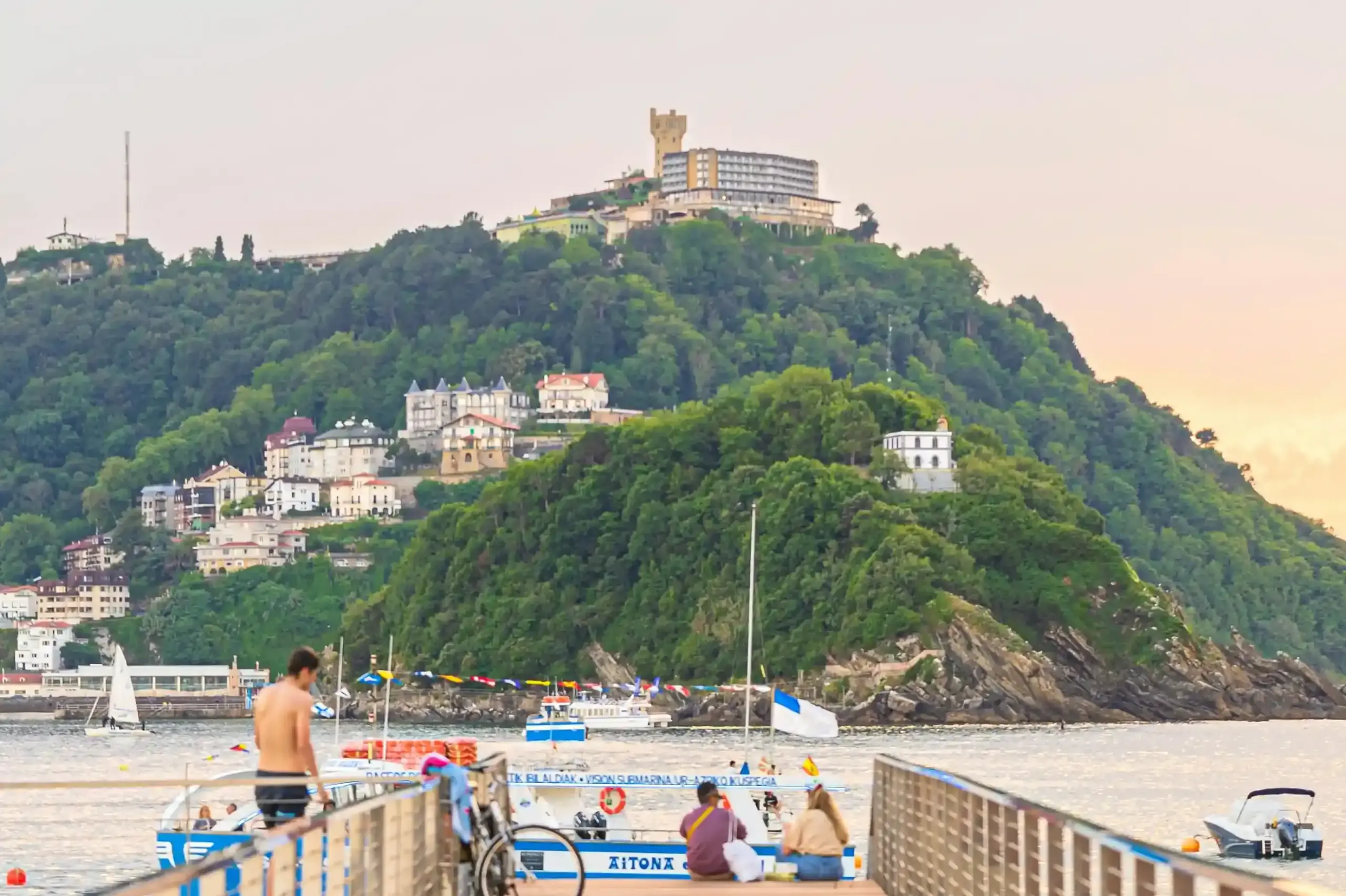
Monte Igeldo
After experiencing all the ancient power of the Peine del Viento, it is time to reconnect with a gentler and more orderly kind of nature: Monte Igeldo — or Igueldo in its older form. The mountain not only offers one of the most beautiful views over the city and the sea, but is also a genuine tourist attraction. Take a look at the dedicated website.
Reaching the summit is actually part of the experience, and you can choose how to get there.
If you have rented an electric bicycle, there is a rather demanding but definitely spectacular loop to follow. If you do not feel like tackling the climb by bike, no problem. There are several options suitable for everyone:
- The funicular is the most iconic option and the most romantic, quintessentially Donostian way to reach the top. The station is located in Plaza del Funicular, at the western end of Ondarreta Beach, not far from the Peine del Viento. In just a few minutes, the historic wooden carriages climb the steep slopes of Monte Igeldo, still preserving an atmosphere reminiscent of the Belle Époque. A return ticket costs approximately €5.50 for adults and includes both the funicular journey and access to the panoramic enclosure at the summit. The park attractions, however, are not included and must be paid for separately. Tickets cannot be purchased online in advance and are only available on site.
- Bus line 16 connects the city centre, from Plaza de Gipuzkoa, directly with Monte Igueldo. You can find timetables and frequencies on the San Sebastián tram website. Remember that the bus ticket does not include admission to the enclosure.
- Travelling by car is, of course, a very practical option. Thanks to the paved road, you can reach the summit very easily and park inside the enclosure. There is no standard hourly parking fee: access costs approximately €3 per person travelling in the vehicle and includes admission to the panoramic area. Tickets cannot be purchased online in advance and are only available on site. The park attractions are paid for separately.
- On foot, for those who enjoy walking: a pleasant, shaded path also starts near the funicular station and leads to the summit in around 30–40 minutes. It is a fairly gentle climb, ideal on days that are not too hot.
If you are looking for the perfect postcard view of San Sebastián — the one featured in every guidebook but even more beautiful in person — you need to come up here.
Monte Igeldo is not just a hill: it is the city’s most famous panoramic balcony, a small vintage amusement park and a genuine time machine that takes you back to the Belle Époque. At the summit, you will find kiosks and a restaurant — tourist prices, yes, but the view makes up for them. There are also green areas that are perfect for a picnic.
Historically, it was always a strategic lookout point for the defence of the city, and traces of this role can still be found today, including the remains of bunkers and military positions from the Spanish Civil War.
The turning point came in 1912, at the height of the Belle Époque: the funicular was inaugurated — one of the oldest still operating in Spain — and the amusement park opened at the summit. It immediately became a favourite destination for high society spending the summer in the city.
Today, Igeldo is a rare and highly successful blend of nature, panoramic views and nostalgia. It makes no attempt to be modern, and that is precisely why it works.
From the large panoramic terrace, you can take in the whole of La Concha Bay at a single glance: the shell-shaped beach, the city overlooking the water, Monte Urgull with the Castillo de la Mota and, on clear days, even the Pyrenees on the horizon.
It is the view that defines San Sebastián.
The best time to visit? Sunset, when the sun sinks behind the mountain and wraps the city in golden light. Here, as on other occasions, a smartphone is not enough to capture the experience: be prepared to stop, look and admire.
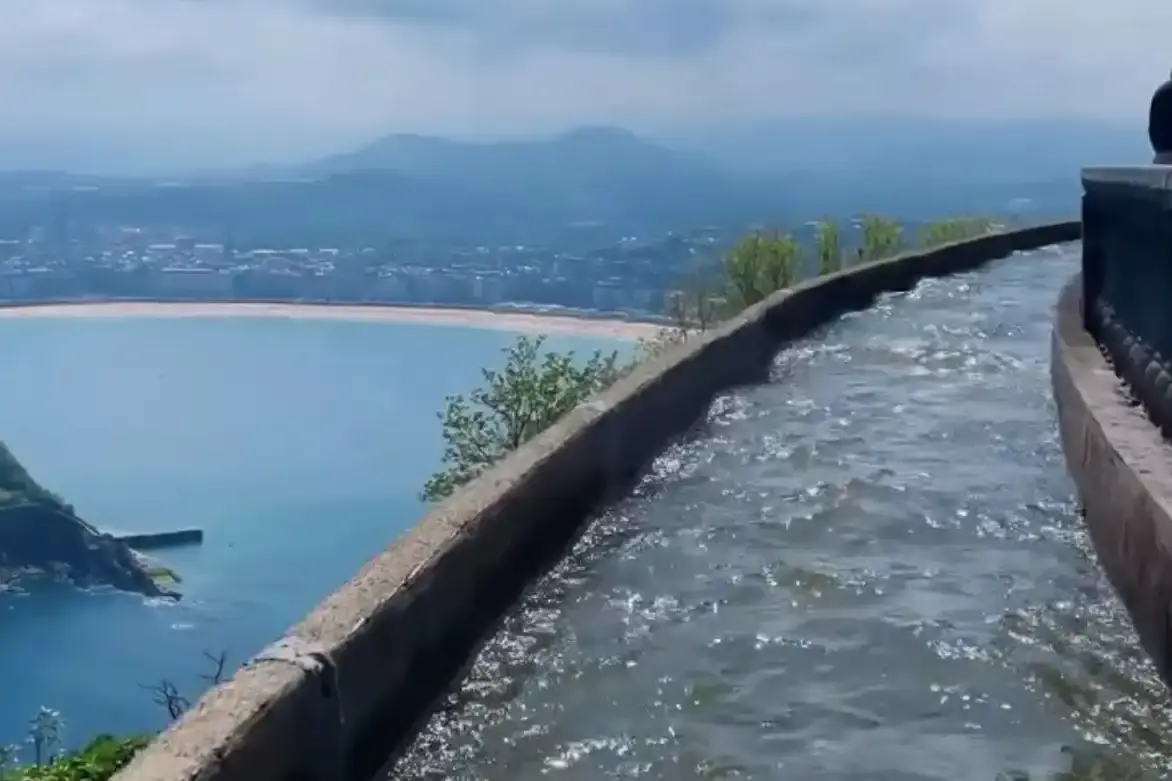
The Amusement Park
One of the reasons the mountain is so famous is precisely this: the amusement park. Do not expect ultra-modern roller coasters: this is a vintage 1950s–60s park, simple, well maintained and full of charm.
It is perfect for families, but also for anyone who loves places that do not need to amaze in order to be memorable.
You will find a historic wooden roller coaster, short but fun, a timeless maze, vintage bumper cars, a Ferris wheel that takes you a little higher, and the Torreón, the old lookout tower that adds a historic touch to the landscape. It is the former wood-fired lighthouse, where the exhibition inside allows you to discover what Basque ways of life and traditions were like until not so long ago.
Admission is included in the funicular ticket — tickets cannot be purchased online in advance and are only available on site — while the attractions are paid for separately, at around €3 per ride. I chose the Río Misterioso… it really is a nostalgic journey back in time!
At the highest point of the mountain stands El Faro, a modern lighthouse that is still in operation, solitary and surprisingly romantic.
Not far away is the Hotel Monte Igueldo, inaugurated in 1928, with a slightly Alpine and timeless elegance. Even if you are not staying there, you can stop at the bar or on the terrace for a drink with an unbeatable view.
Monte Igueldo is the antidote to excessive modernity. It is vintage, simple, panoramic and deeply Donostian. Even without going on a single attraction, the view alone is worth the journey.
I was told that, if you do not want to return the same way you came up, you can complete the loop by taking the old road back down towards the city. It is closed to traffic and open to pedestrians and bicycles. I did not have enough time to verify it myself, but people say it is very atmospheric, as it feels like a tunnel of vegetation with constant views over La Concha from above.
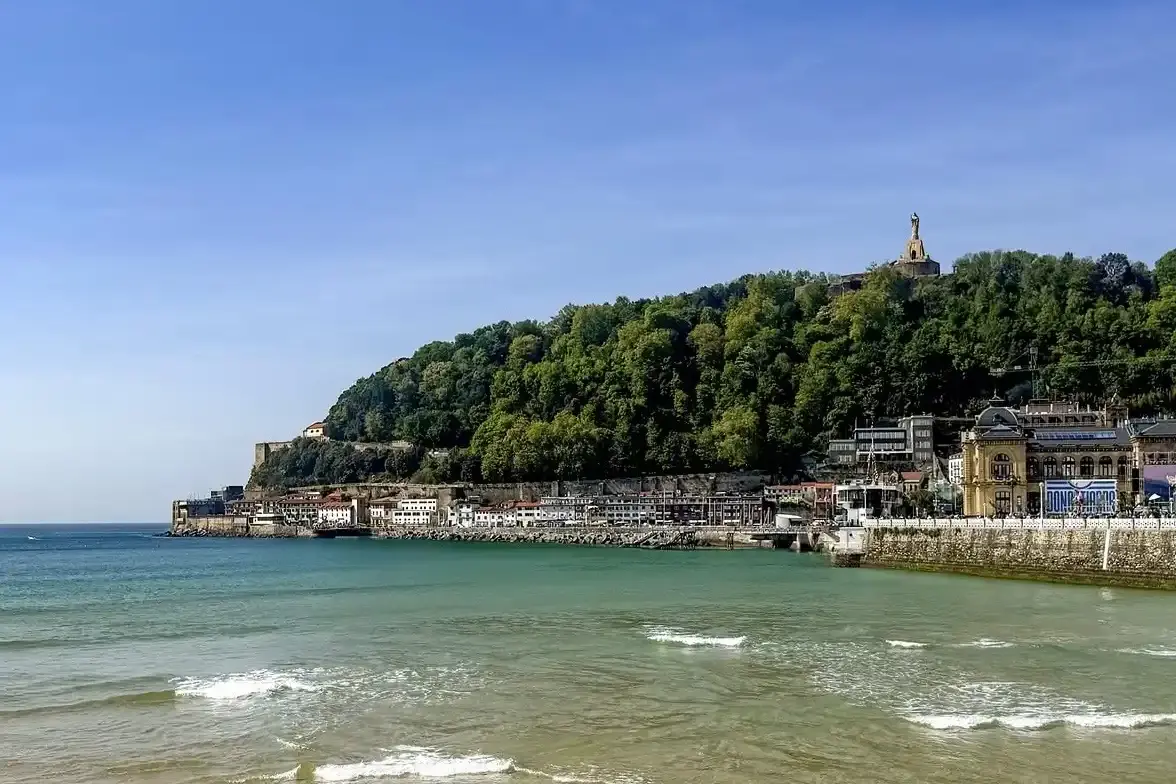
Monte Urgull
If Monte Igeldo is the elegant balcony from which to admire San Sebastián, Monte Urgull is its protective fortress. It is the city’s wildest green lung, the guardian of its memory and, for centuries, its first line of defence. Entering Urgull means taking a journey through woodland paths, military fortifications, reflective silences and a 360-degree view that only appears at the end, when you least expect it.
For centuries, Urgull formed part of San Sebastián’s defensive system. From its first medieval towers, between the sixteenth and eighteenth centuries it developed into a true star-shaped fortress designed to withstand sieges. And it witnessed many of them: the siege of 1719, the devastating siege and fire of 1813 during the Spanish War of Independence, and later the Spanish Civil War. Its scars are still visible along the paths, among broken walls and silent cannons.
In 1920, Urgull was demilitarised and transformed into a public park. Yet it did not lose its soul: it remains a sober, essential place, entirely consistent with what it has always been.
My favourite way to reach Urgull is from the Paseo del Muelle, the promenade along the fishing harbour. Here, San Sebastián smells of the sea: moored boats, nets, seagulls and the salty air accompanying every step. This is also where the boats to Santa Clara Island depart. From here, take Calle Puerto, the street running alongside the inner harbour, lined with seafood restaurants: some touristy, others still authentic.
The climb up the mountain is not particularly demanding, but take your time and enjoy it. Many people walk straight to the summit and immediately come back down. Instead, enjoy the paths and wander through the vegetation: you will be surprised by cannons, chapels, walls and bastions, as well as small miradores overlooking the city and the sea. In short, discover the views and remains of old San Sebastián.
At the summit, you will find the Castillo de la Mota, the ancient fortress that defended the city for centuries. Do not expect a fairytale castle: it is a sober, military and austere place, perfectly consistent with its function. Today, it houses a small museum space and several panoramic viewpoints.
Above the fortress rises the Cristo del Sagrado Corazón, a large statue visible from many parts of San Sebastián. It is not so much the work itself that is striking as its position: from here, the city appears gathered at your feet, protected by this enormous statue.
The view is complete: La Concha, the Parte Vieja, the port, the open ocean and Gros. It is one of the city’s few true 360-degree viewpoints.
If you do not want to climb the mountain, I recommend the Paseo Nuevo, which circles Urgull along the sea. It is less elegant than the Paseo de la Concha, but truly atmospheric.
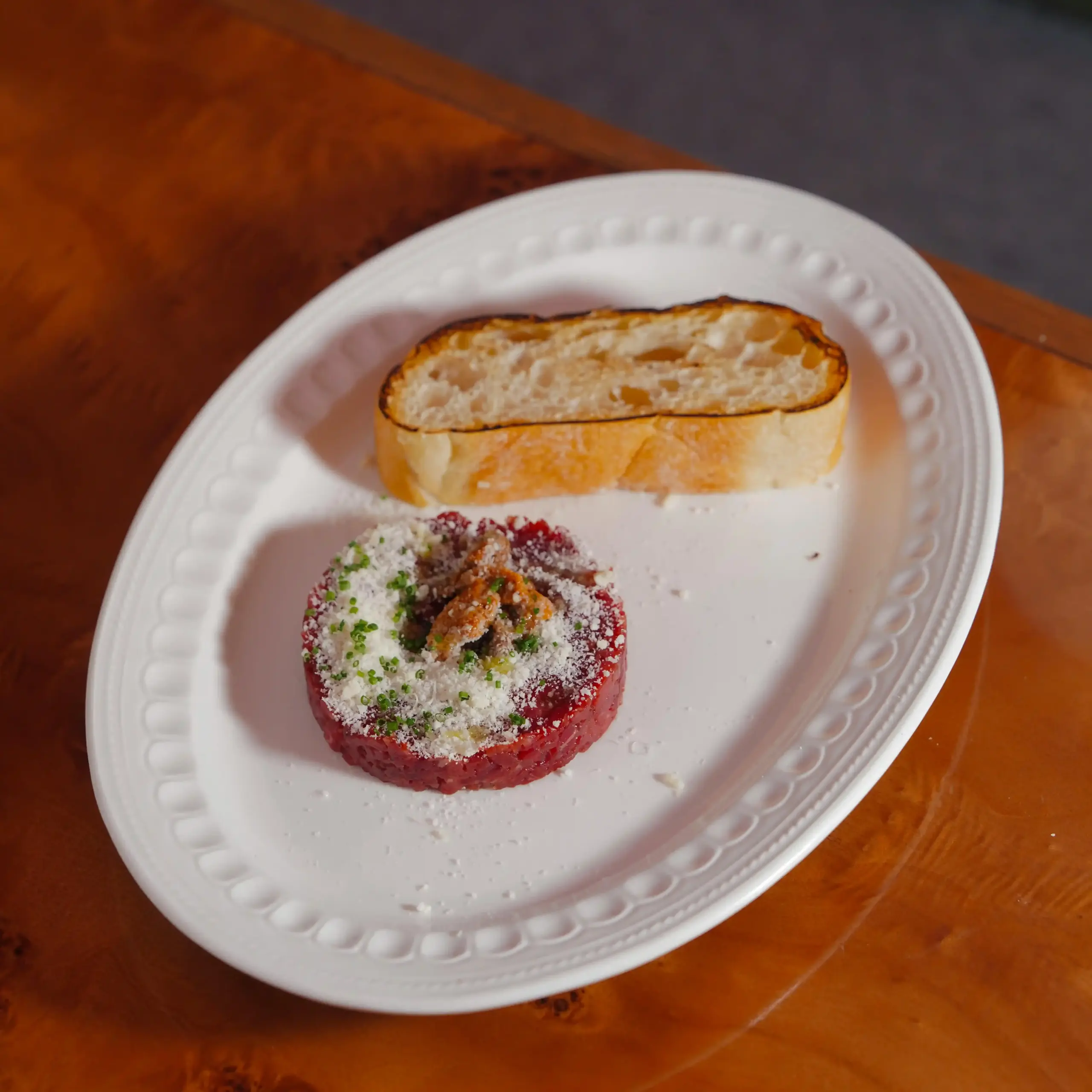
Where to taste a little of San Sebastián
San Sebastián is not simply a place where you eat well: it is a place where food is celebrated.
Donostia’s gastronomy grew out of a collective passion for food, with roots stretching back to the nineteenth century and an ability to evolve ever since. This was the period in which the txokos, or gastronomic societies, began to appear: private clubs, historically male, where local people gathered to cook together. They were not restaurants, but places of belonging where food became a social ritual. Here, people experimented, discussed, passed down recipes and strengthened a very Basque idea of cooking: eating well is a serious matter, but it should be done together.
After all, the proximity of the Cantabrian Sea guarantees exceptionally fresh fish every day: kokotxas, txangurro, cod and anchovies. The green inland landscape also provides a constant supply of high-quality vegetables and meat.
Basque cuisine combines outstanding local ingredients — incredibly fresh fish, produce from the land and seasonal vegetables — with a deeply rooted tradition.
Alongside this popular dimension are restaurants of the highest level, some of them Michelin-starred, which have brought San Sebastián into the global gastronomic elite. The most iconic name is Arzak, awarded three Michelin stars. It is an essential stop for anyone who wants to understand the depth and innovation of contemporary Basque cuisine. You need to book well in advance, especially during the high season. I called in June and there was no availability until September.
The most enjoyable thing, however, is still going out for pintxos in the Parte Vieja. Pintxos are a refined evolution of tapas and one of the most authentic expressions of Basque gastronomy: small bites of endless creativity served on bread, pierced with a cocktail stick — hence the name “pincho” — and designed to be shared. A glass of wine, a sip of txakoli, a few words at the bar. In the Parte Vieja, the streets become a true tasting route, with every bar ready to offer you its speciality.
As always, my most sincere suggestion is to choose at random and discover bars or restaurants that feel entirely your own, but if you have little time, here are a few addresses worth noting down or dreaming about:
- La Cuchara de San Telmo: there is no counter piled high with ready-made pintxos here; instead, you order from the blackboard and everything is served hot and freshly prepared. The cooking is of an exceptionally high standard, yet the prices remain accessible. Do not miss the cochinillo… it is out of this world. I was also told that the cod and octopus are among the best dishes on the menu. The dishes change periodically, but these ingredients remain firm favourites.
- Borda Berri: traditional dishes are reinterpreted with a creative twist and prepared to order. If, like me, you love risotto, try their “de Puntalete” with Idiazábal, a typical Basque cheese. It is incredibly creamy and has an intense flavour — I loved it! As you eat it, you will discover that it is not actually made with traditional rice, but with a short pasta called puntalette, or puntalete, which is shaped like a grain of rice and cooked in the same way as risotto.
- La Cepa de Bernardo: a historic establishment in the Parte Vieja. It is excellent both as a bar and as a restaurant. This is the right place if you are looking for a more traditional experience, perhaps to enjoy excellent fish or a good cut of meat in an atmosphere steeped in history. The sautéed clams are unforgettable, I can guarantee it!
- La Viña: it serves excellent hot pintxos, but is famous worldwide for its legendary cheesecake. It does not matter whether you have tried cheesecakes in Florida or New York: this is on another level! It is perfect for an afternoon snack or for ending the evening with something sweet… you cannot leave San Sebastián without trying it. The last time I went, in August 2025, the queue stretched halfway along Calle 31 de Agosto, but if you ordered the cake to take away, you could skip the queue. I do not know whether that rule still applies, but it is worth trying!
But you can choose from an endless number of places: Bar Valle, Bar Sport, Antonio, Casa Urola, Bar Txuleta, Bar Txepetxa… they all have their own speciality. Try whatever appeals to you most and enjoy the flavours of Donostia!
Unfortunately, in recent years San Sebastián has been overwhelmed by tourism, making the pintxos experience feel a little too commercial and Instagram-driven. Bars that were once frequented by locals are now so crowded that the people of Donostia often give up, while the bars themselves end up simply opening their windows and serving pintxos as takeaway food.
The first time I visited San Sebastián, for example, I was able to try the txangurro al horno at Bar Sport, which is why I recommended it above. The last time, however, the queue was so long that I would have risked spending half the day waiting.
For this reason, if the situation looks too chaotic and you feel like leaving the historic centre, I recommend spending the evening in Gros. The atmosphere is different, but the quality remains unquestionable:
- Bergara: one of the best examples of gourmet pintxos done properly. It is excellent both for a long aperitif and for an informal dinner, moving from one dish to the next.
- Bodega Donostiarra: a great classic, much loved by locals too. The atmosphere here is more traditional, almost like a neighbourhood bar, but with solid and reliable cooking. It is famous for its cold pintxos, well-made sandwiches and consistently interesting wine selection.
- La Madame: a perfect evening venue for ending the day. Carefully prepared cocktails and an elegant but relaxed atmosphere. It is the right place if, after dinner, you want to stay in the Gros area without heading back towards the Parte Vieja, perhaps after a day at the beach or surfing. Or for brunch before leaving!
And if you’re still hungry for more, click here to savour the full flavour of San Sebastián.
Travelling through the Basque Country means accepting one small truth: the weather here is part of the adventure. Sunshine, wind and rain can alternate within just a few hours, so your suitcase needs to be ready for almost anything.
The best strategy is to dress in layers. Always carry a sweatshirt or jumper to wear over a T-shirt. I bought this waterproof and windproof jacket, and it was one of the most useful things I packed. Even in summer, the Atlantic wind can feel surprisingly cold, so a lightweight scarf or neck warmer can also come in handy.
Choose comfortable, practical footwear. If you plan to explore the coast, you will need walking or hiking shoes suitable for the trails, as well as a pair of water shoes for the rockier beaches. You should also pack your swimsuit and a lightweight beach towel. I bought this one so that I could always carry it with me when visiting a seaside destination. The Atlantic may be cold, but the temptation to take a quick dip or walk with your feet in the water is always there.
Do not be fooled by the cool breeze: the summer sun can still burn. A hat, sunglasses and a high-protection sunscreen are essential. I always carry this sunscreen with me: it is small, but very effective.
For the evening, one slightly smarter outfit is enough to suit the understated elegance of San Sebastián. There is no need to pack anything particularly formal.
I almost forgot one very useful item: a wind-resistant umbrella. I had a Samsonite umbrella with me and it survived two days of rain, but a girl from Bilbao recommended this type of sturdy, wind-resistant umbrella. I later found a similar model online, which may be useful if you are looking for something of the same kind.
A little useful technology can also make travelling easier. Download offline maps and check a reliable weather app regularly, especially before setting out along the coast or heading into the hills.
As always, I also brought my power bank. It may seem like a small detail, but it makes long days much easier, particularly when you are using navigation to find your way along the trails and taking photographs of the most beautiful places and moments of the journey. I was given this one, and I am very happy with it. There are, of course, countless models available, but regardless of which one you choose, I strongly recommend bringing one.
Bear in mind that, although frosts are rare along the coast, winter can feel very cold, particularly when the wind and humidity combine. If you are travelling during the colder months, bring a warm jacket and dress in layers.
San Sebastián is a city that does not need to amaze in order to be unforgettable: its bay is enough, along with the way it experiences food as a collective ritual, its almost “aristocratic” nature on one side and its wild spirit on the other. It is an elegant city, but never cold, proud of its history without being trapped by it.
And, in a way, it is also the most refined gateway to a much wider world: the Basque Country, a land of spectacular coastlines, fishing villages and a powerful identity that deserves to be discovered slowly.
If you feel like continuing the journey, less than an hour away you will find Bilbao, with its industrial soul reinvented in a contemporary key, or the almost unreal landscape of San Juan de Gaztelugatxe, the islet connected to the mainland by a staircase that seems to have emerged from a legend. Or you can visit other equally fascinating towns such as Zumaia and its Flysch, Orio — famous for the last great traditional whale hunt along the Basque coast — or Zarautz, home to the longest beach in the region.
In the end, San Sebastián is the perfect starting point for falling in love with everything else. So, if you want to keep falling in love, continue your journey and explore the rest of the Basque Country with us.