Things to Do in San Sebastián When It Rains
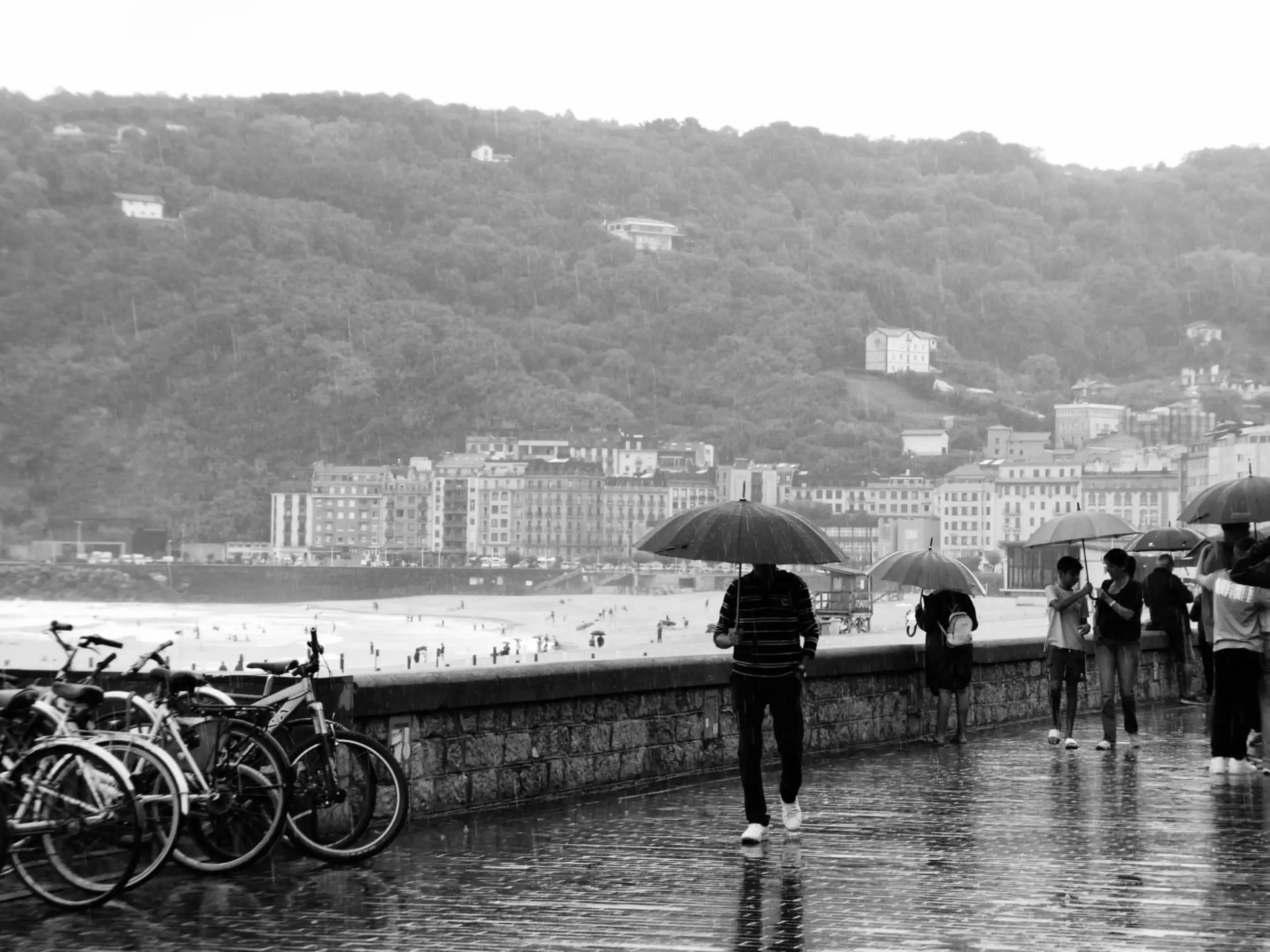
As I have already told you several times, including in my guide on what to do in Bilbao when it rains, in the Basque Country rain is not an unexpected inconvenience: it is part of the journey. That is why, as well as packing the right things, your spirit also needs to be ready to experience the Basque adventure with a few drops on your face… and, sometimes, with your face completely soaked!
And San Sebastián is no exception.
Of course, sunny days allow you to enjoy the city outdoors, make the most of the beaches and breathe in the sea air surrounded by the elegant Belle Époque buildings. But do not underestimate the beauty of the rain and the opportunities it can offer you: San Sebastián, when it rains, is still just as wonderful and shows you a perspective that many people overlook.
So here is what to do in San Sebastián when it rains.
A museum scene you might not expect
San Sebastián is certainly not Spain’s museum city par excellence. It does not have Madrid’s great monumental museums, it is not “the city of museums” like Málaga, and it cannot boast one of the world’s most important contemporary art museums like Bilbao. But it has a museum approach all of its own, and you will notice it. Here are my favourite museums:
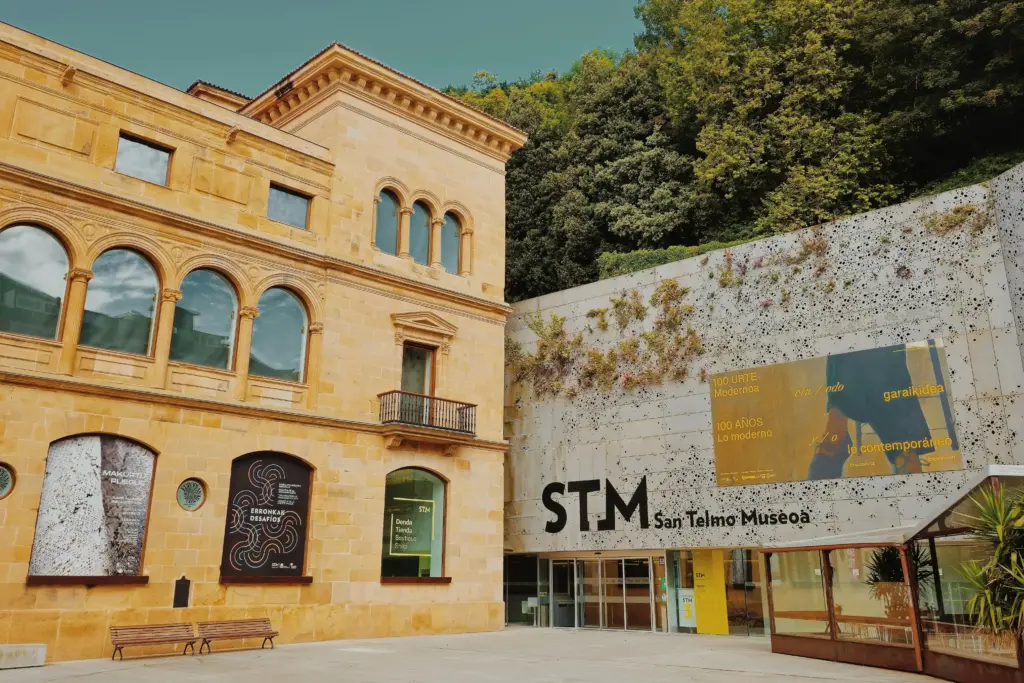
- San Telmo Museum: if you are curious travellers, you will not be surprised that the San Telmo Museum is my first suggestion. I will not go into detail describing it, since I have already talked about it in my article on San Sebastián, but I will say it again: it is an unmissable stop, especially on a rainy day! And remember that admission is free on Tuesdays!
- Basque Maritime Museum / Euskal Itsas Museoa: it is one of those places that many tourists overlook, but in my opinion it is really worth visiting: it is small, but it has a lot to tell. It is a public museum run by the Provincial Council of Gipuzkoa and dedicated to Basque maritime history: navigation, fishing, shipyards, exploration and heritage linked to the sea. The building itself is already a piece of history. It is the Casa-Torre del Consulado, built in the 18th century for maritime rescue and to control harbour activities. It is located on Paseo del Puerto, in the same area as the Aquarium, so if you feel like it, it is easy to combine the two visits. It can be the ideal complement to a route exploring the relationship between the Basques and the sea. Attention: the museum periodically closes while exhibitions are being changed. Always check the official website before going.
- Cristóbal Balenciaga Museum in Getaria: if you happen to get a drizzly day, this can be a really interesting option. Getaria is about thirty to forty minutes from San Sebastián, and the museum dedicated to Balenciaga is one of the most important fashion museums in Spain. From Donostia you can take the Lurraldebus UK10 directly. Once you get off in Getaria, the town centre is so small that the museum is reached with a very short uphill walk. I really loved it, also because Balenciaga is often considered a French brand, but its origins are 100% Spanish. Cristóbal Balenciaga was born right here in Getaria in 1895. He only arrived in Paris in 1937, driven there by the Civil War, and it was there that he opened the salons on avenue George V that made him famous around the world. The museum complex incorporates the Palacio Aldamar, linked to the aristocratic family that played a decisive role in his first contacts with high society and fashion. The contrast between the historic palace and the museum’s large contemporary black volume is already part of the visit. A tip to save money: admission is free from one hour before closing until half an hour before closing, subject to availability. This only applies to tickets purchased at the ticket office during that time slot. Opening hours change depending on the season, so always check the official website before setting off.
- Albaola Faktoria in Pasai San Pedro: I am mentioning it more for completeness than as a true rainy-day destination. Albaola is in Pasai San Pedro, about 4 km from Donostia, but it is not especially convenient to reach. From the centre of San Sebastián you can take the OR05 or the OR09, which connect Donostia with Pasai San Pedro, but from there you will still have to walk for another 15 minutes or so. There is also an option by sea, definitely more charming on sunny days: it drops you directly in front of the Faktoria, but it is not exactly ideal when it is raining and the sea is rough. Also remember that booking is required. In any case, it is a kind of museum-shipyard where traditional shipbuilding techniques are being recovered. It is a more original version of the classic museum, bringing you closer to the history of whalers and to San Sebastián’s maritime soul. This is where the replica of the San Juan was built, the 16th-century Basque whaling ship that sank in Canada. The replica was launched into the sea on 7 November 2025, after eleven years of work and with a “christening” using cider instead of champagne!
Eureka! Zientzia Museoa, the science museum
A full-price ticket can be purchased on the official website and costs around €10. There are also reduced rates for children and young people, as well as for other categories. Be careful, though: the planetarium, simulators and some special activities may require a separate or combined ticket. With the San Sebastián Card, you get a 10% discount on the full price of the museum and planetarium. I have also read that admission is free on Sunday afternoons, but I have not tried it personally. The museum is located at Paseo Mikeletegi 43-45, in the Miramón technology park. It is not especially convenient to reach on foot from the city centre, but it is easy to get there by Dbus on routes 28 and 17. If you are driving, there is free parking.
I decided to give it a separate section from the other museums because it really is a science museum unlike the usual ones. Do not imagine rooms full of objects locked away in display cases, to be viewed only from a distance, explained by a guide who is the same age as the fossils. Here everything is modern and technological, and there are so many things to do, from exhibitions to interactive experiences. There are more than 170 experimentation stations spread across themed rooms, designed so that science is learned by touching, trying, making mistakes and playing.
Its slogan is precisely «Prohibido no tocar», forbidden not to touch. Exactly the opposite of a traditional museum! It is a museum aimed above all at families and children. But if, like me, you studied science the old-fashioned way, here you will rediscover the desire to explore things in more depth and feel a little “electricity” from getting hands-on with everything.
Because it is designed for younger visitors, it is easy for everyone to understand, and the information panels are in four languages: Basque, Spanish, French and English.
Here you can really have fun:
- You can travel through the solar system, and really travel, thanks to the 3D planetarium.
- You will see the rotation of the Earth demonstrated by the Foucault pendulum, suspended in a 14-metre glass tower.
- In the Animalia room, you will observe live animals from different ecosystems, from snakes and lizards to fish, which you are unlikely to find elsewhere.
- And you can even lie down on a bed of nails, like a real fakir: there are 10,000 of them!
For younger visitors, although I am sure older ones will enjoy it too, there is the chance to ride a MotoGP bike, drive an F1 single-seater or fly a plane with the MAXFLIGHT simulator. There are even roller coasters and the Orion spacecraft. For adults, there are also temporary exhibitions of photography, contemporary art and more, which never disappoint.
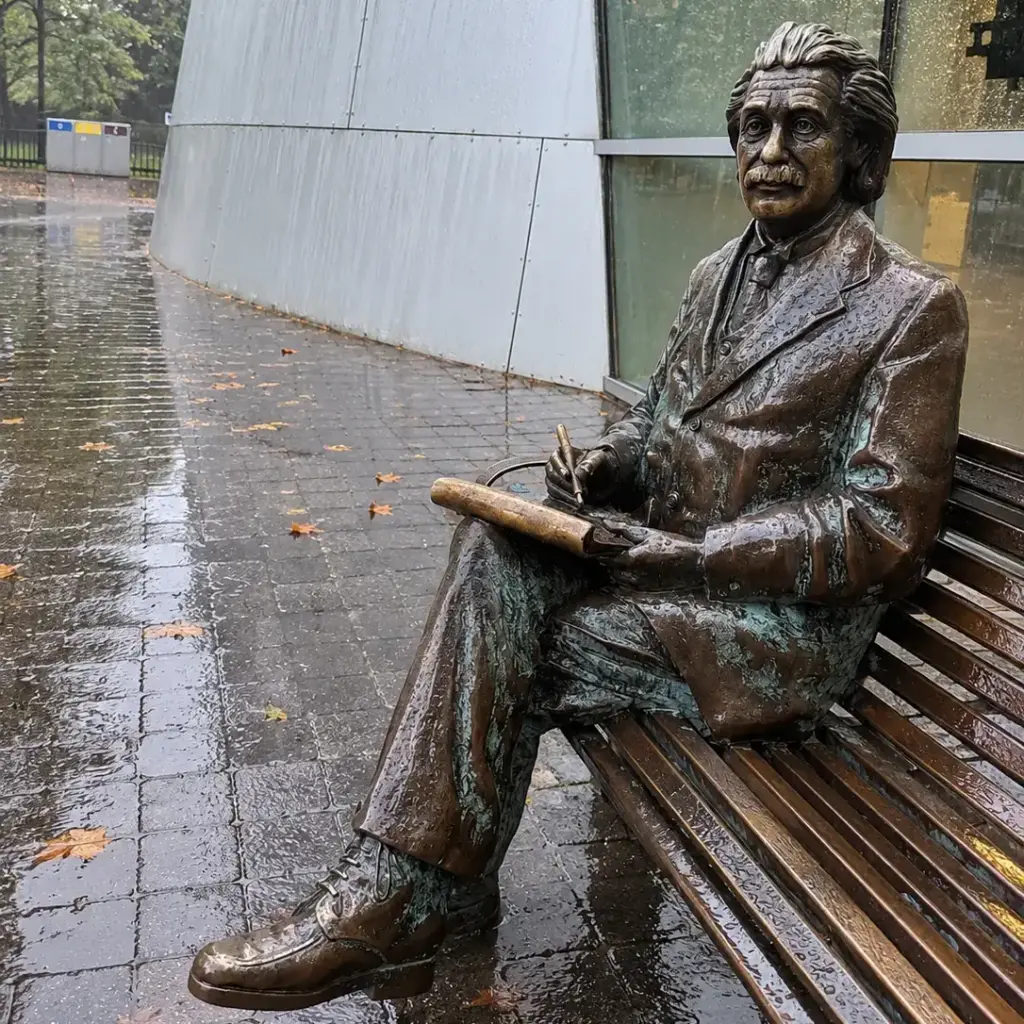
If it is not raining too heavily, do not stay indoors. Outside, as well as the statue of Einstein, you will find miniature reproductions of historic buildings and monuments from Gipuzkoa and a small botanical garden. A little further on, in Miramón Park, there are also the Torres de Arbide: a small castle builtruito nel 1904 nel centro di San Sebastián e trasferito qui pezzo per pezzo tra il 1972 e il 1975.
Even if the sun is shining outside, this is one of those places I would still recommend visiting. And since 2026 there has been one more reason to do so: the museum risked closing down.
In March, the Kutxa Foundation, which manages it, had announced that it would close at the end of June, after 25 years of activity. According to the foundation, the traditional science centre model needed to evolve towards a more interdisciplinary approach, bringing together science, technology, engineering, art, mathematics and the humanities. The new project is called ATENEA and will be created in the spaces of Tabakalera.
But the decision did not go unnoticed by the Basque people, whom we have now come to know quite well. Scientists, teachers, families and citizens began to protest, and even the mayor of San Sebastián asked for the decision to be reconsidered.
And incredibly, it worked: the foundation reversed its decision and declared that Eureka! will remain open. It is now discussing its future and renovation with the institutions.
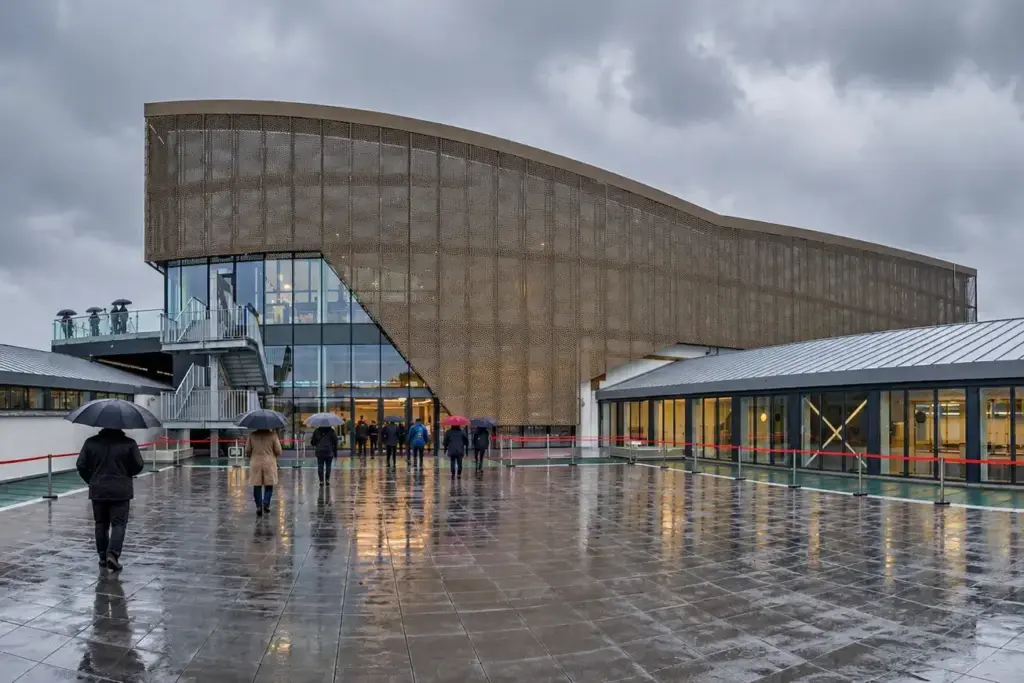
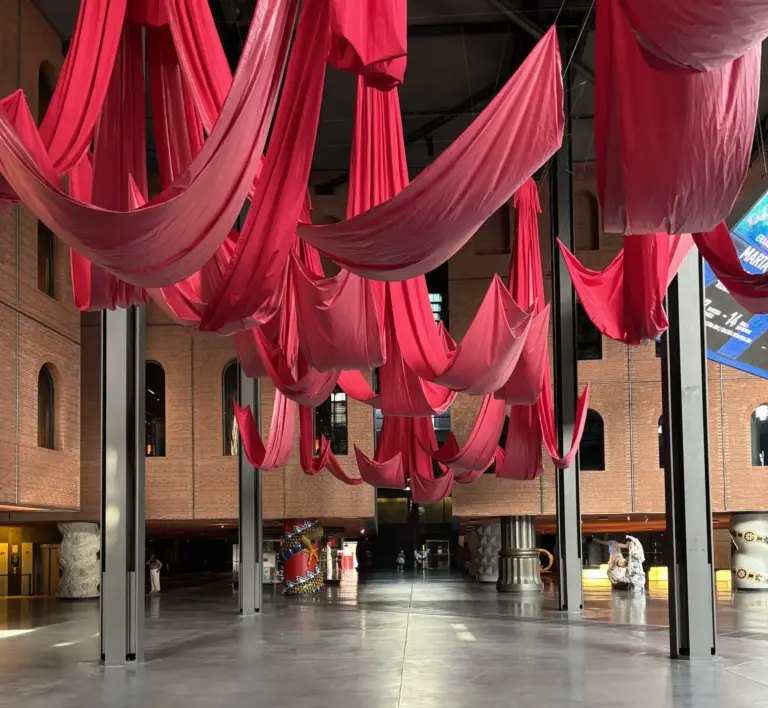
Tabakalera
Admission to the building is free, as are most of the exhibitions. Some activities and screenings may require a ticket. It is located at Plaza de las Cigarreras 1, in the Egia neighbourhood, practically next to San Sebastián railway station, the bus station and Cristina Enea Park. How much time to spend there depends very much on the programme: if you just want to have a look, 45 minutes to an hour is enough; if you find an exhibition that interests you, allow at least an hour and a half to two hours; if you add Medialab, the cinema or other activities, you can easily spend half a day there without even noticing. Pay attention to the opening times: the building stays open all day, but the exhibition rooms have more limited hours and are usually closed on Mondays. Always check the opening times and contact details before going.
For me, this stop is almost essential. Tabakalera is not “a museum”: it is a large cultural building where you can spend hours among exhibitions, cinema, the Medialab library-laboratory, shared spaces and activities. And above all, it has a history that is deeply connected to the city. It is the former tobacco factory, which operated for 90 years, from 1913 to 2003, and has now been transformed into the International Centre for Contemporary Culture. For decades, most of the people who worked here were women, the famous cigarreras, extremely important figures in the social history of Spain’s tobacco factories. So the cigarreras were not only those of Seville, whom you will probably also know thanks to Bizet’s opera Carmen: throughout Spain, tobacco factories were an almost entirely female world, and San Sebastián was no exception.
The interior is often described, quite rightly, as a cultural ecosystem. Its activities revolve around:
- contemporary art;
- arthouse cinema;
- photography;
- technology;
- music and performing arts;
- workshops and educational activities.
In short, projects that bring together art, science and society. The great thing is that you never know exactly what to expect, because the programme changes several times during the year and many exhibitions are temporary, free pop-ups — in the current 2026 programme, for example, several exhibitions have free admission. You really can go in to shelter from the rain, have a look around and decide how long to stay, without necessarily having to buy a ticket. Go in, wander around, see an exhibition, have something to drink, go to the cinema.
Yes, because Tabakalera has a film programme that is anything but commercial: retrospectives, arthouse cinema, cycles linked to exhibitions and screenings by the Basque Film Archive. In the 2026 programme, for example, the cycles on Billy Wilder, cinema and art, and Basque cinema continue.
And in a city so closely linked to Zinemaldia, the San Sebastián International Film Festival, going to the cinema when it rains also has a particular cultural meaningle particolare. Non a caso, dal 2016 Tabakalera ospita la sezione Zabaltegi-Tabakalera del festival.
San Sebastián Aquarium
You can buy tickets for around €16 on the official website. The audio guide costs €3. With the San Sebastián Card, you get a 10% discount on the adult rate. Attention: the online ticket is not a priority-access ticket. It still has to be validated at the ticket office, so if there is a queue, it does not necessarily allow you to skip it. In addition, the ticket office and entrance close one hour before closing time. Always check the updated opening hours, because on a rainy day, finding the door closed is the last thing you want! A tip: on Tuesdays, Thursdays and Saturdays at 12:00 you can watch the feeding in the large Oceanarium, with bull sharks and more than 6,000 fish. If you can, plan your visit around that time! If you also take your time to enjoy the initial section dedicated to maritime history, Basque whaling and the oceanographic collections, as well as the tanks and the Oceanarium, I would comfortably allow a little over two hours. The Aquarium is located at Plaza Carlos Blasco de Imaz 1, at the far end of the harbour, at the foot of Mount Urgull and just a few minutes’ walk from the Parte Vieja: the best way to get there is simply on foot.
Many people make the mistake of thinking of it only as a place to go and see sharks (and yes, you really will see them!). But the true value of the San Sebastián Aquarium is that it is an authentic museum of the sea. Just to set expectations: it is not a huge modern aquatic park like Valencia’s Oceanogràfic. The value of the Donostia Aquarium lies not in pure spectacle, but in the combination of history and a modern aquarium.
It owes its origins to the Sociedad de Oceanografía de Guipúzcoa, founded in 1908. It was not created as a tourist attraction: it was a scientific institution dedicated to the study of the sea, marine life and the coastal environment. And it is still active today, now as the Fundación Oceanográfica de Gipuzkoa.
The Palacio del Mar was inaugurated on 1 October 1928 in the presence of King Alfonso XIII and Queen Victoria Eugenia, at a particular moment in the city’s history. In 1924, during the dictatorship of Primo de Rivera, gambling had been banned and casinos had been forced to close. San Sebastián, which based a large part of its tourism precisely on that world, had to reinvent itself. In those years, new projects appeared that were more geared towards family and popular tourism, such as the Club Náutico and, indeed, the Palacio del Mar.
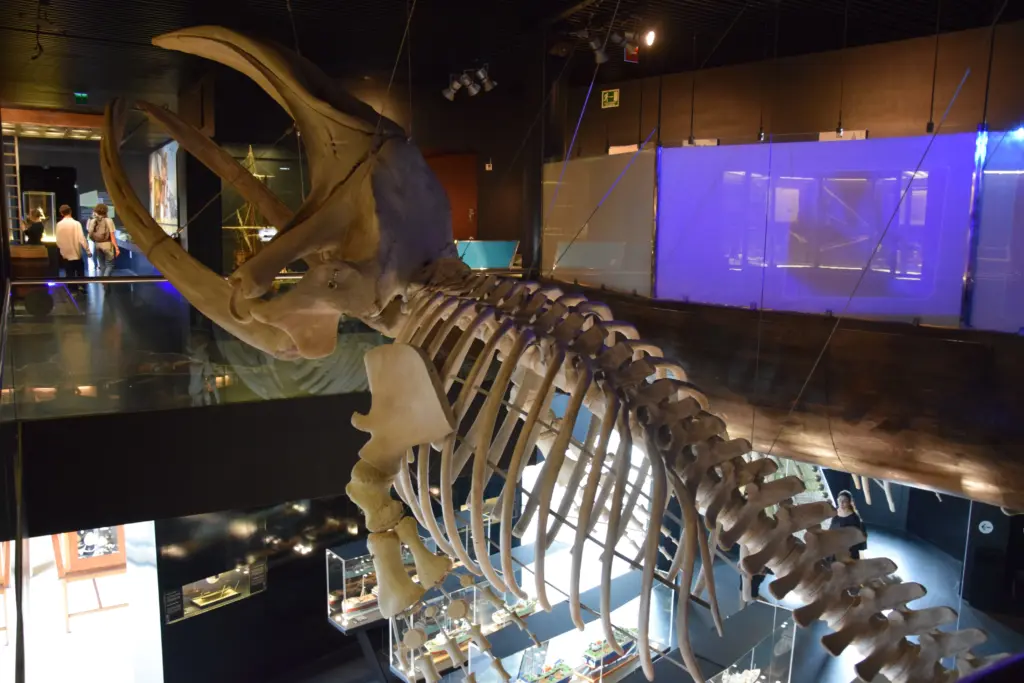
An important part of the building is dedicated to Gipuzkoa’s maritime heritage. You will find oceanographic collections, instruments, model ships, objects related to fishing and navigation and, of course, the whale.
One of the Aquarium’s great attractions is in fact the skeleton of a North Atlantic right whale, about 12 metres long, captured in 1878. It was the most hunted species: in English it is called the right whale, the “right” whale to hunt, because it was slow, rich in fat and, once killed, tended to float. That is why this skeleton is not just a zoological curiosity. It has become one of the symbols of the historic collection and is closely linked to the history of the Bay of Biscay coast, whose sailors were considered the best whale hunters in Europe. If you are curious, in my guide to the Basque Country I tell you about other aspects of whaling, including the legal authorisation to kill a Basque!
Besides the museum, of course, there are the aquariums. A large part is dedicated specifically to species from the Cantabrian Sea. Today the complex houses more than 200 species, including both Cantabrian and tropical fauna. There are pelagic species, moray eels, jellyfish, seahorses and small ecosystems, as well as tropical aquariums dedicated, among others, to the Caribbean and the Indo-Pacific.
For decades, the old Palacio del Mar remained very different from the Aquarium we see today. The decisive transformation came in 1998, with a major extension. That was when the attraction almost everyone associates with the Aquarium was created: the large Oceanarium, a tank holding around 1.8 million litres of water, crossed by the famous 360° transparent tunnel. You will literally walk inside the tank, while fish, rays and, above all, sharks swim beside you and above your head. It is, naturally, the most spectacular part of the visit.
The Aquarium also organises Durmiendo con peces, “sleeping with the fish”: night-time activities to discover how life in the aquarium changes after closing time. It also offers diving, guided tours, conferences and educational activities.
Sagardoetxea, the Basque Cider Museum
Tickets cost €5, including a guided tour and cider tasting. There are also more complete experiences, such as the Premium tasting visit (€9) or the Museum + Cider House package, starting from €53. Everything can be booked on the official website. The museum is open from Tuesday to Saturday, but opening hours may change, so always check the website before going. Visits are always guided and are available in Basque, Spanish, French and English. If you do not understand at least one of these languages, the experience is a little limited. Allow around one hour for the museum. If you add lunch or dinner at a cider house, allow about another two hours. The museum is located at Kale Nagusia 48, in Astigarraga, about 6 km from San Sebastián, and it is easy to reach. If you are planning to do the tasting or stay for a meal, I would leave the car behind and take the bus: from central Donostia, the Lurraldebus BU12 and BU13 lines take you there in around 25 minutes. If you are travelling in a group, a taxi is even more convenient and normally takes 10-15 minutes.
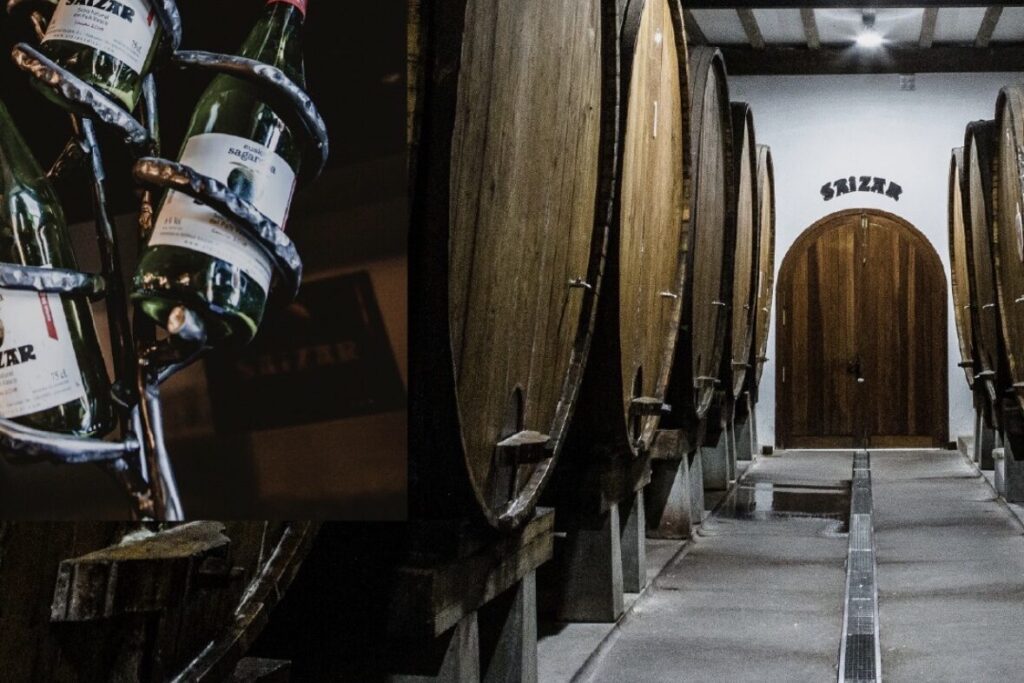
Sagardoetxea is not just a museum: it tells the story of the apple, cider production, the txotx ritual and the whole culture of the sagardotegi, the traditional cider houses.
The museum is divided into three parts:
- the apple orchard, where you learn about apple varieties and cultivation;
- the museum area, dedicated to the history and production of cider;
- the tasting area, where the visit ends with a cider tasting.
The museum area and the tasting are indoors, so it is a great plan for a rainy day. The apple orchard, however, is outdoors: in a heavy downpour you would miss part of the experience, which would be a shame, because that is precisely what makes this visit different from a simple museum.
What is interesting is that Sagardoetxea wants to explain that, in the Basque Country, cider is not simply a drink. A real social and gastronomic ritual has developed around the sagardotegi. The famous txotx is the moment when the barrel is opened and the cider is collected directly from the stream into the glass.
For this reason, the museum also offers the “Museum + Cider House” experience: first you discover how cider is made, then you go to a sagardotegi to put into practice what you have just learned. The traditional menu generally includes:
- cod omelette;
- fried cod with peppers;
- txuleta;
- cheese with quince paste and walnuts;
- and, of course, cider served txotx-style.
It is more or less the standard menu you will find in all cider houses.
If, on the other hand, you are not interested in the museum, I spent a wonderful half-day at the Saizar cider house in Usurbil, with a guided tour, cellars and dinner: I tell you all about it in my article on where to eat in San Sebastián.

Discovering Basque cuisine
If the rain shows no sign of letting up, you might as well turn it into an opportunity to discover Basque cuisine from the inside. In San Sebastián, there are genuine cooking classes dedicated to pintxos and traditional dishes. And they are not the kind of standard lessons you might have in mind. They often start at the Bretxa or San Martín market, where you choose the best ingredients together with an expert, and then move on to the kitchen to prepare some of the city’s most representative recipes.
My advice? If you can, choose one that takes place in a sociedad gastronómica, what elsewhere in the Basque Country they call a txoko. These are private clubs created for cooking and eating together, where recipes are handed down from one generation to the next and where you can really understand what sitting down at the table means here. They are not normally open to the public: to get in, you need to be invited by a member, or take part in an organised experience like this culinary adventure. It is certainly not the cheapest activity, but for anyone who loves cooking it can become one of the best memories of the trip.
In any case, there is no shortage of alternatives:
- Tenedor Tours, one of the longest-established operators in the city. It has been organising tailor-made private experiences since 1997 and has its own kitchen right on Calle Fermín Calbetón, in the heart of the Parte Vieja.
- The BCulinary Club, the space dedicated to enthusiasts of the Basque Culinary Center, San Sebastián’s university of gastronomy.
- The updated list of cooking classes on the official tourism website.
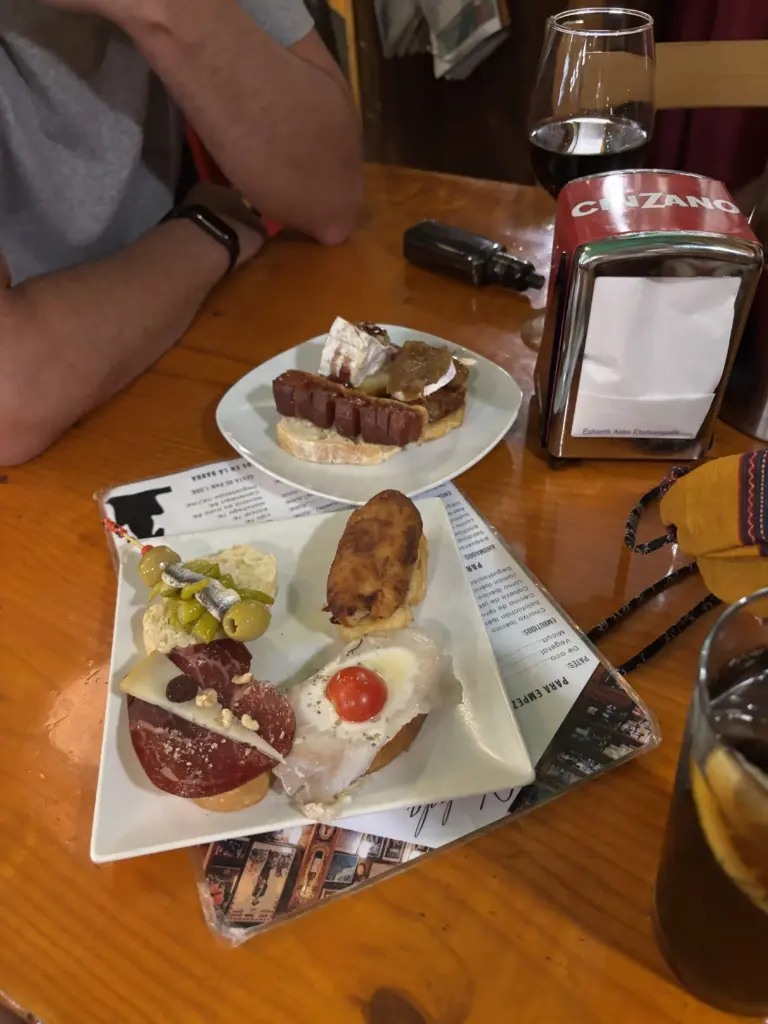
If you do not feel like cooking, you can always turn the rain into a pintxos crawl: one pintxo, one drink, then another fifty metres under the umbrella to the next delicious refuge. Or go into a historic bar and order a hot chocolate or a coffee, with no rush at all. Donostia in the rain is made for this kind of pause.
Another idea is a tasting of Basque products: cheeses (first and foremost Idiazabal), Cantabrian preserves, txakoli, cider and chocolate. You can book an organised tasting or create your own by exploring the gourmet shops that the tourism website lists among the best in the city. These include:
- Casa Otaegui, San Sebastián’s oldest pastry shop, opened in 1886;
- Bombonería Maitiana, chocolate artisans since 1949;
- Aitor Lasa, for artisan cheeses, including, of course, Queso Idiazabal.
Whatever you choose, first take a look at my article on where to eat in San Sebastián, it will give you the basics you need to find your way around before diving into the city’s gastronomic world.
Watching the stormy sea
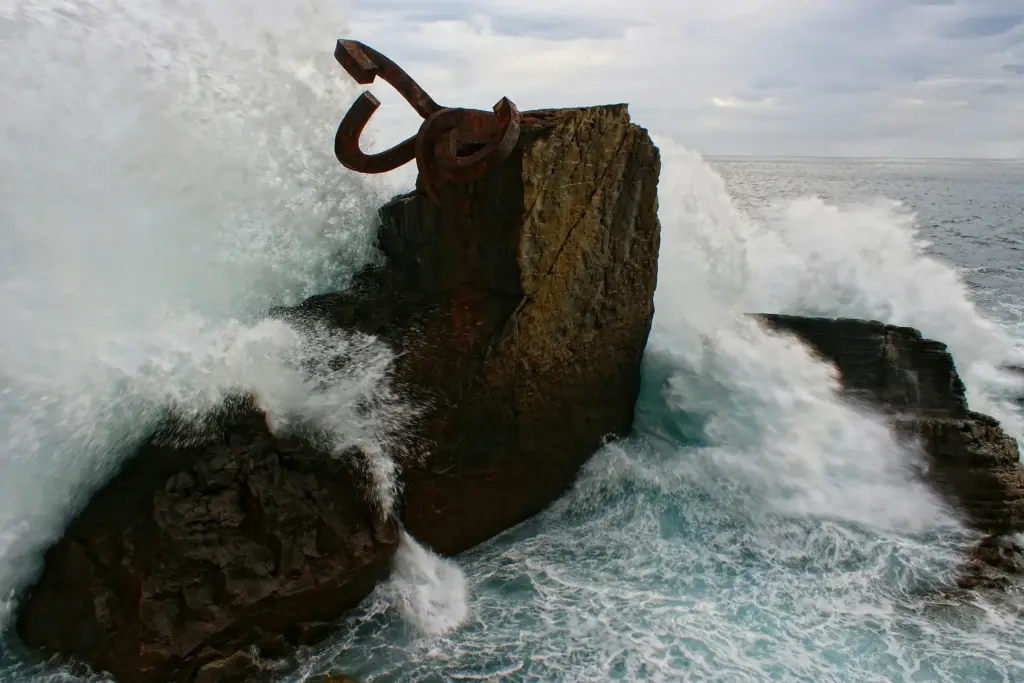
This one is a little counterintuitive, I know. But when it is raining without pouring, one spectacle you should not miss is the stormy sea. Especially in autumn and winter, you can watch the huge waves crashing against the coast, see the surfers at Zurriola chasing the perfect wave, or experience the Peine del Viento in a much more immersive way, when the water bursts up through the holes in the square and the Cantabrian Sea shows all its power.
The best time is high tide, when the waves hit the coast with more force. Check the tide times and weather alerts on Euskalmet, the Basque weather agency, before going out.
But be careful: all of this only in permitted areas, and never beyond the barriers. When an orange wave alert is issued, the City Council closes Paseo Nuevo, access to the Peine del Viento and the Zurriola pier, and sometimes also suspends boats to Santa Clara Island. If the authorities close a section, that is not the moment to go looking for the spectacular photo… I assure you! The waves of the Cantabrian Sea can be really dangerous, even for those who are “just watching”.
The walk from La Concha beach to the Peine del Viento — I also talk about it here — but if the rain becomes heavier on the way to the Peine del Viento, you can take a breather in the MiramArt tunnel, the pedestrian passage beneath Pico del Loro that connects La Concha beach with Ondarreta beach. Since 2016, it has been decorated with an installation inspired by the seabed: as soon as you step inside, it will feel as though you are underwater… but staying dry! And it is even a “smart” tunnel: it gives you information about the weather and the state of the sea and the beaches. Exactly what you need on a rainy day.
On the Basque coast, there is a word for the storm fishermen fear most: galerna. It is a sudden phenomenon capable of turning a calm sea into a trap within just a few minutes.
The most tragic one struck on the night between 12 and 13 August 1912: it caught boats out at sea fishing for albacore tuna and claimed the lives of 143 fishermen, 116 of them from Bermeo. It was an enormous tragedy that, in the years that followed, contributed to the creation of the first social protection systems for fishermen’s families.
In Bermeo, the memory of that night is still alive in the sculptural group Badatoz! (“They’re coming!”), which depicts families waiting on the pier, gazing out towards the sea.
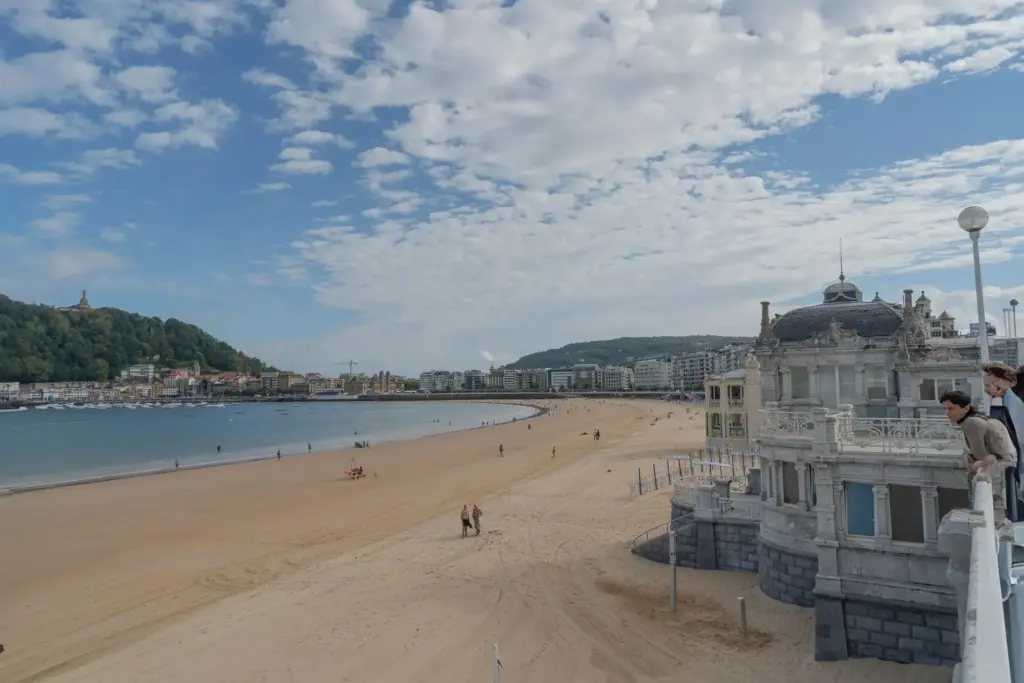
Relax with views over La Concha
La Perla is located on Paseo de la Concha, right on the beachfront, in the heart of San Sebastián. The circuit is open every day. It is closed only on 25 December and 1 and 6 January. Booking is compulsory, either online or by phone, but payment is made directly at reception. Entry sessions last 2, 3 or 5 hours and cost approximately between €25 and €54, depending on the duration and the day. With the 5-hour entry, you also get free access to the gym. You can find the updated prices on the website. On weekdays, there is a 2-hour entry for €28 in the 13:30–16:00 time slot, when everyone is having lunch :-), while on Sunday afternoons there is the “Domingos dúo” option, designed for two people, at €56 in total. What to bring: swimsuit, compulsory swimming cap and flip-flops, although these are only used in the changing rooms, as the circuit is done barefoot. Towels and bathrobes can be rented, with a €10 deposit. Attention: at the end of winter it may close for maintenance work.
There is a very Donostia way to enjoy the sea without getting wet… or rather, getting wet by choice. La Perla is the thalassotherapy centre overlooking La Concha Bay, and everything here uses seawater:
- hydrotherapy and relaxation pools;
- panoramic jacuzzi;
- the “labyrinth of sensations”;
- marine steam bath and sauna;
- ice fountain;
- cold pool.
All of this comes with views over the bay and direct access to the beach. The bravest, especially in winter, go out for a dip in the Atlantic and then rush back into the warm bubbles. Outside it is raining, the sea is grey and rough, and you are there, in the warm water, watching it. It is hard to imagine a better way to experience a day of bad weather in San Sebastián.
And it is not just any place: La Perla is one of the symbols of Donostia’s Belle Époque. When Queen María Cristina made the city the summer destination of the royal court, sea bathing became one of the refined pleasures of holidaymakers. In 1912, the old wooden bathing establishment was replaced by the current building, which the press at the time described as one of the most beautiful in the world.
And if you want to extend the pampering, you can combine the circuit with a massage or treatment, or stop at La Perla’s restaurant or bar, both with views over the bay..
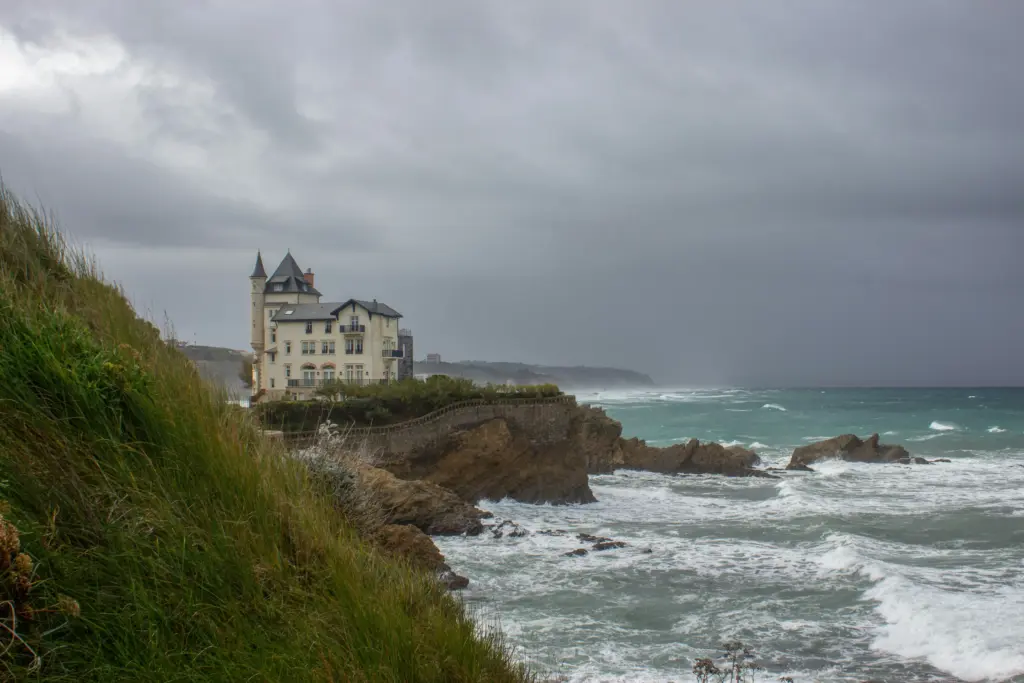
Escape to somewhere it isn’t raining
One last tip, perhaps the cleverest one: open your weather app and check the nearby towns and cities too. The weather on the Basque coast changes quickly, and sometimes travelling just a few dozen kilometres is enough to find kinder skies. Here are a few ideas:
- Biarritz is very close, and yet sometimes the storm soaking San Sebastián has already passed over it, or has not reached it yet. The easiest option is one of the organised day trips, which take you directly there. If you prefer to travel independently, take the direct bus San Sebastián → Biarritz. There are several services a day operated by Alsa, FlixBus and other companies, the journey takes around 50 minutes and tickets start from just a few euros. Once you arrive, you will need a local bus from the Txik Txak network to reach the heart of the city: factor that into your timing!
- Hendaye: if you do not feel like taking a long day trip, the Topo (Euskotren line E2) takes you to Hendaye, the first French town across the border, quickly and without changes. It is worth visiting the Abbadia Castle-Observatory, a perfect indoor visit for an uncertain day. It can be visited on guided tours lasting around 45 minutes. When the rain lets up, you can walk through the park that reaches the cliffs, opposite the famous Deux Jumeaux rocks, the “Two Twins”.
- Bilbao: with or without bad weather, the right choice is Bilbao, a city that almost seems more at ease in the rain than in the sunshine. With the DO01 bus, which passes through Zarautz, you can get there in around one hour and fifteen minutes. The Guggenheim alone is worth the day trip, but there are also plenty of things to do indoors: I tell you all about them in my article on what to do in Bilbao when it rains.
To look for the most convenient train or coach options, I always use Trainline and Trainpal. Take a look before organising your trip.
Travelling in the Basque Country means accepting one small truth: the weather here is part of the adventure. Sun, wind and rain can alternate within just a few hours, and your suitcase needs to be ready for everything.
The winning strategy is layers. Over a T-shirt, always bring a sweatshirt. I bought this waterproof and windproof jacket and it was the most useful thing I had. Even in summer, the Atlantic wind can be biting, so a light scarf or a neck warmer is never a bad idea.
Choose practical shoes. If you decide to explore the coast, you will need comfortable hiking boots for the trails, but also a pair of water shoes for the trickier rocky beaches. And pack your swimsuit and a lightweight towel (I bought this one so I could always have it with me when travelling to a seaside city): the Atlantic is cold, but the temptation to take a heroic dip or walk with your feet in the water is always lurking.
Do not be fooled by the cool breeze: the summer sun can burn. A hat and high-protection sunscreen are essential. I always carry this sunscreen, small but very effective.
For the evening, just one slightly smarter item of clothing is enough to fit in with the understated elegance of San Sebastián.
I almost forgot: a wind-resistant umbrella. I had a Samsonite one with me and it survived two days of rain, but a girl from Bilbao recommended one by Lendoo , which she had and which looked very sturdy.
Complete everything with a little useful technology — offline maps and a weather app to check often — they can really help. As always, I brought my power bank. It may seem like a small detail, but it makes the days much easier, especially if you have navigation running to find your way along the trails and want to capture in photos all the most beautiful corners and moments of the trip. I was given this one and I am very happy with it. But there are thousands of different types. Whatever the model, I highly recommend having one.
Bear in mind that in winter, although frosts are rare on the coast, the cold can be biting. Wrap up warm!
And so, umbrella in hand, we have reached the end of our tour of San Sebastián in the rain.
And after all, that is precisely the beauty of the Basque Country: it never disappoints. Not even when the sky is grey or the rain follows you for days on end. Because here bad weather is not an obstacle to work around, but part of the character of this land. And, in my opinion, it is precisely in the rain that San Sebastián reveals its most authentically Basque side.
So do not let the forecast ruin your trip. Pack a good waterproof jacket, leave your expectations of a sunny holiday at home and get ready to be surprised. If you want to keep exploring, in my guide to San Sebastián you will find everything there is to see when the sun comes back out.
Because yes, it will rain here. But I assure you: you will leave wanting to come back… perhaps on another rainy day.