La Mancha by car: among windmills, unexpected lakes and medieval villages
We were in Madrid for a long weekend, the first stop on a trip that would later take us to Toledo. While strolling among the stalls of El Rastro, the capital’s famous Sunday flea market, we came across an old second-hand copy of Don Quixote. And it was there, between one yellowed book and another, that the crazy idea was born to change our plans and go and see La Mancha with our own eyes, that land we have all, whether we wanted to or not, heard about at school.
And when you arrive, you immediately understand why Cervantes chose these very lands for his novel Don Quixote: endless landscapes where the windmills rising from the hills are the only feature capable of breaking the horizon. Every little village, every dusty corner, seems to take you back to that precise moment in Spanish history.
That day, born entirely by chance, impressed us so much that the following year we came back —this time taking things slowly, with a whole week at our disposal— to properly set out and discover this land that, deep down, we knew very little about. And that was when La Mancha welcomed us with all its surprises: if you think it is all about an imaginary knight and his wonderful windmills to photograph, then you too are missing the most interesting part. We discovered that behind those landscapes that seem frozen in time lies a land whose roots go back four thousand years before Cervantes, with some of the earliest wells dug by humans in Europe; there is one of the most famous cheese designations in the world; there is Spain’s most prized saffron, still harvested by hand today; there are vineyards stretching as far as the eye can see and, where you least expect it, turquoise lakes and even flamingos in the middle of what everyone imagines to be the driest land in Spain.
La Mancha, in short, is a region that tells its own story, if only you look at it with a little more attention.
So, into the saddle, knights: let our adventure begin.
Here are a few practical tips to make the most of La Mancha: how to get there, how to get around, how to plan your trip and when to go. They are simple, but they can help you save time, avoid unnecessary kilometres and organise your trip better in a territory that is much larger than it may appear when looking at a map.
Show all tips ↓ Hide tips ↑
How to get to La Mancha
La Mancha is very large and there is no single ideal access point. The best choice depends mainly on which part of the region you want to explore and the direction you are coming from.
- By plane: Adolfo Suárez Madrid-Barajas Airport is generally the most convenient arrival point, especially if you want to explore the areas of La Mancha around Toledo and Ciudad Real. It offers a very wide choice of domestic and international flights and makes it easy to continue by train, bus or car. For the eastern part of the region, airports on the Mediterranean coast can also be useful, especially if your trip continues towards Albacete or Cuenca. To compare flights, airports and fares, I use Google Flights .
- By train: from Madrid you can reach several strategic points to use as gateways to the region. Toledo is convenient if you want to start from the western side; Alcázar de San Juan takes you directly into the heart of La Mancha; Ciudad Real is useful for more southerly itineraries, while Albacete is a good access point for the eastern part. From there, you can continue towards the villages you have chosen for your itinerary. Always check timetables and tickets on the official Renfe website . To compare different rail connections quickly, I also use Trainline and TrainPal .
- By bus: there are long-distance connections from Madrid and other Spanish cities to the main towns of Castilla-La Mancha. Here too, the easiest option is to first reach a well-connected town such as Toledo, Alcázar de San Juan, Ciudad Real or Albacete, and organise your onward travel from there. Connections to smaller villages are covered instead in the section on how to get around La Mancha.
- By car: this is the simplest option and, in my opinion, the one that allows you to make the most of the trip. From Madrid you can enter La Mancha from the north, while if you are arriving from Andalusia or the Mediterranean coast you can reach it directly from the south or east without passing through the capital. If you already have a car, there is therefore no need to choose a specific town as your arrival point: you can build your itinerary directly around your first stop.
How to get around La Mancha
- Renting a car is the best option and, in my opinion, almost essential if you really want to get to know La Mancha. Public transport allows you to reach several villages, but it becomes much more difficult to combine windmills, castles, vineyards, wineries and small towns scattered across the region in a single day. With a car, you can also organise your itinerary by area and make use of secondary roads, which cross some of the region’s most characteristic landscapes. Parking is usually much easier than in Spain’s larger cities. In the villages you will generally find places to park within a short distance of the centre or the main attractions. During festivals, public holidays and particularly busy weekends, however, you may need to leave the car farther away, especially near the windmills of Consuegra and Campo de Criptana. Do not always stick to the fastest road. An important part of the journey is the landscape between one stop and the next: vineyards, cereal fields, olive groves, sunflower fields and windmills appearing on the horizon. When time allows, taking a few detours along secondary roads is definitely worthwhile.
- By bus: from Toledo you can reach Consuegra and Madridejos, two of the main stops in western La Mancha. Connections are operated by SAMAR and some services continue towards Camuñas, Villafranca de los Caballeros, Quero and El Toboso. Frequencies vary considerably depending on the day and destination, so always check both the outbound and return services before planning your day. Watch out for one detail that could ruin your plans: on several services along this route, it is not possible to travel specifically between Madridejos and Consuegra —the bus stops in both towns, but passengers are not allowed to board in one and get off in the other. If your itinerary involves connecting these two stops by bus, check carefully before setting off, otherwise you may have to return to Toledo and start again from there. From Alcázar, buses run instead towards Miguel Esteban and El Toboso. The SAMAR route then continues towards Quintanar de la Orden and Villanueva de Alcardete. In this case, however, the frequencies are far less suitable for sightseeing: some services only run on weekdays and there may be very few options during the day. Visiting El Toboso without a car therefore requires careful planning, and you should not assume you can simply go and return whenever you like. You can check services directly on the SAMAR website . Buses work best if you choose a base and visit one single place, rather than trying to follow a multi-stop itinerary. For example, from Toledo you can reach Consuegra, or from Alcázar de San Juan you can reach El Toboso, but trying to link three or four villages in the same day can become difficult because of limited frequencies and poorly coordinated timetables.
- By train: it can be very useful along certain routes, but it does not form a true tourist network across La Mancha. Alcázar de San Juan is the main railway hub in the area and Campo de Criptana has its own station, but important places such as Consuegra, Madridejos and El Toboso cannot simply be included in the same itinerary by relying on rail travel alone. To check connections, you can use Renfe , Trainline or TrainPal .
In short, trains and buses allow you to reach some towns, but many of the places that make a journey here special —windmills, castles, vineyards, wineries, lagoons and small villages— are scattered across the region and are not always conveniently connected to one another. So if you want to build a multi-day itinerary travelling through different villages, a car gives you a freedom that public transport currently cannot provide.
How to plan a trip to La Mancha
The most important thing, in my opinion, is not to think of La Mancha as one large attraction to rush through. Part of the beauty of the journey lies in the spaces between one village and the next: vineyards, cereal fields, wetlands, low hills and that almost endless horizon that characterises much of the region. Bear in mind, however, that distances on the map can be deceptive. Consuegra, Campo de Criptana, El Toboso and Belmonte all look relatively close together, but once you add detours, visits and photo stops, the kilometres quickly add up. Avoid planning days with five or six villages simply because your satnav shows apparently short driving times.
- Do not try to see every windmill. After visiting several of them, you will inevitably risk losing some of the surprise. It is better to choose a few of the most significant groups. The official Castilla-La Mancha Windmill Route can be a good starting point for deciding which ones to include in your trip.
- Save at least one sunset for the windmills. During the day, the landscape can feel harsh and completely exposed to the sun; during the final hours of daylight, however, the plain changes colour and the windmills take on a completely different charm. If you enjoy photography, I would therefore avoid concentrating all these visits between midday and early afternoon.
- Always check opening times before setting off. In smaller villages, museums, windmills open to visitors, castles and tourist offices may have reduced hours, long breaks in the middle of the day or different closing days depending on the season. This is one of those places where arriving half an hour after closing time can mean not getting a second chance without changing your entire itinerary.
- Book winery visits in advance. La Mancha is not only the land of Don Quixote: along the La Mancha Wine Route you will find wineries, cheese dairies, tastings, vineyards, ancient caves and huge wine jars. Many experiences, however, run at fixed times and, especially at weekends, booking in advance is recommended.
- If you enjoy nature and photography, also consider the Mancha Húmeda. It is a large biosphere reserve made up of lagoons, floodplains and wetlands spread across the plains of La Mancha, particularly important for birdlife.
- Lunch and dinner are served later than in Italy. As a rough guide, lunch begins from around 1:00-1:30 pm, while many kitchens open for dinner from around 8:00-8:30 pm. In smaller villages this is even more important because, outside traditional mealtimes, the available options can become much more limited.
If you would rather rely on a guide or include a few organised experiences in your trip, it is also worth checking the activities available on GetYourGuide and Civitatis . You will find guided tours, excursions, windmill-related experiences and wine tourism activities, which can be a good alternative, especially for some stops you would rather not organise entirely on your own.
When to visit La Mancha
- April and May are an excellent choice for a first trip. La Mancha is still green, flowers begin to bloom, the days are long and temperatures are generally pleasant. In April, El Toboso also celebrates the Jornadas Cervantinas , while between late April and early May Pedro Muñoz hosts the traditional Mayos Manchegos.
- Between June and August, the landscape becomes the classic image of La Mancha, with golden cereal fields, dry countryside and sunflowers. It can be beautiful for photography, but the heat is intense: in midsummer I would plan visits mainly in the morning and late afternoon.
- September is harvest season and one of the most interesting times to visit wineries and vineyards. If wine is one of the reasons for your trip, it is also worth checking the La Mancha Wine Route .
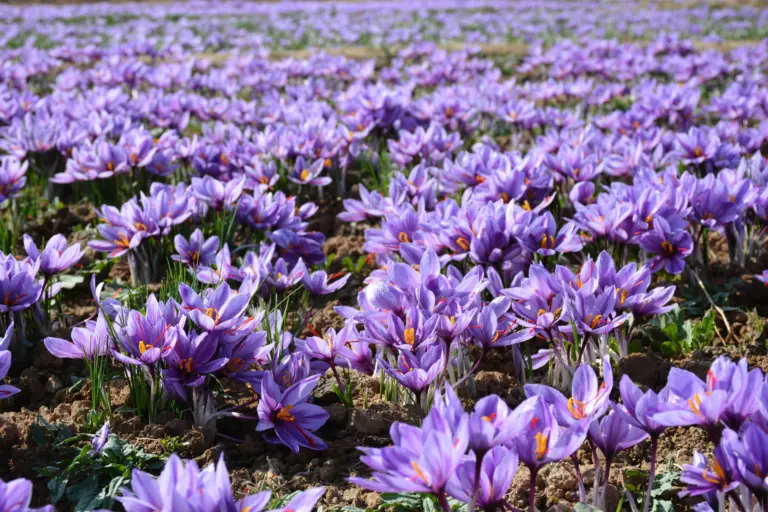
- October is probably the most complete month: pleasant temperatures, autumn vineyards, softer light and, towards the end of the month, the saffron harvest. Consuegra also hosts the Fiesta de la Rosa del Azafrán .
- In winter you will find very few visitors, but the weather can be cold and windy, with large temperature swings. I have also been there in March, and I can assure you that it was still very cold.
A brief history of La Mancha
The first misunderstanding to clear up —because I have noticed that many blogs confuse the two— is that Castilla-La Mancha and La Mancha are not the same thing. Castilla-La Mancha is the official autonomous community, with political and administrative status (5 provinces: Toledo, Ciudad Real, Cuenca, Guadalajara and Albacete). La Mancha, on the other hand, is a historical and geographical area with imprecise boundaries, occupying part of those provinces —but not all of them.
La Mancha is in fact a vast plateau within the Meseta, stretching across Toledo, Ciudad Real, Cuenca and Albacete, where you will inevitably find yourself driving along endless roads in search of those windmills we have all heard about.
The history of La Mancha, however, begins long before Don Quixote, long before the Romans, Muslims or Castilians. Around 2200 BC, on the plains of the Upper Guadiana, what archaeologists call the Culture of the Motillas, or Bronce Manchego, began to develop. The name is modern, of course: those inhabitants did not consider themselves “Manchegans” in the sense we understand the term today.
The people of the area began building fortified settlements on artificial mounds between 4 and 10 metres high. The typical structure consisted of a fortified central core, a small surrounding settlement with concentric walls and a nearby necropolis. These are the first true permanent settlements documented in this region.
Their function was twofold: military control of the territory and, even more surprisingly, access to groundwater. The earliest structures appeared around 2200 BC, but it was between 2000 and 1800 BC that the region experienced a particularly severe period of aridity: during this time, communities intensified the construction of these settlements, genuine strategic hubs organised into “jefaturas” (tribal chiefdoms) to control water, grain and the other resources necessary for survival. Taken together, they represent one of the oldest systems in Europe for reaching underground aquifers, within an economy based on agriculture and livestock farming.
Around 32 have been recorded, and the most spectacular example is the Motilla del Azuer, near Daimiel: inside it, archaeologists discovered a well at least 18 metres deep that reached the water table —considered the oldest known system for accessing groundwater on the Iberian Peninsula, and one of the oldest in Europe.
With the arrival of the Romans, La Mancha was incorporated into the vast imperial network: crossed by important communication routes linking the Mediterranean with the interior of the country, it became a crucial hub for trade and military movements. For a long time, the Romanisation of the area was thought to have been limited, but discoveries such as the villas and mosaics of Carranque (Toledo) reveal a stronger presence than previously believed, especially in strategic and mining centres.
After the fall of the Roman Empire came the Visigoths, who made Toledo their capital: a moment of enormous historical importance, because for the first time the plains of the Meseta —and therefore La Mancha— became the centre of political power on the Iberian Peninsula. Despite Toledo’s importance, however, La Mancha should still be imagined as a predominantly rural area, made up of small settlements and villas, crossed by communication routes linking the northern Meseta with Andalusia and the Mediterranean.
It was precisely this combination —a vast territory with few fortified centres— that facilitated the northward expansion of the Muslim troops who arrived from Africa in 711, and the subsequent fall of the Visigothic kingdom: La Mancha thus became part of Al-Andalus, integrated into its political, economic and cultural dynamics.
The very name La Mancha tells the story of this land: the Arab conquerors, when Spain more or less coincided with the kingdom of Al-Andalus, called it Al-Mansha, “land without water”, or, according to another interpretation, Manya, “high plain” or “elevated place”. Whichever etymology is the more accurate, both reflect the characteristics of the region well: a vast arid plateau with scarce natural water resources.
And this is a detail that already tells us something that will accompany the entire history of La Mancha: the central element of the territory —or the missing element, depending on how you want to look at it— is water.
During the period of Al-Andalus, La Mancha was not the beating heart of Islamic power —which was concentrated instead in present-day Andalusia, with its capital in Córdoba— but a strategically vital frontier region. It was not a land of great cities, but a territory of alquerías (rural villages) and small settlements, often located near fertile river valleys and springs and devoted to agriculture.
Its strategic position, crossed by the main route connecting the capital Córdoba with Toledo (an Arab stronghold in the north of the peninsula), determined its role as a military outpost. It was precisely because of this defensive function that rural fortifications known as ḥuṣūn (singular ḥiṣn) gradually appeared, serving as defensive strongholds and centres of territorial control.
One of the key strategic points was Qalā’t Rabāḥ, ancient Calatrava la Vieja (today Carrión de Calatrava): a true fortified city on the Guadiana, with a medina, alcázar, walls, around forty towers, a moat, mosque, baths, ovens, a cistern, extramural neighbourhoods, craft areas, a cemetery and systems for accessing and controlling the river water. Today the site can be visited —if you are passionate about history, you can find some information here: Castillo de Calatrava la Vieja, Turismo Castilla-La Mancha.
When, in 1147, Alfonso VII succeeded in conquering it in the name of the Christian kingdoms, it marked a turning point in Spanish history: the gradual shrinking of the kingdom of Al-Andalus, which had already begun with the capture of Toledo, was giving way, step by step, to the Christian Reconquista.
As you can imagine, defending these new and insecure frontier territories against the Muslim kingdoms was no easy task: the king therefore divided the region into zones and entrusted each territory to the military orders.
These orders were expected to protect the frontier, garrison castles, conquer territories and encourage their repopulation. They therefore received vast territories, castles, villages, rights and revenues directly from the king in order to defend them —and their role went far beyond simply providing soldiers. They were very often made up of religious men who fought on horseback and who, at the same time, organised the territory through the encomiendas: they administered the lands, collected revenues, attracted new settlers and contributed to the foundation or development of numerous settlements.
One of the orders entrusted with an area of the region —in particular the territory of Calatrava— was the Knights Templar, but Muslim pressure was so intense that within just a few years they abandoned the stronghold and returned it to the Crown.
It was then that something unexpected happened: no nobleman was willing to take on the risk of defending it, until a humble Cistercian abbot, Raymond of Fitero, together with former soldier turned monk Diego Velázquez, volunteered for the task.
King Sancho III accepted, granting them the fortress in perpetuity through a charter signed on 1 January 1158 in Almazán. This marked the birth of the Order of Calatrava: an order of warrior monks that, within a short time, gathered an army of more than 20,000 men and would go on to become the most important order in La Mancha, with an emblem destined to become famous —the red cross with four arms ending in fleur-de-lis.
Alongside the Order of Calatrava —the most important in La Mancha— other orders active in the area included the Order of Santiago, the Order of Saint John (the Hospitallers) and the Order of Alcántara.
The allocation of these territories to the different orders can still be recognised today in the towns and villages that inherited their imprint. This division explains many of the distinctive features of the towns of La Mancha: each order administered its own territories and left a tangible mark, often still visible today.
It was during this period that places such as Almagro, Consuegra and Campo de Criptana began to take on the form of the towns we can still see today.
To give a concrete example: Campo de Criptana —today the town of the oldest windmills— belonged to the Order of Santiago, which did not leave major military structures here.
Consuegra and Argamasilla de Alba, on the other hand, were under the control of the Order of Saint John, which built powerful castles there: the most spectacular is the Castle of Consuegra, whose origins go back to a 10th-century Muslim fortress, handed over to the Knights of Saint John in 1183 and expanded over the course of a century until it became the almost impregnable stronghold that can still be seen today on Cerro Calderico.
The Order of Calatrava, meanwhile, built imposing Christian fortresses such as Alarcos and Calatrava la Nueva, with a much more distinctly military character.
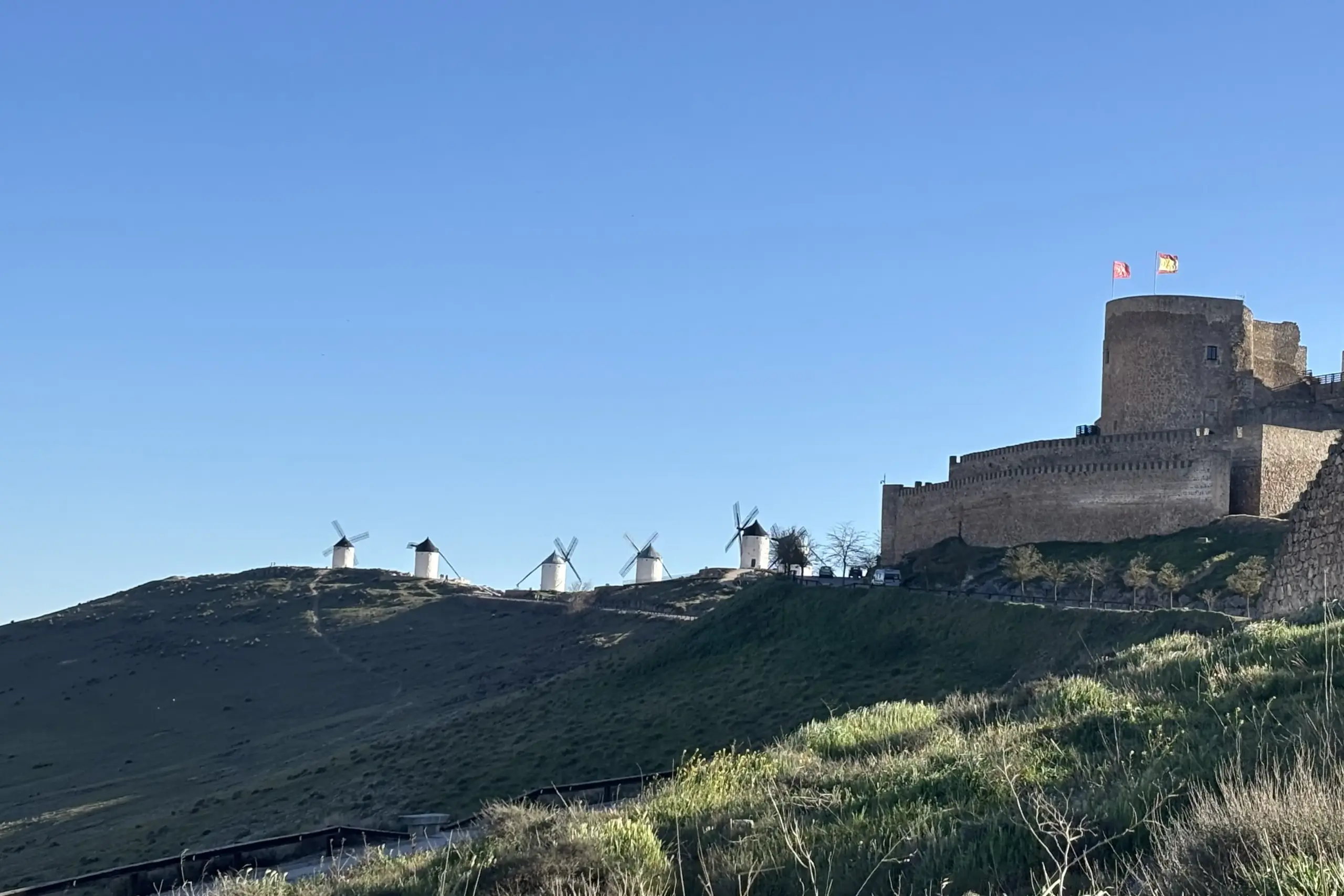
La Mancha thus became the land of the military orders: with their castles and encomiendas, they became the true masters of the territory, managing the region’s defence and economy for centuries. To attract new inhabitants to lands that were still sparsely populated and insecure, both the king and the orders themselves —which exercised seigneurial power over their domains— granted fueros: local charters that guaranteed privileges and tax exemptions to those willing to move there and repopulate these frontier lands.
Although strategically important, the region remained largely rural and only lightly urbanised: a network of small towns dominated by large estates —belonging to the military orders and the nobility— whose owners exercised almost undisputed power over vast territories, reinforced by the fueros granted to them by the Crown.
The enormous power of the military orders caused considerable concern for the Crown: a Grand Master at the head of an order such as Calatrava or Santiago held the maestrazgo —a term referring both to his office and to the vast territorial domain that came with it— and therefore controlled enough money, castles, land and men to represent, in the event of conflict, a rival power to the Crown itself. Villa Real (present-day Ciudad Real) was founded precisely as a counterweight to the enormous influence of the Order of Calatrava in the area —a royal town placed outside the authority of the order.
It was only under the Catholic Monarchs, Isabella of Castile and Ferdinand of Aragon, however, that the issue was finally resolved. The Catholic Monarchs took control of the maestrazgos one by one —starting with Calatrava in 1489, followed by Santiago in 1494 and Alcántara in 1495— arranging for themselves or their relatives to be elected as Masters, until the military orders were officially incorporated under the direct authority of the Crown.
It was in this context that La Mancha, by then firmly established as an inland region of the Kingdom of Castile and no longer a frontier land, was reorganised into small towns centred around a nobleman loyal to the Crown, with an economy devoted mainly to agriculture and related activities.
But the aridity of the land, the scarce rainfall, a sun that in summer turns the Meseta into a scorching oven while in winter giving way to frosts that can reach fifteen degrees below zero —I have been there in both seasons, and I can confirm it— and the constant wind hardly made for flourishing agriculture.
For this reason, over time La Mancha focused on crops capable of surviving in an environment where the lack of water was a serious problem: saffron, secano cereals (dry-farmed, without irrigation), probably pulses, and transhumant livestock farming (Merino sheep, wool). Nor should we forget the exploitation of woodland resources, which, unlike what we see today, were far more widespread across the region —especially holm oak, oak, juniper and Spanish juniper woodland.
Water, as you can see, has always been a critical issue for this region: there are few rivers, rainfall is uncertain and so watermills —which worked perfectly well elsewhere— were unreliable here and did not allow the area’s resources to be fully exploited, starting with the abundant cereals that needed to be ground into flour.
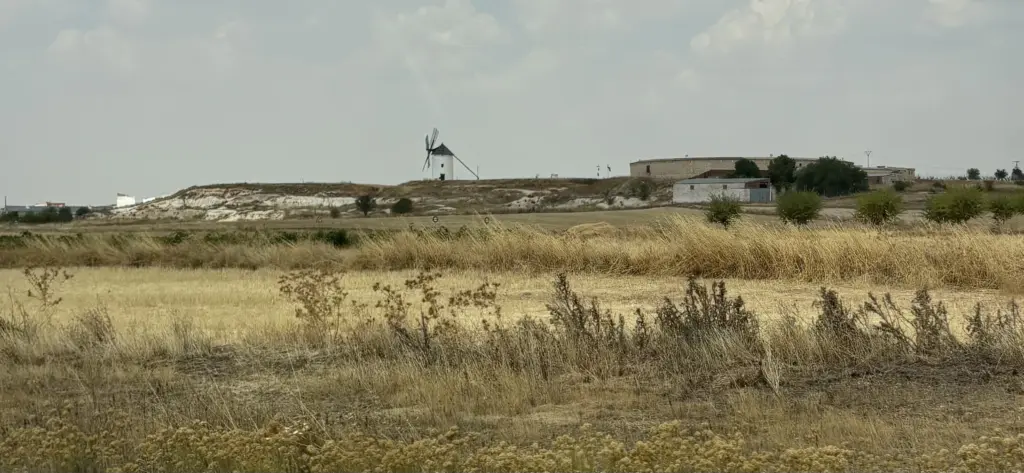
It was precisely this difficulty that taught people to exploit what, by contrast, was plentiful: the wind, which sweeps across the plain with almost obsessive regularity and which, unlike water, never failed. And so, between the 16th and 19th centuries, windmills experienced their true golden age: by making use of the most generous resource this land had to offer, farmers transformed the hills into genuine wind farms.
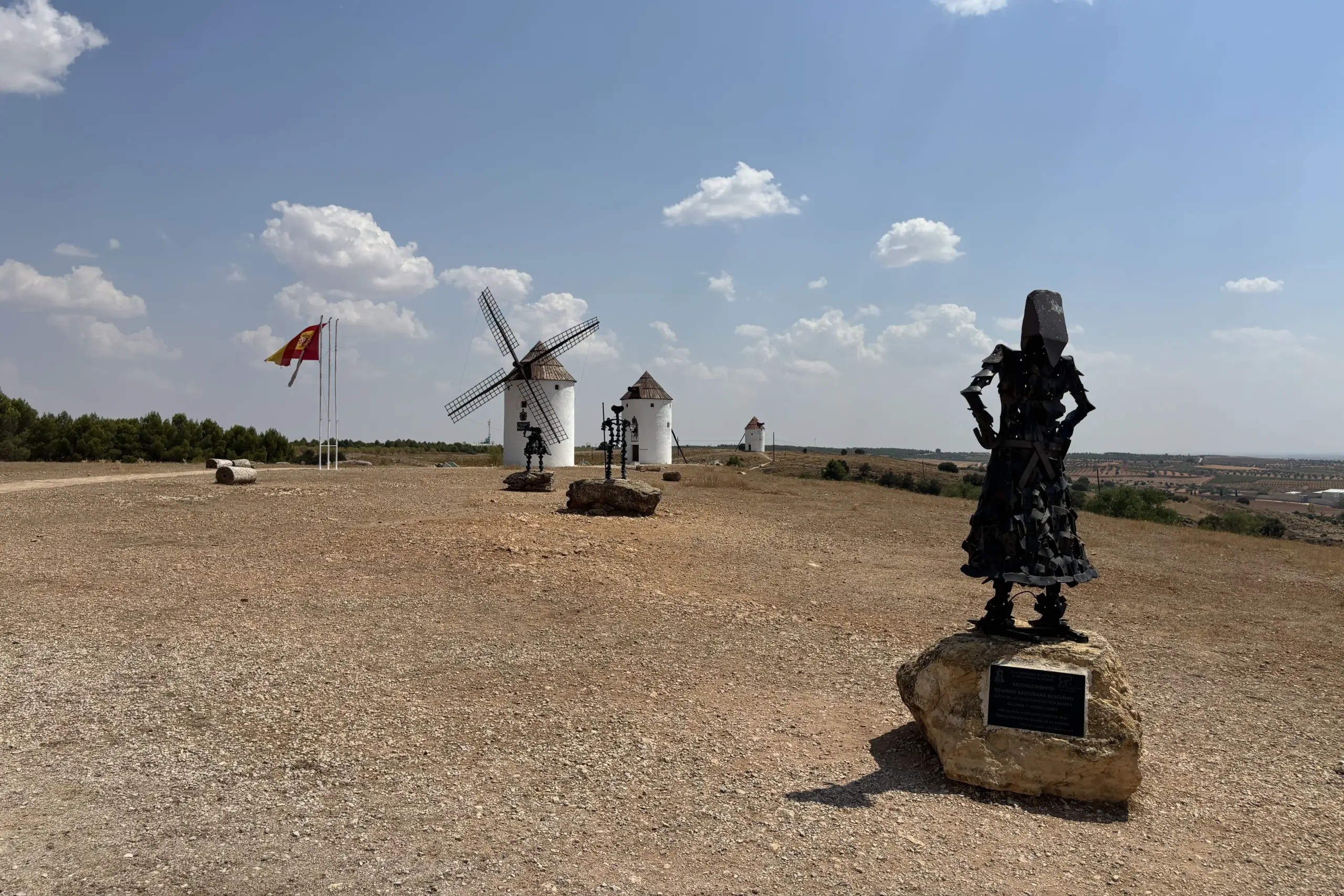
And it is precisely during this period —more specifically in 1605, with the publication of Don Quixote by Cervantes— that La Mancha became forever associated with the collective imagination. Cervantes took a territory that, in the eyes of many of his contemporaries, may have seemed like a vast rural province to pass through, and transformed it into one of the most famous literary landscapes in the world, dominated by the famous “giants”.
If you have never read it and you are planning a trip to La Mancha, this is the perfect time to discover El Ingenioso Hidalgo Don Quijote de la Mancha. It tells the story of a provincial gentleman, Alonso Quijano, who, after reading too many books of chivalry, loses his mind and decides to become a knight-errant himself. He chooses a grand-sounding name —Don Quixote—, finds a scrawny horse that he names Rocinante, persuades an uneducated but wise peasant called Sancho Panza to become his squire, and sets off in search of adventures.
The most famous episode in the entire novel is the one in which he battles the windmills. Don Quixote and Sancho are crossing the Meseta when, suddenly, the knight cries out: “Look, friend Sancho, over there: thirty or a little more enormous giants! With arms so long that some of them reach almost two leagues!” Sancho, a man of common sense, tries to dissuade him: “But those, sir, are windmills!” In vain: Don Quixote spurs Rocinante on and charges at what he believes to be a giant. His lance becomes lodged in one of the windmill’s sails, the wind turns the wheel, and the knight is thrown to the ground together with his skinny horse.
This episode gave rise to the expression “tilting at windmills”, which we still use today to describe fighting imaginary enemies or pursuing a cause that is doomed from the start.
But behind it all there is also the melancholy of a man desperately searching for an identity and fighting for noble but anachronistic ideals, while his squire, with his down-to-earth pragmatism, constantly brings him back to reality. Together, Don Quixote and Sancho Panza represent two sides of the human spirit: the idealism that dreams of changing the world, and the realism that knows what the world is really like. Perhaps that is why, four centuries later, we still love them both.
Although it represents a fascinating period from a literary point of view, the 17th century was a time of profound demographic and economic crisis for La Mancha, marked by a sharp decline in population. There were several causes: poor harvests, epidemics and the difficulties of an economic system still too dependent on agriculture, characterised by an unequal distribution of wealth.
Precisely in order to manage such a vast and problematic territory, in 1691 the government decided to separate La Mancha from the rest of the Kingdom of Toledo, officially creating the Province of La Mancha, with its capital in Ciudad Real.
The period between 1700 and 1900 was a time of profound transformation for La Mancha: wars, administrative reforms and political struggles continually redrew its boundaries.
The 19th century, in particular, was a turbulent period for the whole of Spain. In 1808, the Napoleonic invasion swept across the country, triggering the Spanish War of Independence: guerrilla bands also formed in La Mancha, ready to attack French troops along the roads crossing the plain.
Once the war against Napoleon was over, Spain found no peace: the century was marked by the Carlist Wars, civil conflicts between supporters of the liberal monarchy and defenders of traditional absolutism, which repeatedly plunged the country into bloodshed until 1876.
It was precisely at the beginning of this turbulent period, in 1833, that the historic Province of La Mancha was abolished and divided among the new provinces of Ciudad Real, Albacete, Cuenca, Toledo and Jaén —a decision that fragmented the region’s administrative unity and still fuels debates about its boundaries today.
And this is precisely what explains why, although modern-day La Mancha is now politically and administratively fragmented into many different areas, there is still a strong shared cultural identity that brings them together into a single, large imagined community.
A century after the Carlist Wars, Spain was shaken by an even more devastating conflict. Between 1936 and 1939, the Spanish Civil War deeply affected La Mancha, as it did the rest of the country. Much of the territory remained in the Republican rear, playing a crucial strategic role: numerous military units were formed and trained here, including the International Brigades, and the region’s economy became fundamental to the Republican war effort. The mercury mines of Almadén, for example, were a priority target for Franco’s troops.
Franco’s victory was followed by extremely harsh repression. In the province of Ciudad Real alone —which today appears to be the Spanish province with the highest number of executions, around 6% of the estimated 50,000 across Spain— almost 3,900 victims of Francoist repression have been identified, 2,800 of whom were executed by firing squad.
After Franco’s death in 1975, and during the Spanish Transition, the identity of La Mancha once again made itself strongly felt. In 1982, the autonomous community of Castilla-La Mancha was officially created. The name reflects the particular nature of the new region: on the one hand, its historical Castilian heritage; on the other, the identity of La Mancha, which geographically occupies only part of the present-day autonomous community. Even the hyphen joining Castilla and La Mancha has been interpreted as a symbol of the link between these two components.
Today, La Mancha is no longer an official administrative entity, but it remains a very strong geographical and cultural identity, spread across several provinces, with a complex history that goes far beyond the windmills of Don Quixote.
What to see in La Mancha: my itineraries
Today, travelling through La Mancha means taking a journey into late medieval Spain: a rural culture, certainly, but no less elegant or fascinating for that.
Below you will find several itineraries organised according to how much time you can devote to the region. I will tell you more about some of the towns along the way, for those who want to know a little more before setting off.
Because, let’s be honest, if you have enough days to spend here, this region will not disappoint you. Over time, La Mancha has learned how to make the most of its territory, becoming one of the most famous regions in Spain thanks to Don Quixote, one of the tastiest thanks to its food and wine specialities, and one of the most surprising thanks to a natural landscape you would never really expect to find here.
One day in La Mancha – windmills between Consuegra and Campo de Criptana
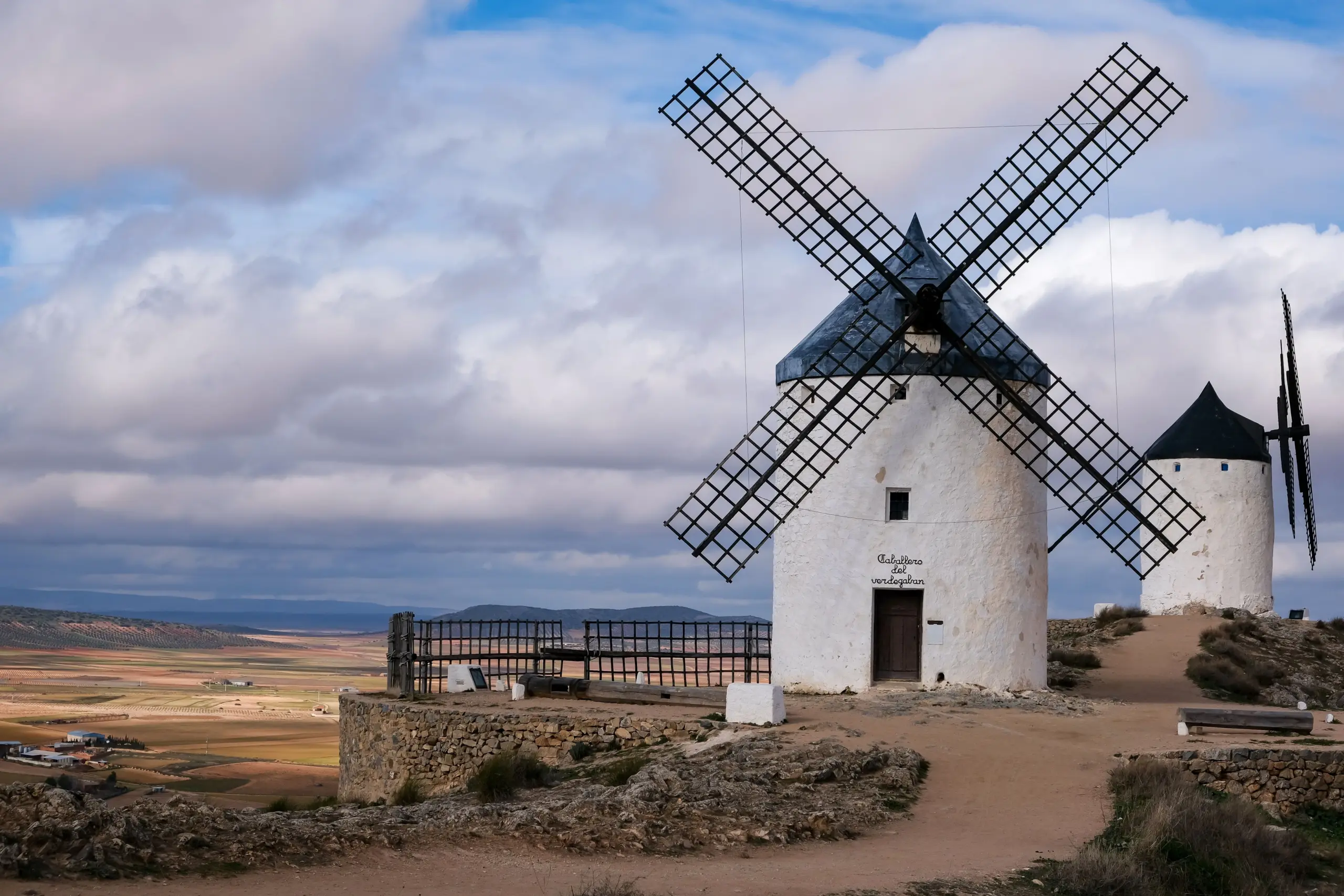
If you have little time available because your trip is focused mainly on Madrid or Toledo, my advice is to follow the Don Quixote Route and, in particular, the windmills between Consuegra and Campo de Criptana.
I know I am going against many official guides and blogs here, but I would not go to Puerto Lápice. I have seen it recommended everywhere as an essential stop, but Don Quixote’s Inn , for which the town is famous, seemed picturesque, yes, but also rather “staged” —so artificial that I did not even take a photograph. It is more of a pleasant 45-90 minute stop along the A-4, perhaps while driving towards La Mancha if you have flown into Madrid or Toledo.
I would choose Consuegra in the morning, spending time at the windmills and the small castle —very charming, and often overlooked compared with the windmills themselves. It is not always open, so check the website before planning your visit.
After that, I would head towards Campo de Criptana for an excellent lunch at Restaurante Abrasador La Alforja de Sancho (check the latest opening hours before setting off, as they change depending on the season and the day of the week) —it is definitely worth a stop.
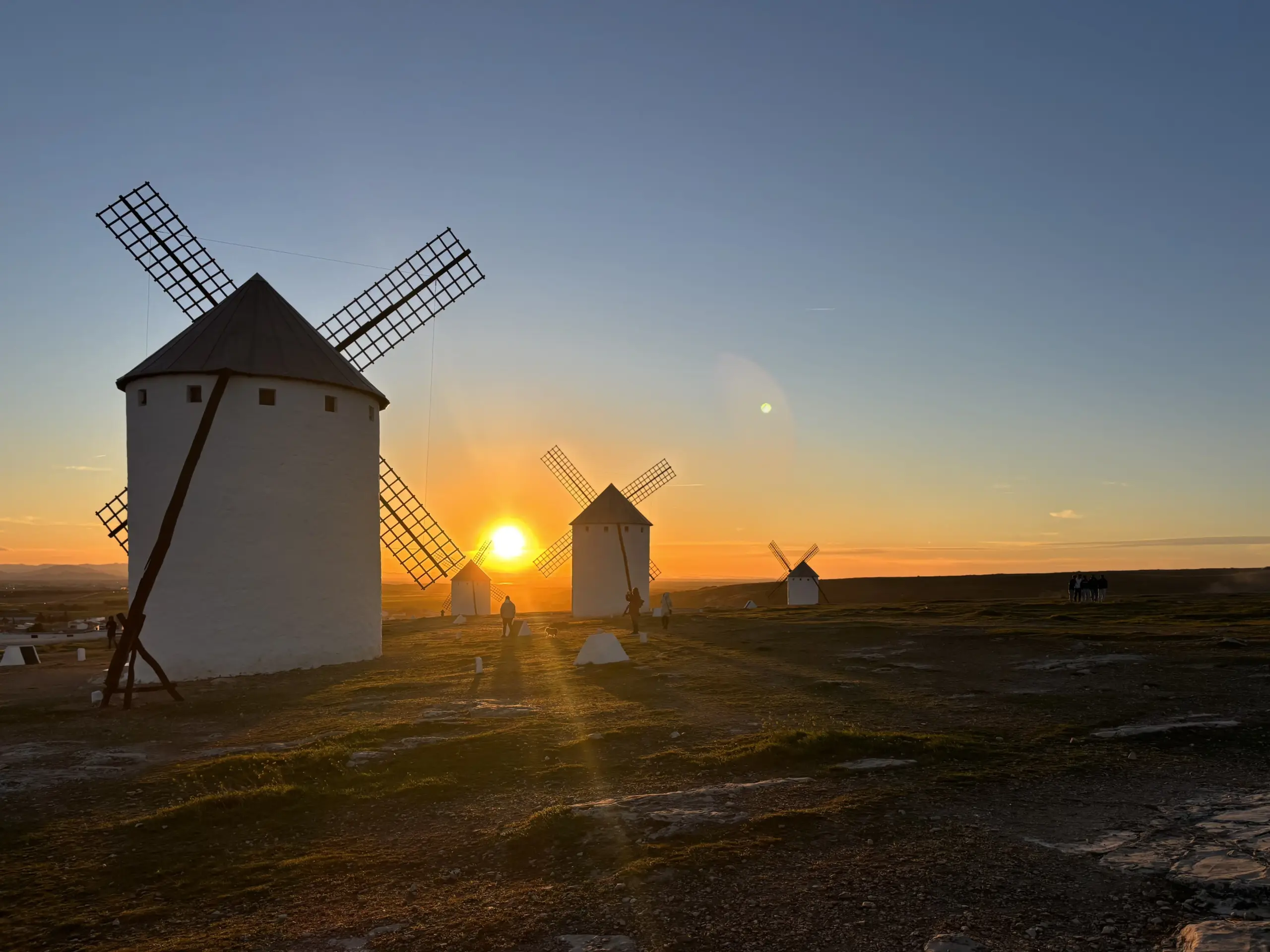
Campo de Criptana is a place to enjoy until sunset among the windmills: it is one of the most evocative images you will take home from this trip. I guarantee it!
The distances are not great, but personally I would not add other towns simply for the sake of being able to say “I’ve seen it”.
An alternative for Cervantes lovers
If, however, you are passionate about Cervantes, you can add or replace one of the towns above with El Toboso —the village of Dulcinea, one of the very few places mentioned by its exact name in the novel, with a house museum dedicated to her— or continue as far as Mota del Cuervo and, fifteen minutes away, Belmonte, to admire the splendid castle from the 15th century that dominates the town. Bear in mind, however, that adding this stop makes the day considerably longer: consider it only if you start early and are in no hurry to return. It is the same route you will find developed in full in the weekend itinerary next to this one.
Weekend: two days among windmills, Dulcinea and castles
Two days is probably the ideal amount of time to see the essentials of La Mancha. When preparing this itinerary, I considered two full days, assuming flights and transfers are well organised around them.
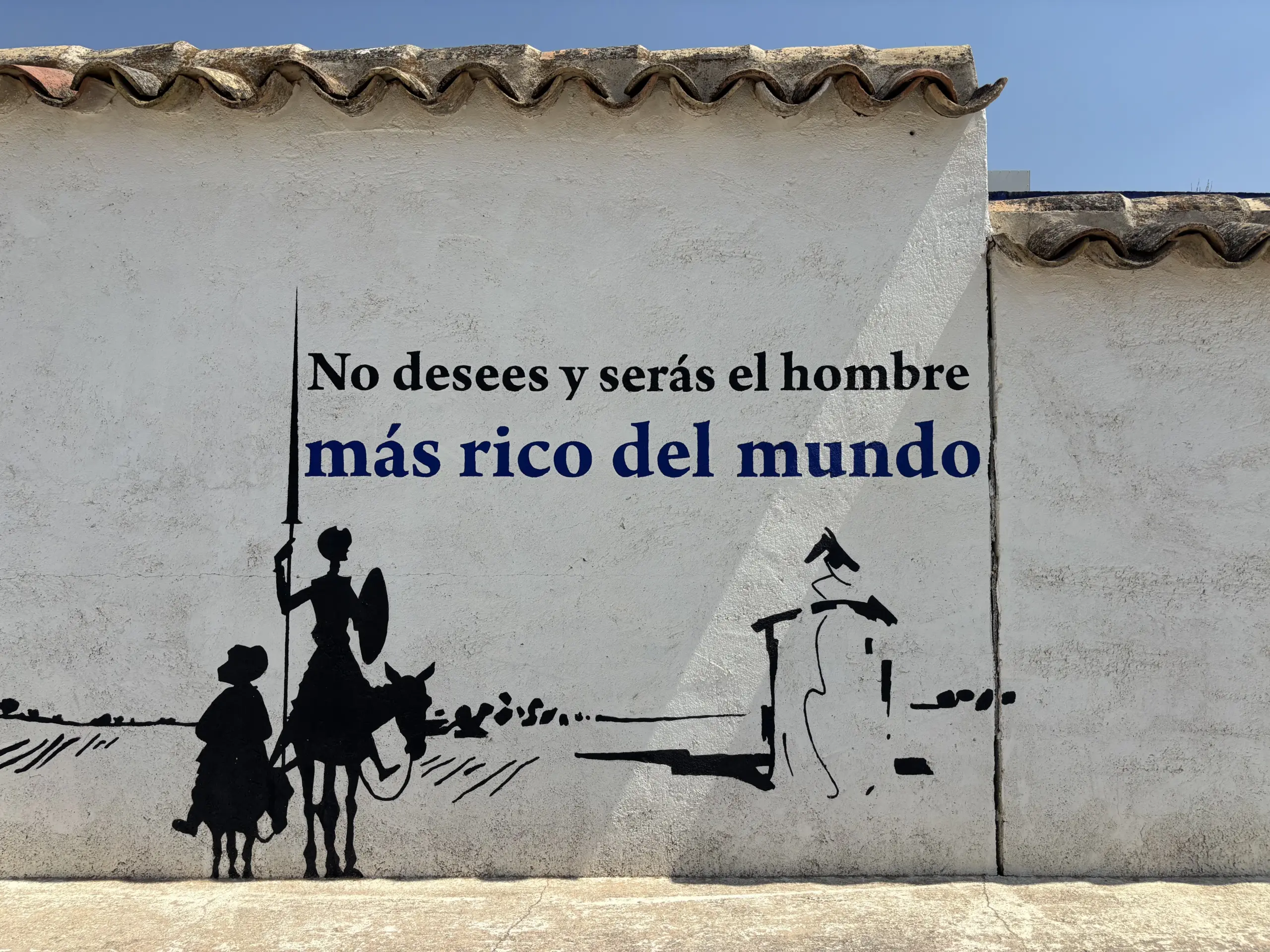
If you have little time available because your trip is focused mainly on Madrid or Toledo, my advice is to follow the Don Quixote Route and, in particular, the windmills between Consuegra and Campo de Criptana.
I know I am going against many official guides and blogs here, but I would not go to Puerto Lápice. I have seen it recommended everywhere as an essential stop, but Don Quixote’s Inn , for which the town is famous, seemed picturesque, yes, but also rather “staged” —so artificial that I did not even take a photograph. It is more of a pleasant 45-90 minute stop along the A-4, perhaps while driving towards La Mancha if you have flown into Madrid or Toledo.
I would choose Consuegra in the morning, spending time at the windmills and the small castle —very charming, and often overlooked compared with the windmills themselves. It is not always open, so check the website before planning your visit.
After that, I would head towards Campo de Criptana for an excellent lunch at Restaurante Abrasador La Alforja de Sancho (check the latest opening hours before setting off, as they change depending on the season and the day of the week) —it is definitely worth a stop.
Campo de Criptana is a place to enjoy until sunset among the windmills: it is one of the most evocative images you will take home from this trip. I guarantee it!
The distances are not great, but personally I would not add other towns simply for the sake of being able to say “I’ve seen it”. If, however, you are passionate about Cervantes, you can add or replace one of the towns above with El Toboso — the village of Dulcinea, one of the very few places mentioned by its exact name in the novel, with a house museum dedicated to her.
Start in El Toboso, the village of Dulcinea: an almost essential stop for anyone who loves Cervantes, with its house museum dedicated to Don Quixote’s (imaginary) beloved. Continue towards Mota del Cuervo, less famous than Consuegra and Criptana but no less beautiful —if you happen to be there on a Saturday and the wind is blowing, at the town’s Windmill Museum you may be able to watch an authentic traditional milling demonstration, showing live how the windmills actually ground grain. Finish the day in Belmonte, fifteen minutes away, where the splendid castle from the 15th century —one of the best preserved in Spain— probably offers the most spectacular view of the whole weekend.
An alternative for Day 2
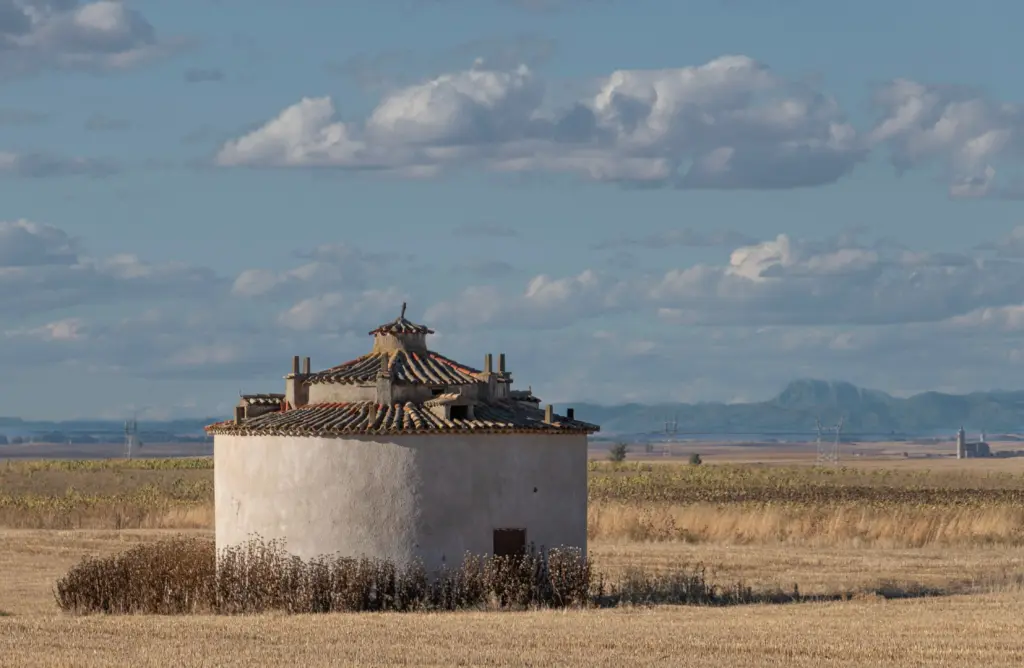
If you would prefer something different, here is an alternative for Day 2, with a completely different atmosphere: start in Tomelloso — where it is worth spending some time on the Ruta de los Bombos (the typical dry-stone shelters of the Manchegan countryside, an architectural curiosity that few tourists know about) or, as we did, on the Ruta de las Bodegas with a wine tasting included — before heading towards the Lagunas de Ruidera Natural Park , for an afternoon immersed in a landscape that surprises anyone who has the usual image of La Mancha in mind: fifteen turquoise lakes set among the rocks, water everywhere, the complete opposite of what you might expect after two days of golden plains and windmills. Along the way you will come across the Castle of Peñarroya , a 13th-century fortress marking the entrance to the natural park —a beautiful reminder of a rather different La Mancha from the usual stops.
If you are travelling in October, I recommend replacing part of this second day’s programme with an activity related to saffron . If possible, try to make your weekend coincide with the last full weekend of the month: this is when Consuegra, already visited on Day 1, hosts the Fiesta de la Rosa del Azafrán —saffron-stripping competitions, folklore and the traditional Molienda de la Paz, a truly rare opportunity. Otherwise, in Madridejos this period still coincides with flowering and harvesting, and it is an experience well worth seeing for yourself.
One week – among windmills, literature and the unexpected side of La Mancha
Below you will find the itinerary I followed myself, improved with a few detours that turned out to be wonderful surprises. Our trip lasted six full days, as we decided to spend 1 day in Madrid, where we landed.
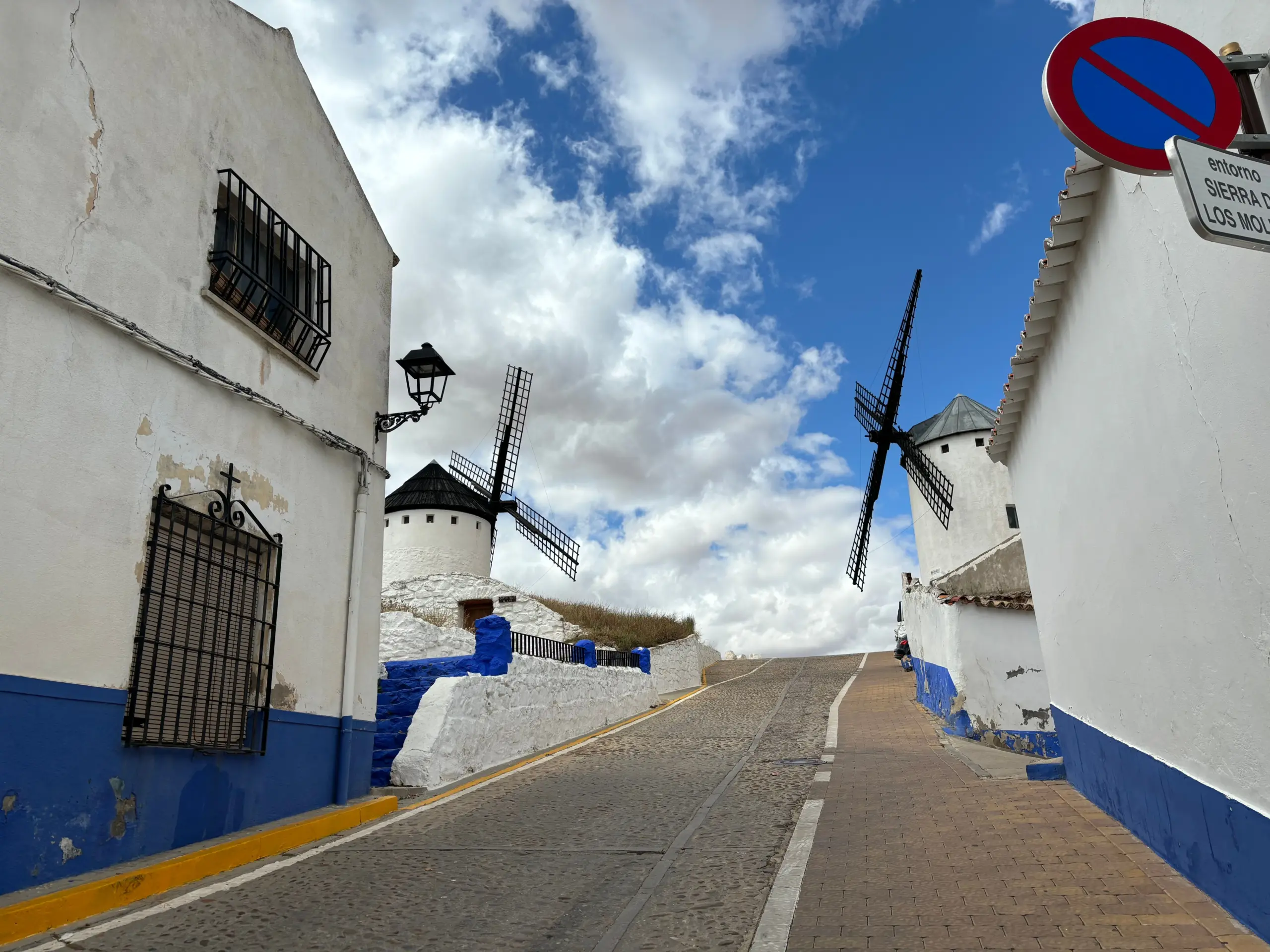
We start with something I discovered almost by chance, thanks to a road sign: in Villacañas, in the heart of the Toledo area of La Mancha, you will find one of the most curious architectural complexes in the region —the silos , actual underground homes, inhabited until the mid-20th century by the poorest families in the town. Today they form an ethnographic museum, and it is worth spending an hour there before getting back on the road.
In the afternoon, head to Campo de Criptana for the windmills you will already know well if you have read the other itineraries, and which simply cannot be missed on any trip to La Mancha.
And here comes the most original part of the day. If you are in this area on a Saturday evening, and if time allows, head towards the La Hita Astronomical Observatory . It lies between La Puebla de Almoradiel and La Villa de Don Fadrique —under one of the clearest and darkest skies in all of Spain, certified as a Starlight Star Park. It is not a museum you can simply visit whenever you like: visits take place only during organised outreach evenings, almost always at weekends, so check the calendar and book well in advance before planning this stop. But if you manage to find the right moment, it is a truly “out-of-this-world” experience.
There is also a second astrotourism area in La Mancha, farther east: Júcar-Mancha Centro, a Starlight Destination that includes Villarrobledo, Minaya, La Roda and Barrax —too far away to include in this itinerary, but an excellent idea if you are planning a different trip, focused more on the Albacete area.
Start in El Toboso, the village of Dulcinea — an almost essential stop for anyone who loves Cervantes, with its house museum dedicated to Don Quixote’s imaginary beloved.
Continue towards Mota del Cuervo, less famous than Consuegra and Criptana but no less beautiful, and then, fifteen minutes away, Belmonte, where the splendid castle from the 15th century — one of the best preserved in Spain— probably offers the most spectacular view of the day.
Finish in San Clemente, a real surprise. The heart of the town is its Renaissance Plaza Mayor, dominated by the old 16th-century town hall, which today houses a small but interesting contemporary graphic art museum .
A practical note: this is a busy day, with four stops spread some distance apart — set off early, and consider lightening the programme (perhaps leaving out El Toboso, if you are not a devoted fan of Cervantes) if you would rather enjoy each place at a slower pace.
Today the atmosphere changes completely with Tomelloso, one of my favourite discoveries. Although not everyone considers it beautiful, Tomelloso —nicknamed “the Athens of La Mancha” because of the surprising concentration of artists and writers born here— is the beating heart of Manchegan wine tourism: almost 50% of Spain’s entire vineyard surface is found here, under the DO La Mancha.
Spend the morning on the Ruta de los Bombos : a route through the vineyards to discover these curious dry-stone structures, built without a drop of mortar from the mid-19th century onwards as shelters —and often actual homes— for shepherds and farmers while working in the fields. More than ninety still remain, scattered across the countryside around the town: a landscape you would hardly expect from the “postcard” La Mancha of windmills.
In the afternoon, stopping at one of the local wineries for a tasting is almost compulsory. We followed the Ruta de las Bodegas and were not disappointed.
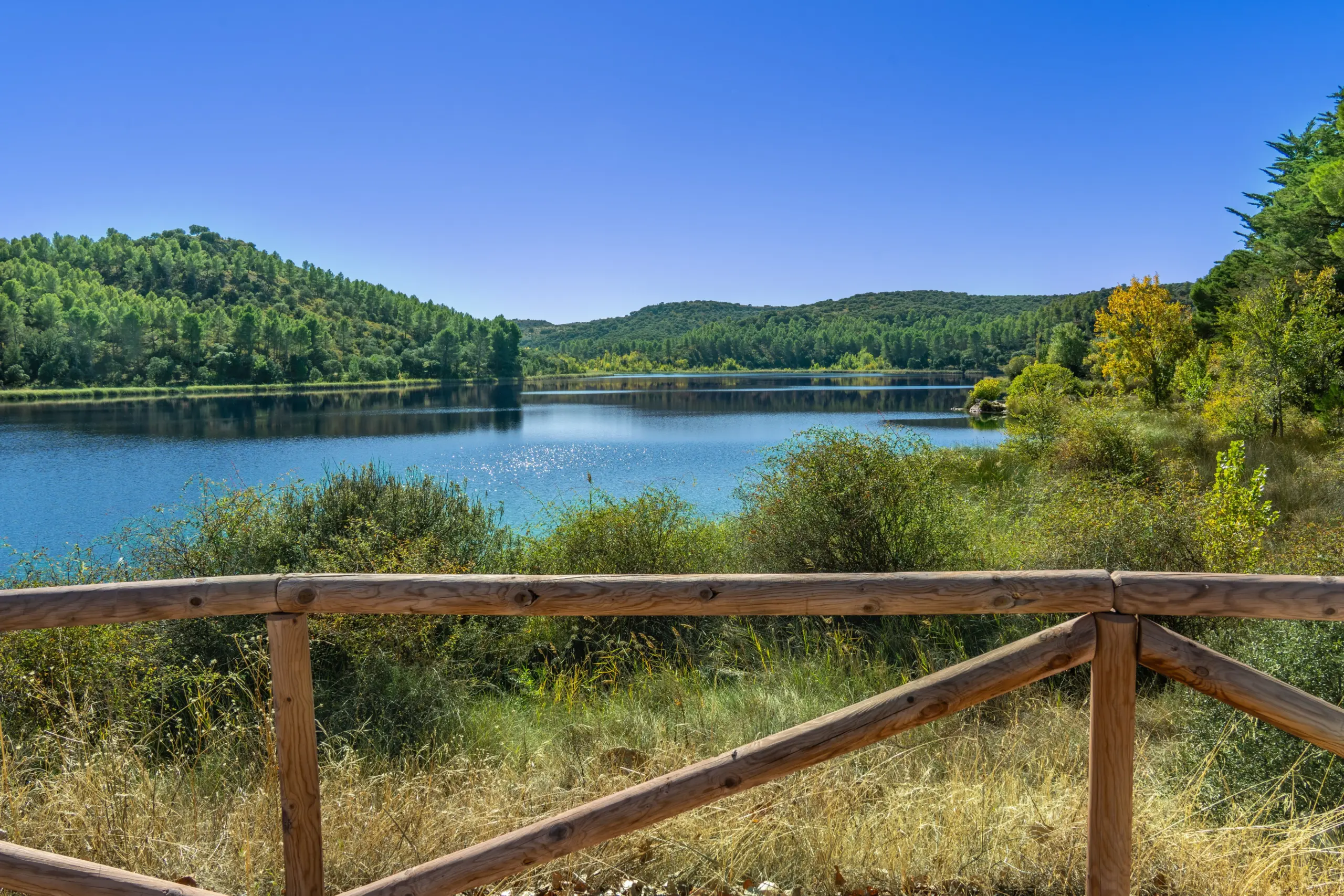
Start with the Lagunas de Ruidera Natural Park , for an afternoon immersed in a landscape that surprises anyone with the classic image of La Mancha in mind: fifteen turquoise lakes set among the rocks, water everywhere, the complete opposite of what you might expect after two days of golden plains and windmills.
In the morning, I recommend a walk along the trail bordering the most accessible lagoons —there is something for every pace, from a short walk to a longer route for those who enjoy being more active. In the afternoon, if you are visiting in season (June-September), it is the perfect time for a swim or to hire a kayak and experience the lagoons from the water, rather than only from the shore.
Along the way you will come across the Castle of Peñarroya , a 13th-century fortress marking the entrance to the natural park — a beautiful reminder of a La Mancha quite different from the usual stops.
Here we return to the literary side of the region, with a visit to Villanueva de los Infantes —one of the most beautiful towns in Spain, yet almost unknown to Italian tourists. One curiosity alone makes the trip worthwhile: according to a study by the Complutense University of Madrid, this may be the mysterious “place in La Mancha” that Cervantes chose not to name in the opening line of the novel. Here you can have lunch or a drink in the Plaza Mayor, in the company of our favourite knight.
Finish the day in Almagro, a jewel of La Mancha’s Golden Age. The heart of the town is its spectacular Plaza Mayor, recognisable by its long green glazed galleries; here you will also find the famous Corral de Comedias , an extraordinarily well-preserved 17th-century theatre that is still used today for theatrical performances.
On the final day, we decided to dedicate our time to Daimiel, which takes you symbolically back to the beginning of this story: just outside the town lies the Motilla del Azuer —the prehistoric site I told you about in the section on the history of La Mancha, with its 18-metre-deep well dug four thousand years ago. If you have made it this far after reading the whole article, this is the moment to see it with your own eyes.
Daimiel is also the gateway to Las Tablas de Daimiel , the only ecosystem of this type still remaining in Spain: fresh water and brackish water meet within the same park, creating a refuge for herons, egrets and all kinds of ducks —even flamingos, if you are lucky enough to venture as far as the nearby Laguna de Navaseca . Be aware, however: the water level varies enormously from one year to another and from one season to the next —always check the park’s official website before planning the detour, because during periods of drought the wetlands can be almost dry and the visit loses much of its charm.
Finish the week in Consuegra, returning to the windmills, the small castle , and sunset over Cerro Calderico — the image with which you could have begun this journey, and the perfect one with which to end it.
Where to stay in La Mancha
In La Mancha, even where you sleep becomes part of the journey. In a land like this —made up of cave houses, wine cooperatives, medieval castles and convents transformed into hotels— choosing carefully where to spend the night means adding another chapter to your discovery of the region. Here is where we stayed, night by night, along our one-week itinerary.
CAMPO DE CRIPTANA – Where to stay in Campo de Criptana
At first, I had looked at the Hotel Boutique Casa Treviño, housed in a 1905 manor house in the heart of Campo de Criptana, just a short walk from the windmills —contemporary design, an outdoor swimming pool and a curious private “cave spa” carved into the rock. It is a perfect option if you are visiting La Mancha in summer. But for a more authentic and less luxurious experience, choose one of the many cave houses in the Sierra de los Molinos, such as Casa Cueva “El Atardecer”, as we did —rooms carved into the rock, naturally cool temperatures and a terrace often overlooking the windmills. A truly immersive experience.
EL PROVENCIO – Where to stay near Mota del Cuervo and San Clemente
Hospedería Nuestra Señora del Rosario, in El Provencio: it occupies the building of the town’s first wine cooperative, founded in 1950 and expanded in 1964 —one of the few surviving examples in Spain of this kind of post-war industrial architecture. The renovation preserved the original rural-style façade, while the interiors were completely refurbished. It was not my favourite stay, but I have to say that everything was impeccable.
TOMELLOSO / LAGUNAS DE RUIDERA – Where to stay in Tomelloso (or almost)
Here is an unexpected setback that turned into a discovery. We had wanted to stay in Tomelloso, particularly at Casa Rural “El Bombo”, which has one of the traditional dry-stone bombos you will have seen along the Ruta de los Bombos right in its garden. Unfortunately, there was no availability. So instead of settling for the first available hotel in town, we moved closer to the following day’s destination, the Lagunas de Ruidera. And that is how we ended up, almost by chance, at Doña Ruidera —an aparthotel just a short distance from the Natural Park and the Cascada del Hundimiento, with direct views over Laguna del Rey. A real stroke of luck: if the same thing happens to you, do not despair, it may turn out to be the best solution.
MANZANARES – Where to stay near Villanueva de los Infantes
After finishing the day among the Lagunas de Ruidera, and wanting to return to the medieval atmosphere we had experienced between Belmonte and Consuegra, we headed to the Castillo de Pilas Bonas, in Manzanares: a 13th-century castle restored as a hotel, with rooms created in the former stables and an atmosphere that takes you back in time without sacrificing comfort.
ALMAGRO – Where to stay near Daimiel and Almagro
At the end of the trip, we decided to treat ourselves to a slightly more expensive stay at the Parador de Almagro, housed in the former Convent of Santa Catalina, founded in the late 16th century by the Ávila y de la Cueva family and inhabited by Franciscan friars until 1942: one of the most evocative historic buildings in all of La Mancha, with 14 inner cloisters, galleries with traditional blue beams and even an old wine cellar with enormous terracotta tinajas converted into a café. It is definitely worth it!
Packing for La Mancha mainly means keeping one feature of its climate in mind: sun, wind and strong temperature swings can all accompany you on the same trip. Most visits also take place outdoors, among windmills, castles, vineyards and small villages, often with very little shade.
The best solution is therefore to dress in layers. Even in spring and autumn I would always take a sweatshirt or jumper with me, along with a lightweight windproof jacket . On the ridges where the windmills of Consuegra, Campo de Criptana and Mota del Cuervo stand, the wind can be quite strong and, as soon as the sun goes down, the temperature can change quickly. If you are planning an evening at the La Hita Astronomical Observatory, add an extra warm layer: standing still outdoors at night is very different from walking around during the day.
You do not necessarily need technical hiking boots, but choose something comfortable with a good sole. You will be walking through historic centres, climbing the hills where the windmills stand, visiting castles and perhaps following a few trails around the Lagunas de Ruidera or through the wetlands of the Mancha Húmeda.
Water, a hat and sun protection are essential, especially from late spring to early autumn. Around the windmills and castles, shade is often practically non-existent and during a road trip you will not always find a café exactly when you need one. I would therefore bring a reusable water bottle to fill every morning, as well as a high-protection sunscreen .
If your itinerary includes the Lagunas de Ruidera between June and September, pack a swimsuit and a lightweight towel as well. In season you can swim, hire a kayak or simply stop for a few hours by the lagoons: it takes up very little space and may prove much more useful than expected.
There is also one item that can really make sense on this trip: a small pair of binoculars . Between Las Tablas de Daimiel, Laguna de Navaseca and the lagoon complex around Pedro Muñoz, you may spot herons, ducks and, with a little luck, even flamingos. If you enjoy wildlife watching or nature photography, they will help you appreciate these stops much more.
Finally, remember that this is above all a road trip. You will be using your phone constantly for navigation, photographs, bookings and checking opening times, often for entire days away from the hotel. I would therefore definitely bring a power bank . It may seem like a small detail, but running low on battery while trying to find a secondary road between two villages is not the best moment to realise you left it at home.
And above all, do not be fooled by the idea that Spain is always warm. La Mancha can be scorching in summer, but it gets genuinely cold in winter, and even March can bring very low temperatures. In spring and autumn, check the forecast a few days before departure and adjust your layers accordingly.
Visiting La Mancha is much more than simply taking a trip. It means stepping into a landscape that has become literature, walking through the same lands that inspired one of the greatest novels of all time. It means stopping in front of a windmill and imagining Don Quixote, lance in hand, charging towards it, convinced that he is facing a giant. It means tasting a mature cheese and drinking a glass of Tempranillo as the sun sets over the plain.
In this arid and windswept land, which hides green corners for those who know where to look, there is something that touched my heart and made me feel a little like a child again.
I know that my passion for travel sometimes makes me easily impressed, but if you have one or two free days while visiting Madrid or Toledo, don’t miss this stop… Every now and then, it is wonderful to feel free to become a child again… and remember: Freedom, Sancho, is one of the most precious gifts that heaven has bestowed upon men.