Cueva de Nerja: the underground giant of Andalusia between geology and prehistory
Arriving in Nerja, visiting its beaches, and enjoying fresh fish in its restaurants is not enough if you haven’t seen its Cueva.
Just a few kilometers from the town center, one of the most surprising places in Andalusia is hidden: the Cueva de Nerja.
It is not just a cave, but an enormous underground complex made up of gigantic chambers, stairways, prehistoric history, and details that are worth knowing before you step inside.
The Cueva de Nerja is something truly unique in the world… I’m not kidding! It has even entered the Guinness World Records

A bit of history about the Cueva de Nerja
The Cueva de Nerja is a vast complex of natural limestone caves located in the village of Maro, about 5 km from Nerja. It is one of those places that don’t simply seem “beautiful,” but out of scale — hard to imagine until you actually step inside.
The caves were formed around 5 million years ago, when water began to seep into the limestone massif, slowly dissolving the rock and creating tunnels, chambers, and cavities. This process lasted for millennia and is still ongoing: in a way, the cave is alive.
The modern discovery dates back to January 12, 1959, when five young men from Maro, following some bats, found a crack in the rock and decided to explore it using nothing more than a hammer and chisel belonging to the father of two of them (now preserved in the Nerja Museum). What they found beneath their feet changed Nerja’s history forever.
Entering through a narrow opening in the ground, they crawled into a passage that led them to one of the first chambers and quickly realized there was much more to explore. They continued until they encountered human skeletons, which they immediately assumed belonged to other modern explorers like themselves, whose fate had clearly not ended well. This frightened them enough to stop. After saying a prayer for the souls of the deceased, they went to the authorities to report their discovery.
Laboratory analyses later revealed a far more fascinating truth: the remains were those of prehistoric inhabitants of the cave. This was only the first evidence of prehistoric human presence. Later, many tools for daily life were found, along with cave paintings that still exist today and represent an important starting point for the study of this prehistoric era.
In fact, the cave represents one of the most important complexes of prehistoric cave art in the world. Although the oldest artistic traces date back about 30,000 years, the most numerous (around 50) date back roughly 19,000 years. These paintings were mainly created using red or black pigments and depict deer, horses, goats, and fish.
In addition, remains of tools, “jewelry,” and animal bones were found — confirming even the presence of seals in Andalusia in prehistoric times.
As you can imagine, the discovery of the Cueva de Nerja led to an economic rebirth for the area, which in the 1950s was going through difficult times. Today, it remains one of the main economic and cultural drivers of Nerja. It attracts around 500,000 visitors per year, making it the most visited natural monument in Andalusia.
Because of its geological, paleontological, and historical value, the cave has been declared a Bien de Interés Cultural and is considered a site of international importance.

The Cueva: how to visit, tickets, and practical tips
Tickets for the Cueva de Nerja can be purchased on the official website and cost around €18 per person.
There are also combined tickets available that include the cave visit, the museum, and the tourist train connecting the center of Nerja to the cave entrance.
The audio guide is available in several languages in addition to Spanish, including English and Italian. It can be downloaded before entering — an important detail, as there is no internet connection inside the cave. Alternatively, you can rent physical audio guides provided on site for about €2.
The visit lasts on average 50 minutes with the audio guide. Not all chambers are always open to visitors, so the duration may vary.
For citizens of the European Union, the foundation offers around 60 free tickets per day, which can be booked online. These free tickets become available 48 hours before the visit (for example, Wednesday tickets open at 09:30 on Monday) and are taken very quickly, so you need to be ready and fast. I’ve read that there is also a limited number of free tickets available directly at the ticket office in the early morning, but I have never personally tried this.
As for parking, there is an official paid parking lot right next to the cave entrance. During the high season, a tourist train connects the center of Nerja to the cave, which is very convenient for avoiding traffic and queues, and can be purchased together with the cave ticket.
If you prefer to spend less and do a good deed, there is a large dirt parking area right in front of the entrance where you can park by making a €1 donation to the Asociación de Discapacitados de Málaga.
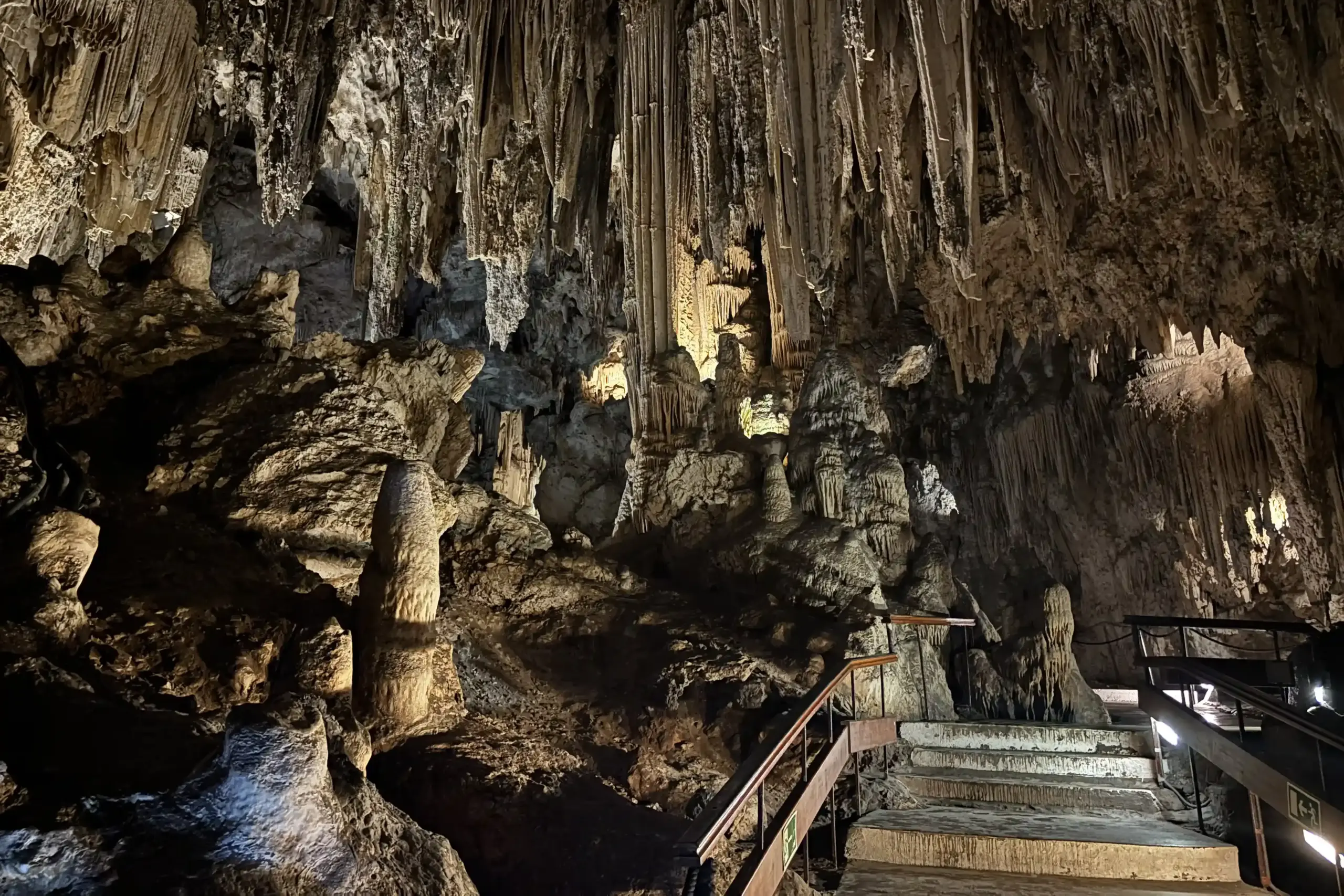
For those who suffer from claustrophobia: don’t worry. This is not about narrow tunnels, but about huge chambers. The largest one has a height comparable to a seven-story building.
At the end of the visit, there is also a nice virtual reality experience, especially enjoyable for children. Outside, you’ll find a small botanical garden with a beautiful sea view, a hiking path, a bar with views over the bay, and a picnic area.
A great way to complete the experience is to combine the visit with the Nerja Museum: entry is free within 10 days of purchasing the cave ticket. It’s quick to visit and displays some of the artifacts discovered inside the cave.
During the summer period, inside the cave — specifically in the Sala del Ballet — the Festival de Música Cueva de Nerja takes place, featuring around 15 internationally renowned music and dance performances. When I tried to attend, it was suspended due to issues related to the foundation, but it’s worth checking. It must be a truly unique experience!
What to expect from the Cueva de Nerja
It’s important to clarify a point that is often misunderstood: don’t expect to see the cave paintings. They do exist, but unfortunately they are not visible to the naked eye. Inside the cave, lighting is deliberately kept low to protect the natural environment. Stronger lighting would encourage the growth of microorganisms, creating a kind of green moss that would damage both the stalactites and stalagmites and the cave paintings themselves.
The tourist route covers about one third of the entire complex, in the area known as the Galerías Bajas, but it is more than enough to leave you speechless.
As soon as you enter, you must face a long staircase going down. Honest warning: you will have to climb all those steps back up. The cave is not flat, so the constant ups and downs are part of the experience. In total, you walk about 800 meters and tackle over 400 steps. Best not to think too much about it and just enjoy the moment!
The first chambers (Vestíbulo, Mina, and Torca) serve as an introduction. These are the outermost areas, the ones most used in prehistoric times, and they provide the first clues about the cave. Here, one of the best-preserved prehistoric burials on the Iberian Peninsula was found, now displayed in the Nerja Museum.
The first “real” chamber you encounter is the Sala del Belén, named after natural cavities that resemble the caves used in traditional nativity scenes. The first cave paintings are located here, though unfortunately not visible.
Another chamber is the Sala de la Piscina, where you can see the gours — small natural pools formed by water over centuries. Today they are dry, but in the past they were completely filled with water, giving the cave an even more striking appearance.
Continuing along the route, just like the first young explorers did, you reach the Sala de los Fantasmas, named for the strange shadows cast on the walls. This is where they encountered the human skeletons that made them turn back.
Next comes the Sala de la Cascada, also known as the Sala del Ballet. For more than 60 years, concerts and music festivals have been held here, especially in summer. The natural acoustics are impressive and make every event feel almost unreal.
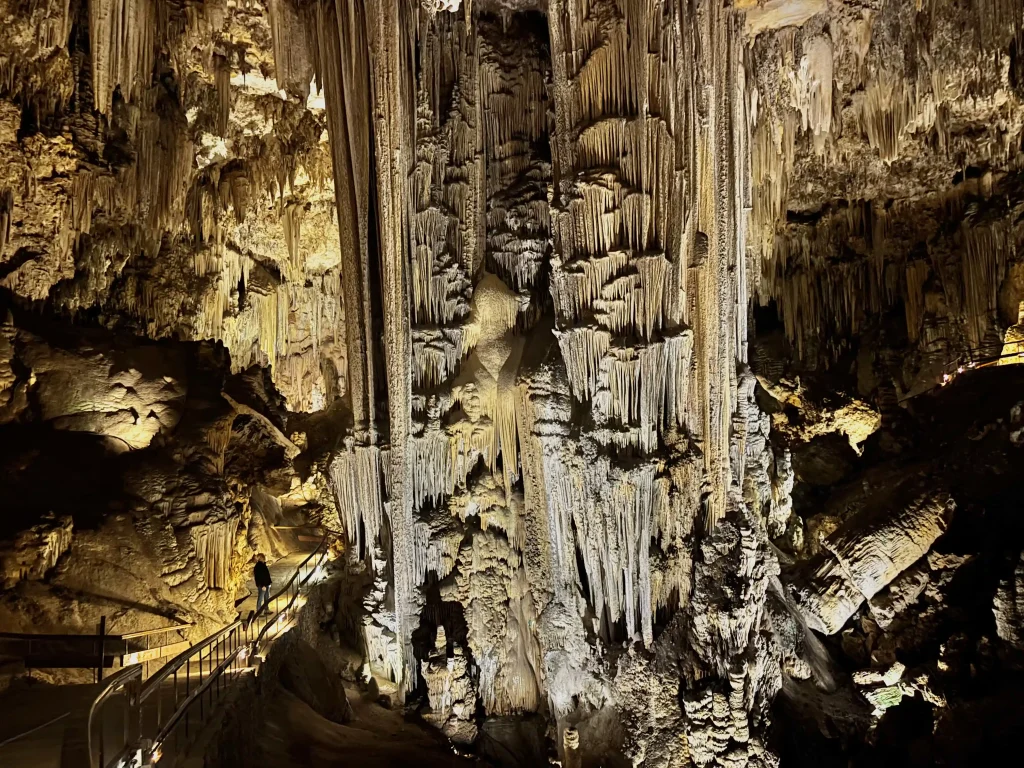
The highlight arrives with the Sala del Cataclismo. Here stands a monumental column formed by the union of a stalactite and a stalagmite: 32 meters high and 18 meters wide.
It is recognized by the Guinness World Records as the largest natural column of its kind in the world. To give you an idea: it’s as tall as a seven-story building and almost as wide as a truck. Standing in front of it, you can’t help but feel small.
As you continue, you’ll notice some stalactites and stalagmites lying “on their side,” an obvious anomaly. This is not a mistake of nature: they are the result of ancient earthquakes that caused parts of the internal structures to collapse. One of the most striking columns is precisely one of these broken by tectonic force, left there like a scar in the rock.
To visit the Cueva de Nerja, I recommend dressing in layers: inside the cave the temperature is mild all year round (around 19 °C), so you might feel a bit cool in summer, especially if you come straight from the coastal sun, or slightly warm in winter.
Even though the path is paved, comfortable shoes with a non-slippery sole are highly recommended: the humidity creates some damp and slippery spots along the route.
The Cueva de Nerja is not just a cave to visit: it is a journey through time, geology, prehistory, and the delicate balance of a natural environment that has lasted for millions of years.
It may not be the most “comfortable” visit, but when you are in Nerja, it is something you simply cannot — and should not — miss.