
The Aigues-Mortes Salt Marshes: a journey through thousands of years of history, pink landscapes and white gold
Beyond the imposing medieval walls of Aigues-Mortes lies a landscape that seems to belong to another planet: the Aigues-Mortes Salt Marshes. An immense mosaic of pink salt ponds, canals and mountains of white salt stretches as far as the eye can see, where nature and human expertise create a spectacle unlike any other in the world.
This is not merely an industrial production site, but a true open-air museum, a precious ecosystem and one of the most fascinating attractions in the Camargue.
Here are some practical tips for visiting the Aigues-Mortes Salt Marshes: how to get there, where to park, how to plan your visit and when to go. A few useful things to know when choosing the best way to explore the salt marshes and deciding which season and time of day offer the best chance to admire their colours.
Show all tips ↓ Hide tips ↑
How to get to the Aigues-Mortes Salt Marshes
- By car: the entrance is located along the RD 979, towards Le Grau-du-Roi, around five minutes from the walls of Aigues-Mortes. A large and convenient free car park is available near the entrance.
- On foot: from the centre of the fortified town, you can reach the salt marshes by walking approximately 1.5 kilometres. The route is easy and alternates between paved roads and stretches alongside the ponds, but it is not particularly scenic. Remember to consider the return journey as well, especially on hotter days.
- By bicycle: the distance from the centre is short and the route is easy to follow thanks to the cycle path running alongside the canal — the same section of the ViaRhôna that, continuing north, would take you as far as the Tour Carbonnière. It is a particularly convenient option if you have already hired a bicycle to explore Aigues-Mortes and the Camargue.
- By public transport: you can reach Aigues-Mortes by regional train or on the liO buses, including line 606 from Montpellier and line 132 from Nîmes. However, there is no stop directly outside the entrance to the salt marshes: from the railway station or the stops near the walls, you will need to continue on foot, by bicycle or by taxi.
How to plan your visit to the Aigues-Mortes Salt Marshes
- The salt marshes can be visited on the tourist train, on foot, by bicycle or by joining a guided tour. Later in the article, we will explain the different options in detail, together with their respective advantages and disadvantages.
- We recommend booking in advance, especially during summer, at weekends and over holiday periods. Even in the low season, seats on the tourist train can sell out quickly.
- Before your visit, always check the official website for opening times, prices and available activities, as these may change depending on the season and weather conditions.
- Near the entrance, you will find a free car park, a picnic area, a bar and toilets. You can therefore arrive a little early or stay for a while after the visit.
- Pets are not allowed inside the salt marshes, not even during the tourist train visit or if carried in a bag. Exceptions are made only for guide and assistance dogs.
- If you prefer an organised excursion combining the salt marshes with a visit to Aigues-Mortes, you can browse the options available through GetYourGuide and Civitatis.
When to visit the Aigues-Mortes Salt Marshes
- In spring: temperatures are more pleasant, the colours of the ponds are usually more delicate and visitor numbers are still fairly low. This is the best time to explore the salt marshes on foot or by bicycle without facing intense heat.
- In summer: the pink colour tends to become more intense, but temperatures and visitor numbers also increase. There is almost no shade inside the site, so bring water, a hat, sunscreen and sunglasses.
- Between late August and September: you may see the salt marshes during the salt harvest and find the ponds displaying their most spectacular colours.
- In autumn: the atmosphere becomes quieter again and temperatures are often pleasant, although the available types of visit and the number of departures may be reduced.
- What time to choose: the middle of the day enhances the contrast between the pink ponds, the white mountains of salt and the Camargue sky, but in summer it can be extremely hot. Late afternoon and sunset offer softer, more atmospheric light.
- The colour of the water and the presence of flamingos depend on salinity, the production cycle, the light and natural conditions. It is therefore impossible to guarantee either an especially intense shade of pink or the sighting of large numbers of flamingos.

The pink ponds and vast mountains of salt at the Aigues-Mortes Salt Marshes, one of the most striking landscapes in the Camargue.
A little history of the Aigues-Mortes Salt Marshes
The history of salt production in Aigues-Mortes stretches back to ancient times. The salt marshes are considered among the oldest in Europe. Although there are no definitive records proving that they were exploited by the Phoenicians and Greeks, it is highly likely that these ancient peoples, renowned navigators and traders, had already recognised the value of these flat, sun-drenched landscapes where nature itself deposited salt.
The first systematic organisation of production, however, dates back to the Roman era. At the beginning of the Christian era, a Roman engineer named Peccius was tasked with developing salt production in this marshy region. The name of the Peccais marshes, located near the saltworks, is a reminder of this distant Roman past.
During the Middle Ages, salt production continued to expand. It was particularly under the reign of Saint Louis —Louis IX—, in the 13th century, that the salt marshes received a new boost. The king, who founded Aigues-Mortes to provide France with a Mediterranean port, ordered the surrounding marshes to be drained and managed, strengthening salt production. By the end of the 17th century, no fewer than seventeen small saltworks, owned by different proprietors, existed in the Peccais area alone.
The history of the salt marshes followed France’s political and economic changes. After severe flooding in 1842, the various owners realised that they needed to join forces to overcome the difficulties. In 1856, they partnered with a merchant from Montpellier and founded Renouard et Cie, which later became the renowned Compagnie des Salins du Midi, the company that still manages the site today. Since then, the Aigues-Mortes Salt Marshes have become one of the Mediterranean’s most important centres of salt production — bear in mind that the Camargue alone produces around a quarter of Europe’s salt.
The site is still managed today by the Groupe Salins, the direct successor of that first association of producers. It is the company behind brands that you may already have in your kitchen, such as La Baleine, France’s leading sea salt brand since 1934, and Le Saunier de Camargue, its premium range of fleur de sel.
Another important salt-producing site in the Camargue is Salin-de-Giraud . Compared with the Aigues-Mortes Salt Marshes, Salin-de-Giraud is better suited to travellers looking for a more scenic, solitary and less touristy experience. It is located in the eastern part of the region, near the mouth of the Grand Rhône, in a much more isolated area.
The main difference is that the working salt pans cannot be visited from the inside as they can at Aigues-Mortes: they are viewed mainly from the Point de vue du Sel, a free viewpoint overlooking the ponds, the geometric patterns of the basins and the vast camelles, some so extensive and tall that they can accommodate several lorries and their trailers at the same time.
The site is larger, more austere and more industrial: it covers approximately 6,000 hectares, and much of its production is intended for industrial uses, including salt used to de-ice roads.
The Aigues-Mortes Salt Marshes are a true “cultivated sea” of impressive proportions. Although the visit focuses on only one part of the site, you should know that the salt marshes cover approximately 9,800 hectares —almost the same area as the city of Paris!— and extend across four municipalities: Aigues-Mortes, Le Grau-du-Roi, Saint-Laurent-d’Aigouze and Les Saintes-Maries-de-la-Mer.
They measure 18 kilometres from north to south and more than 13 kilometres from east to west. No fewer than 340 kilometres of roads and paths cross this vast area, allowing the ponds to be managed and maintained. Around 500,000 tonnes of salt are produced here every year, making the site a true benchmark for salt production around the world.
Salt production in the Camargue is the result of ancient knowledge passed down from generation to generation. The saunier, or salt worker, is the true guardian of this process: a “farmer of the sea” who works in harmony with the elements.
The production cycle takes place between spring and autumn, following a fascinating route of approximately 60 kilometres through different ponds according to the stage of the process and the time of year:
- Pumping (April–August): seawater, which naturally contains around 29 grams of salt per litre, is pumped into a series of shallow ponds known as partènements.
- Evaporation: driven by the wind and warmed by the sun, the water begins its slow four-month journey through the basins, moving from one pond to another and gradually becoming shallower as the salt concentration increases. By the end of the process, 90% of the water has evaporated and the salt concentration reaches 260–290 grams per litre.
- Crystallisation: now saturated, the water reaches the final basin, known as the table salante. This is where the magic happens: the salt crystallises and settles on the bottom, forming a layer known as the gâteau —“cake”.
- Harvesting (August–September): once the remaining water has been drained away, the layer of salt —approximately 10 centimetres thick— is mechanically collected by specialised machines resembling large combine harvesters, known as récolteurs.
- Washing and storage: the harvested salt is washed, drained and finally piled into enormous open-air heaps —the famous camelles. These mountains of white salt, which can reach 15–20 metres in height, are the very symbol of the salt marshes: each camelle represents one year’s production.
- Fleur de sel: alongside mechanical harvesting, there is also a premium product collected by hand —fleur de sel. It is the delicate layer of crystals that forms on the surface of the water in the tables salantes and is gathered using ancient, careful techniques.e delicati.

The mystery of the pink colour: a unique natural phenomenon
One of the most iconic sights of the Aigues-Mortes Salt Marshes is the intense pink colour of their waters, which becomes increasingly pronounced as the salinity level rises. This phenomenon, which attracts photographers and travellers from all over the world, is not artificial, but the result of a fascinating natural process.
The organism responsible for this spectacle is a microscopic alga called Dunaliella salina. This single-celled alga has an extraordinary ability: to survive in hypersaline waters, where the salt concentration is lethal to almost all other organisms, it produces large quantities of beta-carotene, a natural red-orange pigment that protects it from sun damage — essentially the same substance we use to help us tan.
A small crustacean called Artemia salina also lives in the ponds and feeds on this very alga. However, Artemia cannot survive when the salt concentration becomes too high: in the tables salantes, where salinity reaches its maximum level, the crustacean disappears, leaving the alga free to multiply in abundance and turn the water pink.
The intensity of the pink colour is not constant throughout the year. It becomes stronger over the course of the summer, reaching its greatest brilliance between late August and September. In spring, it is much more delicate, with pale lilac and pink tones, while by midsummer it can already become extremely vivid, almost shocking pink. A visit in late summer therefore offers the most breathtaking spectacle.
There is one detail that may surprise you: the same Dunaliella salina that turns the ponds pink — the microscopic alga we will discuss shortly — has also become the starting point for a cosmetics range.
The group has developed Éclaé, a range of anti-ageing products that harnesses the antioxidant and moisturising properties of this alga, which is able to protect itself from the sun and extreme salinity by producing large quantities of beta-carotene.
A perfect example of how, in the Camargue, even the most extreme landscape can conceal valuable resources, whether for seasoning a dish or taking care of your beauty routine.
But the site is not only valuable from an industrial perspective. In 1995, it was included in the General Inventory of French Cultural Heritage for its historical and cultural significance, as well as for its role in preserving biodiversity.

A protected ecosystem teeming with life
Although it is an active industrial site, the Aigues-Mortes Salt Marshes are also an ecosystem of exceptional richness and a true haven for biodiversity. The vast extent of the ponds and their relative tranquillity provide shelter and food for numerous animal and plant species.
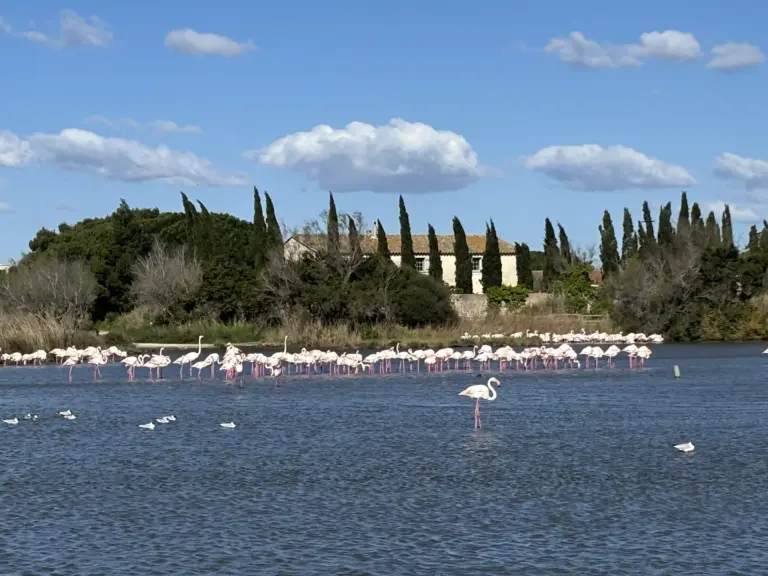
Pink flamingos are the undisputed stars. Here, they find their favourite food, Artemia salina, and can be seen in the ponds in their hundreds, if not thousands. Their presence depends on food availability and the seasons, so it is not guaranteed throughout the year. In summer, the very high salinity and the absence of the crustacean they feed on mean that fewer flamingos are usually seen.
The salt marshes are a wetland of international importance, visited by more than 200 species of birds, both resident and migratory. In addition to flamingos, you may spot herons, egrets, black-winged stilts, avocets, terns, gulls and many other species.
The ecological importance of the site is such that, since December 1995, the salt marshes have been included in the General Inventory of French Cultural Heritage and form part of a wider framework of environmental protection.
And if those pink flamingos and birds have won you over, remember that here you have only seen them in passing: to admire them at their most spectacular, head to the Pont de Gau Ornithological Park.

How to visit the Aigues-Mortes Salt Marshes
There are several ways to explore the salt marshes. Most travellers choose to discover them aboard the characteristic Petit Train, but there are also alternatives by bicycle and on foot.
The tourist train: the classic visit
Tickets can be purchased on the official website or directly at the site, at a cost of approximately €14 for adults and €10 for children. I recommend buying them online whenever possible to avoid the risk of finding no availability, or going directly to the site as soon as you arrive in the Camargue, so that you can secure a place on your preferred day. The website does not always work properly, and I was unable to book online myself. I went there in person on the day I wanted to visit, but by 10:30 in the morning, even in low season, all the places were already sold out. I had to book for the following days and settle for a time that was not exactly ideal for seeing the pink colour at its most vivid. Lesson learned: always book in advance. The tourist train is wheelchair accessible, but you should contact the organisers beforehand so that they can prepare everything required. It operates mainly from March to November. Timetables vary according to the season, but as a general guide they are usually 10:00–17:00 in spring and autumn and 9:30–18:30 in July and August. Always arrive 15 minutes before departure, with trains leaving approximately every 30 minutes. Check the website before setting out: I was told that schedules may change or departures may be cancelled without notice in bad weather, such as strong wind or rain.
The Petit Train du Salin d’Aigues-Mortes is the most popular and accessible way to discover this extraordinary landscape. The visit lasts approximately 1 hour and 15 minutes and begins at the entrance to the site. It is particularly suitable for families and, more generally, for anyone looking for a comfortable guided visit with informative commentary.
During the route, a guide explains the history of the site, the work of the sauniers and its biodiversity. The commentary is mainly in French, but leaflets or QR codes with information in other languages —English, German and Italian— are provided. As we do not speak fluent French, we relied on the recorded guide, although it was not especially detailed. Personally, therefore, if you do not speak French, I would consider other ways of visiting the site. The tourist train also follows a fairly short route, so it does not really convey the true scale of the salt marshes or allow you to admire Aigues-Mortes reflected in the water in all its splendour.
The tourist train follows a set route with several stops, which are essential for understanding the site you are visiting:
- The pink ponds: the route takes you through the evaporation basins, where the water acquires different shades of pink, especially between May and September.
- The camelles: the highlight is the stop at the foot of the camelles, the spectacular mountains of white salt. Here, you can get off the train, climb to the top for a panoramic view and take unforgettable photographs with the walls of Aigues-Mortes in the background.
- The wildlife: along the route, you will have the opportunity to spot the famous pink flamingos, as well as more than 200 bird species that inhabit the area, which is protected as a Natura 2000 site. In summer, it is more difficult to see birds because the high salt concentration in the water makes this area less attractive to them — they prefer other places where food is easier to find and more abundant.
- Museum/exhibition area: the visit includes a stop at the salle d’exposition, where you will discover the secrets of salt crystallisation and the centuries-old work of the sauniers. Most of the videos and commentary are in French.
- Boutique: at the end of the visit, you can browse the shop and buy the famous sel de Camargue and other local products.
Many people confuse the salt marsh tourist train with the Petit Train d’Aigues-Mortes, which instead travels through the heart of the medieval town for around 25 minutes, departing from the Porte de la Gardette, the main entrance to the fortified town.
It does not enter the salt marshes or travel along the top of the walls: instead, it passes through the streets of the town centre, offering an initial overview of Aigues-Mortes.
During the tour, you will mainly see:
- the streets and squares of the walled town;
- the medieval walls viewed from the inside;
- the gates and some of the towers along the fortified enclosure;
- the historic and religious buildings in the centre;
- the most characteristic views of the inner neighbourhoods.
The commentary recounts the foundation of the town commissioned by Louis IX, the departure of the Crusades, the construction of the fortifications and the Wars of Religion. It is therefore more of a panoramic tour with commentary than a detailed itinerary covering each individual monument.
The journey lasts approximately 25 minutes and departs, as a general guide, every 40 minutes from the Porte de la Gardette. Tickets can only be purchased on site, with no possibility of booking in advance. Written information in Italian is also available.
Take care when asking for information or searching online: the results may refer either to the salt marsh tourist train or to the Petit Train d’Aigues-Mortes. They are two completely different experiences, with different routes, departure points and ways of visiting.

By bicycle
It is certainly a very convenient option. You can enter the site with your own bicycle —or a rented one— by paying an admission fee of approximately €18 —subject to change—. A minimum level of experience is recommended and, preferably, you should use a mountain bike or e-bike, as the surface is not always in perfect condition. There are signposted circuits of different lengths —4, 12 and 30 kilometres— to suit every fitness level. The routes are well marked, but they mainly follow unpaved tracks and require at least two hours.
In town, you will find several bicycle rental shops, offering both traditional bicycles —around €25 for the full day— and electric bikes —approximately €30 for half a day—. Here are some interesting options:
- Station Bees
- Bike 30
- Sport Expert: I could not find an official website, but you can contact them by phone at +33 04 66 51 67 34 or by email at [email protected].
On foot
One of my absolute favourite alternatives. There is a 4-kilometre signposted walking trail that allows you to discover the ponds, wildlife and vegetation in complete freedom. Thanks to the authorised paths, you can enjoy a slower and more intimate exploration of the area without missing anything compared with the bicycle visit. Naturally, it takes longer: allow around three hours, and it is not the most suitable option during the hottest part of the day — but it remains perfect for anyone who wants to discover the secrets of the Camargue at a leisurely pace. The route is accessible with pushchairs and tricycles, and adults are provided with a compulsory reflective vest for safety reasons.
Guided tour by bicycle or on foot
It is the perfect option for anyone who wants to discover the secrets of salt harvesting at a relaxed pace and with expert guides, while learning more about biodiversity and production. These routes and activities are perhaps better suited to adults and children aged 10 and over, given their length and the amount of information provided. Personally, I chose to enjoy the salt marshes at my own pace, but I saw that guided tours cost around €22 for adults. Booking is strongly recommended and can be made on the official website, especially in high season — and if you decide to take the bicycle tour, book early: places sell out fast!
The Aigues-Mortes Salt Marshes are a completely open environment, where the sun, wind and reflections from the water and salt can make the visit more demanding than expected. Packing your backpack carefully really makes a difference, especially if you choose to explore them on foot or by bicycle.
- Wear comfortable shoes that you have already broken in. The routes inside the site mainly follow unpaved roads, gravel and uneven ground. Avoid very open sandals or footwear with smooth soles, especially if you have chosen to visit on foot or by bicycle.
- The sun is one of the undisputed stars of the salt marshes. Always bring a hat, sunglasses and a good sunscreen: there is almost no shade, and the reflections from the water and the mountains of salt make the light even more intense. I always carry this sunscreen with me; it is small but extremely effective.
- A reusable water bottle is essential, especially in summer or if you choose one of the longer routes. There is a bar near the entrance, but once you begin the visit, you will not always have the opportunity to buy water. I bought a collapsible silicone one from Natura, although I have noticed that it is often out of stock. In any case, you can find a similar one here; it is very practical because it takes up very little space when empty.
- If you want a better view of the flamingos and the other birds living in the salt marshes, bring a pair of binoculars. The animals are often far from the routes accessible to visitors and, without binoculars, you may barely be able to distinguish them.
- Bring a windproof jacket, even during the warmer months. The salt marshes are completely exposed, and the Mistral can rise suddenly, making the air feel cooler and blowing dust across the paths. A lightweight jacket that is easy to store in your backpack, such as this one, is sufficient. During the shoulder seasons, a sweatshirt and a scarf may also be useful.
- A good mosquito repellent can be very useful, especially in the late afternoon, at sunset and during more humid periods. I use this one. If you have booked an evening departure, I definitely recommend bringing it with you.
- If you have chosen a longer visit, bring a few snacks. There is a bar and a picnic area near the entrance, but opportunities to buy food inside the salt marshes are very limited.
- A power bank may seem like a minor detail, but it makes the visit much easier, especially if you frequently use your smartphone to take photographs, check information about the route or find your way around. Between pink ponds, mountains of salt and flamingos, it is easy to drain the battery quickly. I received this one as a gift and have been very happy with it, but many different models are available.
You do not need much else. To visit the salt marshes, the most important things are comfortable shoes, sun protection, water and binoculars: just a few items, but the right ones.
The Aigues-Mortes Salt Marshes are much more than a simple tourist attraction: they are a place where thousands of years of history, human labour and untamed nature come together in a perfect and spectacular harmony. Walking along the top of a mountain of white salt and gazing towards an immense mosaic of pink ponds on the horizon, framed by the silhouette of the fortified town, is an experience that remains imprinted on both the heart and the memory. A true masterpiece of the Camargue that should not be missed.
If the salt marshes were your first stop, I recommend completing your visit by discovering the rest of Aigues-Mortes: its medieval walls, the Tower of Constance and its legends deserve just as much time.
And if this is only one stop on your journey through the Camargue, do not miss its wildest and most authentic side in Saintes-Maries-de-la-Mer, perhaps with the help of our general guide to the Camargue, which will help you find your way through the many different sides of this region.