
Aigues-Mortes and the Petite Camargue: a journey through crusader history, the sea and the pink salt pans
Aigues-Mortes is a small medieval gem that, if the Camargue had made you believe you were somewhere else, immediately reminds you that you are in France.
It rises like a mirage from the plain of the salt pans, beyond the expanses of pink water, with its imposing medieval walls that seem to guard a city from another age. Walking here means stepping back into the Middle Ages, among crusader kings, mighty towers and a suspended atmosphere that is truly difficult to put into words.
Its name, evocative from the very beginning —“Dead Waters”, from the Latin Aquae Mortuae— tells the story of its origins well: the area was a land of marshes and malaria-infested wetlands, far from easy to inhabit. Today, however, it has become one of the most fascinating destinations in southern France: a true jewel of military architecture, with more than 1,600 metres of walls, among the best preserved in Europe, attracting visitors from all over the world.
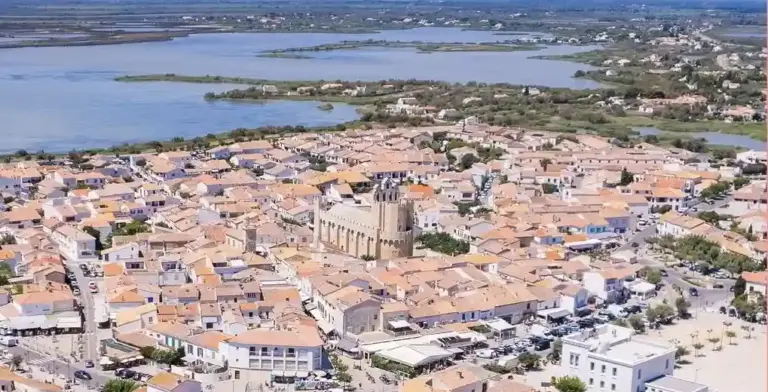
The town is small, but its setting makes it incredibly picturesque. If Saintes-Maries-de-la-Mer is the wild soul and beating heart of the Camargue and its natural park, Aigues-Mortes is its historical soul, the queen of the Petite Camargue, the more “urban” part of the region. If you are in the Camargue, you cannot miss it.
Here are some practical tips for visiting Aigues-Mortes: how to get there, where to park, how to get around, how to plan your visit and when to go. A few useful things to know when choosing your transport, exploring the historic town and organising trips to the salt pans and the surrounding Camargue.
Show all tips ↓ Hide tips ↑
How to get to Aigues-Mortes
- By plane: the nearest airports are Montpellier Méditerranée and Nîmes Alès Camargue Cévennes, although the latter generally offers a more limited number of connections. Another alternative is Marseille Provence, which is farther away but served by many flights. To compare fares across several dates, I use Google Flights. From Montpellier, you can continue by public transport, while from the other airports the most convenient option is generally to rent a car.
- By train: Aigues-Mortes has its own railway station and is directly connected to Nîmes by the regional line running to Le Grau-du-Roi. The journey takes approximately fifty minutes and crosses a beautiful flat landscape of canals, fields and wetlands. Aigues-Mortes station is located just outside the walls, a few minutes’ walk from the Tour de Constance: therefore, if you only plan to visit the historic town, a car is not essential. Always check the timetable on the liO Train SNCF Occitanie website, as frequencies vary depending on the day and the season.
- By bus: regional bus line 132 connects Nîmes with Aigues-Mortes and stops near the Tour de Constance. From Montpellier, line 606 is available instead, also passing through La Grande-Motte before reaching Aigues-Mortes. Services may be less frequent at weekends, on public holidays and during certain times of the year, so always check the timetable on the liO Occitanie website.
- By car: this remains the best option if you want to use Aigues-Mortes as a base for exploring the salt pans, the Tour Carbonnière, Le Grau-du-Roi, Espiguette Beach and other areas of the Camargue. The historic centre is enclosed within the walls and is not designed to be freely crossed by car. Several car parks can be found around the fortified enclosure, including those near the remparts and the Tour de Constance, but most of them charge a fee. P8, on Rue Jeanne Demessieux, is free, but it is approximately a twenty-minute walk from the centre.
In short, if you only want to visit Aigues-Mortes and Le Grau-du-Roi, you can also manage quite well by train. If, on the other hand, you want to explore the Camargue more fully, reaching salt pans, beaches, nature parks and more isolated places, it is best to rent a car.
How to get around Aigues-Mortes
- The historic centre can be explored entirely on foot. Distances within the walls are short, and almost all the main monuments, restaurants and shops are concentrated around Place Saint-Louis and the surrounding streets.
- The Petit Train of Aigues-Mortes travels through the streets of the fortified town on a short guided tour. It does not allow you to see any monuments other than those that can also be reached on foot, but it can be useful for getting your bearings, for those travelling with small children or for anyone who has difficulty walking.
- A bicycle is an excellent way to reach Le Grau-du-Roi, the salt pans and the Tour Carbonnière. The terrain is flat and crossed by cycle paths and voies vertes, although the wind can make the route more demanding than it appears. Traditional and electric bicycles can be rented directly in Aigues-Mortes.
- To reach the Aigues-Mortes salt pans, you can follow the walking route from the southern side of the walls, although honestly it would not be my first recommendation. It is better to arrive by car, bicycle or taxi. Free parking is available at the salt pans.
- The regional train allows you to reach Le Grau-du-Roi in around ten minutes. It is a particularly practical option during the summer months, when traffic and finding a parking space along the coast can become complicated.
- With an organised tour: this can be a good option for anyone staying in Montpellier or Nîmes who does not want to deal with transport arrangements. Before booking, check the itinerary carefully: some tours spend only a few hours in Aigues-Mortes, while others also include the salt pans or part of the Camargue. I always check the available options on GetYourGuide and Civitatis.
How to plan your visit to Aigues-Mortes
- One day is enough to see the historic centre, the chapels and walk along the walls. If you also want to add the salt pans, a canal cruise or Le Grau-du-Roi, I recommend staying for at least two days.
- In summer and at weekends, it is best to arrive in the morning, both to find parking more easily and to visit the walls before the hottest hours of the day. The streets of the centre are also pleasant in the late afternoon, when many day-trippers begin to leave.
- Book visits to the salt pans in advance, especially if you want to take the tourist train, join a guided walking tour or take part in a cycling activity. Booking is particularly important in summer, during holiday weekends and at weekends, but it may also be necessary outside the high season. In March 2026, when I was last there, by 10:30 in the morning all the places on the tourist train were already sold out for the entire day, and we had to return on one of the following days.
- Visits to the salt pans do not begin in the historic centre. Allow enough time to reach the entrance and remember that the salt pans’ tourist train is not the same Petit Train that travels through the centre of Aigues-Mortes.
- To admire and photograph the colours of the pools, the best times are generally late morning and late afternoon, when the light enhances the shades of the water most effectively. The pink colour tends to be more intense in late summer, but it always depends on the salt concentration, the microorganisms present in the pools and the weather conditions.
- Whenever possible, avoid days with rain or very strong winds, because the Mistral can make visiting the salt pans, walking along the walls and cycling less enjoyable. I decided to brave the wind anyway and, if you dress appropriately, it can become an experience worth talking about!
- The Mistral can blow very strongly in any season. Check the weather before climbing the walls, taking part in a cruise or planning a cycling trip: in the most exposed areas, the wind can be limiting.
- Watch out for mosquitoes! They are especially common in the wetlands, near the salt pans and along the canals, particularly in summer and at sunset. Bring an effective insect repellent even if you plan to spend most of the day in the historic centre.
- The traditional market takes place on Wednesday and Sunday mornings along Avenue Frédéric Mistral. On Saturday mornings, generally from late March or April until the beginning of autumn, a charming antiques and second-hand market is held in the historic centre, perfect for anyone who enjoys browsing among vintage objects and small treasures from the past.
- People eat fairly early, and many restaurants stop serving after lunch or close their kitchens in the evening earlier than you might expect. During the less touristy months, some establishments also close for several days: always check the opening hours and make a reservation at weekends.
When to go to Aigues-Mortes
- The liveliest season generally runs from April to October. During these months, more visits, cruises, salt-pan activities and tourist services are available. However, July and August are also the hottest and busiest months, with more congested car parks and a greater number of mosquitoes.
- The best time to visit Aigues-Mortes is, in my opinion, between May and June or between September and October: temperatures are generally more pleasant, the light on the walls and salt pans is beautiful, and the crowds are less intense than during the high season.
- Summer, especially its latter part, is the period when the salt pans can display their most intense pink shades and when the greatest number of activities are organised, including some visits connected with the harvesting of fleur de sel. However, you should expect heat, very little shade and a high number of visitors.
- Winter can also be fascinating: the town is quieter, the walls seem even more imposing and the landscape of the Camargue takes on a suspended atmosphere. However, the days are shorter, and some attractions, cruises, guided tours, restaurants and shops may be closed or operate with reduced opening hours.

A little history of Aigues-Mortes
The history of Aigues-Mortes is actually quite recent when compared with that of other French cities: it sprang up practically from nothing in the 13th century, and its foundation is owed to Louis IX, the man who would become Saint Louis.
During his reign, King Louis IX of France faced a significant strategic problem: he had no access to the Mediterranean Sea, and in order to fulfil his dream of setting out on the Crusades, he was forced to depend on the ports of Genoa or Marseille. At the time, Provence was under the control of the Holy Roman Empire, while the Kingdom of Aragon dominated the Montpellier region.
He therefore decided to build a new port town from scratch in a seemingly unsuitable location, but one that represented France’s only outlet to the sea: a way to give France direct access to the Mediterranean without having to depend on rival cities such as Marseille —which was not yet French— or on Italian ports. The solution came with the purchase of marshy, unhealthy land from the Benedictine Abbey of Psalmodi.
To attract people to this far from welcoming land —and thus support the development of the new port town— the king granted its future inhabitants extraordinary privileges, including exemption from taxes. It worked, and the town began to grow rapidly.
The sovereign gave the town a clearly defined territory and ordered the construction of the Tour de Constance, directly connected to the royal castle and designed as a defensive and observation point overlooking the town and its surroundings.
Around 46 metres high, the tower controlled access to the town, the port and the surrounding waterways. At its summit there was also a lantern used as a navigational landmark. Its name is said to derive from “constancy”, or perseverance: the virtue the king supposedly wished to instil in his successors.
He also created a network of canals linking the town to the sea, Arles and Montpellier: little by little, this was how a town in which life was genuinely worth living began to take shape.
Although it is difficult to imagine today, Aigues-Mortes once occupied a privileged position on the Mediterranean. The port was organised into two large basins, or étangs. The first, closest to the town walls, was shallow and could only be entered by flat-bottomed boats. The second, connected to the first by a small canal, was deeper and more open towards the sea: larger vessels moored here and transferred their goods onto flat-bottomed boats, which carried them as far as Aigues-Mortes.
Aigues-Mortes thus became the first French port on the Mediterranean and, in 1278, was granted the kingdom’s commercial monopoly. Spices, fabrics, grain, wine and, above all, salt passed through the town.
But under Louis IX, the town’s role was not limited to port and commercial activities.
The most famous moment in its history came on 25 August 1248, when Louis IX left Aigues-Mortes at the head of the Seventh Crusade.
Thousands of soldiers, knights, sailors, servants and pilgrims boarded ships bound for Cyprus and later Egypt. However, the expedition ended disastrously: the French army was defeated and the king was captured, before eventually being released in exchange for a ransom.
In 1270, Louis IX returned to Aigues-Mortes to organise another expedition, the Eighth Crusade. This time, the fleet headed for Tunis. During this crusade, Louis IX died, reportedly from dysentery —no comment.
After his death, his successors Philip III the Bold and Philip IV the Fair completed the work, ordering the construction of the imposing fortified walls that still surround the town today. Measuring 1,643 metres in length and perfectly preserved, they are considered one of the most consistent examples of medieval military architecture in France.
For much of the Middle Ages, Aigues-Mortes was an essential stop for French trade in the Mediterranean. However, recurring silting problems caused by sediment carried by the Rhône showed, after barely two centuries, how difficult it was to maintain the port at the level required by maritime traffic. Over time, the sea receded and access for ships became increasingly difficult. The town repeatedly attempted to keep new canals open towards the coast, but many eventually filled with sand.
The final blow came in 1481, when Provence —and with it Marseille— was annexed to the Kingdom of France, becoming its main port. From that moment onwards, Aigues-Mortes lost all strategic importance.
Aigues-Mortes remained a commercial and administrative centre, but it never managed to recover the Mediterranean role imagined by Louis IX.
In July 1538, Aigues-Mortes hosted one of the most important diplomatic meetings of the European Renaissance.
King Francis I of France received Emperor Charles V, his great political rival, in the fortified town. The two sovereigns were seeking reconciliation after years of war for control of Italy and Western Europe.
The meeting was accompanied by ceremonies, banquets and solemn promises of peace. However, the reconciliation was short-lived, and hostilities resumed a few years later.
The episode nevertheless shows that, despite the decline of the port, Aigues-Mortes still retained important symbolic value for the French monarchy.
Aigues-Mortes regained prominence in the centuries that followed, but not for anything positive.
In 1598, King Henry IV had signed the Edict of Nantes, an extraordinary act of tolerance for its time that granted French Protestants —known as Huguenots— freedom of conscience and worship across much of the kingdom, bringing decades of bloody religious wars to an end. Aigues-Mortes was one of the eight safe havens granted to Protestants.
Everything changed in October 1685. King Louis XIV, convinced that the religious unity of the kingdom depended on Catholic uniformity, completely revoked the Edict of Nantes, leading to a brutal repression of Protestantism:
- Protestant worship was banned throughout the country;
- pastors and teachers were forced into exile;
- places of worship were systematically destroyed;
- Protestants were ordered to renounce their faith or leave France, abandoning all their possessions.

Those who remained and were caught secretly practising their faith risked imprisonment in the Constance Tower in Aigues-Mortes.
The persecution continued until 1767, when the last female prisoners held in the tower were finally released.
The history of the town is reconstructed extremely well in the museum inside the walls: do not miss it, because it genuinely helps you understand the atmosphere that can still be felt in the town today. Unfortunately, it is available only in English and French, but it is exceptionally well designed. Audio guides are also available in several languages: they are not quite the same thing, but I absolutely recommend them.
It then took the French Revolution and the restoration of freedom of worship to truly close this chapter. During this period, Aigues-Mortes temporarily changed its name to Port-Pelletier, in an attempt to remove every reference to the Ancien Régime and the monarchy.
By then, however, the town was going through a period of commercial decline: the medieval port was almost completely unusable, and the economy depended increasingly on salt production, winegrowing, livestock farming and activities connected with the lagoons.
A turning point came in 1806, with the opening of the Canal du Rhône à Sète —the canal that still runs beside the Constance Tower today— which connected Aigues-Mortes to the inland navigation network of southern France. The town did not become a major seaport again, but it developed into an important river port used to transport salt, wine and other goods.
In the 19th century, salt production reached an industrial scale: in 1856, the Compagnie des Salins du Midi was established, organising and expanding the exploitation of the salt pans around the town. Even today, the Salin d’Aigues-Mortes remains one of the main salt-producing areas in the Camargue and one of the most recognisable features of the local landscape.
However, this industrial development did not improve living conditions in the town. The work was seasonal and extremely hard: during the harvest, thousands of labourers temporarily moved to the area to break up, pile and transport the salt beneath the summer sun. Harsh working conditions, competition for jobs, the economic crisis and a growing climate of xenophobia fuelled intense social tensions, which only gradually eased once working conditions became more regulated.
At the beginning of the 20th century, interest in preserving the fortified town began to grow. In 1903, the walls, the Constance Tower and the castle were classified as historic monuments, and the first protection and restoration projects were launched.
Tourism developed more rapidly after the introduction of paid holidays in France in 1936. Coastal resorts such as Le Grau-du-Roi began attracting increasing numbers of visitors, many of whom also travelled to Aigues-Mortes.
The town, which for centuries had suffered from the sea gradually receding, thus began to transform its isolation —and the exceptional preservation of its walls— into a genuine resource. During the 20th century, the historic centre was progressively restored, while commercial and tourist activities became concentrated around Place Saint-Louis and the town’s main gateways.
Today, Aigues-Mortes is a lively town, but its development inevitably revolves around its historic heritage and the landscape of the Camargue. The town still relies on salt production, winegrowing, agriculture, livestock farming and Camargue traditions.
Its walls tell the story of the power of medieval kings, the Constance Tower preserves the memory of religious intolerance, while the salt pans recall the labour, migration and social conflicts that shaped the area. It is precisely this meeting between grand history and everyday life, between stone, water and salt, that makes Aigues-Mortes one of the most fascinating places in the Camargue.
What to see in Aigues-Mortes
If you are in the Camargue, you should absolutely devote at least a full day to Aigues-Mortes and its surroundings. This fortified town is not only a jewel of medieval history, but also represents the Camargue in its most authentically French form, where nature, history and beauty come together in a landscape unlike anywhere else in the world.
To make your visit even more special, I recommend starting with the official tourist office website, which is extremely well designed and full of ideas for planning every stage of your trip, from seasonal events to nature excursions.
Here are my recommendations for what you should not miss in Aigues-Mortes.

The historic centre
The historic centre of Aigues-Mortes is a small world enclosed within imposing walls. And there is only one golden rule: it should be explored entirely on foot. The best option is to leave your car in one of the car parks outside the walls and take your time getting lost in the maze of narrow streets.
If you enter from the northern side —the one facing inland— you will pass through the Porte de la Gardette, which was the town’s main entrance. It was once preceded by a drawbridge, traces of which can still be seen on the façade.
Unlike the typical hilltop medieval villages, Aigues-Mortes has a grid layout —an orthogonal plan— characteristic of the bastides, the “new towns” founded during the Middle Ages. The streets intersect at right angles, forming regular blocks, and walking along straight roads such as Rue de la République or Rue Jean Jaurès means discovering artisan workshops, galleries and picturesque views. This is exactly where you can buy the most elegant and refined souvenirs from your stay in the Camargue.
One of the main stops is undoubtedly Place Saint-Louis, the town’s central square and the beating heart of Aigues-Mortes since its foundation. It is surrounded by colourful, typically Mediterranean façades and welcoming cafés and restaurants —the ideal place for a break, perhaps in the late afternoon, when the golden light of sunset illuminates the buildings and the terraces come to life.
At the centre of the square stands the statue dedicated to Louis IX —Saint Louis—, the king who founded the town in 1240. It was created by the sculptor James Pradier and unveiled in 1849: a tribute to the sovereign who departed from here for the Crusades.
Near the square, you will find two charming chapels: the Chapel of the White Penitents, known for its sacred art and monumental frescoes, including Xavier Sigalon’s famous Descente du Saint-Esprit, completed in 1817, and the Chapel of the Grey Penitents, which still preserves an important artistic collection, particularly its altarpiece and marble altar, which partially survived the destruction of the Revolution. They are reminders of the ancient religious brotherhoods —still active today— that once played such an important role in the life of the town.
Behind the names White Penitents and Grey Penitents, which may sound rather mysterious today, lie two ancient Catholic brotherhoods that played an important role in the religious and social life of Aigues-Mortes.
The penitents were not monks, but groups of devout laypeople, which were widespread throughout southern France from the Middle Ages onwards. They gathered to pray, take part in processions and, above all, assist the most vulnerable: they cared for the sick, helped the poor, accompanied the dead during funerals and, in the case of the Grey Penitents, supported the most destitute.
At a time when no public welfare system existed, these acts of mercy, together with devotional practices, processions and the care of the chapels, made the brotherhoods a genuine pillar of the community’s religious, social and artistic life. Today, we have bars, social media and events where we can meet; back then, however, these associations represented one of the few ways to create bonds and build a sense of community.
The Pénitents Gris, active in Aigues-Mortes since at least the 15th century, were involved in prayer, caring for the sick and the poor, and preserving local religious traditions. Tradition links them to an ancient convent granted by Saint Louis, while their chapel is now one of the town’s historic monuments.
The Pénitents Blancs, founded in 1625, also combined charity and worship, paying particular attention to the artistic heritage of their own chapel. The building is dedicated to the Virgin and the Holy Spirit and is best known for Xavier Sigalon’s Descente du Saint-Esprit and for other paintings connected with the history of the brotherhood.
The colour of their robes made it possible to distinguish the different brotherhoods during ceremonies. The members wore a long garment, sometimes accompanied by a hood that concealed the face: not to inspire fear, but to remind them that acts of charity should be carried out with humility, without drawing attention to the person performing them.
The two brotherhoods still exist today and mainly look after the management and maintenance of their respective chapels. The chapel of the Pénitents Blancs is also still used as a place of worship on certain occasions, including Palm Sunday, and hosts musical events connected with the Pénitents’ choir.
The brotherhoods also take part in certain local celebrations, such as the great procession of the Fête de la Saint-Louis, keeping alive the link between medieval Aigues-Mortes and the contemporary town. Still active, at least as religious and community associations, they are one of the most authentic examples of how the social fabric of this small fortified town has never truly been broken.

Church of Notre-Dame-des-Sablons
Almost overlooking the square stands the Church of Notre-Dame-des-Sablons, which dates back to the 13th century. It was commissioned by Saint Louis, with a restrained architectural style that deliberately contrasts with the richness of many other churches from the same period. Its name comes from the “shifting sands” —sablons— on which it was built, and according to historical sources, this is where the Crusaders were blessed before their departure.
Over the centuries, the church has had a rather turbulent history: it was looted by Protestants in 1575, lost its bell tower —which collapsed in 1634, leaving the building unusable for almost a century— and was even turned into a salt warehouse during the French Revolution. It was returned to worship in the 19th century and restored in the 1960s.
The greatest surprise, however, is inside. In 1991, the artists Claude Viallat and Bernard Dhonneur created magnificent contemporary stained-glass windows that fill the interior with changing coloured light, producing a fascinating contrast with the austerity of the ancient stone walls. It is a perfect example of how ancient and modern art can exist in dialogue.
Its bell-gable, with its three bells, can be seen from several points around the town. The bells, each different in size and tone, made it possible to produce distinct sounds: calling worshippers to Mass, announcing weddings, funerals or feast days, or signalling dangers and civic events.
The largest bell dates back to 1740 and is itself regarded as a monument of historic value. The bells bear inscriptions and religious symbols, as is often the case in French and European bell-making traditions, including a cross and the Virgin of Mercy, intended to give them a protective role over the town’s inhabitants.
The walls and the Constance Tower
There is a single entrance to the monument, located at the foot of the Constance Tower. Tickets can be purchased on the official website or directly on site and cost around €12 in high season and €9 during the rest of the year. The ticket includes access to the entire monument —the walls and the tower. My advice is to book online, especially during high season.Opening hours vary depending on the time of year, but admission is generally guaranteed between 10:00 and 17:30, while from May to August closing time is extended until 19:00. Always check the official website, because the monument is completely closed on certain public holidays.For around €4, you can purchase an audio guide, available in four languages —French, English, German and Italian— which tells the history of the site and also helps you interpret the surrounding landscape. I recommend it 100%, especially if you do not speak French or English, since the museum inside provides explanations only in these two languages. Free information leaflets are also available in six languages: French, English, German, Italian, Spanish and Dutch.The route along the walls is linear and you cannot turn back: it begins at the tower and continues along the fortifications to the exit, which is located near the Constance Tower but on the opposite side from the entrance. This means that once you begin the walk along the walls, you must complete the entire route.
As soon as you pass through the entrance and collect any guides or leaflets, you will need to climb the stairs. You will reach a landing where, on the right, you will find an exhibition that explains the history of the town extremely well and offers some interesting details on how to “read” the walls and their features.
I genuinely recommend taking the time to explore this section, because it reveals details, explanations and historical elements that will help you understand everything you are about to see much more clearly. What may initially appear to be “just” a stone wall will from this point onwards reveal itself as the product of a remarkably well-designed defensive system.
On the left, meanwhile, you can enter the Constance Tower, passing through the building that once served as the governor’s residence. The residence was built in the 17th century on the site where the town’s castle once stood. It cannot be visited, but from the kiosk that provides access to the walls and the tower, you can admire its magnificent spiral staircase: designed for military purposes, yet still beautiful to look at.

The walls
Let me say this straight away: if you have to choose just one thing to do in Aigues-Mortes, walk along the walls. In a sense, the entire town lives within this rectangle of stone —and it is from up here that you truly understand why. This crenellated defensive enclosure, which can be walked along in its entirety, is one of the best-preserved examples of medieval military architecture in France, and I am not exaggerating: you only need to climb up to see it for yourself.
Their history, however, begins with a project that was left unfinished. It was Louis IX who commissioned them, to protect the town both from enemies and from the Mistral, the wind that carried sand right into the streets —a detail that has always struck me, because it shows just how uncomfortable this place was even before it was dangerous. The king died during the Crusade in Tunis in 1270 without seeing the work completed. Construction resumed two years later under Philip III the Bold and continued under Philip the Fair: the walls were only completed between the end of the 13th century and the beginning of the 14th.
Let us look at the numbers for a moment, because they are worth knowing here: the walls extend for 1,640 metres, the walkway rises to a height of up to 11 metres and is almost 3 metres thick, while the structures positioned around the perimeter reach an average height of 18 metres. What we see today, however, is only the “stone” part of the fortifications: the walls were once topped by an entire wooden structure —the hourds— which has since disappeared. To reach the upper level, soldiers used 15 military staircases connected directly to the town. Some of them have since been sealed, but you can still see them both while walking through the town and, of course, from the walls themselves.
The walls naturally had entrance gates, but you will notice that on the inland side there are very few of them and they are equipped with additional defensive protection. To the south, towards the sea, however, there are as many as five, designed to facilitate trade and the constant movement of sailors, dockworkers and merchants.
As you walk along the walls, you will notice stone recesses built into them: these were used by sentries as places to rest, and today they are the perfect spot to stop for a couple of minutes and enjoy the view. They are not the only traces of the defenders’ everyday lives. The structures within the walls also contained fireplaces for warmth and latrines —stone seats with an opening that emptied outside the fortifications— showing how even the most practical aspects of guard duty were taken into account, not just defence.
More generally, by following the walls and passing through their gates and towers, you can trace the history of Aigues-Mortes and understand its defensive strategy.
Along the first section of the walls stands the Tour des Bourguignons, which hides a rather dark story. To understand it, we need to take a brief step back. At the beginning of the 15th century, France was divided by an extremely violent civil war between the Armagnacs and the Burgundians. On one side were the Armagnacs, loyal to the French Crown and the future Charles VII; on the other were the Burgundians, supporters of the Duke of Burgundy, who eventually allied themselves with England during the bloodiest years of the Hundred Years’ War.
Aigues-Mortes became caught up in this conflict in 1421, when it was betrayed and handed over to the Burgundians by its own governor, who tricked his way into allowing them into the town. The inhabitants, loyal to the Armagnacs and to the Dauphin of France, did not accept this peacefully: they rose up against the Burgundian garrison that had settled within the walls and massacred it.
The bodies were then piled inside this very tower and covered with salt to prevent the heat and decomposition from causing an epidemic. This gave rise to the somewhat mocking expression “Bourguignons salés” —“salted Burgundians”— a macabre and derisive way of ridiculing their defeat. The Burgundians were regarded as traitors because they had sided with the English enemy rather than with “true” France. A popular act of revenge, in other words, which over time became an anecdote —and the name of a tower— that has survived to the present day.
To the south, meanwhile, towards the sea and lagoons, the town opened through no fewer than five gates —including the Porte des Galions, Porte de la Marine and Porte de l’Arsenal— reflecting its importance as a port. This is also the side where you will find the most beautiful decorations.
At the Porte des Moulins —raised in the 17th century to accommodate two windmills— the keystones of the two upper rooms are carved with an angel holding a crown and an old man with a mocking expression. At the Porte des Galions, the vaulted ceilings are decorated with a Minotaur and a monk speaking to birds. And for the best views over the salt pans, climb to the Porte de la Marine: its terrace alone is worth the detour.

Moving eastwards, you will reach the Porte de la Reine, which once opened onto the road leading to the royal salt pans. And this is where, speaking from personal experience, you will find the most beautiful gargoyles along the entire route: stone waterspouts designed to carry rainwater away from the walls, but with a meaning that went beyond their practical function —they were also intended to ward off evil spirits and strike fear into enemies. Each one has a different expression, with floral motifs, monsters and grotesque figures: it is worth slowing down and observing them one by one.
A little further on stands the Porte des Cordeliers, which is unique along the entire fortified enclosure —starting with its name. “Cordeliers” was the term used for the friars of a nearby Franciscan convent, because of the knotted cord they wore around their waist over their habit as a symbol of poverty. But the real peculiarity of this gate is something else: it is the only one in the entire enclosure without defensive reinforcements. It is said to have been a concession made specifically to the Friars Minor, allowing them to reach the fields around the town more easily.
If, on the other hand, you are more interested in the town’s military side, head north: here, everything was designed for defence, without unnecessary decoration. There are only two large gates on this side: the Porte Saint-Antoine, a secondary entrance, and the Porte de la Gardette, the main gateway, once protected by a drawbridge whose traces can still be seen on the façade.
To fully understand this section, it is essential to stop at the museum room at the beginning of the visit, which explains very clearly how the defensive strategy of the walls worked —the moat, the arrow slits and the carefully calculated distances between one firing position and another. Just a few minutes are enough to completely change the way you look at the entire route, and this section in particular.

The Constance Tower
Within the walls, the Constance Tower deserves a section of its own. This imposing cylindrical tower was built by Louis IX around 1249. Originally, it served as a lighthouse and was surrounded by a moat crossed by two bridges, with the purpose of protecting the entrance to the king’s castle —the area where the governor’s residence now stands.
Everything changed when Louis XIV, convinced that the religious unity of the kingdom depended on Catholic uniformity, revoked the right to practise the Protestant faith. From that moment onwards, the tower became one of the harshest prisons of its time. Initially, it held both men and women —the men on the first floor and the women on the ground floor, which was considered healthier.
But everything changed again in 1705, when the Protestant pastor Abraham Mazel managed to escape with sixteen companions by dislodging a block of stone from an arrow slit. After this escape, the authorities decided to transfer all male prisoners to the American colonies, and the Constance Tower became an exclusively female prison.
This marked the beginning of the darkest chapter in its history. From 1730 and for almost forty years, dozens of Huguenot women were imprisoned inside this freezing tower, surrounded by the unhealthy marshes of the Camargue. According to historical studies, at least 88 women were incarcerated because of their faith. Isolated from the outside world and separated from their loved ones, they could rely only on the bread and straw granted to them by royal decree and on water from the well that you can still see today at the centre of the tower. For everything else, they had to survive on their own resources or on whatever a benefactor managed to send in from outside. Many died from epidemics, malnutrition or mistreatment; many others lost their sanity or their sight because of the lack of light.
The most famous prisoner was Marie Durand, who is traditionally believed to have carved the word “REGISTER” —still visible today on the edge of the well— a term in the local dialect meaning résister, “to resist”. That word became a symbol of Huguenot resistance: a silent cry against intolerance and an appeal not to give in.
The prisoners were offered a way out: all they had to do was renounce the Protestant faith, convert to Catholicism and they could return home. And yet, among all the women imprisoned from 1730 onwards, only eight conversions were recorded between 1735 and 1743 —an extraordinarily low number that says everything about the strength of their convictions.
In January 1767, the Prince of Beauvau, who had governed the region for twenty years, visited the tower and met the prisoners. Contrary to the legend that portrays him as immediately freeing them all, the reality was more complex. At the time, eleven women were still being held, and the prince had to proceed cautiously, against the wishes of Louis XV’s minister, releasing them one by one.
The last two, Suzanne Pagès and Marie Roux, who had been imprisoned for 27 and 23 years respectively, were released on 26 December 1768. With their liberation, the Constance Tower ceased forever to hold prisoners on religious grounds.
Marie Durand was born on 15 July 1711 in Bouchet-de-Pranles, in the Ardèche, into a lower-middle-class Protestant family. Her father, Étienne, was a consular clerk and, like many Protestants of the time, lived a double life: outside the home he presented himself as a Catholic, while within the family home they continued to pray according to the Protestant faith.
Marie’s older brother, Pierre Durand, had become a Protestant pastor and preached in secret in the so-called Désert, the name given to clandestine gatherings held in woods and isolated places. A reward was soon offered for his capture and, unable to arrest him, the authorities began targeting the entire family.
First, her father was arrested and spent 14 years in prison. Then, on 25 August 1730, Marie and her mother were also arrested, accused of taking part in a clandestine Protestant gathering. Marie was imprisoned in the Constance Tower, where she would remain for 38 very long years. Her brother Pierre was captured in 1732 and executed in Montpellier, while her husband, Mathieu Serres, had already been arrested and put to death.
Living conditions inside the tower were extremely harsh. In her letters, Marie described the damp, the darkness, the cold and the lack of supplies. In winter, the prisoners could be left without firewood or food and were even forced to collect snow from the terrace to obtain a little water.
As one of the few literate prisoners, Marie soon took on the role of spiritual guide for her companions: she cared for the sick, read the Psalms and sang Huguenot hymns. Above all, however, she wrote. Around fifty of her letters still survive today, addressed to officials, members of the clergy, benefactors and relatives, asking for better conditions and the release of the prisoners.
Her correspondence became so well known that it also circulated among the intellectual circles of the time. Today, it provides an exceptionally valuable account of life inside the tower and of the strength of the women who were imprisoned there.
Tradition holds that it was Marie herself who carved the word “REGISTER” into the edge of the central opening in the room, an Occitan form connected with the verb to resist. It did not simply mean resisting hunger, cold and imprisonment, but also refusing the freedom that could be obtained by renouncing one’s faith.
Marie Durand was finally released on 14 April 1768. She was 57 years old: she had entered the tower at the age of 19 and left after spending almost her entire adult life in prison.
She returned to her family home in Bouchet-de-Pranles, but lived her final years in great poverty. She died in July 1776, at around the age of 65, and was buried in the small cemetery of her village.
When you visit the Constance Tower and stand before the word “Résister”, now highlighted and protected by an iron frame, think of this human story of extraordinary dignity. At a time when women had very little voice, Marie Durand became a symbol of the struggle for freedom of conscience and against every form of intolerance.
Today, a street in Aigues-Mortes bears her name. Her birthplace in the Ardèche has been transformed into a memorial site, while the Constance Tower continues to tell visitors the story of a woman who chose to resist.
The tower extends over four floors, connected by a spiral staircase and, nowadays, also by a lift for those who prefer to avoid the climb. To get a clear idea of just how thick the walls are, take a look at the lift itself: it is built into the masonry and occupies its full depth —a detail that says more than a thousand descriptions.
The visit begins with the dungeons, which are not open to the public and are connected to the ground-floor room through an opening in the centre of the floor. From there, you reach the ground-floor chamber, where you can see the well, the oven and the arrow slits once used by soldiers armed with crossbows.
From this room, you can then continue to the upper floors.
As soon as you enter the upper chamber, stop for a moment to look at the walls of the vestibule: you will find carvings of boats and marks left over the centuries by prisoners and soldiers. It is in this very room that you will see the famous word “REGISTER”.
Here you will also come across a kind of internal terrace, a passage that allowed soldiers to defend the tower from outside while also keeping watch over its interior.
The climb —whether on foot or by lift— is rewarded by the terrace at the top, which offers a 360-degree view over the fortified town, the Camargue and the nearby salt pans. On the clearest days, you can see as far as Mont Ventoux and the Tour Carbonnière, which once controlled the only overland access to the town. This is also where the old lighthouse stood: it is not always accessible, but you can still see the guard passage and the hearth where the fire once burned to guide ships.
Beyond the walls: what to see around Aigues-Mortes
Aigues-Mortes has an extraordinary amount to discover within its walls, but it would be a shame to stop there. All around the town, you will find a wide range of landscapes and experiences: isolated towers rising from the marshes, canals to explore by boat, a livelier seaside town and the vast, untamed expanses of the authentic Camargue.
Whether you have half a day or an entire week available, here is what is worth exploring just beyond the fortified walls.

Salt and the salt pans (Salins d’Aigues-Mortes)
Access to the salt pans is possible by purchasing a ticket online through the official website or directly on site, at a cost of €9.60 for the self-guided walking route. My honest advice: always book online in advance, especially in summer. And if the website does not work properly on your first attempt, do not panic —it happens, speaking from personal experience— but keep trying. Do not risk finding that there are no places left. A useful note about opening times: the last admission is allowed around 1 hour and 30 minutes before closing, so make sure you calculate your timings carefully before setting off. To reach the salt pans, you will need to travel by car or walk. They are about 1.5 kilometres from the town: the walk is manageable, although not particularly exciting. Opening times vary considerably depending on the season, so I recommend always checking the updated calendar on the official website before planning your visit. One practical tip: go when the sun is high, because that is when the pink colour of the salt pans truly comes to life.
As mentioned above, the ecosystem of the Camargue —shallow, stagnant water, the salt that naturally collects in the inlets, the sunshine and temperatures that never fall too low— has encouraged the exploitation of the salt marshes over the centuries, an activity that has survived almost unchanged to the present day.
The Aigues-Mortes salt pans cover an enormous area of between 8,000 and 10,000 hectares, where nature and human activity intertwine to create a spectacle you are unlikely to forget.
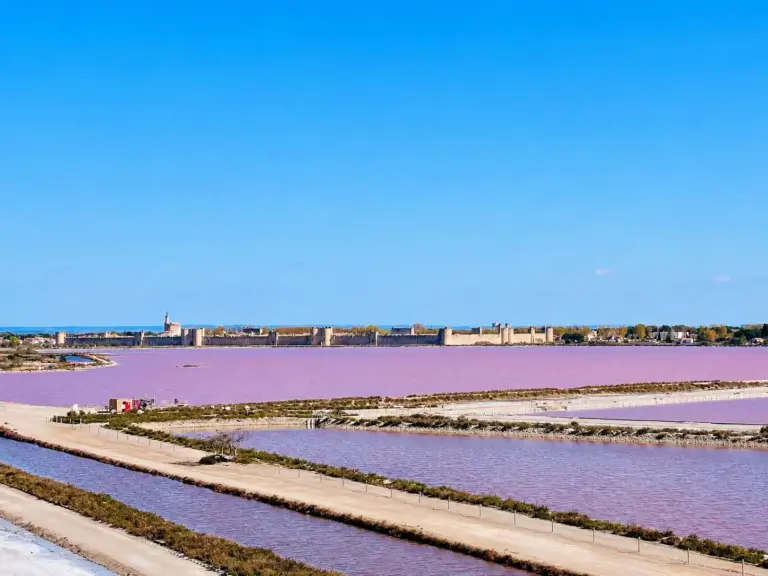
The phenomenon that has made these salt pans famous around the world is their pink colour, which transforms the evaporation ponds into shades ranging from candy pink to deep red. The cause is a microorganism: a microscopic alga called Dunaliella salina. To protect itself from intense sunlight in such a highly saline environment, this alga produces large quantities of beta-carotene —the same pigment that makes carrots orange— and it is these pigments that give the water such a surreal colour.
The phenomenon becomes particularly intense in summer and early autumn. In March, for example, the colour is already visible, but not all the ponds have reached the same level of salinity, so some remain blue. In August, however, the pink colour appears everywhere, and this is also when you may be able to watch the salt harvest, still carried out by hand today by a small team of producers.
Inside the site, you will find a small exhibition room dedicated to the work of the saunier, the salt worker. Here, you can discover the tools used over the centuries, the development of production techniques and all the work required to obtain Camargue salt. Part of the visit is also dedicated to harvesting the precious fleur de sel, which is still collected by hand from the surface of the ponds, following knowledge passed down from one generation to the next.
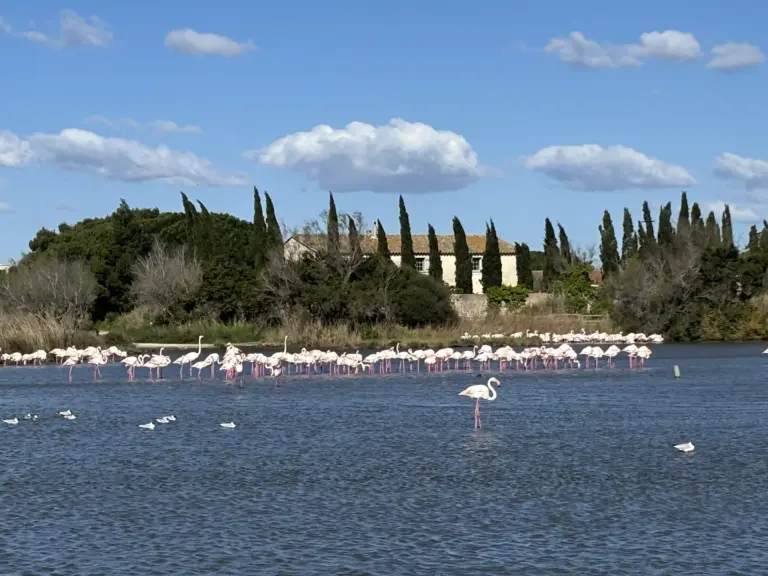
The salt pans are also a genuine paradise for bird lovers, as they are home to more than 200 species. And, of course, the main attraction is the pink flamingo, which finds its favourite food here: a tiny crustacean with the scientific name Artemia salina, which is extremely rich in beta-carotene.
Flamingos feed on large quantities of these crustaceans by filtering the water through their distinctive beaks. The pigment gradually accumulates in their growing feathers, giving them the pink colour that has made them iconic around the world. Without this small crustacean in their diet, flamingos would simply lose their characteristic colouring.
The salt pans offer several different ways to visit, suitable for every kind of traveller. Whether you enjoy slow walks, prefer exploring on two wheels or would rather join a guided tour, there is an option for you. The route crosses the vast pink ponds, follows the canals and stops at the foot of the impressive camelles —the salt mountains— which you can also climb for a spectacular panoramic view over the entire site and the fortified town in the distance.
Here are the different ways to visit the salt pans —there really is something for everyone:
- Tourist train — Petit Train du Salin d’Aigues-Mortes: Tickets can be purchased online or directly on site and cost around €14 for adults and €10 for children. My advice is to book online whenever possible, so you do not risk finding it fully booked. The visit lasts around 1 hour and 15 minutes and departs practically from the salt pans’ car park. During the journey, a guide explains the history of the site, the work of the sauniers and the area’s biodiversity —the only drawback is that the commentary is exclusively in French. If, like us, you do not speak fluent French, you will have to rely on the recorded guide, which unfortunately is not particularly detailed.
- By bicycle: This is a very convenient option. There are marked routes of different lengths —4, 12 and 30 kilometres— suitable for every fitness level, with clearly signposted paths that require at least 2 hours.
- On foot: One of my favourite options. There is a marked 4-kilometre walking trail that allows you to explore the ponds, wildlife and plant life at your own pace. Naturally, it takes a little longer: allow around 3 hours. The route is also accessible with pushchairs and tricycles.
- Guided tour, by bicycle or on foot: These routes and activities are mainly designed for adults and children aged 10 and over, considering their length and the amount of information provided. Booking online is strongly recommended, especially in high season —and if you choose the cycling option, book well in advance: places are snapped up incredibly quickly.
If you would like to learn more about the salt pans, take a look at my dedicated article. There, I explore their history in greater detail and also share some practical information for planning your visit.

The Tour Carbonnière
The tower is located in the municipality of Saint-Laurent-d’Aigouze, along the D46. There is a small free car park next to it, and access is free throughout the year. From Aigues-Mortes, you can also reach it on foot or by bicycle by following a section of the ViaRhôna —a flat, protected cycle path running alongside the Canal du Rhône à Sète. The route is approximately 4.5 kilometres each way and is also suitable for families. The final section follows a raised walkway through the water and reed beds, an experience that alone makes the detour worthwhile. Alternatively, if you prefer not to organise the visit independently, you will find many guided tours on platforms such as GetYourGuide or Civitatis. A walking trail on wooden boardwalks has also been created around the tower, leading into the marshes and accessible to people with reduced mobility —although it should be noted that the interior of the tower can still only be reached by stairs.
The Tour Carbonnière is an isolated medieval tower standing among the marshes of the Petite Camargue, around 4.5 kilometres north of Aigues-Mortes. Today, it may seem almost forgotten within the landscape, but during the Middle Ages its position was anything but marginal: it controlled the only overland road leading to the fortified town through the marshes.
It was built at the end of the 13th century, during the same period as the walls of Aigues-Mortes. The road once passed directly through the tower, beneath a gateway protected by a portcullis, arrow slits and other defensive systems. Anyone arriving from the north had to pass through it, so it served both as a military checkpoint and as a place where a toll was collected.
In practice, the Tour Carbonnière functioned as a kind of outer gateway to Aigues-Mortes. It controlled access to the town before travellers even reached the walls and protected the road, which had been built across bridges and embankments in an area that was far more difficult to cross than it is today. During the Wars of Religion, Catholics and Protestants fought over the tower several times, precisely because whoever controlled it also controlled one of the main routes into the town.
Today, after centuries of battles, sieges and transformations, it has once again become a place of peace and simple beauty. Walking along the wooden boardwalks surrounding it, watching the sunset over the reed beds and glimpsing the rooftops of Aigues-Mortes in the distance is perhaps the perfect way to end a day devoted to a place where history has never truly disappeared.

Boat trips
To truly understand the landscape of the Camargue, one of the most fascinating perspectives comes from allowing yourself to be carried slowly across the water. Several boat trips —bateaux promenade— depart from the port of Aigues-Mortes and travel along the Canal du Rhône à Sète, passing reed beds, marshes and flat landscapes stretching as far as the eye can see.
During the cruise, you will leave the fortified town behind as the scenery gradually gives way to a landscape shaped by both water and human activity. Some routes take you close to the manades, the traditional livestock farms of the Camargue, offering a closer look at the world of the region’s white horses and bulls raised in semi-wild conditions.
The simplest trips generally last between 1 hour and 30 minutes and 2 hours and 30 minutes, but there are also cruises with lunch on board and evening trips devoted to Camargue traditions. Boats depart from the section of the canal that forms a kind of basin, almost directly opposite the Constance Tower. This is also where you will find the distinctive railway swing bridge crossed by the train —a view that is worth a photograph in itself.
Booking is recommended, especially during the summer months, and it is worth checking times and routes in advance, as they may vary throughout the season.
From Aigues-Mortes, you can choose between several boats: the Isles de Stel and Constance barges, operated by the Compagnie des Bateaux d’Aigues-Mortes, or the Bateau Iris, another option for exploring the canals of the Camargue.
A boat trip does not replace a visit to the salt pans or the walls, but it offers a slower, quieter perspective, closer to the authentic Camargue and less like a postcard.

Le Grau-du-Roi
If you have time and would like to experience the maritime soul of the Camargue, Le Grau-du-Roi, just a few kilometres from the medieval walls of Aigues-Mortes, is absolutely worth a visit. This is where the canals of the Camargue finally meet the Mediterranean: an old fishing village that grew around the canal connecting Aigues-Mortes to the sea.
Founded in the 16th century as a fishing settlement, it is now the only coastal town in the Gard department. It has a picturesque harbour, where fishing boats return at around 17:00 and bring the quays to life, as well as a distinctive swing bridge that opens to let boats pass.
The heart of the town stretches along both sides of the maritime canal. Here, you can walk among fishing boats, small restaurants, low-rise houses and bridges that open as vessels pass through. The atmosphere is much livelier and more seaside-oriented than in Aigues-Mortes, and the connection with fishing and the sea is tangible.
Le Grau-du-Roi can be explored in just a few hours and is perfect for a late-afternoon walk, perhaps continuing as far as the seafront. It is also a departure point for catamaran excursions and sea trips, which are different from the river cruises leaving from Aigues-Mortes.
Among the various options available from here, you will find:
- L’Escapade de Camargue, which travels along the canals towards the Petite Camargue and may include Aigues-Mortes in its itinerary, despite departing from Le Grau-du-Roi;
- Catamaran Picardie II, for sea excursions;
- Bianco Sport Nautic, mainly for boat trips and rentals, with or without a licence.
I always take a look at GetYourGuide for inspiration and to find activities that may also be available at discounted prices.
From Aigues-Mortes, Le Grau-du-Roi is easy to reach by car, train or bicycle. The two towns are connected by a flat cycle path of around 6 kilometres, which takes approximately 40 minutes to complete. The train remains a convenient option during the busiest periods, when finding parking near the coast can become a small nightmare.
The downside is that, over time, Le Grau-du-Roi has filled with buildings and beach resorts that make it feel a little too touristy —do not expect the understated charm of Aigues-Mortes. However, if you are looking for a few days by the sea, it is still an excellent option, not least because of the modern Port-Camargue district. With its 5,000 berths, it is one of the largest marinas in Europe and a major hub for services, shops and wellness centres.
One of the attractions you should not miss in Le Grau-du-Roi is undoubtedly the Seaquarium , a large aquarium where you can see sharks, seals and sea turtles, making it perfect for families travelling with children.
Also worth seeing are the two historic lighthouses that define the town’s skyline, including the famous Espiguette Lighthouse, surrounded by dunes.
If, like me, you love traditional markets, you will be spoilt for choice: Tuesdays, Thursdays and Saturdays in the town centre and Mondays, Wednesdays and Fridays in Le Boucanet.
They are the perfect opportunity to experience the authentic atmosphere of the town and taste local produce, from freshly landed fish to regional specialities.

The beaches
Le Grau-du-Roi is surrounded by beaches of extraordinary beauty, and my undisputed favourite is still Plage de l’Espiguette.
It is nothing like the typical beach in a tourist resort: before your eyes stretches an almost endless expanse of pale sand, dunes and vegetation shaped by the wind —a landscape that seems to belong to another continent.
The area includes around 10 kilometres of undeveloped coastline, with a dune system that reaches heights of 10–12 metres in some places. Espiguette forms part of the Grand Site de France de la Camargue gardoise and is protected because of its environmental importance and biodiversity. The south-eastern end of the beach is reserved for naturism.
From the car park, you will need to walk to reach the sea, crossing boardwalks and sandy paths —allow around 10–15 minutes, depending on where you park. It is essential to follow the marked routes and avoid crossing protected areas: the dunes are fragile environments that provide a habitat for numerous plant and animal species. Paradoxically, it is precisely this distance from the car park that creates the feeling of being somewhere still wild and almost untouched.
For this very reason, however, you need to bring everything you will need with you: water, food, a beach umbrella and perhaps even a trolley to carry your belongings from the car park —which is subject to a charge from April to September and free from October to March— down to the shore.
Espiguette is also a small paradise for sports enthusiasts: thanks to its constant winds, it is perfect for surfing, kitesurfing and windsurfing.
One final thing to know if you are travelling with family members with reduced mobility: Plage de l’Espiguette is not wheelchair accessible, because of the sandy terrain and the long walk required to reach the beach.
If you are looking for greater comfort and an accessible, equipped beach, there are other options: Boucanet Beach, which has been awarded the Handiplage label and provides suitable equipment and assistance for entering the water, and extends towards La Grande-Motte; or the two beaches near Port-Camargue, which are much better equipped and livelier.
At the tip of Espiguette stands its distinctive 19th-century lighthouse, which is still in operation and open to visitors. From its height of 27 metres, you can enjoy views over the sea, dunes, lagoons and surrounding wetlands. Reaching the top requires climbing 111 steps —not an insignificant number, but the view rewards every one of them.
The visit must be booked through the lighthouse’s official website and costs around €10.50 for adults. If you have time, it is definitely worth arranging in advance: this is not an attraction you can simply visit on the spur of the moment.

Spotting free-roaming horses and bulls
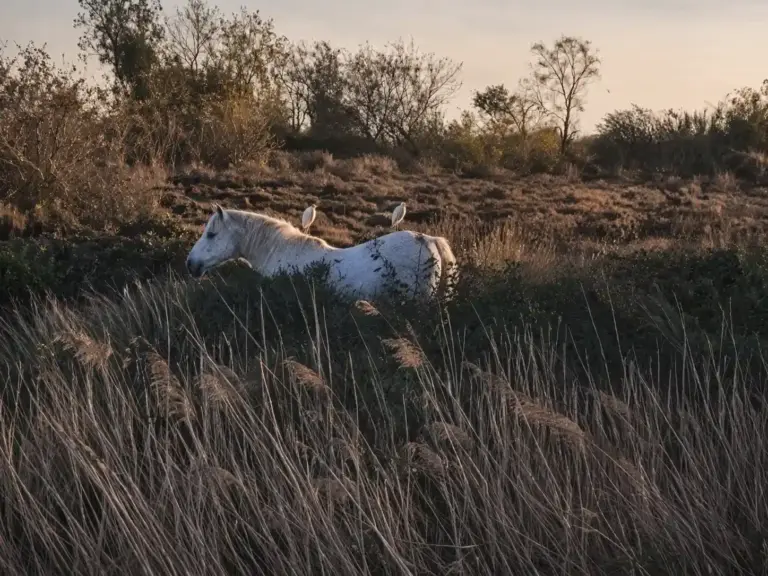
To see horses and bulls roaming freely, drive slowly along the D36B beside the Étang de Vaccarès, follow the roads between Saintes-Maries-de-la-Mer and Aigues-Mortes, or explore some of the quieter roads in the area. These are the places where you are most likely to encounter them, provided you are patient and take your time.
Horse rides and visits to local manades are enjoyable experiences that allow you to spend time close to these extraordinary animals. They can last from a couple of hours to an entire day, but bear in mind that the guides almost always speak only French and, in some cases, the atmosphere can feel rather touristy. I am not saying you should avoid them —it is always wonderful to experience these animals up close— but do not expect something completely wild.
There are still some excellent options close to Aigues-Mortes:
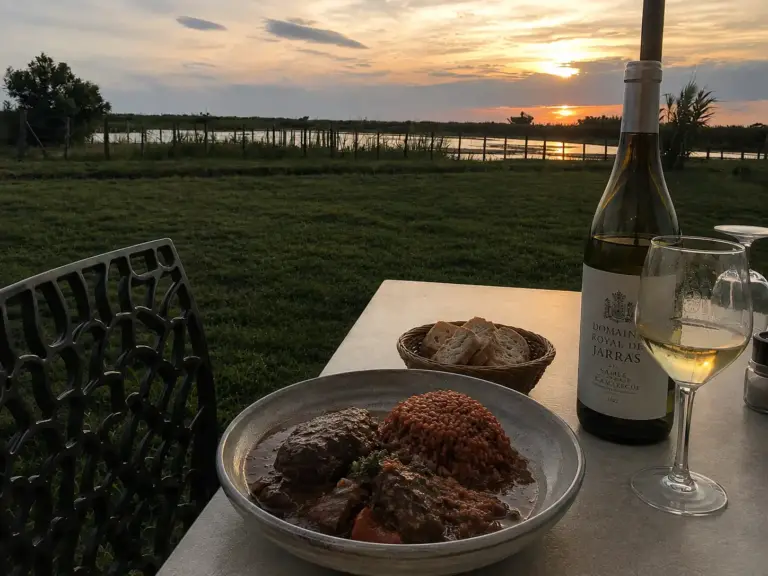
- The Domaine Royal de Jarras combines a visit to the manade with the discovery of its vineyard. A small train first takes you through the vines, then into the manade to watch a demonstration of bull sorting, before ending in the historic cellars with a tasting of local wines —a perfect combination of Camargue tradition and wine culture.
- If, on the other hand, you dream of a slower and quieter experience, Camargue Découverte at the Manade des Chanoines organises horse-drawn carriage safaris, pulled by powerful draught horses, across a private estate covering more than one thousand hectares. The experience includes a gastronomic break with Aigues-Mortes fougasse and local sand-grown rosé wine.
- For those looking for a more sociable and festive atmosphere, many manades organise complete Camargue evenings, with equestrian shows, livestock-sorting demonstrations, gypsy music and dinners based on local products. At Mas de la Comtesse, for example, you can take part in an evening that begins with a short boat cruise from Aigues-Mortes, followed by demonstrations of the gardians’ work and games in the arena, before ending with a generous meal of bull gardiane, mussels cooked à la brasucade, Camargue rice and fougasse, all accompanied by live music.
Personally, I prefer the options around Saintes-Maries-de-la-Mer. As always, I checked GetYourGuide in advance and found an option with a small discount, but in general, take a look at these experiences: they are all wonderful!

Saintes-Maries-de-la-Mer and the Camargue Regional Nature Park
Aigues-Mortes is an unmissable stop on any trip to the Camargue, but technically it forms part of the area known as the Petite Camargue. If you truly want to discover the wild, natural side for which this region is famous around the world, you should continue as far as Saintes-Maries-de-la-Mer.
Even if you are staying in the Petite Camargue —whether in Aigues-Mortes or Le Grau-du-Roi— I recommend devoting at least one day to the rest of the region to visit:
Camargue Regional Nature Park: the true heart of the Camargue lies in its landscape. Beyond the incredible variety of scenery, this is where you can genuinely enjoy close contact with nature in different ways: cycling between ponds and manades, driving along whichever roads inspire you most in search of new views, or exploring on horseback. In short, this is where you can truly appreciate the region’s wildest soul. Visit our Camargue section to discover everything this park represents.
Saintes-Maries-de-la-Mer: it is very small, and the centre can be explored quickly among its white houses, the famous Église Notre-Dame-de-la-Mer, the climb to the church’s rooftop terrace and a walk along the beach. To plan your visit more easily, you will find itineraries, excursions and practical advice in our complete guide to Saintes-Maries-de-la-Mer.
Parc Ornithologique du Pont de Gau: just 30 minutes by car from Aigues-Mortes, along the road towards Arles, lies one of the most precious natural treasures in the entire Camargue. Sixty hectares of marshes, ponds and reed beds where hundreds of bird species live in their natural habitat, with pink flamingos as the undisputed stars of the scene. For all the practical details you need to plan your visit —opening times, prices, routes and the best advice for making sure you do not miss a single flamingo— you will find everything in the article dedicated to the park.

Events not to miss
Attending one of the traditional festivals in Aigues-Mortes means stepping back in time and immersing yourself in the most authentic soul of this unique town. Two unmissable events mark the year, offering completely different but equally exciting experiences.
Fête de la Saint-Louis — late August: a journey back to the Middle Ages
If you dream of seeing Aigues-Mortes return to its medieval splendour, you should visit during the Fête de la Saint-Louis, held every year on the last weekend of August.
For a few days, the town founded by Louis IX in the 13th century is transformed into an authentic medieval village. Its cobbled streets fill with jugglers, men-at-arms, ladies in costume and knights, creating the atmosphere of a major historical festival that involves the entire town.
The highlight is the spectacular re-enactment of Saint Louis’s departure for the Seventh Crusade in 1248. Hundreds of participants dressed in period costume parade through the streets, recreating the emotion of that historic moment with horses, banners and scenes of everyday medieval life.
- A traditional medieval market winds its way along the walls and through the squares, where artisans and merchants display local products, weapons, clothing and works of art inspired by the Middle Ages.
- The entire town becomes a stage: you will find musicians, fire-eaters, falconers, jugglers and acrobats bringing every corner to life with continuous performances for adults and children alike.
- One of the most atmospheric moments is the night-time parade, when torches illuminate the walls and costumes, creating a magical and timeless atmosphere.
- The festival also has a profound religious meaning, with celebrations in honour of Saint Louis, the holy king who chose this place to give France access to the Mediterranean.
It is an experience that enchants both adults and children: a complete immersion in history that turns the visit into an unforgettable memory.
Fête Votive — October: the heartbeat of Camargue tradition
While the August festival looks back to the medieval past, the Fête Votive, generally held during the first half of October, celebrates the present and the most authentic traditions of the Camargue. This is when the town comes together around its bullfighting culture in an explosion of life, colour and adrenaline.
Lasting several days, this festival is the true beating heart of the town: the local community gathers to honour its patron saints and celebrate its deep connection with the land, horses and bulls —the biòu.
The unmissable highlights include:
- The Abrivado: this is the most eagerly awaited and adrenaline-filled spectacle. A herd of bulls is “released” and driven at a gallop by riders —the gardians— through the streets of the town centre, from the arena to the place where they will later be gathered. The crowd lines the streets behind protective barriers, while the thunder of hooves echoes between the ancient walls: pure emotion and a direct, almost ancestral encounter with the power of nature.
- The Bandido: this is the complementary counterpart to the Abrivado. At the end of the events, the bulls are driven at a gallop back out of the town towards their herds —the manades— once again escorted by the gardians. It provides one final burst of adrenaline to bring the celebrations to a spectacular close.
- The Encierro: a gentler and more participatory version, in which both younger and older participants try running in front of the bulls —generally heifers or young bulls— for short distances along enclosed routes. For many local teenagers, it is a genuine rite of passage.
- The Course Camarguaise: traditional Camargue bull races take place in the town’s arena, where highly skilled raseteurs challenge the bulls —known as cocardiers— and attempt to remove the rosette attached to their horns. It is a contest based on agility and courage, without bloodshed or violence. The bull is the true hero and is the one applauded by the crowd.
- Evening dances and peñas: in the evening, the town comes alive with concerts, dancing and peñas —musical groups— performing in the streets and squares, creating an authentic and engaging atmosphere of popular celebration.
The Fête Votive is not a festival created for tourists, but a local celebration in which visitors are warmly invited to take part. It is an opportunity to experience the authenticity of Camargue culture first-hand, shaped by pride, tradition and a deep respect for the animal that symbolises this land.

What and where to eat in Aigues-Mortes
The cuisine of Aigues-Mortes is a delicious meeting of land —the Camargue— and sea —the Mediterranean— and you can taste it in every dish. As in the rest of the region, the traditional specialities include:
- Gardianne de taureau — Camargue bull stew, made with AOP-certified meat, marinated and slowly cooked in red wine with garrigue herbs. It is traditionally served with Camargue IGP rice.
- Tellines — tiny shellfish typical of sandy beaches, sautéed with garlic, parsley and olive oil. They are traditionally eaten with your hands, almost like a small convivial ritual.
- Riz de Camargue IGP — locally grown rice from the nearby rice fields, available in white, red and black varieties. It is the perfect accompaniment to both meat and seafood dishes.
- Vins des Sables IGP — light, fresh wines produced on the sandy soils of the Petite Camargue. The rosés, in particular, are ideal with fish or as an aperitif.
- Sel de Camargue — salt from the local salt pans, sold under the La Baleine brand, which you will find almost everywhere, both in restaurants and in shops selling regional products.
There is also the Fougasse d’Aigues-Mortes —a local sweet made from soft dough flavoured with fleur d’oranger and often topped with sugar crystals. It is perfect for breakfast or as a sweet snack during the day.

The best restaurants in Aigues-Mortes
There’s one restaurant in Aigues-Mortes I’ve grown particularly fond of: Le Galion, right in the heart of the old town. It’s where I had my first meal with my parents during one of our trips to the Camargue — a lunch I still remember fondly, with its homey atmosphere and tables that feel more like family than tourism. I’ve been back several times since, and the last time, in March 2026, it was just as good as ever: both meat and fish done well, with that honest, no-nonsense quality that never lets you down. My tip is to order the midday menu: it costs very little and lets you try several dishes, with slightly smaller portions, sure, but perfect for getting a full taste of the local cuisine without breaking the bank. The only thing that’s never fully won me over is the desserts — but otherwise, Le Galion never disappoints.
That said, this is just one of my go-to spots in Aigues-Mortes. For the full list of restaurants I’ve tried — with atmosphere, and tips on what to order — you’ll find everything in our in-depth guide to Camargue cuisine, in particular in the section Where to eat in Aigues-Mortes.
Aigues-Mortes is mainly explored on foot, among cobbled streets, medieval walls and vast open spaces. If you also decide to visit the salt pans or the Tour Carbonnière, the sun, wind and distances involved can completely change the experience. Packing your backpack carefully really does make a difference.
- A good mosquito repellent is extremely useful, especially if you visit the salt pans, follow the trails outside the walls or stay until sunset. Aigues-Mortes is surrounded by canals, ponds and wetlands, so it is always best to carry an effective product with you. I use this one. Lightweight long-sleeved tops can also be useful in summer.
- Bring a windbreaker even during the warmer months. The Mistral can rise suddenly and is particularly noticeable along the walkway on the walls, beside the canals and in the salt pans, where the landscape is completely open. A comfortable jacket that is easy to pack into your backpack is all you need, such as this one. I own it myself and find it incredibly convenient. In winter or during the shoulder seasons, a hat and gloves can also be useful.
- To get a better view of the flamingos and other birds living in the salt pans and wetlands around the town, bring a pair of binoculars like these, which are small but extremely useful. The animals are often far from the accessible paths and, without binoculars, you may barely be able to make them out.
- There is no shortage of cafés, bakeries and restaurants in the centre of Aigues-Mortes, but the situation changes as soon as you leave the fortified town. If you plan to spend several hours in the salt pans, reach the Tour Carbonnière or explore the surrounding area by bicycle, always carry a small supply of snacks. You will also find a picnic area near the entrance to the salt pans, which is convenient for a break before or after your visit.
- You will walk a great deal, especially if you decide to complete the entire walkway along the walls and visit the towers. A comfortable pair of shoes that you have already worn in is therefore essential. In the historic centre, you will encounter cobblestones and uneven paving, while the salt pans and cycle routes mainly consist of dirt tracks, gravel and dust. Avoid shoes with overly smooth soles and unstable sandals.
- A reusable water bottle is an excellent companion, especially if you visit the salt pans or walk along the walls during the middle of the day, when there is almost no shade. I bought a collapsible silicone bottle from Natura, although I often see that it is sold out. In any case, you can find a similar one here, which is practical because it takes up very little space when empty.
- The sun is one of the main features of Aigues-Mortes at any time of year. A hat, sunglasses and a good sunscreen are essential, particularly on the walls and in the salt pans, where reflections from the water and salt make the light even more intense. The wind can also dry out your skin and lips, so a nourishing moisturiser and lip balm may also be useful. I always carry this sunscreen with me: it is small but extremely effective.
- Small items such as a power bank may seem like minor details, but they make the day much easier, especially if you use your phone for navigation to reach the salt pans or the Tour Carbonnière and want to photograph the walls, the pink ponds and the animals. I received this one as a gift and have been very happy with it. There are thousands of different models available, but regardless of which one you choose, I strongly recommend bringing one.
You do not need much else. In Aigues-Mortes, it is not about having everything, but about having the right things to move effortlessly from the medieval streets to the open landscapes of the Camargue.
Aigues-Mortes is an essential stop on any trip to the Camargue. This fortress of kings, with its imposing walls, orderly streets and extraordinary backdrop of pink salt pans, will leave you with unforgettable emotions and memories.
As you will have realised from reading this guide, there is far more here than first meets the eye: history, legends, nature and traditions that are still very much alive.
But Aigues-Mortes, as we have said, is only the gateway to the Petite Camargue. If you have time —and I strongly recommend making time— do not stop here. The wildest side of the Camargue, shaped by lagoons, flamingos and free-roaming white horses, lies a little further east, towards Saintes-Maries-de-la-Mer. This is where you will find the region’s most authentic and least touristy soul, between the Parc Ornithologique du Pont de Gau and the manades scattered across the landscape.
Whether you choose to spend two days or two weeks in this land suspended between water and salt, one thing is certain: the Camargue deserves time, patience and a willingness to lose yourself a little, far from the main roads. And if you would like to know where to get lost —or rather, how to do it properly— you will find everything in our complete guide to the spectacular Camargue.