The Alhambra: the Pearl of Andalusia
Before taking you on a journey to discover the Alhambra, I need to make a confession: I am completely, madly and hopelessly in love with it.
The first time I saw it, I was in Andalusia on a short trip with my sister, and I had to seriously fight the temptation to spend the entire stay simply admiring the Alhambra — from every possible angle, at every hour of the day, letting the light tell its own story.
For me, it was the most beautiful human creation I had ever seen: romantic, sensual, almost unreal.
Perhaps because of the stories I had read before arriving, perhaps because of its colors, or because of the Sierra Nevada in the background, but the Alhambra is, to me, an extraordinary spectacle that truly makes you fall in love.
So I will try to be as objective as possible in telling you about it… but I can’t promise anything!
Please remember: to visit the Alhambra, make sure you book well in advance on the official website. The Alhambra is visited by millions of people every year, and tickets often need to be reserved months in advance, especially in spring, autumn, and during the peak holiday seasons.
And there’s something else to keep in mind: the Alhambra takes time. This is not a visit to squeeze in between other activities. Ideally, you should dedicate at least three hours to it (even more if you enjoy stopping, observing, and taking photos). The most important ticket is the one that includes the Nasrid Palaces: without it, you would miss the emotional and artistic heart of the entire complex. When booking, you will be assigned a specific time slot to enter the palaces: it is strictly enforced, and you will not be allowed in either before or after. Plan the rest of your visit around this time.
A bit of history about the Alhambra
To truly understand the Alhambra, it is essential to immerse ourselves in one of the most fascinating chapters of Spanish history: Al-Andalus.
The Alhambra as we recognize it today was born from the evolution of Al-Andalus and stands as one of its most profound legacies.
If you are familiar with the history of Andalusia, or if you have read my article about Andalusia, you will know that the Moors arrived in Spain in the 8th century and unified most of the Iberian Peninsula under a single great realm: Al-Andalus.
For centuries, this political and cultural reality profoundly transformed Spain — and especially Andalusia — turning it into one of the most advanced and sophisticated centers of Western Europe.
The Moors brought with them new agricultural and irrigation techniques, refined architecture, surprisingly modern hygiene systems, and a new way of thinking about the city, space, and daily life.
With the gradual advance of the Christian kingdoms from the north, Al-Andalus slowly began to shrink. This was not a sudden collapse, but a process that unfolded over centuries, marked by military defeats, temporary treaties, fragile alliances, and continuous territorial retreats.
City after city, Muslims were forced to withdraw further south, losing control of major historical capitals such as Toledo, Córdoba, and Seville.
And yet, what remained from the 13th century onward was far from insignificant.
In 1238, Muhammad I ibn Nasr founded the Nasrid Kingdom of Granada: a small state, surrounded by powerful enemies, yet remarkably resilient.
Granada thus became the last stronghold of Al-Andalus — a political capital, but also a refuge for artists, craftsmen, scholars, and families fleeing from cities conquered by Christian forces. With them came knowledge, architectural styles, traditions, and practical skills accumulated over centuries of Muslim presence on the Iberian Peninsula.
It was within this context that the Alhambra was born: built to defend the new Nasrid kingdom and to demonstrate its greatness. To ensure security, Muhammad I chose to establish his residence on the hill, on the remains of an earlier 11th-century fortress. From there, the Alhambra overlooked the city, the fertile Vega, and every possible access route.
It was not conceived as an aesthetic whim, but as a fortified city atop the hill — a place that concentrated power, daily life, defenses, storage areas, baths, and streets. A space meant to be self-sufficient, elegant, and impregnable.
A perfect contradiction — and precisely for that reason, an unforgettable one.
As you can imagine, 800 years ago, when the Alhambra was built, there were no advanced machines like the ones we have today. In an unstable political context and on a complex hillside site, sourcing materials and labor for such a monumental construction was anything but easy.
The solution was ingenious in its simplicity. Nasrid architects adopted an extremely effective technique: the walls were built using compacted earth and clay, excavated directly from the hill near the Alhambra site. This made it unnecessary to transport stone over long distances or rely on large lifting equipment.
The same logic was applied throughout the entire complex. The columns were often made of white marble from :contentReference[oaicite:0]{index=0} (in today’s province of :contentReference[oaicite:1]{index=1}, then part of the Emirate of Granada). The walls were built from rammed earth and lime; the decorations, with the exception of the columns, were made of plaster and small mud mixtures. Even the wood came from Nasrid territory, mainly from pine forests in the Cazorla mountains and the wooded areas surrounding :contentReference[oaicite:2]{index=2}.
Everything was sourced and processed locally — a form of zero-kilometer architecture. Simple materials, yet perfectly suited to Granada’s climate, with its cold winters and extremely hot summers.
While much of Europe at the time relied on worked stone, often imported from far away at high cost and with very long construction times, the ingenuity of Nasrid architects made it possible to create buildings that were quick to build, affordable, and climatically intelligent, often completed in just two or three years.
After all, in an era when a sultan’s reign could be short and uncertain, every ruler wanted to live to see his own works completed. And the Alhambra, in this too, is the result of clear-headed, practical, and surprisingly modern choices.
The Alhambra, as we see it today, is the result of about 250 years of history, from 1238 to 1492. During this period, around twenty sultans of the Nasrid dynasty succeeded one another, and each of them left a mark — small or great — on this city suspended between power and beauty.
After all, the Alhambra was never conceived as a “finished” work.
Like many cities and palaces in the Islamic world, it was designed as a living organism, constantly evolving, meant to be expanded, refined, and reinterpreted by each ruler, according to his own vision and his own way of exercising power.
Not all sultans, however, had the same impact.
It was six or seven key figures who truly transformed the Alhambra into what still makes us fall in love with it today.
The first was Muhammad I ibn Nasr, the founder.
He was the one who built the Alcazaba, the military citadel, and established his residence there. This was where he ruled and lived, in a space that was still strongly defensive in nature. Although many structures are no longer easy to interpret, the towers and some areas connected to the court and the sultan’s daily life remain.
With Muhammad II and Muhammad III, the Alhambra ceased to be only a fortress and began to take shape as a true palace-city. Monumental gates were built, such as the Puerta del Vino, and the residential area was expanded. Some palaces from this period no longer exist or were later transformed: one example is the palace of Muhammad III, which after the Reconquista became the Convent of San Francisco.
The reign of Yusuf I marked a decisive turning point.
He restructured a pre-existing building to create the Mexuar, the space for justice and administration, and commissioned the Palacio de Comares, the political heart of the Alhambra. The Patio de los Arrayanes, the Sala de la Barca, and the Tower of Comares with its majestic throne room were created. Here, power became representation, order, and symbol.
Then came Muhammad V, and with him the absolute peak of Nasrid art.
He was the sultan who built the Palacio de los Leones, giving life to masterpieces such as the Patio de los Leones, the Sala de las Dos Hermanas, and the Sala de los Abencerrajes. Under his rule, the Alhambra reached its highest artistic level. If the Alhambra still enchants the world today, much of the credit belongs to him.
At the same time, Ismail I and his successors devoted increasing attention to the Generalife. They improved the gardens, perfected the water channels, and built pavilions for rest and leisure. The Alhambra was no longer only a place of government and defense: it also became a space for contemplation, silence, and pleasure.
Over the decades, as sultans succeeded one another, the city continued to grow and become denser. Orchards and buildings appeared even outside the walls; inside, existing palaces were expanded, connected, and transformed. Each ruler adapted the Alhambra to the needs of his own time, leaving a legacy that the next would reinterpret.
By the end of the 14th century, the Alhambra had taken on a form very similar to the one we know today. It is estimated that between one and two thousand people lived within its walls: not only sultans and courtiers, but also soldiers, artisans, officials, and families. A living city, complex, fragile, and magnificent.
External pressure increased dramatically in the second half of the 15th century, when the marriage between Isabella of Castile and Ferdinand of Aragon made the Reconquista finally coordinated and unstoppable. At that point, the fate of the Kingdom of Granada was sealed.
On January 2, 1492, Granada surrendered.
That day, Isabella of Castile entered the city on horseback, holding a cross, as she had done in every other conquest. On that same day, the flag of the new Catholic kingdom was raised on the Tower of La Vela at the Alhambra, definitively marking the end of an era.
Meanwhile, the center of gravity of the new empire was shifting toward the Atlantic and the Americas. Trade with the New World reshaped Spain’s political and economic priorities, pushing Granada into an increasingly marginal position, while Seville became the great commercial hub of the empire.
The Napoleonic era also left visible scars.
Napoleon’s troops turned the Alhambra into a military headquarters and, upon their retreat, blew up parts of the complex. The wounds from those explosions are still visible today — permanent scars on one of the city’s most precious symbols.
Few people know this, but if today we can still admire the Alhambra, we also owe it to the courage and quick thinking of José García.
When Napoleon’s French troops abandoned Granada at the beginning of the 19th century, they left behind a series of explosive charges, intending to blow up the Alhambra during their retreat. Some parts of the complex were indeed damaged, but a total disaster was avoided.
According to historical accounts, it was José García — then the military commander of the area — who identified and defused the remaining active explosives, preventing the entire citadel from being destroyed. A silent, swift, almost invisible act, yet a decisive one.
It is one of those moments when history changes because of the actions of a single person. Without him, the Alhambra we know today — its palaces, towers, courtyards, and gardens — would probably no longer exist.
Walking among these walls, it is impossible not to think about how fragile beauty can be. And how, sometimes, it takes just one person to save it.
Another particularly dark chapter was that of the Francoist era.
Granada was one of the places most severely affected by the regime’s repression, with arrests, executions, and systematic persecution. The Alhambra was used as a prison or as a place of execution. Among the most emblematic victims was Federico García Lorca, who more than anyone else was able to capture the deep, fragile, and passionate soul of Andalusia.
You will notice that this intense history can be felt throughout the entire Alhambra complex. The Alhambra is a living city, one that speaks to us and tells its own story… so all that remains is to begin our tour in silence and listen.

Enhance your visit with the audio guide
Discover stories, details and insights while you explore. The full experience is just 2€ away.
Download the audio guideThe Alhambra
Although the Alhambra is often associated with a palace, when we speak of the Alhambra we are actually referring to a true fortified city, built on the hill overlooking Granada.
A city that combines military superiority and aesthetic refinement, without ever separating the two. If you have already been to Málaga, you will immediately recognize the concept of the Alcazaba, here taken even further and on a much larger scale.
The name Alhambra comes from the Arabic al-Ḥamrā’, meaning “the red.” Probably not only because of the color of its walls at sunset, but also because of the nickname of Muhammad I, its founder, known as al-Ahmar, “the Red,” due to his reddish beard. This theory is very likely, as it was common in Arab culture to name a palace or a city after its creator.
At the beginning, the Alhambra of Muhammad I almost entirely coincided with the Alcazaba, the military citadel. It was a fortress, with towers, walls, and defensive spaces. But within it there was also a medina, a real city inhabited by artisans, soldiers, officials, and families.
Over time, the walls were extended for more than two kilometers. Houses, places of worship, baths, warehouses, and gardens were added. The Alhambra ceased to be just a fortress and became a royal city, complete in all its functions.
Today many of those buildings no longer exist, but while walking through the Alhambra it is still possible to read the voids, the foundations, and the paths. It is a city that must be imagined as much as it must be seen.
Higher up on the hill, outside the urban walls, stood the Generalife, connected to the Alhambra by a route protected by walls. It was not a political palace, but a leisure residence: a kind of refuge to escape the pressures of court life and rediscover silence, greenery, and water. A place to breathe.
To help you find your way during the visit, the Alhambra provides audio guides and maps (although it must be said that the audio guides are not always available or fully functional).
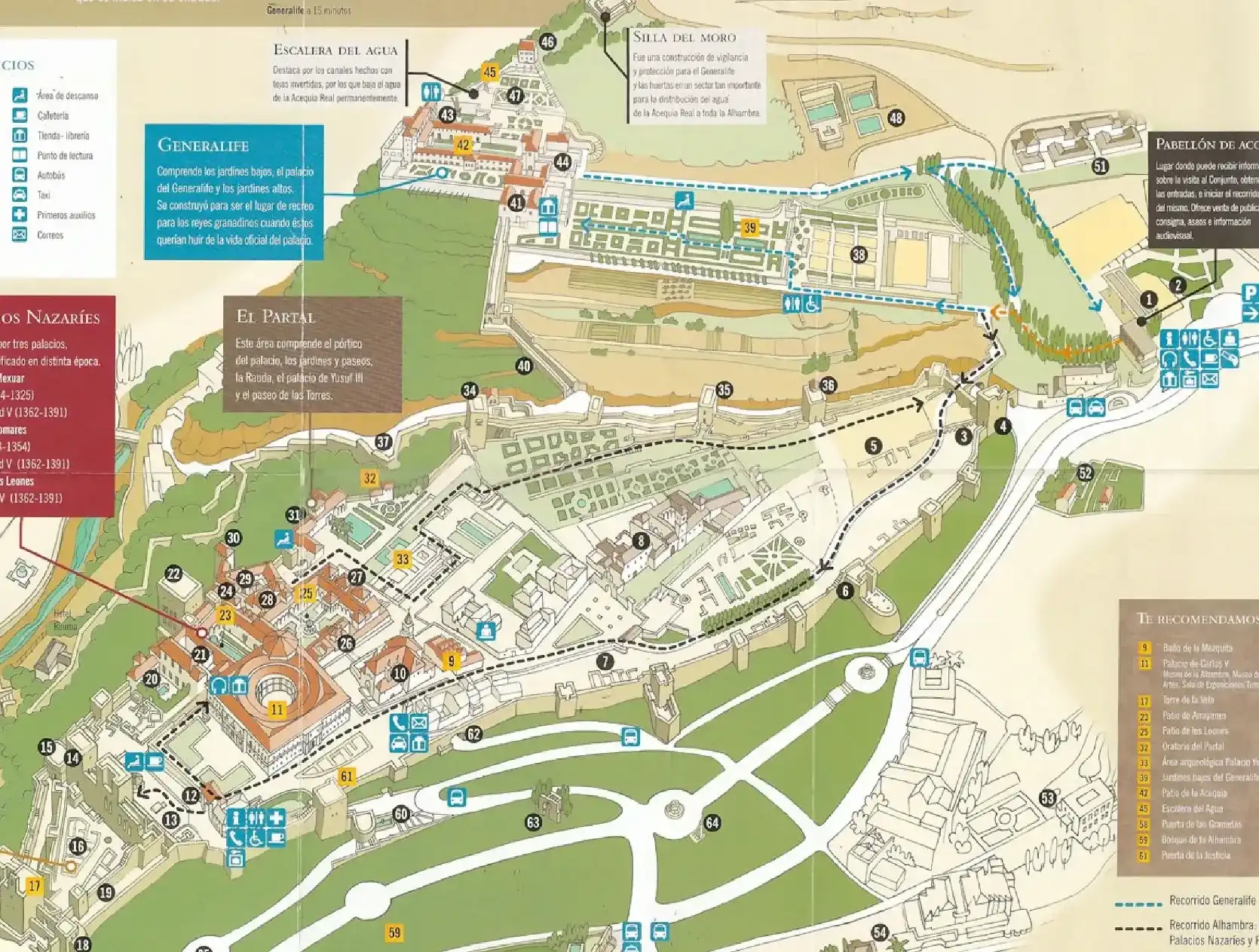
Online I found a really well-made map, clear and intuitive, which I will use as a reference to guide you through the various points of the route.
By clicking on each point on the map, you will be taken to the corresponding paragraph, or you can simply follow the itinerary I have built for you step by step.
Whichever path you choose, there is only one thing that truly matters: let yourself be enchanted by the magic of the Alhambra, because after visiting it, no other place will ever seem as beautiful as before.
A tip that truly changes the experience: if you can, reach the Alhambra on foot from the center of Granada, walking uphill from Plaza Nueva to the Gate of Justice. This is the historic route taken by travelers, ambassadors, and officials: you’ll pass through towers, walls, and control gates, gradually entering the logic of the fortified city.
If you prefer a more convenient access, you can arrive by car or take the C32 bus to the parking area on the hill. In this guide I’ll follow this route, but you can easily reverse it if you enter through the Gate of Justice.
Entrance to the Alhambra
As mentioned earlier, I have planned our tour starting from the hilltop entrance, assuming that you will reach the Alhambra by car or coach.
Once you pass the entrance and the ticket checkpoints (1), you will find yourself in front of a paved path that immediately opens into a fork.
Turning left, you will enter the heart of the citadel; going straight ahead, instead, you will reach the gardens of the Generalife.
We begin our journey through the Alhambra by turning left.
We will walk over what was once one of the channels of the aqueduct, suspended above a ravine. Through these channels, water was directed and brought into the fortified city, and today they allow us to reach the Tower of Water (4), one of the most important points in the entire water system of the city.
This was not a true entrance gate to the city. The Tower of Water controlled the access of water into the enclosure and was the starting point of a complex network of diversions and branches that supplied all the cisterns of the citadel. Even today, as you move closer to the center of the Alhambra, you will notice the channels (3), the acequias, built of brick: some are open-air, others covered with roof tiles. You will see that water is never a secondary detail in the Alhambra.
Continuing along this path, before reaching the controversial Palace of Charles V — yes, I admit it, for me it is decidedly out of context — on the right you will come across the remains of the medina (5). This is what remains of the area that once hosted daily life in the Alhambra: low houses, workshops, inns, people at work, a small city within the city. Much has been lost, but pause for a moment and try to imagine it alive, noisy, industrious.
After passing the tree-lined avenue and the turnstiles, still on the right, you will find the Convent of San Francisco (8). Originally, it was an important palace commissioned by Muhammad III; after the Reconquista it was transformed by the Catholic Monarchs into a convent, and today it is a Parador, with a truly remarkable patio. If you can, ask at the reception desk: they will gladly point out where you can admire what remains of the Nasrid decorations. You can also eat and stay here. It is a unique experience!
Continuing along this street, called Calle Real, you will find yourself surrounded by tourist shops. They may be annoying at first glance, I understand that, but many occupy ancient palaces and preserve surprising ceilings and decorations. Step into whichever one inspires you most: sometimes all it takes is to look up to receive the first, unexpected gift for the eyes.
On the opposite side of the path, on the right, you will encounter the baths of the mosque, today the Church of Santa María de la Alhambra. These were not “luxury” baths like those of the royal palaces, but functional structures dedicated to ritual purification before prayer, a necessary condition for entering the sacred space.
The baths and the church (9–10) are theoretically visitable, but access is not always guaranteed: they often open only at specific times or on the occasion of religious services. So do not be surprised if you find them closed. To give you an idea… after four visits to the Alhambra, I still have not managed to get inside.
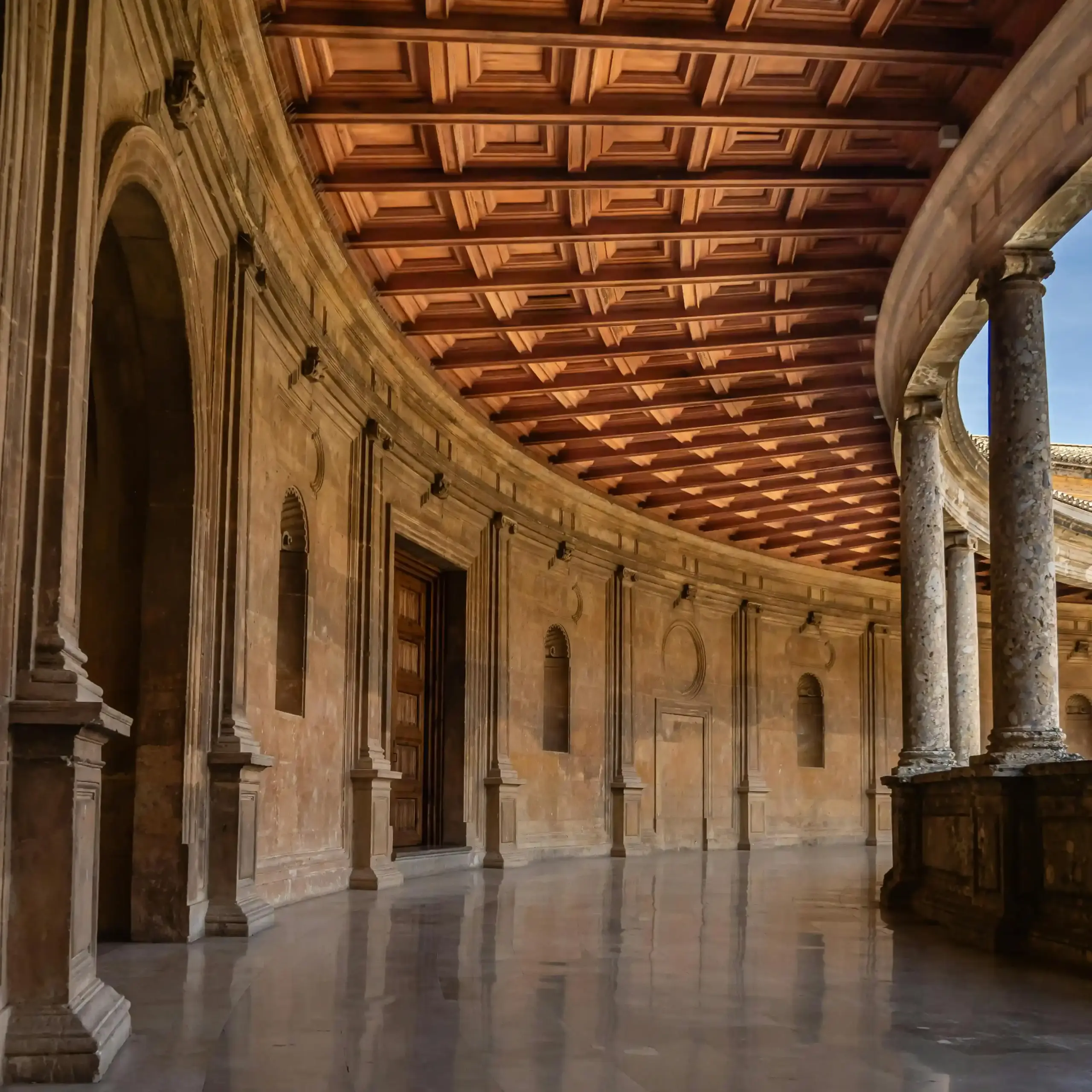
We thus arrive at the Palace of Charles V (11).
I admit it: at first glance it has always seemed to me… out of place, to put it politely. Perhaps this is a somewhat harsh — and maybe even unfair — judgment, but you can tell me if you did not have the same impression.
In 1527, Charles V, Holy Roman Emperor, ordered the construction of what is still today the most imposing Catholic presence within the citadel: a huge Renaissance palace, attached without hesitation to the Nasrid palaces.
The building has a square plan measuring 63 meters on each side, rises to a height of 17 meters, and encloses within it a circular courtyard 30 meters in diameter. A bold choice, revolutionary for its time, and without precedent in Spain.
Its architecture is rigorous, symmetrical, almost severe: pure Renaissance, made of mathematical proportions, rationality, and monumentality.
The contrast with the Alhambra is so stark that, at first sight, it might seem like an act of defiance, if not even an affront to Nasrid refinement. And yet, the reality is completely different.
Charles V deeply loved the Alhambra. He was fascinated by those palaces, to the point of spending six months there on his honeymoon and imagining Granada as a future imperial residence. His palace was therefore not born out of contempt, but from the desire to leave his own mark amid all that beauty.
Unlike the Nasrid palaces, built with light and decorative materials, the Palace of Charles V is entirely made of worked stone, puddinga — a stone formed from pebbles and earth that compacted over time, creating this “pebbled” effect. A choice that made construction slow, complex, and extremely expensive, as was often the case in Renaissance architecture.
The paradox? Neither Charles V nor his son ever lived there. And in 1637, more than a century after construction began, work was abandoned. The building remained unfinished, without a roof, for centuries.
Today, however, this space has found a new life.
Inside the palace are two museums, both with free admission, even without the full Alhambra ticket:
- Alhambra Museum
An archaeological and educational museum, small but incredibly dense. It is clearly organized and tells the story of the Alhambra from the inside: ceramics, stucco work, Arabic inscriptions, objects from everyday Nasrid life, as well as panels explaining the hydraulic system, construction techniques, and the urban organization of the citadel. My advice is to visit it before the Nasrid Palaces: it will help you read them with different eyes. - Granada Fine Arts Museum
Here you move into a different era: painting and sculpture from the 15th to the 20th century, post-Reconquista religious art, and works connected to the history of Granada and Andalusia. A good way to understand what happened after Al-Andalus, when the cultural center of gravity shifted.
A place that divides, clashes, and surprises. But this too is part of the Alhambra: layers of history that coexist, even when they look nothing alike.
Leaving the Palace of Charles V, you will find yourself facing a symbolic crossroads: straight ahead lies the entrance to the Alcazaba, while to your right is the entrance to the Nasrid Palaces.
My advice is to start with the Alcazaba. This is where the Alhambra was born, and it is from here that you can truly understand how this fortified city gradually transformed into one of the most extraordinary complexes in Europe.
Enhance your visit with the audio guide
Discover stories, details and insights while you explore. The full experience is just 2€ away.
Download the audio guideThe Alcazaba
The visit to the Alcazaba naturally begins at the Puerta del Vino (12), one of the best preserved and most richly decorated gates in the entire Alhambra complex.
Originally, it separated the residential area from the military zone of the Alhambra, marking a clear boundary between power and defense.
On the façade, Arabic inscriptions are still visible, now somewhat worn, dedicated to Allah, to His greatness, and to the victories achieved by the Nasrid dynasty in His name. As you pass through the gate, you will notice side niches: these were the spots where the guards would sit to rest, talk, or wait during the rare moments of calm.
The name “Gate of Wine” may seem strange, especially if we think of the symbolic names typical of Islamic gates, such as Gate of Justice or Gate of Forgiveness. And it is precisely here that several hypotheses emerge.
According to some historians, the name derives from a mistranslation that occurred after the Reconquista: the original Arabic Bāb al-Ḥamrā’ (“Red Gate”) may have been reinterpreted by phonetic similarity as “wine.”
According to another theory, instead, this gate was the point through which controlled goods entered, in particular wine destined for soldiers, servants, or non-Muslim communities. After the Christian conquest, wine was stored and taxed here. This version, however, is not widely supported by historians, especially because, although wine was not entirely forbidden in the Islamic world, it was excluded from official and religious spaces and tolerated only in military or popular contexts.
Walking along Calle Real, you will move alongside the ancient walls of the Alhambra. And here one thing becomes immediately clear: to defend this fortified city, the Nasrid builders did not limit themselves to bastions and gates. They created a true system of territorial control, made up of 29 towers placed at the most strategic points.
The towers played a key role because they stood on the highest parts of the hill, allowing them to survey the valley and the access routes. But above all, they were not “isolated” structures: they were designed to communicate with one another, like a chain of ever-watchful eyes.
To communicate, they used simple yet ingenious tools: mirrors to reflect light and smoke signals to transmit messages over long distances. From one tower to another, they could warn in real time of troop movements, suspicious approaches, or how best to prepare the defenses.
The most fascinating detail is that these towers were not part of the Alhambra alone. They formed the core of a vast communication system that extended across the entire kingdom: dozens of fortified towers in dominant positions, built within sight of one another, from cities to villages, from mountain peaks to the lowest valleys.
In this way, a sighting at the borders of the territory could travel from tower to tower and reach the Alhambra in a very short time. An ultra-efficient network that allowed the Nasrids to respond quickly to any threat, whether from the Christian kingdoms of the north or from other sultanates to the south.
Once past the gate, Plaza de los Aljibes (13), the cistern square, opens up before you.
Beneath your feet lies one of the most impressive engineering works of the Alhambra: a cistern holding 1,660 cubic meters of water, the equivalent of about 33 private swimming pools. It is so vast, with stairs, arches, and internal passageways, that — according to tradition — when Queen Isabella saw it, she exclaimed: “It’s like a cathedral!”
The system worked by exploiting the principle of the hydraulic ram: the pressure generated by the mass of water made it possible to push it through smaller channels, bringing it back up to the surface and distributing it throughout the citadel. An engineering calculation of extraordinary precision for its time.
Today the cistern cannot be visited for safety reasons, but in the center of the square you can still see the rectangular access opening — often used simply as a place to sit, without realizing what lies beneath.
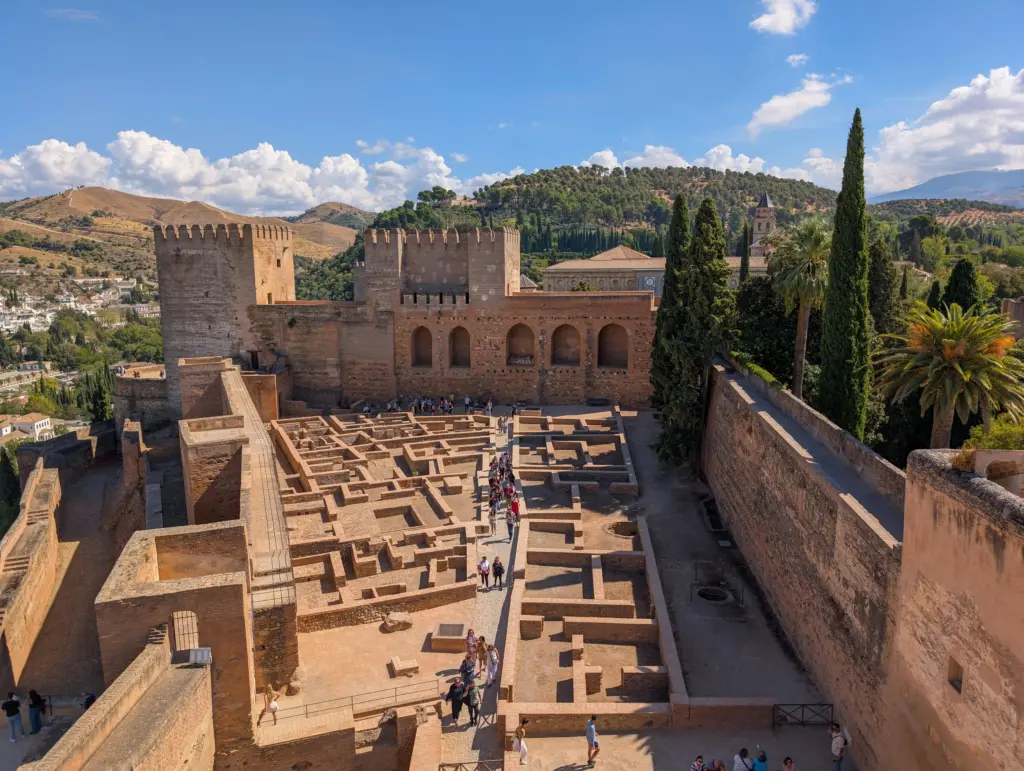
Crossing Plaza de los Aljibes and passing the first line of walls, you enter Plaza de Armas (16), the true military heart of the Alhambra.
Imagine it as a small city within the city: warehouses, weapon workshops, soldiers’ quarters, public baths at the foot of the Tower of La Vela, and even a mosque.
Many structures are now reduced to ruins, but what is identified as the Barrio Castrense was the district where the military lived, alone or with their families. The dwellings were tiny: small courtyards with a single walled room that served as kitchen, storage space, and bedroom during the winter months.
Sanitary facilities were located outside the houses — simple openings in the ground connected to the outgoing water system, designed to maintain hygiene and remove odors. The courtyards opened onto shared communal spaces, where people worked, talked, and accessed water basins.
The streets were extremely narrow, true alleyways, designed to ensure rapid movement and easy access to surveillance points.
Looking up, you will notice the walls and towers, each with a precise function.
The medina is separated from the rest of the complex by the Torre Quebrada, built in tapial (rammed earth), a traditional construction technique using compacted earth, often reinforced with embedded stones (piedra empotrada). Beneath its arches, the white stones once used as ammunition are still visible.
The tower that immediately draws the eye, however, is the Torre de la Vela (17).
It was the main lookout point, with a 360-degree view over Granada, the Albaicín, the Sacromonte, and the surrounding valley. From here, the entire network of towers across the kingdom was monitored, communicating with one another through smoke and light signals.
The name Torre de la Vela comes from a vela, meaning a candle-beacon that was lit to signal the presence of the fortress to the surrounding Sierra.
Today, Spanish flags fly in its place, and a bell stands there, installed after the Christian conquest. That very bell is still rung every January 2, the anniversary of the fall of Granada, commemorating the day when, instead of the candle, the banner of the Catholic Monarchs was raised, symbolically marking the end of an era.
To the right of the Torre de la Vela, halfway across Plaza de Armas, stands the Torre de las Armas.
It was part of the original defensive structure and served as the main entrance to the citadel in the 13th century. From here, every entry and exit from the city was monitored. Its name derives from its function: anyone entering the Alhambra had to deposit their weapons, a necessary condition for accessing the inner spaces. It was therefore a tower used mainly by the inhabitants of the citadel rather than by external visitors. Even today, the simple yet carefully executed decorations of the Nasrid military style are visible; according to historians, the tower was also adorned with banners and flags, clearly visible from afar, signaling authority and the presence of power.
To the left, instead, stands the Torre de la Pólvora, more massive and almost devoid of openings, which housed the gunpowder. It was designed to limit humidity and airflow and to contain the risk of explosions, and it was easily accessible from the other towers so that gunpowder could be supplied when needed.
In the early decades of the Alhambra, when the Nasrid Palaces did not yet exist, the sultan and his court lived here, within the Alcazaba. For this reason, the Torre del Homenaje (14) is one of the most important structures in the entire complex. In addition to being the place where soldiers took refuge before the final fall of Granada, its importance lies above all in the belief that it was the first royal residence of Muhammad I. The interior is arranged over five floors, one of which was richly decorated and reserved for the private quarters of the sultan.
Another noteworthy tower is the Torre de la Sultana, located directly opposite the Torre de las Armas. According to scholars, this space was used by the sultana and the women of the court as a kind of elevated garden: a protected place where they could be outdoors and enjoy views over the Vega of Granada, away from the strictly military areas of the citadel.
All the towers were connected by a wall-walk, the Aldarve, from which the garden below the Alcazaba (19) takes its name, created in a later period. Here you can notice a white marble fountain with three sea monsters and a small Christian chapel added after the conquest.
Grooves are still visible along the parapets: in the 19th century they held flower pots, later removed for stability reasons.
From here, with your gaze sweeping over Granada, it becomes impossible not to understand one thing: the Alhambra was born as a fortress. Everything else came later.
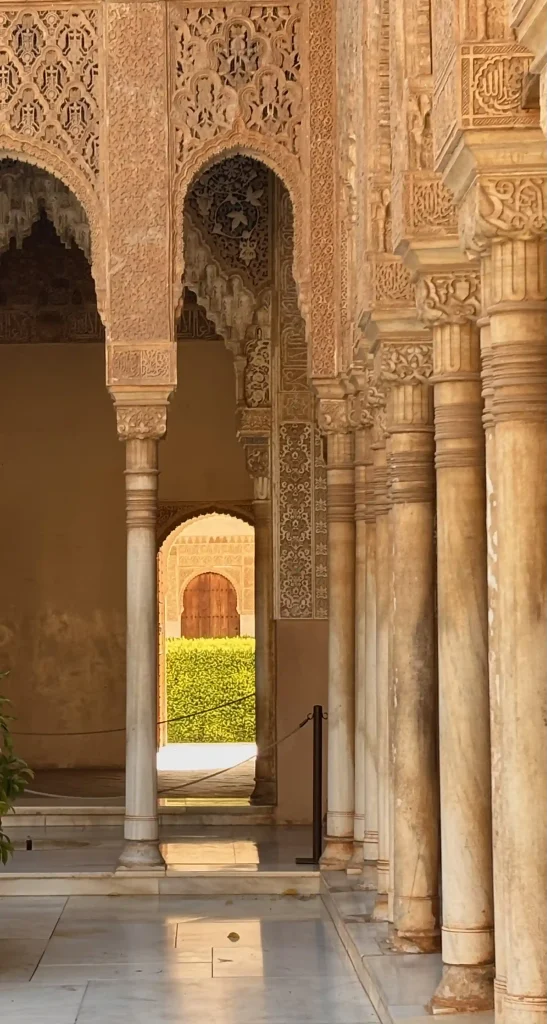
The Nasrid Palaces
To access this part of the Alhambra, you must purchase the full ticket, the one that includes the Nasrid Palaces — without a doubt the most emotionally powerful part of the entire citadel. At the time of booking, you will be assigned a specific entry time: entry is not allowed before or after that time, so plan your entire visit around this fixed constraint. At the entrance, you will be asked to show your ticket in digital format (QR code) along with an original ID document (identity card or passport). Punctuality here is not a suggestion, but a rule: no late entry is allowed for the Nasrid Palaces. With the “Alhambra General” ticket, you can freely visit the rest of the complex — the Alcazaba, the Generalife, and the Partal — throughout the day and during opening hours, but access to the Nasrid Palaces remains strictly tied to the assigned time. To truly enjoy them, allow at least 60–90 minutes for this section alone, depending on crowd levels and your pace. And while you are waiting in line, take a look at the patios on the left: they are no longer accessible today, but they once formed the true entrance to the palaces. Seeing them before entering already helps you slow down and change your rhythm.
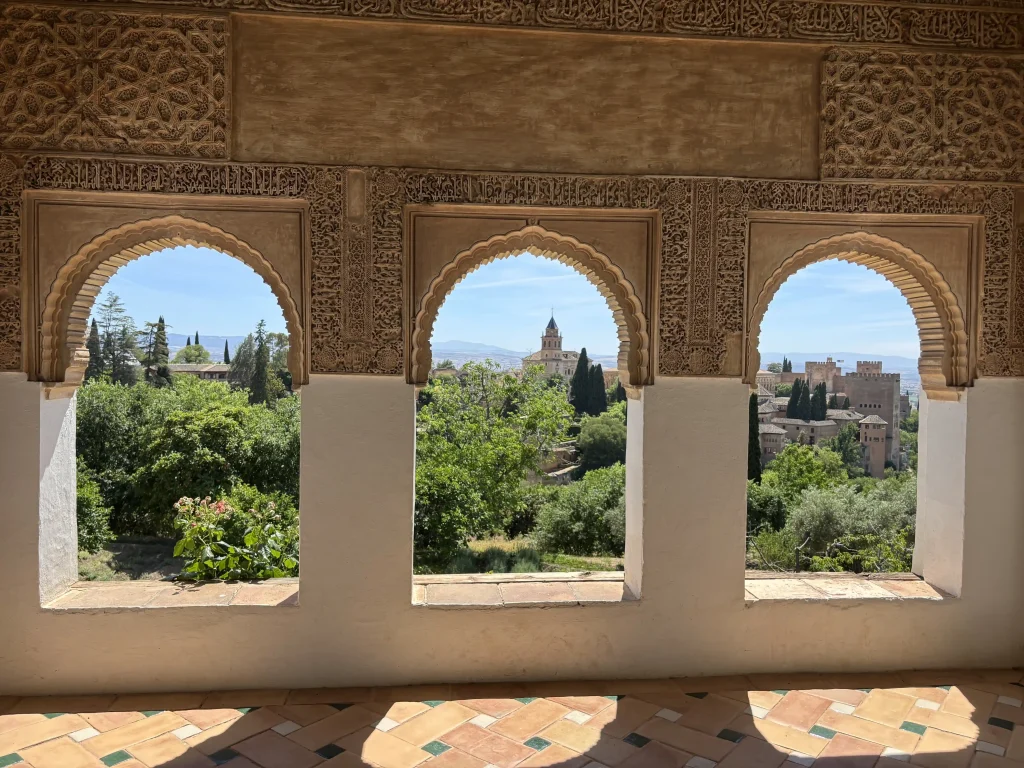
The Nasrid Palaces are one of the most important and famous architectural complexes of the Alhambra (20–30 on the map), considered the pinnacle of Islamic art and architecture in Western Europe. These spectacular palaces have dazzled visitors for centuries.
Everything was decorated, from bottom to top, according to a precise logic:
- the floors were covered with precious textiles, ceramics, and majolica;
- the walls were clad with polychrome decorative panels;
- higher up, plaster, wood, and muqarnas — the famous “stalactites” — transformed ceilings and domes into true carved skies.
Everywhere you will notice geometric forms, floral motifs (inspired by the Islamic idea of paradise), and Qur’anic inscriptions. The most recurring one appears dozens of times: “There is no victor except Allah,” the motto of the Nasrid dynasty.
Today we see them in the pale tones of plaster, but originally the palaces were an explosion of color: reds, blues, greens, and gold. Light filtered in through lattice screens and stained glass, creating shifting reflections that changed throughout the day depending on the sunlight.
It must have been something absolutely spectacular, almost hypnotic, capable of lifting the visitor’s mind away from earthly life and elevating it toward a more spiritual and refined dimension.
The complex of the Nasrid Palaces was not created at a single moment, but grew through successive modifications and additions, following the evolution of the Alhambra and the dynasty that ruled it. Each sultan added to, expanded, and transformed what he had inherited, while maintaining a remarkable sense of harmony.
The visit unfolds through three main palaces, built or modified by different sultans, yet conceived as a progressive journey of power, sacredness, and beauty:
- Mexuar
It is the first space you encounter. The semi-public area, where the sultan administered justice and state affairs. Here, power is still accessible, regulated, and controlled. - Palace of Comares
The official residence of the ruler and the political heart of the kingdom. Around the famous Patio de los Arrayanes (Court of the Myrtles), embassies and distinguished guests were received. Here, the architectural language becomes more solemn. - Palace of the Lions
The most intimate palace, what we might describe as the harem: the sultan’s private apartments, accessible only to family members and servants. Here, art reaches its peak, and space becomes light, refined, almost unreal.
Each of these sections is designed to make you perceive a gradual increase in sacredness and authority, guiding you step by step toward the most secret heart of Nasrid power.
It is not just a visit: it is an experience crafted with extreme awareness.
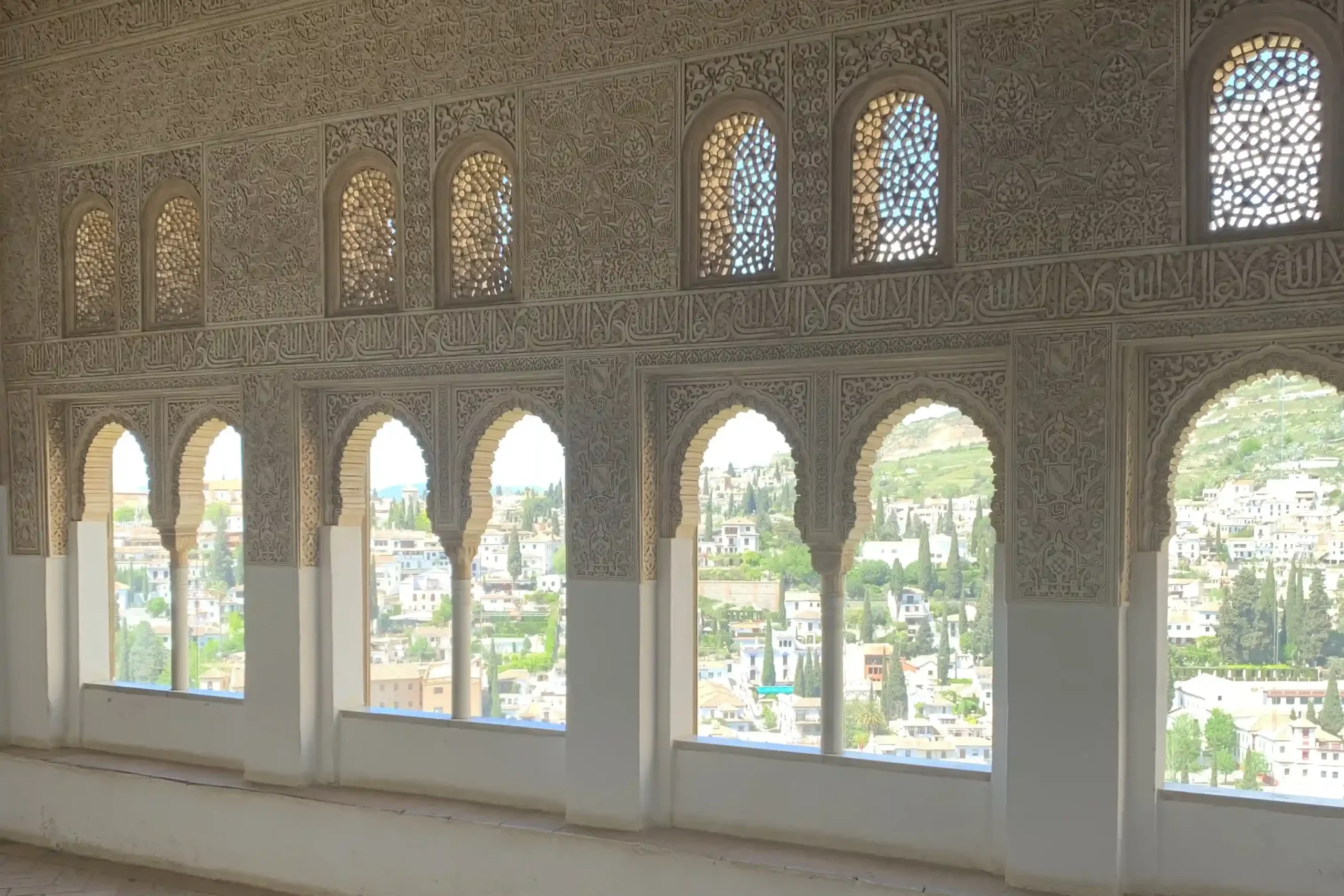
Mexuar: the “public” palace of power
The Mexuar is, in practice, the threshold between the outside world and the heart of Nasrid power. It is not a “palace” in the romantic sense: it is the administrative sector where the sultan managed audiences, petitions, decisions, and (in certain periods) trials and sentences in consultation with the highest members of the “government.” Even the etymology points directly there: Mexuar derives from an Arabic term linked to the idea of a “place of council / consultation.”
One thing that is often not imagined is that the “public” did not necessarily enter the main hall. It is very likely that people remained in the adjacent courtyards (the Patios de Machuca), visible while you wait for your turn to enter. Once their moment arrived, they accessed the space through the side doors (still visible today); requests were collected and put into writing by officials, and then brought to the sultan, who was in the Sala del Mexuar. In this way, power remained “reachable,” but never exposed.
As you enter, it is immediately clear that the hall underwent several transformations over time.
The four central columns, for example, originally supported an elevated structure designed to filter the light and illuminate the space. On the left, just after the entrance, you can notice the remains of a room that probably housed the guards, responsible for maintaining order and security during meetings.
Do not expect the splendor we will soon discover elsewhere. The Mexuar was not meant to impress the visitor; rather, its purpose was to create an environment of sobriety and careful deliberation. What dominates above all are the Arabic inscriptions, dedicated to Allah and His greatness.
On one hand, they reaffirm the primacy of God; on the other, they underline that the sultan rules by divine will, not by mere earthly force.
A detail often overlooked is the acoustics. The hall is designed so that sound spreads evenly, allowing everyone to hear clearly even a speech delivered in a low voice. The words of power did not need to be shouted.
After the Christian conquest, the main hall was converted into a chapel. The original access toward the courtyards, on the left, was closed, and new structures were added, many of which were later removed during modern restorations.
Despite this, the floor, the balustrade, and the ceramics are still largely original.
From an artistic point of view, the true jewel of the Mexuar lies at the back: a small oratory, one of the many prayer niches scattered throughout the palaces, all strictly oriented toward Mecca.
It is deliberately small, because for the Nasrid elite prayer was an intimate act, not a public one. The miḥrāb is aligned with surprising precision for the time, achieved without a compass, but through astronomical calculations.
It is not accessible, but it is clearly visible from the entrance, from which a splendid view over the Albaicín also opens up.
This public sector of the palace concludes with the Cuarto Dorado, from which you can admire the Façade of Comares: the true scenic gateway to the royal palace.
The name “golden” is not poetic at all: many decorations were actually covered in gold, applied in extremely thin leaves over the stucco. It was a transitional space, but also a place of judgment. Anyone who reached this point knew they had been deemed worthy of approaching the heart of power.
The façade features two almost identical doors — symmetry is a key element of Nasrid art — but with different functions.
The one on the right was a service passage, used by servants to avoid crossing paths with guests.
The one on the left, instead, was the official entrance to the Palacio de Comares.
And that is exactly where we will pass as well.
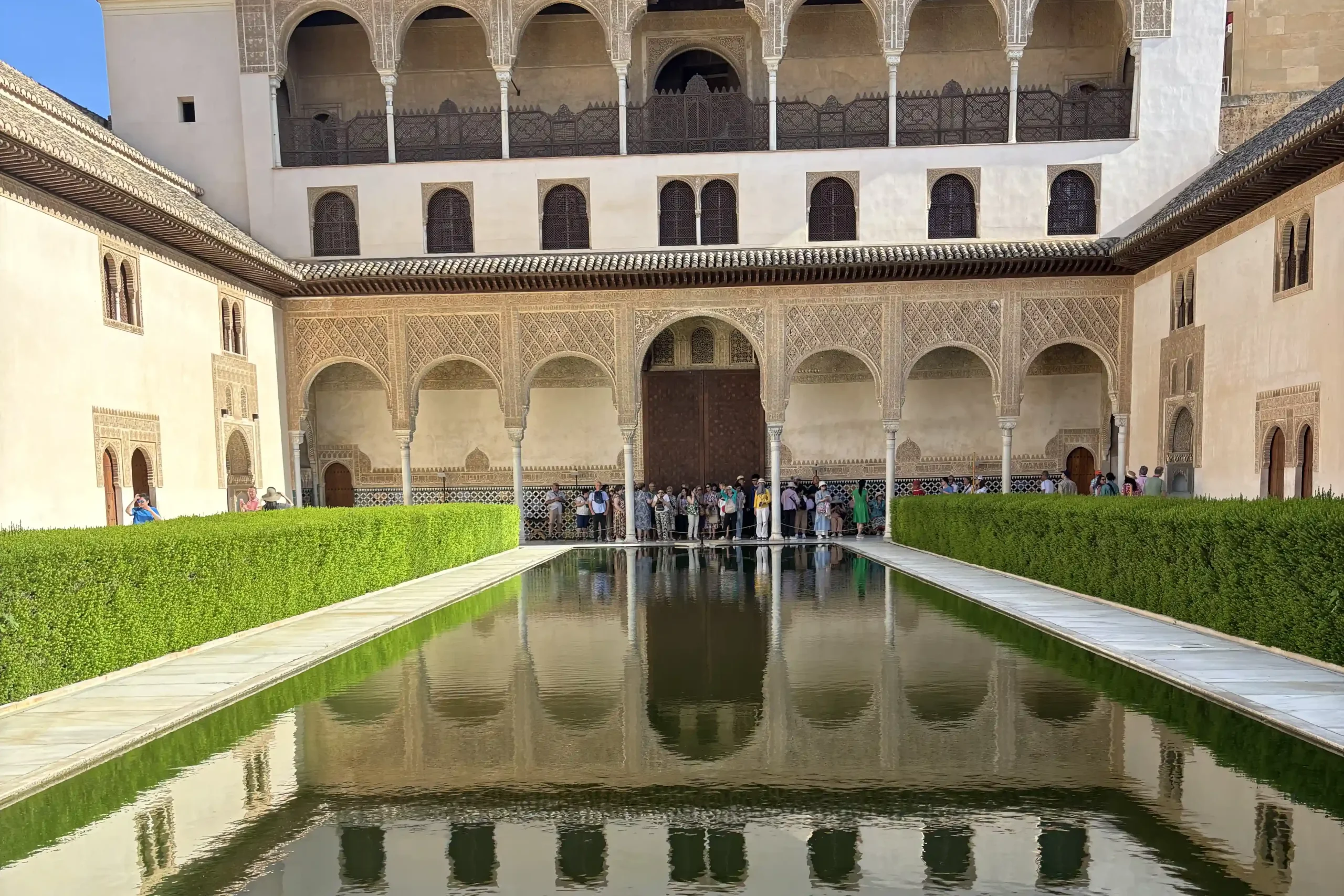
Palacio de Comares: the power of the sultan
The Palacio de Comares was not conceived as a “residential” space in the modern sense.
It is indeed an official residence, but above all a palace of representation. Here the sultan received ambassadors, dignitaries, Christian and Muslim envoys. It is the place where Granada presented itself to the world as a refined, legitimate, and stable state, even in moments when, politically, it was anything but solid.
Everything is designed as an emotional and symbolic journey, guiding those who enter through a precise sequence:
Waiting: Before accessing the palace proper, visitors had to wait for their turn, often under a portico. Waiting was not wasted time: it served to slow down, to prepare the spirit, to make it clear that access to power was not immediate.
Contemplation: From here one enters the Patio de los Arrayanes, the Court of the Myrtles. The myrtles are not a decorative choice: they are evergreen plants, symbols of continuity, stability, and the durability of the kingdom. At the center, the long water basin acts as a perfect mirror. Architecture is doubled, the Tower of Comares is reflected motionless on the surface. It is an image of absolute order, of total control. Everything is still, everything is under dominion.
If you want the perfect photo, stay low and let the reflection do the work.
The patio is also a functional space: side passages allow the circulation of courtiers and servants; the rooms overlooking it were intended for ambassadors and viziers. All close to power, but never inside its private space.
Above all, however, the patio guides you toward the Tower of Comares, named after the colored glass that once adorned its windows.
The tallest tower of the Alhambra rises above everything else and is recognizable from afar, exactly as the place that housed the sultan was meant to be.
Awe: Access to the tower passes through the Sala de la Barca, the antechamber to the throne room. According to the most widely accepted interpretation, the term Barca derives from baraka, meaning blessing.
This is where visitors psychologically prepared themselves for the meeting with the sultan.
The ceiling, deliberately lower, compresses the space and diminishes the sense of self. The celestial dome above one’s head serves to remind visitors that, even before standing before the ruler, they are standing before the works of God.
The inscriptions reinforce this message, repeating the motto of the Nasrid dynasty: “There is no victor except Allah,” a formula that recurs in almost all the rooms of the palaces, like a silent guiding thread.
The ceiling is decorated with eight-, ten-, and twelve-pointed stars, symbols of harmony and the greatness of the universe. The stars allude to divine beauty and spiritual guidance; a careful eye will also catch references to the sun and the moon, together with vegetal motifs evoking the Islamic paradise.
Originally, as in much of the Nasrid Palaces, the colors were intense and vibrant: red for majesty, gold for the divine, blue for the sky.
The result must have been extraordinary: the real sensation of standing beneath a starry sky, just before the revelation of absolute power.
Although already beautiful today, it is a simple and calming space.
Here you began to perceive the value of the Nasrid dynasty. But the moment when everything became clear — when you were left speechless (in silence) — was the throne room (Salón de Embajadores).
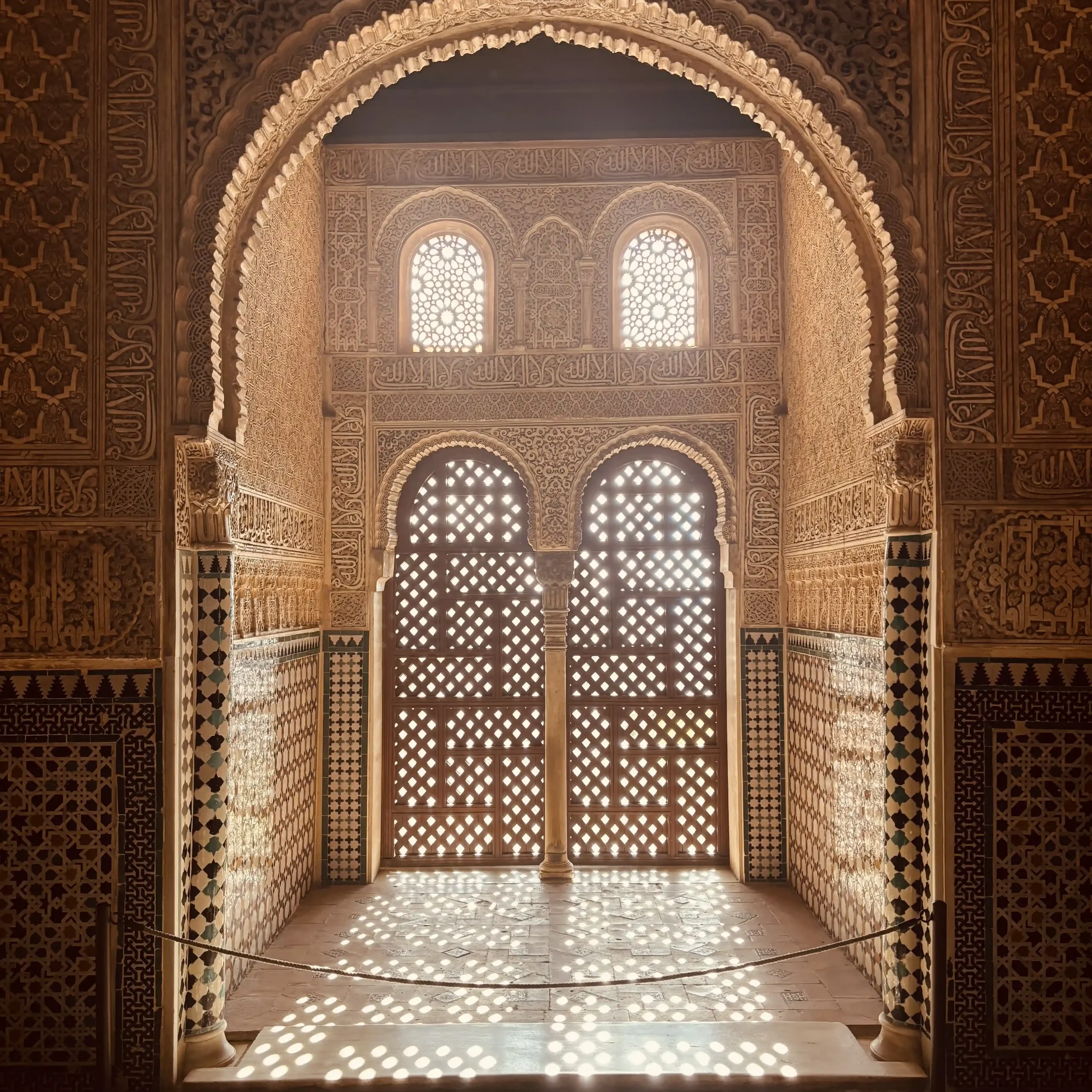
Silence: the Salón de Embajadores, the throne room, is the most majestic space in the entire palace. Its purpose is singular: to generate awe and silence. And it is here that Nasrid art surpasses every expectation.
The room is perfectly square. In medieval Islamic thought, the square represents stability, order, and justice: it is the shape of the earthly world, the foundation upon which the balance of the human universe rests.
The entrance is slightly off-center in relation to the axis of the room. When a visitor — you included — entered, they were forced to rotate their body, to orient themselves, before they could even direct their gaze toward the sultan.
This initial, subtle disorientation created a natural loss of confidence, once again reaffirming the superiority of the ruler.
The sultan, by contrast, is perfectly centered in relation to the wall and the dome, symbolizing the sultan as the sole stable point.
Now try to imagine a slightly raised platform, with the sultan seated on colored cushions, not on a monumental throne. The platform was positioned exactly beneath the center of the dome, not the room itself. Even today, on the floor, it is possible to identify the spot where it once stood.
This room is the ultimate example of the artistic mastery of its time.
Above, a spectacular cedar-wood ceiling dominates, representing the cosmos. It is composed of around 8,000 carved pieces, assembled to form a starry dome made of stars and geometric figures.
The concentric levels symbolize the seven heavens of the Qur’an, leading progressively toward God, represented by the largest central star: a celestial ascent toward divine wisdom.
The walls are entirely covered with calligraphic inscriptions, among which the most famous formula stands out: “Wa lā ghāliba illā Allāh” — There is no victor except God.
The floor was originally made of marble, but over time it was replaced with the one we see today.
Light, too, is an integral part of the message. The high windows filter it indirectly: the room is never fully illuminated. Faces are only partially visible. Those who enter see the sultan, but never see him completely. Light thus becomes an instrument of hierarchical distance.
At the same time, the windows open onto a magnificent view of Granada, while from the outside no one can glimpse what is happening inside, thanks to the lattice screens.
Another fundamental element is acoustics. Once again, the architects created a space in which, even when speaking in a very low voice from the center of the room, sound spreads perfectly to every point —
from the sultan to everyone present, clearly and unmistakably.
And it is precisely here, in this room, that the most delicate political and diplomatic relations took place — even with Christian envoys — the very relationships that allowed the Nasrid dynasty to continue to exist.
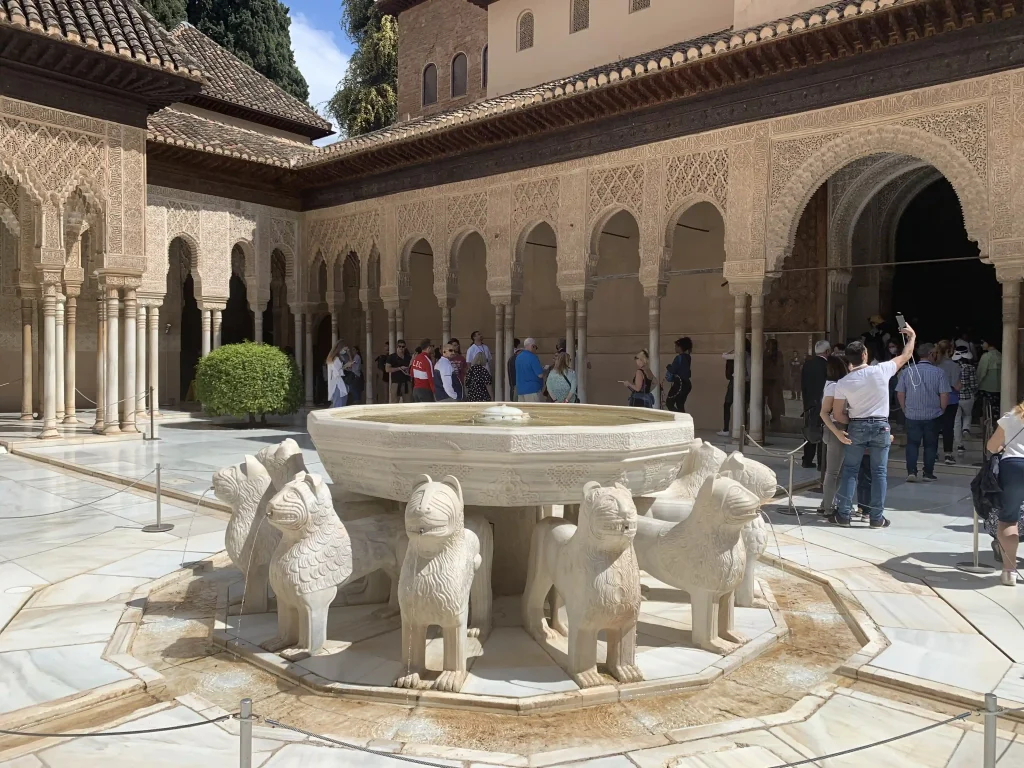
Palace of the Lions: the sultan’s intimacy
If Comares still belongs to the realm of political power, the Palace of the Lions instead represents the court in its most internal and private dimension: the harem.
It was built during the second reign of Muhammad V and is organized around its magnetic center: the Patio de los Leones.
Here, architecture changes tone. Everything becomes lighter, more intimate, more refined.
The patio incorporates a highly sophisticated hydraulic system made up of channels, small fountains, and basins. Four main channels converge toward the center, evoking the four rivers of Paradise mentioned in the Qur’an.
The number four speaks of cosmic order and the harmony of time. It appears repeatedly: the four seasons, the four cardinal points, the four natural elements.
At the center stands the Fountain of the Lions, a large basin supported by twelve marble lions, each different from the others. Their postures are calm yet alert, ready to defend their sultan.
The exact meaning of the twelve lions is not certain, but the number twelve recurs in many cultures: the months of the year, the signs of the zodiac, the tribes of Israel. It is thought, in fact, that the fountain was reused from, or inspired by, an existing fountain in a Jewish palace.
What is fascinating is that this fountain is not just sculpture: it is hydraulic engineering and theater at the same time. The water flows with a precise rhythm, maintains the correct level, cools the air, and produces a constant, relaxing sound. It also served to irrigate plants, shrubs, and aromatic herbs, transforming the patio into a true paradisiacal garden.
Engraved on the basin is a poem by Ibn Zamrak, praising the ruler and the symbolism of water as a manifestation of power. It is one of those moments when you realize that, in the Alhambra, architecture, poetry, and politics are one and the same.
In fact, the entire patio is covered with symbolic phrases. One of the most fascinating reads:
I am a garden adorned with beauty,
look closely and you will see my wonders.
Here, the walls speak in the first person. The palace is not just a space: it is a living being.
The Patio de los Leones also marks an important architectural turning point. The large, formal rectangular courtyard is abandoned in favor of a central space surrounded by an extremely light colonnade. Architecture becomes more delicate, almost suspended.
It is the palace of a cultured ruler, not only a powerful one.
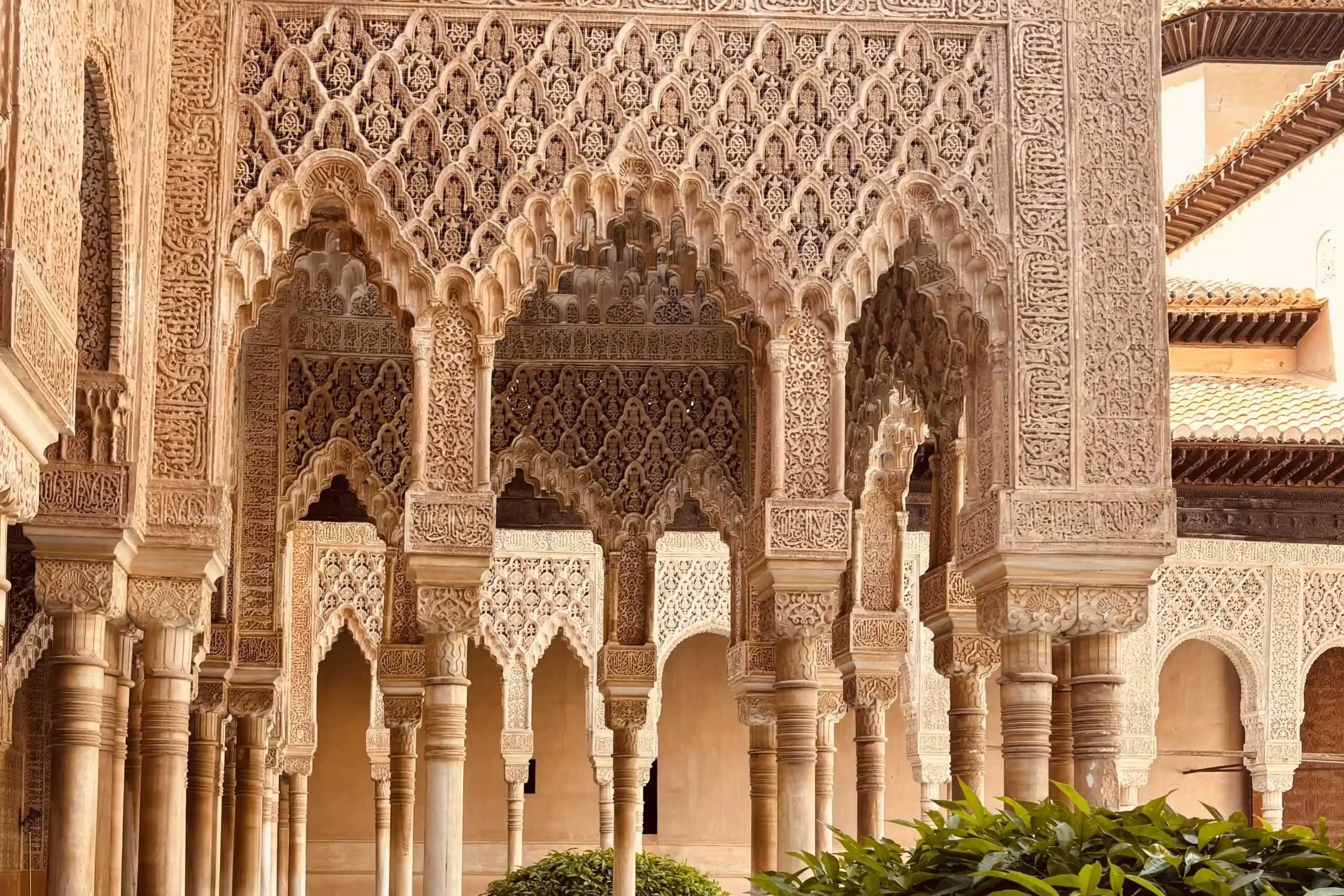
The columns, slender and numerous, recall a grove of palm trees, once again reinforcing the idea of a garden. They are made of white marble, a material that reflects light and makes the space extraordinarily bright, almost unreal.
Access takes place through the Sala de Mocárabes.
From here, the view opens onto the patio, with its side galleries and their constant relationship with water. The ceiling we see today, however, is not the original one. As its name suggests, this space originally featured an extraordinary muqarnas dome, described by historical sources as one of the most beautiful in the entire Alhambra.
Unfortunately, it collapsed following an explosion that occurred nearby. In its place, the current ceiling was built, on which the initials of Isabella and Ferdinand are still visible.
The honeycomb-like structures descending from muqarnas domes recall natural stalactites and are one of the most recognizable features of Islamic architecture.
Behind their apparently irregular and chaotic appearance lies an extraordinary body of knowledge that still amazes both enthusiasts and leading specialists today. When you observe a muqarnas dome, you can never quite grasp how high it is: its fragmented structure creates the illusion of a space that rises endlessly.
At first, designers used only seven or eight basic geometric shapes, conceived to fit together perfectly. These forms were then assembled one by one with plaster, following a carefully studied plan, almost as if the craftsmen already had a complete three-dimensional model in mind before they even began.
The challenge was not only in the design. Muqarnas often had to be installed more than ten meters above the ground. To achieve this, craftsmen built the structures from the bottom upward.
The individual elements were shaped using molds filled with plaster. Once hardened, the material was removed, then carved and polished until it reached its perfect form. Only then were the pieces fixed to the walls, one by one, using a plaster paste as a binder.
Starting from the outer contour of the columns, the craftsmen slowly progressed upward until the dome was closed. It was a titanic task, requiring absolute precision and a deep understanding of geometry. Only a combination of practical experience and mathematical calculation allowed these structures to remain suspended at such heights.
It is difficult not to consider muqarnas as the absolute pinnacle of plasterwork.
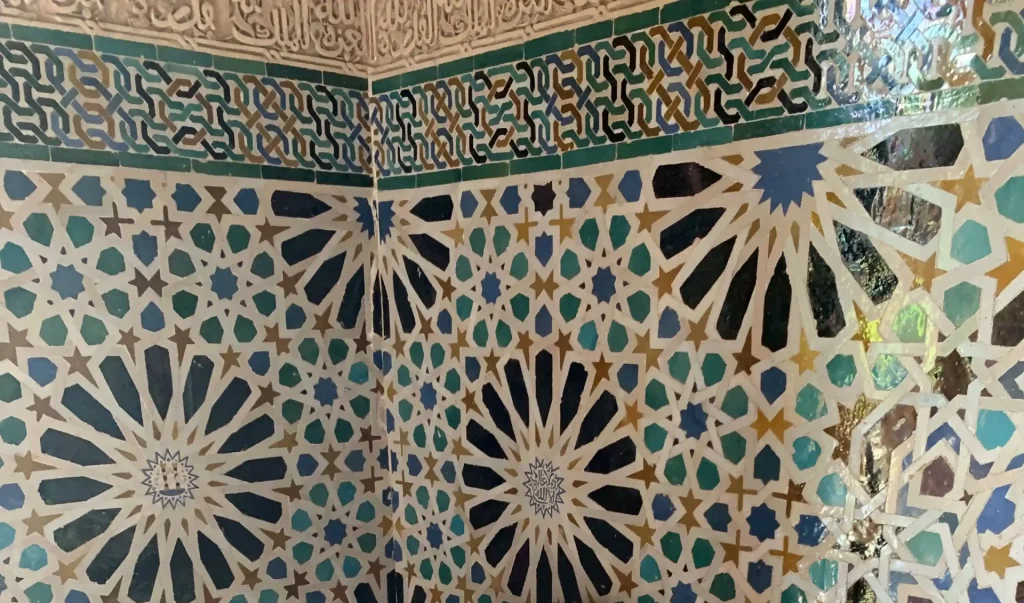
But as your gaze shifts away from the ceilings, another artistic and mathematical marvel emerges. Floors, walls, and even some ceilings are covered with impressive ceramic compositions.
Tens of thousands of small fired terracotta tiles, in different colors, form geometric patterns that seem to extend endlessly. These designs are known as geometric interlaces.
Although they appear extremely complex, they are in fact based on very simple shapes. Everything originates from basic elements such as the square or the circle. A simple rotation of a square can generate stars with 4, 8, or 16 points.
Rotation, reflection, and translation of shapes produce the incredible variety of decorative motifs found in the Alhambra. Here, geometry is not an abstract exercise, but a visual language that governs even the smallest details.
In the palaces of the Alhambra, nothing is accidental: mathematics becomes beauty.
Around the galleries open rooms with a very strong identity, deliberately different from one another, designed to accompany different moods, functions, and moments of court life. Among the most significant are:
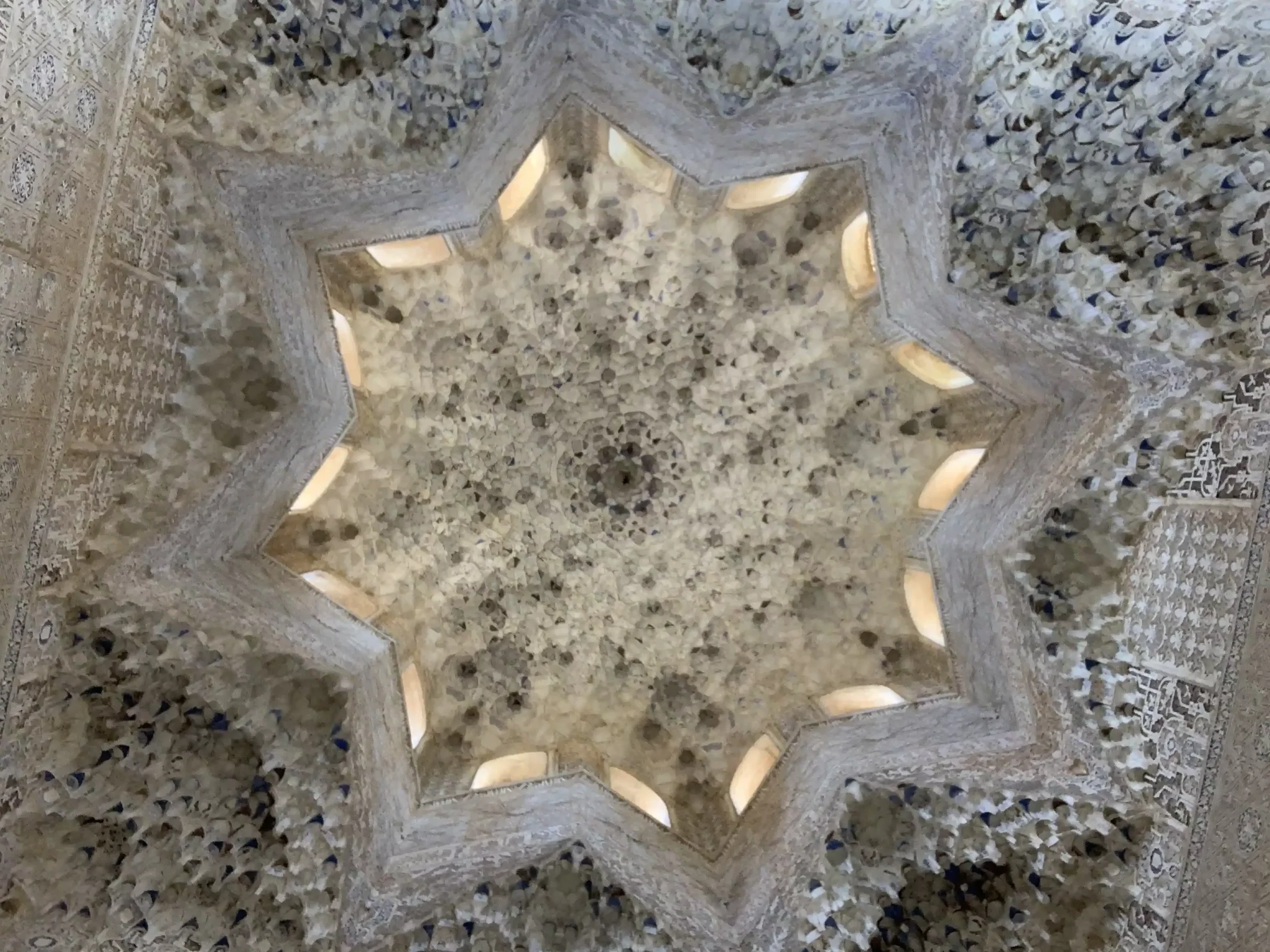
Hall of the Abencerrajes
It was the room where the sultan received close friends and acquaintances, hosting small gatherings accompanied by music.
The most striking element is the muqarnas dome, which forms a 16-pointed star. The high windows allow light to filter in, changing intensity and direction throughout the day and constantly transforming the atmosphere of the room.
In my view, it is one of the most beautiful ceilings in the entire complex. Originally, it would have been reflected in the central fountain on the floor, further enhancing its almost hypnotic effect.
Hall of the Kings
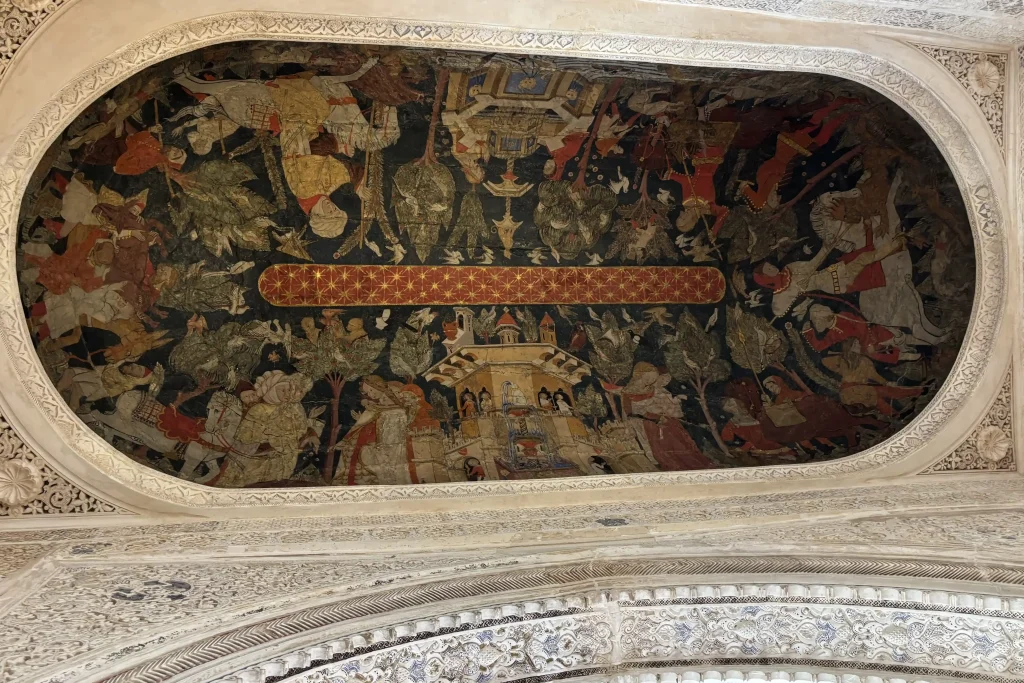
Unique of its kind for its figurative paintings on leather, applied to wooden structures. The presence of human figures is an exception in Islamic art and suggests a period of great cultural openness, probably influenced by contacts with the Christian world.
It is a room that tells the story of a less rigid Alhambra, more permeable, capable of absorbing external influences without losing its own identity.
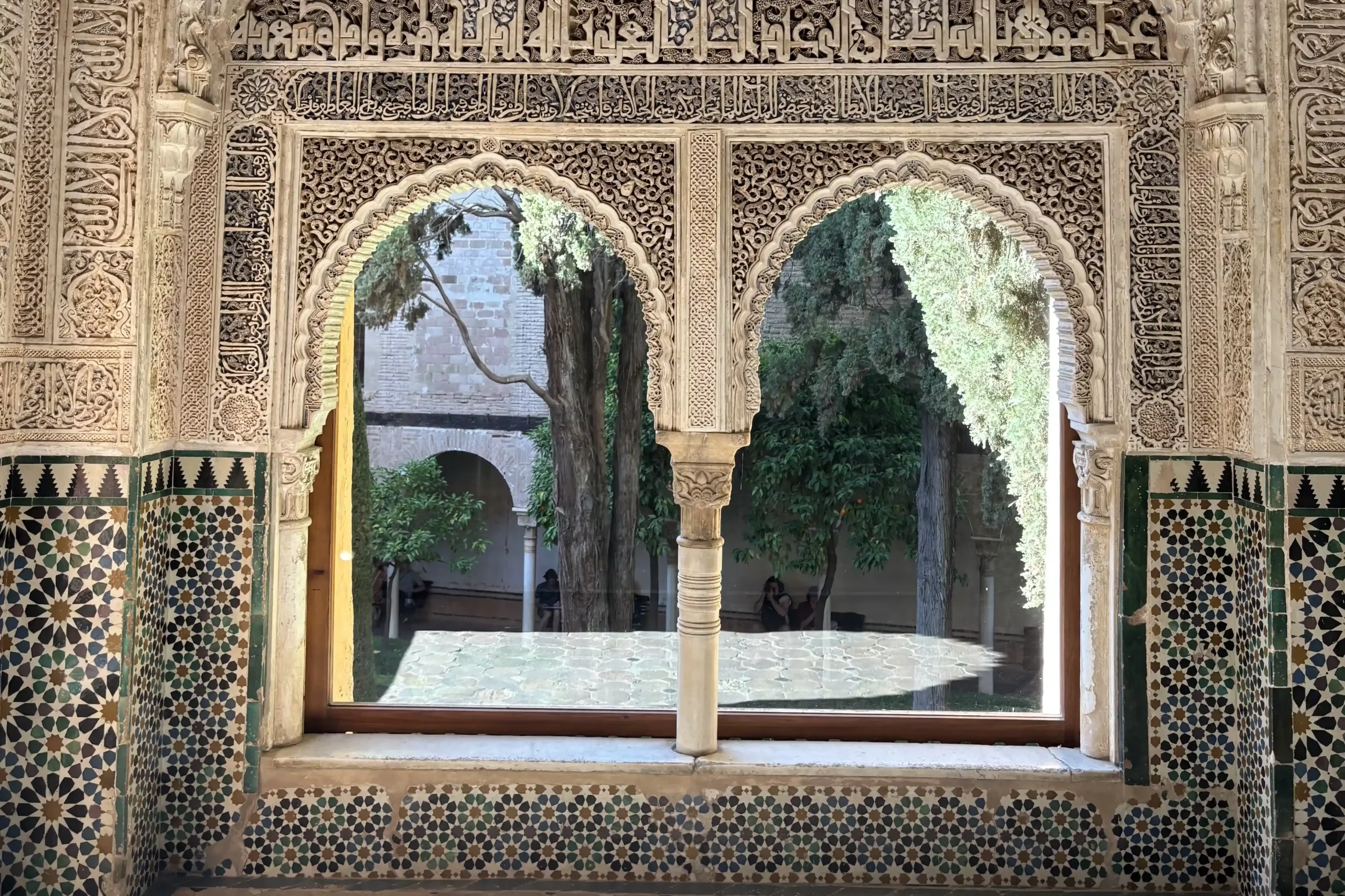
Hall of the Two Sisters
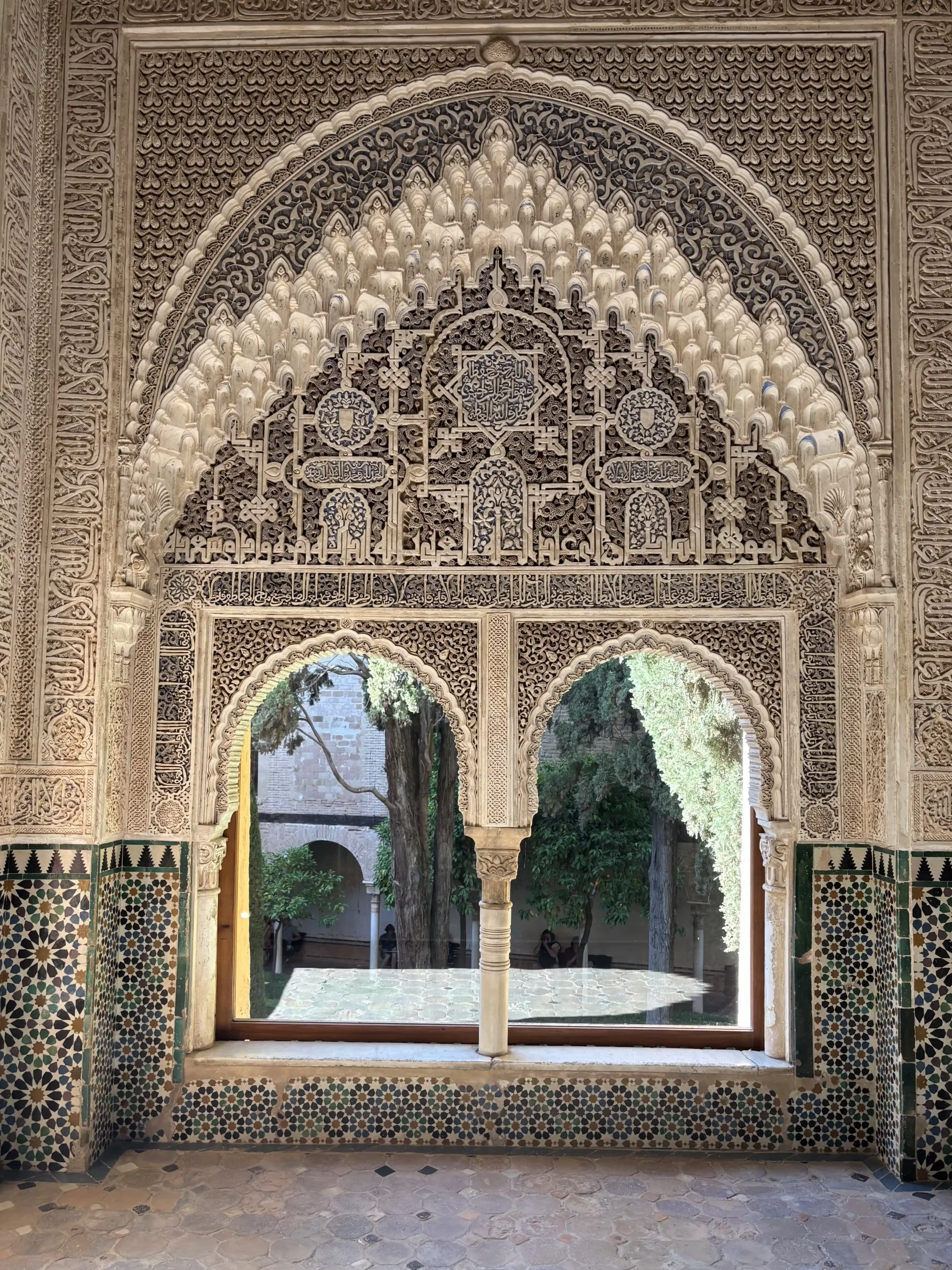
It was the room intended for the sultan’s favorite. It is famous for its monumental muqarnas dome, composed of more than 5,000 honeycomb cells, and for its scenic relationship with the Mirador de Lindaraja, also known as “the eyes of the sultana”, from which the surrounding landscape was once observed (today partly obscured by a later-built patio).
The name comes from two large, identical marble slabs set into the floor. Here too, light plays a fundamental role: filtering in through the upper windows, it creates ever-changing effects depending on the time of day, enchanting visitors anew each time.
The most widespread version recounts that the Abencerrajes were accused of treason (or of a forbidden relationship with a woman of the royal harem, depending on the sources). For this reason, the sultan ordered their collective execution.
They were invited into the hall under a pretext and beheaded one after another; their blood is said to have flowed to the central fountain, staining the marble.
The alleged reddish stains on the floor are still pointed out today as “evidence” of the massacre… although more rational voices suggest they are simply traces of rust.While these rooms were dedicated to reception, the upper floors, not open to visitors, were reserved for intimacy and privacy.
Yet all of this space was conceived for listening and contemplation: the constant sound of water, the wind moving through the galleries, the song of birds.
An environment designed to be in harmony with oneself and with what surrounds it.
Continuing through the palace, you pass through the apartments of Charles V, easily recognizable by an unusual detail within the Alhambra: the fireplaces, which the emperor ordered to be installed to make the rooms more suitable for the European climate and habits.
These spaces were later also inhabited by the writer Washington Irving, who found inspiration here for his famous Tales of the Alhambra.
From here you reach the Peinador de la Reina, or Queen’s Pavilion. In the Christian period it was used as a dressing room for the wife of Charles V, but originally it was an oratory reserved for the sultanas.
A fascinating detail lies hidden beneath the floor: fragrant essences were burned below and diffused into the room through a perforated marble slab, still visible in one corner of the space.
You then pass into the Patio de la Lindaraja, added in the 16th century by the Catholic Monarchs. It may not strike you for its immediate aesthetic impact, but it is a place that clearly tells the story of overlapping worlds: here Islamic and Christian art coexist in an evident way.
The central fountain is made from a basin that originally stood in the Generalife, a further symbolic link between the different spaces of the Alhambra.
From the patio you access the royal baths, rooms decorated with extremely refined mosaics and tiles, lit from above through star- and rosette-shaped openings, once closed with colored glass.
Along the sides of the baths, balconies reserved for singers and musicians are still visible today, entertaining the bathers. According to some sources, they were probably blind, to prevent them from seeing the sultan’s wives.
The baths are often closed and visible only from a distance, but the last time I was there, in 2025, it was possible to access the various rooms.
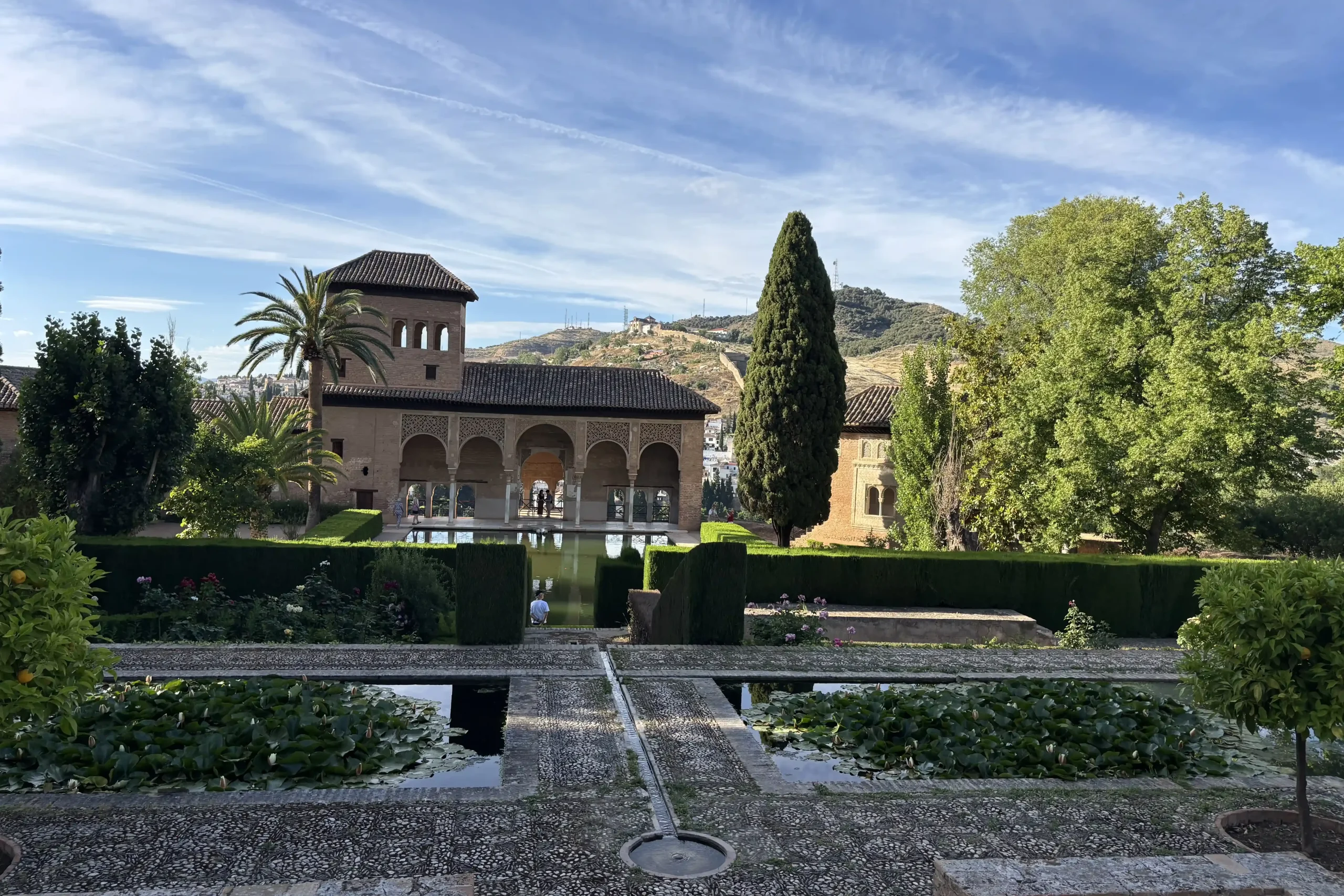
After Lindaraja, you leave the most compact core of the Nasrid Palaces and continue toward the Partal Gardens (33).
Here, architecture ceases to be closed and inward-looking and begins to engage openly with the landscape. This area had a more intimate and relaxed function: closer to the main palace than the Generalife (which, as we will see, was a true summer residence), it offered a moment of withdrawal from political life, encouraging quiet, introspection, and mental balance. Several Nasrid halls once stood here, most of which have now disappeared.
The symbolic heart of the gardens is the Palacio del Partal (31) — the name derives from the Arabic bartal, meaning “portico.” Of this complex, what remains above all is the Torre de las Damas, which houses a small Islamic oratory (32), often not open to visitors.
It is one of the oldest palaces in the Alhambra and represents one of the earliest examples of Nasrid architecture: an open portico, a rectangular water basin, and a panoramic view — solutions that would later be perfected in the Nasrid Palaces.
Unfortunately, it is also one of the buildings most altered and damaged after the arrival of the Catholics, and today only part of it survives.
Here, water is not meant to reflect power, as it does in the Patio de los Arrayanes.
Here, it reflects the sky, the city, the hillside.
It is a space designed to create distance, silence, and contemplation.
And that is exactly the effect it still has today: if you arrive from the Nasrid Palaces, the Partal gently guides you back toward the real world; if you begin here instead, it delicately prepares you for the refinement you will encounter shortly after.
One of the most elaborate examples can be found in the Torre de las Damas, a small palatial residence set within the defensive enclosure which, like many Nasrid structures, was organized around a central patio. What makes this building special is that it concentrates, almost like a “living manual,” all the temperature-regulation strategies found elsewhere in the Alhambra.
Today it may be hard to imagine it when looking up at this tower open on all four sides, but when it was built there is no doubt it must have been a pleasure to live in: outside, temperatures could reach 40°C on the hottest summer days, while inside the rooms could remain at a surprisingly pleasant temperature of around 25°C.
How did Nasrid architects manage to regulate temperature so efficiently during a heatwave? Their secret lay in the design itself, conceived to limit heat accumulation and to manage air as a living matter.
- Smart orientation: as in other buildings of the Alhambra, the most important rooms of the tower (also known as the Tower of the Princesses) were located on the north side, away from the summer sun.
- Thick walls of unfired clay: the walls were considerably thick, so external heat took a long time to penetrate. In this way, the coolness of the morning was preserved until the early afternoon, precisely when temperatures began to rise. The heaviest heat of the late afternoon arrived only toward evening, when the outside air naturally began to cool again.
- Small, controllable openings: many windows were reduced in size to limit heat exchange with the outside. During the day they could be closed with lattice screens or other elements that acted as an initial filter for light and heat, allowing both internal temperature and brightness to be regulated. And, if the opposite effect was needed, they could also be opened.
The key role was played by the numerous windows in the upper part surrounding the building. Hot air, being lighter, tends to rise and could therefore escape through these upper openings: this is the so-called stack effect.
And then there was the element that unites almost every corner of the Alhambra: water. During the hottest hours it evaporated and cooled the air, generating a fresh current that spread through the lower part of the building and pushed the warmer air upward, where it could be evacuated even more easily.
For this reason, the reception buildings of the Alhambra almost always included a cooling pool and often also fountains and small channels: the constantly flowing, cool water contributed to the natural cooling of the space and helped alleviate the effects of extreme weather conditions.
Leaving the Partal, the atmosphere of the route slowly changes.
You find yourself walking along the walls of the Alhambra, with your gaze opening toward the opposite side of the hill, where the Generalife comes into view.
From here you can also make out the walled path (40), a protected passage that allowed the sultan to reach the Generalife unseen, sheltered from prying eyes and potential dangers.
A detail that may seem secondary, yet one that perfectly illustrates how, at the Alhambra, power, security, and intimacy were intertwined in every architectural choice.
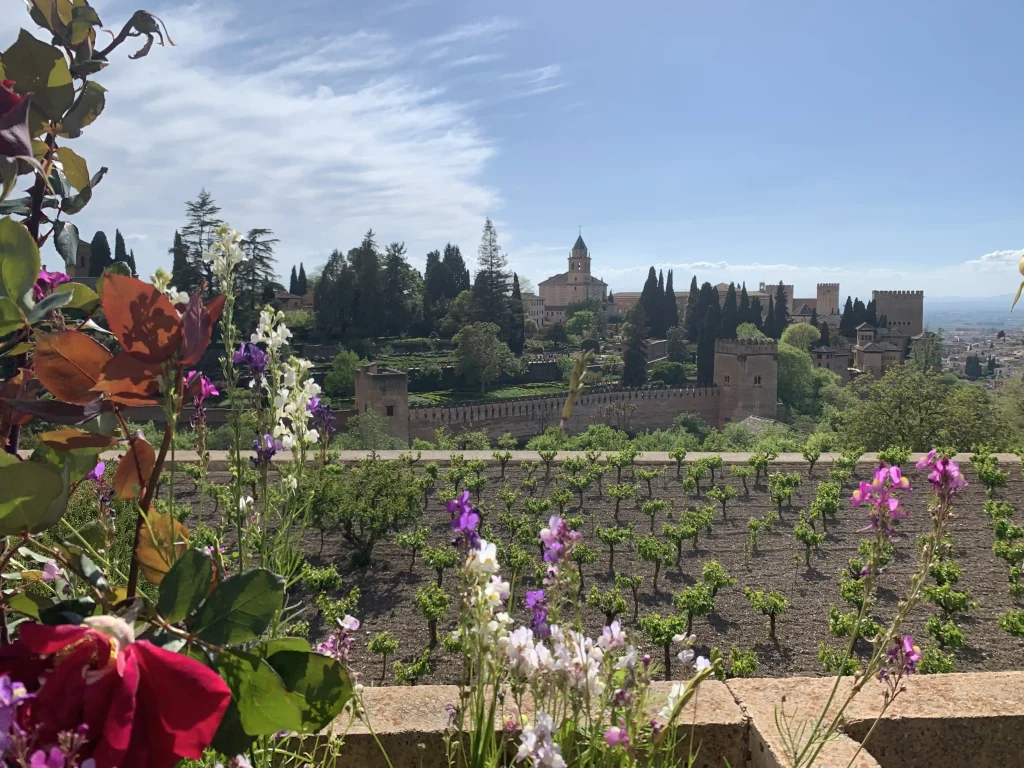
The Generalife
The name Generalife comes from the Arabic Jannat al-‘Arīf, which can be translated as “Garden of the Architect” or “Elevated Garden.”
It was the leisure residence of the Nasrid sultans, used when the heat became unbearable, court life too noisy, or simply when the ruler felt the need for silence and distance.
Not by chance, the Generalife was easily reachable from the Nasrid Palaces thanks to a protected walled passage, which allowed the sultan to move without being seen.
Its gardens are directly inspired by the idea of Paradise described in the Qur’an: a lush, shaded space crossed by flowing water.
An image that, as you will see, describes the Generalife with surprising accuracy.
This is a place meant to be experienced without haste.
Everything invites you to slow down: the constant sound of water, the shade of the trees, the scent of flowers. It is a space designed for thinking, breathing, and relaxing, letting yourself be gently carried by the senses.
Heading toward the Generalife, the first area you encounter is the theater, a modern structure with no historical value, yet central to the Granada International Music Festival.
Next to it, at the beginning of the 20th century, the Jardines Bajos were created in Renaissance style: labyrinth gardens, rose gardens, and a clear reference to Nasrid art through the central water basins. From here you can enjoy one of the most beautiful views of the Alhambra, especially at sunset.
As you approach the Generalife proper, the atmosphere changes: the exterior appears more rural, less dazzling than the Nasrid Palaces, almost deliberately simple.
The first space you pass through is the Patio del Descabalgamiento (or Patio de Apeadero), the place reached from the access path and where, traditionally, one would dismount before entering the gardens.
It was a reception area, and the side porticoes were probably used by stable hands to take care of the horses.
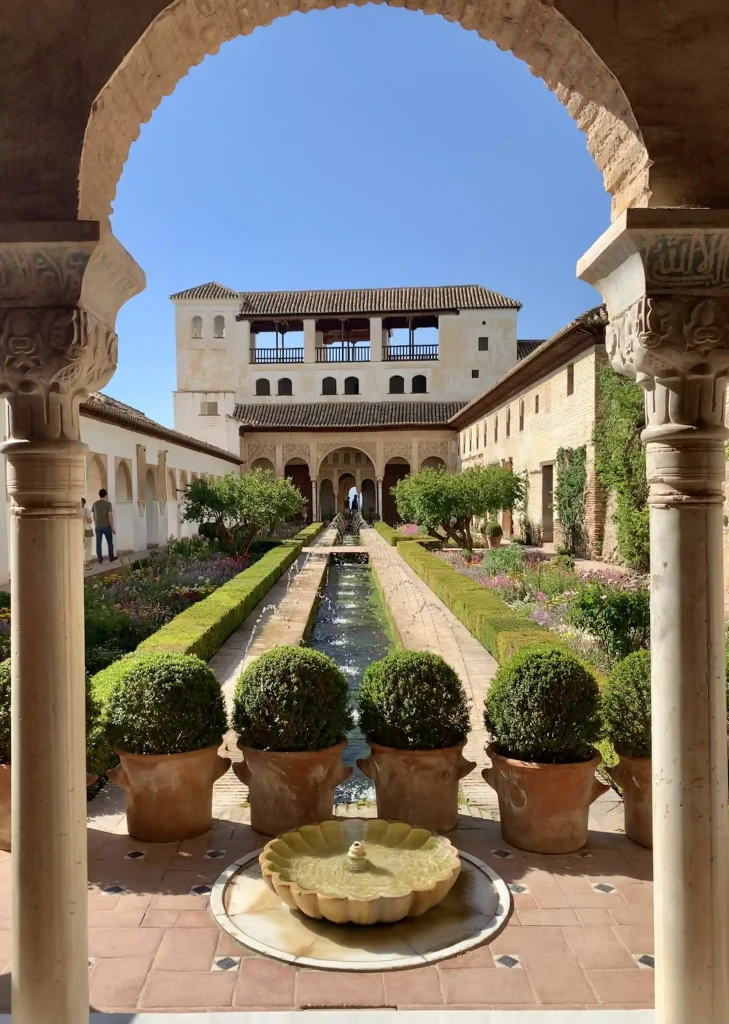
Entering the palace, you pass a series of steps and small patios until you reach the most famous space of the complex: the Patio de la Acequia.
A long, narrow central basin, crossed by intersecting jets of water and surrounded by flowers, fruit trees, and aromatic herbs. Scents, colors, and sounds create a true sensory paradise.
This patio had a precise purpose: to slow down time and disconnect the sultan.
The doors on the right side led to the private quarters of the ruler and the court, while the porticoes on the left were added after the arrival of the Christians. Originally, like all Arab patios, the space was completely enclosed, and the only connection with the outside world was through the four central arches, which still preserve their Nasrid decorations.
Few people know that, beyond its aesthetic value, this basin played a fundamental role in the water system of the Alhambra: about two thirds of the water of the Darro River converged here, diverted toward the citadel.
The basin also functioned as a cistern, supplying water to the gardens and buildings of the entire complex.
From an artistic point of view, the most refined area is the northern side, where the sultan’s residence was located, featuring muqarnas decorations, lattice screens, and an elegant mirador.
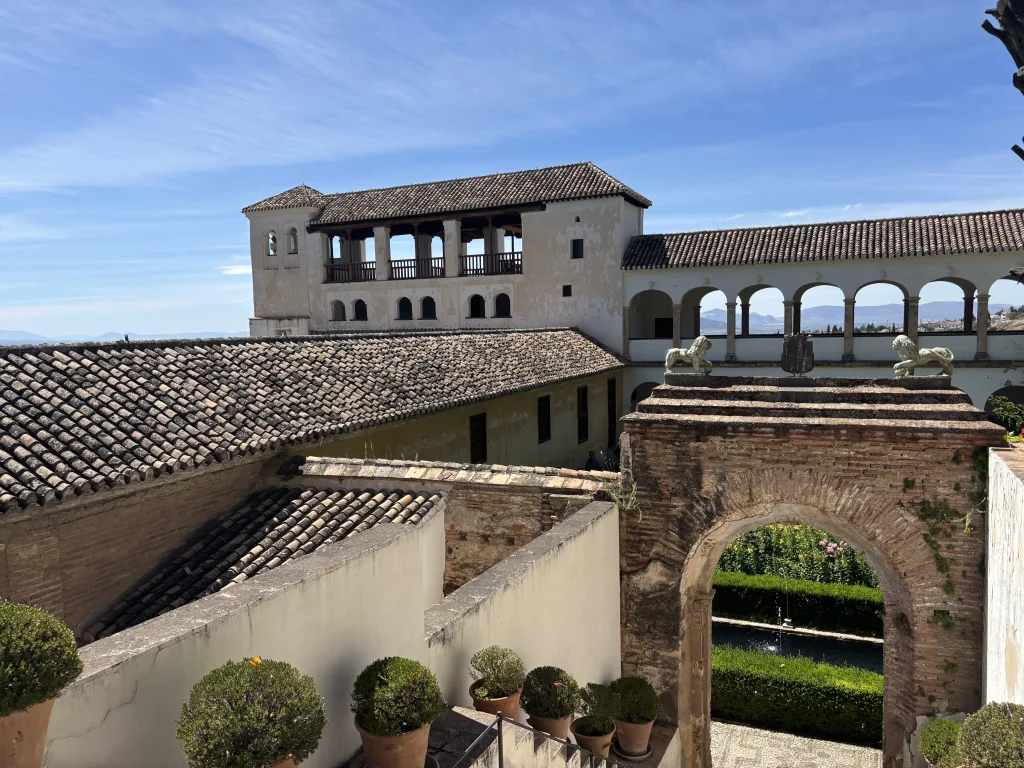
Connected to the Patio de la Acequia is the Patio de la Sultana, rich in plants and fountains along its paths. The name is linked to a legend: here, the wife of a sultan is said to have been caught in the company of her lover, the leader of the unfortunate Abencerrajes, an event that allegedly led to the tragic fate of the entire family.
After the Christian conquest, these gardens were also reworked, and even today they display a fascinating mix of styles: Islamic elements, with water and geometry, alongside Renaissance solutions.
From this point, the view of the Alhambra, the Sierra Nevada, Granada, and the buildings of the Generalife is simply breathtaking.
Continuing through the gardens, you encounter one of the most underrated and profound places in the entire complex: the Escalera del Agua.
It served to connect the Generalife to a mosque located higher up on the hill, later transformed into a chapel. Water flows along the handrails, shade is constant, and the sound is gentle and continuous.
It is a masterpiece of contemplation and hydraulic engineering, as well as of extraordinary architectural wisdom.
At the top of the staircase you reach the Romantic Viewpoint, actually built over an ancient Muslim oratory.
Climbing further along the cypress-lined path, you begin to notice how the lines become less rigid, the plants less disciplined, and the views more open. This is no coincidence.
It is the place where the ruler remembered he was human, accepted the passage of time, listened to nature, and observed imperfection.
Around the gardens stretched vegetable plots and cultivated fields: vegetables, fruit trees, olive trees, medicinal herbs, spices, saffron — highly prized in the cuisine of the time — cereals, and legumes, grown in rotation to allow the soil to regenerate.
They were also a refuge for birds destined for royal hunting and for bees, essential for pollination and the production of honey, a precious commodity in the medieval world.
The problem was simple (and enormous): the hill of the Alhambra had no natural water sources.
With the arrival of the Catholics first, then the Napoleonic troops, and finally the Civil War, the Alhambra underwent numerous transformations.
Many of them are still easily recognizable today: gardens with a mixed visual language, interconnected rooms no longer separated by patios, or the shape of certain towers — such as the Torre del Cubo — altered and made circular to adapt to the use of heavy artillery like cannons.
There were also deliberate attempts at destruction.
During their retreat, Napoleonic troops left explosives ready to detonate, causing severe and irreversible damage to important parts of the Alhambra complex.
And yet, despite wounds, alterations, and violence, the Alhambra has preserved something rare.
A charm that few places in the Western world can offer: romanticism, beauty, power, and history, fused together into a single, extraordinary red pearl.
Granada is a city located in the heart of the Andalusian plain, surrounded by the Sierra Nevada. It is not a chic or fashionable city like Madrid or Barcelona. For this reason, when packing your suitcase, it’s better to focus on comfort rather than quantity.
The sun is one of the main protagonists, at any time of the year. A hat, sunglasses, and good sunscreen are essential even in winter: Andalusian light is intense and becomes especially noticeable during long walks.
You will walk a lot, often on stone streets or gentle uphill paths, so wearing a pair of comfortable, well-tested shoes is essential. A reusable water bottle is a great ally, especially if you visit places like the Alhambra during the summer. I bought a collapsible silicone one at Natura, but it’s no longer available on their website. In any case, here you can find a similar one: it helps save space once it’s empty.
If you plan to visit in winter, it’s better to bring a heavy jacket to protect yourself from the cold. Even though you’re in Andalusia, don’t make the mistake of underestimating the temperature: in winter it can drop to 0°C.
Finally, even though the climate is mild in spring, it’s a good idea to carry a sweatshirt or a light jacket. Being located on a hill, the Sierra Nevada air can often cool things down significantly.
Small items like a power bank may seem like details, but they make days much easier, especially if you keep navigation apps on and want to capture every beautiful corner and moment of your trip. I was given this one and I’m very happy with it. There are many different models available, but regardless of the type, I truly recommend having one.
And here we are, at the end of our journey through the magic of the Alhambra.
I don’t know if this has happened to you too, but at a certain point it feels as though you stop looking at the Alhambra as a monument… and begin to feel it as a presence.
It is a living city, made of filtered light, cool shadows, words carved into the walls like prayers, and water flowing everywhere.
When you leave it behind and return to Granada, you realize that the Alhambra stays with you: like the scent of myrtle, like a reflection of water in your eyes, like a sudden nostalgia for something light and intimate that you didn’t even know you needed.
And perhaps this is its true secret: in reality, it’s not you who discovers the Alhambra, but the Alhambra that helps you discover a little more about yourself.
Similar Posts
The Albaicín: the soul of Granada
The Albaicín: the soul of Granada The Albaicín is the oldest district of Granada. The place where, in fact, the city was born. The Albaicín — al-Bayyāzīn in Arabic — is not a neighborhood in the classic sense of the word.It is not a monument, it is not a museum, and it is not a…
Málaga told through novels: stories to read before (or after) the trip
Málaga told through novels: stories to read before (or after) the trip If you’re planning a weekend in the capital of the Costa del Sol and wondering which books are set in Málaga—or what to read to truly step into the spirit of Andalusia—here you’ll find a selection of titles where the city and the…
Cueva de Nerja: the underground giant of Andalusia between geology and prehistory
Cueva de Nerja: the underground giant of Andalusia between geology and prehistory Arriving in Nerja, visiting its beaches, and enjoying fresh fish in its restaurants is not enough if you haven’t seen its Cueva. Just a few kilometers from the town center, one of the most surprising places in Andalusia is hidden: the Cueva de…
Flavour a Málaga: where to eat in Málaga and discover the authentic local flavor
Flavour a Málaga: where to eat in Málaga and discover the authentic local flavor Málaga is a city full of flavor and character. Eating in Málaga isn’t just about sitting down at a table—it’s a way of living, of slowing down, of sharing a dish even when there’s no rush at all. It’s rightly famous…
What to buy in Málaga: the city you don’t expect, between markets, craftsmanship, and local design
What to buy in Málaga: the city you don’t expect, between markets, craftsmanship, and local design When you visit a city, not all memories are captured through photographs alone.One of the best ways to truly bring a piece of Málaga home is to discover where to shop beyond the usual tourist circuits, among local markets,…
Frigiliana: one of the most beautiful white villages in Spain
Frigiliana: one of the most beautiful white villages in Spain Frigiliana is considered one of the most beautiful white villages in Andalusia.It is famous for its bright white historic centre, with a clear Moorish influence, blue doors and windows that, at first glance, might almost make you think of Greece. Then you look closer: the…