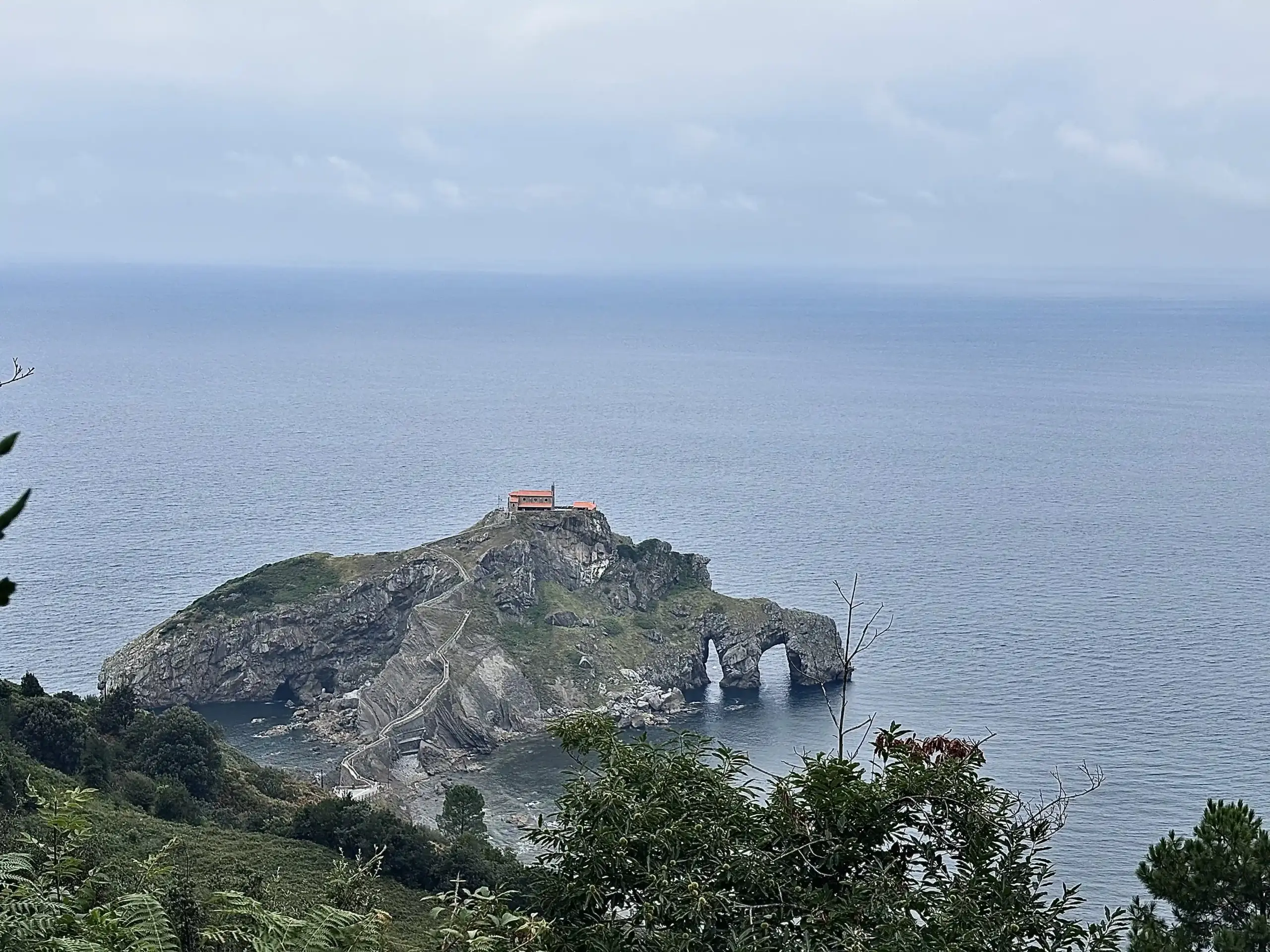
San Juan de Gaztelugatxe
Let’s start with something practical: if you are planning your trip to the Basque Country, very likely San Juan de Gaztelugatxe (in Basque Gaztelugatxeko Doniene) is one of the places and photos you will have seen most often.
San Juan de Gaztelugatxe is indeed one of the most magical and photographed places in the Basque Country and along the entire Cantabrian coast. It is an experience that combines nature, history, spirituality and popular culture.
This impregnable rock, a small rocky islet connected to the coast by a bridge and a staircase, suspended between ocean and wind, has been a fortress, a refuge for pirates, a place of pilgrimage and, more recently, the filming location of Dragonstone in the famous series Game of Thrones, which, for better or worse, has made it even more visited.
It is located about an hour from San Sebastián and Bilbao, and it is one of those places that, the moment you see it, you immediately understand why it has become iconic.
Here are some practical tips to fully enjoy San Juan de Gaztelugatxe. They are simple but can help you save time, money and a bit of frustration. So remember that:
- Access to the natural area of San Juan de Gaztelugatxe is free, but during the high season (and on many holidays) an online reservation is mandatory with access control, introduced to limit the daily number of visitors. In winter or during rough seas there may be temporary closures for safety reasons. If the weather is bad, consider postponing your visit (it is an exposed place).
- The access ticket usually has a specific entry time to the area, but it does not include parking or extra services. I was told that, at every exact hour (for example exactly at 14:00), some access slots are made available on site, but it is not at all easy to get them.
- In summer (from early June to early September, with dates that vary every year) there is a direct bus line from Bilbao and from San Sebastián, which takes you to the stop closest to the entrance of the area; the journey takes about 1 h–1 h 15.
- During the rest of the year there is no direct bus, so the car becomes the most convenient solution. There are 3 parking areas, 2 of which are free, about 1.5 km from the entrance. They are very convenient, but spaces are not unlimited (around 250 in total in the indicated areas) and during the central hours it can be full: roughly 10:00–16:00 is the most critical time slot.
- Many hikers prefer to leave the car or get off the bus in Bakio or Bermeo and reach Gaztelugatxe on foot via well-marked coastal paths, with spectacular views over the Cantabrian Sea. If you can, I strongly recommend this option!
- There are many local agencies that organize excursions, some with a guide. In summer, boat trips are often organized to show the islet from the sea (but without accessing it). Honestly, I find them a bit too expensive, considering that San Juan de Gaztelugatxe is really easy to reach on your own.
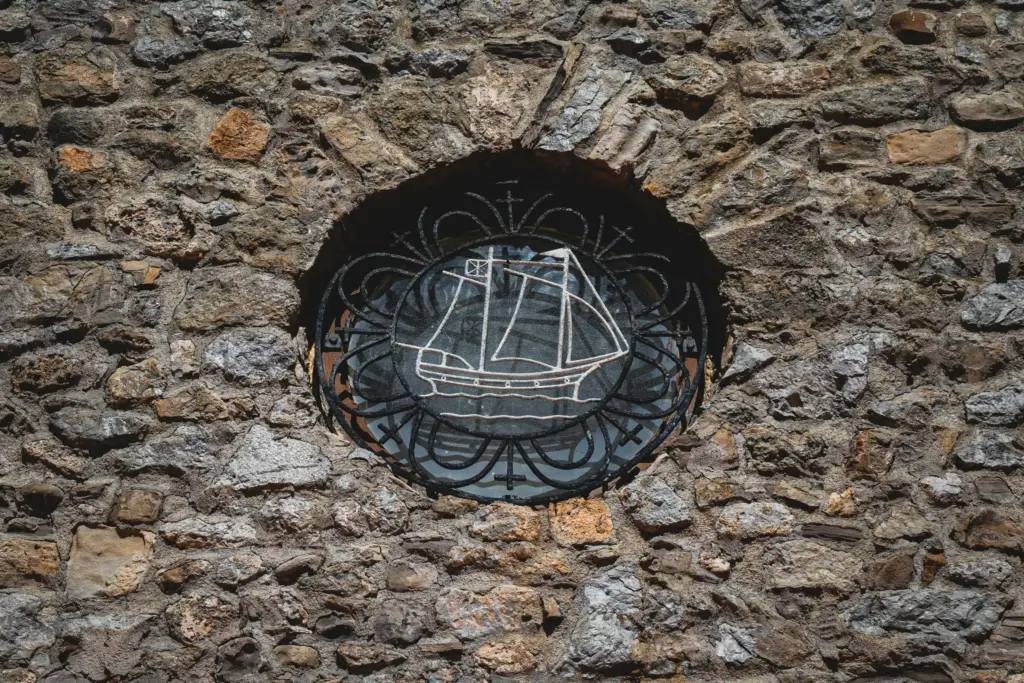
A bit of history (or legend) about San Juan de Gaztelugatxe
San Juan de Gaztelugatxe, often also called Gaztelugatxe or “Castle of the Rocks” in Basque, is a jewel of the Bizkaia coast: accessible through a staircase of more than 200 steep steps, it leads to the ancient hermitage of Saint John the Baptist.
The origins of Gaztelugatxe date back to the 9th century, when King Alfonso III ordered the construction of a hermitage to thank Saint John the Baptist for protecting the Asturian fleet from a storm. It is believed that a structure already existed here around the 9th century; over time the place also had religious and defensive roles. In the Middle Ages, in fact, it became a defensive fortress (the name “Gaztelu-aitz” literally means “castle rock” in Basque, reflecting its defensive role) against Norman pirates and corsairs, suffering multiple sieges and fires.
The most famous episode took place in 1334, when the King of Castile, Alfonso XI, besieged the rock for more than a month. The resistance of only seven knights led by Juan Núñez de Lara, Lord of Biscay, forced the monarch to withdraw in humiliation.
But San Juan did not see only medieval battles. In 1596, the troops of the English pirate Sir Francis Drake looted the hermitage, taking away everything of value.
Years later, during a war with France, fourteen Huguenot ships threw the hermit from the cliff. The hermitage we see today is not the original one: it was rebuilt in 1886 after suffering serious damage.
However, the most fascinating legend — and the one you will hear most often — says that Saint John the Baptist, after landing in Bermeo, reached the islet in three giant steps.
The footprints of his steps are venerated in three places:
- Under the Arch of Saint John in Bermeo.
- At the foot of the rock, before starting the climb.
- On the last step, where there is also an inscription carved into the stone.
Along the path you can still see his “footprints” carved into the rock.
In the past, San Juan de Gaztelugatxe was a pilgrimage site where rituals of folk medicine were practiced: women who wished to become mothers left baby clothes, those suffering from migraines stuck hairpins into the rock or left txapelas (Basque berets), people with walking difficulties placed their feet in the footprints, and stutterers offered coins.
What to see in San Juan de Gaztelugatxe
The experience already begins from the parking area. From here the paths start (more gradual and pleasant) or the direct track that takes you to the bridge access. If you have time, take advantage of the vegetation-rich paths with unexpected views of the sea and Gaztelugatxe. Whatever your destination, the view will be worth it!
Before you can access the monumental complex, you will have to show your reservation. The entrance is in fact closed by a gate with staff checking access. As I recommended, organize yourself in advance and book online, especially in summer. There is also a very interesting free audio guide to download, which accompanies you along the 2 main access paths. Take advantage of it, it is very well done!
In recent months there has been talk about “illegal” access routes promoted on social media. Please avoid them! Besides being dangerous, they damage a delicate area.
Here the true owners are the cormorants and the gulls, which nest safely away from predators. But the most special bird is the European storm petrel. With an intense black color and a white band, it is the smallest among seabirds. And it is very difficult to see, because it spends most of its life out at sea.
The storm petrel returns to land only during the breeding season and when a storm is approaching. Its presence, in fact, announces bad weather. For this reason in Basque it is called Ekaitz Txori Txikia, which literally means the little bird of the storm.
It is not the only special species that inhabits the cliffs of Gaztelugatxe. This place is also a refuge for armeria euscadiensis, a small plant from the carnation family that in spring offers delicate pink flowers. A rarity, because it is not easy at all to grow in such an environment, adapting to harsh conditions such as strong winds, salty air and rocky soils almost without substrate.
The armeria euscadiensis shares this space with ferns, brooms and heathers. And with the wild olive trees, scattered across the island of Aketxe. There are no olive trees this far north in the Iberian Peninsula. Those of Aketxe survive as a testimony of a time when the climate here was much milder than it is today.
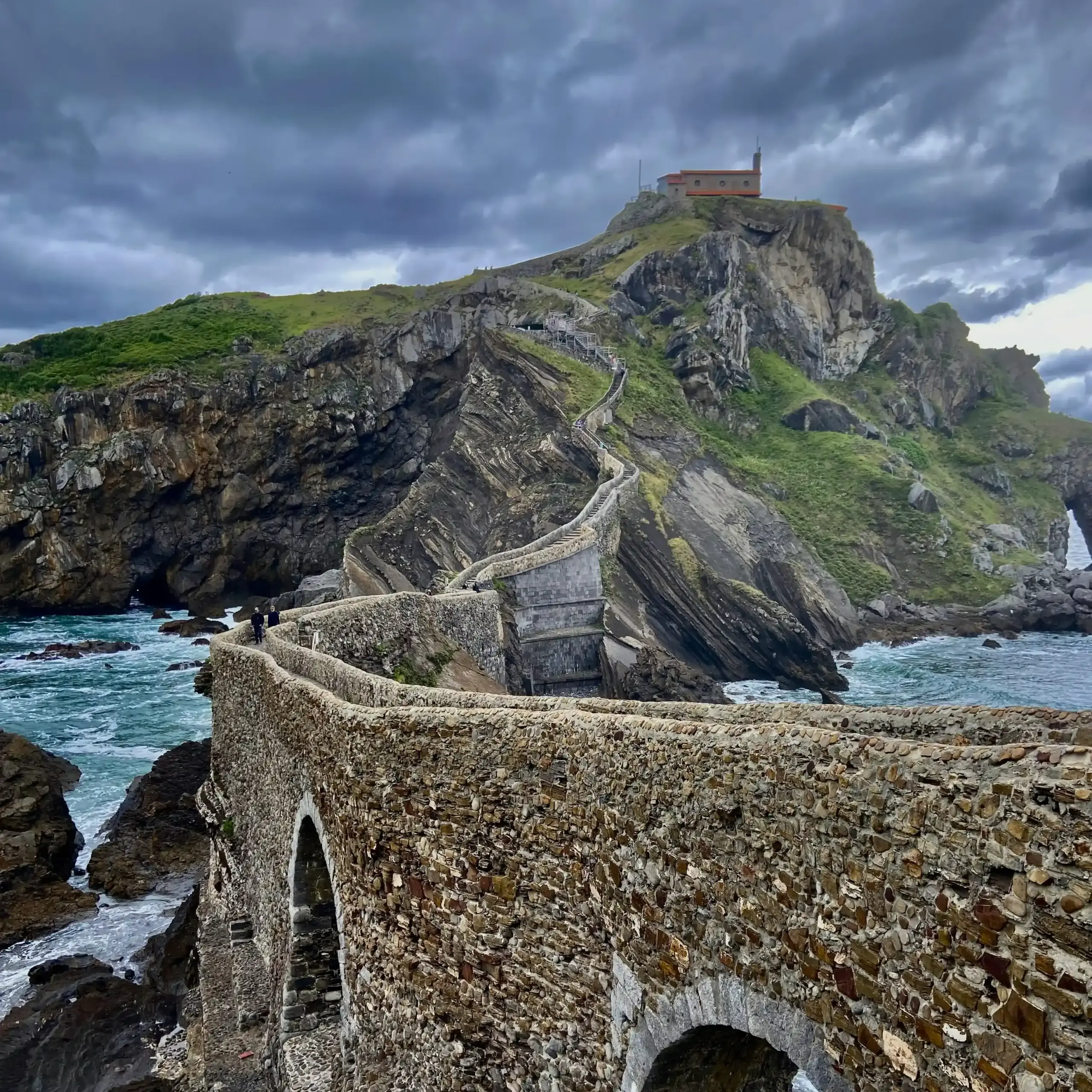
The bridge and the 241 steps
Once you pass the small gate, the first steps are on packed earth, then the bridge appears. Two perfect arches, smoothed by centuries of wind, rain and footsteps. The stone is dark, almost black where it meets the sea, while it is lighter where the feet of pilgrims have worn it down.
Don’t let the rush to reach the top fool you. As always, it’s the journey that makes the difference.
Stop halfway. Below you, you will see emerald green water, then suddenly deep blue. I tried to take a thousand photos, but none managed to capture what I saw and felt in that moment.
Beyond the bridge, the climb awaits you: a winding path of 241 steps (some ancient sources mention 232 or 300, but today the certain number is 241) that overcome 80 meters of elevation gain.
It may feel discouraging, but reaching the hermitage should be a small ritual.
In any case, don’t simply call them “stairs”. These are irregular steps, some high, others low, worn down in the center by the passage of millions of footsteps. They are damp with sea salt, sometimes slippery (be careful!). The wooden handrail in some sections is smooth, in others rough and splintered. It really gives you the sense of what San Juan de Gaztelugatxe has experienced over the centuries.
The higher you climb, the more the world as you know it moves away.
The first stretch is the hardest. My legs started to protest early. Then, mysteriously, I found the rhythm. The more you climb, the more you will understand why this place has been sacred for a thousand years.
Don’t forget to turn around from time to time. The view is a reward that grows with every meter gained. You are surrounded by the coast, the cliffs, the sea and the wind.
Halfway up, you will find a small altar in the rock. An image of Saint John, worn by time, with fresh flowers in front of it. Someone who passed before you must have left a thought, a prayer, a wish. You can do the same.
Then continue until you reach the last step… which is different from the others. It is lower, more worn. If you look carefully you will find a faint engraving. It is the footprint of Saint John’s foot. One of his famous three steps. Place your foot on the same spot… it is said to cure many problems! Not a believer? It doesn’t matter… they say it never hurts to try!
The hermitage of San Juan de Gaztelugatxe
Perhaps you will be surprised, but once you reach the top, the hermitage may disappoint you. It is small, almost intimate. Dark stone, a gabled roof, an iron cross.
Inside it is very simple: there is the scent of incense and humidity, of old wood and wax. A few benches, a handful of statues, and Saint John the Baptist welcoming you.
Outside, next to the entrance, there is the bell. Here you must absolutely respect the tradition: ring it three times. While you ring it, make a wish—everyone does it… even those who say they do not believe in wishes.
Saint John the Baptist once protected sailors from a storm at sea, and it is said that San Juan de Gaztelugatxe can protect people from the storms of life.
If you are lucky enough to be here at sunset, I’ve been told that the panorama becomes a palette of impossible colors: purple, orange, pink, deep blue. It must be truly unique!
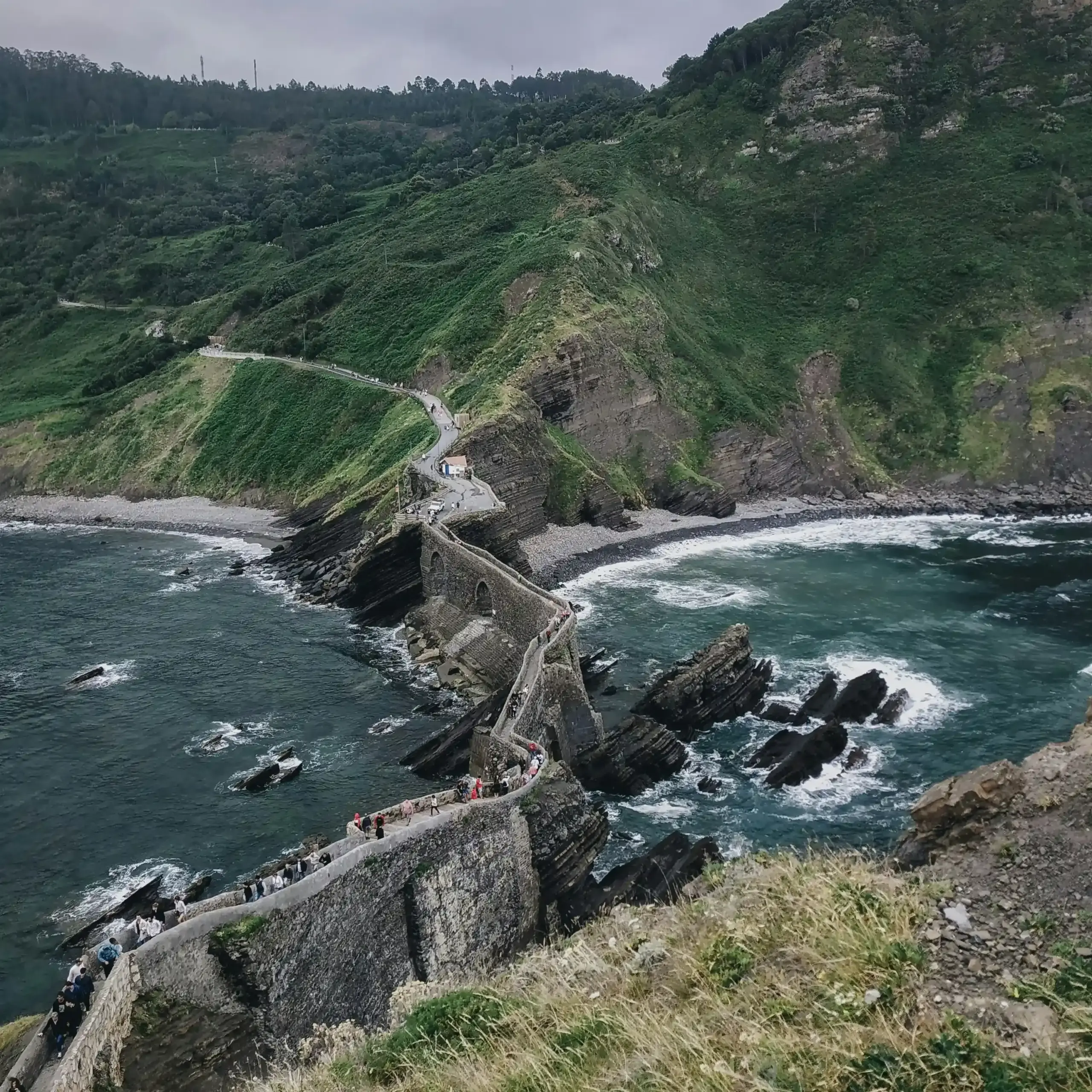
The descent
Going down is less tiring than climbing up, but not faster. Now you can focus on the details: a shell wedged into the rock, faded inscriptions in Basque, the cliff and the coastline opening up before you.
And you meet those who are climbing up. They are out of breath, their gaze focused. Encourage them: “It’s worth it.” They will thank you!
And in the end, after about 2 hours, which in reality have flown by, the bridge appears again and with it the return to reality.
San Juan de Gaztelugatxe is a destination you simply cannot miss if you are in the Basque Country. However, arriving well prepared is essential.
The site is exposed to the wind and the conditions of the Cantabrian Sea: even in summer it is wise to have a windproof or light waterproof jacket;
Don’t be fooled by the oceanic climate. The sun is still strong in summer. A hat, sunglasses and good sunscreen are essential.
The climb will not be easy, often damp from water and the mist rising from the sea, so using a pair of comfortable shoes, without smooth soles and already well tested, is essential. A reusable water bottle is a great ally, especially if you visit San Juan in August. I bought a foldable silicone one at Natura, but I can’t see it on the website anymore. Anyway >here<> you can find a similar one, which allows you to optimize space once it has been used.
If you plan to reach the site by walking along the cliffs, do not underestimate the temptation of a swim in the waters of the Cantabrian Sea. Bring a swimsuit, a >light towel<(I bought this one to always have it with me when traveling to a seaside city, it is convenient and takes up little space), some rock shoes and a practical bag for your wet swimsuit.
Finally, even though the climate is mild, it is useful to carry a sweatshirt or a light scarf with you, when the sea breeze becomes stronger.
Small items like a power bank may seem like details, but they make the day much easier, especially if you want to photograph all the most beautiful corners and moments of your visit. I was given >this< one and it works great for me. But there are many different types. Regardless of the model, I strongly recommend having one.
If I can give you one piece of advice, don’t turn Gaztelugatxe into a “checklist” stop.
Experience it while thinking about the stories of fishermen who came here asking for protection, of lovers who promised fidelity, of mothers who prayed for their children at sea.
Gaztelugatxe is all of this: a physical place that becomes spiritual, a piece of land that tastes of sky… and of sea.