The Albaicín: the soul of Granada
The Albaicín is the oldest district of Granada. The place where, in fact, the city was born. The Albaicín — al-Bayyāzīn in Arabic — is not a neighborhood in the classic sense of the word.
It is not a monument, it is not a museum, and it is not a single attraction to tick off on a map. It is an experience.
The first time I visited it, I immediately realized one thing: the Albaicín cannot be understood until you walk through it, letting the streets, the slopes, and the details tell its story.
And this is how, in my opinion, it still reveals its true value today: by exploring it slowly and trying to observe it as it must have appeared in everyday life, when it was part of a lively, noisy, working Nasrid city.
Along the route we will take together, I will try to show you those details — small and large — that help to understand how important this district was in the Nasrid period, and why it still has enormous historical and cultural value today.
Because yes: the Albaicín has been declared a UNESCO World Heritage Site.
Walking through it today, it is easy to forget, but this maze of alleys, slopes, and silences dates back to the late 13th century, when Arabs from Baeza were forced to abandon their homes after the Christian conquest of the Kingdom of Jaén. According to some sources, the name al-Bayyāzīn itself may derive from Baeza.
They sought refuge on this hill overlooking the Darro River, and here they shaped a district that, in a short time, would become the beating heart of Islamic Granada.
To understand how large it was, a few numbers are enough: during the period of the Alhambra’s greatest splendor, the Albaicín had around 40,000 inhabitants and more than 30 mosques. Not a neighborhood, but a true city within the city.
With the arrival of the Catholics, a long phase of only apparent “truce” began. Muslims who did not wish to convert were progressively concentrated here, where they could live their religion freely. The Albaicín thus became an increasingly dense and vibrant Arab district… but also a closely watched one.
When this truce ended and the Moriscos were definitively expelled, the district changed its face: mosques were transformed into churches, and the most beautiful homes — the famous cármenes — were assigned to the new Christian nobility, often as a reward for donations made in support of the wars.
Even today, these cármenes are easy to recognize: discreet entrances, often decorated with ceramics, names carved above the lintel or composed of individual letters on azulejos. Behind those doors lie inner patios, fountains, gardens — private worlds that cannot be guessed from the outside. Because in Arab culture, beauty was revealed inside.
One of the most fascinating aspects of the Albaicín, in my opinion, is that it has preserved almost intact the urban structure of al-Andalus. Narrow, irregular streets, often shaded; alleys so close together that, if you stretch out your arms, you can touch both walls; whitewashed surfaces that reflect the light and brighten even the darkest corners.
It was a district designed to be lived in, but also defended. Surrounded by walls, irregular streets, and stepped paths.
As you walk, you will immediately notice the central role of water in the life of the Albaicín (as in the entire Arab world).
In a city made up of steep slopes and narrow streets, water had to be close to people, not the other way around. That is why aljibes were distributed along the main routes, next to squares and resting points.
Along the way, you will encounter dozens of public fountains connected to wells and cisterns, which for centuries provided drinking water to the population. Some were used until the mid-20th century. Most are located next to churches — former mosques — for ablutions, but in reality they served the entire district, marking the rhythm of daily life.
Walking through the Albaicín is wonderful, but tiring. If you want to enjoy it more, take the C1 minibus from Plaza Nueva up to the Mirador de San Nicolás and then explore the neighborhood downhill. It’s not my favorite way to do it, but trust me: it makes a big difference. Also, if during your trip to Granada you plan to visit the main monuments of the city’s Andalusí and Nasrid heritage — such as El Bañuelo (ancient Arab baths), Corral del Carbón, Casa Morisca Horno de Oro, and the Palacio de Dar al-Horra — my suggestion is to buy the Dobla de Oro, a “pass” that, for about €8 more than the Alhambra ticket alone, opens the doors of the Red City and other historic sites linked to Granada’s Nasrid history. Check the official website of the Patronato de la Alhambra. Also remember that many monuments or palaces are free on Sundays, so plan your visit carefully!
What to see in the Albaicín
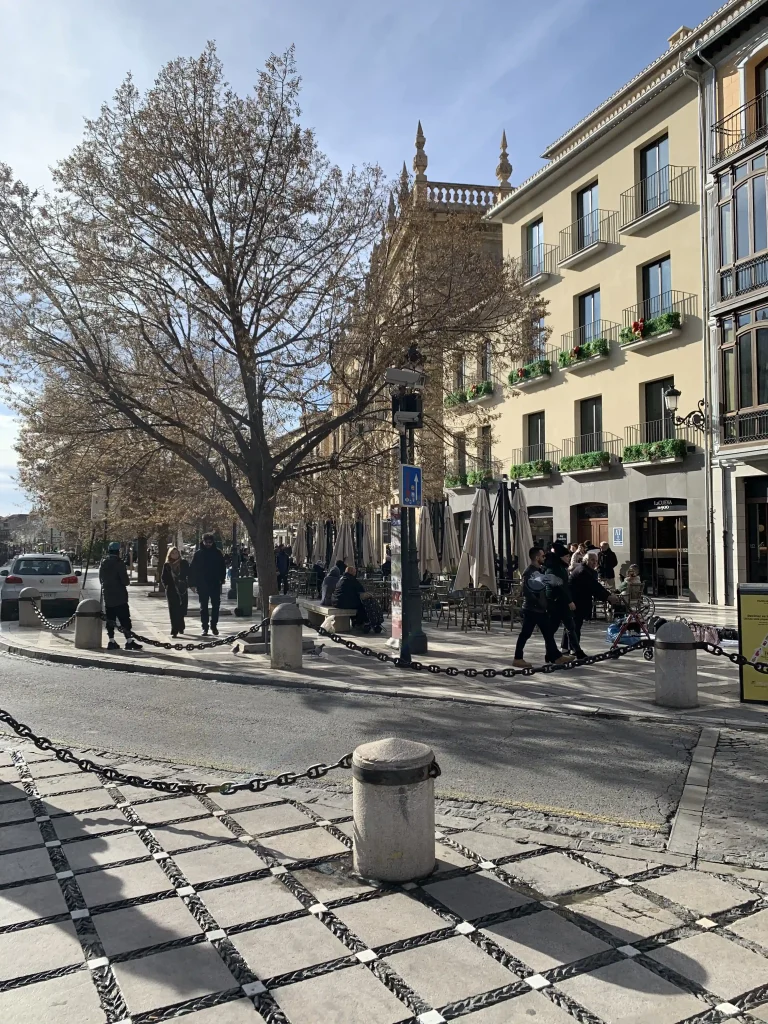
Although there is a minibus that makes the climb up the Albaicín easier, I still prefer the classic approach: starting from Plaza Nueva, then taking the Carrera del Darro as far as the Paseo de los Tristes, and finally immersing ourselves in the neighborhood’s narrow streets.
🚶 Walking tour of Granada: the Albaicín
One of our first stops in the Albaicín is the Iglesia de Santa Ana.
Iglesia de Santa Ana
The church was built on the site of a former mosque and today represents an example of Granadan Mudéjar style, dedicated to Saint Anne. The main façade facing Plaza Nueva stands out for its Corinthian style, the statues, and the medallion of the Virgin. But it is, of course, the bell tower, built of brick and glazed ceramics, that truly captivates, as it preserves the structure of the ancient minaret.
The interior consists of a single nave, topped by a carved wooden ceiling in perfect Granadan Mudéjar style. The church later added the name San Gil, following a fire that destroyed the main church of the parish of the same name. From that moment on, the two saints have shared the same building. Admission is free, and at the back of the church a small Arab bath has been reconstructed, which can help us better understand our next stop.
Continuing along the Carrera del Darro, we need to stop and observe the river: this is the river that once supplied water to the Alhambra, a central protagonist in the life of Granada. Today it is hidden beneath the city, but to give you an idea, it once ran exactly where Plaza Nueva and Calle de los Reyes are now, dividing the city in two. Along the way we cross several stone bridges (such as the Puente de Cabrera), built in the Arab period and later adapted by the Christians.
Continuing along the Carrera del Darro, we come across, as promised, El Bañuelo.
El Bañuelo
El Bañuelo is open every day of the year, except on a few specific dates (such as December 25th and January 1st, for example). It is part of the “Monumentos Andalusíes” circuit managed by the Patronato de la Alhambra y Generalife, which means that admission can be purchased on the official website either as a single ticket or included in the Monumentos Andalusíes combinations (which include El Bañuelo plus other minor Nasrid sites such as Corral del Carbón, Palacio de Dar al-Horra, and Casa Morisca) or in the Dobla de Oro General (a combined ticket that also includes the Alhambra and the Generalife). As often happens in Andalusia, entry on Sunday afternoons may be free (subject to availability). Always check in advance.
El Bañuelo is a hammam, or public Arab bath, dating back to the 11th century, and is considered one of the best-preserved Islamic baths in Spain. Built during the Zirí period, it served as the public bathhouse for the district of Ajsaris (or barrio de los Axares). These hammams — far more than simple places for hygiene — were social and cultural centers where people met, talked, relaxed, and carried out everyday activities.
While many hammams were destroyed after the Reconquista (as they were considered immoral), El Bañuelo survived — partly because it was converted into a public washhouse and later incorporated into a Christian house. It still preserves the classic layout of Arab baths:
- cold room
- warm room
- hot room
as well as the characteristic vault with star-shaped skylights, which fills the interior with light and creates a truly special atmosphere.
Near El Bañuelo, behind the silent walls of the Convent of Santa Catalina de Zafra, there is a tradition that feels as if it belongs to another century: sometimes you can buy sweets made by cloistered nuns. Don’t expect a pastry shop with display windows or signs. Everything here works in an old, discreet way: a closed door, a bell… and the turnstile, the small wooden wheel that allows the exchange without anyone seeing each other. You ring. From inside comes a gentle voice. And if sweets are available that day, they slowly appear in the wheel: pestiños, roscos, and other simple recipes, scented with honey and cinnamon, made as they were in the past, without “tourist” packaging. It is a tiny gesture, but a powerful one: you are not just buying something sweet. You are touching a more hidden Granada, the one that still lives behind the walls, far from the noise and the crowded miradors.
And if you find the door closed or the sweets already sold out, it doesn’t really matter: knowing that this tradition still exists makes that corner of the Albaicín feel more real.
From here we continue towards the Paseo de los Tristes. Its official name is Paseo del Padre Manjón, but no one actually calls it that.
The Paseo de los Tristes was the road taken by funeral processions on their way to the cemetery, and even today it retains a sense of something solemn and unhurried.
You walk alongside the Darro River, with the Alhambra looming above you and the Albaicín waiting ahead… Every time, it feels unreal to me.
Nearby stands the Casa Morisca Horno de Oro.
Casa Horno de Oro
The Casa del Horno de Oro can be visited by purchasing an entrance ticket. Tickets are available on the official website, and the site is part of the Monumentos Andalusíes circuit, like many other monuments in the city we will visit (Corral del Carbón, El Bañuelo, Palacio de Dar al-Horra, and the Maristán). On Sundays, admission is free, so always check the official website.
It is a 15th-century Andalusí house, one of the best-preserved examples of late Nasrid Muslim domestic architecture in Granada. The origin of its name is not entirely clear: according to some, it comes from the presence of an ancient domestic oven; according to other interpretations, gold extracted from the Darro River was melted here. However, there are no definitive sources for either version.
Inside, you can clearly see the typical structure of an Islamic house: a discreet, understated entrance; rooms oriented inward rather than toward the street; and a central patio that acts as the true heart of domestic life. The second floor does not belong to the original structure but was added later and housed the family’s private rooms.
Many visitors tend to prefer the Casa del Chapiz over the Casa del Horno de Oro, but in my view this comparison is misleading. The Casa del Chapiz is a noble residence—large and representative—whereas the Casa del Horno de Oro tells a more everyday, domestic story, that of the daily life of an Andalusí family. They are two different places that do not compete with each other but rather complement one another.
From here we head back toward Calle Carnero, which I discovered purely by chance while getting lost in the Albaicín. It is a very narrow alley that, besides being one of the most emblematic examples of Arab urban planning, is also one of the richest in legends and stories.
The mystery comes from the fact that local residents claimed that, at night, while walking along the street, they could hear footsteps without seeing anyone. Some spoke of laments, others of the sound of hooves, and others still told of doors opening and closing on their own. According to tradition, it was the Carnero: a man known for his cruelty—or his greed—who, after death, could not find peace because his young wife remarried just a few weeks later.
Another nearby alley is the Cobertizo de Santa Inés. It is not an important street and almost never appears in classic itineraries. We reached it simply by following, at random, a group of people slipping into this narrow space. And yet, the moment you step inside, you immediately understand that it is deeply Granadan.
The term cobertizo refers to a covered passage: narrow, sometimes sloping, often including arches, sections beneath buildings, and areas of permanent shade. It certainly served to protect from the sun, but also to control who entered and left the neighborhood, making movements less visible to those unfamiliar with the area.
The Cobertizo de Santa Inés takes its name from the Convent of Santa Inés, located a little higher up, and perfectly illustrates one of the most fascinating characteristics of the Albaicín: the overlapping of eras. An urban structure born in the Islamic period that continues to exist, but under a Christian name.
A little further on, you will find the Maristán.
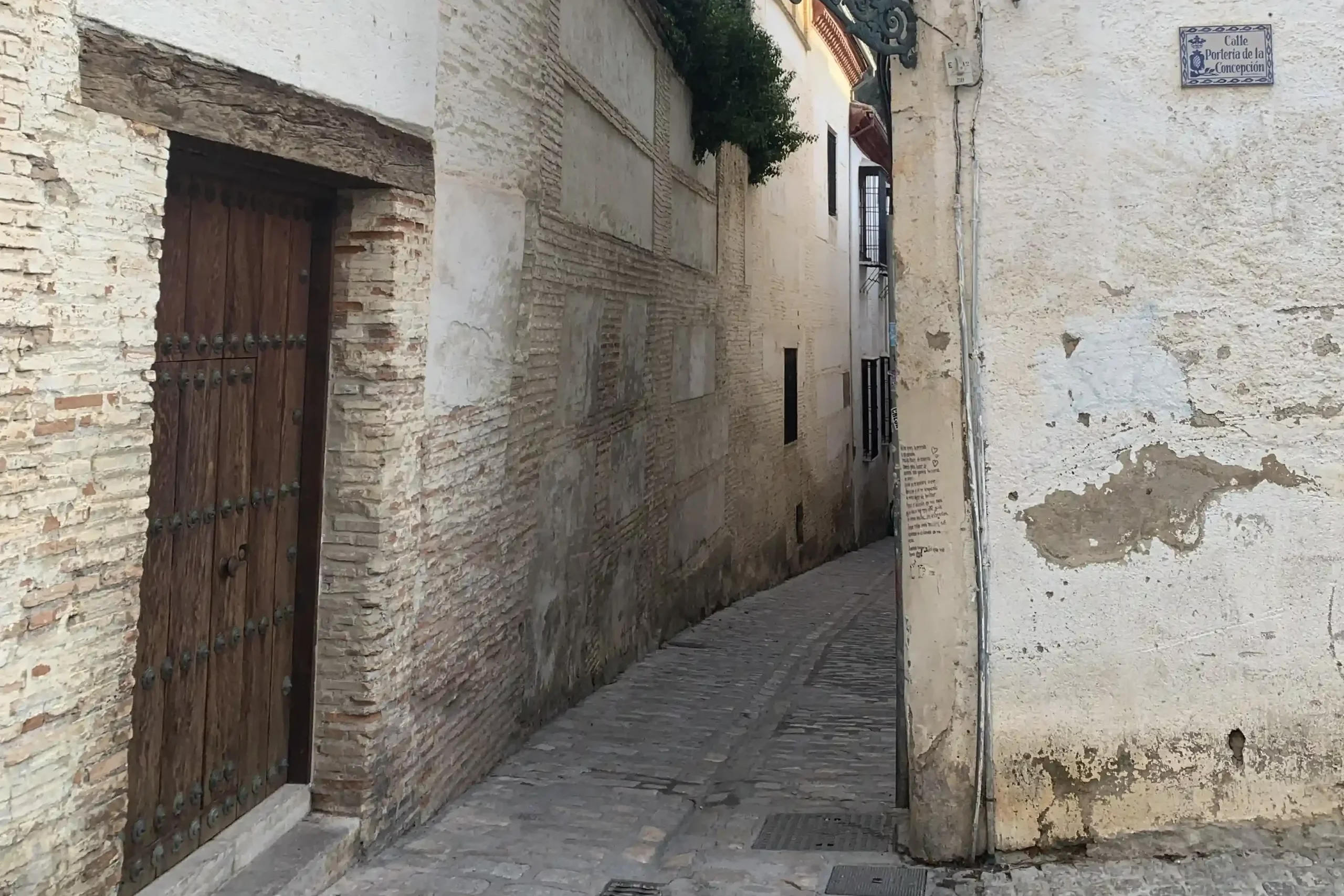
El Maristán
When people talk about Granada and al-Andalus, their thoughts immediately turn to the Alhambra, its decorations, courtyards, and gardens. But there is a lesser-known detail — and perhaps for this very reason even more surprising — that clearly shows just how advanced this city once was: in the 14th century, Granada had a true public hospital.
It was called the Maristán, from the Arabic term bīmāristān, a structure designed to treat and care for people, not merely to “house” the sick.
The Maristán of Granada was founded in 1367 by the Nasrid sultan Muhammad V and stood along the Darro River, right at the foot of the Albaicín. Not on the outskirts of the city, not hidden away. It was there, fully integrated into daily life, as if caring for people were a natural service, on the same level as markets or public baths.
And this is where Granada becomes even more remarkable. The Maristán functioned as a hospital in the modern sense of the word: patients were examined, monitored, and treated with attention to hygiene, diet, and practical care. But above all — and this is perhaps the most extraordinary aspect for the time — attention was also paid to mental disorders.
In many similar institutions in the Islamic world, therapy included water, music, silence, and tranquility. A profoundly humane approach, far more advanced than what would dominate much of Europe for centuries.
Among the intellectuals associated with this world was Ibn al-Khatib, physician and vizier at the Nasrid court, famous for his surprisingly modern ideas about contagion and the importance of hygiene in the spread of disease. He is one of those figures who make you realize that, behind Granada’s aesthetic beauty, there was also a world of science, observation, and genuine care for people.
Today, only ruins remain of the original Maristán, although in recent years major restoration investments have been made, and visits are organized if you purchase the Dobla de Oro or the Monumentos Andalusíes pass. Even though very little of the original Maristán survives, this is a place that tells the story of a city that, 800 years ago, had already understood something fundamental: caring for bodies (and minds) is part of a civilized society.
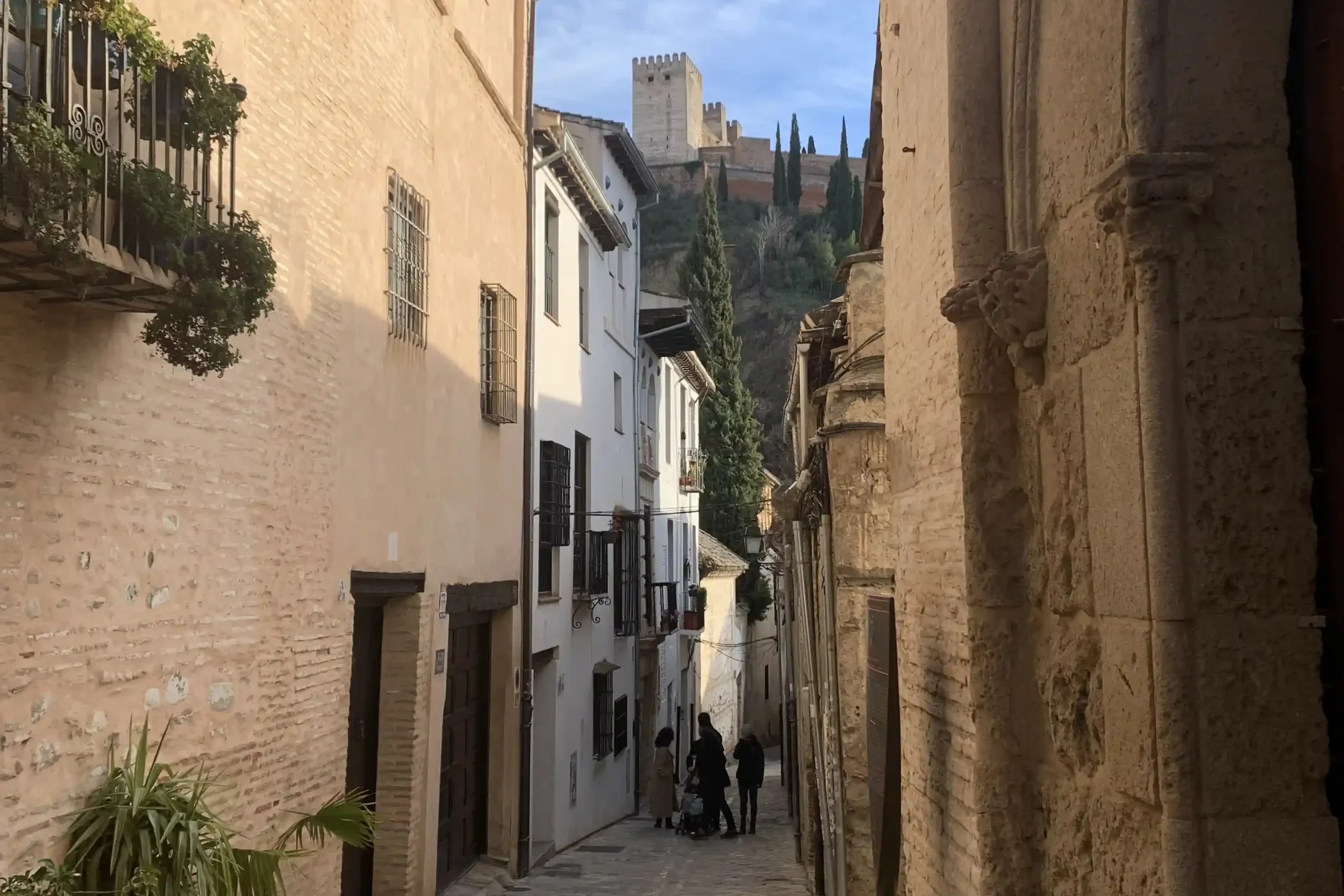
Casa de Zafra
Just after that, you come across the Casa de Zafra, one of the best-preserved examples of a Muslim house in Granada. It is one of those places that does not impress by size or spectacle, but becomes essential the moment you step inside.
Today it houses the Centro de Interpretación del Albaicín and is, in my opinion, one of the best places to understand how the neighborhood really worked: how it was organized, how people lived, how buildings were constructed. It is included in the Dobla de Oro pass. A single ticket costs around €3, and on Sundays admission is free.
Leaving the Casa de Zafra and continuing along the alley, we head towards Calle de Zafra.
On the corner you can spot an Arab doorway, now closed and unfortunately poorly preserved (it is even crossed by a tangle of electrical cables), yet still readable. It is one of those details that risk going unnoticed, and yet they tell the story of the city.
Turning right, we enter an area where some of the best-preserved palaces of the Albaicín are concentrated. Some of these have become true house museums, such as the Casa Museo Ajsaris, which allows you to physically step into a house from the Islamic period that was later inhabited by a Catholic family.
Among them all, one of the most striking doorways is that of the Casa de Don Hernando de Zafra. It is a large original wooden door, and simply observing it carefully allows you to read a key chapter in the history of Granada. This was originally an Arab house that, after the Reconquista, was assigned to a Catholic nobleman. This is clearly visible in the coats of arms carved into the door: Castile (the castle), León (the lion), Aragon (the stripes), Navarre, and Granada (the pomegranate).
These are the symbols of the kingdoms unified under the Catholic Monarchs, carved in a very visible way to remind — those who entered and those who passed by — who now held power.
Walking here, door after door, this religious and political transformation is easier to read than in any history book.
The Zafra family is one of those presences that rarely appear in the “postcard” narratives of Granada, yet they are essential to understanding what happened to the city after 1492.
The name is especially linked to Hernando de Zafra, a key figure in the transition from Nasrid Granada to Christian Granada. Hernando de Zafra was neither a soldier nor a high-born noble: he was a trusted man of the Catholic Monarchs, a diplomat and an administrator, one of those who worked behind the scenes while history was changing course.
He was secretary and direct advisor to Isabella of Castile and played a central role in the negotiations that led to the surrender of Granada. He was not interested in the destruction of the city, but in its integration into the new political order.
As a reward for his services to the Crown, Hernando de Zafra received prestigious properties in the Albaicín, including a residence now known as the Casa de Zafra. It is no coincidence that he was assigned a high-status Muslim house: living there meant occupying, both physically and symbolically, a space that had previously belonged to the Nasrid elite.
The Zafra family thus became part of the new Granadan nobility — a nobility of service, not medieval but modern: tied to the State, to bureaucracy, and to the administration of the territory. It is a pattern that repeats frequently after the conquest: ancient Islamic residences are adapted, reused, but never completely erased.
In a sense, the Zafra family perfectly embodies post-1492 Granada: a city that is not razed to the ground, but reconfigured, where new families of power settle into existing spaces, changing their meaning without erasing their memory.
We continue our climb, skirting the Iglesia de San Juan de los Reyes. It is a discreet presence, almost marginal, yet meaningful: it is dedicated to Saint John, the protector of the Catholic Monarchs. Personally, I do not find it particularly remarkable from an architectural point of view, but it is a sign that reminds you that here different eras have overlapped without ever completely erasing one another.
If you want to take a break and calmly enjoy the view of the Alhambra, turn right towards the Mirador de la Victoria.
It is a small, quiet square, far from the crowds, where you can rest from the climb and finally enjoy your well-deserved reward: the Alhambra opening up in front of you, without haste and without noise.
Another alternative is the Mirador Placeta de Carvajales, not far from Calle Aljibe del Trillo. I assure you that the view has nothing to envy compared to San Nicolás!
We continue straight on, then turn left onto Calle Guinea, and almost without realizing it we find ourselves in Plaza Aljibe del Trillo. In reality, more than a square, it is a junction of streets, a natural point of passage. It’s one of those places where you don’t stop because you “have to,” but because your pace slows down on its own.
The name Trillo comes from Juan del Trillo, but it also evokes the gurgling of water—a continuous, familiar sound that for centuries was part of everyday life in the neighborhood. The cistern-fountain at the center was one of the most important in the Albaicín and supplied water to this entire area. A patio is built directly above the aljibe and still benefits from its water today.
And the more you walk, the more you realize that nothing is accidental.
The slope of the surrounding streets didn’t just serve to connect two levels of the city—it also helped guide the water. Rainwater naturally flowed downhill, while the side aljibes allowed it to be collected and stored. It’s one of those moments when you understand that the Albaicín was designed with intelligence, adapting to the hillside and its needs.
Resuming the climb along Calle Aljibe del Trillo, we head toward Calle Atarazana Vieja. The name says it all: atarazana, from the Arabic dār aṣ-ṣināʿa, refers to places of production. Here were the artisans’ workshops—warehouses, shops, and workspaces.
And as we keep climbing, we finally reach the Mirador de San Nicolás.
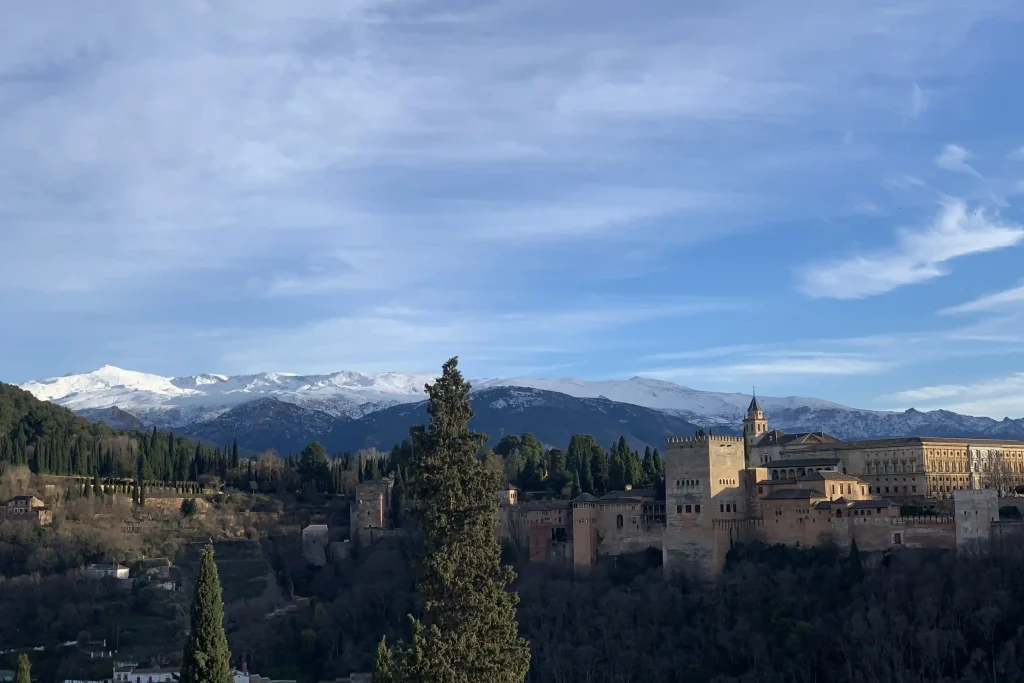
Mirador de San Nicolás
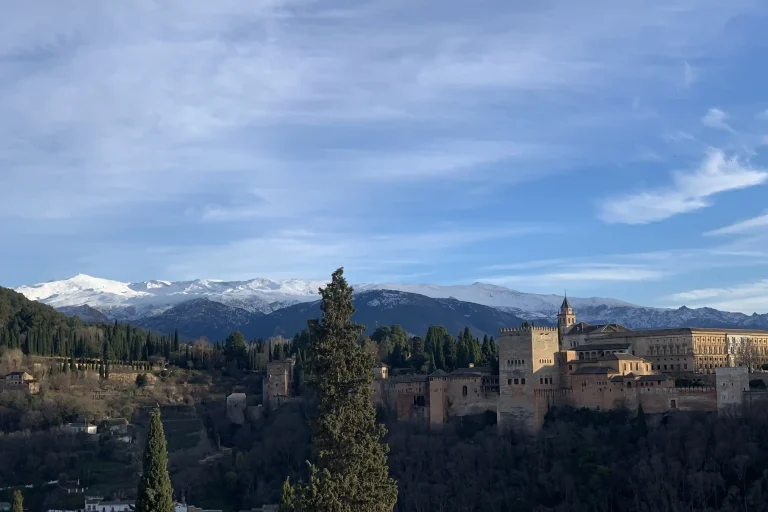
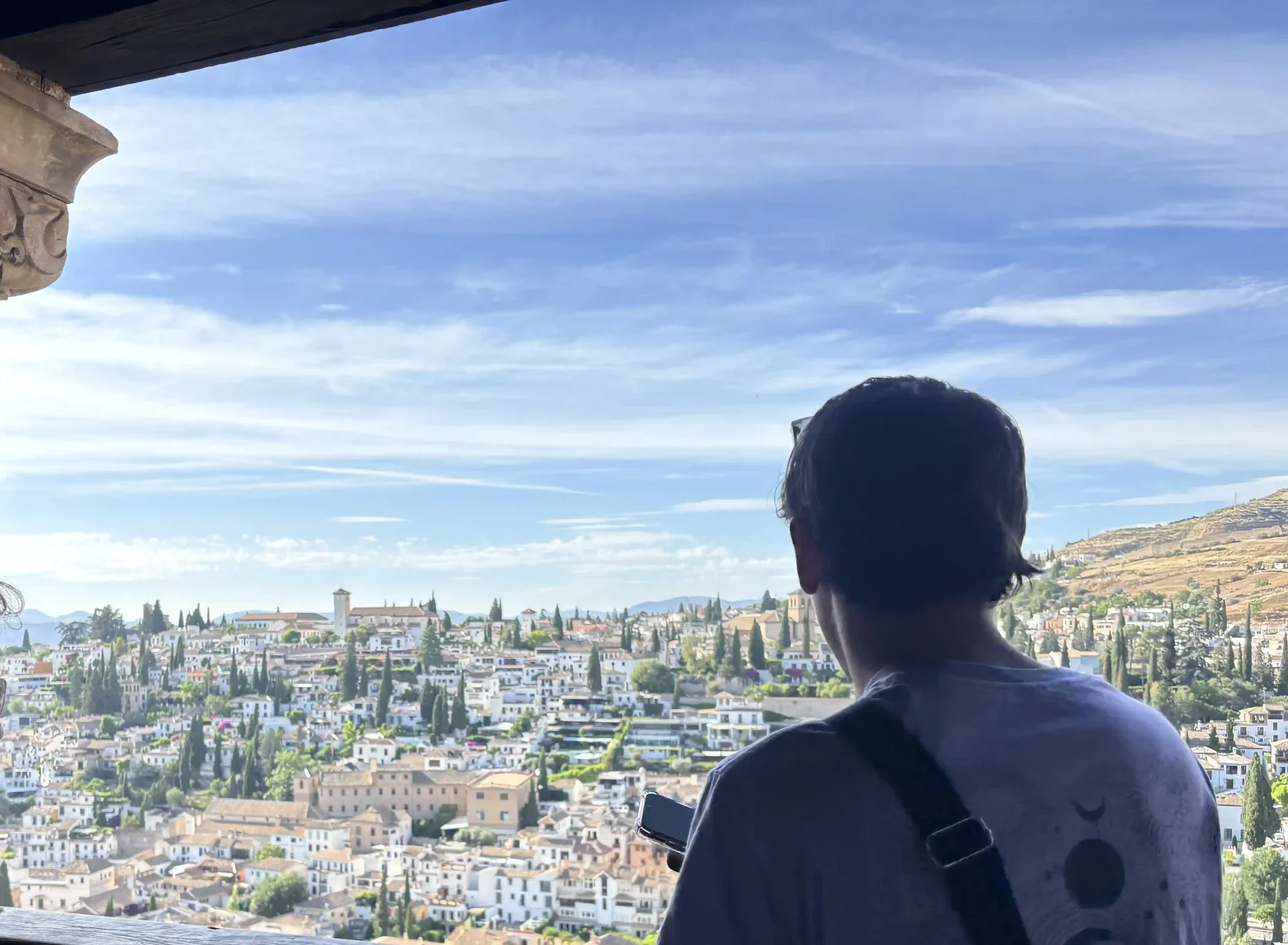
The Mirador de San Nicolás is probably the most famous viewpoint in Granada. It is the highest point of the Albaicín and one of the city’s true landmarks. From here, one of Granada’s most iconic views unfolds: the Alhambra dominating the opposite hill, with the Sierra Nevada in the background. It is a composition so perfect that it feels deliberately designed. During an official visit, Bill Clinton called it “the most beautiful sunset view in the world.” And, honestly, it’s hard to disagree.
If you arrive at the right time, as the sun begins to set, the light turns golden and the Alhambra seems to glow from within. It’s one of those images that stay with you long after the journey ends. In winter, the snow-covered peaks of the Sierra Nevada add an extra layer of magic. In those moments, Granada truly feels enchanted.
Behind the viewpoint stands the Iglesia de San Nicolás, built in the 16th century after the Christian conquest, as often happened in the city, on the remains of an ancient mosque.
The church has a sober, almost austere architecture, the result of the many events that led to its destruction and reconstruction over time. The bell tower is actually the former minaret. And if you find it open, go up: from there Granada is even more beautiful, quieter, and more intimate.
Just a few steps from the church of San Nicolás is the Mezquita Mayor de Granada, Granada’s new mosque, built in recent times.
The outdoor spaces are freely accessible (the interior is reserved for worshippers), and it is truly worth coming this far. From here you can enjoy a splendid view over Granada and the Alhambra, very similar to that of the Mirador de San Nicolás, but with a completely different atmosphere.
There is less crowding, less noise, less improvised music. It is a place that invites contemplation, rather than the perfect photo.
If you want to stop for a few minutes in silence, breathe, and look out over Granada from above without haste, this is one of the best places to do it. A small secret, just a short walk from the city’s most famous mirador.
There are also other beautiful viewpoints that are less crowded than San Nicolás, such as the Mirador de la Victoria.
This is the moment when we can decide whether to continue exploring the Albaicín or head towards the Sacromonte. In this article we continue through the Albaicín, but if you also want to take a look at the Sacromonte, I’ve shared some tips in the article about Granada.
Choosing to stay in the Albaicín, we walk along Calle San Nicolás and pass by an ancient original Nasrid fountain. Just think, I walked past it in 2025 and it was still working, perfect for refilling a water bottle before the next climb!
We then head towards the Cuesta María de la Miel, where the climb really begins.
If you walk it distractedly, the Cuesta María de la Miel might seem like just another uphill street. But slow down for a moment and you’ll notice one of its most fascinating features: the doors of the noble houses.
Worn stone lintels, solid wooden doors, wrought-iron details, hand-painted house numbers, ceramics. In the Albaicín, the door is always a clear threshold: outside the alley, inside a private world made of patios, water, and silence. That’s where beauty hides itself, sometimes revealing branches of orange blossoms emerging from the walls, or unruly bougainvillea coloring the rooftops.
But this street is important for another reason as well. From here you reach one of the most significant points in the entire neighborhood: the Arco de las Pesas.
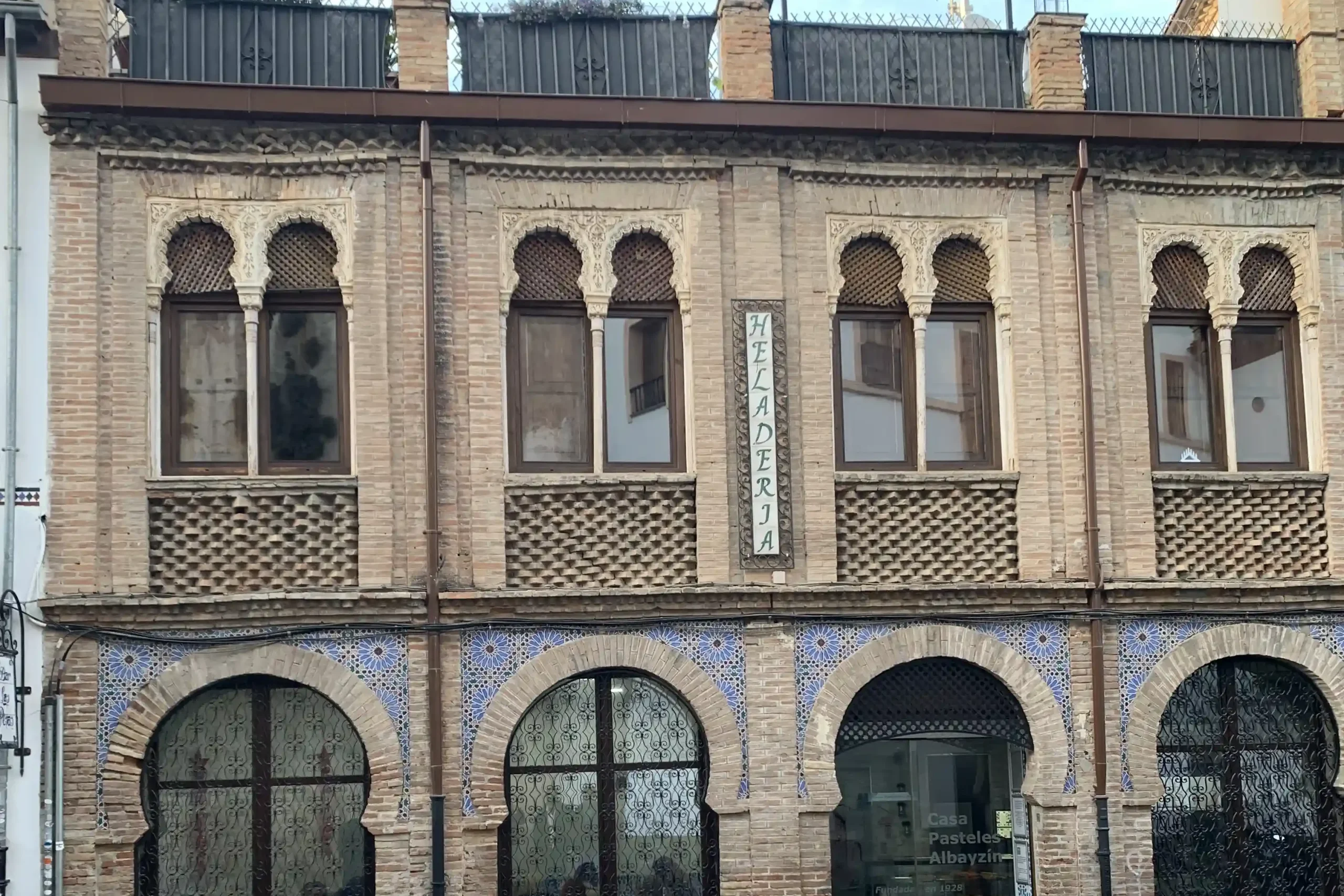
Arco de las Pesas
Also known as Puerta Nueva or Puerta de las Pesas, it was an ancient gateway to the Albaicín—and to the city of Granada—back when the sultan’s seat had not yet definitively moved to the Alhambra. It formed part of the city walls and served both a practical and a symbolic function.
Its current name, de las Pesas, comes from a curious (and very effective) custom: false weights confiscated in the nearby Plaza Larga market were hung on the walls of the gate as a public warning (still visible today). Apparently, even in the past, people tried to cheat!
Built in the classic Islamic defensive style, using brick, earth, and stone, the gate features the typical bent entrance designed to make direct access from the outside difficult and to facilitate defense from within. You can still spot the battlements, the remains of towers, and even a cannon opening—details that tell the story of an Albaicín that was not only inhabited, but defended.
Once you pass through the arch, Plaza Larga opens up, still preserving its original layout. Here—especially during the local market on Tuesdays and Saturdays—neighborhood life remains authentic, everyday, and less touristy.
Nearby, if you want to stop for a drink or some tapas, there’s also Plaza Aliatar: a very quiet, little-visited square where you can truly appreciate the city’s tapas.
Crossing back through the Puerta de las Pesas, we continue walking—this time right alongside the ancient walls—and head toward the Palacio de Dar al-Horra.
We pass through Calle Aljibe de la Gitana, until we reach the Carmen del Aljibe del Rey. And here, once again, Granada surprises.
Carmen del Aljibe del Rey
The Carmen del Aljibe del Rey is one of the most important and least touristy places in the entire city. It was not created as a romantic garden or a postcard-perfect viewpoint, but as a vital piece of infrastructure. At the heart of it all lies the Aljibe del Rey, the largest Islamic cistern in Granada.
The name del Rey is no coincidence: this cistern was likely managed directly by the authorities and intended to supply water to the most important buildings and to a significant portion of the population. In practical terms, the survival of the Albaicín depended on this place.
What’s curious is that many people from Granada have never visited it, even though admission is generally free. Perhaps because it is not spectacular at first glance, perhaps because opening hours are limited (it’s best to check in advance on the official website of the Fundación AguaGranada). But if you’re looking for a place that truly explains how the city functioned, this is one of the most enlightening stops.
Here you understand that the Albaicín is not just a “beautiful” neighborhood: it is a complex organism, built around water, slope, and necessity.
Just a little further on is the Huerto del Carlos, a simple green space, almost domestic in feel, that seems designed for stopping for a moment and catching your breath. The curiosity here is that it is not named after Charles V or any other king, but after the man who once tended the garden of the nearby convent, Señor Carlos.
And so we finally arrive at the Palacio de Dar al-Horra.
Palacio de Dar al-Horra
The Palacio de Dar al-Horra is a stop I particularly love because, although it is included in the Dobla de Oro, it is never crowded and always feels very intimate. Still, always check the official website to see if it is open and what the visiting hours are.
We are in the heart of the Albaicín, standing in front of a 15th-century Nasrid royal palace, built during the final, extremely delicate years of the Kingdom of Granada. This was the residence of Aixa al-Horra, mother of Boabdil, the last Nasrid ruler. And no, she is not a secondary figure: Aixa was a powerful, educated, politically astute woman, one of the strongest personalities of the entire final phase of al-Andalus.
According to tradition, it was she who uttered one of the most famous — and most ruthless — phrases in the history of Granada. When Boabdil, forced to abandon the city after the surrender of 1492, turned to look one last time at the Alhambra and burst into tears, Aixa is said to have told him:
«Llora como mujer lo que no supiste defender como hombre.»
Weep like a woman for what you did not know how to defend like a man.
The name Dar al-Horra roughly means “House of the Noblewoman” or “House of the Honorable Lady,” a reference to its function as the residence of the sultana.
From an architectural point of view, Dar al-Horra is a perfect example of Nasrid domestic architecture. Everything revolves around a central courtyard, with a small square pool that reflects the light. Around it are rooms decorated with delicate stucco and carved wood, without excess, yet with a constant sense of refinement.
There is also a tower, and if the sky is clear it is well worth climbing up: from there, your view takes in the Albaicín and, in some spots, reaches as far as the Alhambra and the surrounding mountains.
During the visit, you can observe:
- the central courtyard with its square pool;
- the original stucco and wood decorations;
- the noble rooms, designed for the everyday life of the court;
- the panoramic tower, discreet yet evocative.
The Palacio de Dar al-Horra is not as large as the palaces of the Alhambra, and perhaps that is precisely its greatest strength. Here, everything feels more intimate, more human, closer to real life.
It is the ideal place to understand how the highest members of the Nasrid court lived outside the great monumental complex, far from the representation of power and closer to everyday life.
Immediately after the Christian conquest, this palace too was assigned to Christian nobles loyal to the Crown, as a political reward granted to those who had supported the war of conquest economically or militarily. Later, the palace was incorporated into the complex of the Monastery of Santa Isabel la Real, founded in 1501 at the will of Queen Isabella of Castile. Dar al-Horra was transformed into a female convent, linked to a community of cloistered nuns.
Many original architectural elements were preserved, adapted, and incorporated into this new function. And this conventual role would last for centuries, right up to the modern era. Only in the 20th century, with the reorganization of historical heritage, did Dar al-Horra finally pass to the State, which recognized it as a cultural asset to be protected and shared with the world.
The Palacio de Dar al-Horra also had a leisure residence outside the city walls: the Alcázar (or Alcazaba) del Genil, next to the Genil River. It was a residence set among orchards, gardens, and water: an almunia, meaning a country villa that combined pleasure with agricultural function. If you want a simple comparison, it was a bit like the Generalife in relation to the Alhambra: a place where the court could breathe, move away from the center, and find calm and freshness.
Today the image is almost disconcerting: the ancient complex has been largely swallowed up by the modern city, and what remains is mainly a pavilion (qubba) that has survived among contemporary buildings.
Inside, there are still stucco decorations, ornamental motifs, and Arabic epigraphic inscriptions with formulas of praise to Allah and to the ruler who had it built.
In popular memory, it is often linked to the female figures of the court, especially Queen Aixa (mother of Boabdil), as the “queen’s garden” and a residence of peace and retreat. Beyond legend, what is certain is its role: a courtly refuge connected to the landscape of the Vega and to the logic of water, so important in Islamic Granada.
Practical visit: it is located just outside the city and is not a monument with a standard ticket office, but it can be visited during limited hours, as it now houses the Fundación Francisco Ayala. Visits are generally possible from Monday to Friday, 9:00–14:00, without prior booking (groups must arrange in advance). Admission is usually free. On some occasions, special openings or guided visits related to cultural activities are organized.
If you’re in the area—perhaps because you’re parking in the nearby car park—take advantage of it!
And as we continue walking, if you feel like making a small detour of just a few meters, you’ll reach the Puerta Monaita, one of the city’s ancient gates: less famous than others, but genuine and authentic.
Now that we’ve explored the Albaicín all the way to its highest point, there’s only one thing left to do: head back down towards Plaza Nueva, with Calle Calderería Nueva as your destination, and get deliberately lost along the way. Forget the map, slip into the side streets, stop where you hadn’t planned to. Take the chance to look at the city from above, from places like the Ojo de Granada or the Mirador de la Lona.
Look for views of the Alhambra that aren’t marked anywhere, peek into small workshops, buy something simple and local from a neighborhood shop. That’s how I discovered some of the most simple and authentic corners of the Albaicín.
One such place is Plaza de San Miguel Bajo.
Plaza de San Miguel Bajo
The name comes from the Iglesia de San Miguel Bajo, which overlooks the square. Bajo (“lower”) is not a random detail: Granada has several churches dedicated to Saint Michael, and this one indicates the church located in the lowest part of the Albaicín, compared to the others on the hill.
In my opinion, it is one of the most authentic and pleasant squares in Granada. It’s not a “postcard” square, with grand monuments or major historical landmarks. I like coming here because local life still survives, despite tourism. In the evening it becomes a spontaneous meeting point: no loud music, no staged performances. Just people sitting, chatting, children playing, glasses resting on small tables.
And then there is the light: in the late afternoon it filters between the houses and gently hits the church façade, almost golden. A simple moment, but a beautiful one.
Continuing downhill towards the city center, you finally reach Calle Calderería Nueva, today known by everyone as the street of the teterías.
Calle Calderería Nueva
In medieval times, this area was something completely different. Here there were artisan workshops, noisy and active, closely tied to the city’s everyday life. Utensils and calderos were produced here—the pots that gave the street its name.
The term Nueva serves to distinguish it from Calderería Vieja, located a little higher up, already in the heart of the Albaicín.
For centuries, Calderería Nueva was a popular, inhabited, functional street.
The major change came in the 1980s and 1990s, when the growth of tourism led Granada to rediscover—and partly reinvent—its Andalusí past. The street filled with Arab- and North African–themed shops, creating the image we know today.
The question arises naturally: is it authentic or is it “fake”? I ask myself that every time I walk through it.
In all honesty, I think it’s both. It’s not a medieval Muslim quarter preserved intact, nor a souk that has survived unchanged through the centuries. But it is still part of the city’s historical layout, and this is where the commercial and productive soul of Granada truly once beat.
Even the famous teterías are not a direct medieval tradition: they arrived later, together with tourism and Moroccan influence. But, as Granada has often done throughout its history, it has known how to welcome new cultures and traditions, make them its own, and weave them into its story.
Teterías are mainly concentrated between the historic center and the Albaicín, the neighborhood that more than any other preserves the city’s Arab imprint. Stepping inside means changing pace: low lighting, scents of mint and spices, cushions, low tables. These are not places meant for quick consumption, but for stopping, speaking softly, or remaining in silence.
The most common tea is mint green tea, slowly poured from a teapot held high, following a tradition that comes from the Maghreb. Alongside it, you’ll find spiced blends, black teas, sweet infusions, often accompanied by Arab pastries made with honey, almonds, and sesame.
Historically, tea was linked to moments of meeting, reflection, and hospitality. It wasn’t drunk to quench thirst, but to share a space and a moment. This meaning has been preserved in Granada, where the tetería is a kind of urban refuge, far from noise, rush, and street life.
Unlike bars, teterías don’t have rigid hours or an imposed rhythm. You enter, you stay, you observe. They are places frequented by students, residents, and curious travelers, but rarely by noisy groups. Here, conversation is hushed and silence never feels uncomfortable.
My favorite is the Tetería del Bañuelo, because in addition to offering a beautiful view of the Alhambra, it’s a bit overlooked and has something authentic about it, making the tea ritual feel less like a historical reconstruction or a tourist attraction.
Drinking tea in Granada means allowing yourself a real pause. And perhaps it’s one of the simplest and deepest ways to tune into the character of the city: introspective, layered, and quiet.
Where to taste the authentic flavors of the Albaicín
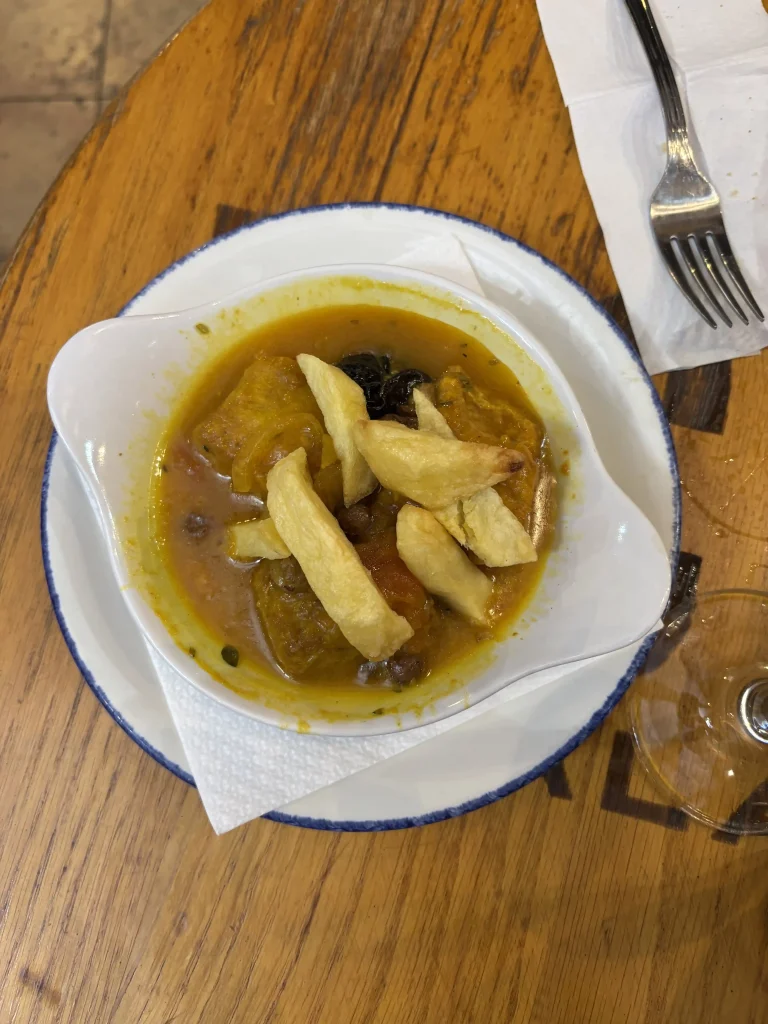
In the heart of the Albaicín, you can sample hearty dishes such as rabo de toro, pulpo a la brasa, and other local meat dishes, as well as tapas and classic Andalusian specialties like berenjenas fritas con miel (fried eggplant with honey), habitas con jamón, patatas a lo pobre, and remojón granadino. But this neighborhood is especially famous for caracoles (snails). In the Albaicín, there are bars renowned for this dish, often served in a spicy sauce.
A classic place to try them is the bar known as Los Caracoles / Bar Aliatar in Plaza Aliatar. It’s famous for this dish served in spicy sauce and is popular with locals as well.
For the more adventurous, there is another typical dish: tortilla del Sacromonte, a combination of brains, testicles, and eggs. I’ve never had the courage to try it!
Other restaurants I recommend, scattered throughout the neighborhood, are:
- Carmen Verde Luna: probably the most panoramic restaurant in the Albaicín, located at the Mirador de San Nicolás. The menu is based on traditional Andalusian cuisine, but people mainly come here for the atmosphere.
- Taberna Salinas: on Calle Elvira. It’s at the top of the list of the best tapas bars in the Albaicín area and is loved by locals for its location and excellent tapas. If you’re unsure what to choose, here are three tapas you absolutely have to try: meatballs, crispy potatoes, and spinach salad with goat cheese.
- Restaurante El Trillo: dining takes place inside a patio full of plants and flowers, with views of the Alhambra. The cuisine is typically Andalusian and Granadan, but thoughtfully reinterpreted. Prices may be a bit higher than average, but everything is delicious.
- Bar Aixa: a true local institution in the Albaicín. It’s a traditional tapas bar with home-style cooking and zero gourmet pretensions. It’s located in Plaza Larga, and here too you can enjoy the Albaicín’s famous caracoles.
- Al Sur de Granada (lower Albaicín): technically an organic shop, but in practice it’s one of those places that makes you want to stay. Simple, genuine dishes made with good ingredients. A very successful mix of modern and home-style cooking. I love it!
As you may have understood, the secret to truly understanding the Albaicín is simply to wander through its streets: discovering unknown spots where the Alhambra suddenly appears, noticing house façades with Arab remnants embedded in the walls, patios that were once orchards or gardens; and even the walls themselves, often worn by time, which still tell the story of the art and techniques of the al-Andalus period.
I believe the Albaicín was perfectly described by Manuel de Falla, who lived in Granada and often frequented the Albaicín: “El Albaicín guarda el alma de Granada.”
It is a profoundly true sentence.