Pont de Gau Ornithological Park: the paradise of pink flamingos in the heart of the Camargue
Just 4 km north of Saintes-Maries-de-la-Mer, along the road to Arles, lies one of the most precious natural gems of the Camargue: the Pont de Gau Ornithological Park. Sixty hectares of wetlands, paths over the water and hundreds of bird species in their natural habitat, with pink flamingos as the absolute stars of the scene.
The park is located in the heart of the Camargue Regional Natural Park, a protected area declared a UNESCO Biosphere Reserve.
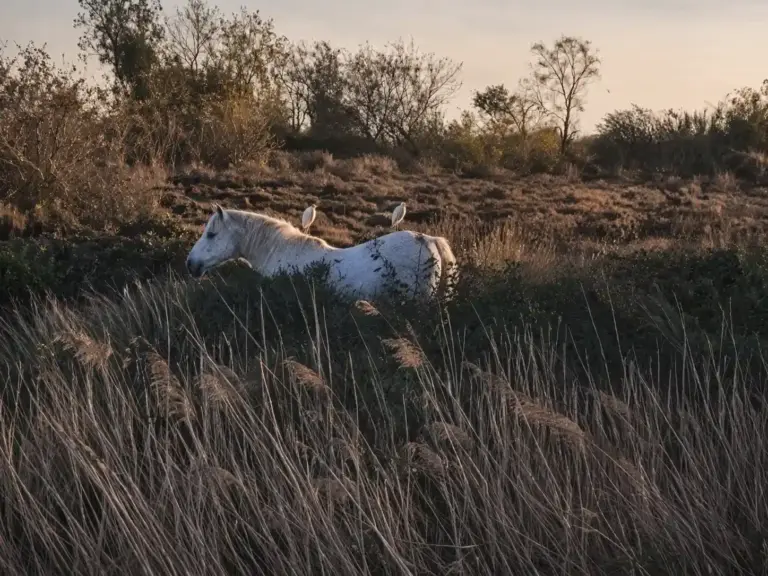
What few people know is that the Pont de Gau Park is not a public site. It is a private property within that territory some people call the “French Far West”: landscapes suspended between land and water, gardians raising black bulls among marshes and rice fields, white horses galloping freely on the horizon.
Although it is an attraction for tourists and birdwatching enthusiasts, the habitat has remained wonderfully authentic: the kind of place that gives you images that are hard to forget.
Its role in the ecosystem of the Camargue is fundamental. And, in all likelihood, so will its role be in your stay.
Now I’ll explain why.
Here are some practical tips that I hope will help you organize your visit to the Parc Ornithologique du Pont de Gau in the best possible way.
How to get to Pont de Gau Ornithological Park
The Parc Ornithologique du Pont de Gau is located along the D570 road, a few kilometers before Saintes-Maries-de-la-Mer, in the heart of the Camargue.
- By car: this is the most convenient option. From Saintes-Maries-de-la-Mer it is only a few minutes away, while the approximate driving times from the main cities in the area are: 30 minutes from Arles, 50 minutes from Montpellier, 50 minutes from Nîmes, 1 hour from Avignon, 1 hour and 15 minutes from Marseille, and 1 hour and 15 minutes from Aix-en-Provence. On the road, just before the entrance, there is a small free car park on site, although on busier days it may be paid and a little crowded. Try to arrive a little early so you have time to look for an alternative or wait for another visitor to free up a parking space.
- By bus: I haven’t tried it personally, but the park’s official website clearly indicates line A50, which connects Arles to Saintes-Maries-de-la-Mer, line A50, Pont de Gau stop. Have a look at the Envia website for general timetables and to get an idea of the available schedules and lines.
- By bike: since it is only 4 km from Saintes-Maries-de-la-Mer, arriving by bicycle is perfectly doable via the D570, which has a cycle shoulder. During your visit, you can leave your bike safely inside the park.
- On foot: technically possible, but it is not the option I would recommend in hot weather, with children or if you have little time: it is only a few kilometers, but the road is completely exposed to the sun and quite busy.
How to plan your visit to Pont de Gau Ornithological Park
- The park is open every day, except on December 25. During holiday periods, always check the website. Opening hours change depending on the season. From April 1 to September 30, the ticket office is open from 9:00 am to 6:00 pm, while from October 1 to March 31, the opening hours are from 10:00 am to 5:00 pm. One useful thing to know is that the ticket is valid for the whole day, so you can enter, leave and come back in whenever you like. Another interesting detail is that once you are inside, you can stay as long as you want until closing time. In fact, the exit remains open until sunset and is therefore independent of the official reception hours.
- Route: there are two routes, a shorter one to the south and a longer one to the north. My advice is to do both, because although the shorter one offers a spectacular view of the pink flamingos, the second offers a much more real and wild landscape.
- Visit duration: the recommended visit time is 2-4 hours, depending on the trail chosen. On average, you can allow between 1.5 and 2.5 hours to walk each trail calmly and enjoy the observation.
- As for the 2026 prices, admission costs around €8 for adults, €5 for children aged 4 to 12, while children from 0 to 3 enter for free. Group rates are available from 15 people. Accepted payment methods are bank card, cheque and cash.
- The park is also quite convenient from a practical point of view. The trails in the short section are fully accessible to people with reduced mobility, there are areas where you can have a picnic, and from April to September there is also a kiosk open for refreshments. The longer trail, on the other hand, is more rustic and the passages are not always easy.
- Pets are not allowed, something worth knowing before arriving with your dog.
- Watch out for mosquitoes! This is essential advice: if you go in summer, bring a powerful repellent with you, especially for sunset. This is their home!
When to go to Pont de Gau Ornithological Park
- The best period, in my opinion, is between April and September, when the visit is more pleasant and there are fewer light-related issues compared to the shorter days. If your goal is to see the flamingos, you should know that they can be spectacular both in summer and in winter.
- From December to February, the days become a little too short, and if the Mistral is blowing, it can be a real obstacle. The positive side, however, is that this is the perfect time to see the courtship displays of the flamingos.
- For photography, try to arrive in the early morning or in the late afternoon, when the light is softer and the colors of the ponds become much more beautiful.
A little history of Pont de Gau
The history of the Pont de Gau Ornithological Park is, above all, a story of family and passion passed down from generation to generation.
It all began in 1949, when André Lamouroux, a passionate Camargue ornithologist, decided to open a small area with aviaries to the public, where visitors could see some of the bird species of the Camargue. At the time, it was what people called a “small zoological park”: nothing more, nothing less.
The real turning point came in 1974, when his son René took over. René had something completely different in mind for the park: no longer a traditional zoological park, but a space dedicated to the protection, discovery and awareness of Camargue nature.
His choices were bold and ahead of their time. He replaced the old cages with large aviaries in which he recreated the natural biotope of each species. He bought 12 hectares of adjacent marshland and transformed them into an area for the protection and discovery of nature. He created trails immersed in this new space, designed to welcome as many wild species as possible. He built artificial islands, planted thousands of trees and shrubs, and installed large, accessible information panels to guide visitors.
In 1987, René took another step forward: he leased the marais de Ginès from the Camargue Regional Natural Park, bringing the total estate to the current 60 hectares. From that moment on, the park never stopped growing, becoming one of the most important natural sites in the region and attracting thousands of visitors from all over the world every year.
Today, management has passed to the third generation of the Lamouroux family — the founder’s grandchildren — who continue the project with the same passion and dedication as those who started it.
The result is a protected natural space that no longer has anything to do with the small zoological park of 1949. Sixty hectares including marshes, ponds, canals, reed beds, salt meadows and open grasslands: a variety of habitats that encourages the presence of an extraordinary number of species, both resident and migratory. A true paradise for birdlife, and not only for birdwatching enthusiasts.
The routes for visiting the park
The park offers 7 kilometers of fully equipped walking trails, winding through natural environments that are very different from one another. There are two main routes, with very different characteristics and atmospheres.
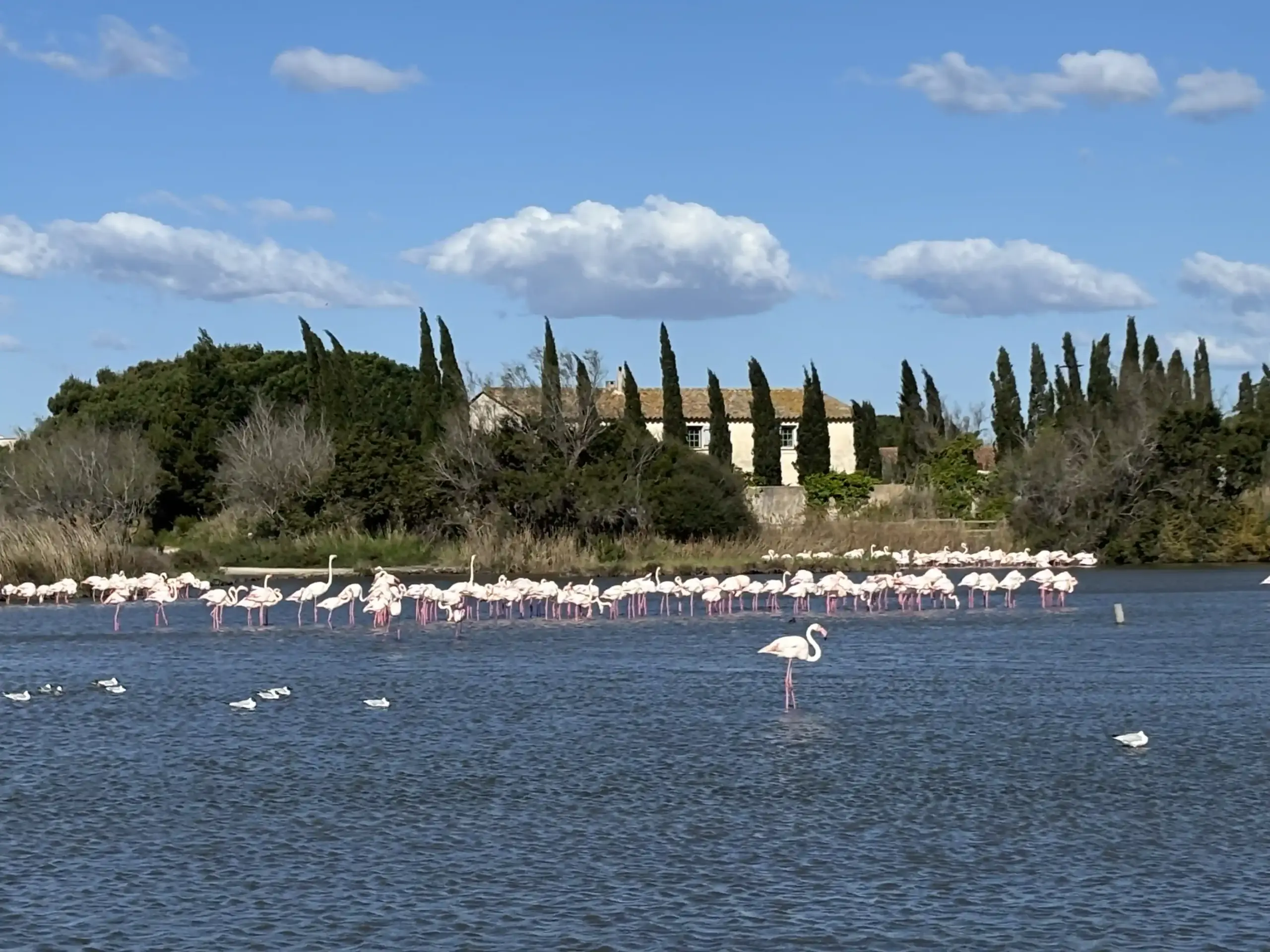
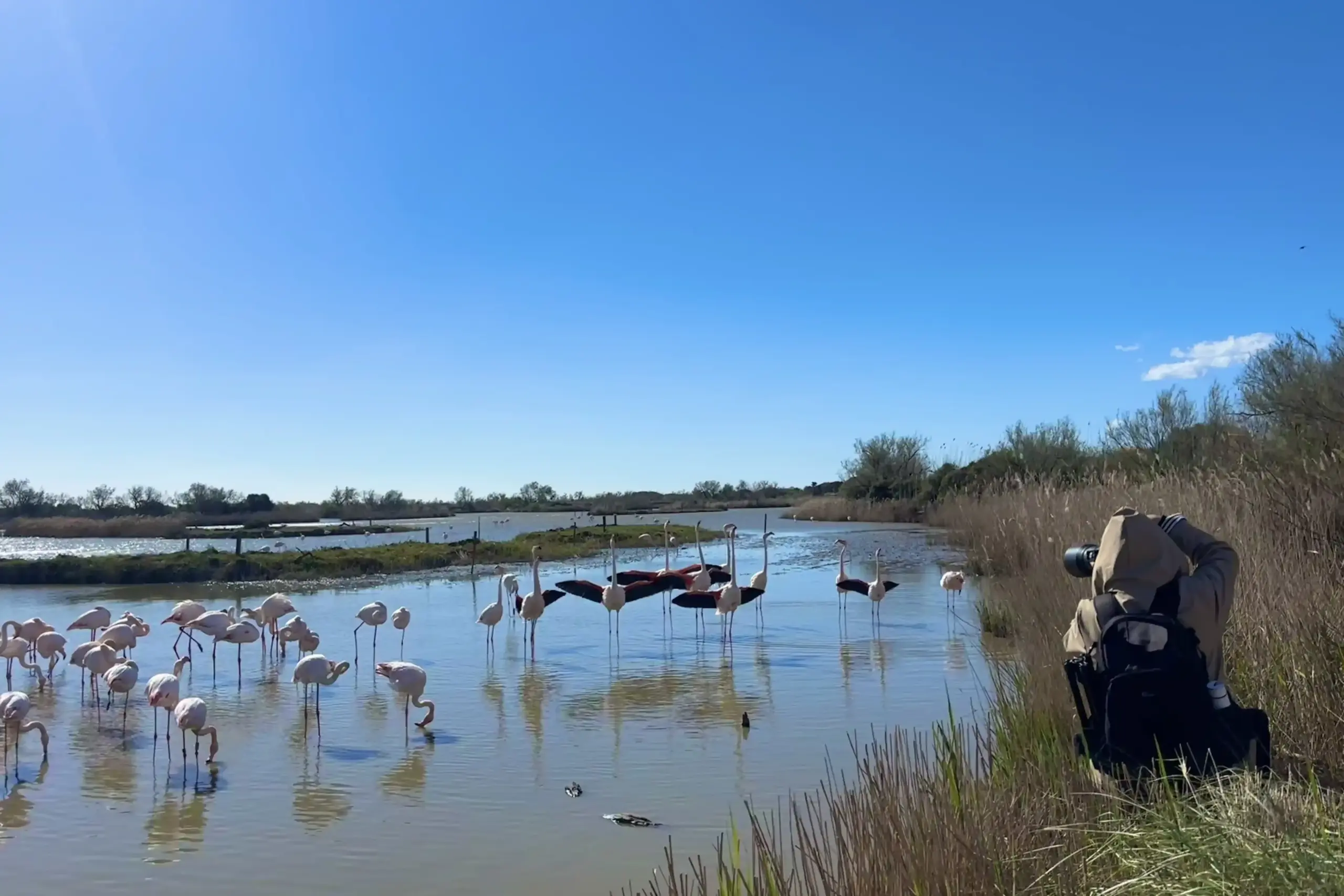
The South Route (2.6 km) is the central part of the park, easily accessible and perfect for starting your visit. The trail winds between two ponds occupied by a large colony of pink flamingos, which you can approach at a distance that surprises you every time. You will see them in every possible way: some in flight, others sleeping on one leg, others honking freely around you. It is fully accessible for people with reduced mobility and is the ideal route for those traveling with small children. Along the way, you will find explanatory panels about the species you can observe, hides and observation towers, as well as panoramic terraces. A beautiful experience, whatever your level of interest in ornithology.
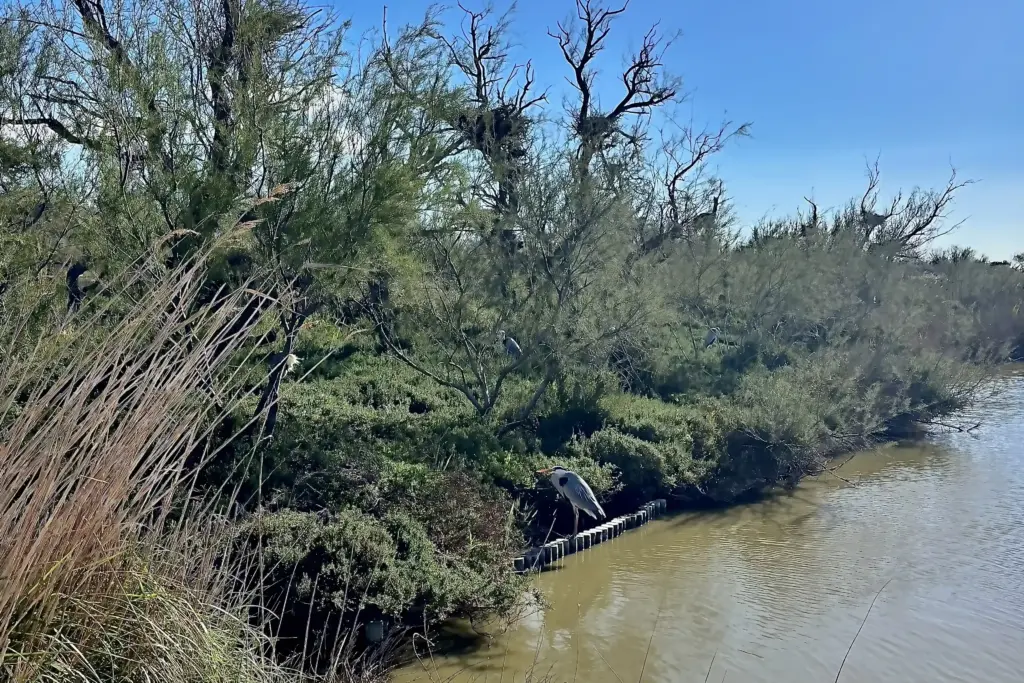
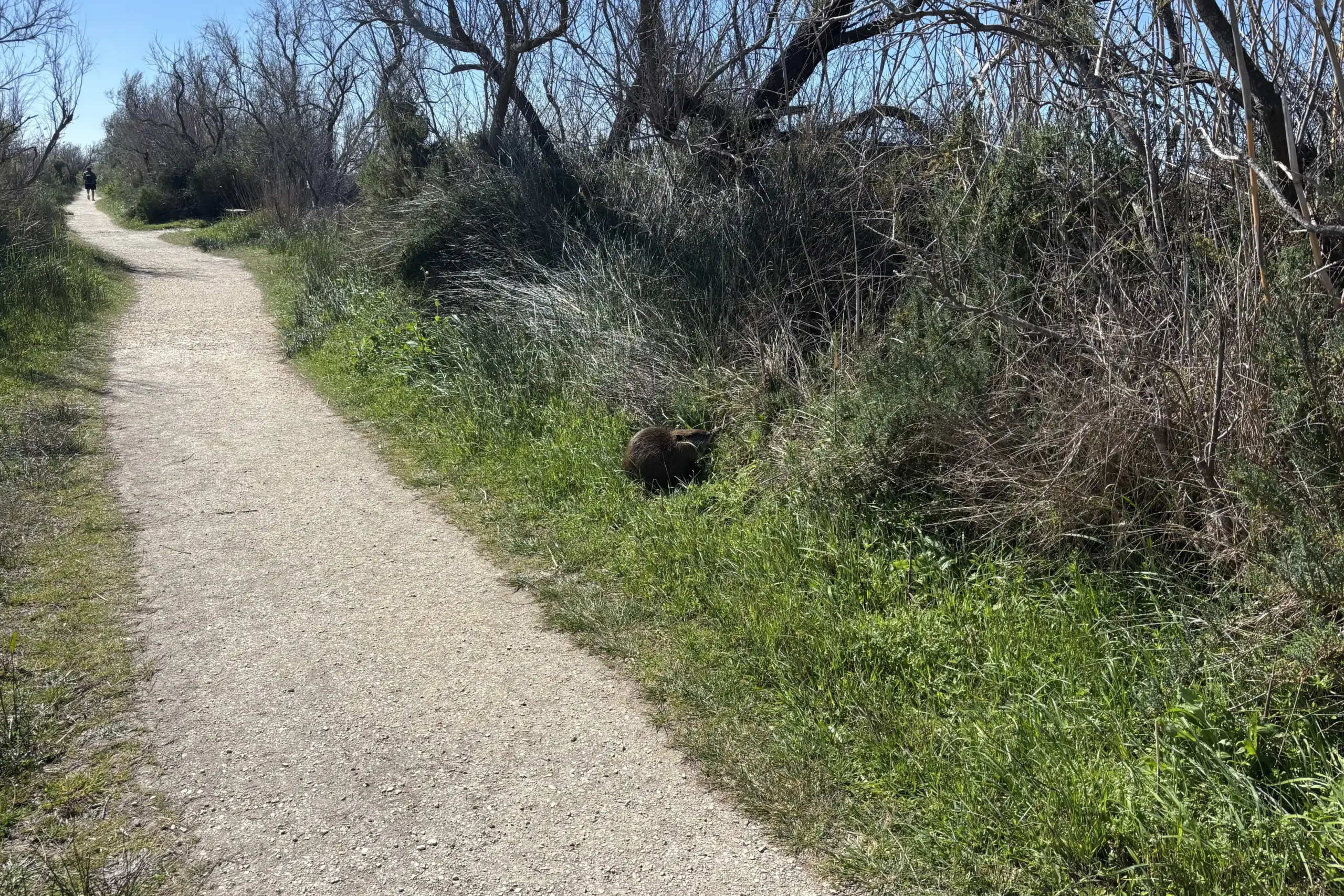
The North Route (4.3 km) is wilder and partly runs along the Ginès pond, owned by the Camargue Regional Natural Park. It offers a more complete view of the diversity of the Camargue, especially thanks to a cleverly positioned observatory where you can calmly observe various species of ducks — gadwall, mallard, shelduck, wild goose — as well as birds of prey, herons, rails and, of course, pink flamingos. But along this route you may spot not only birds: I came across a coypu — surprisingly large, I warn you — lizards and other animals that live in the salt marsh areas.
Although the South Route is the most scenic thanks to the flamingos, the North Route remains, in my opinion, the most authentic and surprising. There are fewer tourists, the observation is quieter and more intimate, and the discoveries along the way are often unexpected.
The pink flamingos of the Camargue
On the South Route, the undisputed king is the pink flamingo. But the first curiosity to know about these extraordinary birds is that they are not born pink at all. The chicks hatch with grey or dirty-white plumage and a beak that is still straight, not curved. It takes almost two years for them to start developing their iconic color, and the secret is entirely in their diet: they feed on spirulina, small crustaceans such as brine shrimp (Artemia salina), insect larvae and mollusks.
All these foods contain carotenoids — the same pigment that makes carrots red and pumpkins orange — and the most important one is called canthaxanthin. Once ingested, the liver transforms them and deposits them in the feathers, skin and beak. The more carotenoid-rich food a flamingo eats, the brighter pink it becomes. In captivity, if they are not fed correctly, they tend to fade until they become pale white. In the Camargue, however, the brackish lagoons are so rich in algae and crustaceans that the flamingos reach particularly intense shades of color.
If you visit the Camargue between December and the end of February, do not miss the courtship display. During this period, hundreds — sometimes thousands — of individuals gather in colonies and perform a hypnotic collective choreography: synchronized marching, wings spread to reveal the darker and more contrasting underside, guttural and rhythmic calls, and a stretching of the neck that resembles a collective bow.
The males, slightly larger and more colorful, try to attract the females, but unlike many other species where the male performs alone, among flamingos the display is a group event: the entire colony synchronizes to stimulate reproduction. Once the pair is formed, the two remain together for one season, sometimes for several years. To see this spectacle, January is the best month, preferably in the early morning when the light is low and the colony is more active.
The Camargue also holds a special record: it is the only place in southern France where greater flamingos nest regularly, with colonies among the most important in Europe. The main site is the Île de la Capelière, a protected island inside the National Nature Reserve, where thousands of pairs build their characteristic mud nests every year, shaped like small volcanoes and 20-40 centimeters high, to protect the single egg from brackish water, predators and the heat of the ground.
In 2023, more than 5,000 chicks were born in Capelière alone: an absolute record for the site. The female lays only one egg per season, rarely two, and both parents take turns incubating it for about thirty days. After hatching, the chick is fed with a reddish secretion produced by the parents’ crop, the so-called “flamingo milk”, which is also rich in carotenoids.
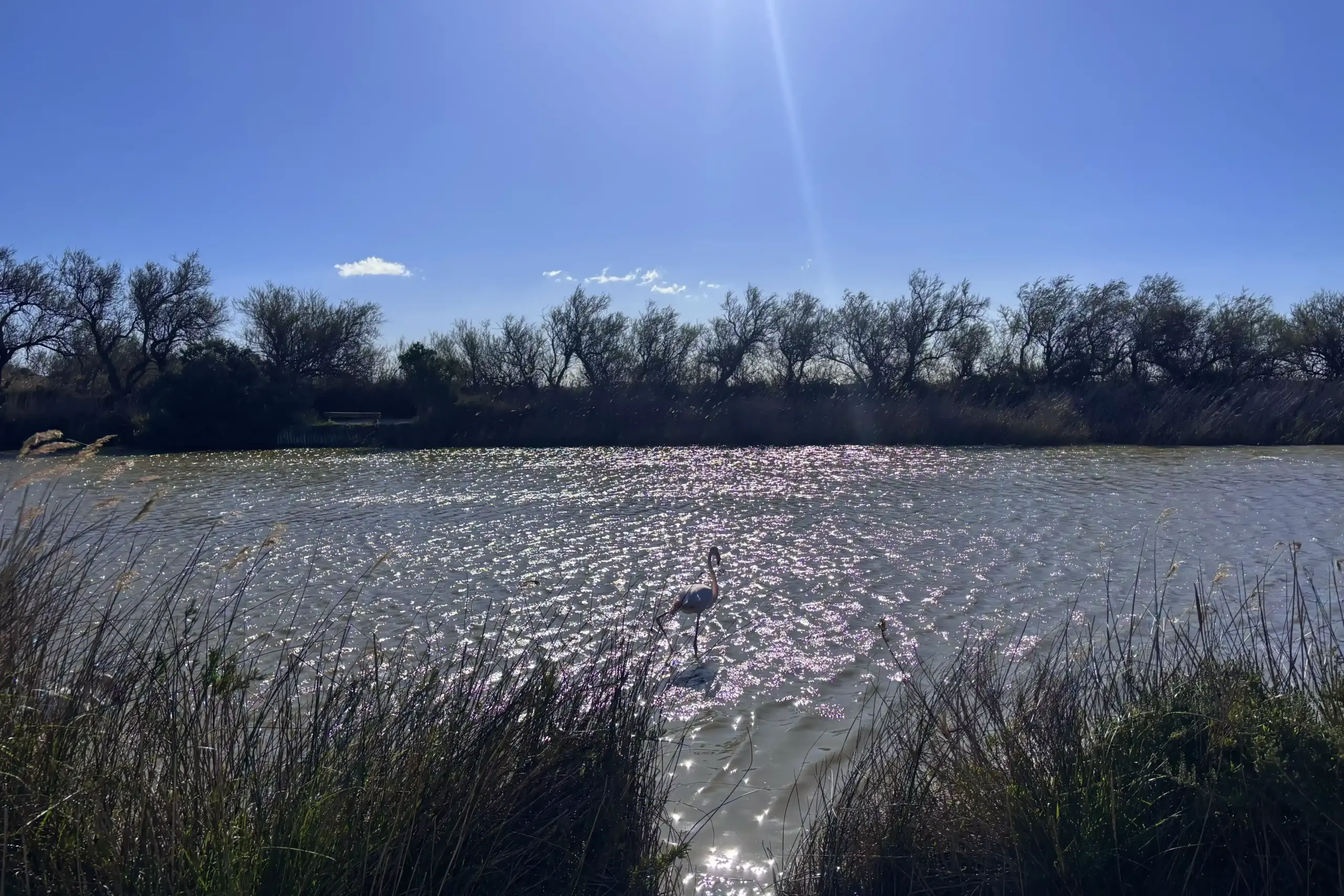
Even the names of these birds tell a fascinating story. Everywhere, the name evokes fire and light. The Italian word fiammingo, like the French flamant, the Spanish flamencos, the Portuguese flamingos and the German Flamingo, all derive from the Greek phoenicopterus, which meant “flame-colored”. But the most beautiful curiosity concerns the English collective term: you do not say “a flock of flamingos”, but a flamboyance of flamingos. The term was coined in the 1990s by a group of ornithologists who wanted something more poetic than the neutral word colony. There is no official equivalent in Italian, but una fiammeggiante would fit perfectly.
Speaking of flamingo colonies, you will notice that seeing a pink flamingo alone is a very rare, almost unnatural event. These birds are among the most social creatures in the animal kingdom and spend practically their entire lives in groups, known precisely as flamboyances or colonies, which can range from a few dozen to tens of thousands of individuals. It is not simply a preference: it is a true survival strategy that affects every aspect of their lives.
Group life is essential for reproduction. Flamingos never build a nest in isolation: they need thousands of other individuals around them to trigger reproductive behavior. Courtship displays would not be possible without a large group — it is the social pressure of the colony, the sight and sound of hundreds of individuals marching in sync, that stimulates hormone production and synchronizes the reproductive cycles of the entire colony. An isolated pair, even in perfect health, would hardly lay an egg. In the Camargue, this mechanism is so effective that the colony has grown from just a few hundred pairs in the 1970s to more than 20,000 nesting pairs in recent years.
In the Camargue, during the breeding season, the colonies become so dense that the mud nests literally touch one another, and the parents keep their distance by pecking if anyone invades their territory.
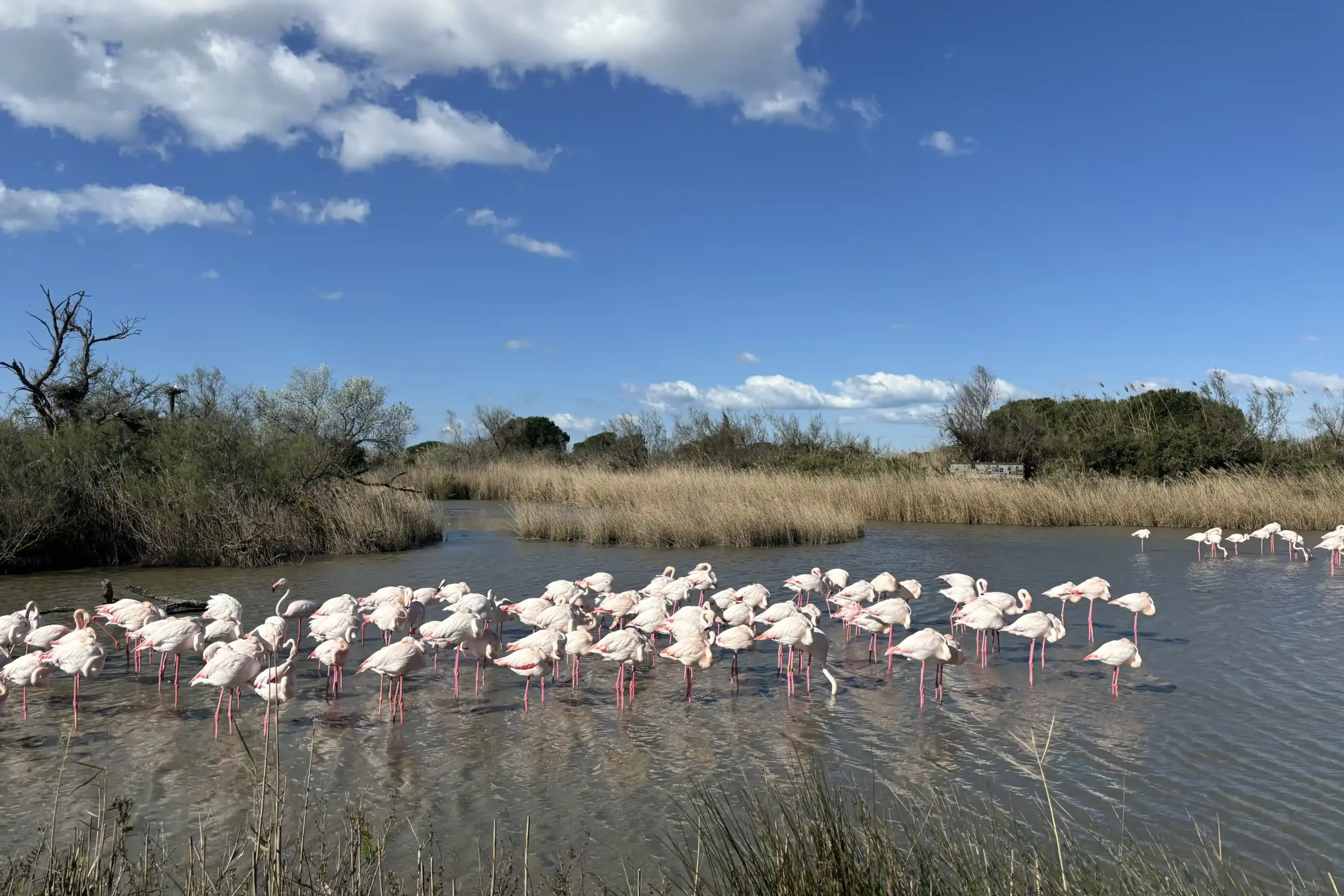
The group also offers extraordinary protection during sleep and rest. Flamingos often sleep standing on one leg, with their head tucked under one wing: a vulnerable position. Arranged in large groups, some individuals always remain awake and on guard, taking turns.
The very density of the group discourages many predators: attacking a compact group of thousands of birds is much riskier than isolating a single individual. When danger approaches, the entire flamboyance takes off simultaneously, creating an explosion of pink and black wings that disorients the attacker.
The flamingos within the group are not all the same either: they tend to form subgroups based on age, sex and reproductive status. The young, still lacking the intense pink color, often stay together in collective nurseries watched over by a few adults. Incubating pairs occupy the most central and protected positions, while non-breeding individuals remain on the edges. There is even a kind of visual hierarchy: the pinkest flamingos — the best-fed ones — occupy the most desirable positions. This means that when you observe a colony in the Camargue, you are not looking at a shapeless mass of pink birds, but at a complex and structured society, with unwritten rules passed down from generation to generation.
The group is also essential for feeding. Flamingos feed together, often lined up in orderly rows or concentric circles, moving their heads underwater with their characteristic upside-down motion. The collective movement helps stir up the bottom and resuspend in the water the small crustaceans and algae they feed on, making the meal more efficient for everyone. There is also a fascinating phenomenon called “behavioral contagion”: when one flamingo starts feeding in one spot, the others imitate it almost by reflex. In this way, the entire group can move in sync from one pond to another in just a few minutes, like a single pulsing organism.
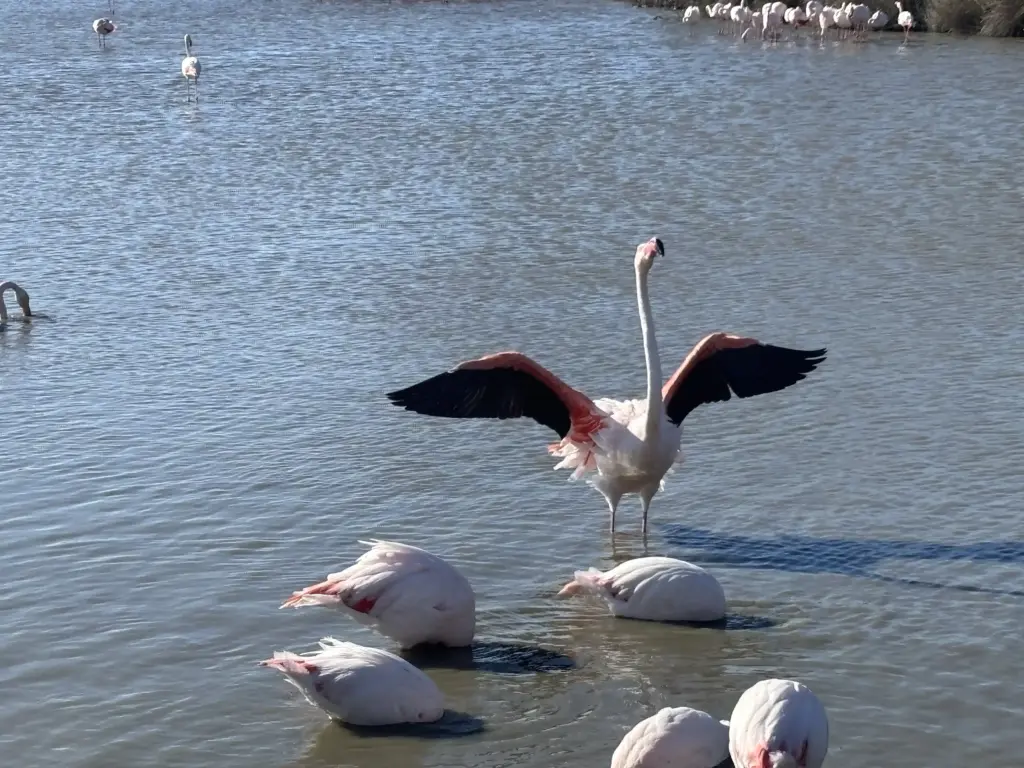
And speaking of feeding, there is an ingenious trick that few people know about. When you see a flamingo moving its head underwater upside down, it is not simply “fishing” at random. It is using a strategy that is unique in the bird world: its curved beak works the opposite way from others. It puts its head underwater with the beak pointing down, the upper mandible below and the lower one above. Then it moves its tongue back and forth ten to twenty times per second: the tongue, fleshy and spiny, pumps the water and traps small organisms, filtering on average twenty or thirty liters of water a day.
The beak is equipped with microscopic filtering lamellae, similar to combs, which retain prey while the water is expelled. With good binoculars, if you watch a flamingo carefully while it is feeding, you can see a very rapid and almost imperceptible movement of the jaw: that is the tongue at work. A true masterpiece of natural engineering.
Finally, one last curiosity about group life concerns flight. Pink flamingos are excellent flyers, contrary to what you might think when you see them walking awkwardly on land. When an entire flamboyance takes off, the spectacle is unforgettable: first, some individuals emit warning calls, then a small group rises into the air, immediately followed by all the others in successive waves. In flight, they arrange themselves in V formations or in long stretched-out lines, similar to those of geese, and they can travel hundreds of kilometers in a single night to move from one lagoon to another.
At sunset, you witness the most magical spectacle. The flamingos fly low over the water, heading towards their night roosts. The red light enhances their plumage, and the sky fills with what look like great flying flames, perfectly aligned, disappearing on the horizon. It is the most beautiful moment to watch them!
The other bird species
It would be a shame to think of the park as just a showcase for flamingos, because in reality it is a concentration of biodiversity where dozens and dozens of different species live side by side. The flamingos are certainly the undisputed stars, but the rest of the cast is just as fascinating.
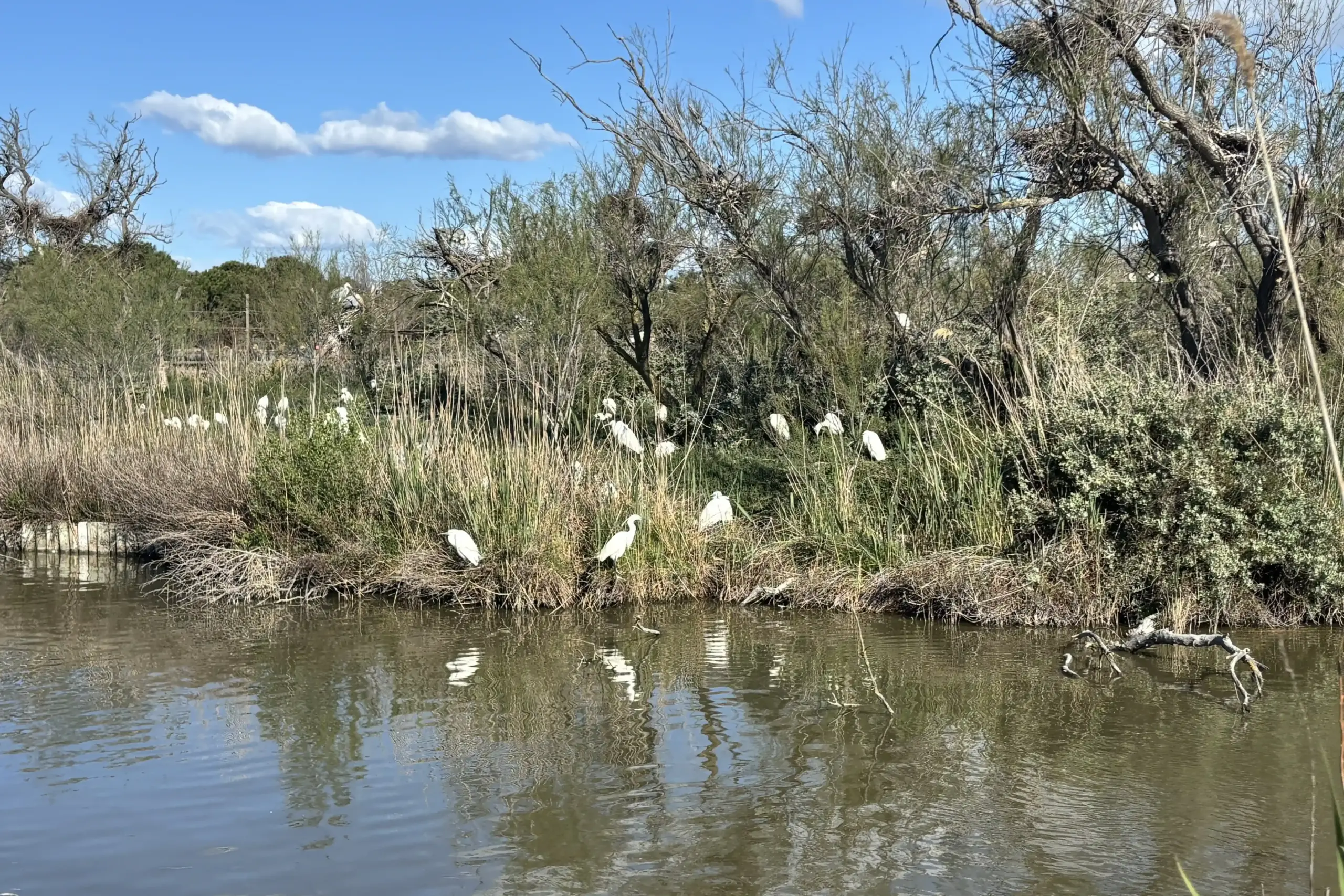
The park is a stage that changes constantly with the seasons. If you visit in spring or summer, you may witness a different spectacle: large colonies of herons and white egrets nest in the trees, while terns, gulls and elegant avocets settle on the artificial islands. It is migration season, so many passing birds will also move through the area. In autumn and winter, on the other hand, the park welcomes wintering birds: geese, cranes, birds of prey and even the rare penduline tit.
But let’s talk about the characters you can almost certainly meet all year round. As soon as you enter, you are likely to be welcomed by grey herons, egrets — those very elegant white herons — cattle egrets and coots. If you look carefully, you will also see mallards, moorhens and, as you move towards the ponds, the distinctive white spoonbills, with their spoon-shaped beaks that they move through the water to filter food. Walking along the trails, you may also come across elegant black-winged stilts and avocets, with their thin, upward-curving beaks.
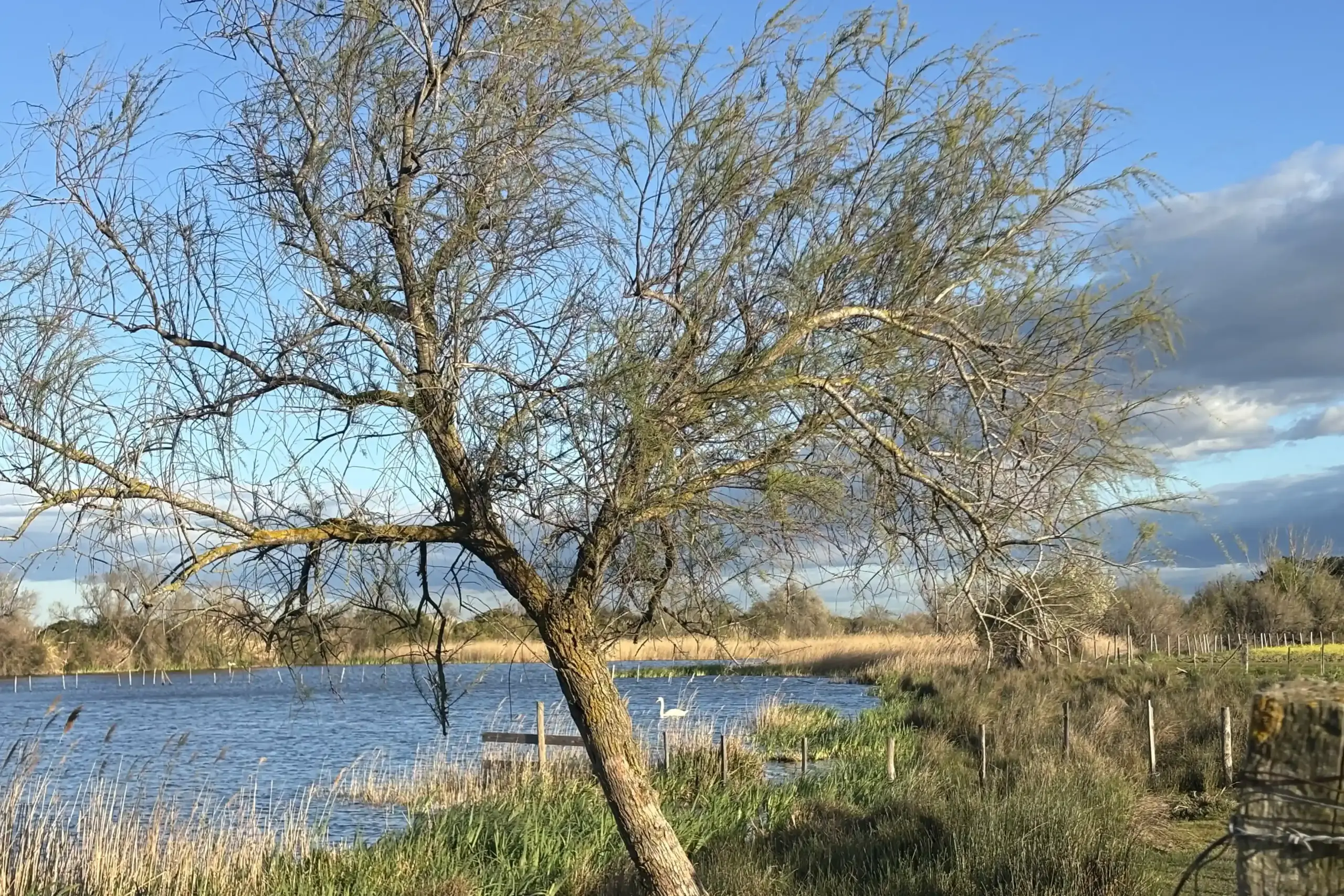
One of the most unusual encounters is with the purple swamphen: a bird with midnight-blue plumage and a fiery red beak, moving with a certain elegance through the marsh vegetation. Then there are the mute swans, silent and majestic, and the cormorants, which are often seen standing still with their wings spread open in the sun to dry. There is no shortage of birds of prey either, such as the black kite and the western marsh harrier, flying over the park in search of prey. And if you are lucky and patient enough, you might even see a crane.
The mute swan, which at first glance looks like nothing more than a beautiful white bird with a graceful curved neck, actually has its own little secrets.
In the Camargue, the mute swan is not native: it was introduced by humans in past centuries to embellish the ponds of parks and aristocratic estates, then escaped from captivity and gradually became naturalized. Today it is perfectly integrated into the ecosystem, but it still has a truly curious behavior.
When it swims, in fact, it often keeps one wing slightly raised like a sail. For centuries, this gesture was interpreted as a sign of vanity, elegance or even defiance. In reality, some scholars argue that the swan uses that wing precisely like a small sail: by tilting it in the right way, it uses the force of the wind to be carried across the pond without effort.
It is an intelligent way of saving energy, a bit like putting the car in neutral downhill.
And there is another curiosity: despite their reputation as romantic and faithful animals, swans can be very territorial and aggressive, especially during nesting. If someone gets too close to a nest, the male emits a threatening hiss and may attack, striking with its wings, which have surprising strength.
So it is better to admire them from a distance, perhaps while a small group of swans takes off in flight. The sound of their wings beating the water is powerful, deep, almost hypnotic, and precedes them with a growing hum that sounds like the distant rumble of thunder.
A small piece of advice from someone who has been there: take your time. The trails are about 7 kilometers in total and take you into the heart of the marshes and reed beds. If you are passionate about photography, it is paradise: the walkways and observation hides are designed to let you get close without disturbing the wildlife. And who knows, you might go home with a photo of an egret fishing or a heron in flight that will be just as valuable as one of a pink flamingo.
The Wildlife Rescue Centre
Between the two routes there is an educational area with large descriptive panels and a series of aviaries that are part of the park’s wildlife rescue centre: a facility that takes in an average of 350 to 600 injured birds every year.
The centre has played a crucial role in times of emergency. In 1985, more than 5,000 flamingos were found starving after the frost had frozen the ponds, preventing them from feeding. In February 2012 the story repeated itself: more than 90% of the surface of the ponds was covered in ice, and the park mobilized to take in and care for these birds that had been left without food.
The aviaries house birds that, due to disability or prolonged contact with humans, would not be able to survive on their own in the wild. It is not always open to the public, so it is worth asking the staff before looking for it. I managed to see them only once, but in my opinion it is an experience that makes you even more aware of the fragility of this ecosystem.
The Camargue is a beautiful territory, but also a rather extreme one: wind, sun, water and distances can completely change the experience. Packing well really makes a difference.
- A good mosquito repellent is essential. Dozens of mosquito species live in the Camargue, especially in wetland areas. The worst time is sunset, so it is better to always carry an effective repellent with you. In summer, I also recommend bringing long-sleeved shirts that can give you a little extra protection.
- Bring a windbreaker even in summer. The Mistral can pick up suddenly and completely change how the weather feels, especially in open areas and along the coast. In winter or during the shoulder seasons, a hat and gloves also become essential.
- If you really want to discover all the birdlife, bring a pair of binoculars with you: small, but extremely useful. They allow you to observe flamingos, horses and birds even from a distance, especially along scenic roads and from the observation towers.
- In low season, the park kiosk is not open. However, there are areas set up for small picnics, so always bring a supply of snacks if you plan to spend a good part of the day here.
- You will walk a lot, often on trails or natural paths, so wearing a pair of comfortable shoes that you have already tested is essential. Between dirt tracks, sand and walkways, they are indispensable. Avoid sandals that are too open.
- A reusable water bottle is a great ally, as shade is not always guaranteed. I bought a foldable silicone one from Natura. In any case, here you can find a similar one, which helps optimize space once it has been used.
- The sun is one of the absolute protagonists, at any time of year. A hat, sunglasses and a good sunscreen are essential even in winter: in the Camargue, the sun is always strong and you really feel it, especially during long walks. In addition, the wind will make you need a nourishing cream, as well as a lip balm.
- Small items such as a power bank may seem like details, but they make your days much easier, especially if you want to capture all the animals, landscapes and most beautiful moments of the visit in photos or videos. I was given this one as a gift and I’m very happy with it. But there are countless different types. Regardless of the model, I highly recommend bringing one.
You don’t need much else. In the Camargue, it’s not about having everything, but about having the right things.
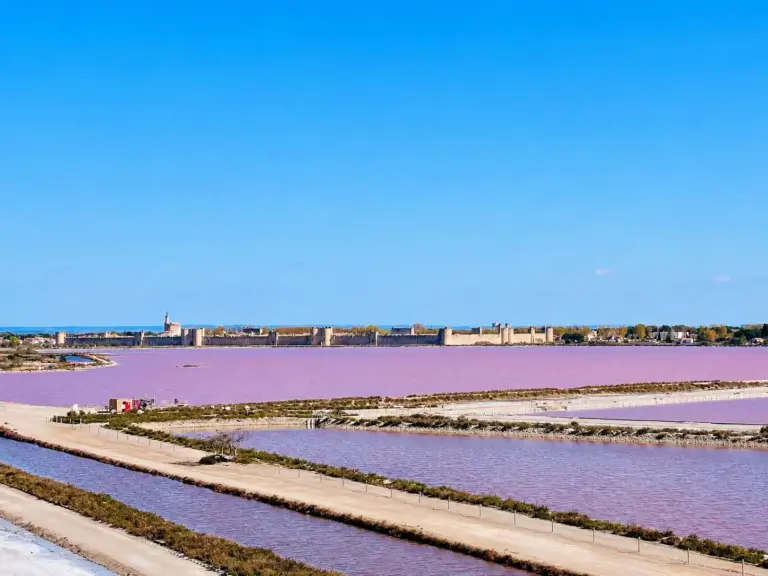
Visiting the Pont de Gau Ornithological Park is an experience that stays in your heart. You walk in silence among the ponds, with only the sound of the water rippling under the wind. The colors are those of the most authentic Camargue: the pink of the flamingos reflected in the still water, the green of the reed beds, the white of the salt along the edges of the banks.
The flamingos feed slowly, indifferent to your presence. The other species quietly inhabit this corner of paradise, as if time here moved at a different rhythm.
It is not a park built for tourists: it is authentic nature, simply cared for with attention and respect. On its own, it may not be enough to understand the whole Camargue, but you could never go home without having visited it.