The Camargue: a Spectacular Harmony of Nature, Colors, and History
The Camargue is something truly unique. A place where the sea, landscapes, animals, inland areas, towns, and history come together in a balance that is hard to find anywhere else.
Its colors and panoramas seem to have come straight from a painter’s brush — and that is no coincidence: Vincent van Gogh, among others, was captivated by this light. But the Camargue is not just visual beauty. It is a living land, shaped by powerful natural forces and by centuries of human presence that, rather than distorting it, have respected and protected it.
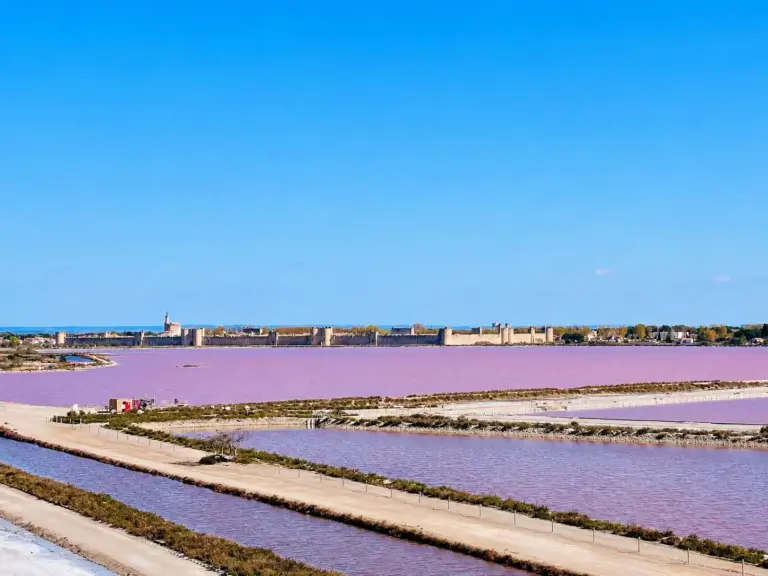
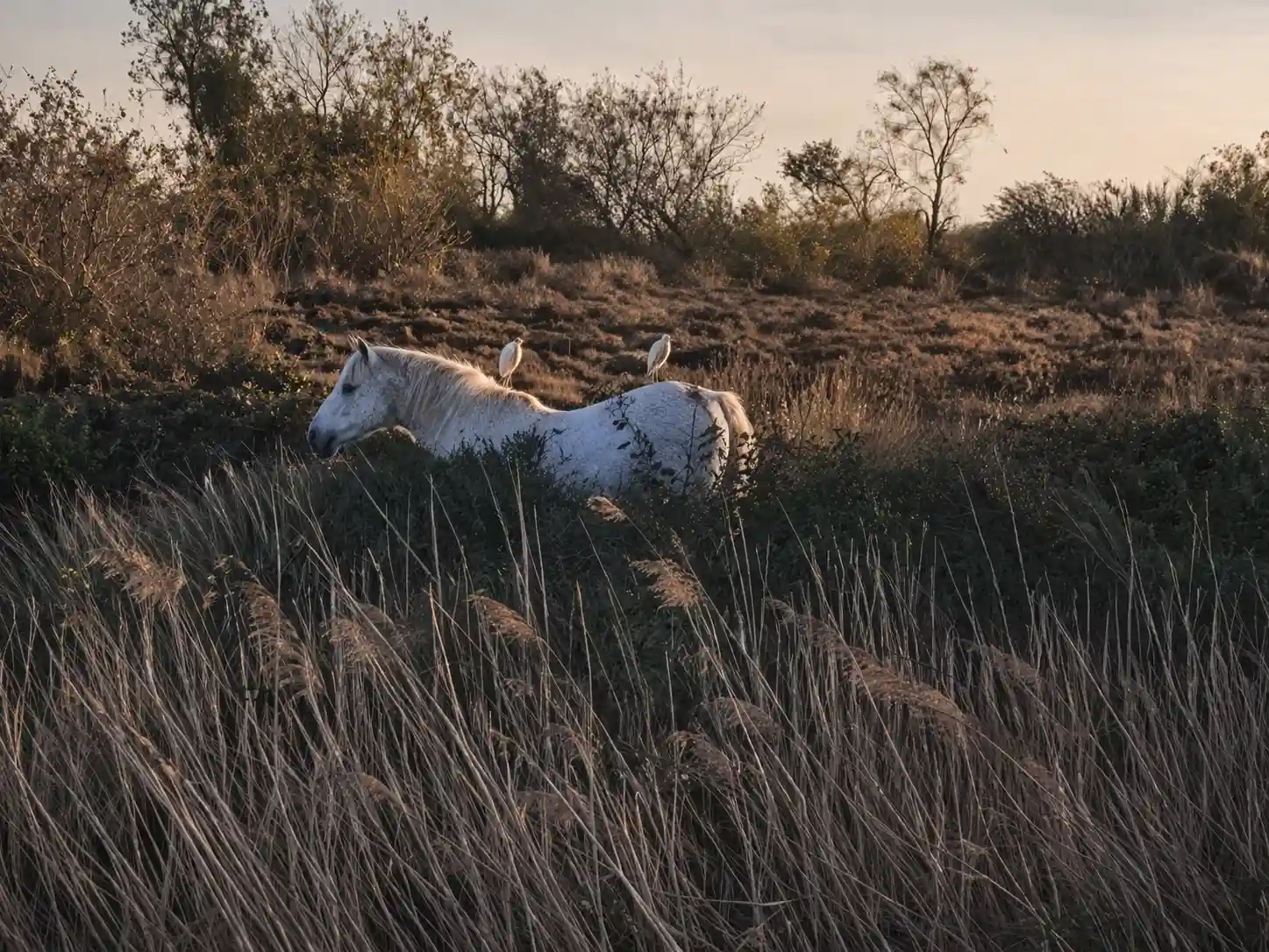
Here you can see white horses running semi-wild through shallow waters, the pink sea of the salt flats glowing at sunset, and black bulls grazing undisturbed on the horizon. It is not a tourist destination in the usual sense of the term: it is an open-air natural laboratory, capable of filling your eyes like few other places in the world.
And when you arrive, you immediately understand why some people have devoted an entire lifetime to protecting it. And I am sure that you too will want to feel deeply part of it.
Here are some practical tips for organising a trip to the Camargue: how to get there, how to get around, how to plan your trip and when to go. A few useful things to know when choosing the most convenient transport, organising your itinerary and exploring the coast, salt flats, wetlands and more isolated areas.
Show all tips ↓ Hide tips ↑
How to get to the Camargue
- By plane: the nearest airport is Nîmes Alès Camargue Cévennes, but it often has fewer flights. Two alternatives are Montpellier Méditerranée — about 1 hour away and probably the most convenient — and Marseille Provence, about 1 hour and a half away. To find the best fares, I use Google Flights: it allows you to compare prices across different dates and find the most convenient combination. From these airports, there are buses or trains that take you to various railway stations, from where you can then continue towards Aigues-Mortes or Le Grau-du-Roi, or towards Arles. However, for those arriving by plane, my recommendation is to rent a car.
- By train: the most practical solution is to arrive in Arles or Nîmes. From Arles, you can then take bus A50 to Saintes-Maries-de-la-Mer. If, instead, you arrive in Nîmes, take the regional railway line Nîmes – Le Grau-du-Roi, which also passes through Aigues-Mortes. It is called the “Camargue line” because it offers some interesting glimpses of the region. To search for the most convenient train options, I always use Trainline and TrainPal.
- By coach: it works well for reaching nearby cities such as Arles and Nîmes, but it rarely takes you directly into the natural heart of the Camargue, with the exception of the A50 line, which takes you from Arles to Saintes-Maries-de-la-Mer. If you travel by bus, it is better to alternate between buses and trains depending on the routes you plan to take. Take a look at the Envia website for general timetables and to get an idea of the buses and existing lines.
In short, if you want a comfortable and complete trip, it is best to fly into Marseille or Montpellier and rent a car.
How to get around the Camargue
- A car is the most convenient solution. Public transport is very limited and does not allow you to follow a complete itinerary. It also takes a lot of time and can turn the trip into a real tour de force.
- I saw many people getting around by bike from one town to another in the Camargue. If you enjoy cycle tourism, then arriving by train in nearby cities such as Arles and Nîmes and then starting your ride can work well. The Camargue is flat and apparently easy, but many interesting places are scattered between ponds, salt flats, secondary roads and natural areas, so in any case, be prepared for long rides. Within the Camargue, it is possible to rent bicycles, including electric bikes, which can be a good alternative for those who are less athletic. In the article, I will give you further tips on how to organise your visit.
- With an organised tour: this is the ideal option for those who do not want to worry about logistics. Many agencies organise departures from Arles, Avignon, Montpellier and Marseille, although they are often one-day tours. You also need to choose your base carefully. For the “wild” Camargue, Arles is better; for the salt flats and Aigues-Mortes, Montpellier or Nîmes are better. I always check availability on sites such as GetYourGuide or Civitatis.
How to plan your visit to the Camargue
- In summer, it is better to book well in advance, not only your accommodation but also the guided visit to the salt flats — especially the little train — and the walls of Aigues-Mortes, if you decide to choose these options. Even in low season, however, booking remains an excellent idea.
- Itinerary: since everything is very concentrated and close together, there is no need to plan every day in detail, except for the places where booking is required. Let yourself be inspired by the wind.
- The Mistral is a strong wind that can blow in any season. It can be so intense that it may not even allow you to walk in a straight line! Check the weather before leaving.
- Beware of mosquitoes! This is essential advice: if you go in summer, bring a powerful repellent with you, especially for sunset. They are very much at home in the wetlands.
- People eat fairly early compared to other parts of Europe. Bear in mind that some restaurants close at 2 p.m. or at 10 p.m.. Keep this in mind when organising your day.
When to go to the Camargue
- The liveliest season begins in April and ends in October. In the other months, not all attractions and services are available. For example, the salt flats are not accessible during the winter months, some restaurants and shops remain closed and, of course, you cannot fully enjoy the sea and beaches. The positive side is that there are fewer tourists, and everything feels more real and wild.
- The best time to enjoy the Camargue is May–June and September–October, with mild weather and fewer crowds. Avoid summer if possible — humid heat, little shade and lots of tourists and mosquitoes — although it is precisely during those months that the salt flats reach their maximum splendour and the sea is truly wonderful. I have to say, from direct experience, that winter is also very beautiful: everything is slower and sleepier, with fewer tourists and nature waiting to explode. Obviously, however, the days are shorter, the weather is less mild and not all attractions and restaurants are open.
A bit of history about the Camargue
To truly understand the Camargue, you need to take a step back — in fact, a few million years back. Because this unique territory is the result of a very long and extraordinary balance between four opposing yet complementary forces: geology, the Rhône River, the Mediterranean Sea, and human presence.
The Camargue is essentially the delta of the Rhône River, a relatively recent geological formation and the result of a long and complex history.
The Earth’s crust, in fact, had to go through millennia of tectonic movements that gradually created a large natural depression — a basin lower than the surrounding land — a perfect place for the river’s sediments to accumulate over the centuries. It was there that, little by little, the delta began to take shape.
The Camargue we see today is the product of a continuous confrontation between two opposing forces. On one side, the Rhône, which for thousands of years carried enormous quantities of sand, silt, and clay eroded from the Alps towards the sea. When the river reaches the Mediterranean, it slows down abruptly and all those materials are deposited, creating new land. On the other side, the Mediterranean Sea, which continuously redistributes those sediments through waves, currents, and storms.
Only when the Mediterranean stabilized, around 7,000 years ago, did the environments we recognize today begin to form: marshes, ponds, reed beds, and the sansouires — expanses of plants that live and thrive in salt.
Before the major embankment works of the 19th century, the delta was a territory in constant motion. The branches of the Rhône frequently changed course, new lands emerged from the water, and these alluvial areas — called crements — were disputed between landowners and local communities, fueling legal disputes as early as the Middle Ages.
Another key element of the Camargue landscape is its coastal sandbars: long strips of sand that separate the inland lagoons from the open sea — the Digue à la Mer is the best-known example. These natural dikes were formed thanks to the sand carried by the Rhône and then redistributed by the force of the waves along the coast, accumulating into parallel barriers that, over time, protected ponds and wetlands from the direct action of the sea.
The landscape of the Camargue is not monolithic. It is a mosaic of different habitats, each with its own character, yet in perfect balance with the others:
- The Sansouïres are salt meadows covered with halophilic vegetation — plants that love salt — such as glasswort, locally called “sansoure”. In autumn, it turns a vivid red, creating landscapes of rare beauty. They are the ideal grazing grounds for horses and bulls.
- The ponds and marshes, known as Étangs, are bodies of brackish or freshwater, such as the great Étang de Vaccarès, the true beating heart of the entire regional ecosystem.
- The salt flats — or Marais salants — are the areas where seawater evaporates and leaves salt behind. Those of Aigues-Mortes and Salin-de-Giraud are spectacular: the water turns an intense pink thanks to the microalga Dunaliella salina, while real mountains of white salt rise in the background.
- The freshwater wetlands, closer to the river and the rice fields, are dominated by reed beds, which are essential nesting areas for dozens of bird species.
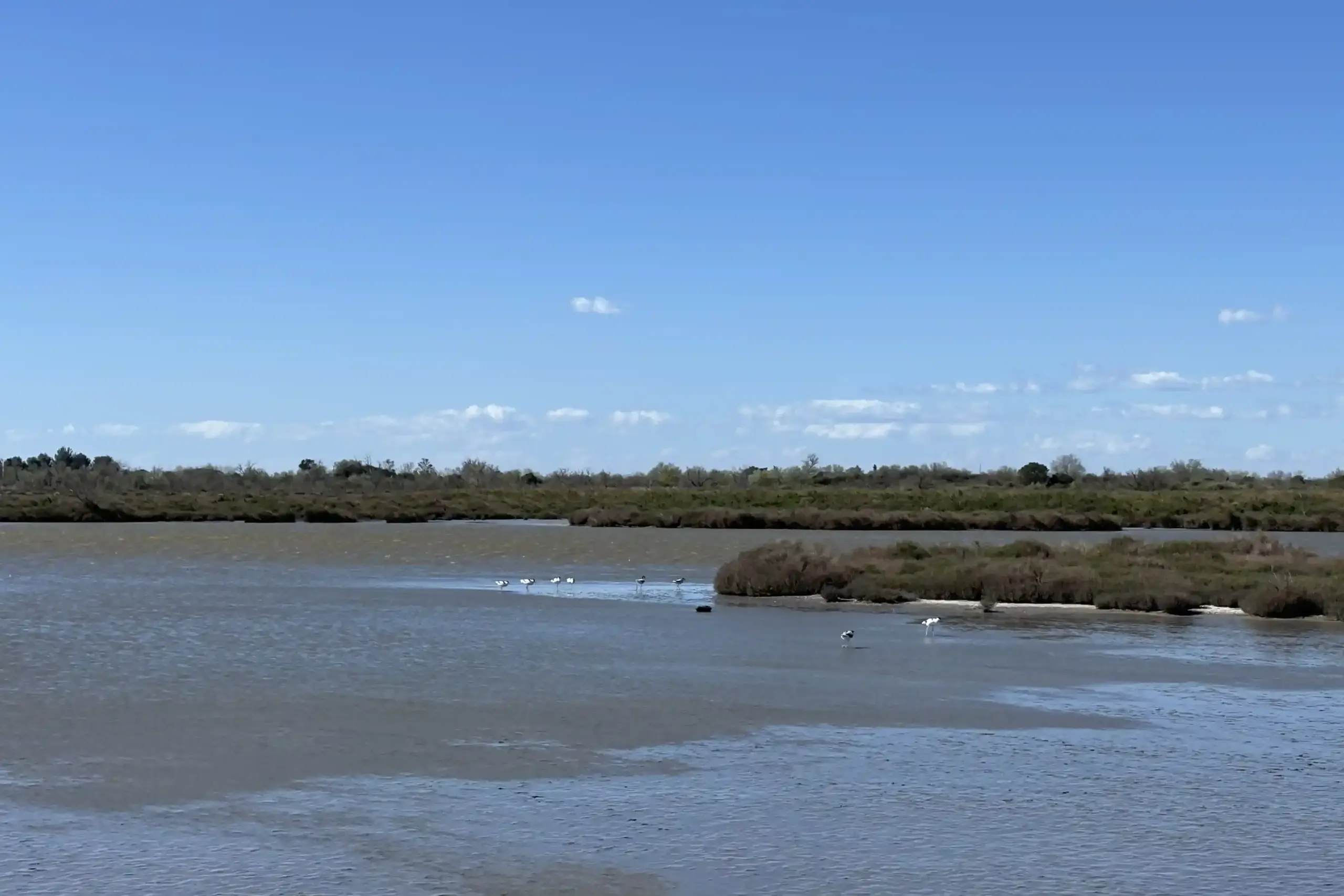
This variety of environments makes the Camargue one of the most important birdwatching sites in Europe. Located on one of the continent’s main migratory routes, it is an essential stopover for tens of thousands of birds in transit or wintering here. Between 2000 and 2005, it was the leading site in France for the number of wintering birds — around 122,000 — and is home to almost 300 species. In the Étang de Vaccarès nature reserve alone, 276 species have been recorded, 258 of which are of heritage interest.
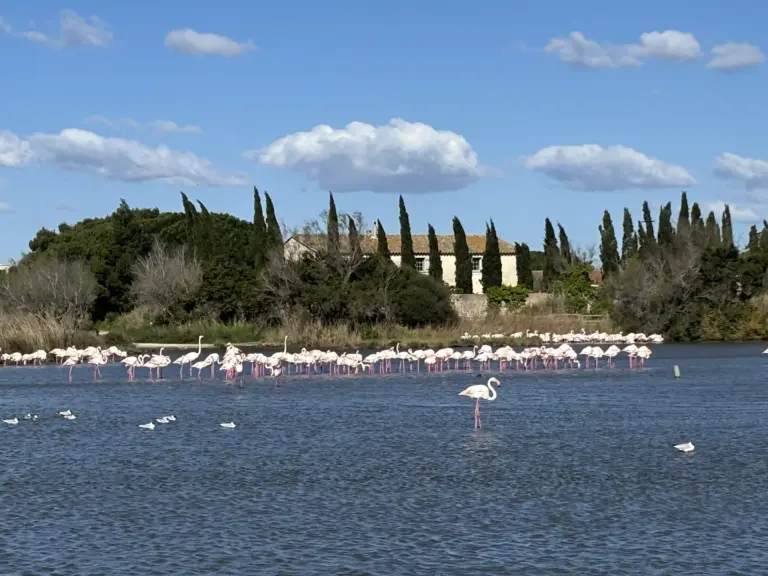
The symbol of all this is the pink flamingo: seeing it fly over the salt flats, in that low sunset light, is one of those images you never forget.
But the Camargue is not only about birds. It is also the kingdom of two unique animal breeds, shaped for centuries by this extreme environment: the white Camargue horse, intelligent and exceptionally resilient, and the black Camargue bull, raised semi-wild and at the heart of local traditions and races.
This mosaic of habitats — unique in Europe for its richness and fragility — is not only the result of nature. It is also the result of human action.
The history of the Camargue is a long story of conquest: first of land reclaimed from water, and then of nature over human beings who tried to dominate it.
The earliest traces of human presence date back to very remote times. The Ligurians, an indigenous population, were already using the lagoons for fishing, as shown by finds of copper harpoons, iron tridents, and lead net weights.
But it was Greek colonization that left a deeper mark. Around the 6th century BC, the Phocaeans of Marseille built a temple dedicated to Diana of Ephesus on the coast, on the small island that would later become Saintes-Maries-de-la-Mer. For the Greeks, this place had something unsettling about it: the writer Hesiod, in the 7th century BC, considered the Rhône delta — together with those of the Po and the Rhine — one of the gates of Hell. A territory suspended between the world of the living and that of the dead.
Then came the Romans, who gave a decisive boost to the local economy. It was a Roman engineer named Peccius, at the dawn of the Christian era, who organized the first large-scale production of salt in the marshes that still bear his name today: the Peccais marshes, near Aigues-Mortes. Salt — the “white gold” — became a strategic resource for the entire region from that time onward.
Fishing was just as vital. Tuna and countless other species were caught, then preserved in salt and shipped throughout the Mediterranean. In some shallow areas, a technique called “segado” was practiced: fishermen slowly moved forward dragging their nets, and the fish hidden in the mud would suddenly emerge in an attempt to escape. It was such an unusual scene that it inspired a legend reported by Livy, according to which the fish seemed to be born directly from the earth, as if they were springing up beneath the blade of a plough.
But it was in the Middle Ages that the Camargue entered its most legendary era — one of raids, miracles, and great works that would mark the territory forever.
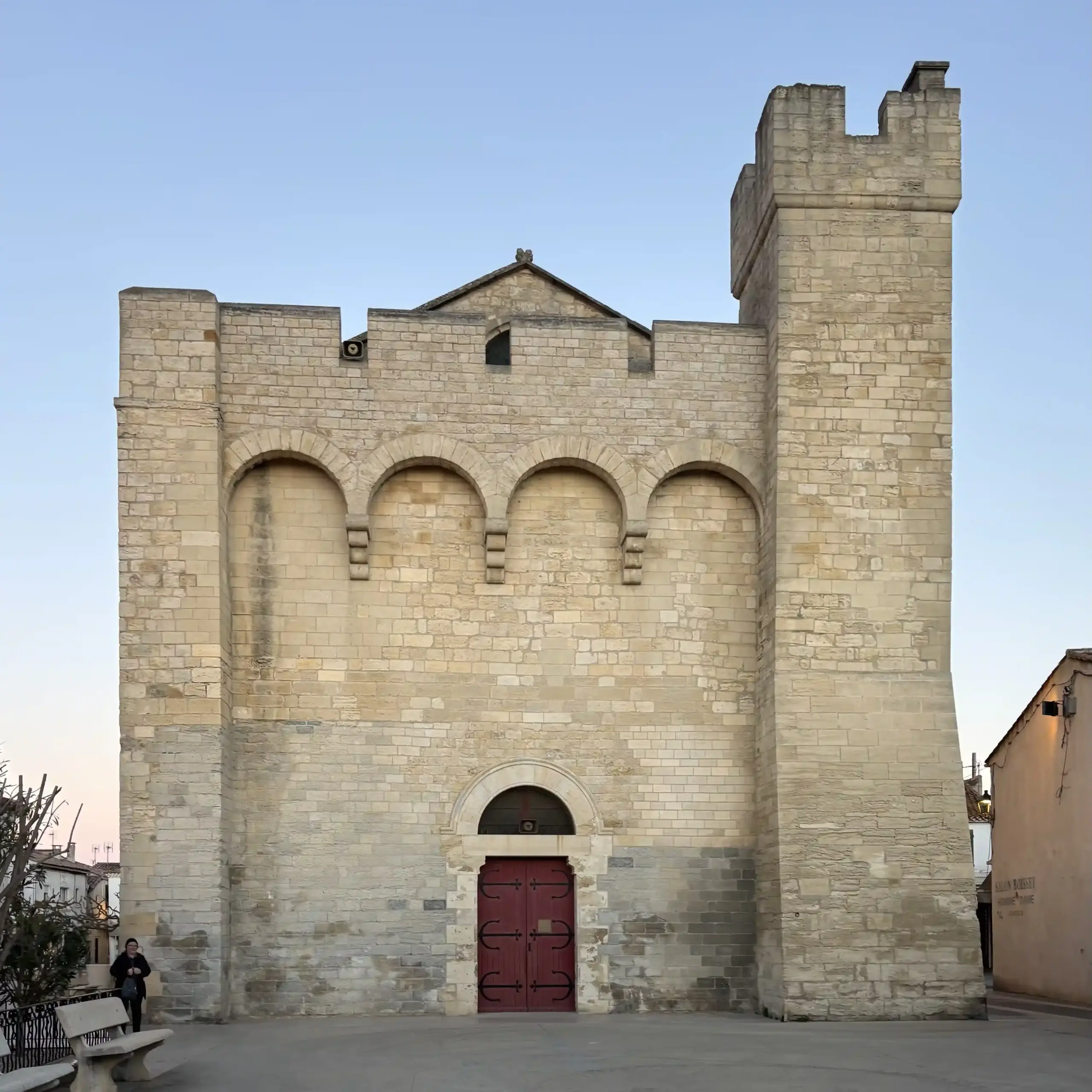
The 6th century marked the birth of the tradition that would make Saintes-Maries-de-la-Mer famous. In 513, Bishop Saint Caesarius of Arles, in order to Christianize a territory still linked to pagan cults, transformed the ancient Greek temple dedicated to Diana into a Christian place of worship, dedicated to Sancta Maria de Ratis — Our Lady of the Raft — in memory of one of the most legendary landings in Christian history.
According to tradition, in 40 AD, a boat without sails or oars reached these shores carrying the three Marys — Mary Salome, Mary Jacobe, and Mary Magdalene — together with their dark-skinned servant Sara. She would become Sara the Black, or Sara-la-Kali, the patron saint of Gypsies all over the world.
Here, legend and faith are inseparably intertwined, and the power of this story is such that even today, Gypsies from across Europe make the journey to the Camargue to venerate her.
On 24 and 25 May, thousands of Roma and Gypsies pour into the village to carry the statue of Sara in procession down to the sea, followed the next day by two of the three Marys. On those days, the atmosphere changes: it is no longer just the air of Provence. It fills with the trills of flamenco, the beat of heels, and the deep sound of guitars. I have not yet been lucky enough to experience it, but seeing Provençal Catholic devotion merge with the lament of cante jondo must be an incredibly powerful emotion. On those days, the Camargue stops being France and becomes the cradle of the Spanish Gypsy soul.
Perhaps this is the heart of the cultural enigma that is the Camargue: the exact point where the South of France allows itself to be conquered by the Iberian soul, creating an explosive and fascinating mix unlike anywhere else in Europe. To learn more about this curious story, take a look at our article about Saintes-Maries-de-la-Mer.
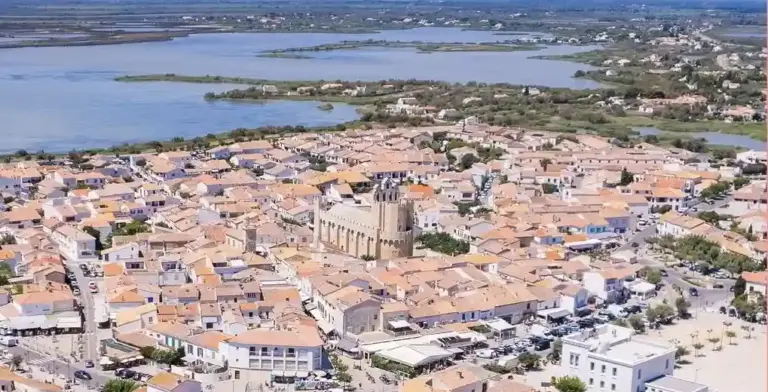
But the Middle Ages were not only about legends. They were also a period of raids, violence, and relentless defense of the territory, which led to the construction of watchtowers and fortified churches. To protect themselves from invasions, the transformation of the church of Saintes-Maries began in the 9th century: the building that still dominates the village today has the severe appearance of a fortress, and that is no coincidence.
During those same centuries, first the Benedictine monks and then the Cistercians began the first major land reclamation works: they drained the marshes, worked the land, and founded the so-called “salt abbeys”. Few ruins remain today, but do not imagine places of worship in the classical sense — they were real centers of agricultural administration, wisely exploiting the natural resources of the Camargue.
In 1200, King Louis IX chose Aigues-Mortes as the port of France — Marseille, at the time, was not yet under the French crown. The region suddenly acquired a strategic role: a commercial port, a crossroads for goods, and an organized center for large-scale salt extraction.
When Marseille was later annexed to the kingdom, the role of the Camargue as a port area came to an end, and the region became focused on farming, livestock breeding, and salt extraction.
As the centuries passed, the land became concentrated in the hands of a few. Between the 18th and 19th centuries, newly wealthy landowners — often merchants and shipowners from Marseille — bought the great mas, the local farmhouses: solid buildings made of hard stone, surrounded by stables and fields, which are still a symbol of the rural Camargue landscape today. These new owners introduced sheep farming and intensive wheat cultivation.
It was during this same period that, to satisfy the most demanding bullfighting enthusiasts, Spanish brava bulls arrived from Spain: the beginning of Camargue bullfighting, a tradition that is still a living part of this territory’s identity today.
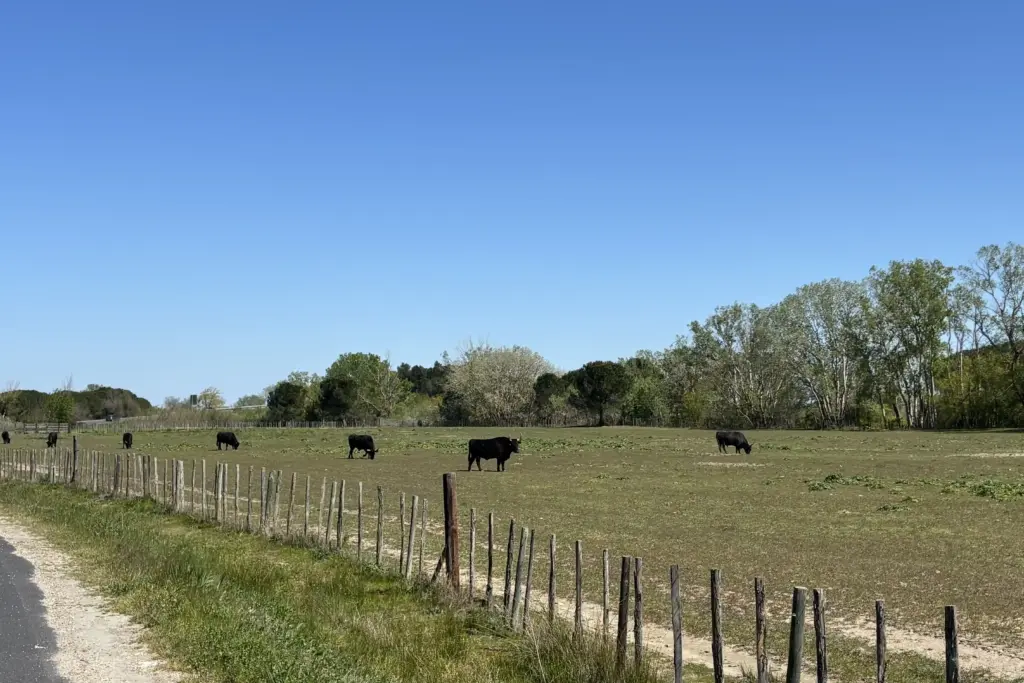
Indeed, when you arrive in the Camargue, it is almost impossible not to think of Andalusia: everywhere you come across the manades — herds of black bulls grazing freely, watched over by the gardians, the local cowboys, riding their magnificent white horses… Spanish passion and Provençal elegance, in a landscape that seems made to hold them both.
As you travel through the region, you will easily notice how Gypsy culture has had an important impact on this territory. This dual identity clashes and blends in the most spectacular way in bullfighting culture.
This meeting of cultures is clearly visible if you enter an arena such as the one in Arles or Saintes-Maries-de-la-Mer and watch the Course camarguaise. Do not expect blood and capes in the Spanish style. Here, the bull — biòu — is king. Young athletes, called raseteurs, try to snatch a rosette and tassels tied to its horns, challenging it with agility and skill. The bull is not killed and, if it is particularly brave, becomes a star acclaimed by the audience. It is a sport, a ritual of courage, where life and cunning are celebrated.
The result? A unique and peaceful coexistence. The French have adopted the Spanish tradition without distorting it, and the Spanish respect the French one. It is the only place in the world where, in the same afternoon, you could eat baguette and escargots in the company of an Andalusian bullfighter.
Then came the 19th century, which marked an epochal turning point in the Camargue’s balance. For centuries, people had been forced to submit to the power of the Rhône. The 19th century changed everything. With the industrial age and the drive of Napoleon III, the State financed the construction of major hydraulic works to tame the river, protect farmland, and keep animals safe.
In 1859, a dike was built to block the rise of saltwater from the sea; ten years later, the Rhône was embanked to contain flooding. The Camargue thus became a true island, enclosed between the two branches of the river and the sea, with a landscape that was permanently transformed.
Between 1870 and 1942, viticulture flourished. And here, the Camargue had a surprise in store: while phylloxera was devastating vineyards across Europe, those in the Camargue remained intact. The frequent floods submerged the roots and killed the parasite before it could cause damage. It was during this period that large agricultural estates prospered, such as the Château d’Avignon — today open to visitors on guided tours — purchased by Louis Prat-Noilly, the famous producer of Noilly Prat vermouth. These estates were not picture-postcard castles: they were serious agricultural properties, equipped with the first engineering tools for managing water and crops.
It is in this context that one of the most fascinating figures in Camargue history emerges: the Marquis Folco de Baroncelli-Javon (1869–1943). Born in Avignon into a family of Florentine aristocracy, he fell in love with the Camargue as a child and decided to devote his life to it. In 1893, at just 24 years old, he bought his first animals; the following year, he founded the Manado Santenco in Saintes-Maries, where he settled permanently in 1899 — choosing the life of a gardian over the salons of the aristocracy.
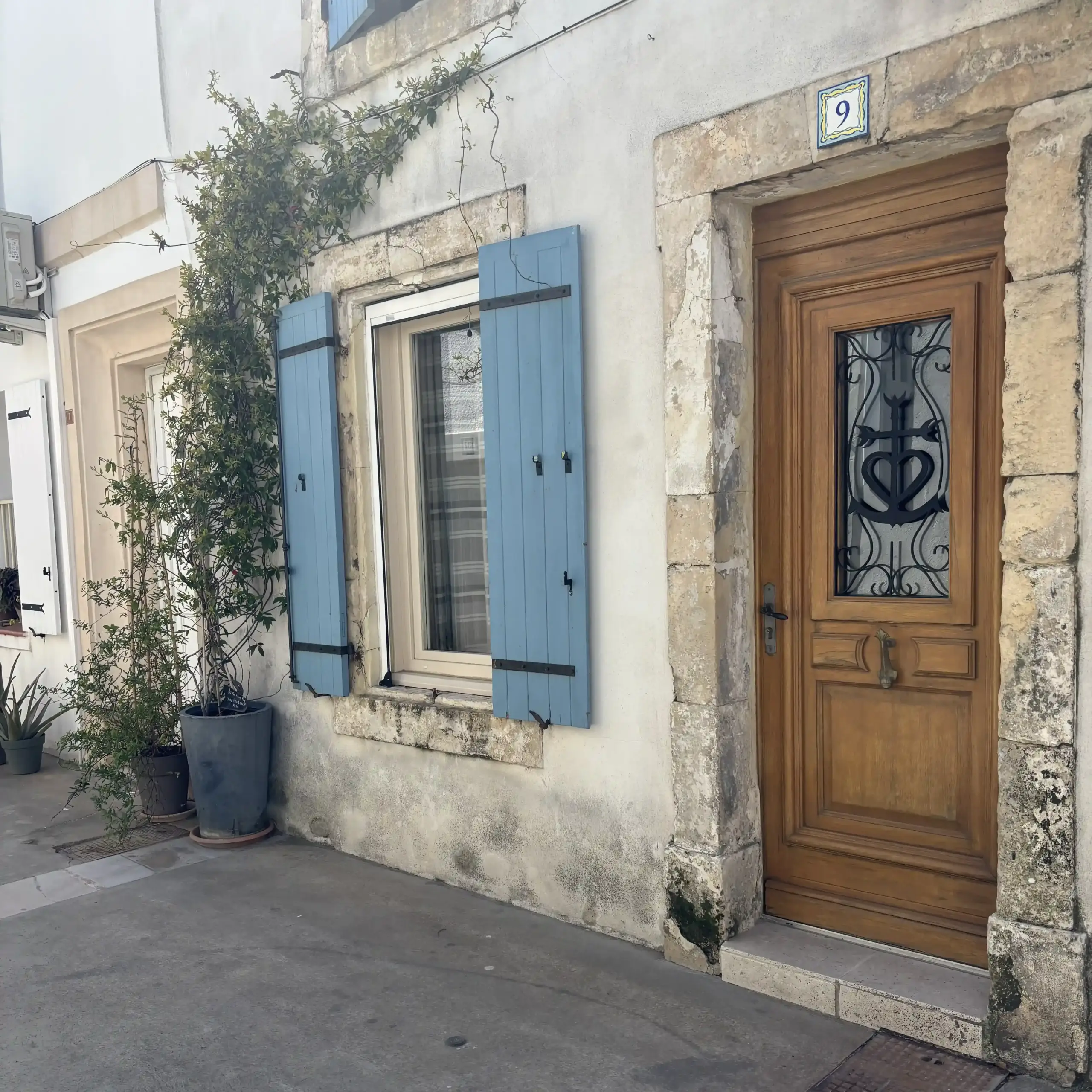
Baroncelli devoted his life to preserving the language, customs, and traditions of the Camargue. He re-established the pure breed of the Camargue bull, which over time had mixed with Spanish bulls imported for bullfighting, founded the Nacioun Gardiano — an association created to protect equestrian traditions — and promoted the creation of the Camargue Cross, a symbol that still today embodies the virtues of this people.
Unlike many regional symbols that are lost in the mists of time, the Camargue Cross has a precise date of birth and a well-documented history, linked to the fascinating figure of the Marquis Folco de Baroncelli-Javon.
As we know, at the beginning of the 20th century, the Marquis de Baroncelli, poet, writer, and passionate manadier — bull breeder — devoted himself passionately to defending the identity of the Camargue.
In 1924, Baroncelli had the idea of creating a symbol that would represent this “nation” of gardians — the cowboys on horseback — and fishermen. He entrusted the task to his friend, the Parisian painter and illustrator Hermann-Paul, who at the time often stayed in the Camargue.
Hermann-Paul created the design, but it was during the production phase that an important change took place. The blacksmith of Saintes-Maries-de-la-Mer, Joseph Barbanson, who was in charge of forging the first cross in his workshop in what is now Place du Grenier à Sel, suggested replacing the three lilies — fleurs-de-lys — initially planned for the ends with three tridents, a more authentic symbol of the gardians.
The Camargue Cross is a concentration of symbolism. Its shape brings together three distinct elements, which represent the three theological virtues of Christianity and, at the same time, the three fundamental components of Camargue society.
⚓ Anchor
It represents the fishermen. The base of the cross is an anchor, which recalls the fishermen of the Mediterranean and the lagoons, a historic activity of the village.
Christian virtue: Hope.
❤️ Heart
It represents the Saintes Maries. At the center of the cross stands out a heart. It is the symbol of the three Marys — Mary Jacobe, Mary Salome, and their servant Sara — venerated in the church-fortress, and of divine charity.
Christian virtue: Charity.
🔱 Tridents
They represent the gardians. The three ends of the cross finish with tridents, the traditional tool that the gardians use to guide and gather the herds of bulls in the pastures.
Christian virtue: Faith.
In this perfect synthesis, the Camargue Cross therefore embodies the threefold soul of the region: the fishermen who sail the waters, the gardians who dominate the land with their horses and bulls, and the deep spirituality that can be felt in Saintes-Maries-de-la-Mer, a place of pilgrimage for a thousand years.
You can find the Camargue Cross almost everywhere… on churches, on buildings, on doors. It is truly deeply felt by the local population. But if you want to see the copy of the original cross, you will have to go to Pont du Mort, at the western entrance to the town, on the road to Aigues-Mortes.
But Baroncelli was also a man of extraordinary humanity and civil courage. He took up the defense of oppressed minorities, supporting the Gypsies and their pilgrimage, obtaining from the archbishop permission for the statue of Saint Sara to be carried in procession to the sea — something that happened for the first time in 1935. Until then, the Roma were not even allowed to enter the church.
Folco de Baroncelli died in 1943 and was buried in the ruins of the Mas du Simbèu, his beloved estate. Still today, every 26 May, the Camargue people and the Gypsies come to pay homage to a man who had always chosen to stand on the side of the least fortunate.
The arrival of the 20th century brought with it new radical transformations. During the Second World War, rice cultivation was introduced, which expanded rapidly after the Marshall Plan of 1946. The rice fields once again changed the face of the Camargue, partly replacing the traditional pastures.
Meanwhile, the breeding of the Arles Merino sheep, central to the local economy, gradually declined, leaving room for the manades of horses and bulls — which became the most authentic and recognizable symbol of the Camargue.
In the Camargue there are houses that seem to come from another time: they are the cabane, the traditional homes of the gardians, the guardians of bulls and horses who have lived for centuries in these difficult lands. At first glance they may seem like simple huts, but in reality every detail is the result of a precise balance with the environment.
Their shape is unmistakable: the rounded back, almost like an overturned boat, is not an aesthetic choice but a necessity. It serves to resist the Mistral, the impetuous wind that often blows in this region. The orientation also has a meaning: the entrance almost always faces south, to protect against the strongest gusts.
The materials tell the story of the territory: wood, white lime, and above all the marsh reeds — called sagne — used to create thick, insulating roofs. The white of the walls, besides being characteristic, reflects the intense sunlight and helps keep the interiors cooler during summer.
Many cabane that can be seen today are still authentic, others have been rebuilt over time, especially after the frequent floods of the Rhône, but they preserve the same logic as always. Some have been transformed into tourist accommodation and are an excellent option if you want an overnight stay that is different from the usual.
Today you can find them in the countryside near the mas — the farms — especially around Saintes-Maries-de-la-Mer.
These wild landscapes and such fascinating traditions slowly began to attract more and more tourists, and with them also new threats.
The fragility of this territory became evident, and with it the need to protect it. In 1927, the first National Nature Reserve of the Camargue had already been established — the largest in mainland France — but in 1970 the Regional Natural Park was also created, with the task of preserving biodiversity and traditional activities, seeking a difficult balance between economic development and environmental protection.
A balance that can never be taken for granted. Today in the Camargue, gardians, manadiers, rice growers, salt workers, hunters, and environmentalists coexist, often with divergent objectives.
And to these internal tensions are added external threats: industrial pollution — such as sulfur dioxide from the industrial area of Fos-sur-Mer, carried by the winds — and the pressure of around one million visitors a year.
And yet the Camargue resists, and the world recognizes it. It is a UNESCO Biosphere Reserve covering 193,000 hectares, a wetland of international relevance under the Ramsar Convention covering 114,000 hectares, and part of the European Natura 2000 network.
The Camargue is all of this together: a territory where the past is never truly past, where every dune, every pond, every black bull tells a thousand-year-old story of resistance and adaptation. It is not a place that can be easily explained. You will realize it for yourselves — it is a balance, an encounter, a composition. It is, in every sense, a masterpiece.
What to do in the Camargue
As you will have understood, the Camargue is an extremely fragile masterpiece, built on a delicate and thousand-year-old balance. Visiting it requires a conscious and respectful approach — it is not a theme park, it is a living territory.
Nor is it a compact region: it is a mosaic of landscapes that change constantly. To the north, rice fields and farms open up; in the center, ponds and birds dominate; to the south, the landscape becomes harsher, with the sea, salt, and wind. The western part is the most touristy and accessible, while the eastern part is the wildest and quietest.
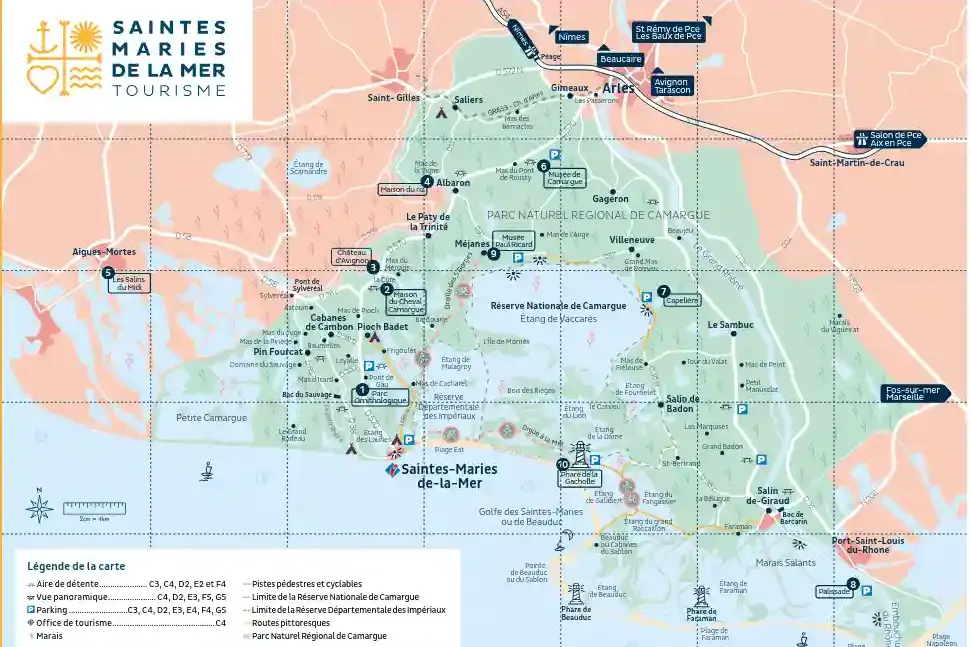
The map below will allow you to quickly find your way among the main attractions. I downloaded it from the Saintes-Maries-de-la-Mer tourism website, which is worth taking a look at, also for those who want to learn more before departure.
More than visiting it, the Camargue should be crossed slowly, letting yourself be surprised by the transformations of the landscape and enjoying the changes throughout the day — the morning light on the ponds has nothing to do with the sunset light on the salt flats.
Many people who have visited the region, once back home, have dismissed it with a “yes, pretty, but nothing special.” Every time I hear this phrase, my heart sinks. Looking into it more deeply, I discovered that almost always behind those words lie the same banal mistakes, but ones capable of completely changing the experience.
I have tried to gather everything I have learned on my trips to the Camargue — the places, the rhythms, the nuances — and I have added the five most frequent mistakes I have heard people talk about, so that you cannot repeat them. I cannot accept that you return home with a “nothing special” on your lips.
First of all: allow at least three days. They are the absolute minimum to see the most iconic places without rushing. And organize your days with a slow and immersive approach — in keeping, after all, with what the Camargue itself will ask you to do.
Below you will find the main attractions to see, with a few suggestions on timing and schedules to help you make the most of each stop on your trip:
- Saintes-Maries-de-la-Mer: it is the gateway to the Camargue. Saintes-Maries is very small: the center can be visited quickly. Allow two hours to walk among the white houses, enter the Église Notre-Dame-de-la-Mer, climb up to the church’s rooftop terrace, and take a walk on the beach. My advice is to go there at sunset: it is the moment when the place has the most atmosphere, the light is perfect, and the crowds thin out. During the day, especially in summer, it can be rather chaotic. Add at least one extra hour if you want to stop and eat — and I absolutely recommend doing so. To plan your visit more easily, you can find itineraries, excursions and practical tips in our complete guide to Saintes-Maries-de-la-Mer.
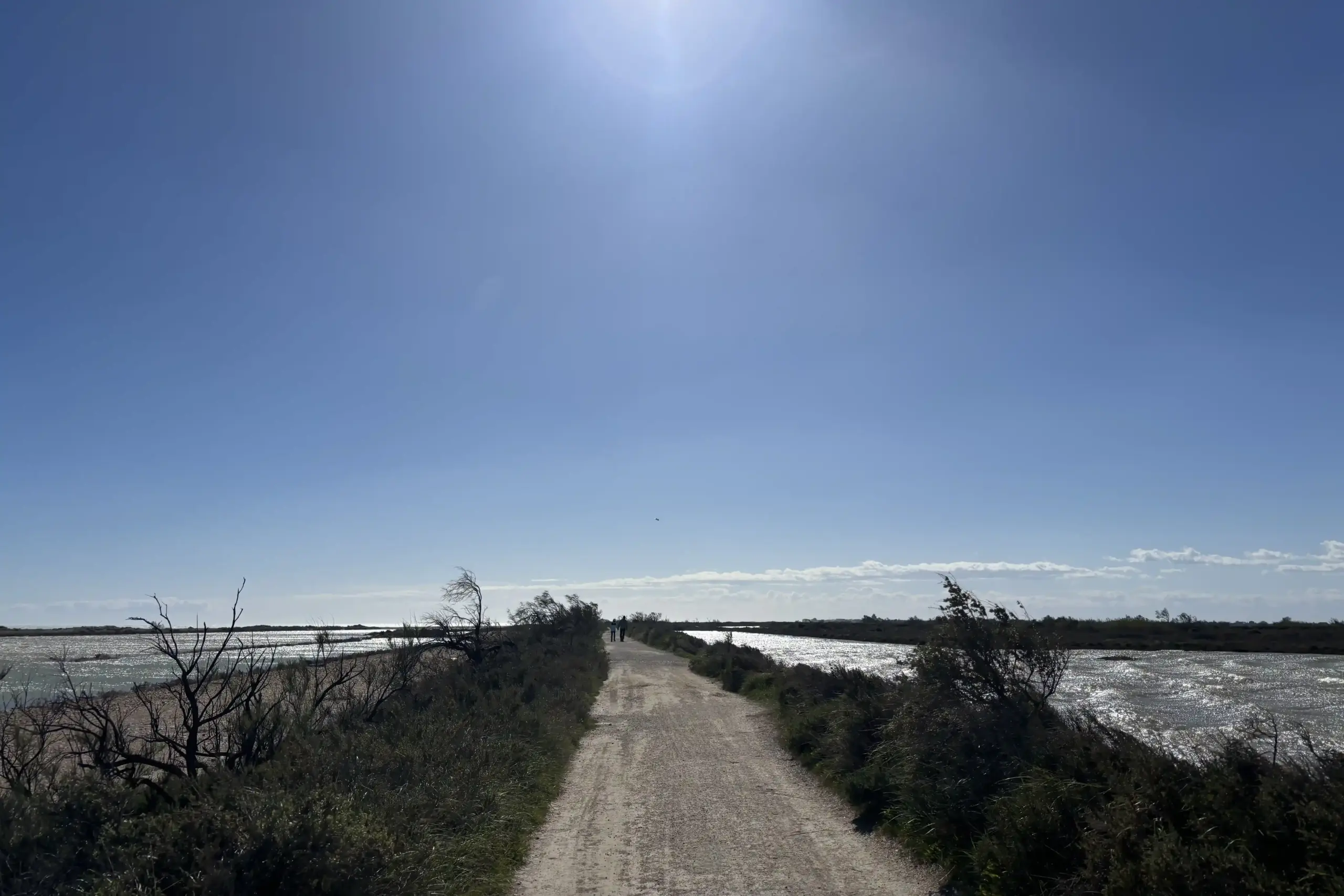
- Digue à la Mer: it is a walk by bike or on foot, where you can be surrounded by the sea and ponds at the same time. In summer, avoid the central hours of the day; at other times of the year, midday is perfectly fine. The most classic stretch is the one from Saintes-Maries-de-la-Mer to the Phare de la Gacholle, about 12 km, but you do not have to walk or cycle all of it. A warning: if the Mistral is blowing, it can become really challenging. I tried it and after 2 km I gave up. Keep this in mind when organizing your day. In any case, here you’ll find more tips and practical information to enjoy la Digue à la Mer.
- Pont de Gau Ornithological Park: the best time to visit it is in the morning: the birds are more active, the light is softer, and there are fewer visitors. If you want to make sure you see the flamingos, do not worry: they are almost always visible, but in the morning they move around more, feed, and take flight more often. I would enter at opening time — check the opening hours on the website here. Allow two hours for the short route, four if you also want to explore the wilder part. The ticket is valid all day, so nothing prevents you from returning at sunset too, but you must be at the entrance before closing time, so always check the opening hours. You will find all the tips in my dedicated article about the park.
- Camargue Regional Park: the heart of the Camargue is its territory itself. Beyond the incredible variety of landscapes, here you can truly enjoy direct contact with nature. Here is how:
- Spotting free-roaming horses and bulls: they are not completely wild animals — they belong to the manades, that is, herds raised in a free-range state. In summer, the best time to see them is early in the morning or late in the afternoon, when the heat eases and they come out to graze. At other times of the year, they can easily be seen during the day too. If you want to maximize your chances, drive slowly along the D36B beside the Étang de Vaccarès, or along the roads between Saintes-Maries and Aigues-Mortes, or venture into the less-traveled roads of the area. These are the places where it is easiest to encounter them.
- Horseback rides and visits to local manades: these are pleasant experiences in direct contact with these extraordinary animals. They can last from just a couple of hours to a full day, but bear in mind that the guides almost always speak only French, and the atmosphere, in some cases, tends to be rather touristy. I am not saying not to do them, because it is always beautiful to experience these animals up close, but do not expect something wild. Take a look at these suggestions, but you can also check with the tourist offices in Saintes-Maries or Aigues-Mortes, or on GetYourGuide, and look for the option that suits you.
- Cycling route between lagoons and manades: the Camargue is beautiful to explore by bike because it is almost completely flat, but the route needs to be planned carefully. Distances may look easy on paper, but there can be strong winds, intense sun, very little shade and some fairly isolated stretches. In my opinion, it is perfect if you take it slowly, rather than treating it like a sporting stage where the goal is simply to “rack up the miles”. There are plenty of bike rental points throughout the region, and you will also find many places where you can rent an e-bike if you prefer. Tourist offices and the park website offer several suggested routes to follow. To plan your ride properly, I recommend checking a few useful websites in advance. The most important is the Parc naturel régional de Camargue, where you can find several official routes with maps and practical information sheets. The official French cycle tourism website, Komoot and Outdooractive are also very useful, but here are a few specific options:
- From Saintes-Maries-de-la-Mer, you can choose between the Digue à la Mer — through seascapes, lagoons, flamingos and wide-open horizons —, the Circuit Gacholle and the Circuit du cheval Camargue et du riz. For routes starting in Saintes-Maries-de-la-Mer, the Le Vélo Saintois website is particularly handy, with descriptions of routes such as Gacholle and Méjanes, including distance, duration and type of terrain.
- In the western part of the region, between Aigues-Mortes, Le Grau-du-Roi, Vauvert and Gallician, there are easier routes that are also suitable for families, such as the voie verte Vauvert-Gallician and the circuits of the Camargue Gardoise. For this area, you can also check the routes on the Petite Camargue and ViaRhôna websites.
- Aigues-Mortes salt flats: they are much more beautiful in the afternoon and during the summer months. The pink color of the water, in fact, depends on the concentration of salt in the basins and becomes more intense towards the harvest period, which takes place every autumn. In general, however, with the sun high in the sky or in the late afternoon, the pink is more intense, the contrasts are stronger, and the mountains of salt are spectacular. I suggest entering around 4:00 p.m. or, in any case, close to sunset. Allow at least two hours. There is also a very nice little train that takes you to the most interesting areas: if you choose this option, book in advance online, by phone, or by going there in person a few days before.
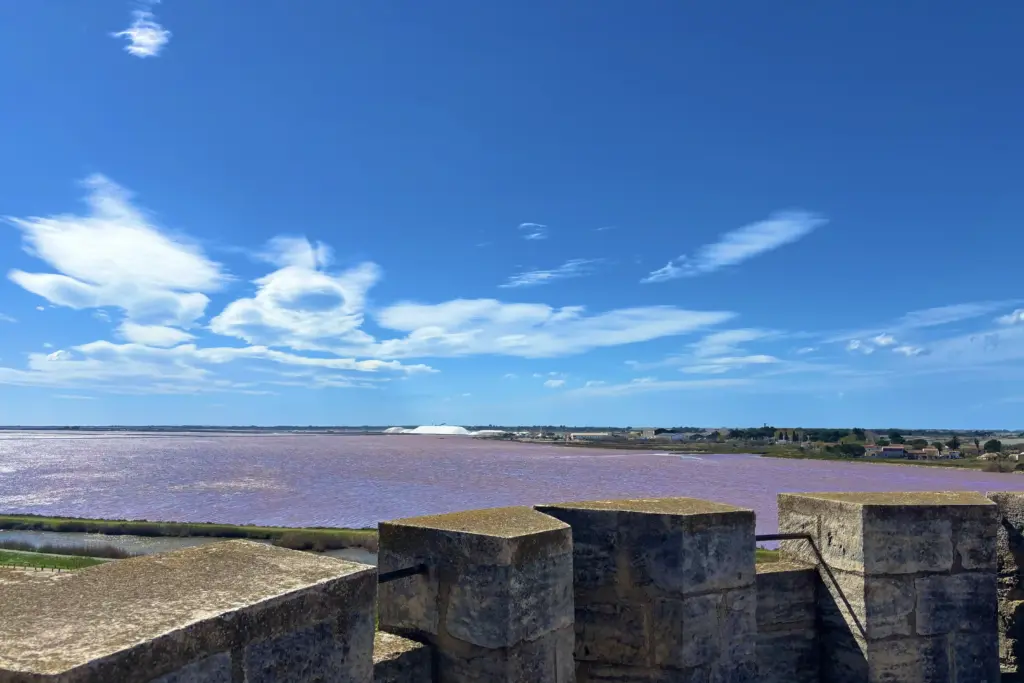
- Aigues-Mortes: it is a small but extraordinarily scenic town, thanks to its perfectly preserved medieval walls. Allow at least 2 hours to walk along the walls — 1.6 km — visit the Tower of Constance, wander through the streets of the center, and look at the salt flats from above. My advice is to combine it with a visit to the salt flats, so as to make the most of the day — and to end with a stop in one of its restaurants… you cannot miss their fresh fish dishes!
Here, instead, are the 5 most frequent mistakes. Consider them carefully, because they can truly give your trip a completely different meaning.
Visiting the Camargue at the wrong times of day: the landscape of the Camargue changes completely depending on the light. At midday, in summer, the heat can be intense, to the point that the animals prefer to stay hidden, and the flat midday light does not bring the colors to life — the landscape becomes almost monotonous. The Camargue, instead, gives its best early in the morning or in the late afternoon, when the water reflects the sky, the animals come out, and the colors become deeper. The only exception is the salt flats, whose pink shines precisely during the central hours of the day, but be prepared for extreme heat in summer.
Thinking it is a destination “to be seen quickly”: many people arrive, visit Saintes-Maries-de-la-Mer, take a photo from the car, and leave. But the Camargue is not made of monuments. It is made of spaces, water, and silence. You need to drive slowly, stop, walk, observe, and surrender to its rhythm.
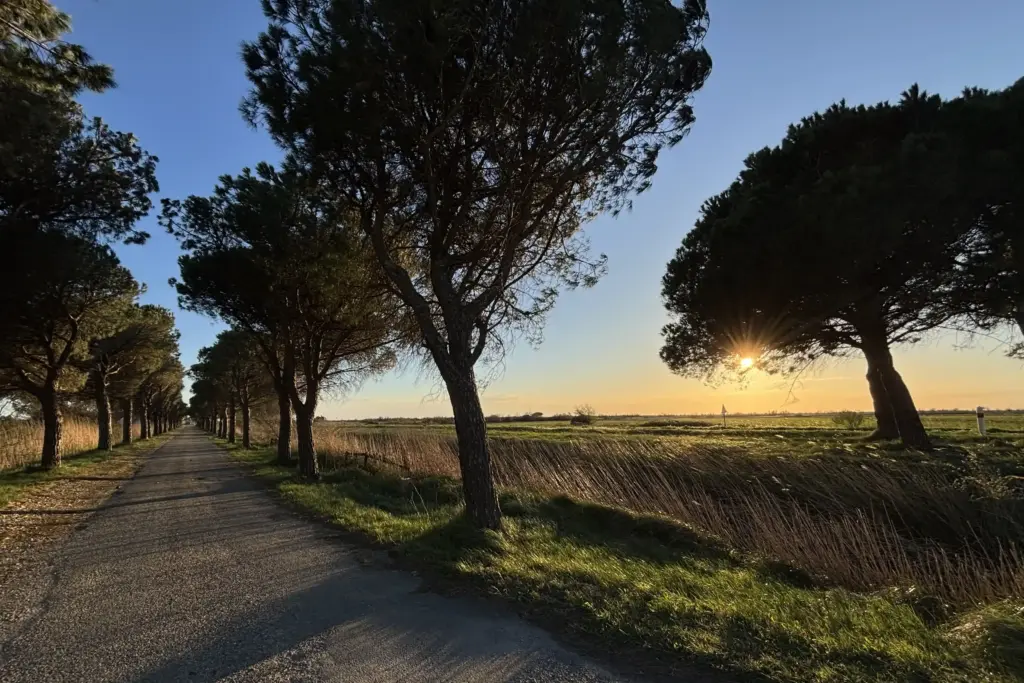
Not leaving the main roads: if you stay only on the D570 and on the main roads, you will see only a small part of the Camargue. The most beautiful landscapes are found on the secondary roads, along the small agricultural roads, at the edges of the ponds. That is where you meet horses, bulls, and birds. But to do so, you need to walk, cycle, and push yourself further. The panoramas I remember best are the ones I found by deliberately slipping into the less-traveled roads towards Salin-de-Giraud. The wildest nature always has something more.
Not preparing for the wind and mosquitoes: they are two “constitutive” elements of the Camargue, for better or worse. The Mistral can be extremely strong — I will tell you that it is the strongest wind I have ever faced in my life. In winter and in the shoulder seasons, it can be truly limiting. Bring a windbreaker with you and something to protect your head. And what can be said about the mosquitoes? They are part of the landscape… and not in a romantic sense. In summer, always bring a serious repellent and also clothing that protects you if you decide to visit the stagnant areas at sunset. I read that in the Camargue people say: “Mosquitoes, flies, and the Mistral protect us from outsiders.” There is a bit of truth in that.
Looking only for “Instagram places”: most travelers come for the pink salt flats and the flamingos. But the most authentic Camargue is often elsewhere: in the rice fields, in the silent ponds, on the isolated roads, on the farms. The most beautiful moments are often the ones in which nothing particular happens. Just wind, water, and sky.
Visiting the Camargue by bike without preparation: the Camargue is one of the most beautiful territories to discover by bicycle. Looking at the map, everything seems easy: the landscape is flat, the distances do not seem enormous, and there are no major climbs. In reality, here the real difficulty is not the elevation gain, but the wind, the sun, the lack of shade, and some very exposed stretches between ponds, salt flats, canals, and secondary roads. Precisely for this reason, the best way to experience the Camargue by bike is to choose a cycling circuit suited to your own rhythm.
The secret, in the end, is to change rhythm. The Camargue is not a destination for a to-do list. It is a landscape to enter into — or to let pass through you.
3-day itinerary in the Camargue — by car, from west to east
The itinerary I am sharing with you is the one I followed myself, refined over time with a few adjustments that only experience can suggest, but always in the spirit of respect and delicacy that this place deserves.
Do not follow it to the letter: let yourself be inspired by the day, by the light, by the colors — and by the people you will meet along the way.
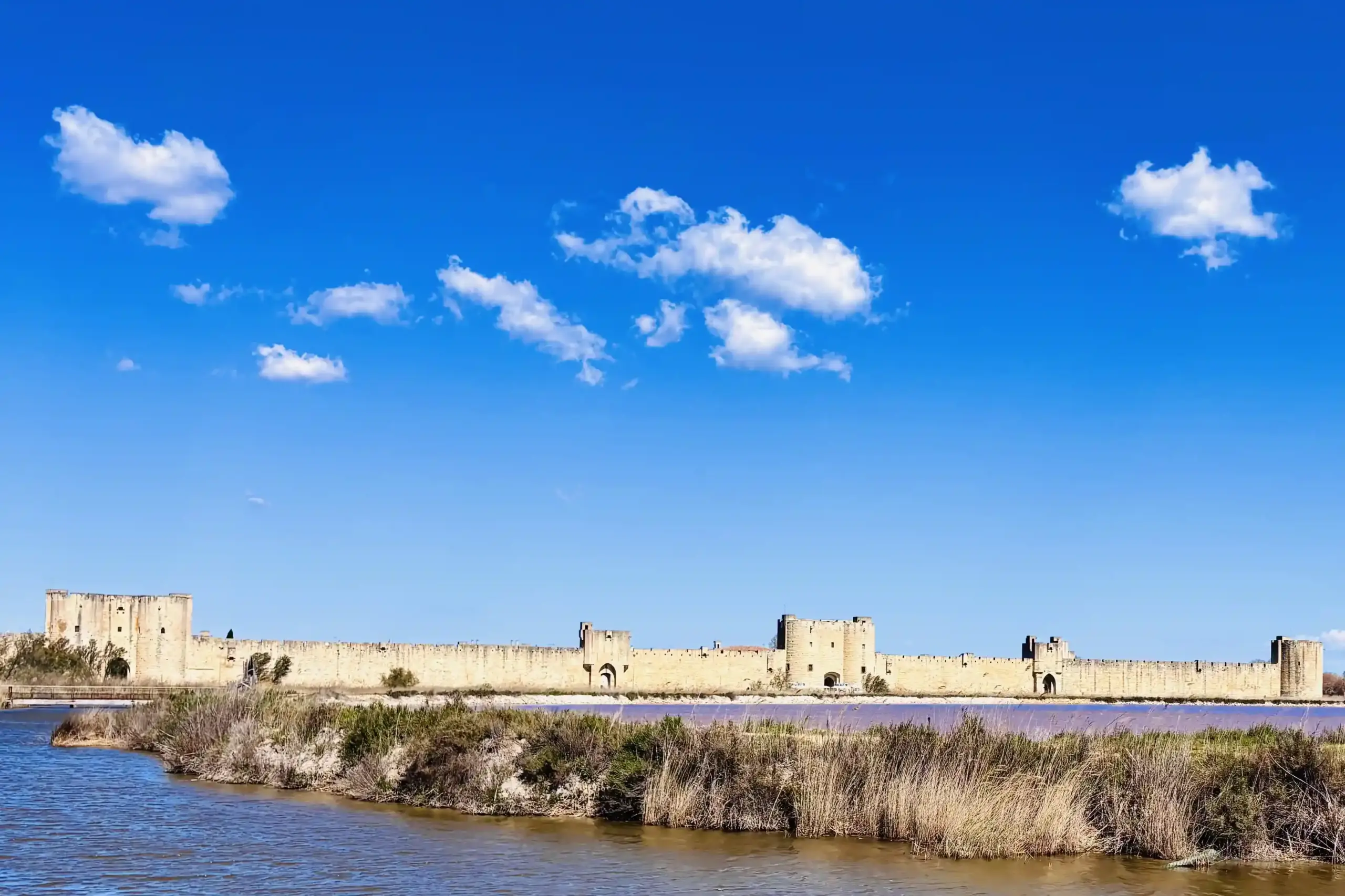
Day 1: welcome to the Camargue!
- Morning: strolling through time in Aigues-Mortes. This fortified city is a medieval jewel: lose yourselves among its narrow streets, but above all climb up onto the walls — the imposing city walls offer a spectacular view over the city and the salt flats that surround it.
- Lunch: stop in one of the characteristic restaurants inside the walls, perhaps at Le Galion, which is always a certainty.
- Afternoon: the surreal pink of the Aigues-Mortes salt flats. Just a few steps from the city, visiting the Aigues-Mortes salt flats is a must. The spectacle of the expanses of pink water — the color is due to an alga that proliferates especially in summer — standing out against the blue sky, with the mountains of white salt in the background, is something unique. You can visit them on foot, by bike, or with the charming little train that explains the salt production process. The guide, who is also the driver, speaks only French, but you will have an audio guide available in many languages.
- Late afternoon: another Camargue. If the weather allows, treat yourselves to a detour to Plage de l’Espiguette: a wild and boundless beach of fine sand, perfect for a regenerating walk or one last swim in the Mediterranean. Alternatively, try one of the many cruises on the canals that leave from Aigues-Mortes; they offer a completely different perspective on this territory.
- Evening: I recommend having dinner in Le Grau-du-Roi — I ate very well at Aux Délices de la Mer. It is a simple restaurant, focused on fish.
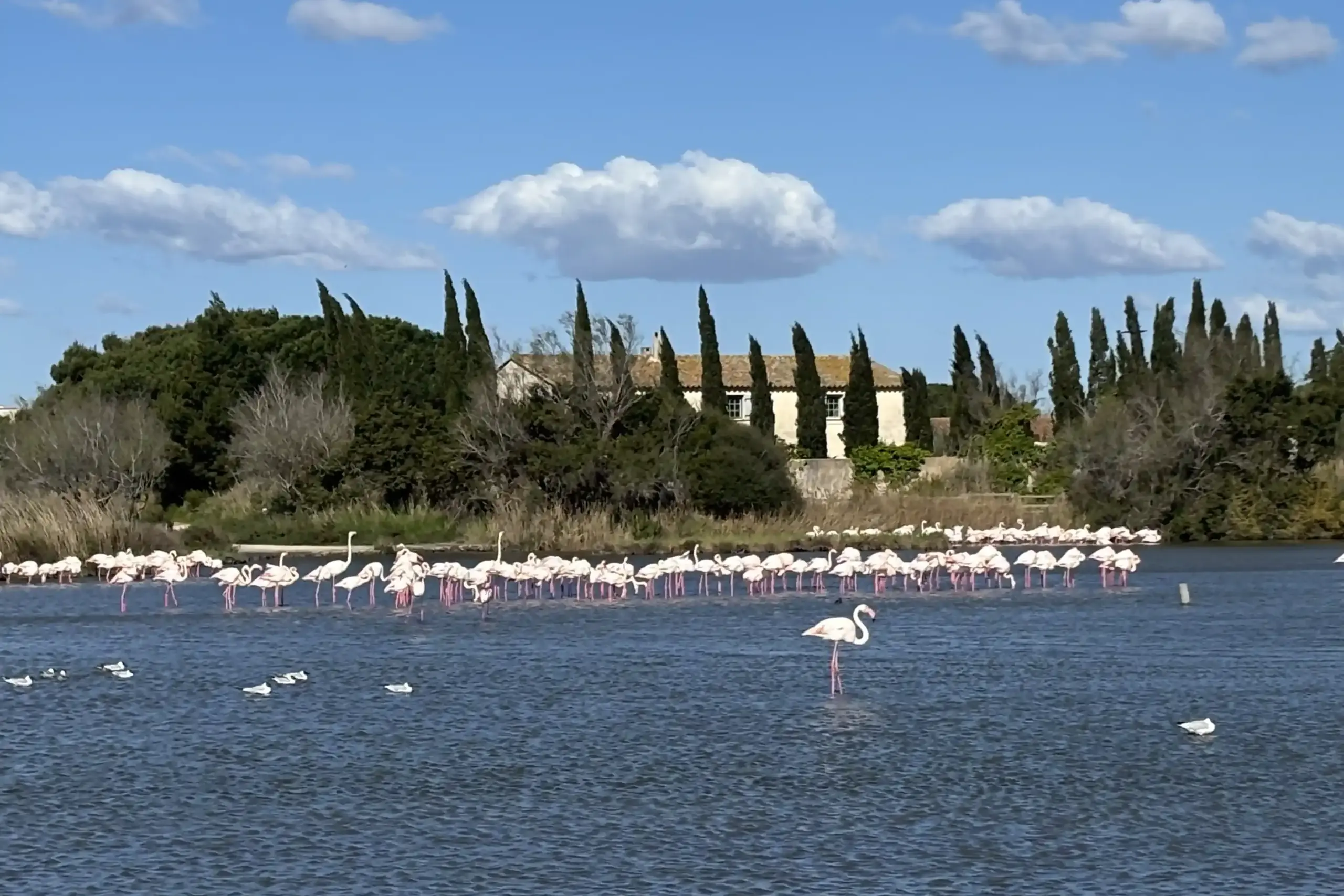
Day 2: the heart
- Morning: discovering the natural heart of the Camargue. The Pont de Gau Ornithological Park is an unmissable experience: you walk along wooden walkways among hundreds of pink flamingos, herons, and other species in complete freedom. Allow at least two or four hours, depending on the route you choose, but know that the tickets are valid all day — you can enter, leave, and return whenever you want. It is worth keeping this in mind for one precise reason: returning in the evening to watch the flamingos parade at sunset is something magical. We did it too, and we did not regret it.
- Lunch: choose a restaurant in the center of Les Saintes-Maries-de-la-Mer. There are several options, but for lunch I would choose Rico & Rocco or La Casita.
- Afternoon: the Digue à la Mer. Rent a bike — or take a walk on foot if you feel like it — and follow this 12 km dirt track that runs alongside the nature reserve, offering incredible views over the lagoons and the sea. The ideal destination is the picturesque Gacholle Lighthouse. On foot it takes about five hours; by bike it is much easier. A warning: if the Mistral is blowing, carefully assess whether it is feasible. In general, with the wind against you, having an electric bike is not a luxury — it is almost a necessity.
- Late afternoon: a walk through the center of Saintes-Maries-de-la-Mer and along the seafront is the right way to end the day.
- Evening: have dinner in one of the places with a sea view. Le Belvedere is an institution, but there are plenty of other interesting options too!
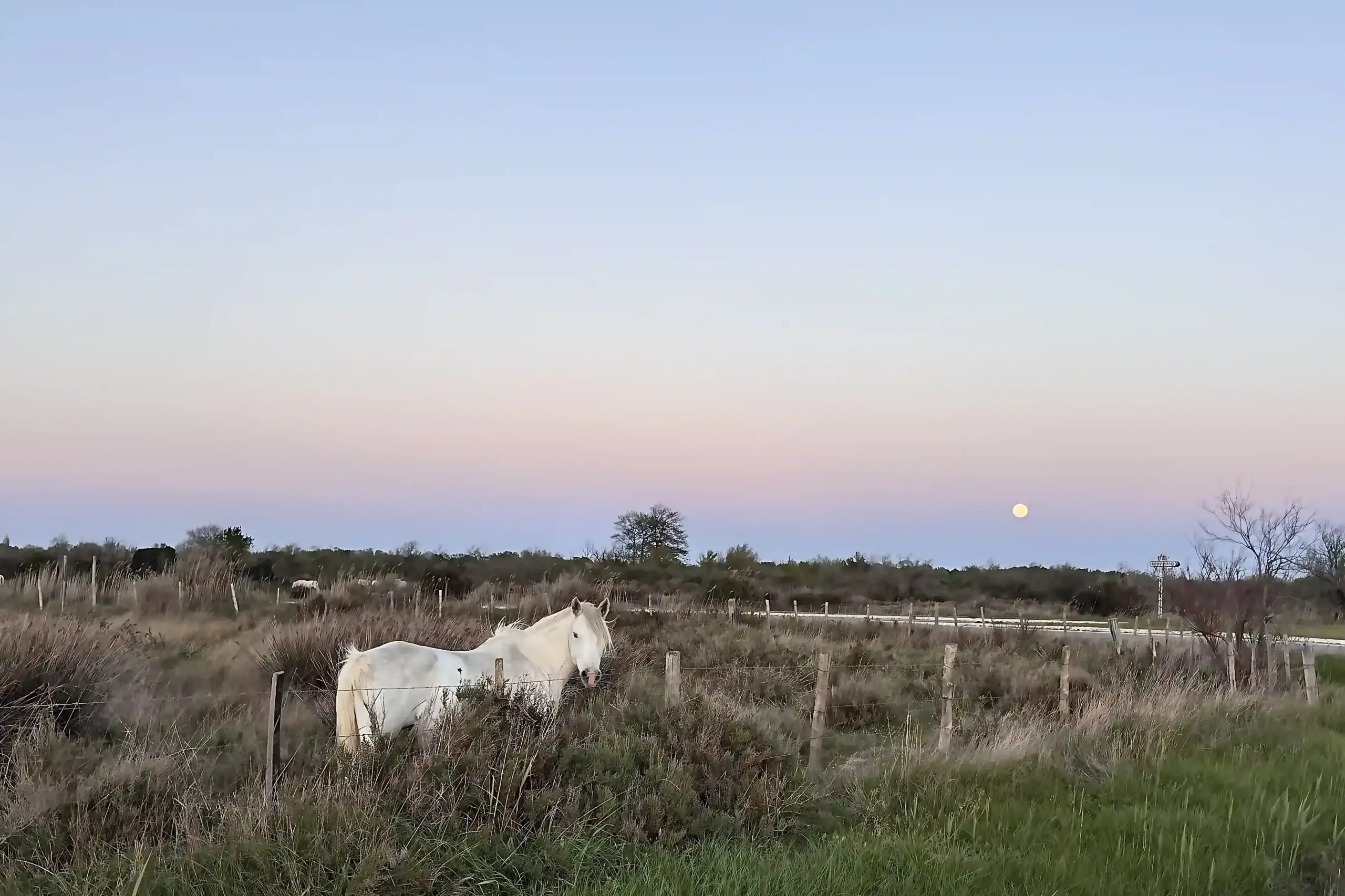
Day 3: wild nature
- Morning: the most authentic Camargue. Follow the panoramic road D570 / D85A / D36B to admire horses and bulls grazing in the fields along the sides of the road, and head towards Salin-de-Giraud. If you want to add something special to the route, do not miss the Bac du Sauvage: the barge ferry — for a fee — that crosses the Petit Rhône, one of the two branches of the Rhône, in just a few minutes. It is a small detail, but it has its charm and significantly shortens the route. You can then manage the return entirely by road.
- Lunch: forget the tourist places and choose a restaurant in a mas. La Manade des Baumelles — which offers gourmet cuisine and also visits to the property — or La Telline, immersed in the nature reserve, are two institutions.
- Afternoon: the Camargue Museum is perfect for a recap of the history and traditions of this unique territory. Located at the Mas du Pont de Rousty, on the road to Arles, this ethnographic museum tells the thousand-year-old relationship between humans and this environment: the wetlands, agriculture, livestock breeding, and traditions. Allow at least one hour to visit it calmly. Since it is on the road towards Arles, it can also be an intermediate stop on the way back home.
- Late afternoon: experience the Camargue like a true gardian, with a horseback ride through the wetlands or even galloping on the beach. Or else go and discover a manade. There are many centers that organize excursions for all levels, and several mas or manades that offer visits with a small tasting of local products. I will not hide the fact that I find them a bit touristy — and the explanations are almost always only in French — but they remain a beautiful way to get closer to the life of the herdsmen and to everyday Camargue.
- Dinner: if you are visiting a mas or a manade, the most beautiful solution is to stay directly there for the tasting. A perfect way to end the trip properly.
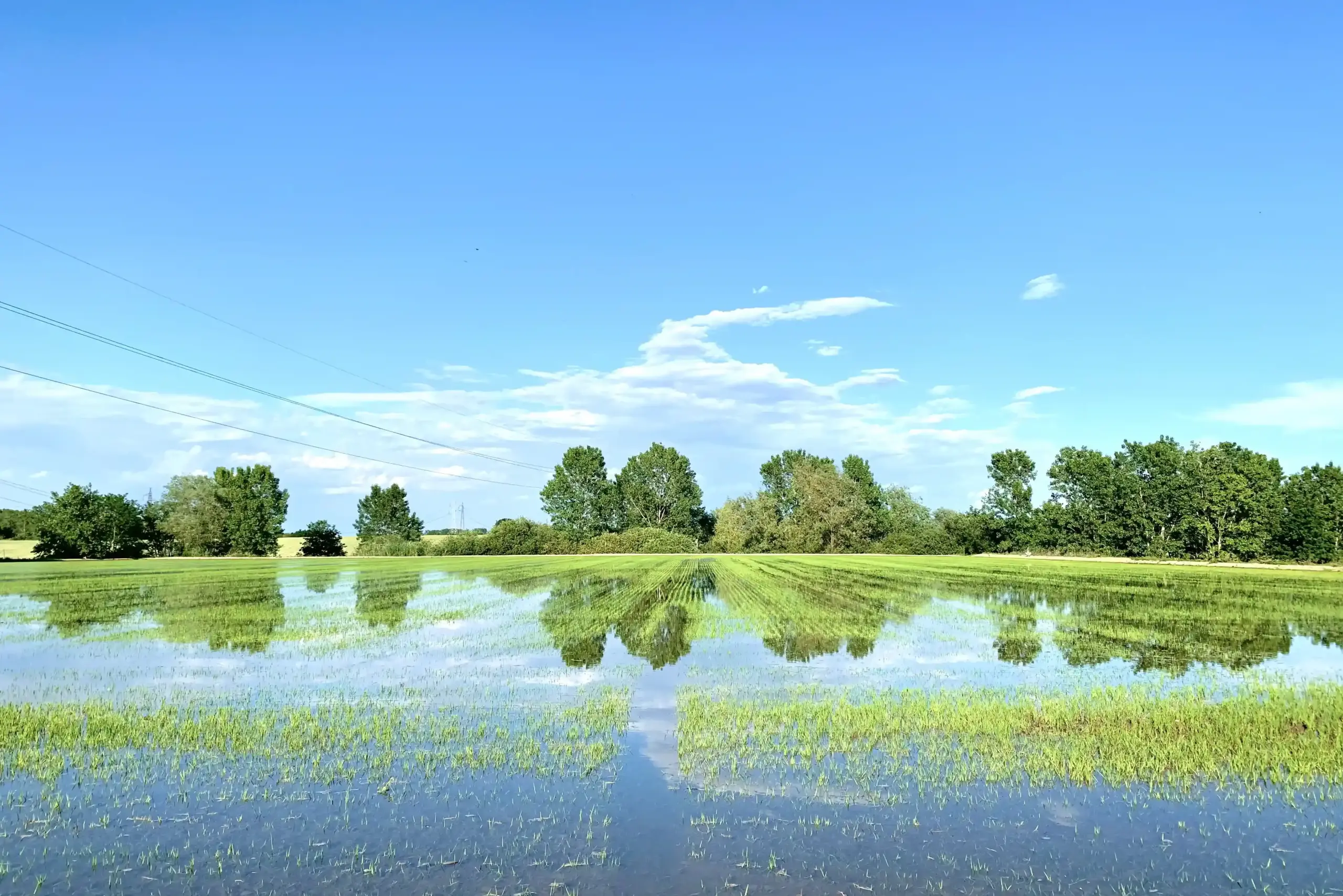
The possibilities, in reality, do not end here. If you have time before returning, the Camargue still has a lot to offer: the wild beach of Beauduc for a bit of sea, a beach day in Le Grau-du-Roi — perhaps by bike from Aigues-Mortes — a little more pink at Salin-de-Giraud, or a quieter stop in Port-Saint-Louis-du-Rhône and its surroundings. And if you pass through this area between late April and early May, stop in front of the flooded rice fields in the northern part of the park: for a moment, you will no longer understand where the land ends and where the sky begins.
Whatever choice you make, you will see: the Camargue does not disappoint, if you know how to follow its rhythm.
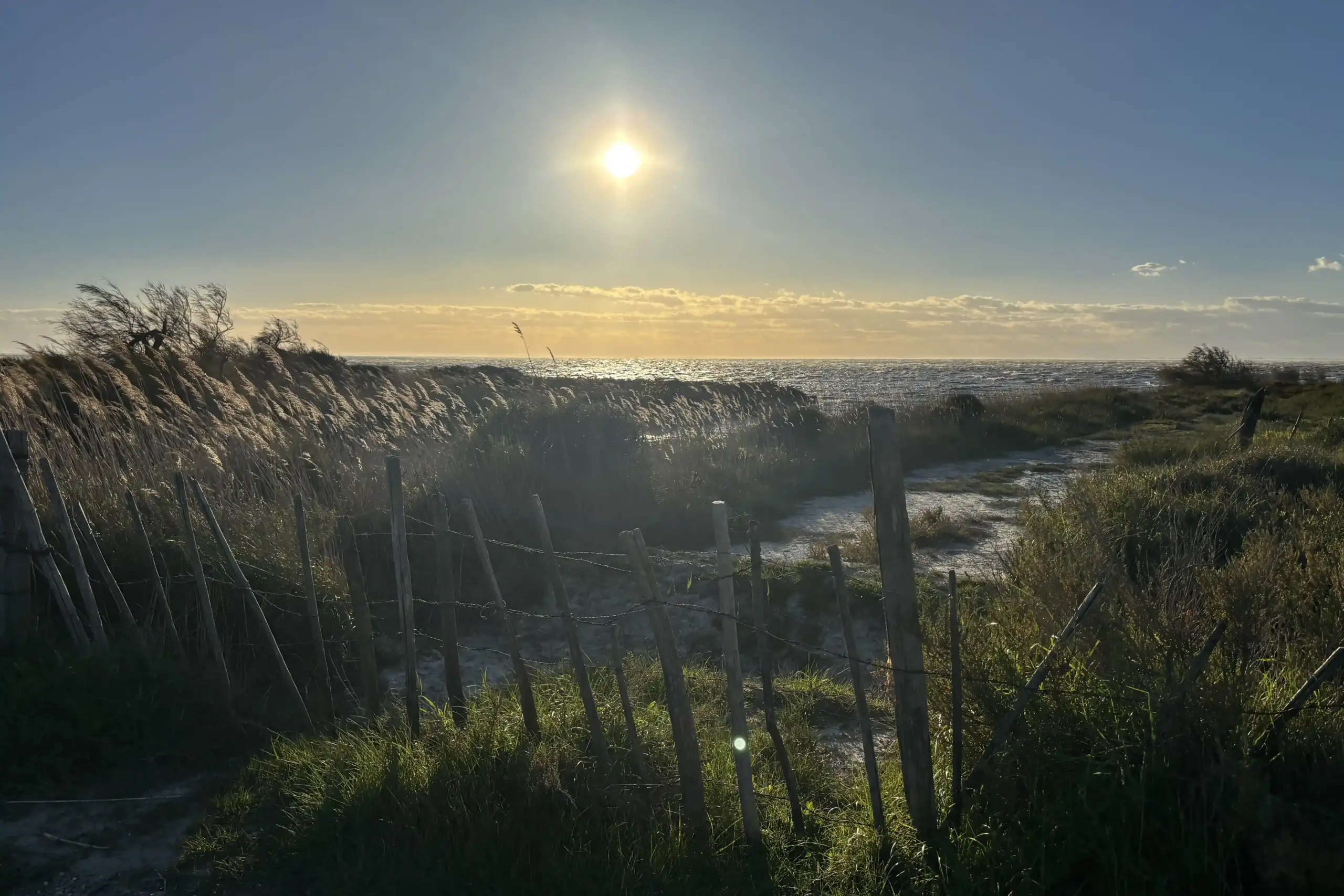
For those who have more days and feel like walking or cycling, I have added below some truly unmissable hiking trails.
Additional hiking trails
If you have time and feel like exploring more, here are other routes worth doing, by bike or on foot:
1. ÉtÉtourneau Trail — Vigueirat Marshes
This is a combination of 3 routes that, in total, cover 6 km of trails on wooden walkways that seem to float on the water. You will cross 5 different habitats — riparian forest, reed bed, salt marsh, dune, and coastal plain — with observation points for birdwatching.
To reach it, head towards Marais du Vigueirat, Mas Thibert, between Arles and Port-Saint-Louis-du-Rhône. From there, you will find the signs.
2. Pont de Rousty Trail
Right next to the Camargue Museum, there is a loop trail of about 3 km. It runs alongside the Rousty Canal and crosses rice fields, marshes, and meadows, with panoramic points and observation hides for spotting herons, ducks, and waders.
3. Domaine de la Palissade
This trail runs inside a private property, so there is an entrance fee. You will find everything on the official website. It consists of trails along the Rhône, including an 8-meter panoramic tower and several observation points over sansouïres, rush beds, marshes, and lagoons. That said, personally I find it interesting but not superior to the other routes: the others have nothing to envy it.
4. Étang de Vaccarès
It is the largest lake in the National Nature Reserve of the Camargue. It is a site of crucial importance for migratory birds and for the flamingos that live there all year round. It is not the first stop I would include for a weekend trip, but if you have time, I recommend taking the dirt track that runs along the small Monro lake as far as Vaccarès. Much less frequented than the main D37 road on the northern shore, this track — used by hikers and horse riders — will take you as close as possible to the lake and to the animals that live there: white horses, bulls, and flamingos. The starting point is this parking area on the D85A.
Falling asleep in the Camargue
I usually do not devote much space to accommodation: when traveling, for me, the hotel is just the place where I sleep and recharge my energy. But in the Camargue, this rule does not apply. Falling asleep here is part of the experience — and doing it in the right place can change everything.
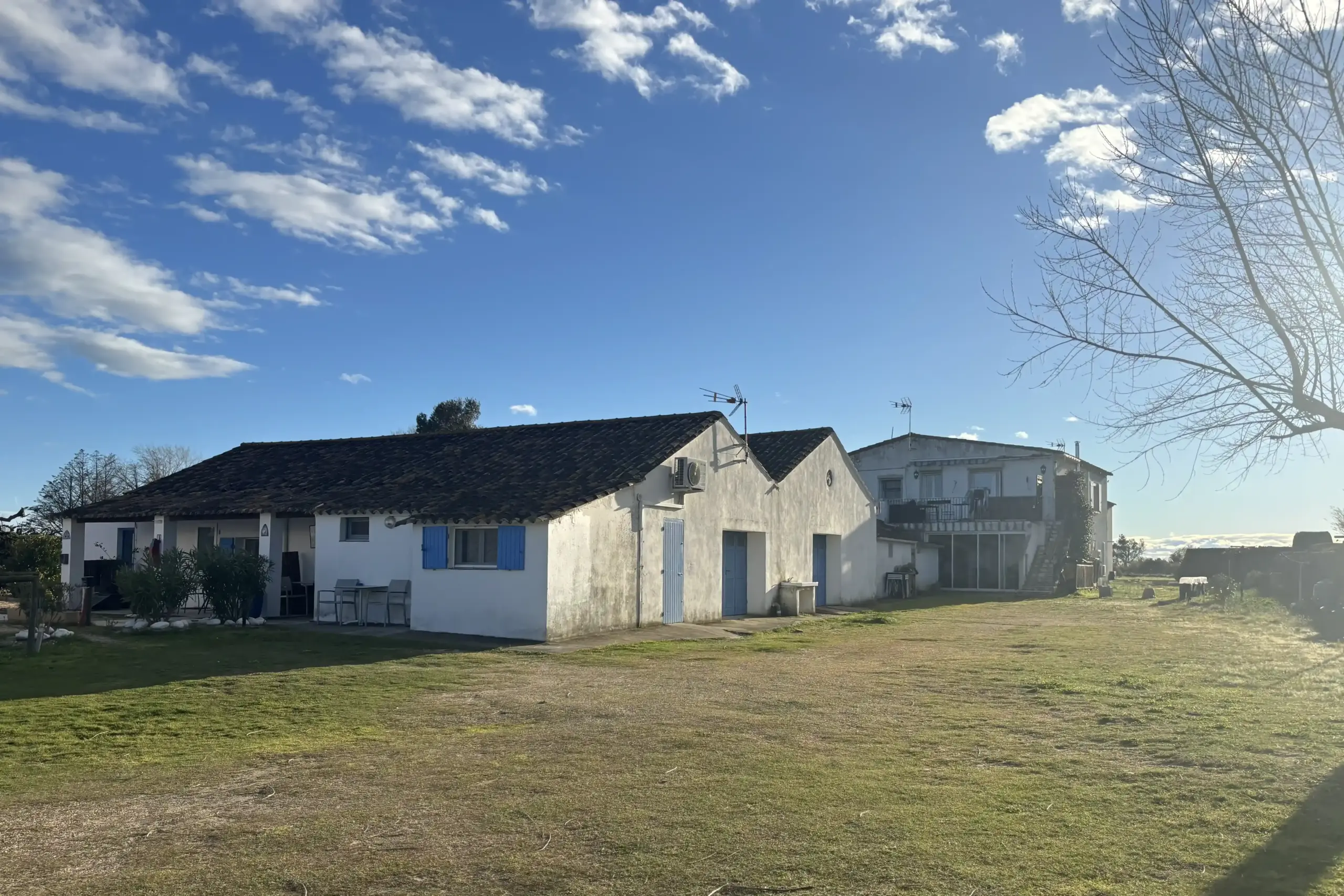
The most authentic choice you can make is a mas, the typical Camargue farmhouse. Or directly a manade. In both cases, you will be able to experience the daily life of bull and horse breeders up close, with an immersion that no tourist guide can offer.
To truly enjoy the silences and Camargue nights, my advice is to look for accommodation in the eastern area, around Saintes-Maries-de-la-Mer or even near Port-Saint-Louis-du-Rhône. Here are some ideas.
Le Manade des Baumelles: near Saintes-Maries-de-la-Mer, it combines bull culture with an elegant and refined restaurant that will not disappoint you. You will be able to experience the Camargue at 360°. It is not exactly cheap, but it gives an idea of the type of structure to look for for an authentic stay.
Le Mas de mon Père: it is a simpler version, but it enchants me every time. It is a traditional mas in the most genuine sense of the term: you will sleep in small houses that open directly onto the meadows and fields of the property. In the morning, you wake up with white horses before your eyes. It is also perfect for those who love camping: it is in fact possible to camp in the designated areas of the property and use shared bathrooms and showers.
Studios MISTRAL21: these rooms are not located in a mas, but in the old workers’ houses built for the salt flat workers. In Salin-de-Giraud, in the middle of a wild landscape, rows of identical brick houses appear, surrounded by perfectly orderly tree-lined avenues. You will have the opportunity to see another side of the Camargue.
Mas Constantin: if you are traveling in summer or with children and need a swimming pool for the hottest hours, I recommend Mas Constantin. The pool is small, but at least you will not have to give up the atmosphere of the Camargue by taking refuge in a standard hotel.
Directly in the salt flats: both in the Aigues-Mortes salt flats and in those of Giraud, it is possible to sleep and wake up in the morning surrounded by an intense pink. I have not done it personally, but here you can get an idea:
The Camargue is a beautiful territory, but also a somewhat extreme one: wind, sun, water, and distances can completely change the experience. Packing well really makes a difference.
- A good mosquito repellent is essential. Dozens of mosquito species live in the Camargue, especially in the wetlands. The worst time is sunset, so it is better to always have an effective repellent with you. In summer, I also recommend bringing long-sleeved shirts that can protect you a little.
- Bring a windbreaker even in summer. The Mistral can rise suddenly and completely change the perception of the weather, especially in open areas and along the coast. In winter or in the shoulder seasons, a hat and gloves also become essential.
- If you really want to discover all the local birdlife, bring a pair of binoculars with you: small, but very useful. They allow you to observe flamingos, horses, and birds even from a distance, especially along the scenic roads and from the observation towers.
- Many areas of the Camargue are isolated, with no bars or shops. Also, in low season, not all supermarkets and restaurants are open. In many parks and trails, there are areas set up for small picnics, so always create a supply of snacks.
- You will walk a lot, often on trails or natural paths, so using a pair of comfortable shoes, already tested, is essential. Between dirt tracks, sand, and walkways, they are indispensable. Avoid very open sandals, especially in the wetlands.
- A reusable water bottle is an excellent ally, as shade is not always guaranteed. I bought a foldable silicone one from Natura. In any case, you can find similar ones, which allow you to save space once used.
- If you plan to go to the beach, there is no need to bring half your house with you: a lightweight towel — I bought this one to always have it with me when I travel to a seaside town — sandals, and a practical bag are more than enough.
- The sun is one of the absolute protagonists, at any time of year. A hat, sunglasses, and a good sunscreen are essential even in winter: in the Camargue, the sun is always strong and makes itself felt especially during long walks. In addition, the wind will make you need a nourishing cream, as well as a lip balm.
- Small items like a power bank may seem like details, but they make the days much easier, especially if you have the navigator on to find your way around and want to capture in photos all the animals, landscapes, and most beautiful moments of the trip. I was given one as a gift and I am very happy with it. But there are thousands of different types. Regardless of the model, I highly recommend it.
You do not need much else. In the Camargue, it is not about having everything, but about having the right things.
The Camargue is not a place to be conquered, to be “done” in a hurry, or to be reduced to a handful of beautiful photographs. It is a land that must be listened to. It must be crossed slowly, leaving space for the wind, the silences, the light changing on the water, and that strange feeling of being in a place that truly does not resemble anywhere else in Europe.
Perhaps this is exactly what makes it so difficult to explain: the Camargue is not only visited, it is absorbed. Every time you leave, you take away much more than a landscape. You take away a different rhythm, unexpected colors, and that sense of rough and authentic freedom — rare and fragile — that deserves all our respect.