Saintes-Maries-de-la-Mer: the gateway to the most authentic Camargue
Saintes-Maries-de-la-Mer is not simply a French village overlooking the Mediterranean: it is a destination that speaks to the heart, capable of offering much more than just a seaside holiday.
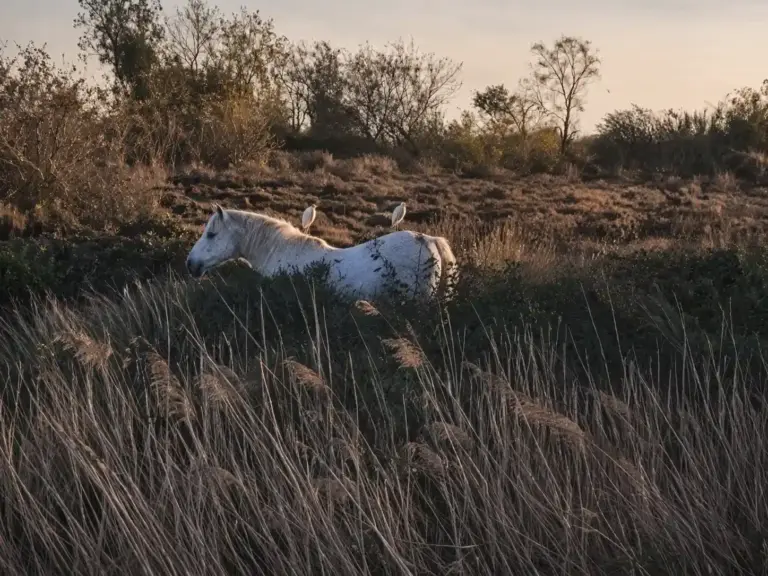
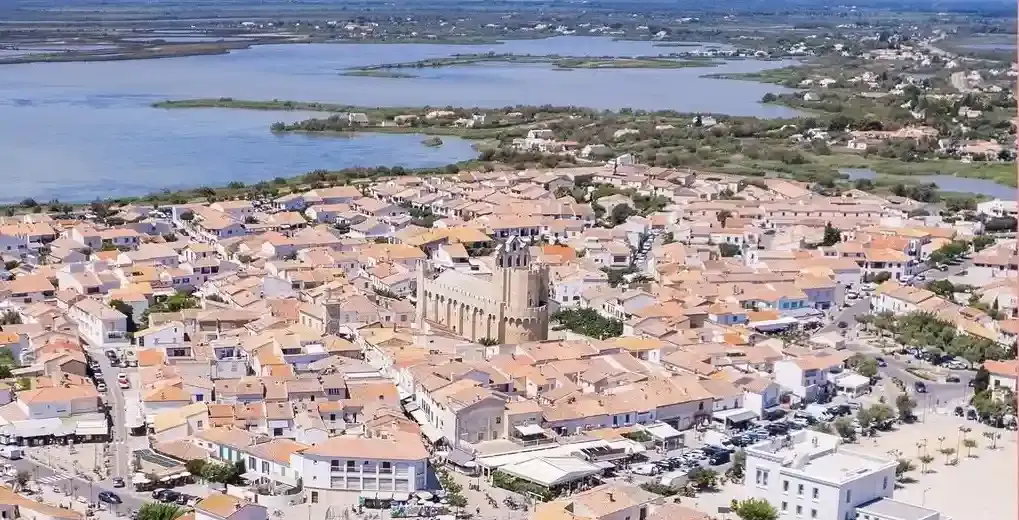
Try to imagine it: white houses with red roofs gathered around an ancient fortified church, the gaze stretching out over the Mediterranean and, all around, the wildest Camargue opening up as far as the eye can see — silent marshes, lagoons tinged with pink, white horses galloping freely and flamingos tracing the sky with their flight.
Saintes-Maries-de-la-Mer is much more than just a seaside town. With over 30 km of sandy coastline, its vast wetlands, the salt marshes of the sansouires, the salt flats of Salin-de-Giraud and the endless rice fields, this place is the beating heart of the Camargue soul — and, above all, the spiritual capital of the Romani people. Here, wild nature, centuries-old spirituality and authentic traditions intertwine in an atmosphere found nowhere else in the world.
So prepare yourselves for a journey through centuries-old traditions, faith and unspoilt nature: an experience that remains in the heart long after the return home.
Here are some practical tips for organising your trip to Saintes-Maries-de-la-Mer and the Camargue: how to get there, how to get around, how to plan your visit and when to go. A few useful things to know when choosing the most convenient transport, exploring the surrounding natural areas and organising your days around the weather and distances.
Show all tips ↓ Hide tips ↑
How to get to Saintes-Maries-de-la-Mer
- By plane: the nearest airport is Nîmes Alès Camargue Cévennes, but it often has fewer flights. Two alternatives are Montpellier Méditerranée (about 1 hour away and probably the most convenient) and Marseille Provence (about 1 hour and a half away). To find the best fares, I use Google Flights: it allows you to compare prices across several dates and find the most convenient combination. From these airports, there are buses or trains that take you to various railway stations, from where you can continue towards Aigues-Mortes or Le Grau-du-Roi, or towards Arles. However, for those arriving by plane, my recommendation is to rent a car.
- By train: the most practical solution is to arrive in Arles. From here, take the A50 bus to Saintes-Maries-de-la-Mer. It is absolutely not convenient to arrive in Aigues-Mortes, even though it is served by the railway and is connected to Nîmes by a beautiful train route. In fact, travelling from Aigues-Mortes to Saintes-Maries-de-la-Mer by public transport is very complicated, as there is no truly convenient direct connection.
- By coach: it is fine for reaching nearby cities such as Arles and Nîmes, but it rarely takes you directly into the natural heart of the Camargue, with the exception of the A50 line, which takes you from Arles to Saintes-Maries-de-la-Mer. If you travel by bus, it is better to alternate between buses and trains depending on the routes you intend to take. Take a look at the Envia website for general timetables and to get an idea of the available buses and routes.
In short, if you want a comfortable and complete trip, it is best to fly into Marseille or Montpellier and rent a car.
How to get around Saintes-Maries-de-la-Mer
- A car is the most convenient solution. Public transport is very limited and does not allow you to follow a complete itinerary. It also takes a great deal of time and risks turning the trip into a gruelling tour.
- I saw many people travelling by bicycle from one Camargue village to another. If you enjoy cycle tourism, then it is fine to reach nearby cities such as Arles and Nîmes by train and then begin your ride. The Camargue is flat and apparently easy, but many interesting places are scattered among ponds, salt flats, secondary roads and natural areas, so in any case, be prepared for long rides. It is possible to rent bicycles, including electric bikes, within the Camargue, and these can be a good alternative for those who are less athletic. In the article, I will give you further advice on how to organise your trip.
- With an organised tour: this is the ideal option for those who do not want to worry about logistics. Numerous agencies organise departures from Arles, Avignon, Montpellier and Marseille, but they are often one-day tours. You also need to choose your base carefully. For the “wild” Camargue and Saintes-Maries-de-la-Mer, Arles is the better choice. From Montpellier or Nîmes, on the other hand, there are more tours to Aigues-Mortes. I always check availability on websites such as GetYourGuide or Civitatis.
How to plan your visit to Saintes-Maries-de-la-Mer
- In summer, it is best to book well in advance, not only your accommodation but also Pont de Gau. Even during the low season, however, booking remains an excellent idea, especially for accommodation.
- Itinerary: since everything is very concentrated and close together, there is no need to plan every day in detail, except for places where booking is required. Let the wind inspire you.
- The Mistral is a strong wind that can blow in any season. It can be so intense that it prevents you from walking in a straight line! Check the weather before setting off.
- Watch out for mosquitoes! This is an essential tip: if you go in summer, bring a powerful mosquito repellent with you, especially for sunset. They are very common in wetland areas.
- People eat fairly early compared with other parts of Europe. Bear in mind that some restaurants close at 2:00 pm or 10:00 pm. Keep this in mind when planning your day.
When to go to Saintes-Maries-de-la-Mer
- The busiest season begins in April and ends in October. During the other months, not all attractions and services are available. For example, visits to the manades are reduced, some restaurants and shops remain closed and, of course, you cannot fully enjoy the sea and beaches. The positive side is that there are fewer tourists and everything feels more authentic and wild.
- The best time to enjoy the Camargue is May–June and September–October, when the weather is mild and there are fewer crowds. Avoid summer if possible, due to the humid heat, little shade and large numbers of tourists and mosquitoes, although it is precisely during those months that the Salin-de-Giraud salt flats reach their greatest splendour and the sea is truly wonderful. I must say, from direct experience, that winter is also very beautiful: everything is slower and sleepier, with fewer tourists and nature waiting to burst into life. Of course, however, the days are shorter, the climate is less mild and not all attractions and restaurants are open.
A little history of Saintes-Maries-de-la-Mer
To truly understand Saintes-Maries-de-la-Mer, you have to accept that here history and myth coexist, feeding one another. The history of this village is, in fact, a fascinating story unlike any other in the world, in which legend, Christian faith, popular traditions and the deep identity of the Romani people merge into a single narrative.
Although its fame is linked to the saints — hence the name Saintes-Maries-de-la-Mer — the sacred nature of this place did not begin with Christianity: it was already considered sacred in ancient times.
Archaeological excavations carried out beneath the present-day church revealed the existence of extremely ancient places of worship: there was a temple dedicated to Artemis of Ephesus, the mother goddess, and another to Mithras, the Persian god who was particularly revered by Roman legionaries. Even earlier, a Celtic cult dedicated to the Tria Fata, the three mother goddesses, was practised here.
The fate of the village changed forever around 40 AD — or 48 AD, according to some traditions — when a story that was both tragic and extraordinary left its mark on this place forever.
It all began at a dramatic time for the first followers of Christ. A few years after the crucifixion of Jesus, the Roman authorities in Palestine, in an attempt to ease growing tensions and rid themselves of the first Christians, decided to exile a group of believers. According to Provençal oral tradition — recorded in the 13th century in the Golden Legend by Jacobus de Voragine and passed down from generation to generation — these men and women were placed on a boat without sails, oars or a rudder, abandoned to the open sea and destined, by all logic, to certain death.
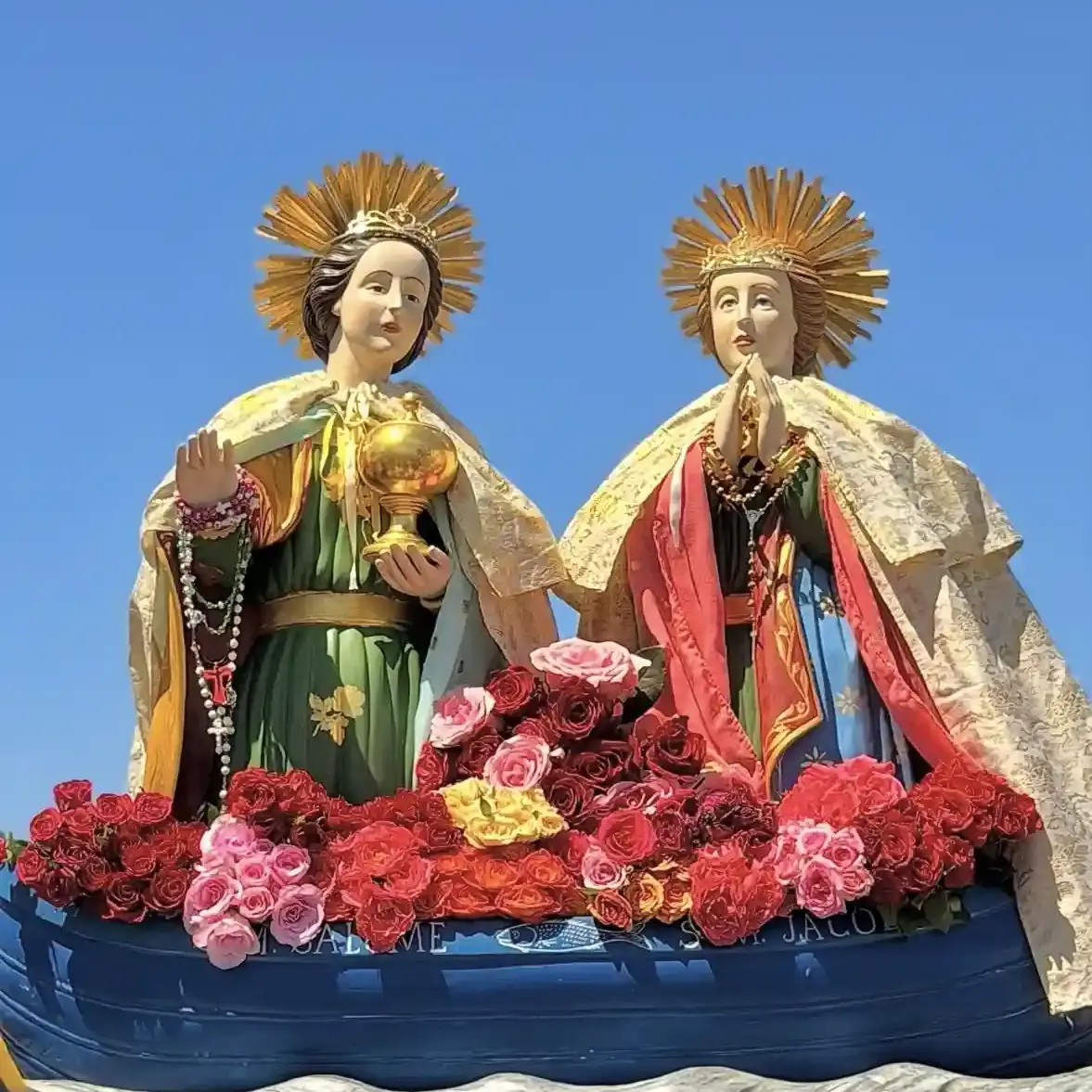
And yet, guided by divine forces, that fragile vessel did not sink: instead, it reached the shores of the Camargue. According to legend, some of the most important figures of early Christianity were travelling on board: Lazarus, his sister Martha, Mary Magdalene, Mary Jacobe and Mary Salome. With them was also a figure never mentioned in the Gospels: their Ethiopian servant, Sarah.
According to the story, during that miraculous crossing the group separated: Mary Magdalene, Lazarus and Martha landed in other parts of Provence — respectively at Sainte-Baume, Marseille and Tarascon — while the two Marys, together with their servant Sarah, continued their journey. Once they had reached their destinations, each of them devoted themselves to evangelising the region: Martha defeated the fearsome Tarasque — a monstrous creature, half dragon and half turtle — in Tarascon, Lazarus became the first bishop of Marseille, and Mary Magdalene withdrew into a life of solitude at Sainte-Baume.
Guided by Providence, the rudderless boat carrying the two Marys continued its journey across the Mediterranean and finally reached the shores of the Camargue, in a small village of fishermen and shepherds then known as Oppidum Râ. It was a desolate, marshy land, constantly swept by the winds — and yet, for them, it became the Promised Land.
Here, the two Marys, who were older than Sarah, decided to remain forever. They began preaching the Gospel to the local people, converting many pagans, and chose to live in poverty and prayer, founding one of the very first Christian communities in France. When they died in old age, they were buried on the very site where the imposing fortified church stands today: their tomb soon became a place of worship for the region’s first Christians. According to legend, a spring of fresh water appeared at the burial site itself — a sign, for the faithful, of the holiness of that place.
While the legend of their arrival has been passed down to us through oral tradition, the first written records date back to the Middle Ages. Around 500 AD, Saint Caesarius, Archbishop of Arles, had the first church built, dedicated to Notre-Dame-de-Ratis, Our Lady of the Raft, on the very spot where the saints were believed to have been buried. Inside, there is also a freshwater well linked to the memory of the saints.
From the 9th century onwards, the coast of Provence was struck by increasingly frequent and devastating raids carried out by the Saracens — Muslim pirates from North Africa — and the Normans. The danger was so great that simply protecting the village was not enough: it was also necessary to defend what represented a priceless treasure for the local population and pilgrims — the relics and the cult of the Holy Marys. It was therefore decided to transform the sacred site into something more: no longer merely a church, but a genuine and impregnable fortress.
Between the 9th and 12th centuries, the present-day Church of Notre-Dame-de-la-Mer was therefore built, a structure as imposing as it was necessary, designed down to the smallest detail to withstand any siege:
- the walls are up to 3 metres thick;
- the building originally had no entrance at street level — access was provided by a removable staircase, which could be taken away in the event of danger;
- the crenellated top, similar to that of a castle, also served as a watchtower overlooking the sea, ready to signal the arrival of any threat.
Inside, the original church of Saint Caesarius was not destroyed, but incorporated into the new structure and carefully preserved, almost as though to offer even greater protection to what it contained: a kind of “church within the church”, a hidden sanctuary in the heart of the fortress — evidence of just how sacred and precious everything connected with the Holy Marys was to the people of that time.
And yet, throughout all of this, the figure of Sarah — the servant — remained in the shadows for a long time, confined to the margins of the legend just as, during her lifetime, she had been confined to the margins of society because of her status as a servant and a foreigner.
To understand the decisive turning point in the history of Saintes-Maries, we need to move forward to around the 15th century and follow the migrations of an entire people. The Romani people — Roma, Sinti, Kalé and Manouches — originated in the Indian subcontinent and began migrating westwards as early as around 1000 AD, travelling through Persia, the Byzantine Empire and the Balkans, before reaching Western Europe from the 15th century onwards. Their arrival in Provence is documented around 1420–1430.
When the first groups of Romani people arrived in Provence and learned of the legend of the Holy Marys, it was the figure of Sarah, the servant, who struck them more than any other. In that dark-skinned, foreign, exiled and marginalised woman, they immediately recognised their own condition: just as Sarah had been forced to leave her homeland and live in a foreign country, so they too were a people in constant migration, met everywhere with distrust and suspicion.
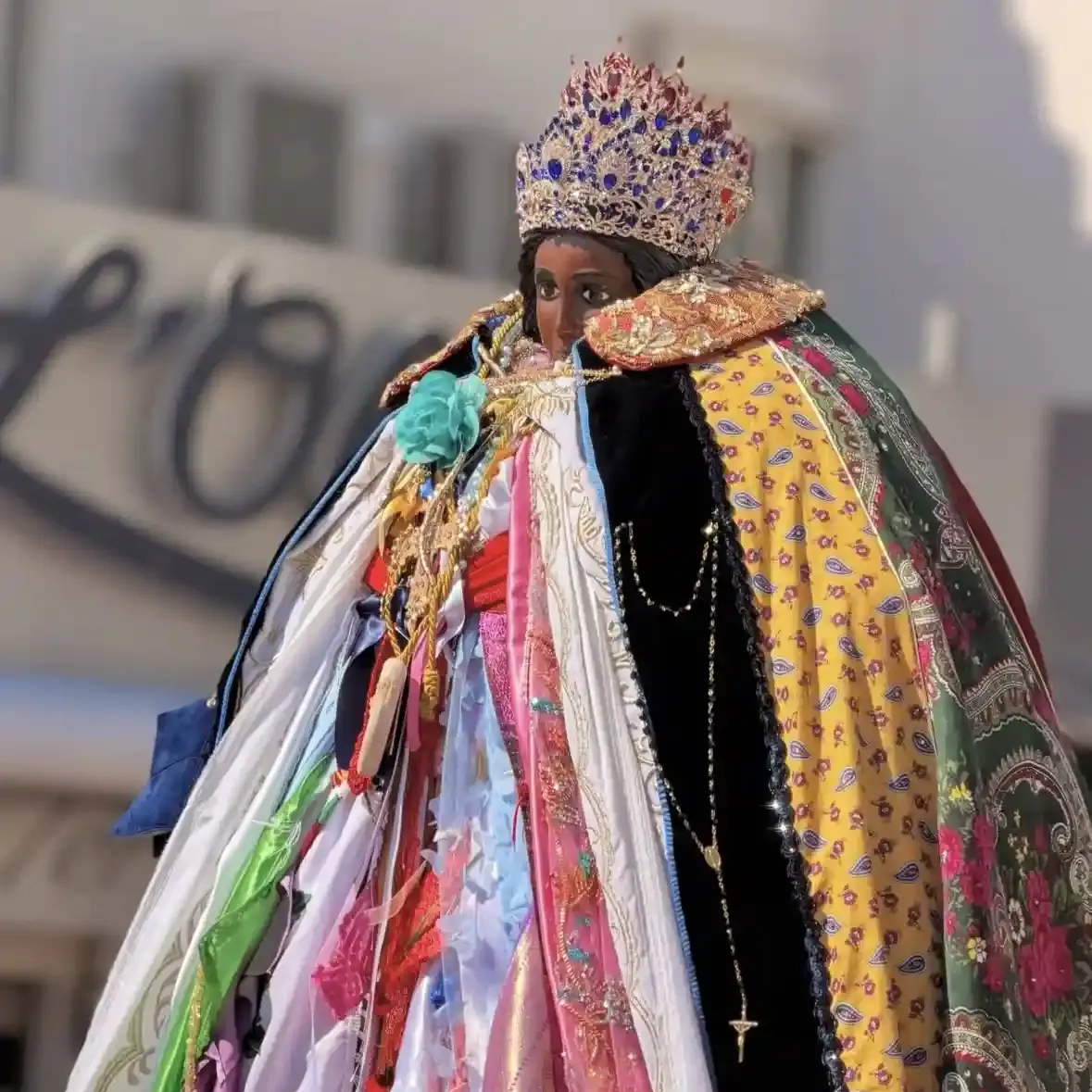
The Romani people therefore chose Sarah as their patron and protector, giving her the name Sara-la-Kali — “Sarah the Black”, but also “Sarah the Romani”, since kali means “black” in Romani and is also the root of the word Kalé, the name of one of the Romani groups. Her cult spread rapidly, and the Romani people began making pilgrimages to Saintes-Maries to honour her, bringing with them their music, their songs and a devotion as profound as it was spontaneous.
At first, the Catholic Church viewed this popular cult with suspicion, considering it close to the limits of orthodoxy. However, faced with the growing devotion of the Romani people, the ecclesiastical hierarchy eventually chose to accept and channel that fervour, officially recognising Sarah as a venerable figure — without, however, raising her to the altars as a canonised saint, since no official canonisation process exists for her. Her statue was placed in the crypt of the church, where it is still kept and venerated today.
During the 15th century, the flow of pilgrims to Saintes-Maries-de-la-Mer grew considerably. It was King René of Anjou, Count of Provence — an educated ruler, a lover of the arts and deeply attached to the traditions of his time — who decided to clarify the matter of the saints’ burial places once and for all. In 1448, he therefore ordered systematic excavations inside the church.
At a depth of about one and a half metres, the workers discovered two perfectly preserved skeletons, wrapped in precious silk cloths and accompanied by a Latin inscription confirming their identity. The bones, immersed in an oily and fragrant liquid — interpreted at the time as a sign of holiness — were identified as the relics of Mary Jacobe and Mary Salome.
From that moment onwards, the relics found their permanent place in a precious gilded wooden reliquary chest, kept in the upper chapel of the church. Even today, twice a year, during the major pilgrimages, the chest is lowered from above to be displayed for the veneration of the faithful, in a solemn and moving ritual that has crossed the centuries to reach us.
Then came the French Revolution, a dark period for many places of worship. On 5 March 1794, at the height of the iconoclastic fury, a group of revolutionaries stormed the church of Saintes-Maries: the statue of Saint Sarah was thrown into the fire and burned, and the relics of the two Marys met the same fate.
However, according to tradition, some villagers, who remained secretly faithful, managed to rescue part of the bones from the flames and hide them. Only a portion of the original relics was thus saved from destruction, and today it is kept in the reliquary chest together with other bones from various churches in the region.
The statue of Saint Sarah that we see today in the crypt is actually a 19th-century reconstruction, created after the end of the religious persecutions: since then, it has become the centre of Romani devotion.
For centuries, the village was known by different names — Notre-Dame-de-la-Mer, Saintes-Maries-de-la-Barque, or simply Les Saintes. It was only in 1838, by official decree, that the municipality adopted its present name, Saintes-Maries-de-la-Mer, in honour of the two saints who are its patronesses.
The arrival of the railway from Arles in 1892 opened the doors to seaside tourism, attracting a great many visitors, some more famous than others.
In the summer of 1888, the Dutch painter Vincent van Gogh, who was living in Arles at the time, decided to take a short holiday in Saintes-Maries-de-la-Mer. He stayed there for only a few days, from 30 May to 3 June, but that was enough to leave a profound impression on him.
He was captivated by the dazzling light, the sea and the colourful boats pulled ashore on the beach, and during that brief stay he produced several drawings and three paintings that would become particularly important:
- Fishing Boats on the Beach at Saintes-Maries, now housed at the Van Gogh Museum in Amsterdam.
- View of Saintes-Maries, housed at the Kröller-Müller Museum in Otterlo.
- Fishing Boats at Sea, now in a private collection.
His letters to his brother Theo still convey the enthusiasm of those days: “I painted boats at sea, I set off very early in the morning, and brought back a large study”. It was precisely this brief artistic interlude that helped make the village famous in the art world.
But if there is one person to whom the Camargue owes its fame more than anyone else, it is Marquis Folco de Baroncelli-Javon (1869–1943) — a figure who has become legendary in this land. A poet, writer and lover of popular traditions, he fell so deeply in love with the Camargue that he decided to settle there, becoming a manadier — a bull breeder — and a gardian himself.
Baroncelli devoted his entire life to defending and promoting Camargue identity. In 1909, he founded the Nacioun Gardiano — the “Gardian Nation” — an association created with the aim of preserving:
- the provençal language;
- traditional costumes — the gardians’ clothing, saddles and riding style;
- the Camargue horse and bull breeds;
- traditions such as the course camarguaise and local religious festivals.
It is thanks to him that the modern image of the Camargue — made up of gardians on horseback, herds of bulls roaming freely, traditional costumes and a very strong sense of identity — was codified and spread throughout France and the world. His manade was one of the most famous in the region, and his home in Saintes-Maries became a true cultural centre, a point of reference for all those who loved the Camargue. Today, the Baroncelli Museum in the village is dedicated to his memory and to the history he helped shape.
Today, Saintes-Maries-de-la-Mer is a place unlike any other in the world: a small village capable of embracing profoundly different identities, and of doing so without any contradiction. It is, at the same time:
- a seaside tourist destination, with some of the most beautiful beaches on the coast;
- the heart of the Camargue Regional Natural Park, an ideal starting point for those who want to venture into wild and protected nature;
- a centre of bullfighting and equestrian culture, shaped by arenas, manades and gardians;
- the spiritual capital of the Romani people, and the destination of an annual pilgrimage that draws tens of thousands of Roma, Sinti, Kalé and Manouches every year;
- a place of Christian devotion, preserving the centuries-old cult of the two Marys.
Different identities coexist in this small village of white houses, blending together and enriching one another in a unique and fascinating balance that has no equal in Europe.
It is no coincidence that artists and famous figures such as Vincent van Gogh, in 1888, and Bob Dylan, in 1975, were fascinated by this place, contributing — almost a century apart — to spreading its fame far beyond the borders of France.
What to do in Saintes-Maries-de-la-Mer
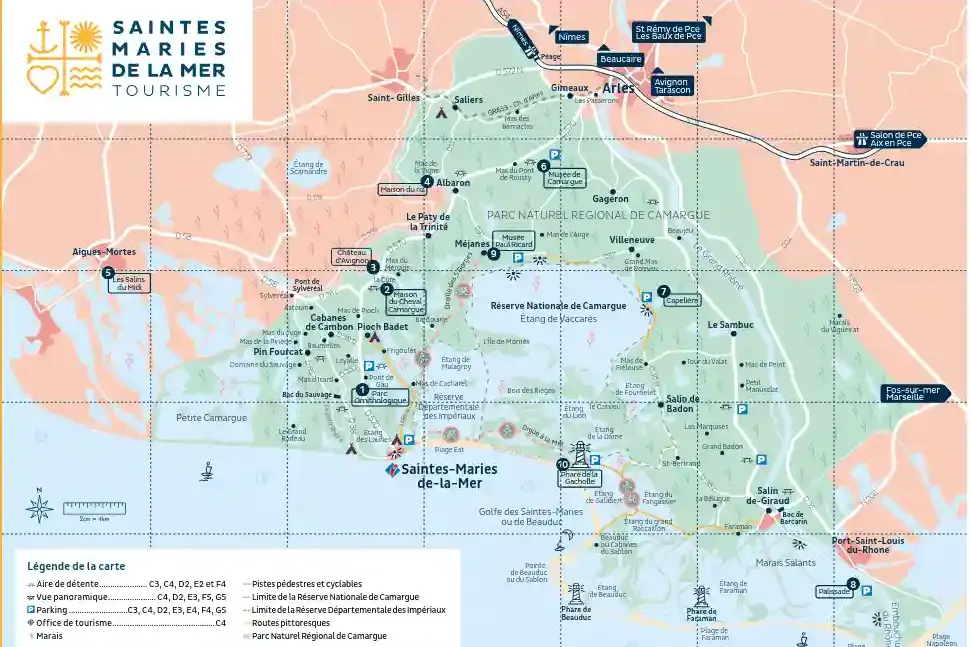
The unique geography of Saintes-Maries-de-la-Mer has shaped its history, its development and now its appeal as a tourist destination. Covering 372 km², the municipality is one of the largest in France, even though the town itself is actually quite small: its territory stretches for more than 30 km from west to east and 15 km from north to south, encompassing a vast section of the Rhône delta. Since 1970, this entire area has formed the heart of the Camargue Regional Natural Park.
The landscape is a true mosaic of natural environments: lagoons, or étangs, such as those of Launes, Gines and Impérial, the sansouïres — salt marshes — reed beds and vast sandy beaches. These are joined by the Camargue National Nature Reserve, which includes the Étang de Vaccarès and its islands: a protected area of European importance, closed to traffic and accessible only at certain points.
The village lies on the coast, slightly east of the mouth of the Petit Rhône, and its development has been shaped since the 16th century by a constant struggle against water, with dykes and canals built to protect the land. The result is a town of low white houses in Provençal style — designed to provide shelter from the sun and wind — all clustered around the imposing fortified church.
Saintes-Maries-de-la-Mer is, in the end, a concentration of wonders: from the majestic fortified church to the wild beaches, from museums that recount centuries of history to the ornithological park that fascinates both adults and children.
Every corner of this place deserves to be discovered.
First of all, visit the Saintes-Maries-de-la-Mer tourist office website. It is really well designed! It will already give you an initial idea of how the area works, the activities and the festivals.
Below, you will find everything you absolutely must not miss, along with a few extra tips to make your holiday in the Camargue truly unique!
The historic centre
The heart of Saintes-Maries-de-la-Mer is a small jewel of Provençal authenticity. Imagine a maze of narrow, winding streets lined with low whitewashed houses and topped with the characteristic red-tiled roofs — just like the fishing villages scattered along the Mediterranean.
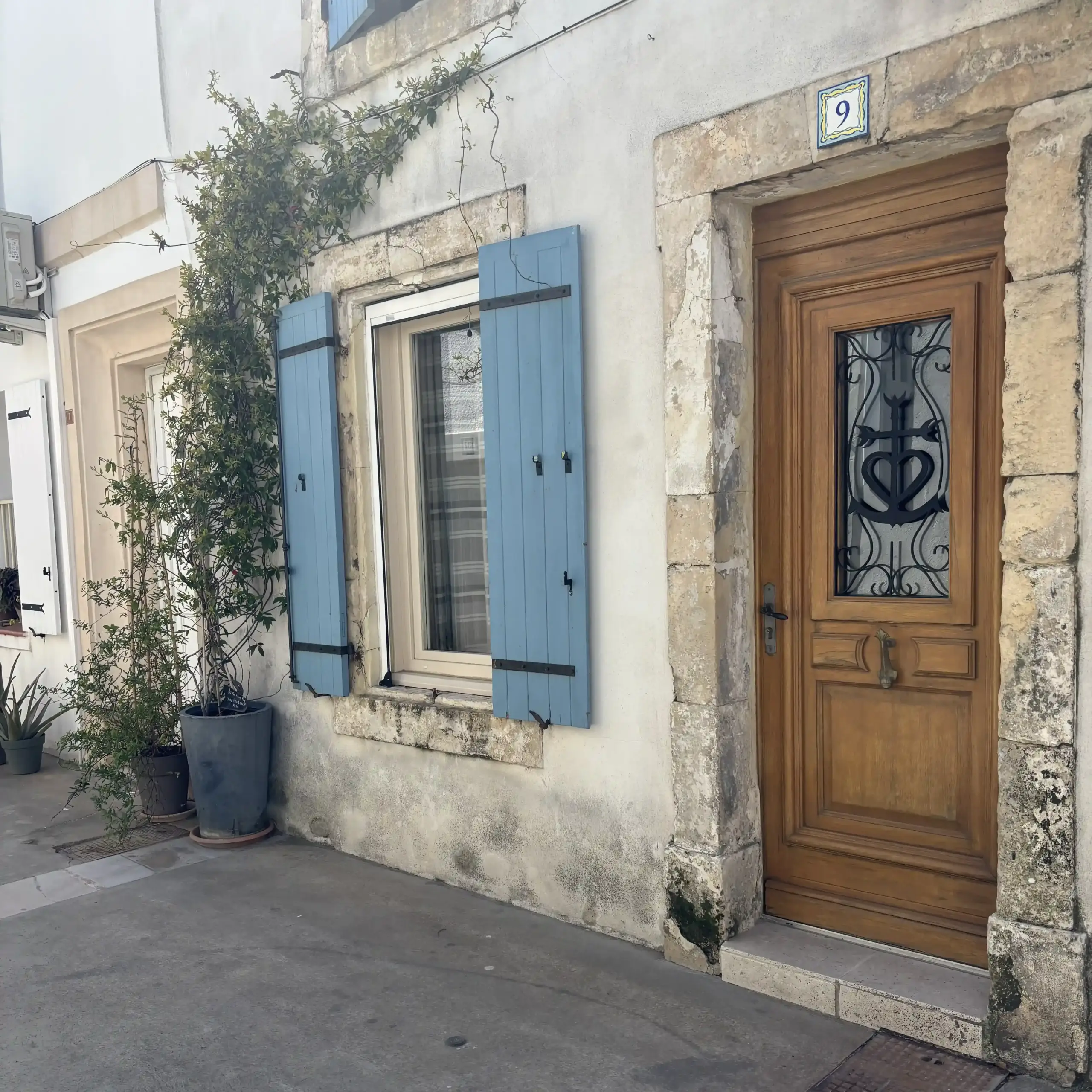
The historic centre, entirely pedestrianised, is perfect for exploring at a leisurely pace, simply letting instinct guide you. Around every corner, you will discover picturesque views, small squares shaded by trees and peaceful corners far from the summer crowds, while the façades of the houses come alive with shutters and doors painted in the soft pastel colours typical of the region. Along the streets, local craft shops follow one another, offering hand-painted ceramics, Provençal fabrics — such as the famous textiles decorated with floral and bird motifs — wooden and wrought-iron objects, and of course the typical products of the Camargue: the ideal place to look for a truly unique and authentic souvenir.
The village, after all, has always attracted artists, painters and sculptors, captivated by its light and landscapes. It is no coincidence that today numerous art galleries are scattered throughout the historic centre, displaying works by contemporary artists who continue to draw inspiration from the Camargue — from its white horses, black bulls and pink flamingos.
Unlike many regional symbols whose origins are lost in the mists of time, the Camargue Cross has a precise date of birth and a well-documented history, linked to the fascinating figure of Marquis Folco de Baroncelli-Javon.
As we know, at the beginning of the 20th century, Marquis de Baroncelli, a poet, writer and passionate manadier (bull breeder), devoted himself wholeheartedly to defending the identity of the Camargue.
In 1924, Baroncelli came up with the idea of creating a symbol that would represent this “nation” of gardians (cowboys on horseback) and fishermen. He entrusted the task to his friend, the Parisian painter and illustrator Hermann-Paul, who often stayed in the Camargue at the time.
Hermann-Paul created the design, but an important change was made during its production. The blacksmith of Saintes-Maries-de-la-Mer, Joseph Barbanson, who was commissioned to forge the first cross in his workshop in what is now Place du Grenier à Sel, suggested replacing the three fleurs-de-lis originally planned for the ends with three tridents, a more authentic symbol of the gardians.
The Camargue Cross is rich in symbolism. Its shape combines three distinct elements, representing the three theological virtues of Christianity and, at the same time, the three fundamental components of Camargue society.
⚓ Anchor
It represents the fishermen. The base of the cross is an anchor, evoking the fishermen of the Mediterranean and the lagoons, a historic activity of the village.
Christian virtue: Hope.
❤️ Heart
It represents the Holy Marys. A heart stands out at the centre of the cross. It is the symbol of the three Marys — Mary Jacobe, Mary Salome and their servant Sarah — venerated in the fortified church, and of divine charity.
Christian virtue: Charity.
🔱 Tridents
They represent the gardians. The three ends of the cross terminate in tridents, the traditional tool used by gardians to guide and gather herds of bulls in the pastures.
Christian virtue: Faith.
In this perfect synthesis, the Camargue Cross therefore embodies the region’s threefold soul: the fishermen who navigate its waters, the gardians who command the land with their horses and bulls, and the profound spirituality that can be felt in Saintes-Maries-de-la-Mer, a place of pilgrimage for over a thousand years.
As you walk through the village, you will notice it in many places:
- Pont du Mort: a copy of the original cross can be found here, at the western entrance to the village, along the road to Aigues-Mortes.
- On the church: it can be seen on the walls of the fortified church of Notre-Dame-de-la-Mer.
- On buildings and doorways: as you will certainly have noticed while walking around, it appears on many public and private buildings, often in wrought iron, bearing witness to the inhabitants’ pride in their identity.
- In the manades: one in particular can be found near the Mas du Simbeú, where Folco de Baroncelli lived.
The Fortified Church of Notre-Dame-de-la-Mer
Admission to the church is free for all visitors. However, if you want to climb up to the rooftop terrace and enjoy the breathtaking 360-degree view, the cost is around €3 per person, payable directly on site at the entrance to the church — I was unable to find any website selling tickets in advance, so it is best simply to turn up. The church is open every day, all year round, from 8:00 am to 6:00 pm, although it is sometimes closed for special ceremonies or during the lunch break. To enjoy the terrace at a leisurely pace, away from the crowds at the busiest times, I recommend visiting early in the morning or late in the afternoon — perhaps around sunset, for a truly unforgettable sight. Access to the terrace is from outside, on the south side of the church. Access is not permitted in the event of strong winds.
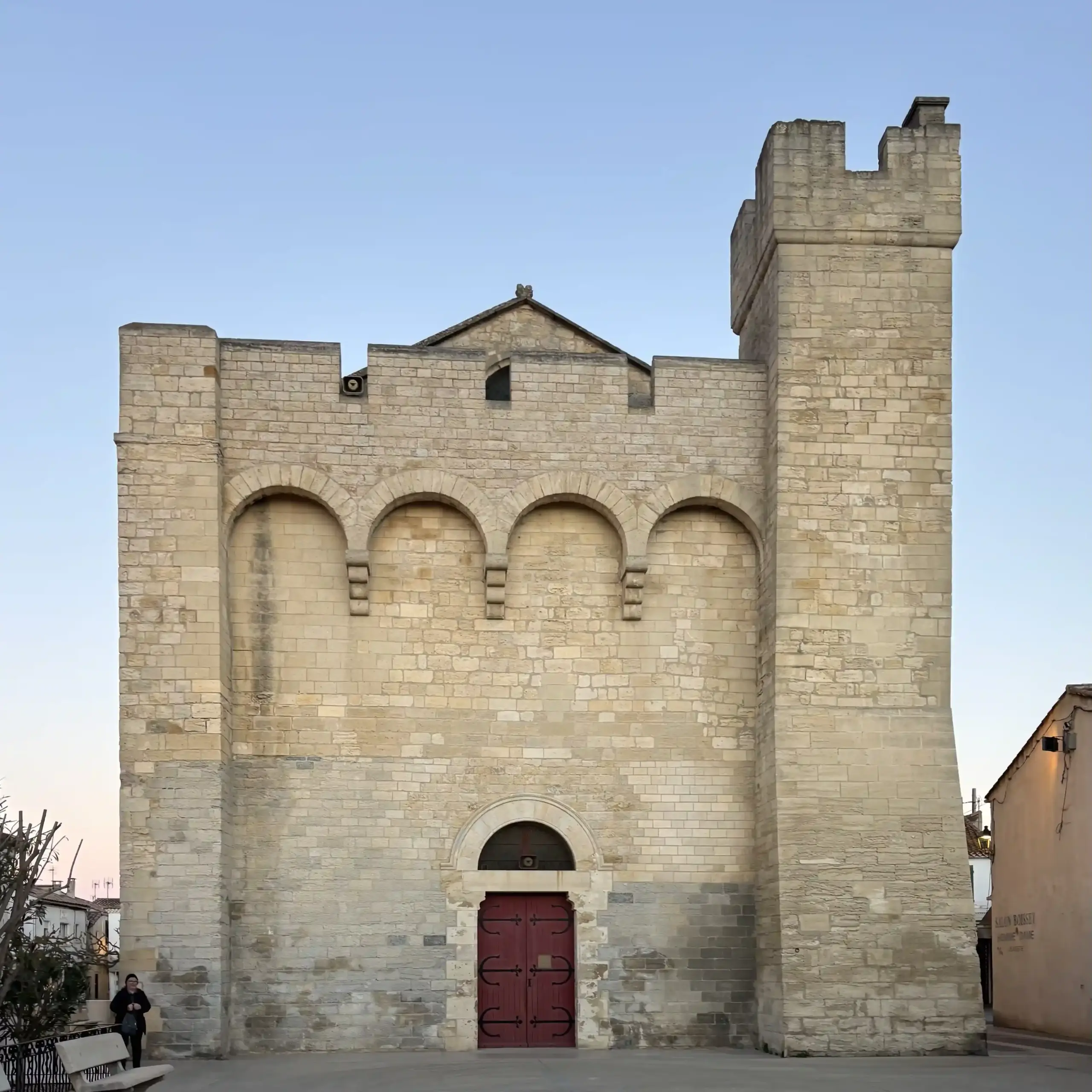
The Church of Notre-Dame-de-la-Mer is not simply a religious building: it is the beating heart of Saintes-Maries-de-la-Mer, the monument that dominates the village and holds centuries of history, legend and devotion within its walls. This imposing fortified church is a masterpiece of Provençal architecture and a sacred place for millions of pilgrims, particularly for the Romani people. Its construction, in the Romanesque style, lasted for almost four centuries, from the 9th to the 12th century: the result is a masterpiece of architecture that is both military and religious.
The site on which the church stands has an extremely ancient history. In Roman times, an oppidum called Ra already stood here. According to the historian Jean-Paul Clébert, there was a temple dedicated to Artemis of Ephesus, the mother goddess, and another to Mithras, the Persian god greatly revered by Roman legionaries. Even earlier, a Celtic cult dedicated to the Tria Fata, the three mother goddesses and goddesses of fertility, was practised here, later Romanised under the name of Juno.
It was only in the 6th century that the Archbishop of Arles, Saint Caesarius, decided to Christianise this ancient pagan place of worship by having the first church built here, dedicated to Notre-Dame-de-Ratis, Our Lady of the Raft, in memory of the legendary arrival of the saints.
From the 9th century onwards, however, the coasts of Provence were subjected to increasingly frequent and devastating raids by the Saracens and Vikings. To protect the relics of the saints and provide a safe refuge for the population, it was decided to transform the sacred place into something more: a church that was, at the same time, an impregnable fortress.
The construction of the present building, in the Romanesque style, lasted for almost four centuries, from the 9th to the 12th century.
Walking around the Church of Notre-Dame-de-la-Mer, you immediately realise that you are standing before something more than a simple place of worship: its architecture tells a story of defence, protection and survival, at a time when danger came from the sea.
The first thing that strikes you is the massive grandeur of its walls, which range in thickness from 1.5 to 3 metres and are made of hard, resistant stone — designed not only to support the building, but above all to withstand attacks and attempts by enemies to break through them. These are walls built to last, to protect those who sought refuge within them.
The church rises to a height of 15 metres and measures 41 metres in length and 10 metres in width. Although today it may seem small, its dimensions were considerable for the time and bear witness to the importance of the site, as well as to the need to accommodate not only the faithful but the entire population of the village in the event of danger.
Because of the sandy and unstable ground typical of the Camargue, medieval architects had to face a considerable engineering challenge: chronicles from the period report that the foundations were dug so deeply that they almost equalled the height of the building itself — “as much foundation as construction” — in order to ensure an extremely solid base and stability capable of lasting for centuries.
Looking at the façade, you immediately notice the absence of large windows or stained-glass openings: elements that would have weakened the structure and provided enemies with easy points of entry. Inside, the light enters faintly and mysteriously through a few narrow arrow slits, just as it would in a military fortress.
The roof also follows a purely defensive logic: it is made of stone slabs, a choice intended to prevent fires caused by flaming arrows or attempts by enemies to scale the building.
Perhaps the most surprising feature, however, is the entrance to the church. Originally, there was no door at street level: to enter, it was necessary to climb a removable wooden staircase, which could quickly be withdrawn in the event of danger, making the building practically impossible to attack.
During the 14th century, as siege techniques evolved, the church was further reinforced: additions were made to its upper sections
- a wall walk, which allowed sentries to patrol the perimeter and keep watch;
- battlements, to protect the defenders during attacks;
- machicolations, the projecting openings through which projectiles or boiling liquids could be dropped onto attackers.
Inside the main keep, a guardroom was even created, where the defenders could rest and organise the watch. In every stone, every arrow slit and every battlement, this church tells the story of a community that knew how to defend its faith and its very existence, transforming a place of prayer into an impregnable stronghold in the heart of the wild Camargue.
In 1448, King René of Anjou, Count of Provence, ordered excavations inside the church. Two skeletons were discovered and identified as the relics of Mary Jacobe and Mary Salome, together with three cippi — sacred stones from the Roman period — dedicated to Juno and the cult of Mithras, which can still be seen in the crypt today. Following this discovery, the church underwent major internal changes:
- the original church, which had been preserved inside the fortress, was demolished;
- the guardroom was converted into an upper chapel dedicated to Saint Michael, where the precious reliquary chests of the Holy Marys could be kept;
- a large window was created overlooking the nave below from the upper chapel, allowing the faithful to see the relics during religious celebrations.
The church does not contain any particularly remarkable works of art, but it is still worth visiting because of the historical importance it holds for the town and beyond.
Descending the stairs, you reach the most sacred and evocative place in the entire building, the heart of Romani devotion. The crypt houses the statue of Sara-la-Kali — “Sarah the Black” — patroness of the Romani people: her black face and hands emerge from precious, richly decorated colourful garments donated by the faithful over the centuries. The setting is very simple, almost disappointing to some, but the atmosphere here is filled with devotion and mystery — hundreds of lit candles, votive offerings, photographs and notes containing requests and words of thanks cover the walls, silently bearing witness to centuries of prayer, while soot accumulated over time has blackened the pale stones around the crypt’s only window.
The three Roman cippi discovered during the excavations of 1448 are also preserved here, evidence of the ancient pagan cult that animated this site long before the arrival of Christianity.
Returning upstairs, you can instead enter the upper chapel, dedicated to Saint Michael, where the church’s most precious treasures are kept: inside a display case are the gilded wooden reliquary chests containing the bones attributed to Mary Jacobe and Mary Salome, in a space decorated with elegant Louis XV-style wooden panelling.
Inside the church, in the left nave at the third arch, there is a reproduction of the boat that, according to legend, carried the Holy Marys to the shores of the Camargue: during the May pilgrimages, this same boat is carried in procession to the sea. At the centre of the church, below floor level, an ancient well can still be seen: according to tradition, it was around this well that the Holy Marys used to pray, and it was there that the very first oratory was built. Some people told me, however, that it was the well into which the spring of water that appeared after the saints’ death was channelled. A little mystery surrounding an already fascinating subject.
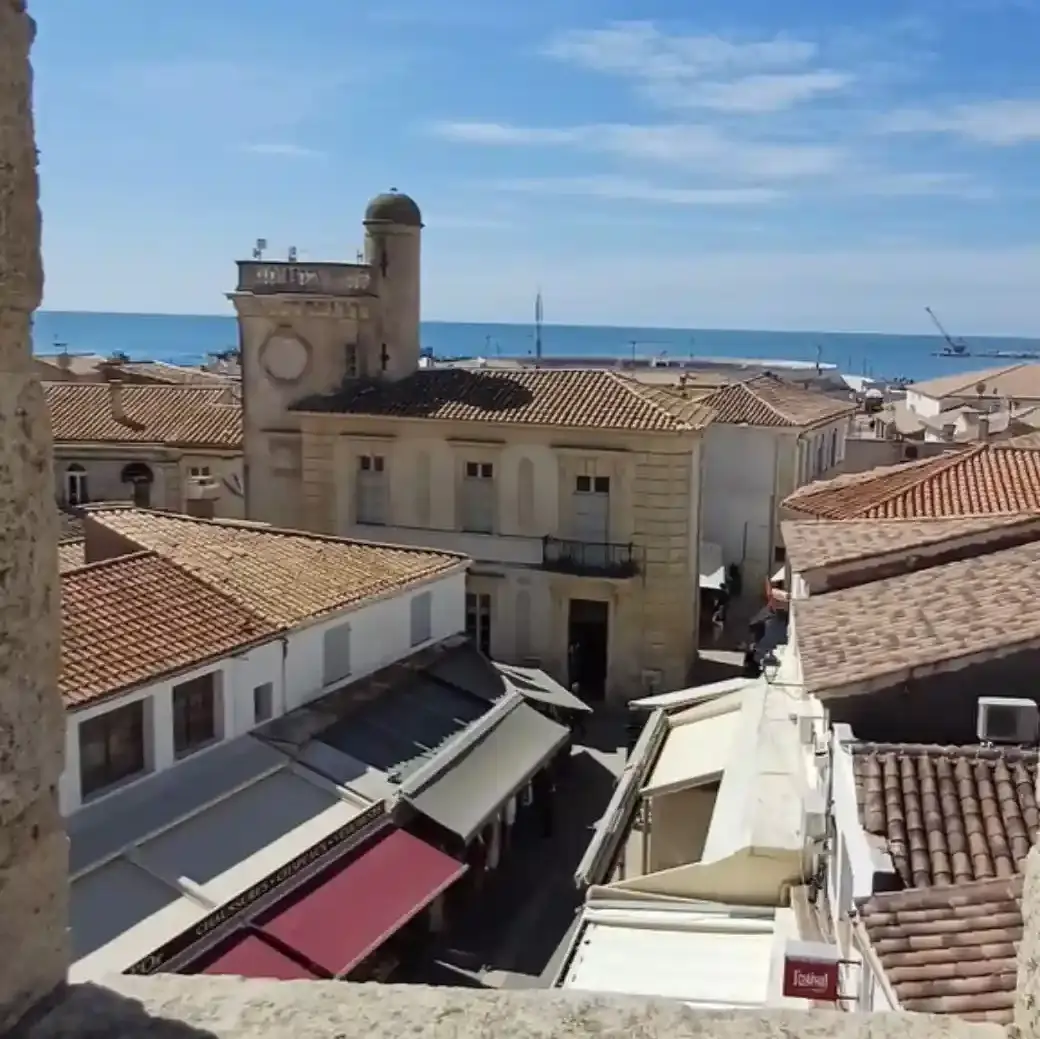
One of the most exciting moments of the visit, however, is the climb to the rooftop terrace, reached by a narrow spiral staircase of 53 steps, accessed from outside the church. The climb requires a little effort, but the reward is a simply spectacular 360-degree view:
- to the south: the Mediterranean, the long sandy beaches and the harbour;
- to the north: the boundless Camargue, with its lagoons (étangs), marshes and pastures;
- to the east and west: the village’s red rooftops, the arena, the Camargue Cross and the vast delta plain.
On exceptionally clear days, the view stretches as far as Mont Ventoux and the Alps, but it is at sunset that the panorama is at its most spectacular, when the golden light bathes the entire landscape in warm colours.
The church is the focal point of two annual pilgrimages, which attract tens of thousands of worshippers. The most important and spectacular event is undoubtedly the May Pilgrimage, held on 24 and 25 May.
- On 24 May, the statue of Saint Sarah is taken from the crypt and carried in procession to the sea, where it is symbolically immersed in the water: a moment of extraordinary emotional intensity for the Romani community.
- On 25 May, the reliquary chests of Mary Jacobe and Mary Salome are solemnly lowered from the upper chapel through an opening in the nave, before being carried in procession to the sea, where the blessing of the waters takes place.
The pilgrimage held on 22 October, dedicated to the liturgical feast of the Holy Marys, is more intimate and subdued.
If you decide to visit the town on these days, be prepared for enormous crowds and a unique atmosphere capable of leaving a truly unforgettable memory.
The Saintes-Maries-de-la-Mer Museum
Admission to the museum can be purchased on the official website and costs around €7, with free entry available for certain categories — children, RSA recipients, unemployed visitors and so on. Opening hours are usually from 10:00 am to 5:00 pm, with a one-hour closure for the lunch break, but I recommend always checking the official website before planning your visit, as the museum is closed on certain days: usually Mondays and Tuesdays, although opening times may vary in summer.
Opened in July 2022, the Saintes-Maries-de-la-Mer Museum is the village’s new cultural institution, a modern gem that is absolutely worth visiting. Located on Avenue Théodore Aubanel, just a short walk from the harbour and the historic centre, it offers an original and fascinating perspective on the history of the Camargue, far removed from the beaches and tourist restaurants. The exhibition route extends over two floors and ranges from antiquity to the present day.
The heart of the museum is its extraordinary collection of underwater archaeological finds, which tells the story of Saintes-Maries as an important trading hub in the Mediterranean: numerous ancient shipwrecks lie off its coast, and the museum displays objects recovered from these underwater sites. In the rich, well-arranged display cases, accompanied by numerous and detailed explanations, you can admire amphorae from all over the Mediterranean — evidence of the trade in wine, oil and other goods — Roman-era artefacts recovered from the seabed, and objects dating from antiquity through to the Second World War.
On the first floor, the exhibition instead focuses on the more recent history of the Camargue and the creation of its modern identity, with a section dedicated to Marquis Folco de Baroncelli, the poet and manadier who founded the Nacioun Gardiano in the 20th century to preserve the traditions, language and customs of the Camargue. Through objects, documents and photographs, you can discover how Baroncelli effectively “invented” and codified the image of the Camargue that we know today: the gardians, white horses, bulls and equestrian traditions. Personally, this was the section I appreciated the least; perhaps it could be developed a little further.
The museum also hosts some truly beautiful temporary exhibitions. I saw one dedicated to the history of the Romani pilgrimage, with magnificent photographs documenting centuries of devotion to Saint Sarah. It was genuinely moving.
Perhaps €7 is a slightly generous price, but if you want to discover a different side of the Camargue and are interested in understanding how the cultural identity of this unique land was born, it remains an essential stop — and it is also the perfect solution for a rainy day or the hottest hours of the day.
The Harbour and Seafront
The harbour of Saintes-Maries-de-la-Mer embodies the most down-to-earth soul of this fishing village. It is a scene that seems to have come straight out of a painting, and not by chance: it was the traditional fishing boats of the Camargue, the famous pointus, that inspired Vincent van Gogh during his stay in Provence.
With their brightly painted hulls, pointed bows and sails billowing in the wind, these boats sway gently on the water, alongside more modern pleasure craft and the small boats that take visitors out every day to discover the Petit Rhône.
Walking along the seafront, perhaps at sunset, remains one of the simplest and most authentic pleasures the village has to offer.
Treat yourself to an aperitif in one of the many cafés or restaurants overlooking the harbour. Choose an outdoor table, order a pastis, a glass of local rosé or a fruit juice, and let yourself be lulled by the coming and going of fishermen returning with their nets, the laughter of children playing on the quay and the rustle of sails filling with the wind.
It is a moment to let go and breathe in the salty air scented with sea and marshland.
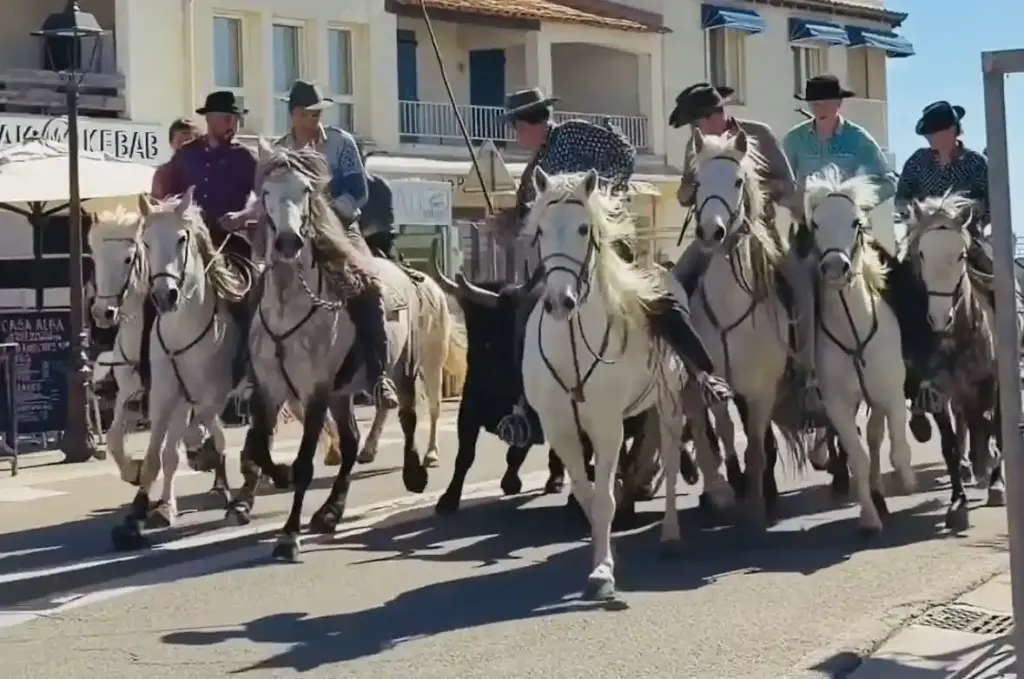
The course camarguaise
Right in front of the sea, you will notice the arena of Saintes-Maries-de-la-Mer. In a spectacular location and with a capacity of around 4,500 spectators, it is the focal point of Camargue bull culture.
This is where the course camarguaise, the traditional Camargue bull race, takes place: a spectacle inspired by Spanish bullfighting, but without any cruelty.
The course camarguaise has roots stretching back through the centuries and, even today, it is capable of filling the arenas and stirring the passions of its supporters. Unlike the better-known Spanish corrida, the bull is not killed here: the aim is not the animal’s death, but an athletic and spectacular confrontation between man and beast, a challenge of agility, courage and intelligence in which the true protagonist is the bull itself.
It is a sport that was officially recognised by the French State in 1975 and that, in Saintes-Maries-de-la-Mer, is a regular and deeply felt event: spectators attend with the same regularity with which others go to a café or play tennis.
To fully understand the course camarguaise, you need to know its protagonists. At the centre of the scene is the Camargue bull, an animal belonging to an authentic breed. It has a more agile and slender build than Spanish fighting bulls, with horns that curve upwards rather than forwards. He is the true star: his name is the first to appear on the posters, and a bull that performs well can become a genuine celebrity, earning a well-deserved retirement in the pastures when his career comes to an end.
The protagonists who challenge him are the raseteurs, athletes dressed in white with their names printed in black on their backs. Their task is to approach the bull in lightning-fast runs known as rasets and, with the help of a small metal hook called a crochet, try to remove the “attributes” attached to the base of its horns and forehead. There are three types of attributes: a red rosette, the cocarde, two white woollen tassels, the glands, and cords, the ficelles, wrapped around the horns, whose number varies according to the value and difficulty of the bull. Each attribute has a monetary value and earns points in the official rankings; the ficelle, in particular, is the most difficult to remove and the most valuable.
Assisting the raseteurs are the tourneurs, also dressed in white but with their names in red. They are often experienced former raseteurs whose task is to attract the bull’s attention, position it and “turn” it in the right direction to prepare a favourable run for their teammate. They do not carry a crochet, but use only their bodies and voices to manage the animal, performing an essential supporting role that requires great experience and timing. The race is then directed by the President of the Race, who uses a microphone to animate the spectacle, announce the names and rewards, and decide when to increase the value of the attributes according to the difficulty and quality of the bull.
A course camarguaise follows a precise ritual steeped in tradition. It begins with the Capelado, the opening parade during which all the participants cross the arena to salute the President, to the notes of the overture from Bizet’s Carmen, music that accompanies the entire spectacle. Each event consists of 6 to 8 bulls, and each bull is allowed a maximum of 15 minutes in the arena. At the first trumpet call, the bull leaves the toril and is given one minute to become familiar with the arena. The second trumpet signals the beginning of the actual challenge: the raseteurs and tourneurs enter the scene. The bull, which often chooses one corner of the arena as its defensive position, is called and challenged in rapid runs. After each attempt, the raseteur runs towards the barriers and jumps over them to escape; a particularly aggressive bull may chase him right up to the barrier and try to strike him, in a spectacular moment known as the coup de barrière.
The course camarguaise season runs from March to November and includes several categories, from events for young bulls to high-level competitions such as the Course Royale, featuring the six best bulls from a single manade, or breeding farm.
The most prestigious competitions include the Cocarde d’Or in Arles, held on the first Monday in July, and the Trophée des As, which rewards the best raseteur of the season.
The origins of this sport go back a very long way: the first traces of the tradition can already be found in Arles in 1402. Initially, it was a rural game, a challenge between herdsmen and bulls. At the end of the 19th century, breeders began to understand the sporting value and potential of the Camargue breed, and the competition developed into the form we know today.
The famous Marquis Folco de Baroncelli, a key figure in the rediscovery and promotion of Camargue traditions, played a crucial role: he was, for example, the person who introduced the white costume for the raseteurs, designed to give the event greater unity and visual impact.
Today, the course camarguaise is an all-encompassing cultural phenomenon that lives not only in the arenas but also in the streets of the villages. This is the case with the abrivado, held on the morning of the race, and the bandido, held in the evening after the race: the moments when the bulls are driven at a gallop through the streets of the town, guided by gardians on horseback, in an explosion of adrenaline and tradition.
Attending a course camarguaise therefore means not only watching a sporting competition, but taking part in an ancient ritual that reveals the proud and untamed soul of this land.
On certain dates, the arena also hosts Spanish-style bullfights and corrida de rejón, the latter performed on horseback, while during festivals it is common to see genuine demonstrations by the gardians and their magnificent white horses.
I recommend taking a look at the official website to check the programme and purchase tickets. You will not regret it!
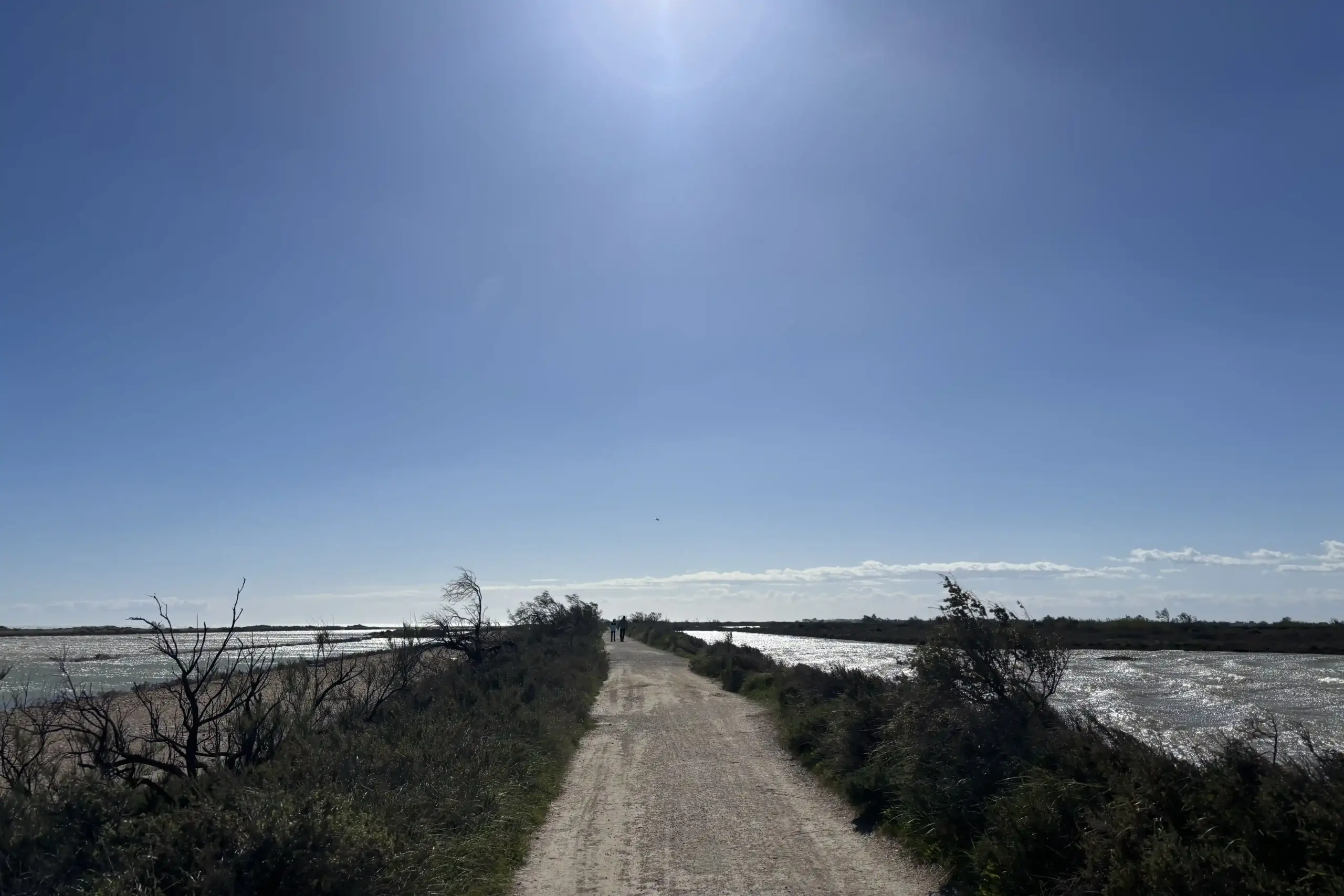
The Digue à la Mer
The Digue à la Mer is much more than a cycling or walking route: it is one of the few places in the world where you can walk with the sea on one side and the lagoons on the other, surrounded by a landscape that seems to have no boundaries. But it is not a work of nature: it is a man-made structure which, together with the other so-called coastal barriers, made it possible for the Camargue to develop as we know it today.
Built in the mid-19th century, between 1857 and 1859, this dyke, more than 20 km long, was created with a very practical purpose: to protect the Rhône delta from seawater flooding and make the agricultural development of the lower Camargue possible.
Today, its purpose has expanded. The Digue à la Mer has become an uninterrupted route, closed to motorised traffic, winding between saltwater lagoons and dunes and offering a privileged view of one of Europe’s most fragile and fascinating ecosystems.
The dyke ideally connects the village of Saintes-Maries-de-la-Mer with the Gacholle car park, near Salin-de-Giraud. The route is about 13.6 km long — not all 20 km of the dyke are accessible — and can be travelled in either direction.
Its main feature is the complete absence of elevation gain, which makes it technically easy. The real challenge, however, lies in the wind, the sun and the length of the route.
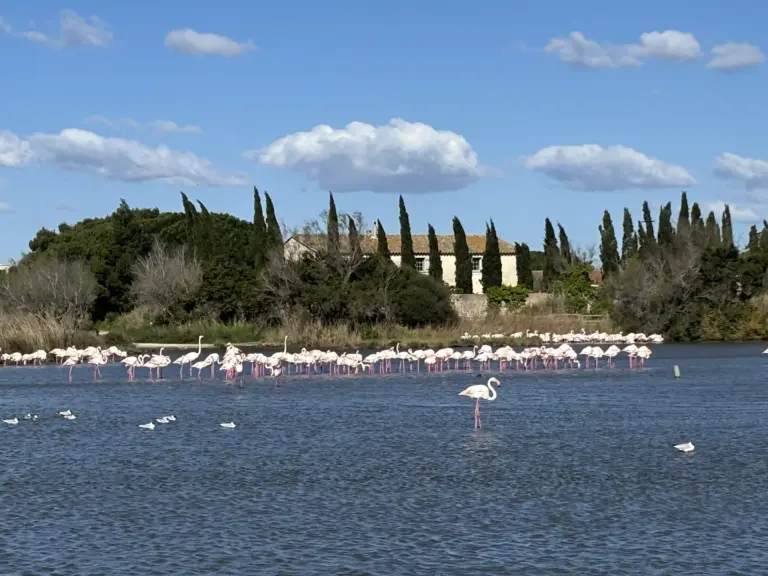
The dyke runs alongside the Camargue National Nature Reserve, and with a pair of binoculars at hand, you can spot pink flamingos, grey herons, little egrets, black-winged stilts, gulls, terns and numerous species of ducks. If you are passionate about birdwatching, the best times to visit are spring and autumn, when migration brings even more life to an already spectacular landscape.
The most convenient car park for starting the excursion from the Saintes-Maries-de-la-Mer side is the La Playa… en Camargue car park:
- On foot: the classic route to the Gacholle car park — also known as the Comtesse car park — located at the end of the D36C, shortly before the famous lighthouse, takes around 3–4 hours and covers 13–14 km.
- By bicycle: the journey time is considerably shorter, and many people choose to continue as far as Salin-de-Giraud, covering a total of around 45 km there and back.
As this is a protected environment, always staying on the marked trails and avoiding walking on the dunes is not simply good practice: it is compulsory.
Always bring water, food and sun protection with you: there are no refreshment points along the route, with the exception of the lighthouse, which is open at weekends and during holidays.
In summer, avoid the hottest hours in the middle of the day; at other times of the year, even midday is perfectly fine.
A sincere warning: if the Mistral is blowing, the Digue à la Mer can become truly demanding. I tried it myself and gave up after 2 km. Keep this in mind when planning your excursion: here, the wind can really make all the difference.
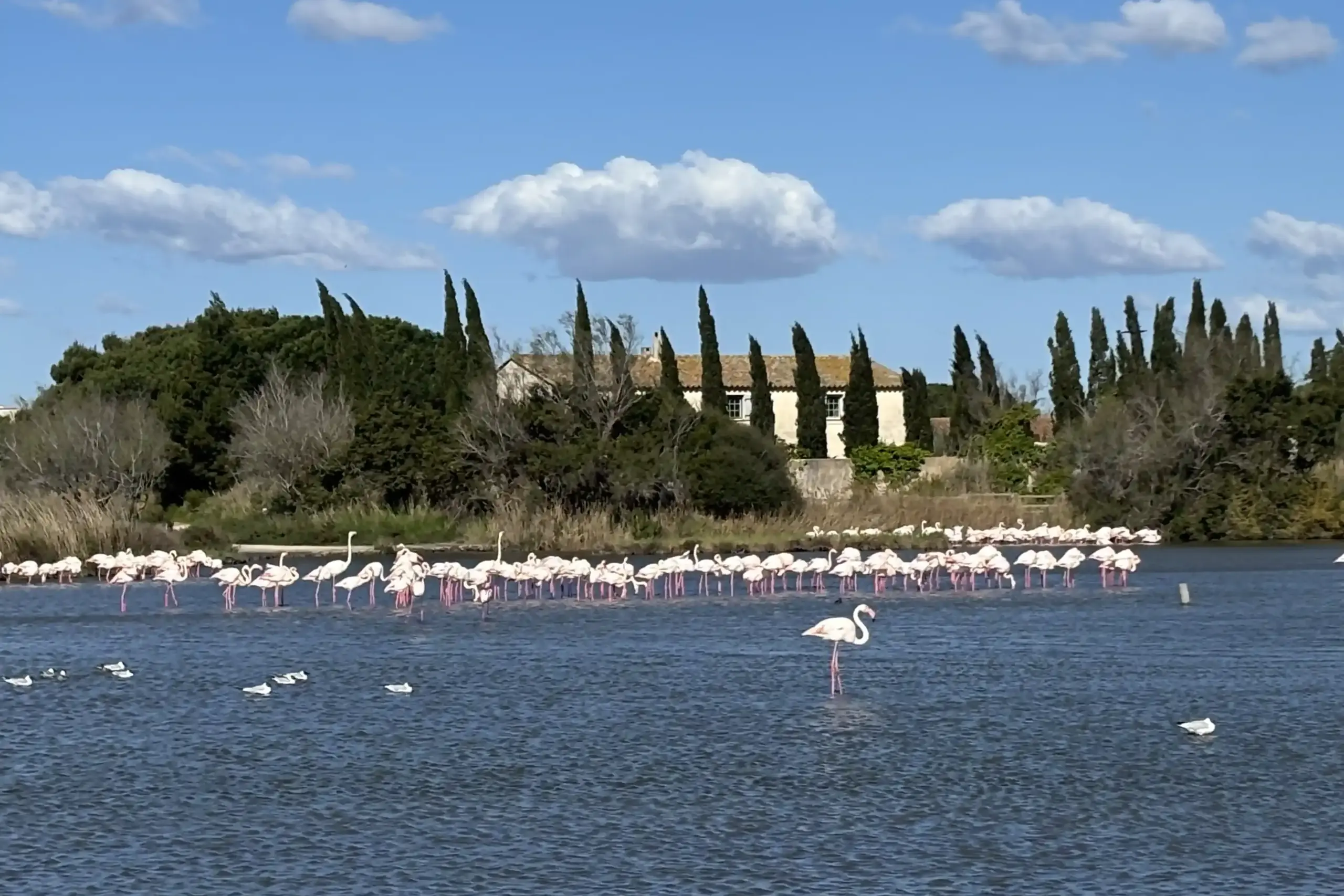
The Pont de Gau Ornithological Park
Just 4 km from Saintes-Maries-de-la-Mer, along the road to Arles, lies one of the most precious natural treasures in the whole of the Camargue: the Pont de Gau Ornithological Park. Sixty hectares of marshes, ponds and reed beds where hundreds of bird species live in their natural habitat, with pink flamingos as the undisputed stars of the scene. Few people know that this is not a public site, but a private property founded in 1949 through the passion of a Camargue ornithologist, André Lamouroux, and transformed in the following years by his son René into a place dedicated to the protection and discovery of nature: today, it is managed by the third generation of the same family.
Two walking trails, covering a total of 7 km, allow you to immerse yourself in very different atmospheres: the southern route, shorter and more accessible, offers an astonishingly close view of the large flamingo colonies; the northern route, wilder and more remote, leads into the heart of the authentic Camargue, among ducks, herons, birds of prey and — with a little luck — even a few unexpected encounters. You walk in silence, with only the sound of the wind and the rippling water, in one of those rare places where time seems to pass at a different pace.
For all the practical details you need to organise your visit — opening hours, prices, trails and the best tips to make sure you do not miss a single flamingo — you will find everything in my dedicated article about the park.
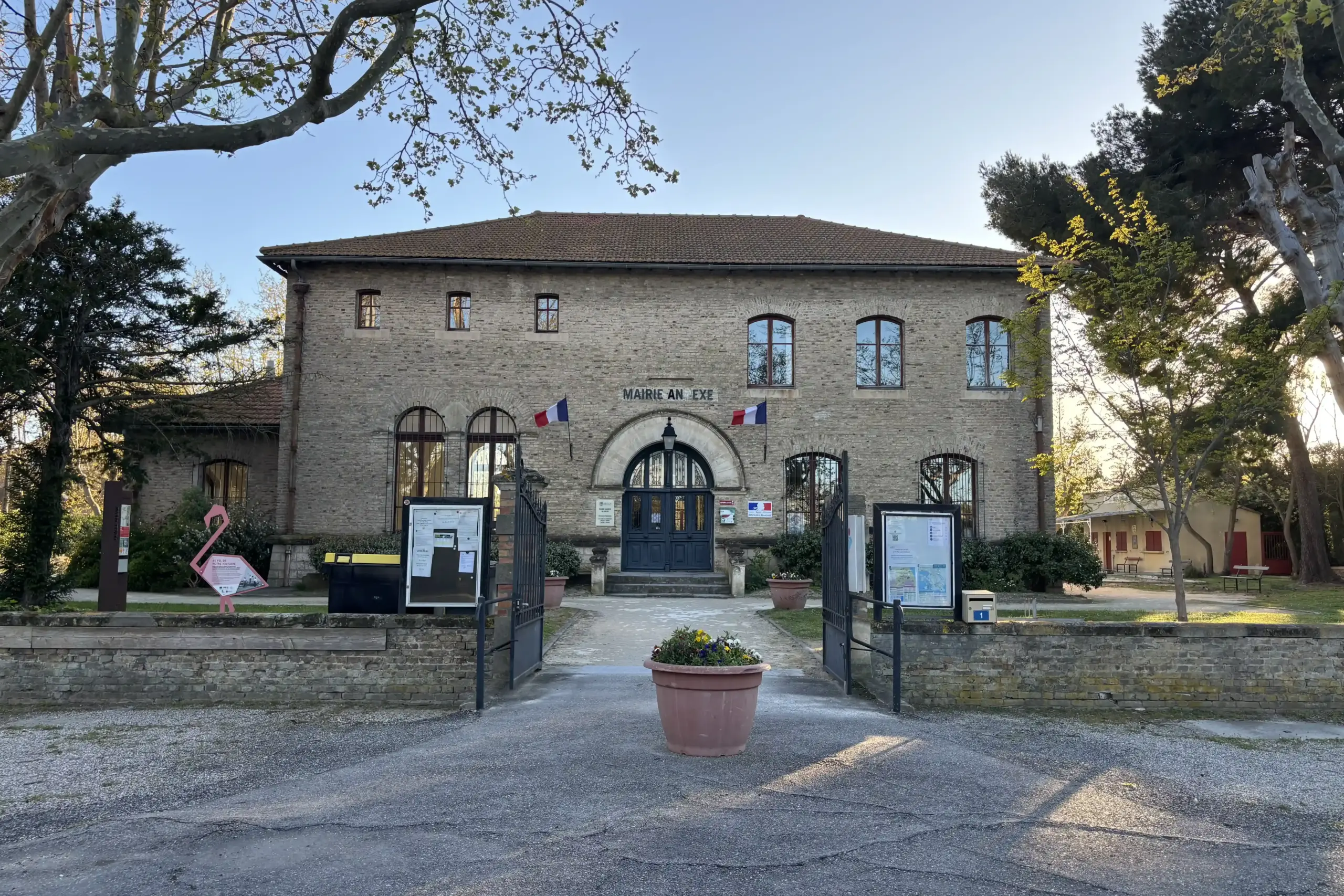
Salin-de-Giraud
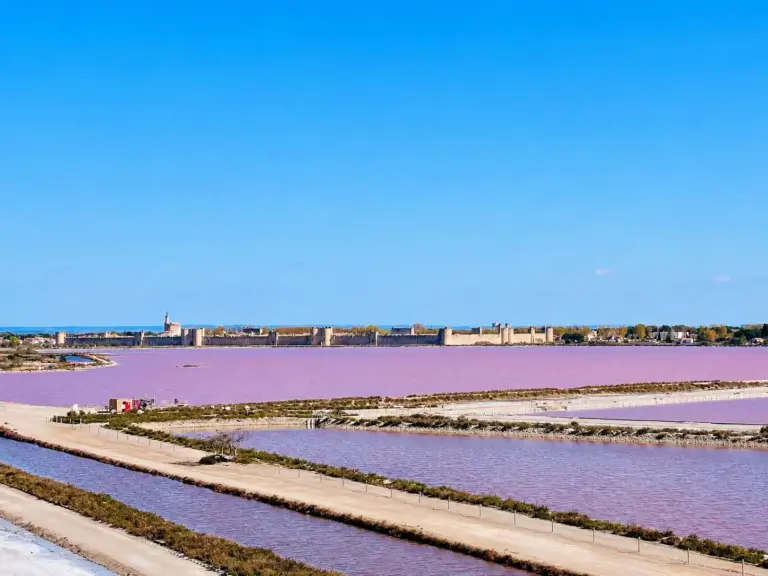
When people talk about Salin-de-Giraud, the first thing that understandably comes to mind is the salt flats. Covering more than 11,000 hectares and producing around 800,000 tonnes of salt per year, the Giraud salt flats are one of the largest salt extraction sites in Europe. During the summer months, when the sun is high, the water in these basins turns pink thanks to the presence of algae and microorganisms that thrive in highly saline conditions, creating a spectacular sight that attracts photographers and visitors from all over the world.
These expanses were once entirely artificial and separated from the sea by dykes; today, a major renaturalisation project, launched in 2011 after the area was acquired by the Conservatoire du Littoral, has reopened the hydraulic connections, encouraging the return of a more resilient natural environment and creating new habitats for local wildlife. First and foremost is the pink flamingo, which finds one of its most important nesting sites in Europe here.
In reality, Salin-de-Giraud is much more than that. Even the road leading there is a wonderful experience: by following the D36, you will travel along one of the most beautiful and evocative routes in the whole of the Camargue.
And yet, once you arrive, you will be struck by a surprise. This is because the name Salin-de-Giraud refers both to the salt flats and to the village that grew up beside them, almost merging with them.
Salin-de-Giraud is, in fact, a story of people and migration. To carry out the hard work in the salt flats, the two founding companies — Péchiney, which began extracting salt in 1855, and Solvay, which opened a factory there in 1895 to produce soda, an essential compound for Marseille’s famous soap factories — attracted workers from all over Europe: Italians, Spaniards, Russians, Armenians fleeing the genocide and, in large numbers, Greeks from Asia Minor and the island of Kalymnos, renowned sponge fishermen.
To support the workers, the two companies also built two separate workers’ towns, each with its own church, square and houses.
Today, the village still preserves traces of that former cosmopolitan character, such as the small Greek Orthodox church, and maintains a unique identity within the Camargue. As you walk through the village, these two different souls are still visible: the Péchiney district, with its more restrained and “southern” architecture, and the Solvay district, where the brick houses and strict grid layout recall the corons of northern France and Belgium — a landscape made all the more surprising when you remember that you are in this wild corner of Provence.
This makes Salin-de-Giraud one of the most fascinating and unexpected places in the Camargue, a village that seems suspended between the myth of the industrial town and the poetry of a pink-hued landscape. As you will have understood, this village of just over two thousand inhabitants truly surprised and enchanted me: it has an atmosphere that seems frozen in time. If you have the chance, try to spend a night there: it is genuinely worth it.
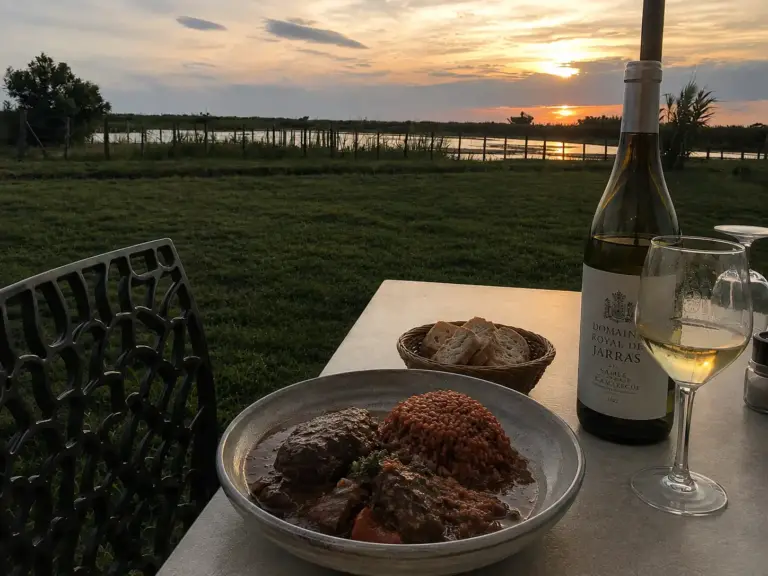
Salin-de-Giraud also has some wonderful food to offer. My recommendation is Mas Saint Bertrand, a spot tucked into the natural park serving Camargue specialities like bull gardiane and organic red rice, along with fresh fish and shellfish from the Gulf of Beauduc — a place I love, partly because it feels like stepping into a rustic curiosity shop!
But it’s just one of the restaurants I recommend around here. For the full list — including a more refined option and a more casual spot overlooking the ponds — you’ll find everything in our in-depth guide to Camargue cuisine, in the section Where to eat in Salin-de-Giraud.
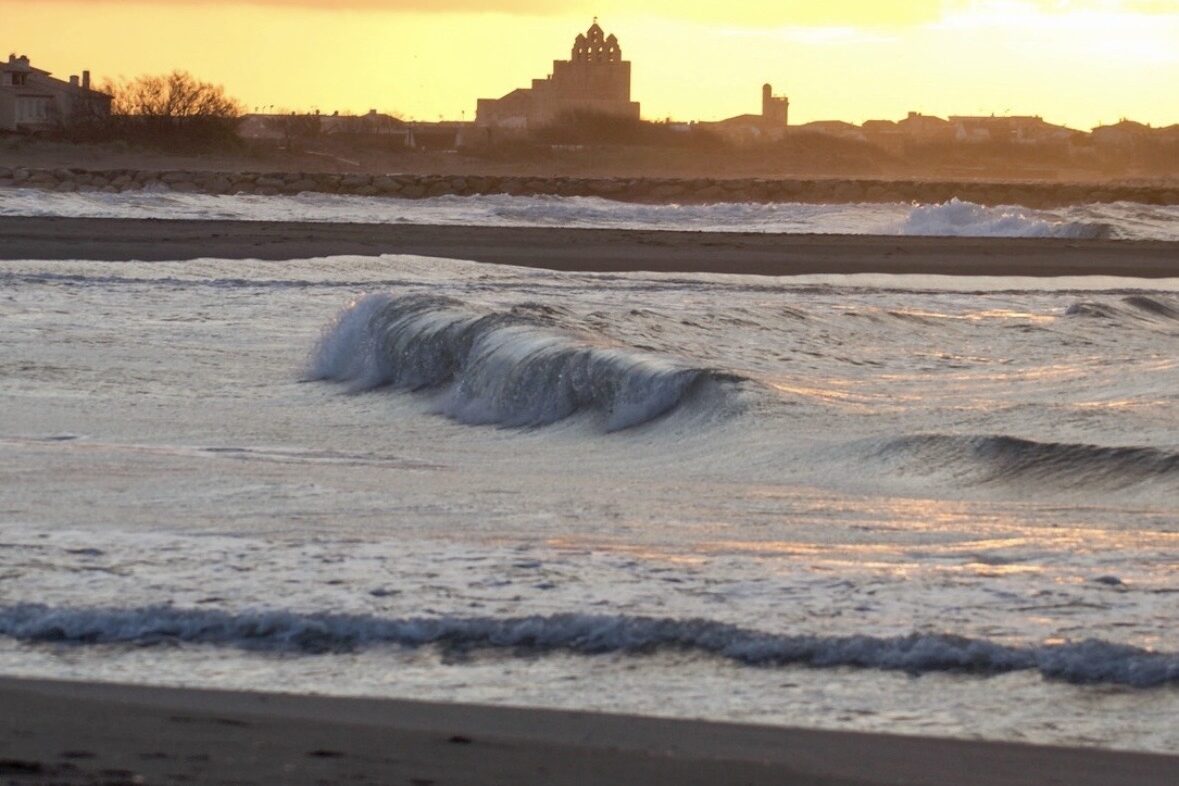
The Dreamlike Beaches and Coastline
The beaches of Saintes-Maries-de-la-Mer are a world unto themselves, a natural heritage that few people know in its entirety. When people think of the Camargue, their minds immediately turn to white horses, black bulls and pink flamingos — and they often forget that this strip of land, enclosed between the two branches of the Rhône, is also washed by the Mediterranean.
Its coastline, with more than thirty kilometres of fine sand stretching as far as the eye can see, offers a truly surprising variety of landscapes and atmospheres: every beach has its own soul and character, and choosing where to lay your towel can completely change the feel of a day by the sea.
The best-known and busiest is undoubtedly Plage des Arènes, named after its proximity to the town’s arena and, in practice, the quintessential urban beach. Located directly opposite the town centre, it is wide, convenient and fully equipped for families: the water is calm, protected by breakwaters that make swimming safe even for very young children. Along the seafront, you will find beach clubs, bars, restaurants and all the services needed for a carefree day. It is the beach of social life, the place where people gather for a lunch of fresh fish with their feet in the sand, and where sunset over the sea remains a spectacle that no one wants to miss.
A little further along, Plage de l’Amphore offers a similar atmosphere, but is slightly less crowded, with easy access from the centre and equally calm water: perfect for those looking for a day at the beach without going too far from the village.
It is when you move away from the town centre, however, that the Camargue reveals its truest and wildest sea. A 10-minute walk from the centre, in the direction of the Digue à la Mer, lies Plage Est, which continues into Plage de la Gacholle, where the landscape changes dramatically: the sand becomes finer and more golden, dunes begin to form, and spontaneous vegetation — rushes and salt-tolerant plants — reclaims its space. This is where you enter the Camargue National Nature Reserve, a protected area where humans are merely respectful guests. It is the ideal beach for long walks on foot or horseback, for those seeking solitude and contact with unspoilt nature, and for anyone who simply wants to feel small before the immensity of the landscape.
Continuing even further, you reach the legendary Plage de Beauduc, considered by many to be one of the last truly unspoilt beaches in France. Accessible only by sandy tracks and unpaved roads that deliberately make it difficult to find, Beauduc is an almost mythical place for lovers of wind and surfing: a world-class kitesurfing paradise, thanks to constant winds and ideal conditions that attract athletes from all over Europe.
But it is also a place where time seems to have stood still — colourful wooden huts, built by fishermen decades ago, dot the shoreline like small shelters from a bygone era, creating the atmosphere of a desert island, a corner of the Mediterranean where modern life has not yet taken root.
Getting there is a little complicated: on foot, the journey is extremely long — about 3 hours, so do not consider it a realistic option — while by bicycle it is certainly more manageable via the Digue à la Mer, although the return journey under the sun after a day at the beach can be difficult.
My advice is to enter these coordinates into your satnav, head towards Salin-de-Giraud and, from there, take the Chemin de la Bélugue, an unpaved track of about 10–12 km that is particularly rough: be prepared to drive slowly and for a route that will put your car’s suspension to the test.
It is not recommended for campervans or very large vehicles: shortly before you arrive, you will find a gabarit, a kind of metal width restriction that allows only vehicles less than 2.08 metres wide to pass. There is a compulsory natural parking area where you must leave your car, and from there you will need to walk the final stretch along wooden boardwalks crossing the dune belt before finally reaching the sea.
As you will have understood, getting there is an adventure, but those who make the journey are rewarded with an unforgettable panorama of sand, sea and sky that seems to go on forever.
Easier to reach thanks to an unpaved road, but just as beautiful, is Plage de Piémanson: a vast and wild beach within the Camargue Regional Natural Park, an oasis of sand and nature that seems suspended in time. With around 6 kilometres of fine sand, it is considered one of the largest natural beaches in the Mediterranean. Here, you are far from mass tourism: there are no hotels, restaurants or shops on the beach, only the sound of the wind, birds in flight and a horizon stretching endlessly into the distance.
Had you asked me the first time I visited, I would have advised against it without hesitation: before 2016, hundreds of caravans and campervans used to settle directly on the sand, creating a temporary village that lasted throughout the summer. The authorities tolerated the situation for a long time, but camping was finally strictly prohibited, vehicle access was blocked with barriers and boulders, and a large free car park was created just a short walk from the shore.
The result? The beach has regained its wild spirit: those who visit today — I was there in April 2026 — can enjoy a landscape that is slowly reclaiming its space, with dunes rebuilding and nature beginning to flourish again. In July and August, it is also supervised by firefighters, making swimming safe even for younger children.
It is also the largest naturist beach in France, a place of freedom and respect that attracts visitors from all over Europe, especially Germany. The naturist area is clearly marked and lies further away from the supervised entrance.
Finally, looking towards the mouth of the Petit Rhône, the western branch of the delta, you will find beaches with a more intimate and sheltered character, such as Crin Blanc and Clos du Rhône. Here, the sea meets the river, and the water — less salty and stirred by the river current — creates a unique environment where vegetation becomes denser and the landscape takes on a more secluded and familiar atmosphere. These beaches are less well known, visited mainly by local residents and by those who truly know the secrets of the Camargue: they offer an authentic seaside experience, far from mass tourism, where time passes slowly and the sound of the waves blends with the rustling reeds and the flight of water birds.
In the Camargue, then, there is not just one beach, but an entire archipelago of landscapes unfolding along the coast, each with its own voice and charm: choosing one or another means choosing an emotion, a story and a different way of experiencing the sea.
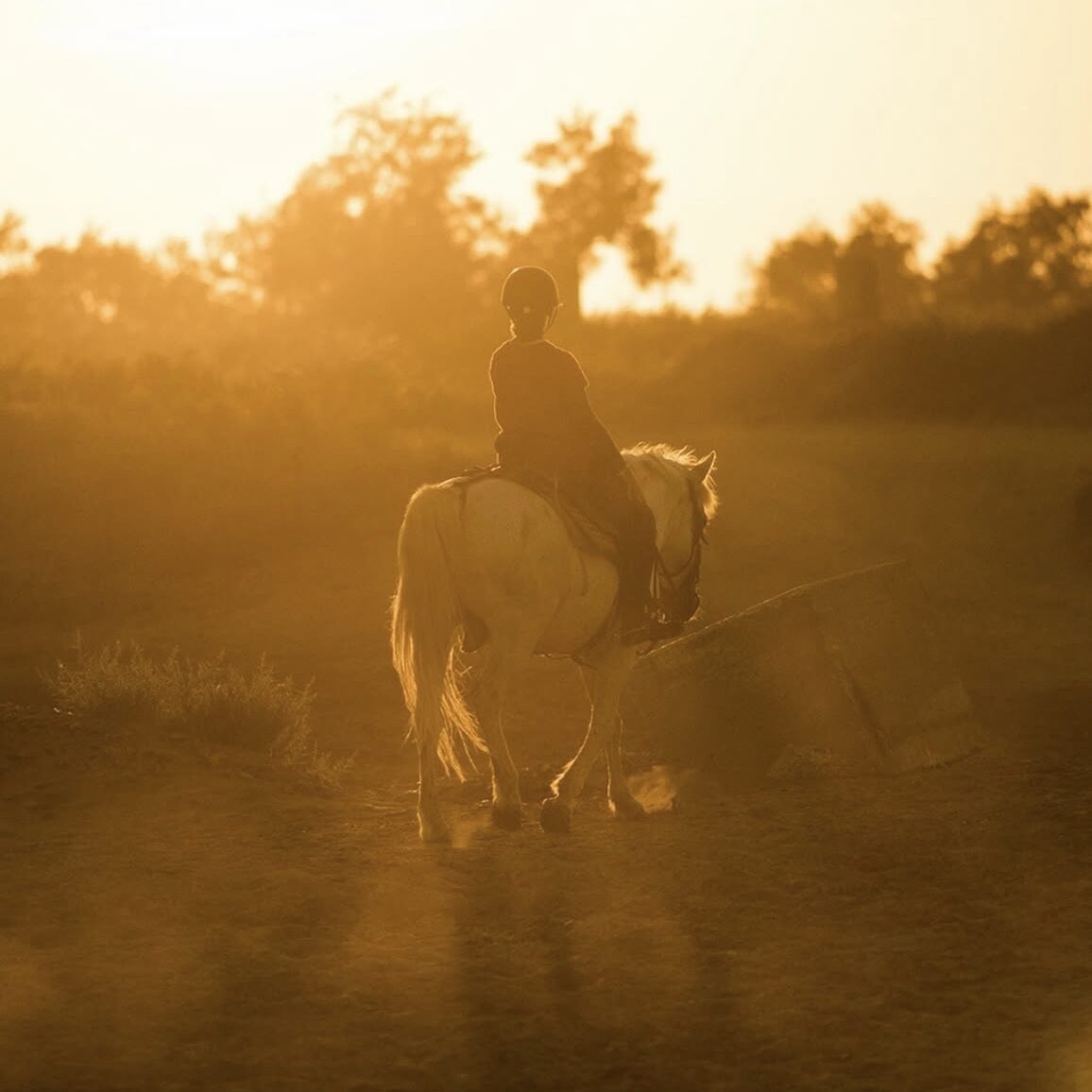
Unmissable Activities
If you can set aside a little time — and trust me, it is worth doing — below you will find a selection of activities not to be missed in Saintes-Maries-de-la-Mer. They are the perfect way to discover this corner of the Camargue from a different perspective, in a more authentic way and with a closer connection to the local area.
Experience the Camargue Like a True Gardian
Experiencing the Camargue like a true gardian goes far beyond ordinary tourism: it is a journey into the most authentic soul of this land suspended between sky and water, a way of stepping into the shoes of the herdsmen who have guarded the secrets of this delta for centuries. There are many ways to do it, and each one offers a different perspective on the landscape.
The most iconic experience is undoubtedly a horse ride. The white Camargue horse is a true symbol of the region, a creature that seems to have stepped out of a painting, and riding one means connecting with the very history of this land. Numerous riding centres and manades organise excursions of varying lengths, from one hour to half a day, suitable for all levels — even if you have never ridden a horse before, there is no need to worry. You can choose to explore the wetlands, following paths that wind through reed beds and lagoons where pink flamingos move gracefully, or opt for a gallop along the beach at sunset, with the sun sinking into the Mediterranean and the wind in your hair.
Another experience not to be missed is discovering a manade. Manades are the farms where the famous black bulls and white horses of the Camargue have been bred for generations, and visiting one means entering the beating heart of this land, where traditions are handed down from father to son and the bond between people and animals is still tangible and genuine. There are countless centres offering excursions for all levels, and many mas or manades organise visits that end with a small tasting of local products — a perfect way to combine discovering the area with the pleasures of the table.
Each manade has its own character and specialities, so there is a wide range to choose from. For example, the Manade de Sylvéréal, in the heart of the Petite Camargue, offers visits by small tourist train through pastures, rice fields and marshes, including a demonstration of the work of the gardians on horseback and, at the end, a tasting of the farm’s products, such as organic rice, honey and bull meat. If you prefer a more intimate and close-up experience, the same manade also offers 4×4 tours, which take you within a few metres of the bulls accompanied by the manadier himself: a privileged moment that you are unlikely to forget.
For those looking for a more convivial and festive atmosphere, many manades organise complete Camargue evenings, with equestrian shows, livestock-sorting demonstrations, Romani music and dinners featuring local products. The Manade Saint Louis at Mas de la Paix, for example, offers evenings of this kind every Wednesday in July and August, with a visit to the manade, a ferrade, bull games and a full meal. The Manade Fernay, in Arles, is instead highly appreciated for its family atmosphere and visits that include authentic demonstrations of working with bulls and horses, with the opportunity to taste a platter of bull charcuterie and other local products, such as tapenade and olives.
In short, whether you are looking for a relaxing and educational experience by tourist train or horse-drawn carriage, a more adventurous 4×4 excursion, or an evening of music, dancing and traditional flavours, the manades of the Camargue have something for every kind of curiosity and will leave you with an unforgettable memory of this wild and fascinating land.
It is an experience that many people describe as unforgettable, and I have to be honest with you: some of them felt a little too touristy to me, and the explanations are almost always only in French — a limitation if you do not speak the language. Even so, it remains a lovely way to get closer to the life of the gardians and everyday Camargue, and to breathe in that atmosphere of freedom and wild nature that is the true heart of this land.
Boat Trips on the Petit Rhône
If you prefer a more relaxed approach, a boat trip on the Petit Rhône is the perfect choice. The boats travel slowly upstream in an atmosphere of complete tranquillity, allowing you to observe the wildlife from a different, almost privileged perspective. You will see white horses drinking along the riverbanks, black bulls grazing among the reeds, flamingos taking flight with a rustle of wings, and herons standing motionless like statues in the shallow water. It is an experience that surrounds you, makes you feel part of the landscape and gives you images that are difficult to forget.
In Saintes-Maries-de-la-Mer, boat trips depart directly from the village harbour, a very convenient starting point that is easy to reach on foot from the centre. Among the best-known and most highly regarded companies are Bateau le Camargue and Les Quatre Maries, both departing from the harbour. Most excursions last around an hour and a half and follow a route that begins at sea and continues up the Petit Rhône, allowing you to observe the wildlife, salt flats and traditional fishermen’s huts from close range. During the journey, the crew explains the region’s history, flora and fauna in French. For those who do not speak French, however, there is a useful little aid: Bateau le Camargue provides passengers with information sheets in several languages — including Italian, Spanish and English — so that you can follow the commentary despite the language barrier.
And what about the prices? They may vary slightly depending on the company and the season. According to the latest information available to me, as of April 2026, adult tickets cost around €17, while tickets for children under 14 are approximately €9. However, I always recommend checking the latest prices and timetables directly on site or contacting the companies, as fares may change. As mentioned, most excursions last around an hour and a half, but some companies also offer longer options of up to two and a half hours, as well as private sunset cruises for an even more evocative experience. Departing from the harbour of Saintes-Maries-de-la-Mer is ideal because it allows you to easily combine the boat trip with a walk through the village or a lunch of fresh fish in one of the many restaurants along the seafront.
The Tourist Train
For those who have little time or are travelling with young children, the Le Petit Train Camarguais tourist train is a convenient, relaxing and enjoyable way to get a general idea of the area when you first arrive, without the stress of travelling on foot or by car. Lasting around 50 minutes and covering a 13-kilometre route, the train offers a panoramic tour that starts in the centre of Saintes-Maries-de-la-Mer and continues into the heart of the Camargue Regional Natural Park, taking you to some of the wildest and most unspoilt areas surrounding the village.
Along the way, you will be able to see the great symbols of the Camargue up close: white horses grazing freely, black bulls lying among the reeds and pink flamingos colouring the lagoons. The guides provide a lively account of the village’s history, local traditions and the region’s rich biodiversity. The commentary is in French, but there is no need to worry: foreign visitors are given information leaflets translated into several languages, including English, Spanish, German, Italian, Dutch, Chinese, Russian and Japanese, so that everyone can follow the explanations and enjoy the experience to the fullest.
The train is particularly popular with families, also because the seats are numbered, allowing you to board without crowds or confusion. It is an activity designed to spark children’s curiosity while giving adults a relaxing moment in the open air. The price is also affordable: adult tickets cost €10, while tickets for children aged 3 to 10 cost €6. The service operates from mid-February until the end of October, with several departures throughout the day — I recommend arriving at the departure point at least 15 minutes early. The train leaves from Avenue Van Gogh, near the tourist office, and if you arrive by car, there is a paid car park near the arena, just 10 metres away, or a free car park at Étang des Launes, 300 metres away.
It is certainly not the deepest or most authentic experience the Camargue has to offer, but it is a pleasant and effortless way to get your bearings, discover the park’s wildlife and flora, and become curious about this fascinating area — perhaps helping you decide which places to explore more slowly over the following days.
Cycling in the Camargue
The Camargue is one of the most beautiful regions to explore by bicycle. From Saintes-Maries-de-la-Mer, you can choose from many cycling routes: the Digue à la Mer — between the sea, lagoons, flamingos and wide-open horizons — the Gacholle Circuit and the Camargue Horse and Rice Circuit.
Looking at the map, everything seems easy: the landscape is flat, the distances do not appear excessive and there are no major climbs. In reality, the real difficulty here is not the elevation gain, but the wind, the sun, the lack of shade and some very exposed stretches between lagoons, salt flats, canals and secondary roads. For this reason, the best way to experience the Camargue by bicycle is to choose a cycling circuit suited to your own pace.
To plan your route properly, I recommend checking a few useful websites in advance. The most important is the website of the Camargue Regional Natural Park, where you will find several official itineraries with maps and practical information sheets. For routes starting from Saintes-Maries-de-la-Mer, the Le Vélo Saintois website is very useful, as it describes circuits such as Gacholle and Méjanes, indicating distance, duration and type of terrain.
The official French cycle tourism website, Komoot and Outdooractive are, of course, also useful resources. There are also many guided tours organised by local agencies.
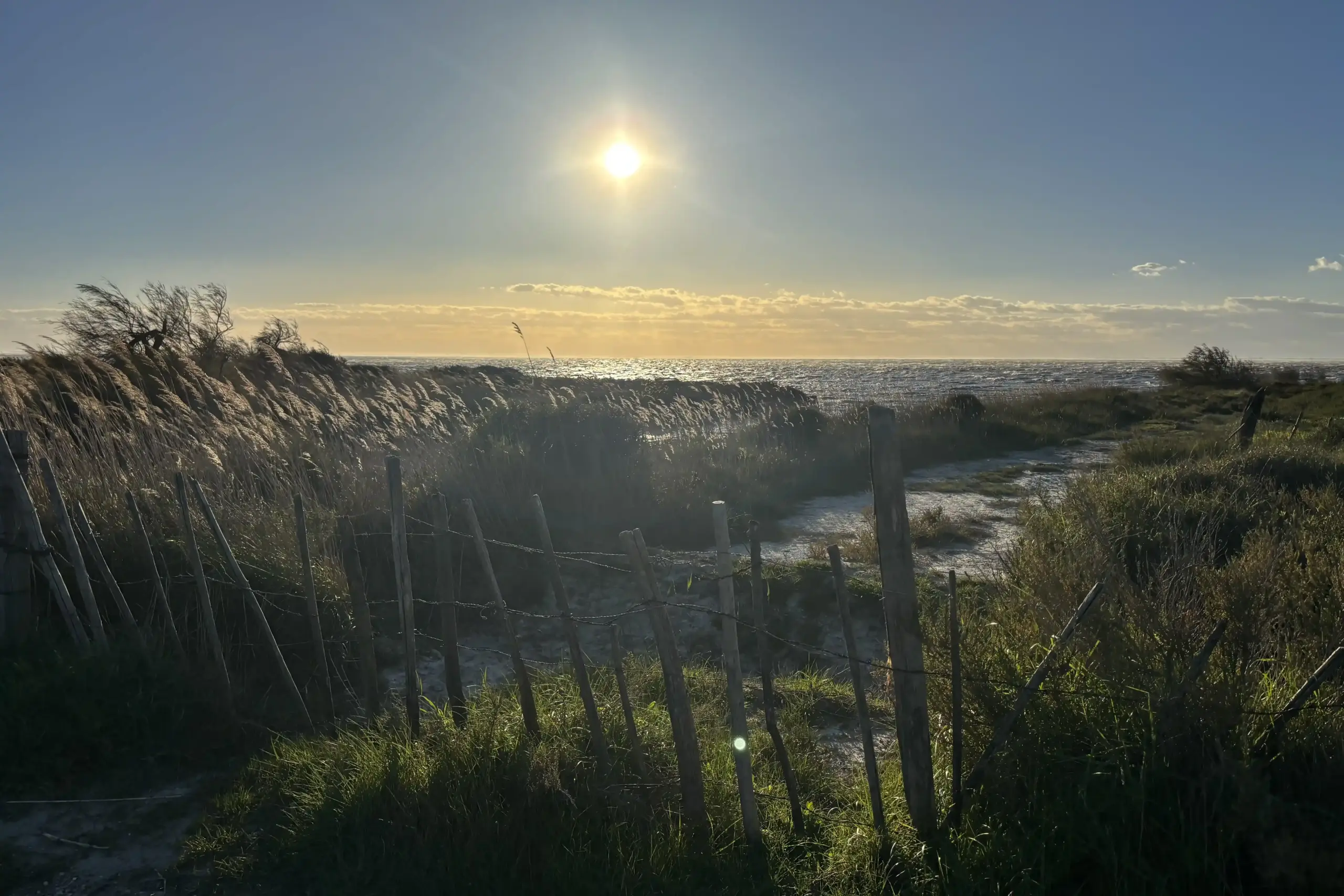
Additional Hiking Trails
If you have the time and would like to explore further, here are some other routes worth taking, either by bicycle or on foot:
1. Étourneau Trail (Vigueirat Marshes)
This is a combination of three routes covering a total of 6 km, with wooden boardwalks that seem to float above the water. You will cross five different habitats — riparian forest, reed beds, salt marshes, dunes and coastal plains — with observation points for birdwatching.
To reach it, head towards the Marais du Vigueirat in Mas-Thibert, between Arles and Port-Saint-Louis-du-Rhône. From there, you will find signs for the trail.
2. Pont de Rousty Trail
Right next to the Camargue Museum, there is a circular trail of around 3 km. It follows the Rousty Canal and crosses rice fields, marshes and meadows, with scenic viewpoints and observation hides where you can spot herons, ducks and wading birds.
3. Domaine de la Palissade
This trail runs through private property, so there is an admission fee. You can find all the information on the official website. The routes follow the Rhône and include an 8-metre panoramic tower and several observation points overlooking sansouïres, rush beds, marshes and lagoons. That said, I personally find it interesting but not better than the other trails: the others have nothing to envy it for.
4. Étang de Vaccarès
It is the largest lake in the Camargue National Nature Reserve. It is a site of crucial importance for migratory birds and for the flamingos that live there all year round. It would not be the first stop I would include on a weekend trip, but if you have time, I recommend taking the unpaved track that runs alongside the Monro lagoon as far as Vaccarès. Much less busy than the main D37 road along the northern shore, this track — used by hikers and horse riders — will take you as close as possible to the lake and the animals that live there: white horses, bulls and flamingos. The starting point is this car park on the D85A.
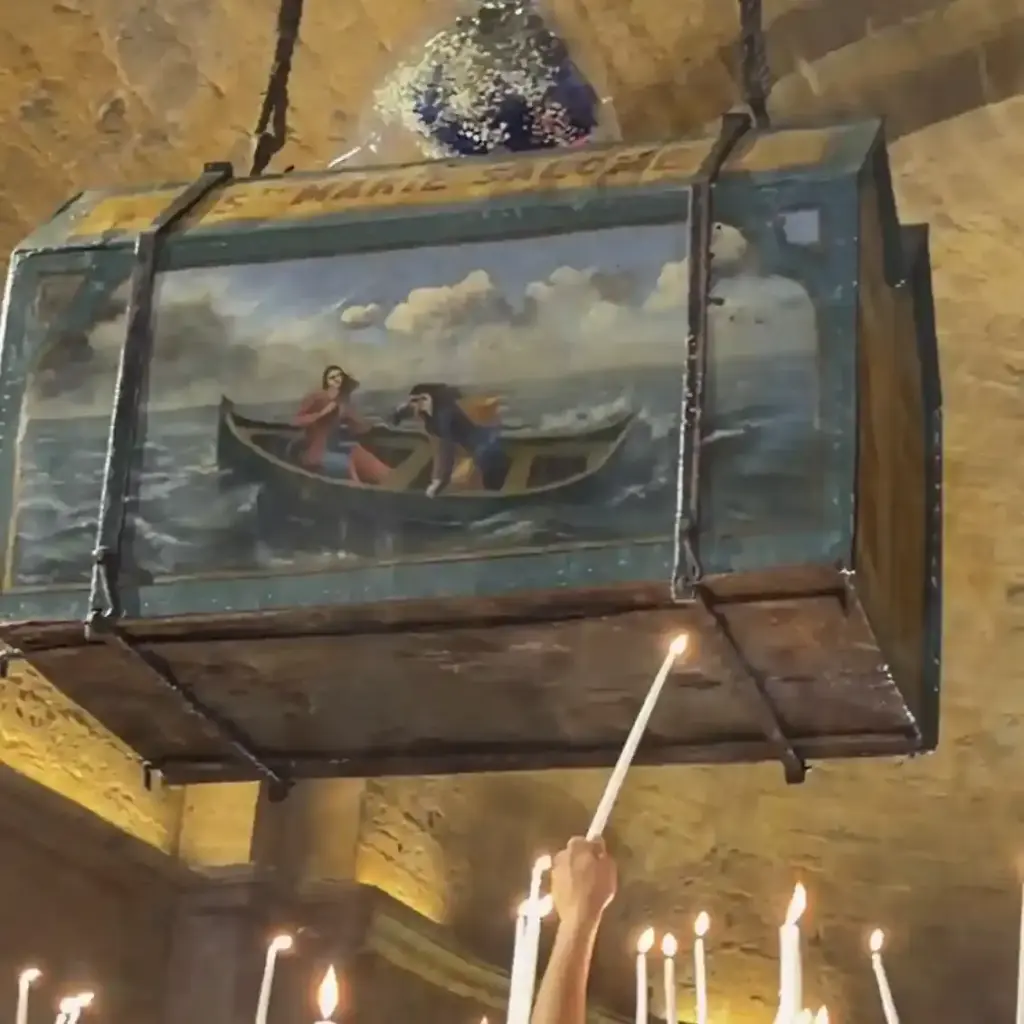
The Festival Calendar to Keep in Mind
Life in Saintes-Maries follows a rich calendar of events that blend faith, folklore and tradition.
- The Romani Pilgrimage (24–25 May): This is the most famous and evocative event. Thousands of Roma and Romani people from all over Europe gather in the village to honour their saint, Sarah the Black. The highlight is the procession on 24 May, when Sarah’s statue is carried triumphantly to the sea, followed the next day by the procession of the two Marys in the boat. The atmosphere is an explosion of music, singing, flamenco dancing and profound devotion.
- The Feria du Cheval (July): A major gathering dedicated to horses, with equestrian shows, dressage competitions, demonstrations by the gardians, the show “Songe d’une nuit en Camargue” and plenty of Romani music.
- The Votive Festivals: During the summer and on other occasions — such as the Fèsto Vierginenco in July or the Festival d’Abrivado in November — the village comes alive with abrivados (herds of bulls driven through the streets by gardians on horseback), bandidos (the controlled release of bulls), bull games and evening dances.
- The Provençal Pilgrimage (third weekend of October): A more intimate and local celebration, during which the statues of the two Marys, kept in a shrine in the upper part of the church throughout the year, are lowered and carried in procession to the sea to commemorate their arrival.
Take a look at the Saintes-Maries-de-la-Mer tourist office website for all the dates updated year by year.
If, on the other hand, you are looking for something truly magical and evocative, and you are in the Camargue during the summer, you must not miss the night-time show “Songe d’une nuit en Camargue”, the Dream of a Night in the Camargue.
It is one of those events that remains etched in your memory long after the lights have gone out: an experience that goes beyond a simple show and becomes a genuine journey into the deepest soul of this land.
It takes place in an open-air theatre in the heart of the marshes, along the Route de Cacharel, and every year celebrates Camargue identity with a breathtaking combination of horses, bulls, gardians in traditional dress, Arlésiennes in period costumes, live music, lighting effects and fireworks, transforming the landscape into a waking dream.
I recommend checking the Saintes-Maries-de-la-Mer tourist office website directly when planning your trip, as the dates and exact programme may vary from year to year: Feria du Cheval – Saintes-Maries-de-la-Mer .
The show is held in conjunction with the Feria du Cheval, which brings Saintes-Maries-de-la-Mer to life around mid-July — in 2026, more precisely, on 11 July — and is the result of an enormous amount of work involving hundreds of people.
Each edition features around 200 horses, one hundred gardians on horseback and just as many performers, all coordinated by director Thierry Pellegrin and guided by the narration of Daniel Demonflin.
The setting is extraordinary in itself: spectators gather along the edges of the reed beds, often bringing chairs and a picnic to secure the best spot, and watch the show almost with their feet in the water, in direct contact with the wild natural surroundings that frame every scene.
The theme changes every year, but the aim always remains the same: to tell the story of the Camargue and its people. The scenes range from fishermen and Arlésiennes from the 1950s dancing beside the water, to the arrival of the Romani people with their carts, and even the American influence of the 1970s, with rodeos and trick riders performing breathtaking acrobatics on horseback.
There are moments of pure poetry, such as dozens of Mireilles dancing in the water to contemporary music, and moments of great excitement, such as the abrivado and roussataïo, with bulls and horses charging through the scene and thrilling the audience, especially the children.
Everything is accompanied by professional sound and lighting systems that heighten the emotion, together with pyrotechnic effects illuminating the starry Camargue sky.
The evening always ends with a deeply moving moment, such as when the narrator dedicated a text to the memory of Roland Chassain, the former mayor of Saintes-Maries-de-la-Mer who supported the show from the very beginning.
“Songe d’une nuit en Camargue” is not simply an equestrian show, but a collective celebration: a ritual that brings the community and visitors together in an ideal embrace around the values and traditions of this land. It is an experience that moves you, transports you back in time and makes you feel part of something greater, almost ancient.
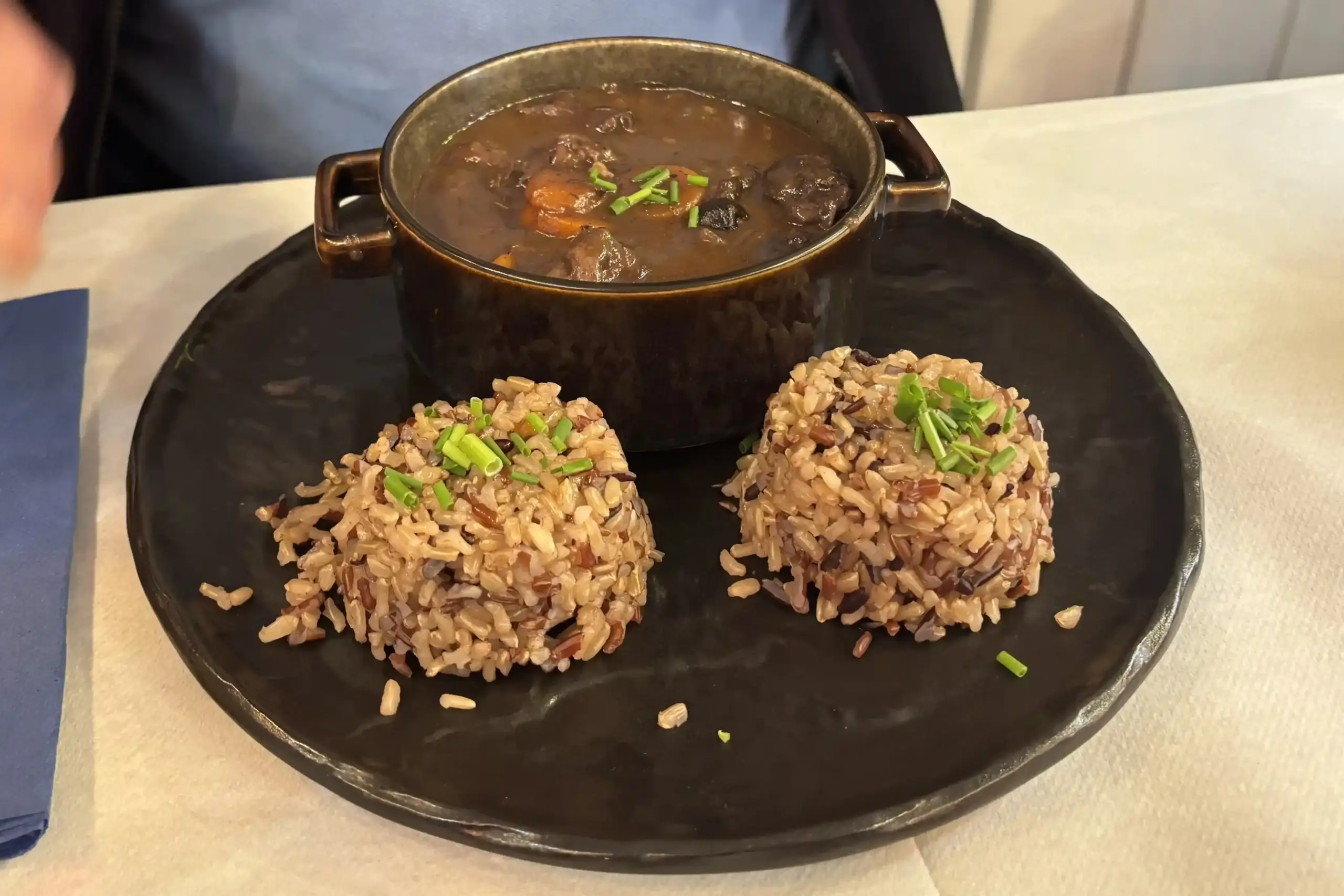
Where to Taste a Little of Saintes-Maries-de-la-Mer
In Saintes-Maries-de-la-Mer, right on the sea, the cuisine is all about fish: the must-try local dishes here are tellines, tiny clams sautéed with garlic and parsley that you’re meant to eat with your hands — an absolute treat! — and grilled fish, fresh off the boat and as flavourful as only harbour-caught fish can be. To drink, don’t miss a Camargue pastis at sunset, watching the harbour come to life: it’s a ritual you simply can’t resist. And if you also want to try gardianne de taureau, the great Camargue classic, you’ll certainly find it on plenty of menus in town — though personally, I usually prefer to have it further inland, where the dish was born and truly shines.
My go-to spot for fish, right in town, is La Casita. The setting is bright, sunny, Mediterranean — the kind of place where you feel at ease straight away, no fuss. The menu covers both fish and meat, but I always order fish here, and I’ve never had a reason to change my mind. It’s also where I tried Camargue pastis for the very first time, paired with a plate of tellines — one of those moments that stays with you more than the dish itself.
If you venture into the inland countryside, my favourite is La Telline: an institution tucked away in the nature reserve, reachable only by car or taxi, the complete opposite of a touristy spot. You eat inside a thick-walled, ivy-covered house, with a stark, authentic beauty that adds just as much to the experience as the food itself.
But La Casita and La Telline are just two of the many addresses I recommend in the area. For the full list of my favourite restaurants — organised by area: harbour, old town, seafront, and countryside — plus typical dishes and a few practical tips on eating well without overspending, you’ll find everything in our in-depth guide to Camargue cuisine, in the section Where to eat in Saintes-Maries-de-la-Mer.
To find the right spots, though, don’t be afraid to ask your host or a local shop owner for advice. Everyone will be more than happy — and proud — to point you toward the best place for real gardianne or the finest tellines.
The Camargue is a beautiful but rather extreme region: wind, sun, water and distances can completely change your experience. Packing carefully really does make a difference.
- A good mosquito repellent is essential. Dozens of mosquito species live in the Camargue, especially in the wetlands. Sunset is the worst time of day, so it is always best to carry an effective repellent with you. In summer, I also recommend bringing some long-sleeved tops to provide a little extra protection.
- Bring a windproof jacket, even in summer. The Mistral can rise suddenly and completely change how the weather feels, especially in open areas and along the coast. In winter or during the shoulder seasons, a hat and gloves also become essential.
- If you truly want to discover all the local birdlife, bring a small but extremely useful pair of binoculars. They allow you to observe flamingos, horses and birds from a distance, especially along panoramic roads and from observation towers.
- Many parts of the Camargue are isolated, with no bars or shops. In addition, during the low season, not all supermarkets and restaurants are open. Many parks and trails have areas equipped for small picnics, so always carry a supply of snacks.
- You will walk a great deal, often along trails or natural paths, so wearing a tested and comfortable pair of shoes is essential. They are indispensable on unpaved tracks, sand and wooden boardwalks. Avoid very open sandals, especially in wetland areas.
- A reusable water bottle is an excellent companion, as shade is not always available. I bought a foldable silicone one from Natura. It saves space once it is empty.
- If you are planning to go to the beach, there is no need to bring half your house with you: a lightweight beach towel — I bought this one so that I could always carry it with me when travelling to a seaside town — a pair of sandals and a practical bag are more than enough.
- The sun is one of the main features of the Camargue at any time of year. A hat, sunglasses and a good sunscreen are essential even in winter: the sun is always strong in the Camargue and is particularly noticeable during long walks. The wind also means that you will need a nourishing moisturiser and a lip balm.
- Small items such as a power bank may seem like minor details, but they make your days much easier, especially when you are using navigation to find your way and want to photograph all the animals, landscapes and most beautiful moments of your trip. I received one as a gift and have found it extremely useful. There are countless different models available. Regardless of the model, I strongly recommend bringing one.
You do not need much else. In the Camargue, it is not about having everything, but about having the right things.
And so we come to the end of this journey through Saintes-Maries-de-la-Mer, but I hope that, for you, it is only the beginning. We have told you an ancient story of pilgrimages and legends, one that can still be felt today within the walls of its fortified church, the silent guardian of centuries of faith and life by the sea. We have spoken about white horses, boat trips, manades and gardians, because I truly believe that this is how the real Camargue should be discovered: slowly, allowing yourself to be guided by the unhurried rhythm of this land.
All that remains is to pack your suitcase, because Saintes-Maries-de-la-Mer is not a destination that can ever be fully described: it is a place to be lived, breathed in and explored slowly, so that you can take home a little of that wild Camargue which, I assure you, is not easily forgotten.
But remember: Saintes-Maries-de-la-Mer is only one of the many faces of the Camargue. To discover this land — from Aigues-Mortes, with its medieval walls that seem to belong to another age, to the delta’s other hidden corners — follow our complete itinerary through the Camargue.