
Sabor a San Sebastián: where to eat in San Sebastián, the gastronomic capital of the Basque Country
If you are wondering where to eat in San Sebastián, do not worry: if there is one place in the world where food is a living cultural heritage, it is San Sebastián. Its gastronomy is not simply a list of delicious dishes, but the result of a collective passion rooted in the history, geography and social soul of the Basque Country.
After the demolition of the city walls in 1863, San Sebastián opened itself to the world, and it was precisely at that time that one of the city’s most distinctive institutions was born: the txoko (or gastronomic societies). They were — and to some extent still are — private clubs, historically reserved for men, where friends gathered to cook, eat, sing and discuss. They were not restaurants open to the public, but true sanctuaries of conviviality, where recipes were passed down and a principle as simple as it was fundamental was reinforced: eating well is a social act.
This tradition probably goes back even further in time, to a period when sharing the little food available shaped a way of being together that still lies at the heart of Donostia’s culture today.
Here are some practical tips to help you navigate pintxos bars, markets and gastronomic restaurants, understand how to order and enjoy San Sebastián’s extraordinary cuisine without missing any part of the experience.
- Breakfast, lunch and dinner: in San Sebastián, breakfast is normally served from early morning until around 11:00 am or 12:00 pm. In bars, you will find coffee, pastries, toast and savoury pintxos. Lunch is mainly served between 1:00 pm and 4:00 pm, while dinner often begins after 8:00 pm. Pintxos bars can also be visited earlier, but not all hot pintxos are prepared throughout the day. At the Mercado de La Bretxa, you can buy fresh produce and ready-made dishes or stop for a quick break. Individual stalls and producers may follow different opening hours, so it is best to visit in the morning if you want to see the market at its liveliest.
- Reservations: pintxos bars normally do not accept reservations: you simply walk in, find a space at the counter and order. For the best-known restaurants, it is advisable to book, especially at weekends and during the high season. San Sebastián is also one of the world’s leading fine-dining destinations: Michelin-starred restaurants and the most sought-after tasting menus may require reservations well in advance and a credit card as a guarantee. Also check the duration, price and cancellation policy.
- How to eat pintxos: going out for pintxos normally means ordering a drink and one or two pintxos, enjoying them and then deciding whether to order more or move on to another bar. Cold pintxos may be displayed on the counter, while hot pintxos are generally ordered from the staff and prepared on the spot. Each bar usually has its own speciality, often listed on a blackboard or menu. Pintxos and gastronomic restaurants represent two different but equally important ways of discovering the city’s culinary culture.
- Drinks: with pintxos, it is common to order a zurito, a small beer, a glass of txakoli or cider. Soft drinks and mixed drinks are often served with ice; if you do not want any, you can ask for sin hielo.
- Bread, olives and small accompaniments: in restaurants, these may be brought to the table at the beginning of the meal and may be added to the bill if consumed. Pintxos bars operate differently, depending on what you order.
- The bill, payment and tipping: the system varies from one establishment to another. In some bars, you pay at the end, while in others you pay after each order; follow the staff’s instructions. Tipping is not compulsory, and card payments are widely accepted. In crowded establishments, however, carrying a little cash can make payment quicker.
- Language: in the Parte Vieja, Gros and the establishments most frequently visited by tourists, it is fairly common to find staff who speak English. In less touristy bars, this is not always guaranteed, but pointing to what you would like and knowing a few Spanish phrases makes the experience much easier. You may also see menus, signs and information written in Basque.
- Useful words and phrases: un pintxo is a small dish or bite, sometimes resembling a miniature fine-dining creation; un zurito is a small glass of beer; un txakoli is a fresh Basque white wine; ¿Qué pintxos calientes tienen? means “Which hot pintxos do you have?”; ¿Cuál es la especialidad de la casa? means “What is the house speciality?”; ¿Se pide aquí o en la mesa? means “Do I order here or at the table?”; ¿Este pintxo es sin gluten? means “Is this pintxo gluten-free?”; ¿Este pintxo es sin lactosa? means “Is this pintxo lactose-free?”.
- One thing not to do: do not help yourself to pintxos from the counter before understanding how the establishment works. In some places, you serve yourself; in others, you need to point them out to the staff, while hot pintxos normally have to be ordered. Also avoid ordering too many pintxos in the same bar: part of the experience consists of trying the specialities of different establishments.
Traditional cuisine in San Sebastián
San Sebastián’s geographical location is the first secret ingredient of its cuisine: the Cantabrian Sea provides exceptionally fresh fish, and everything begins from there:
- Bacalao al Pil-Pil: the symbolic dish of the Basque Country. Cod fillet cooked very slowly in olive oil with garlic and chilli pepper. Thanks to the natural gelatin in the skin, it forms a creamy, velvety emulsion (“pil-pil” evokes the gentle bubbling sound of the oil as it cooks).
- Kokotxas: delicious cod or white-fish cheeks with an exceptionally soft texture, often cooked in green sauce made with parsley and garlic, or al pil-pil.
- Txangurro: spider crab, similar to a large crab, emptied from its shell. The meat is cooked again with onion, tomato and brandy, then returned to the shell and gratinated.
- Anchoas del Cantábrico: the famous Cantabrian anchovies, salted and preserved in oil, often served simply on toasted bread — pure simplicity.
From the land come excellent meats such as Txuleta — a beef rib steak, usually from an ox or an older cow rather than a young calf, grilled over charcoal or wood: one of the symbolic dishes of Basque cuisine — and the prized Tolosa beans. Everything is accompanied by local products such as Idiazábal cheese, smoked or unsmoked and made from sheep’s milk, which you absolutely must try. I tasted it in every possible way: on its own, with a drizzle of honey or quince paste, in the most creative pintxos and even grated over fish dishes.
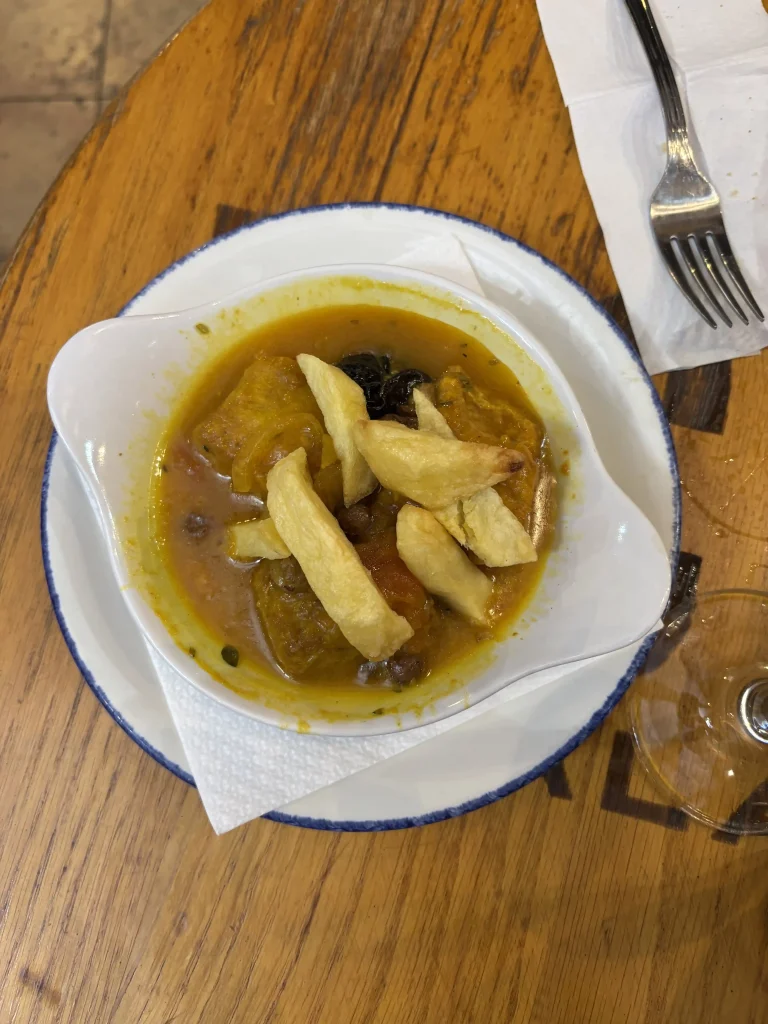
Alongside these great classics, there are two dishes I discovered during my travels through the Basque Country that deserve a special place. The first is marmitako, a tuna and potato stew rooted in the tradition of Basque fishermen: a humble, simple dish, but one whose flavour warms the soul. I tried it while staying in the Zumaia area, but you can also find it in some traditional restaurants in San Sebastián, as well as in a few cider houses outside the city.
The second is piperrada, a kind of Basque ratatouille made with green peppers, onion and tomato, often served with a fried egg on top. It is the perfect side dish for grilled meat, but it also works wonderfully as a light and flavourful main course. I am including it in honour of my travel companions, who enjoyed it immensely.
And if you still have room for dessert, besides the famous cheesecake, look for goxua: a traditional Basque dessert made with custard, caramel and biscuits, a kind of Basque tiramisu that everyone seems to love. It is not as famous as tarta de queso, but it is the true traditional dessert.
Pintxos — pronounced “pin-chos” — remain the most democratic and joyful expression of this culture. They are not simply “tapas”: they are small compositions, often genuine works of art, arranged on a slice of bread and held together with a cocktail stick — “pincho” literally means “to pierce”.
The ritual is known as poteo or ir de pintxos: you move from one bar to another, ordering a glass — a “pote” — of wine, cider or beer and one or two pintxos in each bar.
And what should you drink? The symbolic beverage is Txakoli, a young white wine that is slightly sparkling and acidic. The real magic lies in the way it is served: it is poured from above, from about a metre away, using a technique known as “a txotx” or “el salto”. It is not merely for show: the technique oxygenates the wine and breaks up its slight carbonation, enhancing its aromas and softening its acidity. Watching a txakolinero pour it is already a spectacle in itself. The best examples come from the Getariako Txakolina D.O. — the most famous, produced along the coast of Gipuzkoa — and from Bizkaiko Txakolina, produced in the province of Bilbao and somewhat rarer and more sought-after.
However, we should not forget that the Basque Country is the gateway to Rioja, one of Spain’s most famous wine-producing regions. In particular, the Rioja Alavesa subregion, located within Basque territory, produces excellent wines.
- Red wines (Tinto): this is where exceptionally high-quality Tempranillo is produced. Look for labels marked “Crianza”, “Reserva” or “Gran Reserva”: structured wines with notes of ripe red fruit, vanilla and spices, perfect with the legendary txuleta or a roast.
- White wines (Blanco): Rioja is not only about red wine. Modern whites, often made from Viura and sometimes with a touch of Malvasía or Garnacha Blanca, are fresh, fruity and mineral: an excellent alternative to Txakoli with richer fish dishes.
And then there is cider (sidra). It is not a wine, but it is the other sacred fermented drink of the Basque Country, especially in Gipuzkoa: natural, tart, dry, cloudy and without added carbonation — very different from sweet Anglo-Saxon ciders. Alongside the traditional cider houses outside the city, in San Sebastián you can also drink sidra in the city centre at Txirrita Sagardotegia, a place that recreates the traditional experience just a short walk from La Concha beach.
But now, enough words: let us follow our taste buds!
To make things easier for you, as always, I have combined my personal opinions with information gathered from local people, dividing the recommendations by type of experience. Because in San Sebastián, as you will see, it is not simply about eating: it is an all-encompassing experience.
San Sebastián is a gastronomic destination at any time of year, but during certain months the city and its surroundings take on an even more distinctive energy.
In October, the San Sebastián Gastronomika takes place, one of the most important gastronomic congresses in Spain. Internationally renowned chefs come together to present new ideas, take part in demonstrations and discuss the future of cuisine. Even without attending the professional sessions, the atmosphere can be felt throughout the city during those days, and some restaurants offer special events and menus.
Between January and April, meanwhile, the spotlight is on the txotx season. The sagardotegiak, traditional Basque cider houses, open the barrels of the new cider and fill with people who come to taste it directly from the source, accompanied by the typical menu of cod omelette, cod with peppers and grilled meat.
In August, during the Semana Grande, San Sebastián changes its character once again: concerts, shows and fireworks enliven the days and evenings. Pintxos bars and other venues are much more crowded than usual, but the festive atmosphere is an integral part of the experience.
In short, you can eat well in San Sebastián throughout the year, but choosing when to visit according to the events can make the trip even more engaging.

Where to eat pintxos
If you have already read my complete guide to San Sebastián, these names will sound familiar — but repetita iuvant, especially when it comes to knowing where to get your hands — and your fork — on the best pintxos in the city:
- La Cuchara de San Telmo: there is no counter piled high with ready-made pintxos here — you order from the blackboard and eat everything hot, freshly prepared. The cooking is of an exceptionally high standard at affordable prices. Do not miss the cochinillo: it is out of this world. I was also told that the cod and octopus are excellent. The dishes change periodically, but these ingredients remain firm favourites.
- Borda Berri: traditional dishes reinterpreted with a creative approach and prepared to order. If, like me, you love risotto, try their “de Puntalete” version with Idiazábal, the typical Basque cheese: it is incredibly creamy, with an intense flavour, and I loved it! As you eat it, you will discover that it is not actually made with traditional rice, but with a short pasta called puntalette or puntalete, shaped like a grain of rice and cooked just like a risotto.
- La Cepa de Bernardo: a historic establishment in the Parte Vieja, open since 1942. It is excellent both as a bar and as a restaurant: the right place if you are looking for a more traditional experience, perhaps to try excellent fish or a cut of meat in an atmosphere steeped in history. The sautéed clams are unforgettable, I guarantee it!
But there are countless others to choose from:
- Bar Valle: this is where the Gilda was created in 1942 — an olive, a Cantabrian anchovy and a chilli pepper threaded onto a cocktail stick, the most iconic pintxo in the Basque Country, named after the 1946 film starring Rita Hayworth. A piece of living history to taste directly at the counter.
- Bar Sport: a must for anyone who loves foie gras a la plancha, served on a slice of toasted bread — a pintxo that is worth the detour on its own.
- Antonio: famous for its txangurro al horno, as well as its king prawn ravioli in Martini sauce and its potato tortilla, considered one of the best in the city.
- Casa Urola: a historic establishment in the Parte Vieja, led by chef Pablo Loureiro, winner of the 2019 Euskadi Gastronomy Award. On the ground floor, there is a counter of traditional and creative pintxos, while upstairs there is a restaurant that makes the most of charcoal grilling.
- Bar Txuleta: as the name suggests, this is the kingdom of txuleta — try it here in pintxo form, or taste their famous croquetas.
- Bar Txepetxa: the kingdom of anchovies, served in dozens of creative ways on bread.
- Gandarias (Parte Vieja): both a pintxo bar and a restaurant, especially renowned for its txuleta and listed among the leading bars of the Instituto del Pintxo.
- Atari (Parte Vieja): a bar with a warm, wood-panelled atmosphere overlooking the Basilica of Santa María — famous for its carrillera de ternera, or veal cheek, and its foie gras dishes.
- Astelena (City Centre): an institution with a monumental counter and impeccable classic pintxos.
Unfortunately, in recent years San Sebastián has been overwhelmed by tourists, making the pintxos experience feel a little too commercial and Instagram-oriented. Bars that were once frequented by locals are now so crowded that many Donostians simply give up, while the bars themselves sometimes end up opening only their display windows and offering pintxos as takeaway.
The first time I visited San Sebastián, for example, I was able to try the txangurro al horno at Bar Sport, which is why I recommended it above. The last time, however, the queue was so long that I would have risked spending half the day waiting.
For this reason, if the situation looks too crowded and you feel like leaving the historic centre, I recommend spending the evening in Gros. The atmosphere is different, but the quality remains unquestionable:
- Bergara: one of the best examples of gourmet pintxos done properly. It is an excellent choice for both a long aperitif and an informal dinner, moving from one dish to the next.
- Bodega Donostiarra: a great classic, much loved by locals too. The atmosphere is more traditional, almost like a neighbourhood bar, but with solid, reliable cooking. It is famous for its cold pintxos, well-made sandwiches and consistently interesting wine selection.
- La Madame: a perfect evening venue for ending the day. Carefully crafted cocktails and an elegant but relaxed atmosphere. It is the right address if, after dinner, you want to stay in the Gros area rather than head back towards the Parte Vieja, perhaps after a day at the beach or surfing. Or even for brunch before leaving!
For a complete and up-to-date guide to where to eat pintxos, visit the website of the Instituto del Pintxo, an independent, non-profit association founded in 2019 that publishes the Guía del Instituto del Pintxo every year. The latest edition, published in 2026, lists 69 selected bars across the province of Gipuzkoa. The Institute awards the Barandillas, prizes recognising excellence in pintxos, service, sustainability and tradition, supported by a committee of independent experts who are not active restaurateurs.
It also organises events, such as the gala at the Victoria Eugenia Theatre, and technical sessions dedicated to the pintxo as an intangible cultural heritage. If you are planning a visit to San Sebastián, take a look at their website: these events are perfect for exploring Basque gastronomy in greater depth through a different kind of experience. In addition, you will be supporting a local initiative that promotes the city’s authentic bars and Donostia’s gastronomic heritage.

Where to eat for a special evening: Michelin-starred restaurants
Alongside the lively, popular atmosphere of its bars, San Sebastián is home to a unique concentration of Michelin-starred restaurants, true landmarks of world gastronomy. Between the city and its surrounding area, there are 19 Michelin stars in total — a number that says everything about the extraordinary density of gastronomic excellence found in this corner of the Basque Country.
The most iconic name is Arzak, with three Michelin stars. It is an essential stop for anyone who wants to understand the depth and innovation of contemporary Basque cuisine. You need to book well in advance, especially during the high season — I called in June and there was no availability until September.
An alternative could be Akelarre: Pedro Subijana offers refined cuisine with breathtaking ocean views from Mount Igueldo. It is also a spectacular hotel for anyone who wants — and can afford — to extend the experience with an overnight stay.
Or, if you are willing to settle for two stars ;-), try Amelia by Paulo Airaudo: the city’s only two-Michelin-starred restaurant, recently relocated to its new premises inside the iconic Hotel María Cristina.
There are also several one-Michelin-starred alternatives:
- Kokotxa: in the heart of the Parte Vieja, close to the Basilica of Santa María — market-driven cuisine with a strong focus on fresh fish and txangurro.
- iBAi by Paulo Airaudo: the chef’s second project in San Sebastián, with an even stronger emphasis on seasonality.
- Itzuli: the new arrival for 2026, created by Iñigo Lavado — located inside the Luzee Boutique San Sebastián Hotel, it offers a personal and family-inspired reinterpretation of traditional Basque cuisine.
Outside the city, but still within the gastronomic region of Gipuzkoa, you will find Martín Berasategui — three Michelin stars — in Lasarte-Oria; Mugaritz — two stars — in Errenteria, one of the most influential names in Spanish avant-garde cuisine; Elkano — one star — in Getaria, on the coast, one of the world’s great temples of grilled fish and included in The World’s 50 Best Restaurants 2025 ranking; Alameda — one star — in Hondarribia; and Ama — one star — in Tolosa.
I have read that, in some cases, reservations need to be made at least six months in advance during the high season — especially for the three-Michelin-starred restaurants.

Mercado de La Bretxa
To truly understand San Sebastián’s cuisine, a visit to Mercado de La Bretxa is essential. On the lower floor of the covered market, among the city’s ancient walls, stalls filled with exceptionally fresh fish and perfect vegetables reveal the raw ingredients that make all this magic possible. Here, vendors and restaurateurs come together through relationships of trust and knowledge passed down over generations, where every ingredient tells a story.
On the upper floor, you will find restaurants and bars, some authentic and others more tourist-oriented, where you can taste the market’s specialities.
Personally, I found it a little expensive, but the prices are perfectly in line with the quality displayed on the stalls. It is not the cheapest market in the city, but it is certainly one of the most reliable: here, quality is not a promise, but a certainty.
If you would prefer to spend a little less while still enjoying the authentic experience of shopping at a market, head to Mercado de San Martín, near La Concha promenade. It is a smaller, less touristy covered market than La Bretxa, housed in a renovated historic building.
If you would like to take home a memory in the form of flavour and taste, both Mercado de La Bretxa and the quieter Mercado de San Martín have specialist stalls where you can sample products before buying them.

San Sebastián cheesecake
San Sebastián is famous throughout the world for its tarta de queso (cheesecake): a slightly burnt crust, a creamy, wobbly centre, and an intense flavour of fresh cheese and caramelised sugar. But do not be misled: it is not an ancient traditional Basque dessert, but a relatively recent creation. The famous cheesecake was born almost by chance at La Viña, a bar and restaurant in San Sebastián’s Parte Vieja. In 1990, Santiago Rivera, who worked in the family restaurant, was carrying out various cooking experiments to learn and improve. He tested several tarta de queso recipes, adjusting the quantities and cooking times until he created the version with a very dark surface and creamy centre that would later become famous around the world. Its global fame is certainly due to social media and international chefs who brought the recipe to competitions and restaurants around the world, but its popularity grew even further when The New York Times named it one of the flavours of the year in 2021.
It does not matter whether you have already tried versions in Florida or New York: this one really is on another level! Perfect for an afternoon snack or for ending the evening with something sweet… you cannot leave San Sebastián without trying it.
This cheesecake is special precisely because it breaks all the traditional rules. Here is what makes it unique:
- No biscuit base: unlike classic cheesecakes, it does not have a crunchy base. According to its creators, this choice allows the creaminess of the cheese to stand out without any distracting elements.
- The perfect “burnt” top: its most iconic feature is its dark, almost burnt surface. This is not a baking mistake, but an intentional result achieved by cooking the cake at a very high temperature. This caramelisation gives it a flavour reminiscent of crème brûlée.
- A contrasting texture: the outside is dark and firm, while the inside is incredibly creamy, soft and velvety. Once baked, the centre should still wobble slightly.
When I last visited San Sebastián, in August 2025, I obviously could not miss a stop at La Viña — but the queue was so long that it stretched halfway down Calle 31 de Agosto. In situations like this, you can opt for a cheesecake “para llevar”, so you can avoid the waiting time. I did exactly that, following the advice of a Donostian, and it worked!
One tip: the cake often sells out by mid-afternoon, so plan your visit for an afternoon snack or just after lunch.
In June 2026, Santiago Rivera, the man who created the world’s most famous cheesecake in 1990, retired after almost 40 years behind the counter. The establishment is not closing, however: his two children, Ismael and Sara, remain at the helm together with Mikel Castellanos, a long-standing partner in the restaurant for more than thirty years. The recipe — the original one — remains unchanged; only the face behind the counter is different.
If the waiting time at La Viña is too long, an alternative is to head to BASSK Cheesecakers. This establishment specialises in Basque cheesecake, and you can buy either a slice or a whole cake to take away. Naturally, it does not offer the same historic experience as La Viña, but it is a convenient and delicious option for trying this dessert without facing long queues.

Where to have breakfast in San Sebastián
Breakfast in San Sebastián also deserves its share of attention — and there is something for every taste, from a healthy tostada to the classic morning pintxo.
In the Parte Vieja, one of the favourite places among many Donostians is Maiatza: tostadas, bowls, smoothies and natural juices, eggs prepared in every possible way, bagels — there is so much choice that deciding will be difficult. This is not only my recommendation: apparently Elena Arzak, the chef of the three-Michelin-starred restaurant, also particularly appreciates it for its “excellent and varied” brunches.
If you are looking for something sweeter and more “traditional”, Pastelería Oiartzun is the place for you. You can enjoy their coffee at the outdoor tables and choose from special croissants, Basque cake, truffles and éclairs.
In the City Centre, Koh Tao is a “quicker” bar and café just a short walk from the Parte Vieja, offering sweet and savoury tostadas and an excellent selection of teas and herbal infusions — perfect for breakfast before setting off to explore the city.
Close to La Concha Beach, La Issla Coffee & Brunch serves tostadas and bowls in a relaxed setting just a short distance from the sea.
If, on the other hand, you are heading towards Gros and Zurriola Beach, stop at Alabama Café: its specialities are juices, coffee and, above all, organic tostadas made with artisan breads containing quinoa, chia and spelt — an excellent choice for anyone looking for brunch with vegetarian or vegan options.
And if you would rather start the day “the Basque way”, with a proper potato tortilla instead of cereal, return to Bar Antonio, already mentioned among the pintxos bars: its morning tortilla is one of the most popular in the city — but be careful, service ends early, at around 9:30–10:00 am, so it is best to get up early.

San Sebastián’s cider houses (Sagardotegia)
If you really want to understand San Sebastián, you need to leave the city. Just a few kilometres away, between Astigarraga and neighbouring towns such as Usurbil, you will find the highest concentration of the area’s best cider houses — the famous sagardotegiak (from the Basque words sagarra, “apple”, and tegia, “place”: literally, “the place of cider”). This is where the ritual of the txotx — pronounced “choch” — takes place, the word that signals the opening of each barrel and is almost a battle cry here. An interesting fact: in Basque, txotx literally means “small stick” — in the past, a small wooden stick was used to pierce the barrel, which is where the cry comes from, even though the method has since changed.
The tradition is ancient: some cider houses, such as Petritegi, Zapiain and Bereziartua, have centuries of history, with 16th-century farmhouses and families that have passed down the art of cider-making for generations. Stepping inside one of them is like travelling back in time, among long wooden tables worn smooth by years of use and an atmosphere filled with echoes of rural stories.
A fascinating gastronomic and historical anecdote shows just how important cider was in the life of San Sebastián: until the early 17th century, when an aqueduct supplied by the Morlans springs was finally built, water was so scarce that cider and wine were used to put out fires.
This is not a legend. The Ordinances of 1489 required anyone who owned wine or cider to make it available in the event of a fire, with reimbursement provided by the City Council.
There is even concrete evidence: a municipal record dated 7 December 1604 documents the payment for cider used to extinguish a fire that broke out in the Zurriola area.
So, the next time you raise a glass of cider in San Sebastián, remember that here this drink is not merely a pleasure at the table: in the past, it literally helped to save the city from the flames.
I chose Saizar, in Usurbil, founded in 1974: it is younger, but today it is considered one of the most important cider houses in the Basque Country — and I have to say that I could not have made a better choice. They offer several options, including lunches and dinners with more than 10 menus to choose from, as well as guided tours of the cellar and estate that include tastings and/or a meal.
We chose a guided tour with dinner included, and from the very beginning I realised that it would be a complete immersion in Basque culture. Our guide told us the story of the family and the farmhouse, a heritage that has been passed down here for generations. We visited every corner of the house, from the old production rooms to the cellars where the barrels rest in silence, and we talked about how cider is produced and made, discovering the secrets that make each vintage unique. We learned the details of each cider, the differences between the various types and the importance of the apples grown in their orchards. And finally came the most eagerly awaited moment: we sat down to enjoy a traditional cider-house menu.
As soon as I walked in, I realised that this would not be just a meal: long wooden tables, people laughing, glasses being raised and the smell of the grill surrounding you. You pay a fixed price and surrender yourself to a menu that includes txuleta: an enormous beef rib steak grilled over the coals, cut in the centre of the table and shared with the people sitting beside you, even if you do not know them. And it is no coincidence that it is so good: Saizar’s grill master, Ramón Lertxundi, won the 2022 Concurso Nacional de Parrilla.
But the real magic here is the cider, produced with apples from their 12 hectares of orchards, and the authentic atmosphere that makes you feel like a true Basque for an evening. The cider flows directly from the barrel in a thin stream that you have to drink immediately, because contact with oxygen makes it lose its character within a few seconds. The best part is that you can get up whenever you like, walk over to the barrels and be served by whoever opens them.
Whether you choose one of the historic cider houses or a more modern one such as Saizar, the important thing is to experience the txotx: book several months in advance if you can, and when you hear someone shout “¡Txotx!”, raise your glass and let yourself go.
If you want to experience a traditional Basque cider house in Astigarraga without having to worry about driving back, getting there from San Sebastián is fairly simple.
- From the centre of San Sebastián, take the BU12 o BU13 buses. The journey takes approximately 20 minutes and leaves you in the heart of the town.
- Returning after dinner: services are frequent during the day, but the last evening bus to San Sebastián generally departs at around 10:00 pm. If you choose to have dinner at a cider house, check the latest timetable and plan your timing carefully.
- Saizar: if you choose this option, remember that it cannot be reached by public transport. The only ways to get there are by car or taxi.
- Taxi: a journey from the centre of San Sebastián to Astigarraga or Saizar generally costs around €20. If you are travelling in a group, it can be a convenient and affordable option, especially for the return journey in the evening.
If you do not have a car, it is raining, or you simply prefer to stay in the city centre, there is still a solution: Txirrita Sagardotegia, a cider house in the heart of San Sebastián, just a short walk from La Concha Beach. Its name pays tribute to Txirrita, a famous bertsolari — an improvisational poet from the Basque oral tradition — a detail that already says a great deal about this establishment’s commitment to local culture.
The experience is authentic: they take you directly to the barrels and teach you how to pour the cider yourself. The menu is fixed, as in all cider houses, and includes txistorra, cod omelette, fried cod, the legendary txuleta, and cheese with quince paste and walnuts. And, of course, all the cider you want to drink!
It is not open every day, so check before going — and booking is highly recommended.
San Sebastián is an open-air handbook of gastronomic happiness. There is only one rule: surrender to the flow. Alternate Michelin-starred fine dining with the simplicity of a sidrería, the mastery of a chef with the passion of a bartender. Do not be afraid of losing your way: every alleyway in the Parte Vieja promises a new flavour. Book, walk, taste and smile.
Here, every bite becomes an unforgettable memory and will be your sweetest souvenir.
For now, ¡buen provecho! And, as they say here… on egin! — literally, “do it well”, a distinctly Basque way of wishing someone an enjoyable meal.