
Taste of Camargue: where to eat in Camargue, where sea, land and salt come together in perfect balance
In the heart of the Camargue, among pink lagoons and herds of black bulls, a unique cuisine has developed, capable of combining the richness of the land with the freshness of the Mediterranean. A journey through the Camargue is not only about history, colours and nature: it is also about flavour, intensity and unexpected gastronomic discoveries.
To understand what to eat in Camargue today, you first have to go back to its origins. Camargue cuisine was not born in the restaurants of tourist villages, but in the manades, in the huts of the gardians and on fishermen’s boats. It is the reflection of a demanding land, shaped over the centuries by hard work, patience and adaptation. Just a few key ingredients — bull meat, rice, lagoon fish and sea salt — brought together in perfect balance.
So get ready to discover not only the region’s most iconic dishes, but also their deep roots, centuries-old origins and the simple, authentic flavours of the Camargue, a wild and fascinating land.
Here are a few practical tips to help you navigate meal times, Provençal markets, set menus, local products and French dining habits, so you can enjoy the flavours of the Camargue at a relaxed pace and without unpleasant surprises.
- Breakfast, lunch and dinner: in hotels, breakfast is generally served between 7:00 am and 10:00 am, while bakeries and cafés may open earlier. In smaller villages, however, not every establishment serves breakfast. Lunch is normally served between 12:00 pm and 2:00 pm, while dinner often starts at around 7:00 pm. Many restaurants close their kitchens between the two services and may not accept new customers shortly before closing time.
- Provençal markets: they are one of the best places to buy bread, cheese, olives, fruit, local products and takeaway food for an informal lunch or picnic. In Arles, the main markets are held on Wednesday and Saturday mornings; in Saintes-Maries-de-la-Mer, the Provençal market takes place on Monday and Friday mornings; in Aigues-Mortes, meanwhile, the traditional market brings Avenue Frédéric Mistral to life every Wednesday and Sunday morning, from 8:00 am to 12:30 pm. You will also find local specialities such as fougasse, cheese, cured meats and wines from the sandy vineyards. To see all the stalls, it is best to arrive by mid-morning.
- Reservations: booking ahead is advisable, especially at the best-known restaurants, at rural mas set in the countryside, at weekends, during the summer months and in peak periods. Some establishments are located far from towns and have only a few tables; arriving without a reservation could mean finding no availability or discovering that they are closed that day. Always check weekly closing days as well.
- How meals work: meals generally follow the traditional French structure, with a starter, main course and dessert, but many restaurants also offer a fixed-price menu or formule. At lunchtime, also look out for the plat du jour: it often features a local speciality or the catch available that day at a more affordable price than ordering à la carte.
- Drinks: if you would like tap water, ask for une carafe d’eau. If you prefer mineral water, specify whether you would like still or sparkling. Wine can also be ordered by the glass or in a carafe.
- Bread and small accompaniments: bread is normally served with the meal and does not need to be ordered separately. Other small bites or aperitifs offered by the restaurant may work differently; if in doubt, you can ask whether they are included in the price.
- The bill, payment and tipping: service is normally included in the price. Tipping is not compulsory, but you can round up the bill or leave a few euros if you were particularly pleased with the service. To ask for the bill, say “L’addition, s’il vous plaît”. Cards are widely accepted, but in smaller establishments, markets or more isolated areas, it is sensible to carry some cash as well.
- Language: in Arles, Saintes-Maries-de-la-Mer and the more tourist-oriented establishments, you may find menus in English and staff accustomed to international visitors. In rural areas and smaller restaurants, English is not always guaranteed. A greeting in French before asking a question is always appreciated: start with bonjour or bonsoir.
- Useful words and phrases: le menu can refer to a complete fixed-price meal; la carte is the menu from which you choose individual dishes; le plat du jour is the dish of the day; la formule du jour is the daily set menu; une carafe d’eau is a carafe of tap water; sans glaçons means without ice; Qu’est-ce que vous me conseillez ? means “What do you recommend?”; Ce plat est-il sans gluten ? means “Is this dish gluten-free?”; Ce plat est-il sans lactose ? means “Is this dish lactose-free?”; à emporter means takeaway.
- One thing not to do: do not arrive at a restaurant just as service is ending and assume that the kitchen will still be open.
Traditional Camargue Cuisine
The Camargue has a very distinctive gastronomic culture.
At first glance, its cuisine may seem simple, but it has deep historical roots, shaped by centuries of exchanges across the Rhône delta and along the Provençal coast. The true richness of Camargue cuisine comes from the combination of three major traditions that have always intertwined in this landscape: the resources of the wild territory — hunting, fishing, bull and horse breeding, and the earliest rice cultivation —, the Provençal heritage, with deeply rooted classics such as aioli, bouillabaisse, tapenade, fougasse and a strong wine culture, and the Gypsy influence, brought each year by the Roma community that gathers in Saintes-Maries-de-la-Mer for the pilgrimage in honour of Saint Sarah, or Sara la Nera. Their presence has given the region a spirit shaped by music, dance and, according to some, bold and intense flavours.
A crucial role in shaping this gastronomic identity was played by Marquis Folco de Baroncelli (1869–1943), whom we have already encountered while exploring the history of the Camargue. Baroncelli celebrated and idealised the life of the gardians, helping transform simple, humble dishes into symbols of an entire region. Recipes born out of necessity — such as gardianne de taureau and broufade, slow-cooked stews designed to feed many people with very little — gradually became emblems of a strong and instantly recognisable identity.
In Camargue gastronomic culture, there is an almost sacred respect for the original recipe: each dish should be reproduced as faithfully as possible, just as previous generations prepared it. And even those who experiment with innovation here tend to keep one eye firmly on the past, always trying to preserve authenticity and remain faithful to flavours handed down from one generation to the next.
Here are some dishes you should not miss.

What to Eat in Camargue: Typical Dishes, Wines and Local Products to Try
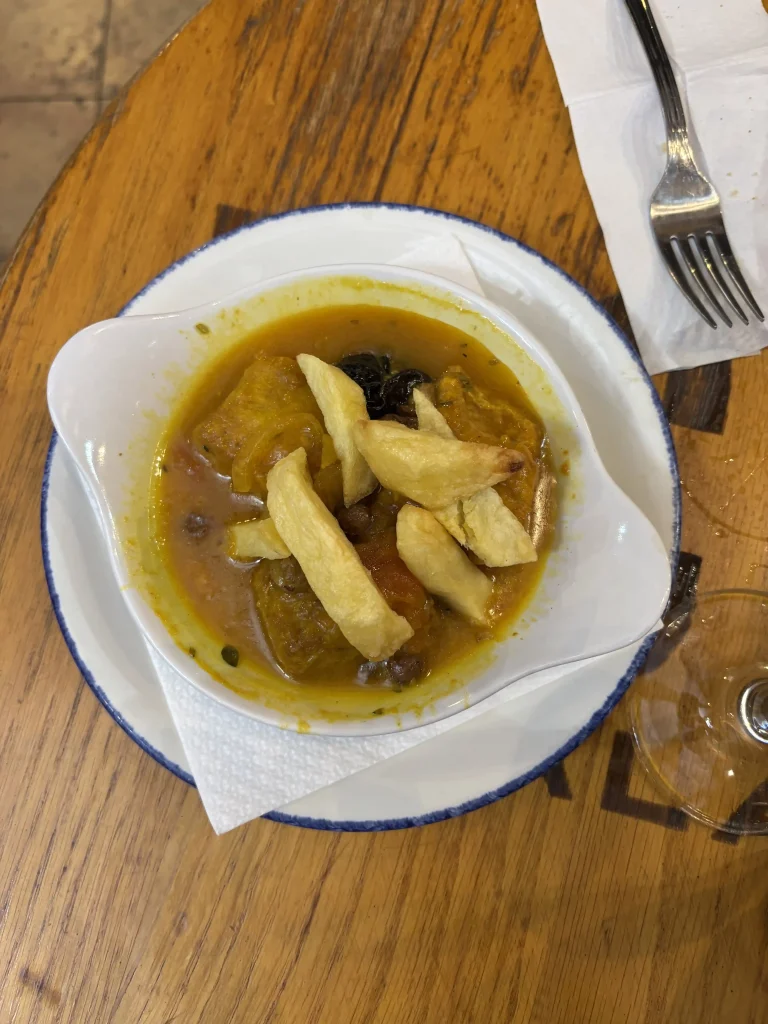
Gardianne de taureau is the signature dish of the Camargue, and its history is inseparably linked to the gardians. This is not haute cuisine: it is a rustic dish, born from the need to preserve meat and feed many people with just a few ingredients.
Preparation begins the evening before, when the bull meat is left to marinate in red wine with onions, carrots, garlic, Provençal herbs and sometimes orange peel. The next morning, it is cooked slowly for several hours, until the meat becomes tender and the sauce turns thick and aromatic. The result is a rich, comforting dish, perfect for restoring your energy after a long day in the saddle.
Personally, I think it is delicious, and I could not help thinking of Cordoban rabo de toro. They are not the same thing, of course — but they belong to the same broad family of traditional dishes born around bull culture: slow cooking, wine, intensely flavoured meat, and the art of transforming a tougher cut into something rich and convivial.
It is usually served with Camargue rice, grown in the local rice fields and with a history that is far from straightforward. After several unsuccessful attempts, rice cultivation only became firmly established here in the 1940s. Today it is protected by PGI status and comes in several varieties, including long-grain, round-grain and wholegrain rice. In the 1980s, the famous Camargue red rice — riz rouge — appeared almost by chance: with its nutty flavour and slightly crunchy texture, it developed from a natural spontaneous mutation that turned the outer layer of the grain a deep red.
Another typical inland dish is côte de taureau: bull rib steak grilled over a flame or cooked in a fireplace, lean and full of flavour.
The Taureau de Camargue — the undisputed star of Camargue cuisine — was the first cattle breed in France to receive Appellation d’Origine Contrôlée status, in 1996.
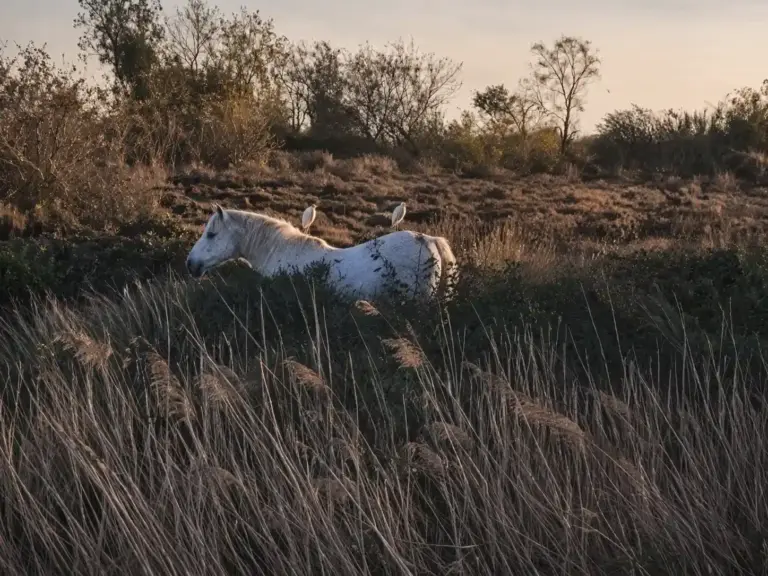
The Camargue bull is a unique animal: it lives in semi-wild conditions and is raised using extensive farming methods that help preserve the delicate balance of the wetland ecosystems. The animals must spend at least six months a year — from April to November — within the designated wetland area, without supplementary feeding, grazing freely among reed beds and sansouires. Stocking density is strictly regulated: no more than one adult animal per 1.5 hectares. In winter, the animals may receive only a supplement of cereals and hay sourced from the designated geographical area.
Slaughter takes place within a very short timeframe, with the aim of preserving meat quality rather than maximising productivity. The result is meat with a deep red, almost brown colour, firm and relatively lean, with a distinctive flavour and rich aromas.
It is also worth mentioning one detail that says a great deal about the nature of this region: on average, only one bull in ten is considered suitable to compete in the arenas. The others are destined for the table.
If the inland areas belong to the gardians, the coast has always been the realm of the fishermen. Saintes-Maries-de-la-Mer and Le Grau-du-Roi are villages that grew around their harbours, and their cuisine reflects this maritime tradition with simplicity and character.

Tellines are the most characteristic dish of all — and my absolute favourite. These tiny clams live in sandy seabeds and are still harvested today using traditional methods. In the past, they were considered food for the poor, collected by fishermen for their own families. Today, they have become a true delicacy: the kind of dish to enjoy in summer, sitting by the beach or at the harbour, with your fingers covered in garlic and parsley. Pure heaven!
Bouillabaisse, although best known as the symbol of Marseille, has also become firmly rooted in the Camargue. Its origins are ancient — it is thought to have developed from a simple soup made by Greek fishermen using unsold fish — and today it has evolved into a complex, refined dish while still preserving its strong connection with the sea and tradition.
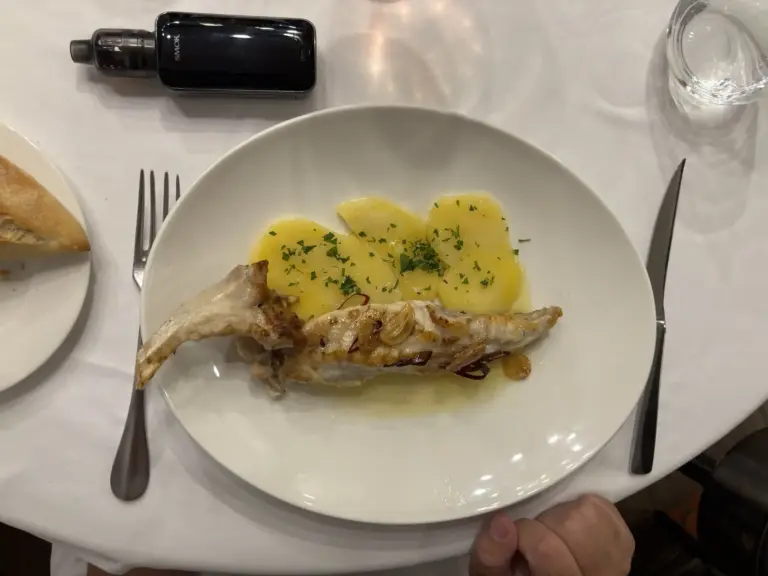
You will also find excellent grilled fish — sea bream, sea bass and other local catches — cooked exactly as it should be: simply, with salt, olive oil and little else.
One of the most unusual fish dishes, however, is eel, served either stewed or grilled. It is not my personal favourite, but its flavour is so distinctive that it is worth trying at least once, especially if you have never tasted it before.
If you enjoy distinctive flavours — and especially desserts — you should not leave the Camargue without trying the sweet fougasse of Aigues-Mortes, the city’s signature cake.
Originally, it was a simple bread dough enriched with sugar, butter and orange blossom water.
Towards the end of the 20th century, the recipe evolved: bakers replaced the bread dough with a softer, lighter brioche dough, creating the version we know today. The result is a sweet, fluffy and wonderfully fragrant brioche, easily recognised by its rectangular shape and generous size. Its main ingredients are flour, eggs, butter, sugar, milk, baker’s yeast and, of course, orange blossom water, which gives it its characteristic aroma.
Unlike the savoury dishes, which were born out of necessity and hard work, fougasse is a dessert associated with celebration and conviviality. Its origins are ancient — some believe it may date back to Gallo-Roman times, when sweet flatbreads were prepared for festive occasions.
Tradition links it in particular to Christmas, when it formed part of the thirteen Provençal desserts. Today, you can find it throughout the year, but it remains a niche speciality, preserved by just a handful of artisan bakeries within the city walls.
Do not leave without buying one.

There are plenty of other lesser-known delicacies too, and they are every bit as good.
Saucisson d’Arles is not just any cured sausage. It has a strong, distinctive flavour: according to local tradition, the original recipe also included donkey meat alongside pork and beef — although historical sources do not fully agree on this detail. I tried to verify both its origins, which are said to be linked to Bologna, and the exact production methods by asking local producers, but they are all very protective of their recipes and not particularly keen to reveal their secrets.
Barbouillade d’artichauts is a humble, almost forgotten dish: artichokes with lard, cooked slowly until they turn into a thick, rich mixture to spread on bread. Simple, rustic and authentic. I tried it in a manade and it was absolutely delicious!
Finally, one rarity worth seeking out is the Tome d’Arles made by Stefan at Mas du Trident — a soft cheese flavoured with bay leaf and Provençal herbs. From what I was told, he may be the last active producer of sheep’s cheese in the Camargue. You will find him in the Petite Camargue, not far from Aigues-Mortes.

And then there is the special ingredient: salt, another of the Camargue’s oldest and most distinctive elements. Salt harvesting in the Aigues-Mortes salt marshes dates back to ancient times, and even today the salt pans are not just an economic resource: they also play an active role in preserving wetlands and biodiversity, giving food production a value that goes far beyond what ends up on the plate.
Camargue salt is not used simply for seasoning. It is also used to preserve fish and meat, to make poutargue — mullet roe — and to enhance the flavour of vegetables and grilled meats.
The most prized variety is Fleur de Sel de Camargue: the lightest crystals, which form on the surface of the salt pans and are harvested by hand at specific times. Delicate and almost weightless, it finally received PGI recognition in 2024.

Camargue Wines
The Camargue is also a land of vineyards, where vines sink their roots into a truly unique soil: sand. This is where wines and aperitifs are produced that tell the same story of resilience and authenticity as the gardians and fishermen.
The history of wine in the Camargue goes back a very long way. The earliest traces of viticulture in the Aigues-Mortes area date to the 7th century, with the foundation of the Benedictine Abbey of Psalmody in Saint-Laurent-d’Aigouze. In 1406, King Charles VI was already referring to vineyards in the territory of Aigues-Mortes — details that reveal just how deep-rooted the relationship between this land and wine really is.
The real turning point came around 1880, when winegrowers discovered that vines planted in sandy soils were resistant to phylloxera, the pest that was devastating vineyards across Europe at the time. Because of its structure and constant movement, the sand prevented the insects from attacking the roots. The discovery proved invaluable, and the sandy soils around Aigues-Mortes were gradually converted into vineyards.
What makes these wines so distinctive, then, is the soil itself: vines growing in land made up of more than 80% marine-origin siliceous sand, just a few metres from the sea, with over 300 days of sunshine a year. Poor in clay and silt, these sands give the wines a particular lightness and minerality, with a subtle iodine note that comes directly from the sea. Today, more than 95% of the vineyards are farmed either organically or under high environmental value standards, and the use of herbicides is prohibited throughout the appellation area.
In 1955, the Compagnie des Salins du Midi created the Listel brand, which helped make vin de sables, or “wines of the sands”, famous throughout France — today you can even find them in French supermarkets. IGP status followed in 2011, and after several more years, full AOP recognition was finally granted, officially creating the Sable de Camargue appellation.
Even today, most wineries are concentrated around Aigues-Mortes. A few names worth looking out for — with the caveat that my information on these labels comes from my own travels, so if you discover others, let me know! — are:
- Vignobles des Sablons, Respire cuvée: fresh and citrusy, ideal as an aperitif.
- Domaine Terres de Sable, La Sagne cuvée: one of the area’s oldest organic producers, with an elegant gris de gris that is fruity, full-bodied and rounded.
- Domaine de la Figueirasse, gris de gris: vineyards just a few metres from the sea, with a distinctive saline, iodine-like note.
- Domaine de la Fourmi, gris: organic, rounded and well balanced.
If you are passionate about wine, Domaine Royal de Jarras also offers guided tours with tastings.
I also really enjoyed Costières de Nîmes wine — it is not strictly a Camargue wine, but it comes from nearby, so I still recommend trying it. It is more structured than the vin de sables and pairs beautifully with gardianne de taureau.
Pastis, on the other hand, is the quintessential aperitif of southern France and, if you are in the Camargue, it is also worth trying Pastis Camarguais, a particularly aromatic version that you can easily find in bars and restaurants throughout the area. The history of modern pastis began in the early 20th century, when the ban on absinthe encouraged the spread of new anise-flavoured drinks. It was in the 1930s, however, that pastis truly became established in southern France, eventually turning into one of the region’s most iconic drinks.
It is a spirit flavoured with anise and liquorice, served diluted with cold water: as soon as the water is added, the liquid turns cloudy and opalescent, while the flavour becomes softer and more refreshing. Pastis Camarguais, in particular, is a highly aromatic artisanal variation enriched with typically Mediterranean herbs and flavours.
Today, drinking pastis is not simply about ordering an aperitif: it is a true social ritual. You sit at a bar by the harbour, slowly pour in the water and watch the drink change colour — that little ritual reminded me somewhat of Turkish rakı, both in flavour and in the way water is added. It is perfect with olives and saucisson de taureau, or simply enjoyed with the sound of the waves in the background.
Lou Gardian — “the guardian” in Occitan — is an aperitif that is little known outside the region but deeply rooted in local life. It is a peach-flavoured wine that combines the freshness of white or rosé wine with the rounded sweetness of the fruit. Its name pays tribute to the gardians, and it is served chilled, accompanied by tellines or a savoury fougasse. For travellers, it is light, fragrant and a lovely way to start the evening.
If you prefer beer, look out for Bière des Gardians: a craft beer made with PGI Camargue rice, which gives it a particularly light and fresh character as well as a direct connection with the region. In the harbour bars of Saintes-Maries or at events such as the Feria du Cheval, it is a familiar presence.
If you would like to buy a few bottles or compare several producers in one place, stop at the Maison des Vins de l’Espiguette, along the road leading to Espiguette beach in Le Grau-du-Roi. It is not a winery, but rather a wine shop and local-produce emporium dedicated to the wines and flavours of the region, with a wide selection of local and regional labels, from vin de sables to Costières de Nîmes, as well as olive oil, cured meats and other local specialities.
One stop to taste — and take home — some of the best flavours of the Camargue.
Where to Eat in Camargue: Restaurants Worth Trying
You can eat well almost anywhere in the Camargue: what really makes the difference is the quality of the local ingredients, fresh, genuine and often sourced just a few kilometres away. Of course, as in any tourist destination, tourist traps do exist, but they are usually easy to spot and avoid — a menu prominently displayed in English and laminated photos of the dishes are already good warning signs.
Once you learn how to steer clear of them, you will be spoilt for choice.
To make things easier, I have divided my recommendations by area, so wherever you are when hunger strikes, you will know exactly where to head.

Where to Eat in Saintes-Maries-de-la-Mer
La Casita is my go-to place for seafood in Saintes-Maries-de-la-Mer. The atmosphere is bright, sunny and Mediterranean — the kind of place where you immediately feel at ease. The menu includes both fish and meat, but I always order seafood here and I have never had a reason to change my mind. It is also where I tried Pastis de Camargue for the first time.
Rocco & Rico was almost a chance discovery: the first time I ended up there because La Casita was closed, but it turned out to be just as good. I had tellines with ginger, bull soup and grilled sea bass — everything was excellent. The restaurant is small and the staff speak almost exclusively French, so keep that in mind if you are not confident with the language. But if you enjoy authentic food and do not need too much hand-holding, it is a very safe choice.
La Cave à Huîtres, overlooking the harbour of Saintes-Maries-de-la-Mer, is the place to go for tellines, oysters and exceptionally fresh shellfish. The atmosphere is relaxed and informal, with everything you need when the seafood is genuinely fresh. It is especially well known for its raw seafood platters.
Along the seafront — Avenue Frédéric Mistral and Avenue Gilbert Leroy — you will find a long line of restaurants and cafés overlooking the beach. They are perfect for a quick lunch of salads, mussels and fish dishes while enjoying the sea breeze. Le Belvédère was recommended to me, but I did not try it because it looked a little too touristy for my taste — so I will leave that one up to you.

Where to Eat in the Camargue Countryside
La Telline is something of an institution. Set deep within the nature reserve — and reachable only by car or taxi — it is the complete opposite of a touristy place. You dine inside a thick-walled house covered in ivy, with an austere, authentic beauty that contributes just as much to the atmosphere as the food itself. Alongside the tellines that give the restaurant its name, it serves an excellent pavé de taureau and grilled eel. The welcome is warm, and I always come back. One practical detail not to forget: it is cash only.
La Manade des Baumelles is a genuine manade: it produces and sells AOP bull meat directly, along with prepared dishes and artisanal specialities. If you really want to understand what eating in the Camargue means, this is a very good place to start. It also has a gourmet restaurant with a tasting menu, offering a more unusual experience while remaining deeply rooted in the region. Always call ahead to book and to check which of the two options is available — in low season, only the gourmet restaurant is open. During the day, you can also join an organised visit of the manade.
Chez Bob, near Arles, is not just a restaurant: it is an atmosphere. I have to be honest — I have never actually been there myself because it was never on my route, so I cannot describe it from personal experience. But I have heard so many good things about it that it felt right to include it anyway. They say it is one of those places you should visit at least once. Live French and Spanish music, a rustic setting, and that feeling of stepping into a place that existed long before you did — it has been an institution since 1971, where the myth of the Camargue is still very much alive.

Where to Eat in Salin-de-Giraud
If you manage to make it to Salin-de-Giraud, do not miss its food scene. One restaurant I definitely recommend is Mas Saint Bertrand, set inside the natural park in a very informal setting. It serves Camargue specialities such as gardianne de taureau and organic red rice, as well as fresh fish and shellfish from the Gulf of Beauduc. I also love it because the place almost feels like an antique dealer’s treasure trove!
If you are looking for something equally informal, Restaurant La Grand Ponche is another well-known choice, serving traditional dishes based on local fish and bull meat. I have to say, dining on its outdoor terrace overlooking the ponds is worth the trip in itself.
For a more refined experience, there is Mas de Peint, a Michelin-listed restaurant located on the road to Salin-de-Giraud, where classic Camargue dishes are reinterpreted in an elegant and atmospheric setting.

Where to Eat in Aigues-Mortes
Le Galion is located in the heart of Aigues-Mortes’ historic centre and has a homely, traditional atmosphere. Both the meat and fish dishes are good, but what I appreciate most is the lunchtime menu: it is very reasonably priced and lets you try several dishes in smaller portions — a great way to explore the local cuisine without spending too much. The desserts did not particularly impress me, but everything else is well worth trying.
Le Bistrot Paiou serves Camargue-inspired bistronomic cuisine in an intimate, welcoming atmosphere, led by a passionate chef. Quite simply, it is not to be missed: excellent food made with exceptionally fresh ingredients, from bull tartare to caramelised pork and fish dishes. It is family-run, with warm, friendly service. Book ahead, because tables fill up very quickly.
La Table de Paco focuses on traditional cuisine and specialises in both fish and meat grilled over a wood fire. It is not one of the cheapest options, but the portions are generous, beautifully presented and, most importantly, delicious. When booking, ask whether you can have a table in the inner courtyard. The atmosphere is particularly pleasant. I have not been there personally, but it was recommended to me when I could not get a table at Paiou.
La Goulue – De Notre Époque offers traditional Camargue cuisine in a warm, family-style atmosphere. Expect to spend around €20–30. The food is homely and comforting — daube, rice and slow-cooked dishes — served in a charming, peaceful courtyard, perfect for an outdoor dinner in a relaxed and quiet setting.
Lady Glagla is super casual and perfect for brunch in a young, informal setting. The portions are generous, making it a good choice for a quick lunch or a substantial breakfast.
Here are also a few historic bakeries within the walls of Aigues-Mortes that jealously guard the secret recipe for the town’s sweet fougasse:
- Boulangerie Pâtisserie Poitaven, a family-run bakery that has been in business since 1932.
- Il était une fougasse, which has several locations in Aigues-Mortes and prepares both sweet and savoury versions every day. Behind the name, in fact, is the historic Boulangerie Olmeda, which the brand took over while preserving a recipe handed down through four generations. Because of this change in management, online reviews are still somewhat mixed — some people swear it remains faithful to the original recipe, while others notice a few differences. As always, the best thing to do is try it and judge for yourself.

Where to Eat in Le Grau-du-Roi
For completeness, here is one recommendation for the Le Grau-du-Roi area as well. It is not somewhere I visit very often, so I do not have many restaurants to suggest, especially because a lot of places here are quite touristy.
That said, if you happen to be in the area — perhaps after a day at Plage de l’Espiguette — I would go to Aux Délices de la Mer, in the Port Camargue area. It is a simple restaurant focused on seafood: plateaux de fruits de mer, prawns, tuna, oysters and baked mussels.
It may not capture the deepest soul of Camargue cuisine, but if you are looking for fresh, well-prepared seafood, it is a reliable choice.
In conclusion, Camargue cuisine is not simply a list of dishes to try: it is the story of a land that learned to live from what it had available — bull meat, rice, lagoon fish and salt — turning necessity into identity.
Whether you are sitting by the harbour in Saintes-Maries with your fingers covered in garlic and parsley over a plate of tellines, in a manade enjoying a gardianne de taureau slowly cooked according to tradition, or inside the walls of Aigues-Mortes with a still-warm fougasse in your hands, you will soon realise that people eat here in much the same way as they live: simply, without unnecessary fuss, and with an almost sacred respect for what the land and sea provide.
But to truly understand this cuisine, sitting at the table is not enough: you also need to know the land and the history that shaped it. That is why I recommend reading my other articles about the Camargue as well: my complete guide to the Camargue, which explains how this landscape evolved over the centuries and made bull farming, vineyards and rice cultivation possible; my guide to Saintes-Maries-de-la-Mer, where pilgrimages and the sea have shaped a unique gastronomic culture; my article on the salt marshes, which explains why salt here is not merely a seasoning but a piece of history; and finally Aigues-Mortes, the fortified town that once drew much of its wealth from the salt trade and still jealously preserves its sweet and savoury recipes within its medieval walls.